The Walking Stick Piece

10505325_10203856954251744_6169871850256699472_n
The walking stick used by St Francis of Assisi

When someone told me to buy my hiking shoes one size larger than normal, I did and I’m glad; walking hundreds of miles every few weeks really does make the feet bigger. And when I was told to drink a lot of water I made sure to stop at every well on the way. But when my son and I decided to climb the Pyrenees on our pilgrimage to Santiago, Spain —a five-hundred-mile trek from France to the Spanish coast—I passed on carrying walking sticks. This wasn’t a matter of wanting to look strong; I simply didn’t want something else to carry.

Curiously, we were the only two pilgrims without walking sticks in all of St Jean Pied du Port, France, where we began our trek. They only cost about five euros for a good solid piece of oak about five feet tall, varnished, “Camino de Santiago” burned into it and a metal casing at the tip to hit the ground, with a tough cord through the handle. Some people carried fold away steel ski poles and others wood ones. Some pilgrims bought two and walked like cross country skiers; most found one would suffice, leaving the other hand free to point at the Pyrenees or hold a water bottle. I simply figured I’d been walking upright without assistance for a long time, uphill included.

It turns out the Pyrenees are profoundly uphill. Those first three unassisted days crossing the mountains made for some interesting balancing acts. With both arms free it was too easy to move too fast and tire out or lean too far and stretch out a muscle. Instead, we took a lot of breaks and watched where we were going so not to step on endless small rocks and countless eight-inch black slugs, bountiful in Basque country. Another reason I went without was my concern that on the Camino I’m come to carry the cane like a crutch and expect it to help me more than it should, especially once we moved past the Pyrenees. We were a rarity on this journey: a father and son together in peace for five weeks, talking, laughing, and sharing peaceful moments in chapels and cafés.

We didn’t need the sticks; we would lean on each other. Absolutely.


As soon as we arrived in Pamplona we bought two walking sticks.

We gave in when we realized we tired more quickly than our fellow pilgrims, and it felt awkward to let our arms dangle all day. Michael found one about five feet tall stained dark and rugged looking. Mine was a bit taller and tan. Both had thick cords through the handle for our wrists. It took some getting used to but somewhere on the way to Logrono, Spain, we found the rhythm and our walking sticks became an extension of our anatomy. I learned just the right timing to pick it up and how far in front of me to place it back down. I figured out when to not let the tip hit the ground, when to carry it on my shoulders, and when to lean heavy on it to relieve pressure on the knees or toes. I learned I needed it more down hill than up, on dry riverbeds more than the pavement, and not at all in larger towns and cities.

And after another week or two that damn cane worked its way into my character, as did everyone’s. We would leave them on our bunks in the late afternoon after we checked into a place to stay and then went out to eat or drink. It marked our space, and a quick glance indicated whose bunk was whose faster than looking at the backpacks. Two mahogany walking canes told us the two men from Frankfort, Germany, were also staying; the silver ski poles with a Belgium flag sticker belonged to Sylvie. And others knew ours leaning against a wall, in a corner, or as they lay on the ground against the wall at night. At some point my walking stick was simply part of the pilgrimage as much as my water bottles, my backpack and my journals.

A few weeks later with a few hundred more miles behind us, it occurred to me I’d be using that stick the rest of my life. Since he was old enough to walk, Michael and I have explored woods and walkways together. At home he always grabs a hand-crafted walking stick from the pile of fallen branches, and off we go. And someday when I am in my eighties no one will need to convince me I’d be safer with a cane; by then this piece of wood with “Camino de Santiago” burned into the side will simply be understood. For my family it will be part of who I had become, the one who walks, who at one time when he was so much younger crossed Spain with his son, and the only items they brought back were their walking sticks.

That was agreed on in Pamplona. With about five hundred miles before us, we knew we couldn’t carry much. In fact, shortly after arriving and evaluating my belongings, I ditched some clothes and equipment to lighten the load. In our other travels, we had been accustomed to acquiring souvenirs to remind us where we had been. When I was young my father always brought back glass mugs with the name of the city or state printed on the side. When I traveled during Michael’s youth I likewise found evidence to give him and make him feel part of my journeys. But this was different; this was a pilgrimage walked by saints and queens. This wasn’t a vacation; it was to be new way of life. So as we walked Michael took pictures and I wrote in my journal and we decided those would be our mementos. We both knew no token could possibly represent the experience of sharing these five weeks, twenty-four hours a day, together.

As it turned out, these walking sticks allowed us, quite ironically, the double pleasure of having an easier time of it on the pilgrimage as well as a very practical souvenir of our time together that summer. We would bring them home. Enough said.

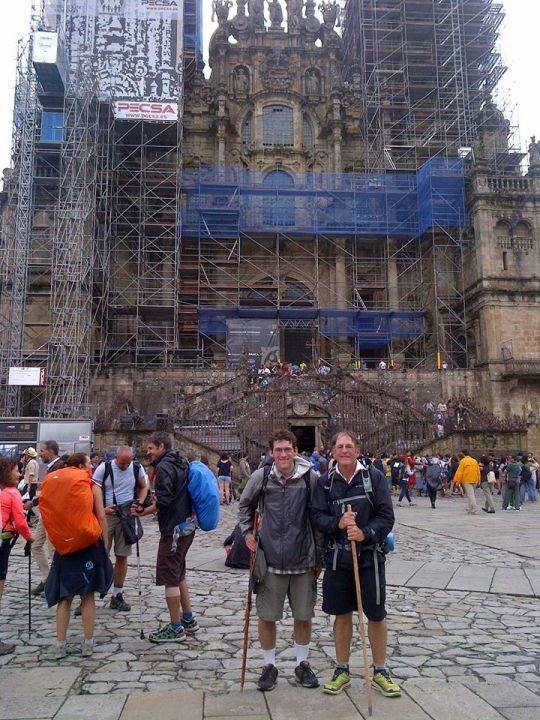
It was difficult not to think of my father when we first bought them. At almost ninety, he sometimes needs to struggle out of his chair, but once he is up he can keep going without assistance from a “third leg” as Sophocles suggested in the Sphinx’s oracle. He sees no reason for a cane. Now here were his son and grandson deciding to rely upon a few canes for five weeks. That kind of time together, talking, walking, mostly remaining quiet and pointing out the beauty around us is simply not often shared between a parent and child. In fact, on our entire Camino we only met a few other similar relationships, a father and son from Holland and a mother and daughter from Sweden. The innkeepers and café owners would comment on how lucky we were to travel together. We knew this, though, and as time went on we both wanted the trip to continue. Together we met people from around the world, drank in cafés as varied as Hemingway’s favorite pub and a garage some woman turned into a bar. We prayed together in churches built before the time of Charlemange and chapels where St Francis of Assisi sought refuge. We shared every moment of every day surrounded by the finest scenery in Europe, and five weeks later we walked together into the sacred city of Santiago de Compostella aided by our walking sticks, which literally guided us across the country.

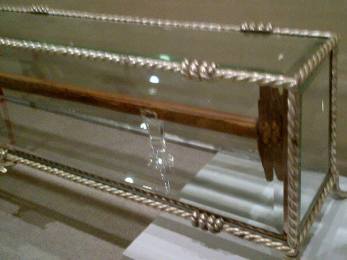
In Santiago one afternoon we toured a museum which had on display relics of those who walked the Camino. One cane in particular was featured—that of St. Francis of Assisi, who walked the same pilgrimage exactly eight hundred years earlier. Encased under two glass boxes was a short, peasant’s staff used by Francis when he journeyed from Assisi to Santiago and back. He was thirty-three and traveled well over a thousand miles with this walking stick of his still in tact and on display nearly a millenium later. I was in awe. The significance of our canes became clearer. They would do more than simply link us to the Camino long after we were home; they linked us to every pilgrim who ever followed The Way.

At the end of the journey one night in Fisterra, the ancient “end of the world,” I stared at our sticks as we sipped a local red wine and watched the small fishing boats in the harbor. We had done it; we completed the Camino, together, and we sat together, father and son, and gazed at the Atlantic.

It gave me complete peace of mind to know that someday, hopefully a long time from now, it will be Michael’s. I wondered if long after his grandfather and I are both gone, when he is an old man himself, will he sit in a chair and stare with aging eyes at our two walking sticks leaning against a wall, probably long worn away at the tips. Will he someday pick one up in his fragile, elderly hands and remember his youth, coming of age on the Camino, walking more than twenty-miles a day with his father? I wondered if he would tell stories to his grandchildren about the great pilgrimage and recall the time we wandered into Pamplona together and picked out those very walking sticks. I hoped he would remember the details while his grandchildren ask if they can hold them as he tells them the same stories again about how much we laughed so long ago in Spain. Yes, these were the perfect items to bring home, if there could be one.

They will collect dust, I thought, much like memories collect dust and cover up some of the details, making them hard to recall. But they will stand as proof. Perhaps there will be small indents near the handle where over time my fingers rubbed away at the varnish. There was a time though, he might say to someone, when my father held this stick, and I held that one, and together we climbed mountains.

Then perhaps some unthinkable time from now he will leave them to his son or grandson. Those descendents won’t have memories from these two simple wooden staffs, but they might have stories of a father and grandfather who more than half a century earlier followed in the footsteps of saints.

At the end of our trip we boarded a train for Pamplona and spent a few days celebrating. We went to the airport to fly home—we would visit my father and tell him about our journey: three generations sitting together sharing stories and memories. Then we got to security. Then we handed the security guard our backpacks and belongings, including the canes.

“You can’t bring the walking sticks with you,” the guard told us quite matter-of-factly.

“Why?”

“Because they are considered dangerous.”

“Yes, I understand, that is why I’m shipping them in cargo.”

“They can’t go through cargo.”

“Why?” My chest hurt.

“They are too large and considered dangerous and also they are not in boxes.”

“No one sells boxes to hold them and they’re not so big. Skiers ship skis and poles longer than these walking sticks!”         

“Skiers have them in specially made carriers and besides you are not skiers, and these are not poles.”

“Yes, they are! In fact they are a sort of religious object very similar to the holy relic cane of St. Francis of Assisi!” My anxiety showed as my voice got louder.

 “But still they are not wrapped correctly to be shipped through our mechanical equipment without a box and they will damage something.”

 “Would you say the same thing to an old man with a cane? Would you tell him he couldn’t bring his cane on the plane because it isn’t wrapped correctly?” Time had passed, and the security guard was losing patience and a line had formed behind us with people carrying backpacks and boxes but no walking sticks.

 “No, the old man with the cane would be allowed to bring the walking stick on board with him. You’re not an old man and this isn’t a cane!”

My heart sank. Michael’s heart sank. The argument continued but I had lost. I asked Michael to carry the canes to a corner and lean them against the wall for someone else to take; perhaps some father and son pilgrims would find them. Michael said if we had known this would happen we could have left them at a place for others; now they’ll probably just be thrown in the trash.

We were quiet a long time. It was as if they cut off my arm. I said, “Well, we promised each other last month up in France that we weren’t going to have any souvenirs, so this just holds us to our original commitment.” Michael sighed and agreed but we were feeding each other’s disappointment by going on about it. So he brought them over to the wall and left them and I am sure he felt as guilty as if he had abandoned two family pets. He got back in line but before we made it through security I looked at the sticks and got out of line.

I went over and took the thick cords from the handles and gave Michel his. Once through security we tied our journals with the cords and I felt somehow as if it was supposed to be like this. We left it all in Spain. There might come a time when I will forget the particulars, and even later when Michael will not recall the details. But for now when I go for walks I don’t use a walking stick at all. I doubt I ever will. I’m a lot like my father that way. Instead, I walk alone along the river and remember when we sat in St Jean Pied du Port, France, restless and anxious and ready to begin.
10497501_10205292911909788_7906987515871434383_o

The Sounds of the Day

images

I don’t listen to music when I walk; I just walk and listen to whatever is out there. At home it is the small birds, osprey calls, and the river sounds; sometimes the diesel engine of an early morning oyster boat not far from shore, and always the gulls. At the oceanfront it is the waves, of course, but also the plows moving sand around, the sweepers cleaning the boardwalk, radios, tourist chatter, children’s laughter. At the oceanfront the occasional fighter jet passes just a few hundred feet above heading to the Oceana Naval Air Station, and at home it is a Cessna 172, a Piper cub, or sometimes flight instructor Mike’s World War Two replica P-19 headed out over the Bay with a passenger who paid for a thirty minute tour.

When I walk, I don’t usually like to walk with anyone. It is different when I travel and we are taking in the sights and sounds and people, but even when my son and I walked all day every day across Spain, we were mostly quiet, taking in the Pyrenees, the vague distances. My son is a quiet person anyway, but still, when I’m home I prefer to walk alone; I like to hear myself think. It is the only way I recognize my own voice.

I find my thoughts, my opinions, my rationalizations and motivations when I walk. When I walk, I move from exhausted and mentally drained to calm and in perspective, to hopeful with new ideas, or different thoughts about old ideas, or sometimes I figure out what to leave out there on the road and what to keep close at hand for further contemplation. I solve problems; I talk myself out of making new problems. I remember and plan and organize and dismiss. It is a thorough cleansing of the mind. I never feel healthier than when I let my thoughts run free without bumping into earbuds on the way out or needing to compete with someone’s complaints or questions. I understand myself better and am able to make decisions without influence, or, more likely, make no decisions at all and just stand by and let it all be.

I have learned the sound of gulls when they circle looking for food compared to their call when confronted by something strange. I can close my eyes and know the direction of the tide and the pull of the current. I do not know most smaller bird calls—Michael has to tell me (over and over) when we are home in the yard and the thrush are in the bushes or the Carolina wrens are behind the patio—but I well know the call of a hawk or osprey, especially when they teach their young to fly. It is a sight to behold, and more, it is a sound I will never forget.

There is nothing “silent” about nature. There is nothing quiet about sunset. On the river at night when the stars blanket the sky above the Chesapeake and up the Rappahannock, the most muffled of sounds carries across the water. It could be a car crossing the bridge, a late-night fisherman dropping traps, rigging against a mast, the gentle, familiar, eternal lap of water on the sand. It always, absolutely always, seems calmer at night. When it’s late and I’m on the beach and I stand still, it is easy to believe I’m the only one listening.

Summer is almost over. Classes, in one form or another, start soon. There has never been a more important time for people to know, really understand, how to listen. 

Last year, I asked my students about their listening habits. They mostly get up and put on music, drive to school with music, at school have their ear buds in with music going except (not always “except”) when in class, and then the same the rest of the day. I asked how often they leave the music off, take the buds out, and just sit and listen to life around them. They all said, “Oh yeah, every day,” and one young woman in class called “bullshit” on them and an argument ensued. She won. By the end they admitted that “quiet time” simply does not exist anymore in their lives, if it ever did at all.

None of them, not even the quiet ones, had ever stood still and listened to the wind and the distant sound of thunder ahead of a storm coming down from the Piedmont.

It seems so many students are so accustomed to hearing other sounds—music, television, friends, games, teachers, parents, and on and on and on without a break–that they even fall asleep wearing earbuds.

I asked them, “Did you ever go to the water at night down at the beach and turn around and just listen? There is life out there carrying on. Or head to the entrance to the inlet at First Street on a foggy morning and listen to the call of the fog horns on the fishing boats as they come across the reach. It is a sound you’ll never forget,” I tell them, remembering the boats on the Great South Bay when I was young, before earbuds were invented.

I wish my students would listen. I don’t mean listen to me. That will come. First, they need to learn something no one ever taught them, to simply listen to life unfold around them. If they would pay closer attention to the quiet sounds around them, the natural pace of life, they would better understand their own thoughts and recognize their own voice. Then, perhaps, they would not simply hear what I say, but would listen to what they hear.

Still, at the end of the day there is nothing I can do but what I do at the end of the day: be still and listen to the intricate and miraculous passing of time.

download

Above Us Only Sky


nine - Copy


I stood near the mouth of the river this morning and watched the clouds across the bay to the east, and back to the west I noticed new ones forming, accumulating and darkening. Most of them will run north of here, but some will drift down the Rappahannock. I’ve been watching them; I’ve noted their movement and habits.

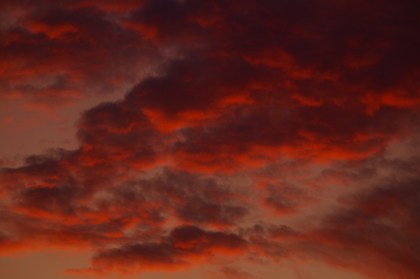
In fact, I’ve been taking pictures of clouds for better than twenty years. I like their brevity, their inability to replicate, their absolute uniqueness and the blending of colors, their playful nature and imposing threat. All of it. I’ve taken pictures of clouds that looked like cauldrons, like billowing snowbanks, like an old woman’s hair. I’ll avoid obvious cultural references like Joni Mitchell and instead refer to artists like Thomas Cole, or the painting “Difficult Cloud” by my friend, the late artist James Cole Young. The sunset (and rise) paintings of another friend, artist Mikel Wintermantel, are so realistic he does what art is supposed to do: he makes me think of his paintings when I’m looking at the clouds.

018

My son has joined me all these years, and we’ve learned together how to tell when the sky will be “blank” at sunset and when the smallest of nuances in the wind means it’s worth the wait at the water to watch the colors emerge out of nowhere, streaks of purple and gold and a dark orange that doesn’t register on most color schemes. At first we captured these fleeting examples of absolute present—since from second to second the shape and color and shading will never be the same, ever—with a wide lens, taking in the river and the farm to the south, the Norris Bridge to the west and out across the reach, but as time drifted by, we focused more on the horizon alone, or a detail of one cloud which let a sunbeam get through. But then my son and I went in opposite directions: I let go of the land, moving the lens into the sky, focusing only on the cloud, and the inner rings of a storm, or the ruffled shoulders of a passing wisp caught in the jetstream. Michael also let go of the land, but he went into the water. I watched him focus on the water and the clouds reflected there, and then I saw him stare at just pieces of the clouds, and then I noticed he noticed just the color on the surface of the water, and that’s when I watched him become an artist. 

On most nights he’ll wander up toward the duck pond or along the sand to the west, and I’ll just stare, looking off into the depths of some formation I can’t make even slightly realistic by finding figures in their shapes. It isn’t even impressionistic to me anymore as I look deeper into the abstract. I get lost in there, looking back as far as I can sometimes. When I still saw shapes, a common formation occurred when the wind pushed a cloud from the west into an elongated fork like puff, and I used to see a lobster in the sky, but once I saw Long Island reaching out to both Orient and Montauk separated by sky, and I remembered so many childhood afternoons in Hecksher State Park where my friend Eddie and I would wander for hours, days on end, for months, and sometimes I’d stay behind and lie in the grass and stare at the clouds. Once I saw a face. I don’t mean a shape like a face; I mean once I saw a face.

032Now though even the recognizable shapes are abstract; and I suppose that has more to do with me than the atmosphere. Still I stare, trying to make sense of what’s out there, and I think about jobs I’ve had and places I’ve been. I stare off into space and think of people I’ve known and wish I still did, and sometimes there on the sand they all seem so connected that I think they must be thinking of me at the same time, they have to be, but it’s just my eyes and mind tricking me into something pretty.
So I’ll shake my head into now and take note of the time and check out the sun’s position above the horizon up river, and if there is time I’ll let my mind wander just a bit more, past the storm clouds, the thunderheads, and remember the time I sat on the edge of a lake in Pennsylvania looking at the clouds with a friend of mine and she and I talked about what the weather was going to do. I’m sure I’m the only one of the two of us who remember. I can look as far back sometimes as Mt. Wachusett in Massachusetts and those times I hiked to the summit and watched kettles of hawks above and clouds, such beautiful clouds out toward Boston and they stretched clear down to the Cape and up past Gloucester. Those stayed with me. 

I remember clouds, I really do. awesome clouds 026

I’m terrified of lightning, though. I don’t mean fearful; I mean terror, paralleling, deeply disturbing, scared out of my mind kind of terror. But I’ll tolerate it for a good long look into the sky on a stormy day when the yellows and reds give way to dark purple and navy blue, and then just black, black like a dark room kind of black. Then what I’m looking at isn’t a cloud anymore but a decree, a shot across the bow. Get inside it says.

It is raining now, which means the clouds have moved beyond being the kind worth watching. For that they need to be approaching or receding, not present altogether, certainly not above. Clouds are at their best when they are going or coming, not here already.

They are honest yet somehow deceiving. And when it is late in the day or early in the morning I get lost in their engulfing truths, swallowed. And there I can forget what ails me, both in the world and in my mind.

When I am lost in the clouds, I can see everything so much more clearly.

august 27th 009


20th Sunday in Covid

1 March 29th

The dogwoods hadn’t yet bloomed back then. Before.

I still wore sweaters during the day and sometimes my fleece jacket at night. The sun set around dinnertime, and I was usually up before the sky lightened in the east out over the bay. It was March, and the winds from up river could be cold, but more often balmy.

The geese had just started migrating back and the scouting hummingbirds began to come around, so I put up a hanging basket with red flowers until we could get the feeders ready.

It really shut down for us about the 18th. I remember because the last time I was in my mother’s apartment was Saint Patrick’s day, the 17th. I believed then that I’d not be back inside to visit with her for a few weeks at the least. That was five months ago. It was March and Saint Leo University, which is now closed for good in Virginia, had no intention of closing, Tim and I had planned to head to lunch in about a week, and just a month later I would have headed to Florida to conduct non-fiction workshops at the Sandhill Writers Retreat. Spring training had just started; the Mets were looking good. 

The river in March is cold, running down from up past Fredericksburg, and the crowds in the area for oyster season were still adhering to the rule that oysters are best during months with an R in it; they thought they had another thirty days anyway, but the local oyster place on the Rappahannock would shut down completely before April arrived.

It was Spring Break when the change found me. Old Dominion University extended the vacation for a week with the hopes of returning seven days late, figuring things would settle down. That was more than one hundred thousand deaths ago. 

So I sat on my porch that first Sunday and looked out at the deep blue sky, the kind of sky under which it isn’t possible for anyone to be sick, let alone unable to breath, suffering their last few hours on a respirator. I sat and looked out through the bare bones of the oaks and took a picture. In my mind the contrast was obvious. That was the First Sunday of Covid for me, twenty weeks ago. I never saw my students again as we went online, and the rest of the semester passed via zoom from one of the tables on my property, behind which they could see the leaves fill in, hear more birds, watch my clothing go from sweaters to polo shirts, watch my hair go from above the ear to longer than it had ever been. And each week at the start we’d talk briefly about how “this can’t possibly last very long.” And each week we’d fall further into the realization that nothing would be “normal” again.  

And I sat on the porch and remembered 1979. This reminds me of then.  

When I was a freshman we started a radio show at the college station. I produced and engineered it, and the hour long, Saturday morning program was hosted by my friend Dave Szymanski and Franciscan priest Fr. Dan Riley. We were so young and still had idealism and the deep-seeded belief everything we did had long-reaching ripple effects. We worked so hard on that show, called “Inscape.”  Each week we would have a guest–writers, administrators, people in the community who had been doing work in service to the area such as soup kitchens, shelters, and more. Also each week we would feature a musical artist such as James Taylor or Dan Fogelberg or someone else relevant to our hour long talk, as well as music reflective of what was in the news. The theme song for the show was Chuck Mangione’s “Hills where the Lord Hides,” and the first song for the first episode was Taylor’s “Secret of Life.” Then in November of that first year Dave pulled the news off the UPI machine and read about fifty-two American hostages at the embassy in Iran. Fr Dan spoke gently and powerfully of their fate and spoke of faith, of coming together, of the need to share in the burden of “hoping for a swift resolution.” 

The weeks passed and every show from November on started with the news of those men and women. We switched musical artists and guests like clockwork, but each week the news was the same, and always followed by the same comments of “this cannot last too much longer.” Winter break came, Easter, summer break came. We returned in the fall as sophomores and continued talking about the poor hostages. Carter debated Reagan, the Winter Olympics coming that February had been boycotted, we left for Thanksgiving, and then we left for Christmas break, and when we returned, second semester our second year, Inauguration Day, it ended. The following weekend on air Fr Dan commented on how since the show’s inception the hostages had been unable to leave their quarters, quarantined for 444 days. 

It is almost fall now, and colleges–no matter how they handle this–are returning to some form of education. This is the twentieth Sunday since March, and the woods in the front of the property from my vantage on the porch are thick and deep, and I can barely see the sky, let alone the road. I listen to the news only to be aggravated and severely depressed at the thought of the financial crisis both personal and nationally, more saddened by the news of those poor souls ill and dying and already gone, and how it seems like this will never end. 

So I come out on the porch to listen to the wildlife and the soft August breeze at the tops of the oaks, and I wonder what can I possibly do to get through this, and I turn on some music to help me cope. 

And somehow it all seems so much more manageable, just briefly, just for a few minutes.

The Secret of Life is enjoying the passage of time.

Any fool can do it. There ain’t nothing to it.

Nobody knows how we got to the top of the hill

But since we’re on our way down, we might as well enjoy the ride

–James Taylor


How to Make and Omelet

step-4-930x930

Writers face a task unlike most of the arts. In music you can judge how well you’re doing by simple comparison to the original song you’re trying to cover. In visual arts it isn’t unusual to see young painters in museums copying the masters, measuring their progress by their ability to replicate Van Gogh or Rembrandt. But writers have no such opportunity. We can’t simply retype a volume of Hemingway and hold it up at the end and say, “Check it out! For Whom the Bell Tolls Baby! I’m getting better every day!” No. It is a crapshoot. If we appear too much like one of our idols, we are emulating too closely. If we have too much of our own voice too quickly we are terrified and, often, ridiculed for straying from the canon (in that way all the arts are the same–music in particular and writing remain siblings in this difficult balance).

That’s why I love small chores with immediate results. Washing the dishes is a good one. Laundry. Cleaning the porch or cleaning out the shed. Mowing might be my classic example. These are all activities I can simply do while thinking of mostly other things, then after not-too-long of a time I can stand back and see the results. I can quickly assess whether or not I did a good job and redo parts that are obviously in need of another go at it.

Not a lot of guesswork is necessary; very little, if any, subjective viewpoints. It is what it is.

I have so little of that in my life. As a writer I am naturally dealing with material which can constantly be changed based upon my mood, the time of day, my caffeine intake. Even when I decide I’ve butchered a piece into place the best I can, I rewrite it again, restructure it, dump the intro and move the conclusion. Shred it. Eventually the editor will send the usual note indicating “only small grammatical corrections from this point on,” and I’ll panic realizing that means the journal is probably going to send back the four replacement paragraphs I shot off to them at the last minute. Instead, if the piece comes out in some anthology or another journal under a different title, I’ll include the new addition then, still knowing it will never be close to finished. Some things will never be finished.

Still, when something does come out in print or online I like to do just one quick take on it to see if they did something strange like add words I’d never use such as “spurious” or take out words I do use, like my name. Then I’m done. To look at the material again is just a way of seeing how differently I’d write it—not necessarily better, just different.

Right after that I mow the lawn. I admire the straight lines of cut grass; grass that was long but is now short. I trim the long grass around the stones and, ouila, done. Nothing to question; it is finished until next time.

However, in the best of days my usually unorthodox approach to everything from work to parenthood to travel and writing has always raised more questions than answers. Part of it is I take a lot of chances; another part is an overwhelming need to experience the passing of time as if I’m taking a dip in the ocean. I want to be absorbed in it, saturated by it. Maybe that’s why I write to begin with; to conjure a counterpoint to the persistence that is time.

Cooking is another task which can be immediately graded. I cook seafood mostly, but I also can make an amazing omelet. I knew a sous chef named Willie at the Hotel Hershey when I worked there half a lifetime ago. Sometimes he would take a weekend off to go to see his family in Puerto Rico, or just stay home, and I’d get to spend that day making omelets to order for the guests. The trick is to let it cook awhile on one side before the flip. I got good and I still love making them. Immediate gratification. Like playing Freecell or Tumbling Towers. I know instantly whether or not I did a good job.

If the temperature is too hot the egg will burn but if it is not hot enough it will not solidify well. The butter first (not spray not margarine not bacon grease butter just butter and if that bothers you eat oatmeal), followed by any hard ingredients—peppers, shrimp, etc—and after they’ve been thoroughly sautéed, pour in the room temperature, already beaten eggs—three is perfect. Keep pushing the egg toward the middle or sides to let the uncooked egg slide under the cooked part, making for a fluffy, well distributed omelet. When the whole thing seems un-oozy, flip it with a snap of the wrist so it lands in the same spot only upside down. Cover with shredded cheese and then fold in half and let it slide in perfect placement with the half-moon side matching the curve of the plate like two ballet dancers in unison.

Then eat.

This doesn’t work in writing. The second paragraph of this piece, for instance, was originally the beginning. The one starting with, “I love small chores with immediate results.” I changed it a few seconds ago. Writing has no guideline, no recipe, no set ingredients. I wonder now why I didn’t write, “When I mow the lawn I always start near the driveway and work my way to the woods.” Or “I do the larger dishes first when I clean and the silverware last.” Both decent starts. I can also point out now that originally the omelet section was the first paragraph, but I buried it later to back off of the “process” style which can be overbearing and misleading. I also couldn’t decide whether or not to include Willie. I kept putting him in and then leaving him out thinking it irrelevant, but then I decided to leave him in because I thought it a small detail that personifies the example. And yet another part of the writer side of me is constantly saying, “Who gives a shit?” as I write. Writers must constantly strive toward uniqueness without the benefit of example which itself defines contradiction.

Thank God I love to cook. Balance is everything.

Still, I like not knowing if what I’m working on is on the right track; not being able to see too far into the work. I like discovering where I’m going only when I get there or maybe slightly before that, and then getting lost again, trying different directions until the landscape reveals itself.

I wonder if I live the way I do because I write, or if I write the way I do because of how I live?

I don’t always want to know what’s going to happen. Maybe what I’ve been working on for all these years will turn out to have a happy ending; or maybe some tragedy will strike and I’ll need to write myself out of a corner and make some alternative escape from the monotony of a three-decade-old narrative. Whatever. I just know that in the end, the old axiom, “Watch pot never boils,” is not true. Of course it will boil. Einstein’s theories aside, the pot on the heat is going to boil. It is one of the few predictable aspects of life we can count on. Time is selfish that way. Not one fat second will ever lose an once on my account.

And no matter how many ways I approach it in the years I have left, I am never going to be finished with this life I’ve been writing. There are just too many ways to rewrite it; and I’ve just started on a new draft.

ba02ec3830cff1feb1767adc74611b80

These Things We are Capable Of

download

We’ve been at each other’s throats from the start. Maybe it was land, maybe shelter. Most definitely food. But someone’s blood pressure went through the cave roof and instead of compassion we bred confrontation; instead of agreement, anger; instead of compromise, deep-rooted rivalries that most definitely predate the old testament with Ruth and her indecisive demands about parenting.

I have spent several hours on several occasions at the Medieval Torture Museum in Prague and have seen what engineers devised to make the pain last as long as possible. One contraption which looks exactly like a birdcage would be stuffed with a very-much-alive and kicking naked person whose crime warranted such punishment, and the cage would hang from  Charles Bridge until birds pecked the flesh from the bones, and nothing was left but carcass. This is real, this is while Magellan was at sea and Sir Thomas More was pissing off Henry the Eighth. Some of humanity’s greatest inventions came from this age, some of its greatest art. This is the Renaissance, moving into the Baroque era, and Vivaldi and Pachelbel would soon be composing. Bach. Michelangelo had already finished the ceiling, and Da Vinci’s David chiseled its way into the top ten list of examples of human potential.

Right about then, a woman for the simplest reason might have been put into a suit of armor filled with small holes and stood in the square with or without a helmet, depending upon her position in town (certainly a woman of worth would be spared exposure since friends might be in attendance at the piercing), and swords would be pushed through one side and through the body and out a hole on the other side. This, over and over so that a dozen or more swords had been used from all angles.

The one which made my blood run cold and my knees weak, though, was a frame about ten by ten, from which someone would hang by the ankles spread eagle, the hands tied in opposite corners at the bottom, looking much like an inverted image of Da Vinci’s Vitruvian Man, which, ironically, he drew at just about this time, and two men would take a huge tree saw, one on each side…

(Caution: What I’m about to write will make your knees weak. Skip this section if you must)

…and saw back and forth from the crotch down through the center of the torso until they reached the neck and the body fell to both sides, a mirror image of itself dangling from the frame. The person was so hung on the structure so the blood would remain in the heart and head keeping him/her alive for most of the ordeal.

These are our predecessors. The things they were capable of. We now have the technology to create the illusion we have improved since the middle ages. Spoiler alert: No, we are worse. If you base success on improvement, much as a student who doesn’t write any better on paper four than on paper one is not going to receive the same grade as given on paper one, than humanity, despite its leaps and bounds and small steps and giant leaps, is still making freshman errors. We put children in cages, we slaughter each other in deserts and mountains of the middle east, we all stand on the bridge to watch the violence unfold, we despise what’s different, we ridicule what threatens us, all the while praising ourselves for creating faster download speeds. 

Maybe it’s too much red meat. Too much caffeine. Not enough contemplative walks in nature.

We sapiens disagree over just about everything, and since humanity’s natural instinct is to survive and protect our own, fighting has been inevitable from the start in a world with more people than cultivated resources, more need than ability, more fear than communication.

It’s a shame how much potential we have squandered; how often through the millennia we might have refocused our attention on constructive endeavors. Across the Vltava River from the torture museum is the remnants of Charles the IV’s Hunger Wall, a stone fortress of a wall which at one time almost encircled the city in the 1400’s. It was built by men who were otherwise starving. Fearing insurrection and at the same time needing protection from outside invaders, he offered food for anyone who worked on the wall, plus enough for their families. A place rarely visited, nearly never walked. Everyone’s over in Old Town at the Torture museum. 

On the top floor is the rack. Yes, an actual, blood-stained rack–not a replica. They’re pretty big, and, yes, they can rip limbs apart. It was in the same room as the chair filled with nails facing up and out from every aspect of the seat and back, and the guilty party sat on it while a press was cranked into his/her chest, and while weights were set on his/her legs. Who designed this? Who swung through the 15th century version of IKEA and fumbled with the parts, directionless, and then tried it out–just a little, “say when,” and signed off on a successful dry run?

We did that. Us humans. The same ones who came up with penicillin and the printing press, the Last Supper, Monet’s Gardens, flight. We figured out how to transplant a heart, how to radiate cancer cells, how to calm a crying baby. Also, how to build gas chambers to eliminate an entire race, how to create one piece of munition with enough power to evaporate a hundred thousand people instantly, and how to find the rationalization to drop the damn thing. Us.

The brain is capable of extremes, of love so timeless that it seems created before two were born and saved just for them; and hatred so virulent that genocide becomes an anticipated act; murder a preconceived plan; road rage commonplace and almost laughable.

The view of humanity from an historic standpoint is disheartening. I understand the accomplishments, the “we can send a man to the moon” yardstick, the soundbite which entices us to really believe there isn’t anything that is bad in society that can’t be fixed by everything that is good in society. Yes, of course. But we’re behind the eight ball here, and apparently the great flaw of creation is that doing right is harder, suppressing anger more difficult, advancing more troublesome, than doing wrong or evil or even worse, nothing at all.

I wish we could just start over again. Give back that metaphorical apple and wipe out the sin. While most people still believe the myth that we use only ten percent of the brain (the truth is all of the brain is usually active and at work), our actions perpetuate that myth since they show we simply are not thinking.

The view of humanity is depressing and embarrassing, and I’m certainly no help. I’m of the category of those who are more likely to do nothing than to help, but right now that has to be a leap ahead of the countless lost souls doing harm, torturing our posterity. I at least hope I have a leg up on them.

So here’s a small contribution with a bow to the better angels: I can point to the east, early, and say, “Look. Look at that,” as the sun breaks the surface of the morning, pushing back the dark blue, unraveling hope, as it always has, and we can watch it together, share a glance of what Rita Dove says is “The whole sky is yours to write on, blown open to a blank page.”

80892057_10219703998937957_781853226633789440_o

Timber: 1. Growing trees 2. To warn of a falling tree

IMG_1546

About a mile from home is a beautiful horse farm, Fountain Green Farm, which stretches across Wake Road and is as beautifully landscaped as the finest ranches in western Kentucky. I’m not sure how many acres it is, several hundred at least. Beyond there had been beautiful woods surrounding a pond. The woods stretched for a few miles all the way from the same road around the corner clear through to Route 33/3, the main highway which runs from Deltaville to all points west (and north and south—this is the end of a peninsula, which etymologically speaking, means “almost an island,” so the road which runs past the woods is THE road which runs past the woods).

Hunters used the woods for a hunt club in deer season, and on any given morning or around twilight, deer and fox, raccoon and opossum in abundance hover at the edge of the road, eating grass or playing “scare the driver.” I’m not really sure what else lived in there. Snakes I suppose, but if you fly over the forested area you can see that the woods stretch pretty far to the west as well as from Wake Road to 33/3.

My point is, you can’t miss them.

Until now.

A timber company came through and sold off the trees, cut them down, left limbs and stumps and branches and arbor-carnage strewn across acres and acres, cutting right through to the west and south, ending at the entrance road over on Route 33, carved out for logging trucks to haul out thousands and thousands of oaks and pine and maple and walnut trees. And more. The picture above doesn’t show the length and width of this destruction. Look at it now. All the way to the right it dips down along a ravine and back up across small rolling hills not seen in the photo. To the left and out of the picture to the top the cleared land covered in wooded waste stretches along the edge of Fountain Green Farm clear out through the once-forest.

We’ve had a lot more deer on the property lately. Now I understand.

I want to put up lawn signs on the once-woods which say, “This is why it has been so HOT out” or “Did you even once consider the flying squirrels?” (it’s true; the area is full of flying squirrels). But business, you know. The timber company which owns the land was doing what everyone knew they were going to do eventually.

The thing is, for me, they decided to do it now in the summer of 2020. Political mayhem is worse than ever, Covid-19 is killing hundreds of thousands of people without any sign of quieting down, Australia burned, Kobe died, George Floyd was murdered, protests followed, a massive African dust cloud covered the country, an East African locust swarm, a northwest swarm of murder bees, and the list goes on. It seems every aspect of life has been shredded, with unemployment out of control, morons gathering in groups postponing our ability to fight Coronavirus, homelessness increasing, hunger increasing, suicide increasing, hope teetering on the edge of lessness, and violence has apparently become the new default position for police.

I turn toward nature for balance, for escape, for some centering so I can better handle what is already nearly impossible to handle, and it brings me some peace, it allows perspective, reminding me that the rocks and trees, the river and north winds do not care who is in office, who is in distress. Nature is steadfast, promising nothing but somehow reliable for its billion-year-old consistency and objectivity.

And the woods around the corner were just a small fragment of that nature, barely noticeable, hardly thought about while driving by. Honestly, I was almost always looking the other way, toward the river, the bay, across the reach toward something just beyond my sight. But now behind me, just over the hill, I can sense a hole, an absence, like an absent limb, or the memory of someone I love who is no longer with us.

By the time the remaining too-small-to-be-sold trees reach the height of those carried off over the course of three weeks or so, my son will be older than I am now and I’ll be, well, harvested.

Still, even the rocks erode ever so much with each tide and rainfall, and shorelines recede and floods change the direction of rivers. The earth is not finished, and nature has always survived our short-sighted greed. The trees can be cut down, of course, but long after the last foreman’s great-great grandson is no longer alive, the trees will return, again and again. And again. They’ll grow old like Redwoods and wide like sequoias, and some lightning strike will cleanse the area again, on her own terms. Until some sapling starts to rise. 

Humanity is impatient. Nature understands the value of persistence. 

It is why I turn to nature, toward the fields at Fountain Green Farm where horses graze in the mist of the summer morning, and toward the paths which run through Belle Isle State Park on Virginia’s Northern Neck, up along the Rappahannock River, and along the back roads of Williamsburg, where Powhatan’s people grew crops and tried like hell to survive, only to be cut down by greed.

Humanity will not let things be. It just might be our most dangerous, self-inflicted act of callousness. We just won’t let things be.

29598286_10214465686343416_2959516907664415271_n

This Familiar Heat

111727372_10221420920299918_4858245368168076758_o

It’s hot.

There is a heat index of 118. The un-humidified temp is about 105. Either way there is some weather going on here. I remember it being this hot without the “index” when I lived in the Sonora Desert and when I called my dad he would say, “Yes but it is a dry heat.” A dry heat–kind of like a blowtorch. 

The humidity is high, and breathing is difficult even without the mask.

This year already sucked. Now it’s hot. 

First of all, full disclosure: Depression is always not far from here, hiding behind trees when I walk the trails. It keeps me walking, though, staying a step ahead. Well, it’s been a hell of a walk these past two years, and I’ve found some balance in nature, even on hot days. Like everyone else most of the troublesome issues in my life are self-inflicted and the graces have all been gifts, so I find balance by going outside, scorching sun or not.

The heat doesn’t bother me. Nor the cold for that matter. In college in western New York the freezing temperatures were tempered by the dryness, and a ten-degree day might warrant a mere sweater, whereas the humidity here at the beach combined with cold temps can be to-the-bone bitter. In either case, many people simply stay inside.

But I have a strange routine: I like to experience and absorb every degree of the extremes. I long for the strong sun on my shoulders or, equally, the cold wind on my face, my boots crushing snow on the walk. As early as mid-July I sense summer slipping into cooler temps and changing colors. And while I might claim autumn to be my favorite season, I miss summer before it is even half over. It is as if it is the only summer that ever was and ever will be again, and I want to suck the marrow out of it, drain it of every ounce by my constant participation, let my senses explode from the enormity of the very reality of feeling summer happen. 

That’s borderline psychotic, I know. 

But listen, when it is hot we want it cooler, when cold we want it warm. When it is dark we turn on lights and when it is sunny we wear sunglasses. We constantly temper reality. My natural instinct is to dive deeper into reality. That’s not to say I want to stare into the sun, but honestly, that really IS where the fun is. It is familiar to me.

I rely upon the familiar, even if it is a steamy hot day. When I am not traveling, which is all the time now, I walk to the river and follow the same routine, barely noticing the weather most of the time. Twenty years ago I built this house frequented by hawks, the occasional eagle, countless osprey, and geese. In recent years the number of bald eagles has increased. I have never been complacent watching such majestic birds of prey in flight. One move of her wings and an eagle can glide on a draft clear across the river before turning east across the bay. Still, they make no sounds. Oh, sometimes hawks call out to each other in a very distinct high pitch caw. But mostly Eagles perch in silence. Their lack of sound creates a distance between us like strangers in a waiting room. Once I walked back from the river and saw an adult bald eagle atop the house. But because of the raptor’s silence and blank stare, we lacked connection, some sort of shared space.

Despite my own random migrations, I find comfort in the familiar. The sounds of nature as well as the voices of those I have loved and lost talk to me sometimes when I sit at night on the porch and recall long-ago conversations.

I am comforted by sound. 

In a world where we often seek silence to escape the never-ending noise, where we know we’ve disappointed those we love, when we can’t get our footing, when we taste self-doubt and don’t know what to do next, when we just don’t know what to know, it is the laughter of friends and companions that call to us through the fog of daily life and steer us home. The bells which I respond to are the sounds of friends laughing, family telling stories, a football game on television on Thanksgiving Day with the smell of turkey filling the house, an old western on a rainy summer Saturday afternoon. I love the daily calls of life, the drifting sounds on a hot summer evening, the persistence of the ocean waves, the relentless ranting of house wrens in the morning.

Wine pouring into wine glasses. Talking with my brother while waiting to tee off. The quiet sweep of the paddle while canoeing with my son.

Bacon in a pan in the morning. The laughter of old friends. 

Children.

28992680643_ae19b9a539_h

Tooter Turtle

photo-2-106-768x1024

I walked into the bar for a drink after leaving the college for the last time, the very last time; absolutely never again would I return to my place of employment after thirty years. I had parked at the bar earlier in the day knowing I would end the afternoon here. I placed my box of office belongings at my feet, all haphazardly tossed together, the remnants of what remained—some class notes, a half-finished manuscript, a biography of Wolfe, a volume of Hrabal’s Dancing Lessons for the Advanced in Age. Just as I ordered a coconut rum with orange/mango juice, a young woman and her shorter friend already at the bar said they wanted the same, that it sounded just fine, and it seemed the best way to celebrate their recent enrollment at the college.

The taller one raised her glass to her friend and said, “Here’s to yet another beginning!” and her friend added, “Done with four years in the Navy, now on to four years in college! Bring it on!” which is a phrase I despise for the sheer vagueness of “it,” a phrase that only by fractions beats out “Game on!” as annoying and overly bullish, but I did appreciate their vigor so I raised my glass, “Good luck” I said, and drank half my glass.  

“Do you teach at the college?”

I smiled and said, quite honestly, “No,” for the first time in six U.S. presidents. “But I used to back in what now seems like a long time ago.” These two new students who after serving in the military are still almost three times younger than me so I insisted on paying the tab to wish them well and thank them for their service when one of them politely asked if I had any advice to offer.

“No,” I responded, thinking about all I could say, all I could offer, all I could inform them of if I knew, I mean if I could even remotely be convinced that they would heed the suggestions gathered from a third a century of observations and engagements with traditional students and returning students and drop-outs and ex-cons and ex-wives and exceptionally misplaced students.

They turned to leave when the bartender refilled my glass and I said “Wait!” and I asked him to refill their glasses. They smiled and for the first time noticed the box on the floor at my feet with papers and desk objects and only then tuned in to the reality that I was on my way out, leaving the collegiate world, a world where the New Year starts in August, the collegiate world of three week breaks every four months, leaving the center ring where the main event between the timeless foes of idealism and cynicism battle it out on Tuesdays and Thursdays or Mondays and Wednesdays, leaving a world where I stared at eighteen-year-olds for thirty years, a world which never aged before my eyes

I smiled. “Advice, huh? How about I tell you one story, if you’ve got a few minutes.”

They sat on stools. I stood.

I talked: 

A student once threw a desk at me. I told him his writing lacked the depth he was capable of and he stood up and threw a desk at me. I don’t think he understood and I caught the desk, put it down and asked, quite firmly if I recall, if he had heard me. The writing lacked the depth he was capable of and he, of course, only heard “lacked,” and armed himself with furniture. Why is that? What is it about our inability to find the positive in criticism? I reminded him that he volunteered to seek my advice on his writing, he in fact paid for it, and he really shouldn’t be upset with me for offering my thoughts but upset he was, to be certain and he stormed out saying he was going to find a new professor who loved his work and then he stormed past me and out the door, a thick aroma of strong coffee behind him.

The class wondered if I was nervous and I said I was not, that I was more suspicious of the quiet one in the corner in the raincoat than the one who now has my attention, but his defenses were up just like so many students’ defenses are up ready to pounce on anyone who doesn’t say what they want to hear.

I sipped and stared at my box a long time. It was all starting to sink in. Thirty years. I try not to say what is the absolute cold hard reality of my life, that I never should have taught college, because I don’t want to hear the myriad responses from “think of all the lives you touched” to “but what opportunities it afforded you” to “but you…” and “but you…” and “but you…” but it is true. I stared at the box and thought, right then, and completely honestly, I never should have done this.  I looked at the two who suddenly seemed identical.

I continued:

I found him in the hallway and stopped him and said I simply had a few questions if he was smart enough to just answer them and then be on his way without any penalty for his previous actions. I think he was more upset that I caught the desk than from my unheeded advice, and he stood still, arms folded, eyebrows up. You answer a few questions honestly, and no matter what the answers, you are welcome to come back to class or I’ll withdraw you without penalty. He nodded.

Okay, I said, first: If I asked you to write five hundred words about yourself, about what drives you, what motivates you, what pisses you off—other than me—and what your passions are, could you do it?

I’m not writing no damn paper about…

I’m not asking you to do a thing you little punk, I said, I’m asking if that was the charge before you could you pull it off? And he looked up to the left, which is what we do when we think—up to the left to anticipate, up to the right to recall—and he said, yeah sure he could do that, of course.

So I said, okay, of course, I knew that, so second: If I said I’m going to ask everyone in the class to do the same, and the couple of people whose writing really makes me sit up and take notice I’ll give an A for the semester and I’ll help get published immediately, would you write better to be among that group of writers? And he thought again but said more definitively he absolutely would go that extra yard. His arms came down to his sides which showed me his defenses were down.

Okay, then, finally: If we actually did that assignment in class, the five hundred words about yourself, but the one person, the one piece of writing, the one work which made me wish I had written it, I’d give on the spot five grand, would your writing suddenly be better, would you put more effort into it for the five thousand dollars? And without thinking he said, yes, of course, raising his shoulders, throwing his body language into his definitive answer, and he said damn right the writing would be better, and he said he knew that for five grand he’d be able to write better than everyone else.

He nodded to himself and smiled at me, proud of himself, feeling somehow vindicated, feeling somehow throwing the desk woke me up to his wise and prophetic prose. I stared at him blankly for a long time, a long long time, and said, finally, with a sigh, There it is. I shook my head. Go home, I told him. You’re wasting my time.

He yelled at me, Wait! I told you I’d put in the best effort I could! What is your fucking problem now? Forget it, you’re out of your mind! he said and started to leave when I turned around and stepped toward him. He stopped.

I already told you the problem before you stormed out of the class. The work isn’t your problem, it’s you.

What the f…

You just said it, you just admitted it to me. You just stood here in the hallway outside a room where twenty-four students are dead silent listening to us, and you said you always could do better. You just couldn’t be bothered. Sure, if I paid you, then you’d put in the effort. But short of that, screw it. I have no room for anyone who can do better but doesn’t bother. I already told you—your writing lacks the depth you are capable of, and YOU just told ME the exact same thing. Go home. I’ve got serious students here and you’re in the way.

The three of us finished our drinks. They waited for me to continue. They said what a crazy dude he must have been and asked what happened to him and was the writing good and did he return to class and was I scared and all the obvious, shallow, thoughtless questions people ask when they miss the point, completely forgetting they had asked me for some advice. At first I thought how even the punk got the point, but instead I just laughed to myself and wished them well, and added, “Oh! Advice, sure. Be just what you is, not what you is not. Folks what do this has the happiest lot.” They just stared at me. 

I picked up my box and left. 

I put the box in my trunk and looked back at the college and sighed. The sun was setting and cars moved out of the campus while some drove into the parking lot, the endless cycle of registration and graduation, the comings and goings of those majoring in mediocrity, seeking their degrees in convenience, and I felt a wave of fear. I knew, I mean I knew with complete conviction, that those close to me will never understand. I stepped off a cliff, knowing at the same time it was either walk away quietly or die quietly. I still hope the ones I love understand but so many have drifted away it seems perhaps they don’t. But from that moment on, something stronger took hold. That moment was mine. Completely mine.

I graduated.

It was time to see what’s next, see if my efforts could rise up to my capabilities. I suggested once to my advanced writing class what a world it would be if everyone suddenly decided to do what they are passionate about, but did so with complete conviction. 

From the car I could see the very building I walked out of every week since the end of the Reagan administration, and felt very, very sad. I could see a twenty-nine year old, wide-eyed novice who had no business teaching but managed to pull it off; I could see my small boy at two running along the grass between buildings; I could see my father coming to meet me for lunch; I could see friends who left too soon, left this beautiful and forgiving world for good too soon, and while I knew I wasn’t ready for it to end, I also knew it had to if I was ever going to breathe on my own. I got in the car and drove to the light to make a left and head away for good, and I stared at the thirty years, the thousands of students, the ebb and flow of a career that I only used to do, and I thought to myself, with complete awareness and absolute conviction, I always could do better, I just couldn’t be bothered.

download