
Every time I go to the doctor’s, the first question they ask me when alone in the room is, “Have you been depressed?” It is a waste of their time–and mine–to consistently ask the question, and the next time I am there I am going to suggest they take that off of their “to do” list for patients. Because the last several times I have actually answered yes, said that I am in fact a little depressed, suggested perhaps it is the medicine, they say nothing, they do nothing, no follow up, no “Oh really, how bad is it?” no “Did you want to talk about it?” no “Perhaps we can recommend a counselor” no “How close to suicide do you think you get?” Nothing. They move on to my blood pressure, which because of the lack of follow-up to their thorough mental-condition question, rises exponentially, and when they say, “Oh, your BP is up! Is there anything you can think of that would cause that?” I answer, “The outrageous indifference of people to other people’s feelings.” They suggest I eat less salt.
Last year I actually saw my cardiologist for the first time in some years as I now have those consultations done at my GP unless he finds reason to refer me back, and when I saw him just for a check up, he asked the question and I said, “Yes, Dr, I am.” He looked at me for some time and asked, “Is there someone you can talk to? Maybe someone at work?” “She died.” “A best friend?” “Dead.” “A priest?” “Dead.” He stared at me a minute more. “So what do you think is depressing you.” Sigh. I hung my head like Charlie Brown and walked to the parking hot, a bubble of %##$%@@& symbols above my head.
The world is burning. Drought. Floods. Political leaders are absolutely out of their minds. The Israeli Prime Minister is trying to kill everyone in Gaza, Putin everyone in Ukraine, and Trump everyone in Canada. The most significant places I traveled as an adult were Mexico, Central Africa, and Russia, and between cartels, war, and invasion, they’re no longer favored destinations. I thought about Hemingway who lost his beloved Paris to World War Two, his beloved Cuba to the revolution, and his beloved life to disease followed by suicide. Depressed?
I planned trips which got cancelled; I have dealt with more than my share of impatient people, and the only salvation I’ve found in the past eighteen months has been in The Netherlands, the Uinta Mountains, and the Oregon Coast. This says a lot, but it also tells me I’m not depressed when I’m not sitting still.
This is all to say this: I started walking again. I had stopped–depression maybe, book deadlines perhaps, but I am walking again, a lot, and I noticed something significant when I’m out along the river or the bay, walking through the trails at the maritime museum or even down the hill at Aerie to the Rapp: I couldn’t care less about all of the news and the happenings in the world, and I just am. It reminds me of when my son and I walked the Camino de Santiago, and after a week of letting all the crap of life fall off of me along the trails crossing the Pyrenees, I was present, completely present in the moment, alive and at peace. Likewise, I recall how in college at retreats or just hanging out in someone’s room, we’d talk about how important it is to carry that peace with us, “bring the peace with you” as Fr Dan used to tell me. And we’d insist that we would, sometimes even making it a day or two before the weight of life settled back on our lives like a nuclear storm. So as I grew older I just assumed, as many people do, that the kind of peace I’m talking about is reserved for vacations and breaks, for mornings with coffee on the porch or watching the dolphins move up the bay.
That’s not true. Peace can be a constant, a presence we learn to accommodate. The Camino may change to hallways or market aisles, but the atmosphere is our call.
***
Listen, I know depressed people; I mean legitimate, clinically diagnosed depressed individuals doing their best. Their struggle is chemical and environmental and real and debilitating. Those of us who feel overwhelmed by the seemingly unbearable weight of existence, who feel alone because friends and family left the party early, who feel worried about the most minute details of otherwise irrelevant minutia, we are not depressed, we are distracted, focused on the question instead of the solution.
I walked today and found that creativity out there next to the soybean farm, and further down near the pasture with deer and rabbit I found the energy to manipulate the creativity how I wish. No wonder I have been depressed; I left most of my work down the hill on the way to the river.
But this casual depression is very real even for those of us who have not officially been diagnosed. There are days the clock is the size of the planet and the hands are spinning like a 78 record, and I wonder how I could have screwed up my life so much that I’m constantly asking what is the point, truly, and I mean this, what is the point to anything if we’re all going to be dismissed anyway.
And then I saw a rabbit at the river just sitting there, and last night the clouds covered the lunar eclipse but I was out there ready, and being out there ready at one am was enough to make me feel connected to everyone else out there ready.
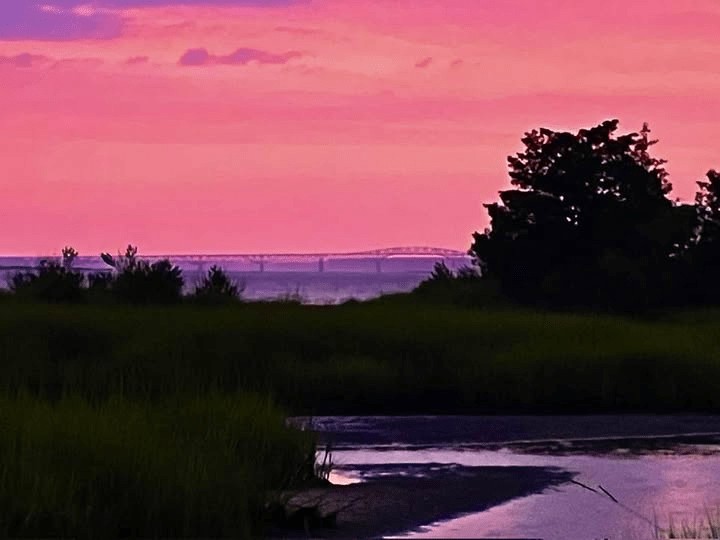
I walked today and the sun turned pink, almost lavender, and it glowed across the river and out toward the bay, and even a heron stood and watched, and for that moment we all brought the peace with us.