The naming of things often mystifies me. I get the planets; apparently the ancients liked Gods, but for their own planet they separated Earth and State and pulled an old Germanic word for “ground” or “soil.” How original. They should have just called it “Here.”
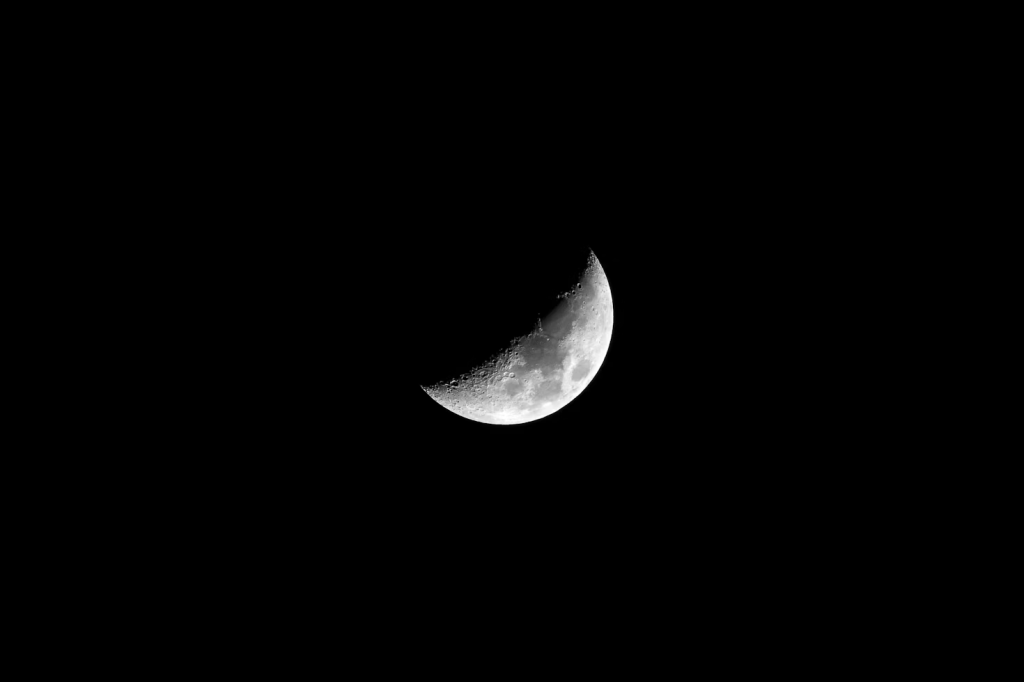
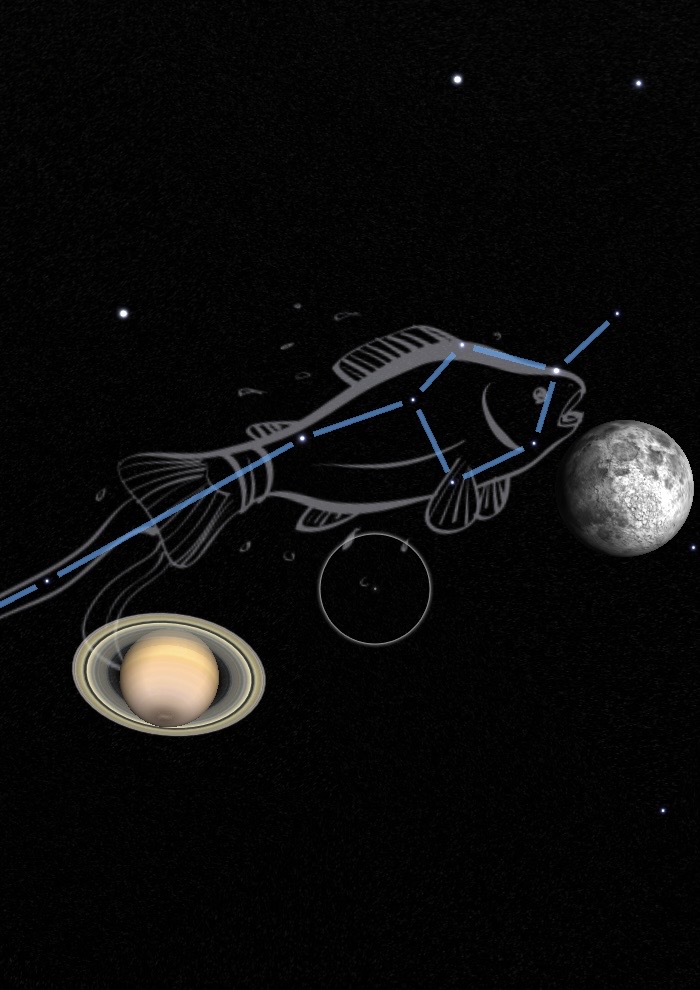
We looked at the stars and planets again the other night, and Saturn hung just to the left of the nearly-full moon, both just under the scales of Pisces. Pisces the Fish. And that’s where you lose me. When a dear friend gave us a beautiful telescope and deep space binoculars, my brother bought me a book about space stuff, including the constellations, and other than the dippers, which really do look like kitchen utensils, and Orion, which I recognize because of the old Orion Pictures reel, I don’t see Bulls or Crabs or Fish. Some ancient astronomers stretched it to be sure. I suppose if I lived in a Dark Sky area, the dominant stars of any particular constellation would pop and I might say, “OH! okay, look, Twins!” But no, not so much. And there are eighty-eight constellations, none of which share stars. That’s a boatload of sky and necessitates some serious imagination.
Look at Pisces above. The blue guide lines of my Space App show me where the “fish” is, but honestly, no–it’s not a fish–a tadpole at best. Taking the blue lines only it more resembles a penis, but I suppose the Penis Constellation would not stand up to scrutiny and no one needs to hear “Constellation Penis is rising in Virgo tonight.” But look again. Not a fish.
And here at soil level we’re not doing much better. Euphemisms abound so that I can’t recognize what the hell some people are trying to say, leaving way too much room for interpretation. In April of last year I was at my sister’s in Pennsylvania when our mom’s nurse called. She quietly and respectfully told us, “Your mom is transitioning.”
What? Honestly, for a split second all I could think of was, “Now? She’s ninety-one! But Go Mom!” It was only a heartbeat later I understood the very new (to me) diction of death. “She’s dying” is apparently not acceptable anymore. I think the reasoning is if they tell us Mom is transitioning, they’ve delivered half the message, and when our minds convert “transition” into “dying” we end up, oddly enough, telling ourselves what is happening, letting the nurse off the hook. Granted, I’m not sure I would want Dr. House to come in and go the other way with it. “She’s just about dead, Bob” probably wouldn’t help at all.
Pets cross the Rainbow Bridge after they are put to sleep. People are between jobs not unemployed, unhoused not homeless, horizontally challenged not fat. I could go on but I am trying to avoid being honest to a fault. Or Rude. Same thing.
Here’s one: Last week a student on campus committed suicide. Wednesday morning, early in the building where my classes are, he killed himself. But the community did not know that. What they were told by the college (and I suppose the police) was that there was an “incident” involving a student and death, but no one else is in any danger. This narrative should have only remained for as long as those in charge needed to verify what happened. At that point, everyone had a right to know exactly what happened. Instead, euphemisms relegated us to some vague interpretation at best, a complete misinterpretation at worst.
Officials then made the news of this tragedy worse by treating suicide like something they literally refuse to even mention by name to be addressed and discussed. Instead, rumor mills ran wild while students and the community wondered how he died, if someone else was involved, and on and on, because “incident” makes the truth as unrecognizable as the Constellation Penis. “A student took his own life today” should have been the first words (after the truth was verified) from the college, and absolutely the lead on any story in the media. Life is too complicated and moves too quickly for euphemistic speed bumps. Everyone wins when everyone knows exactly what everyone else is trying to say.
Ironically, Pisces is actually represented by two fish swimming in opposite directions to represent reality and fantasy. Diction-wise that translates to “being blunt” swimming past “beating around the bush,” I suppose.
But I still can’t help but believe that some Babylonian shepherd standing nearby the Pisces founder had to say, “Oh come on. What fish? That’s messed up. I’ll tell you what I think it looks like.”