Same

91333459_10220279117755568_8273282849587593216_o

Carolina wrens sing in the trees outside my bedroom, like clockwork, every morning. The sun hasn’t yet cracked the surface of the bay and I can hear them call. And mourning doves, too, near the birdbath on the front path. And this time of year in the near distance the grain drills lay down soybeans and wheat in the fields, just after dawn and then on and off all day. Just rising from the cotton sheets, my mind hasn’t adjusted to the world yet, and it remains in the cocoon of here and now and the slight chill of morning, and the faint aroma of coffee my son makes in the kitchen.

At the river the small rolling waves break on the rocks, and the young osprey call  from the nest on the other side of the marsh. My calf muscles tighten on the uphill walk home, and it feels good, as always, the taught skin, the sense of motion. Before the humidity brushes across the bay and overtakes the rising temperature, I take a deep breath and fill my lungs with the faint feel of saltwater, and it fills my senses like air, like first snow, like last light.

Bacon, eggs, and some toast at the small table on the porch, with orange juice, and I can feel the energy rise, my mind wake, and words mix with images and I resist the urge to walk again just yet and instead head to my upstairs office to make notes, scribble out some ideas and digressions for a piece, perhaps about the train ride, maybe Spain, always about life and dying, love and time and their passing. Only then, a few hours later when the sun has lost its intrigue and hangs blankly in the sky, do I meander the paths out to the road and down the hill to the river, and if the tide is heading out toward the bay, a small breeze moves in from the west. It feels later than it is, and the rest of the day comes toward me like a car ahead of me on the highway suddenly backing up, and reality seeps into the rest of my isolation, and what was not confinement, was not “staying at home,” was not anything other than my normal life being normal, is suddenly redefined, impressed upon, constricted by a new diction. I hadn’t really planned on going anywhere anyway, but now I can’t, and there is a difference.

The news bleeds all over my thoughts, my work, and my instinct is to fight the new path, but I can’t. I hear of rising numbers, of a falling economy, and I wonder when I’ll see my mother again, her safe behind several sliding glass doors and an acutely careful staff at her independent living home, hoping. Just hoping. I wonder when I’ll see colleagues, my brother moving to the area, yet, when I see him seems still indefinable. And now the small things I had forgotten about but now remember how they always lay scattered across my normal weeks, like lunch with Tim, pie with Jack, oysters with Michael, and readings, so many readings in crowded cafes leaning into each other, laughing, sharing and embracing. I had not so much forgotten as much as set aside, and that worked fine. But now, midday, when the sun is high and the sky a pale blue, barely catching my attention, and the birds have moved on , and the newness of first light fades, I remember, and I wonder, and things no longer feel…what….in my grasp, perhaps. That sense of absolute conviction that my future is my own has faded to a mere hope that things turn out okay. And once again the power of things unseen is proven.

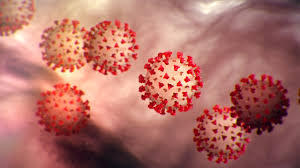
And I recall the strength of this dichotomy, the life and death of things unseen, what doctors tell me is a microscopic serial killer, contrasted with what in my college days we learned was also invisible to the eye, faith, and that “faith is the substance of things hoped for, the evidence of things unseen.” For many it takes one to battle the other. And so goes my mind, followed by my day, until evening.

Evening, when a whippoorwill calls as she ever has from the brush behind the patio, and I read Kevin Codd’s narrative about walking The Way in Spain, and I am reminded of those days when every single day was like the one before, yet somehow unique, and beautiful, and permanent, and how it turns out that a pilgrimage is rarely about reaching a destination and more about finding some peace inside we seem to be in search of all of our lives.

And I crawl back under my cotton sheets, cocooned, and the waning moonlight streams in the skylight, reminding me that things change, and then they’re the same again.

10959403_10205234564891149_6840273504565061606_n

Hey, HEY! Back off…


clouds

As evident in the picture above, wheat does not practice social distancing. Nor do the clouds, often floating along in seeming formation, just to the side from each other, maybe whispering as they meander by. Sometimes they gather quite close in blatant violation of CDC guidelines, like this morning when storm clouds kept climbing on each other’s backs, up higher, mounting and building some black and grey tower until they cracked, and then rained, and then exploded bolts of lightning, further proving the problem of coming too close to each other, such as clouds are apt to do this time of year.

Geese ignore all instructions and fly wing on wing, honking to each other to “Close the gap! Closer! CLOSER!” as they take turns in traditional tandem fashion. Even after they land in the pond they paddle next to each other, like they’re cold, like they’re lovers. Deer too, and swallows, and starlings, so close this last group that they bend east and west in one massive stroke, like a paint brush with black acrylic swept down and back up the canvas. Bats are the same, those bats, those sociable and close-knit colony of mammals that are the supposed ironic root of this inhuman human distancing we now find ourselves learning, like a new language, reminded again and again to stand in the next circle, to wait our turn behind the line of tape on the floor, to step away from the counter, to nod not shake, wave not embrace, and as we depart to say not “good-bye” anymore, but instead, “Stay safe.” It is the new farewell. Decades from now slang dictionaries will note the root of this signature to be from the times of covid. We will never again be able to separate ourselves from these times.

It turns out horses, as well, are social animals who find separation a cause of anxiety. Ants, yes, as proven on the old tree stump in the woods behind the shed; crows, of course, which I well may murder myself for their constant gabbing early in the morning. And who hasn’t seen by now the famous photo of penguins in Antarctica, gathered by the thousands. Topping the list at the social affairs, however, are apes, gorillas, and humans, followed way too closely by dolphins. But this is disturbing: these top three social animals, all primates, are among the only ones—the ONLY one’s—who kill each other. That’s really not very social at all. I’m betting the social nature of primates is simply a bad idea and leads to, among other things, war. Genocide. Annihilation.

Humans? Honestly, I’m not sure why everyone has a problem with social distancing. To be certain, we’re not very good at being close. We push and shove on city streets because someone is too fast or too slow, and we tailgate which leads to road rage which leads to someone being “in your face.” The tediousness of rush hour, the impatience of long lines, the lack of elbow room.

And yet, sometimes we can’t get close enough. Sometimes when we find ourselves away from one another, we wish we had never parted to begin with, and we call, cry, shout to be heard across the distances of not-touching, not making eye contact. Absence makes the heart grow fonder? Out of sight out of mind? Interesting debate topic until now; now, when the verdict is in, and hearts around the world grow weak from tapping deep into their wells of fondness hoping for the call to come to crowd and gather and not ever let go again.  

download

Aerie, for Now


Seems like the entire human race is back in the cave watching the shadows.

Not for long, of course, and to varying degrees. Some studios in the city must be unbearable for any extended length of time, and in some places with large parcels and room to wander, this forced grounding could be considered welcome. That’s the case here.

When I purchased this wooded land just up the hill from the Rappahannock River and just a few miles from the end of Virginia’s Middle Peninsula, where the river meets the Chesapeake, I felt at home immediately. The horse farms made for fine neighbors, and the fields of corn and soybeans offered an Americana landscape that is getting harder and harder to discover.

Not long after I purchased these acres, my father and I came up from Virginia Beach to tape off the area in the woods to be cleared for the house, as well as lay out how I wanted the driveway to wind through the trees. He looked around and said, “You’re not far from Richmond, are you?” I agreed, told him it was about an hour or so, and that I could make it to DC in two-and-a-half, as well as to his place at the beach in an hour and a half on a good day. “This is really centrally located, Dad,” I told him. I grew up in two homes, both on the Island, and both unique for the friends I had, the growing up, the ties, the crazy freedoms I collected as I grew older. When we moved from home one to home two, I never once felt like we weren’t going to be “home” anymore. We simply relocated ground zero. I never told him, but that move Dad made probably did more to define “home” to me than any floor plan could possibly contain.

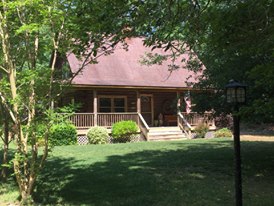
Back here on the river as the months passed, I built the home, contracting out the stacking of the logs and the framing as well as the mechanics, of course—I didn’t want to blow up. But I did nearly all of the inside myself such as the interior walls, the stairwell, the floors and trim work, the kitchen cabinets, in addition to the landscaping when I’d drive up from the beach and sleep in the shed. It makes this place more “home” because of the bruises and blood invested, of course; we can make a house our home by the work invested, the time committed to converting the frame and foundation into a memorable homestead. My new neighbors came by when they saw my jeep out front to welcome this ‘Come Lately” to the area. One of them bragged about the town.

“It’s really centrally located, Bob,” he told me.

“Yes, I was just talking about that with my father,” I replied.

My neighbor went on: “Sure, the village is just three miles from here, and Urbanna is about fifteen miles from here and has great restaurants. And if you don’t mind driving a bit, Gloucester has some good food stores and shopping, but it’s about twenty or twenty-five miles.” My diction and sense of relativity was being redefined. I was fine with that.

I’m pleased it hasn’t changed much in the twenty-four years I’ve been here. Now, I head to the village daily for coffee, sometimes a drink at the Galley, sometimes to just walk about the docks. When I have the energy and time, I’ll make the trip clear over to Urbanna up river about fifteen minutes for some oysters. Yes, centrally located has found me here.

In these twenty-four years I’ve walked to the river almost every day I’m home, and my son—who grew up here since he was just three when we built the place—has taken pictures of these sunsets his entire life. We’ve planted gardens and raised apple trees and a few dozen crepe myrtles I bought for a dollar a piece twenty-one years ago when they were less than a foot tall, which now tower over the house at more than thirty feet. I’ve blazed trails and laid out mulch and scattered about benches and sitting areas in holly-crowded cutouts off the trails.

Then there is the wildlife. While still building the home but after Kenny the builder already framed out the roof, I was walking home from the river and as I came down the winding driveway, I noticed an adult bald eagle perched on the corner of the eave. He took off, of course, but many have returned over the years, and in more abundance. Hawks call out too in the late afternoon, and it is why I quickly named the place “Aerie” for a few reasons. One, an aerie is an eagle’s or hawk’s nest, and two, it is the name of the first John Denver album I ever remember copping out of my sister’s collection when I was a kid, and it made me want to live in nature, surrounded by wildlife, and here I am. It’s not the Rockies, but it’s closer to my nature anyway, water. In the winter, fox ramble about on a nightly basis, and deer are everywhere, particularly after we plant beautiful flowers.

There have been some setbacks. Most notably, Hurricane Isabel in 2003. This monster ripped thirty oak trees up at the roots and dumped them all over the property, including a half dozen sixty-foot tall beauties right down the middle of the driveway. Out in the hinter parts of the property a few downed trees are still working their way back to the soil, all covered by foliage and brush most of the year. Holly, too, and laurel, makes the land quite private in winter since the dark green bushes and trees are everywhere.

And birds. I don’t remember their names, but they’re all here, like an aviary from some museum. I’m certain this place qualifies for “Bird Sanctuary,” and my son has for years recorded in a journal the ones he has seen, matching them up with his tower of guides.

When I worked full-time in Virginia Beach (though I only had to make the drive twice a week), colleagues were curious how I could possibly live so far from work. Then they’d come here and quickly say, “Oh. Okay. Yeah.” This life can’t be bought in the city; not for less than five times what I paid and even then I’d only have one quarter what is here, and there is no price you can put on the health of living in the country with bay breezes and endless trees. We are outside almost all of the time. Even now.

Yes, even now.

When the call came down to “Stay In Place” because of coronavirus, I had no issue. Life here didn’t change much. There’s nobody out here. Sure, if I drive into the village people buzz into the Great Value or Hurd’s Hardware, or swing by one of the “to go only” restaurants, all of us careful of each other, each of us sanitizing our hands upon reentering our cars. No one in this town on the edge of the bay has ever made me feel like a “Come Lately,” and it feels good to be at home. And we’re all really really clean right now. And as of this afternoon the map of Virginia shows this county is one of only a few in the entire Commonwealth which still has no recorded cases of the virus. But all of that aside, the cause of my bragging about home this afternoon is how easy it all has been, being here, living life here. To carry this reflective dirge a bit more—since we are all home reflecting on our routines in the greater picture of how we pass our time on what Tim Seibles calls this “big wet rock,” I can honestly say this land works well for a good quarantine. I’ve lived in five states, spent extended time in several countries including Russia, Spain, the Czech Republic and various third-world locales, and there are only a few places I have ever felt I could stay for good, and I wouldn’t even need an official “lockdown” to do so. This is one. It just happens to be home.

Is there anything missing in this picture I’ve painted of Aerie? Of course, there always will be no matter where we settle down, no matter what path we follow. As beautiful of a place this is for me to spend the rest of my years, under the right circumstances I can leave tomorrow and begin again somewhere else. I could head back north, head out west, sail away. That’s my father’s fault. Without even knowing it, he taught me through a very subtle example that the most important part of being centrally located is understanding the “center” we seek is within, and it moves with us. And thank God, because the pursuit of this life is what makes this life worth living, never the arrival. One of the things I love about being here along the river, not far from the Bay, is I get to look out across the reach and wonder where, if I ever decide to live anywhere else ever again, where will it be? I like wandering the paths here at Aerie and wonder what can be planted, what more my soul might harvest from this land. In a perfect quarantine, the people I love, the ones I laugh with, the ones who finish my sentences, would all be here at Aerie through it all. But, no. So it helps me that I finally understand that home for those of us who seek simplicity, is a place, like love, which we simply “call” home, and for a brief time we let it absorb us like water, like breath, like the fluid promise of dawn.


15541149_1253544308045834_2873510931106247100_n


Departures

52914604_10216802207034973_1415565871518056448_n
Somewhere in Eastern Siberia

Note: 

I generally don’t do this, publish on the blog a work which is destined for a larger, more involved project, but tonight I am for three reasons. One, I just finished what will be a 200 page book about Siberia, called The Iron Scar, and this is only about a third of the final chapter but it feels good to get to this point and I wanted to share it while everyone is getting zoombombed. Two, it’s corona-time, and it’s the only contribution I can make to create a diversion for those sitting inside. Maybe some people won’t mind reading this, traveling across fifteen time zones with my son and me, sharing it with others if  you wish. And three, John Prine just died a very short time ago. He always made me think of moving on.

Thank you for reading my stories on this site these four and a half years.

You’ll be leaving on a new train
Far away from this world of pain

                       –John Prine


Departures        

The engine pulls us across the last sets of trusses and in the distance we see the small, hilly skyline of Vladivostok. Everyone breathes a sigh of relief as the flooded Amur spares this train. The tigers will have to find other fare.

The rare non-saturated fields we passed heading south on this peninsula toward Vladivostok are clearly the land of laborers. Farmers and fisherman, lumberjacks and rail workers all jockey for position, try to make a living. The non-forest land is checkered with farms separated by fences made from trees, and small, lush gardens of cabbage sit inside makeshift walls, endless tiny plots each with its own tool shed. Cattle wander at will on all sides of the waterways, and fields of potatoes and onions stretch across the hills. I’m sure it is an isolated life, but those we’ve met don’t imply loneliness. The sweeping generalizations I’ve heard about Siberia, and Russia in general for that matter, have no support, no evidence of how such trite judgments might have started to begin with. In the nineteenth century, perhaps, and even up through World War Two, but nothing here is the same as cold-war-era kids like me had been taught. Nothing.

I don’t understand the engineering principles which make this train run across these iron rails through green landscapes past forests of birch trees. I can readily enough turn my pen toward the burning oil, the human waste, the garbage, the third-class suffering and see the searing effects of this iron scar. Certainly, these rails brought opportunity to the Siberian outposts, yet these cars also carried innocent millions to gulags and prison camps. It brought soldiers to war and home again, bodies home again, Jews from their homes to eastern towns during the pogroms, tourists trying to reach Baikal, businessmen hoping to spend a few days away from the city; it brought the twentieth century into the twenty-first, the west to the east, and the hopes of millions into the vast indifference of the Russian frontier. These packed train cars have slid past vast fields of indifference for more than a hundred years, and they’ve carried the confessions of gulag guards, of Bolshevik evangelists, the wit and subversive criticism of dissident poets, the last hopes of a dying imperial family; these carriages have carted east those feared in Moscow, those freed in prison camps but forced to flee no further than the next station; these cars moved multitudes to the wasteland beyond the Urals hoping to populate the eastern perimeter of Russia, most dying from disease and deadly winters. This train has moved though our lives carrying stories of strangers, companions beyond communication, brothers without borders bonding over chess and Baltika beer during some late night/early morning leg on the Mongolian border, where laughter remained our only diction. Oh, this train.

This railcar carried this father and son from apprehension to confidence, and the further we rolled toward the barren reaches of the empty lands in eastern Siberia, the closer we came to independence and companionship. It has been three weeks, it has been ticked off the clock not on Moscow time but on the immeasurable growth of a time shared playing music between cars, or over drinks all the while this train moves south and closer to home than Moscow.

We can finally travel at our own pace, on our own tracks. 

The Vladivostok skyline is ahead of us and grows across the flooded plain, China to our west, North Korea not far, and from this rain-soaked window in the dining car, my office for nearly six thousand miles, I sit one last time and listen to Shostakovich, jot down a few final thoughts, and drink a can of Baltika

If I were to ride these rails again, I’d spend more time on the platforms buying fry cakes, pirogi, dried fish, flat bread and fruit from the local women, and talk to them more, engage in what is clearly their existence, that walk from their home to the station and back. The connection I have discovered no matter where I travel, but in particular somewhere as remote as the rural sections of what is essentially already rural Siberia, is the food. It is the common denominator, the shared space on a circle graph, and like the chess games here in the dining car brought us together with strangers, the old women at the stations all along the crossing who sell us their goods make this trip personal. It is food which binds us—not language. I’ve been on trains throughout the United States, in particular the commuter routes from Manhattan to Long Island, and people who do share a language don’t talk anyway, so this isn’t much different. I challenge it is more engaging; too much common ground can kill a relationship, no matter how fleeting.

Still, across this vast empire I believe the reason I spend so much time looking out at the wild landscape, the royal-blue station-houses, the deep truth of birch trees, the small villages and eroding towns, is simply they need no translation, no subtitles. I can let my imagination drone over the landscape without the need for inquiry or answer. Certainly, I would like to know the story behind an apparently abandoned gulag, or what the primary occupations are so far from any town of note, but that information is encyclopedic, and anyway, between cabinmates and dining car chess players, we seem to have discovered a decent cross-section of eastern Siberian culture. None of the people are rude; they’re guarded. Their excited reaction to various topics is at first defensive, yet as soon as they discover our attempt to communicate and learn, not accuse, they have patience and openly desire to engage and assist. This is all accompanied by frustration on both parts when we try too hard. The railway has taught me not to try too hard.

The great irony of crossing Russia from its westernmost city to the eastern port of Vladivostok—just about the widest crossing one can undertake anywhere on the planet and remain in one country—is despite remaining on track moving forward, it is a wandering experience, seemingly erratic and haphazard. I like not knowing what is around the bend, never quite sure of in which town we might have disembarked, and which ones are better left to the tigers. There is always a cost to the choices we make.

There is a price to pay as well for being a father, especially when you are close to your child. A part of you dies with each new passage, and at some point you understand there is no end of the line, there is only moving on, separately, praying the other is well, healthy, still moving forward. I’ve gone as far as I can on this ride with my son, and it is all so familiar. I was twenty, my father fifty-five. He drove me to the airport for my one-way flight away from home toward something else with a vocabulary I had not yet even tried to unravel. I just knew I needed to go, and he let me.

That’s our job, as parents, to let them go. I imagine a life years from now, when some time will have passed since I last saw my son, and he will have aged, and I will have slipped further toward the end of the line, and we’ll embrace, and he’ll tell me a story or two about his life since moving on.

I sit up early before departing the train for the city, then the airport, then home. My bags lay packed on the floor, the linens already rolled up and bagged for the attendant. Outside the sky is grey but clearing, and the morning sun picks up glints of glass on the skyscrapers of the city. Michael returns with his last cup of tea from the samovar and sits across from me on the opposite, now empty, bunk, our knees nearly knocking. I look at him and smile.

“What?” he says.

“Springsteen.”

I know he thinks we had exhausted the Train Song Game, so he stares out the window a while trying to dial up a train song by one of his favorites. Nothing. Of course not, I think. I saved this one on purpose. This one’s for the fathers:

I will provide for you
And I’ll stand by your side
You’ll need a good companion
For this part of the ride
Leave behind your sorrows
Let this day be the last
Tomorrow there’ll be sunshine
And all this darkness past

Big wheels roll through fields
Where sunlight streams
Meet me in a land of hope and dreams

10469710_10203474459849623_4039532387254646453_n
On the platform in Vladivostok

The Nature Readings Blog

At first I was going to just record myself reading a blog, and then I thought I’d record something specifically about nature.

Then I found some videos of Tim Seibles and me from the Jewish Mother sessions we did for several years in Virginia Beach, and I was going to publish them, but, no.

Then I realized how many people I know write about nature, and this page was born. Already since this was published a few hours ago, a list of writers to add to the page has grown. But understand, there is no ranking involved. I reached out to writers I knew well and the first bunch that answered my call and sent me a video I posted. That’s it. And many of them did so while trying to move classes online.

What started a few months ago as a passing thought has turned into this page, and I’m excited to see where it goes. I mean, how can anyone ever get tired of readings about nature.

Thank you for watching. Please if you so desire, like their readings when you watch them, and remember to go to the links of their work and read their bios. 

Here’s the link:

The Nature Readings

Miles from Nowhere

images


My walk was chilly today, a breeze coming from the northwest stirring up the surface of the bay and pushing away the false hopes of an early summer. I love—embrace—the feel of this time of year on my skin, whether it be warmer days or chillier nights. For now, it’s early spring again, closer to late-winter, and I walked along the water and past the farmlands, nothing to see but sky, deep blue sky, clear to the horizon. A young eagle swept across the road and along the duck pond near the river, and the same blue heron I see every day was there only to take off like she always does with a deep honk  to glide across the pond to the marsh, landing in the shallow water without causing so much as a ripple. The kingfisher on the wire as well as the gulls along the rip rap are braver, not caring so much about my routine. The herons, however, and the egrets and buffleheads all distance themselves as fast as possible.

A sign of the times, maybe.

Everyone I know is inside; the entire planet is isolated or quarantined or Staying in Place by whatever decree the local, state, national authorities updated today. It’s like the whole world was put in a Time Out for three minutes or three weeks or three months. Some people are engaged with the news watching the numbers go up, and I suppose it helps us stay in tune to the gravity of the situation, keeps us in check, but it feels an awful lot like for some the CDC tally has replaced Sports Center. I’m not indifferent to the desperate and unprecedented nature of this crisis; it’s simply that I’ve done all I can do at this point. My art and writing students are in check, the kitchen and pantry are stocked, I’m not going anywhere, and by nature here at Aerie I don’t see any more or less people now than I have in the twenty-four years I’ve been out here on the eastern edge of the peninsula.

Still my mother called earlier to make sure I was safe, avoiding contact with people the best I can. I told her, “Mom, I have to drive somewhere to have contact with people.” She felt better. Until tomorrow. As for her, she’s in her independent apartment in Virginia Beach in a facility that keeps her safe, the property spotless, and everyone else—including family—away. Isolation means being away from others. It is safe. But it is also very sad. For some, tragic. Isolation, while the best course of action, contradicts the soul’s desire for human interaction. It is one thing to choose to be alone; it is an entirely different thing to have aloneness thrust upon you. Some, I am sure, would rather die.

But back out here in the Wilderness, the sky is “blank” tonight. That’s what my son and I call the sky at sunrise or sunset when no clouds are resting along the horizon, stirring up the dust, calling up colors for us while we sit and watch or take pictures. Sometimes the western edge just above the reaches of the river, up past Tappahannock and outwards toward Fredericksburg, is so streaked with dark reds and blood orange that we can’t decide whether to shoot pictures or just stare silently while it all goes down. We might hear a boat out past the point, or sometimes Mike landing his P-13 a mile or two to the west at Hummel Field, but mostly it’s just the water, softly, right there, every few seconds at our feet.

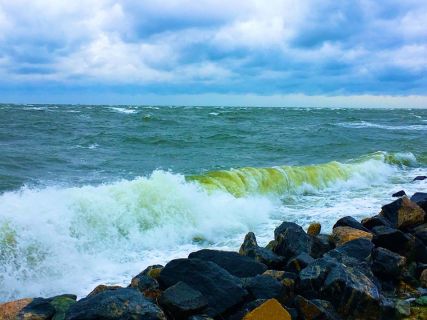
But tonight, well, tonight, as if to underscore the news blasting out from literally every town on Earth, the water is rough, coughing up white caps and slamming the rocks at the end of Mill Creek. Parrot Island looks half submerged, and the pier near the old boat ramp is underwater. It’s like nature knows.

Of course it does.

It’s like the earth is saying, “You’re not paying attention!” It’s like the earth is telling us who is in control, from violent storms to virulent disease, it is calling out for some humility, some humble self-reproach. This crisis has demonstrated, clearly, as if under a microscope, how indiscriminately we brush off people and time and life itself. I know so many will be complimenting the efforts of billions worldwide, and showing how we’ve come together, showing how we’re sewing masks, or clapping for nurses, or thanking cashiers, or washing our hands. We’ve pulled ourselves together to get through this, yes. Yes.

But it’s only now, six feet apart at best, miles apart for sure, lightyears away from each other for certain, that we appreciate the eye contact, the walk along a city street, stopping in stores, sitting at a café; that we appreciate shaking hands, a quick hug, the friendly embrace. The economy will return to something better than this, the chance of contracting the disease will back off, the colleges will reopen for face to face classes, and we will be able to sit at Starbucks and laugh, sharing a muffin. Of course, But I fear it is going to be sometime before we have those sensory experiences, the visceral explosion of life on our souls.

It’s getting dark and my skin is cool, almost wet from the night air. I can taste the salt from the bay on my lips, and my face is lashed red and wet. It feels good, and I can take a deep breath, a deep deep breath, and walk up the hill past the farm under a half-moon into my home for the night.

33472148_10214825475857929_1973836389350899712_n

Allergies in the Age of Covid-19

download

I am fortunate. I live on four acres with trails and gardens, and I have a peaceful walk to the river and the bay. I can be outside from sunrise to sunset without ever seeing anybody, and I can wander at will to watch the eagles trade calls with the osprey, watch the fishing boats out toward the mouth of the river, and I can breathe deep and feel about as healthy as one can possibly feel.

Well, except for my stuffy nose, my fatigue, and my headaches, which have come to stay for a while as they do every year about this time if I don’t medicate just a little and shower a lot. It’s a bit unnerving having allergies which bring on headaches and fatigue the same time as the appearance of the Coronavirus known for some of those same symptoms.

But I tolerate the meds (or, more commonly the last few years, a lot of green tea) for the sake of such beauty. Living in the country has the benefits I’ve long touted on this page, especially in Spring. The buds on the oaks are changing the tone of the sky from dark blue to a hazy blue with speckles of green, interrupted only by the white blossoms on the apple trees a few feet closer. The daffodils have come and gone but the tulips are pushing through now, and the azaleas are ready to explode.

The white flowers on the laurel bushes are still a month off, but between now and then the honeysuckle will fill the woods from here to the river, and the early wheat across the fields will be knee high. I’ve not yet planted the garden; not going anywhere has interrupted my normal routine just a bit, but I have seeds inside I’m ready to sow so they will break ground or perhaps even blossom by the time we can interact with each other again.

It is Spring, and the rains from the west combined with the bay breezes have awakened every aspect of life, from the bees which I saw again this week, to the Carolina wrens headed back north, to the return of the osprey in the marsh where eagles have nested most of the winter. The farmer across the way will drive his tractors and thrashers and slow us down on the main road as I try and head to the village. He’ll pull into a field to let a row of cars by as he gives a small wave. I most likely would have seen him at The Galley in a few days if the Galley was open for anything other than take out.

The river is changing as well, turning to her normal choppiness this time of year as the March winds wake up the waves clear across the reach so that sculling to Windmill point is, well, pointless. But the breezes, oh they are soft again, and warm, with a touch of salt and the fragrances of goldenrod which, anyway, has turned my dark grey car yellow, the site of which ironically calms my nerves when I wonder if my headache and my fatigue are allergies or, you know….(insert a whisper here)…covid-19.

A quick shower clears away the coating and I can breathe again and have energy again and feel excellent, awakening in me the realization that this time of year I nearly always quarantine myself anyway. Problem is, of course, at my age, I’m only looking at so many more Springs, maybe two decades if genetics stays true. That’s just one score of springs and a few odd years before the allergies alone can cause havoc with my respiratory system.

A quick review of this short dirge seems on the surface to indicate some depressing thoughts until now, but that’s only half true. I don’t sit around and count how many seasons I have until I’m eighty, if I ever am eighty. I really don’t. In the normal doings of life it never crosses my mind. But the news, well, the news has been gray at best, and it doesn’t take much for me to ease down that slippery slope of understanding time’s limitations.

I prefer to think of such an acute awareness of how many Spring’s I have left in me like I do the proctor at a timed exam. She might glance at the clock every once in awhile and call out, “Thirty more minutes,” and everyone looks at the clock in unison and everyone takes a deep breathe, lets out a whisper of a curse, and presses down just a bit harder with the pencil, scribbling a bit faster. I don’t mind the warnings, the head’s up. They awaken in me just enough anxiety to appreciate better the weeding I need to do in the rose garden running along the woods behind the house, or thinking about my ambition to rake away the leaves running along the four hundred foot driveway to plant bulbs and wildflowers, which anyway won’t bloom this year, but soon.

But I’m only out in this wilderness because I can return to town, sit and have a drink with friends, laugh, touch each other’s arms when we tell a story, give a hug to those I haven’t seen in some time. That’s life—that contact, that human touch. Even Thoreau ate dinner at Ralph Emerson’s place on occasion. I’m going for a hike through the woods and then to beachcomb for a bit. I wade calf-deep and then slip the flip flops back on and walk the hill to the house, maybe call a friend who anyway is probably out on a hike as well. We are never alone in this being alone, as Gordon Sumner once wrote. Nor do I ever want to be.

90173828_10220210763206747_7619181539682680832_o

I so late.

10426893_10212684993107198_7869380231877784156_n

My entire life I’ve been running behind. I figured out quite late how to plan ahead financially, professionally, and even emotionally; long after everyone else I grew up with. I am the one who always thinks of just the right words to say only after the situation is over. And I’ve objected throughout my life to changes in plans only to completely agree later, after I’ve thought it through more.

I’m not good at so much of what is necessary to maintain a normal life. A significant slice of my brain still thinks I’m in my twenties, ready to start anew, chase some other dream. Another portion of my cerebral pie is still in its teens, excited about a hike through the woods, wondering if any of my friends on the old block are still interested in a long walk along the creeks of Heckscher State Park on the Island. And still another remains the hopeless romantic, surviving crisis after crisis throughout this narrative just knowing that when we get to the climax, it’ll all turn out just fine.

I’ve mastered the art of self-deception. I’m the proverbial creator of castles in the air, and I’ve convinced myself I’m not too old to build foundations under them. My justification for such quixotic approaches to things is how well it has worked for me thus far. I’ve had my share of living, of adventures, of trunks filled with experiences that have filled dozens of journals from Africa to Russia to Mexico to Norway. I’ve done the professor thing. I’ve built the house in the country near the water and raised a fine, fine son. The old Zen stuff I learned in my teens in the seventies panned out—visualize and follow through. I’ve been best friends with adventurers, artists, musicians, writers, soldiers, homeless, and drunkards.

And I’ve been lucky enough to have older siblings who are two of my heroes; two people who I not only look up too, but who have inspired me more than I can appropriately write about; my parents, too, were examples—in all, four people around me all the time, all raising me to some degree, and still, their lessons I learned far too late. I’m not complaining—just the opposite, my God, I’ve had the chance to live more lives than I ever imagined possible when I was young. What a pilgrimage it has been so far.

But (there’s always a “but”). I was at a meeting many years ago and the division chair had asked us all to tell ten of our own accomplishments—not school related—that no one there would possibly know about. My turn came and I mentioned some things I was proud of, and secretly as I read the list, I thought two things simultaneously. One part of me was thinking, Wow, I’ve had some really great opportunities. But the other part of me was thinking, I’ve spent more of my years not doing things than I ever spent doing things. I feel like I’m still trying to figure out what to do with my life.

There is good reason for thinking that second thought, about how I was “not” doing things, because I was, in fact, doing a lot: I had a young family, I finally had a career, a mortgage, and a job that afforded me chances to do so much of what I wanted. But there was always something missing, something I always felt like everyone else knew about for themselves a decade or two before me, but I just couldn’t put my finger on it, like it was always just out of reach. Everyone I knew seemed to feel settled, like they had found for themselves exactly, I mean exactly, where they should be and what they should be doing. I could see it in their enthusiastic attitudes, in their engaged eyes, in their unrestrained energy for their work, and I just figured I’d come to that attitude late, like I always have, but it never showed up. I thought maybe I’d find it in one of the two dozen trips through the years to Russia or Prague or Amsterdam, or if I wrote it through enough, I’d find it in one of my stories. Well, as another influence in my life, Jackson Browne, once wrote, “I can’t help feeling I’m just a day away from where I ought to be.”  Yes.

Then came this allusive Covid-19, a phrase which has suddenly entered our lexicon without any warning or slow introduction at all. Just “Bam! Covid-19!” And we have been told to isolate as much as possible. We’ve not yet been given the order here in Virginia to stay in place, but when we are, well to be honest, nothing’s going to change much around here. The property alone is huge with trails and a wrap around porch and a patio where I spend much of my time doing work. The river is right here, and it leads directly into the Chesapeake Bay. The village is sparse so that pubs are still open for people who, sitting far apart, can relax on the deck and have a drink. Like always. Nothing here has changed much. My daily walks are still my walks daily, and I still never see a soul while doing so.

So last night I sat at the desk about 3:30 in the morning and read some rough drafts of my work and had an urge to go online and plan some trip; maybe drive to see a friend in Ohio, or head to Florida or New England. I’ve had a burning desire to hike the paths on Antelope Island or have lamb at Peklo in Prague. Yes, I’d apply for some grant like I have so many times before, and I’d just go, and I’d write about it.

But we all now find ourselves in this precarious position of not being able to do what we could so easily do just days ago. We’ve been told to isolate. Down in the city it seems these days that just going to the store is dangerous, making us reevaluate how important that bag of chips really is after all. Now all around the world people are staying in place, like it was a massive game of “Red Light” and God suddenly screamed “STOP!”

It is one thing to blame our inaction on lack of finances or being too busy at work and it is another thing altogether to have immobility thrust upon us, to be told any plans we may have had must be cancelled or, at the very least, postponed.

I despise postponing anything, but in particular, life. There isn’t that much of it to begin with for the youngest of us; and there certainly isn’t that much left for the healthiest of us. So postponing and “waiting it out” contradicts everything believed in by those of us who want to empty the tank before we end this mortal ride.

Now’s a good time to think about this. I wasn’t doing anything anyway. So I stayed up late, or got up early, I forget, it was 3:30 am and I was tired, but I was up and I thought about it and I came to a fine realization, an absolutely perfect epiphany: It is the searching I am after; it is the “looking” I look for. Even Don Quixote isn’t trying to slay any windmills; it is the pursuit which draws him. I have learned after so many years and so many miles that it is the absorption of life on the road, the cultures, the laughter with others that is my livelihood. There isn’t anything in the journals I was ever actually after; it was having something to write about at all that mattered.

We are always faced with the ancient and abstract question, “What do you do for a living?” Well, for a paycheck I teach college. For a “living”??? Well, for a living I have celebrated Victory Day with World War Two vets in Russia on the 50th and 60th anniversary; I walked across a frozen lake in the Arctic while bands of aurora borealis bounced just over our heads; I stood on a rock next to an obo with my son on a hillside above Lake Baikal, and a year later we walked across Spain. I sat and drank vodka with a Russian photographer and friend after his wife died, and another friend of mine and I spent hours counting stripes on the wallpaper in our hotel room. We had wine, yes.

This all crossed my mind at 3:30 am after yet another day of not going anywhere along with everyone else on the planet who is not going anywhere for quite some time to come. Sitting still and isolating myself has set my mind free. Too free, perhaps, so I’ve got to occupy my mind before it gets out of hand and I discover, too late of course, that I’ve wasted even more time. To that end, my moments hence forth and until I’m directed differently will be spent working in the garden, fixing the shed, cleaning out the attic, canoeing to Parrot Island, writing letters every day to my dearest friends, and more, and more.

I am very excited about possible quarantine. Very cool. You see, if we are forced to focus on one or two things, we can usually master them. Put anyone alone in a room with just two things to do and wait three weeks. They will have mastered those things, of course. But life doesn’t allow us this; life demands a degree of multitasking we will never be able to master. But limit me to two things? Really?

As they say in this neck of the woods: Here, hold my beer.

This is what I’m best at: Individual moments. I just could never put my finger on it. But this is how I make a life; slipping all these beautiful individual moments together on a string. I’ll make pretzels and we’ll laugh and drink coconut rum and experiment with the dough. I’ll organize all my photos. I’ll clean up all my flash drives. I’ll wash the windows and they’ll be the cleanest frigging windows in the village. 

I’ll learn to be excellent at just a few things within my grasp instead of half-ass at things just out of reach. Why do I feel like everyone else already knows all this?

Still, it won’t last long. I know me. I may have come to understand who I am later than most people, but I’m there, and there’s still too much gas in the tank to not pursue what’s just out of the reach of my headlights, so I’ll keep driving. Someday I’ll learn. Someday.
download

Covid-19. 3.16.2020. Day One

download

The time to be at home begins.

Some have stocked up on food and water and other essentials, some are less worried and go about their business. Some are working from home and many are not working at all, right now sitting at the kitchen table figuring out how to make the money last longer than they had planned just a few days ago, when things were already tight.

Many will try to learn something new or start a new hobby, like the lady at the library a few hours ago who learned to download books onto Kindle so she can catch up on her reading. I heard a man in the store yesterday say he was going to learn to cook. Many will binge-watch shows ad nauseam, all of them trying to avoid this invisible killer, this microscopic mess, and some of them will remember Plato said that courage is knowing what not to fear. An analyst on the radio today, when asked how difficult it is to catch this still relatively uncommon viral critter, compared a town of people to a book and the virus to a page—one leaf of paper, she said—but they’re all bound together. It isn’t easy to keep the pages away from each other, but it must be done. “Take your piece of paper and go home,” she said, her point well taken.

I’m fortunate in that my life won’t drastically change. I’ve moved my art seminars and writing classes online, and I’ll be home to walk, wander about the dock and mess about with boats, since there’s “nothing like messing about with boats” Kenneth Grahame tells us. I’ll get up for the sunrise at Stingray Point and follow it down across the duck pond and the western Rappahannock until the sky blends blue with something like a purple mist, and then deep reds, and then gone.

I’ll sit on the porch and listen to the spring peepers and dream of Spain, of the hot sun and the endless paths through eucalyptus forests and the open plains. I’ll imagine hot nights in the Siberian railroad dining car east of Irkutsk, Michael playing chess as five or six Russians take turns buying Baltika beer and laughing at the way my son keeps winning, noting how good he is, ignoring how drunk they are. I’ll look out through the woods here not far from the Chesapeake Bay and maybe hear an owl, most certainly a whippoorwill, and eventually I’ll head inside and upstairs to this desk and try and rub two sticks together on the keyboard. If nothing ignites, that’s alright; there’s time. I just need patience. They are the two most powerful warriors, Tolstoy reminds us—patience and time. And we’ve been told we’ll have plenty of time, maybe months.

It’s only Day One.

Each day I know I’ll walk to the river and note how predictable the herons can be, fishing the same spot where the water bends along the sand, as they always have, long before this, long before that. Nature has a way of reminding us to come out of the allusive moment, pick up our faces from the flood of current events and study the timeless presence of now, the motion of the tides. Isolation at home is a good time to go out, even if only to a small patch of grass in a park, to find some piece of sky and remember or plan. Some will push strollers, some walkers, and some will walk alone, slowly and against all warnings, preferring the fresh life of nature along a creek behind an apartment complex to the confines of a sterilized hallway. “I just want to go for a walk” someone might say, having never had to say that before.

Sometimes there simply isn’t enough time to take even the slightest of moments away. “Life is paper thin,” my friend Toni Wynn wrote. Yes.

Planets-Pic-611069

Preaching to the Choir

unreceptive-art

On the upside I don’t have to tolerate students staring at their cellphones while I’m trying to talk to them. Are these people raised by wombats that they never learned to look at someone who is talking to them?

I will not have to suffer the slings and arrows of outrageous double negatives. I ain’t got no need for no more of that. 

I, thankfully, will not have to worry about having a stroke every single time one of my students uses upspeak to talk, turning the simplest of phrases into a question, trying to force me to say “uh huh” every single sentence. Gone. 

Oh, and the dastardly parking situation! Gone!

No one coming in late, leaving early, offering excuses instead of doing the work. No one sneezing in class, coughing into the atmosphere, smelling like weed. No one asking me to repeat what they missed or asking me to start over or asking me what they’re supposed to be doing when everyone but them is doing something. No more. 

No more standing in a long line for a long time to buy an overpriced, badly made egg salad sandwich. No more lines. Anywhere.

What if this stays like this a long time?

What if I can’t get back into my mother’s place because of all the elderly people with respiratory problems, including and especially her?

What if I touch someone who touched someone and then later, briefly touch someone else, helping them onto the curb, into the store, into their car, and then it starts. 

It’s like lungs filling up with glue someone said.

It’s like having no ability to breathe in, someone else said. 

“I”m sorry things ain’t what they used to be.”

This evening a writing student wrote about her concerns, and at the end of her email she asked if I’d ever experienced such a change of how things are compared to how things were. I said, yes, I have. Almost twenty years ago now.

She wasn’t born yet. 

It was a Tuesday, just before nine, and the sky  a cobalt blue, bluer than I’d even known. Afterwards, my office mate and I were walking from the other side of campus around the lake, and we talked about how this all seemed suddenly irrelevant, petty. We didn’t yet know if someone was also bombing the UN, the pentagon, the White House. We just didn’t know anything. 

Well, that’s not exactly true. We knew one thing with clarity: We had the absolute conviction that our destiny which had always been our own had suddenly been obliterated. 

It must feel like that now, I wrote back to her, like it’s going to last and things will never be normal again. I paused in my typing, imagining her reading my words and perhaps nodding. 

Well, I added, We’ll develop a new reality, a new routine, which might include more consistent hygiene, more focused learning, and an appreciation for the small things. The really small things.

Microscopic things. What is essential is invisible to the eye, Saint Euxpery wrote. True, but so is what’s deadly, like microbes, viral ones, which slide without detection into the cheek and then the throat. And then you die. 

It wasn’t a rebellion that brought us to our knees, or any sort of invasion. No. Someone coughed. And then, and then, then…

I wish that peace could spread so easily, like fire, like wind, like time. I wish that we’d wash our hands of greed, of pride, of aggravation. 

tick tock tick tock tick tock people

times ticking away

images