
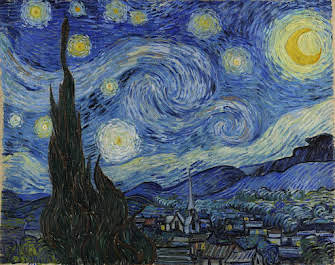
Vincent van Gogh was born on March 30, 1852, and died at birth. His parents buried him in the entrance to the graveyard in the church where his father was an Episcopalian minister. Exactly one year later to the day, the couple gave birth to another boy and named him after his dead older brother. Vincent van Gogh was born March 30, 1853, and spent his youth seeing his name and birth date on a headstone when he went to the church.
He tried working in a bookshop, as a tutor, an art dealer, and a preacher in the mines of Belgium. He spoke multiple languages, read Hugo in French and Dickens in English. He fell in love with his cousin and lived for some time with a prostitute and her daughter. For the last ten years of his life he lived entirely off of his brother, sold only a painting and a scattering of drawings, fought with every artist he knew and rarely paid his bills. He was belligerent and sick with syphilis, manic-depression, and epilepsy. He was considered a bum by every contact he made, and only two art critics thought he showed any promise at all. At thirty-seven he shot and killed himself.
That was 135 years ago this July. We’re still talking about him.
By today’s standards, he would be outcast and dismissed as a man who wasted his life pursuing a passion with no hope of even making a living at it, let alone gaining any success. He would be quickly forgotten.
A few years after his suicide, Vincent began to be recognized for his innovations in art, his vision as an expressionist, and his deeply-moving letters to his brother about life, love, God, hope, art, and death. Today he is considered one of the most influential artists in history.
I’m going to the Van Gogh Museum in Amsterdam next week followed by a reading I’ll be doing at the Van Gogh Library in Neunen, Netherlands.
It started when I was a freshman in college, and a dear friend, the late artist James Cole Young, gave me a three volume set of letters Van Gogh wrote to his brother and other artists. I mostly ignored it for a few years, until in Massachusetts when I went home after work each night and read them several times, intrigued by two seeming contradictions: One, he wrote extensively about his inability to gain any attention at all in the art world and other artists’ bad opinion of his work, yet he became one of the greatest artists of all time; and two, he stated often his thrill for being alive, for life itself, for everyone, and he wrote of the insane idea of taking one’s own life, yet he did just that. So I looked further. As a graduate student, I wrote a one man play as one part of my Masters in Arts and Humanities at Penn State and performed it at the Olmstead Theatre in Pennsylvania, under the direction of the late playwright Eton Churchill. Eventually, my work Blessed Twilight: The Life of Vincent van Gogh was released in 2018. It is all first person from Vincent’s letters.
In just over a week I get to hang out where he lived and wander aimlessly down the same streets of Neunen. Perhaps I’ll even drink some absinth
Most people love Vincent’s art. But I like his writing.
Like this:
In a painter’s life, death perhaps is not the hardest thing there is.
The earth has been thought to be flat. It was true, and is today, that between Paris and Arles, it is. But science has proven the world is round and nobody contradicts that nowadays. But notwithstanding all of this people persist in believing that life is flat and runs from birth to death. However, life too is probably round and very superior in expanse and capacity to the hemisphere we know at present. For my part, I know nothing of it. But to look at the stars always makes me dream as simply as I dream over the black dots of a map representing towns and villages. Why, I ask myself, should the shining dots of the sky not be as accessible as the black dots on a map of France? If we take a train to get to Rouen, we take death to reach a star. One thing undoubtably true in this reasoning is this: that while we are alive, we cannot get to a star any more than while we are dead we can take the train. So it seems to me possible that cholera and cancer are the celestial means of locomotion just as steamboats and railways are the terrestrial means.
To die quietly of old age would be to go there on foot.
I feel more and more that we must not judge God on the basis of this world; it is a study that didn’t come off. What can you do in a study that has gone wrong if you are fond of the artist? You do not find much to criticize; you hold your tongue. But you have a right to ask for something better. It is only a master that can make such a muddle as this, since then we have a right to hope that we’ll see the same creative hand get even with itself. And this life of ours, so much criticized and for such good and exalted reasons—we must not take it for anything more than what it is and go on hoping that in some other life we’ll see a better thing than this.
–Vincent van Gogh
 a view from this wilderness
Don’t rush your life trip my friend. I surely hope van Gogh was correct that in our other life, things will be better. Travel safely O’Bob.
LikeLike
Well said. Look to the eyes. Do you see a man that is mad or an unappreciated genius?
LikeLiked by 1 person