The problem, of course, is we can do without diamonds, and with global protests against the mines in places like Botswana, conflicts which spilled over into warfare, and exposure with movies like Blood Diamond, we are more than aware of Conflict Diamonds as they are so casually called.
But try telling someone to go back to a landline and ditch the smartphone. It’s laughable despite the mining conditions for a phone’s essential cobalt-powered lithium battery being far worse than diamond-mine workers could ever imagine. But, geez, it’s my smartphone; not giving it up.
It is time to accept the fact you’re not going to give up your cell phone or the electric car you have your eye on, even though they are the result of a slavery system in the Democratic Republic of the Congo.
Facts:
The DRC produces roughly eighty percent of the world’s cobalt supply, and has nearly half of the world’s reserves–more cobalt than the rest of the world combined. While the US gets most of its cobalt from Norway, Finland, and Japan, they are processors who take the supply of the metal mostly from the DRC.
So we understand each other, our smartphones and electric cars need cathodes for high-performance lithium batteries, and the primary component in cathodes is cobalt.
The Problem:
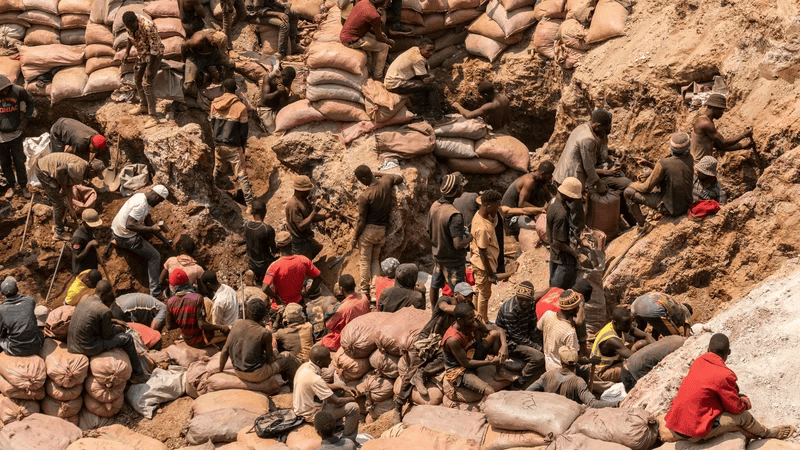
While some mines use heavy machines to do the work, about a third of the mines are so-called “artisanal” mines, where the work is done by hand by “freelance” workers. Roughly forty percent of the workers are children in unregulated pits, and most of those mines are owned by Chinese companies. The dust and grit from the mining gets in their lungs and kills them; and worse is that cobalt is toxic to touch and breathe. Hundreds of thousands of local people–mostly young women and children–mine the material for a few dollars a day, which they then must use to pay their way out of the mines to send home whatever money they have left, leaving them mostly in debt to the companies, much like share cropping or even slavery, and abuse is normal, including whippings and rape. This is from Siddharth Cara, a fellow at Harvard’s T.H. Chan School of Public Health. He insists after two decades of research and investigation that there is “no such thing as a clean supply chain.”
Some twenty-thousand people work at just one artisanal mine in the Lualaba region of the DRC. Armed forces are assigned by the government which is being paid serious money to make sure the mining continues and so-called overseers oversee the production much like overseers of slavery.
I was in the Lualaba region, very briefly, forty years ago. None of this was going on then, and the hills remained green and tranquil. I wondered what it looked like now so I looked it up on my smartphone, whose innards are built with the cobalt from this region.Guilty.
We won’t buy so called blood diamonds because of how they are mined, but no one is suggesting we boycott the companies who support this system of slavery pillaging the earth so we can have electric cars to protect the environment, and so we can have cell phones made from material mined by mostly starving children to be able to call our kids to make sure they are safe.
These phones, these cars, are available to us because of the spilled blood of people overrun by government troops, gathered up and moved to the mining district. The only true solution other than not using cellphones or buying electric cars is to pay the workers a real salary; formulate true working conditions so they can work with dignity and have a normal life. But their current salary is not expected to rise anytime soon. Of course not. It’s the DRC, the southeastern region of the Congo, one of the most dangerous places on the planet mostly because of these cobalt mines.
Samsung remains the largest manufacturer of smartphones.
The executive in charge of devices is Roh Tae-moon who earned roughly $4.5 million dollars last year.
The average cellphone costs about $571.
The average worker in the mines makes about $1.55 a day.
The average price of milk in the DRC is between $1.25 and $2.09 per liter.
At this point you might as well go buy that diamond you had your eye on.
Two ways exist to approach life–at least in the “sweeping generalization of all or nothing” perspective.
Live like you are dying. Live like you’ll live forever.
To practice the first I would have to be acutely aware that the distance from here to eighty is shorter than the distance from here to fifty, which is tragically depressing, but I can do that. I’d perhaps worry less about the shortcomings, the missed opportunities, missed relationships, missed moments of clarity, and focus instead on the truth of being here now, able to hear the wrens in the morning and the whippoorwills at night. I’d experience life more with my senses, feel the river around my calves instead of standing on the sand looking at it; I’d call people I love and tell them I love them. I’d walk more, let go of regret and guilt, let go of aggravation and hostility. I’d no longer let the punk who tailgates me into Deltaville EVERY FREAKING MORNING bother me at all; I’d pull over and let him pass, apologize for holding him up, bid him a good day when we both arrive at the 711 at the same time anyway.
I’d lighten up. I’d make that trip to the Faroe Islands, Belize, the Galapagos, back to New York to see old friends and family. I’d say yes to more things and I’d know better than to pass up a chance to be even more alive, to feel again how I felt on so many times in my life when I did something I never thought I’d get the chance to do.
I’d maybe not be as reckless as Tim McGraw, but definitely more involved in life than my former boss, Richard, who seemed to simply check out.
Or
I could live like I am going to live forever.
I’d let go of the haunting depression that tells me “there’s no point to learning a new language; when am I ever going to use it since I’ll be dead.” I’d sign up for classes like I have new careers waiting for me, and I’d stay in shape and eat well so I could keep going a really disgustingly long time. I’d lighten up a lot and put my focus on the positive so that when I do eventually succumb to some illness which only plagues the oldest of people, I’ll know I wasn’t a downer, wasn’t always complaining about politics and the economy. I’d talk to everyone since I know I’d have the time to start new friendships and learn a new instrument and even learn to make lemon meringue pie. I’d try not to get caught in that trap of taking others for granted, pretend they’ll always be around, because since I will be living forever doesn’t mean they will, and it is not easy being the last one alive out of a small group of people. I’d try and move forward with their memories and stories, and I’d probably pretend they’re just on vacation somewhere. Maybe I’ll run into them again on some travels in the coming decades as I get warmed up.
When you wake up, do you think you’re another day older or do you think you’ve lived another day? They’re not the same thing.
I turned sixty-six last week. It’s not really a big deal. I also swiftly skimmed up a mountain to a waterfall in the Columbia River Gorge (at my age I am allowed the liberty of poetic license). As a professor (which I never thought of as my “career”) I retired from full time almost ten years ago, but as a writer I’m busier now than ever before. The arts leave one the luxury that the longer you are at it the more recognition you get and the busier you become so that most artists never retire, not if you can stay in the game. This leaves us the notion we are not as old as others who hang up the hat and “slow down.”
So, professionally it is time to slow down, but professionally I am just getting warmed up.
How am I supposed to handle 66?
I suppose like I handled 33, and how I will handle, hopefully, 99.
Like this:
Like it or not I have regrets; and while people tell me I shouldn’t, it is exactly how I am able to not take someone’s friendship for granted, how I am able to give a second chance a fighting chance, and how I am able to change when I need to change. I celebrate regret for the lessons, for the reboot.
I am okay with denial and anger and depression and bargaining returning again and again for the same tragic loss. It is exactly how I know we don’t need to always move on in all aspects of our lives, that others will always be part of us and sometimes we get angry at them, sometimes we’d do anything to see them again, and sometimes we simply pretend they’re at the store picking up some Prosecco. It is how I can celebrate our lives even though I’m on my own.
I’m okay with embarrassing the hell out of myself at my age just like I did when I was nineteen in coffeehouses and twenty-four in a health club and twenty-six in love. We do stupid things and we feel ridiculous, and now, at sixty-six, my absolute best memories come from those times I thought, “I’m going to give this a shot.” Plenty of times I fell on my face; more often than not, but I’ll take a good face-plant over a “damnit, I should have said something” any day.
Alan and Marilyn Bergen along with Carol Sayer Bager wrote a piece I’ve never forgotten. Part of the song goes, “I pity the poor one, the shy and unsure one, who wanted it perfect but waited too long.”
Oh, I’ve waited way too long way too many times. It comes from the decree “What is the worst that can happen?” instead of the declaration “What’s the best that can happen?” I’ve had an extraordinary life so far. I know this. But it has always felt like, to lyric you one more time, this one from Jackson, “I’m just a day away from where I oughta be.”
Trudat.
So at sixty-six, with 24,116 days behind me and just 5,114 days until I turn eighty, I’m going to enjoy the passing of time the best I can. I’m going to spend as much time as possible with the people I feel comfortable spending the most time with. I’m going to “give it a shot” whatever it is at any given time. Not kidding. Sheeet, I’m sixty-six. People my age don’t kid around.
It’s difficult to know what we are capable of. No one instructs us early in life on how to recognize the difference between “that might be doable” and “you’re wasting your time and absolutely kidding yourself.” The only sure way of knowing is doing.
Some legitimate guidelines help. Finding people who already know what they’re doing either through experience or expertise; hopefully both. Taking your time and going step by step without feeling overwhelmed by the big picture of the final product. When I was young and learned tennis and guitar—both mostly self-taught—watching professionals was a double-edged sword. On the one hand I felt inspired to push hard and keep pursuing those goals. Clearly it had been done before so this isn’t a fantasy. At the same time, there is reason enough to quit whenever I watched the pros play tennis or guitar and then I’d move with confidence only to annihilate my six string or hit a ball with the corner of my racquet and watch them both fly into the net.
Each day, though, a little more, a little better. Someone nearby to tweak the progress, some down time to recognize that the difference between never having attempted such a foolish ambition and where I was at was growing, and the reach from where I was at to some form of success was rapidly shrinking. Day by day.
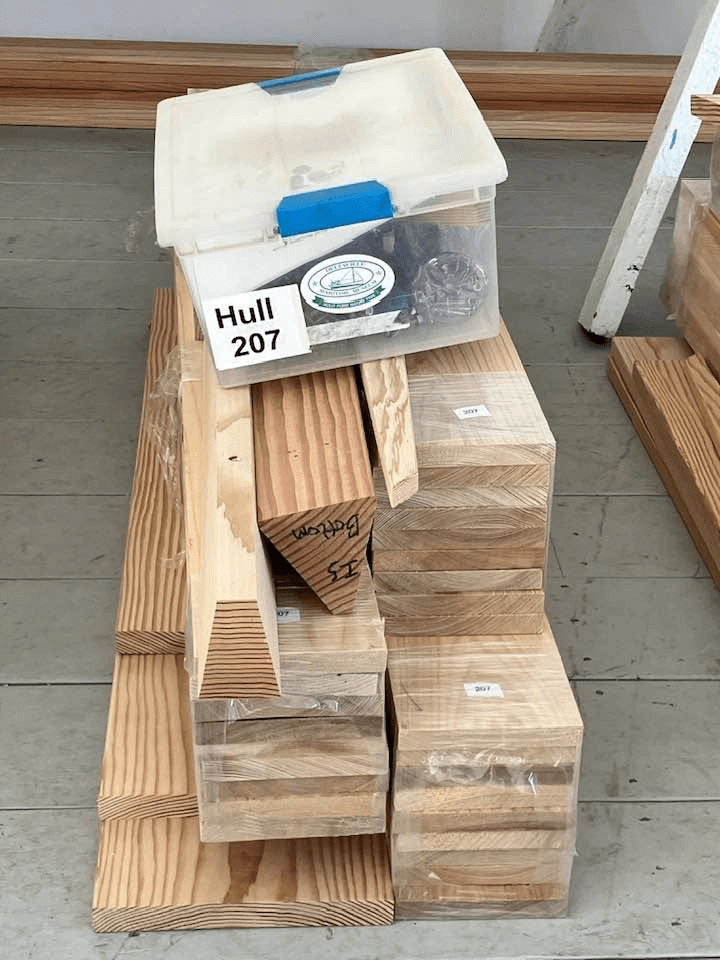
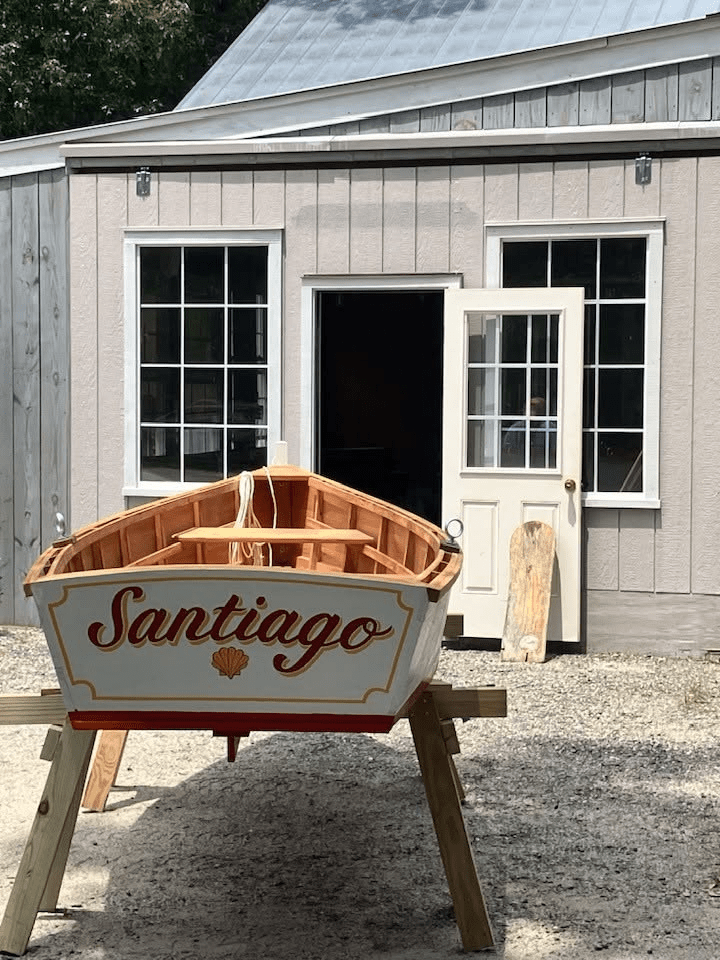
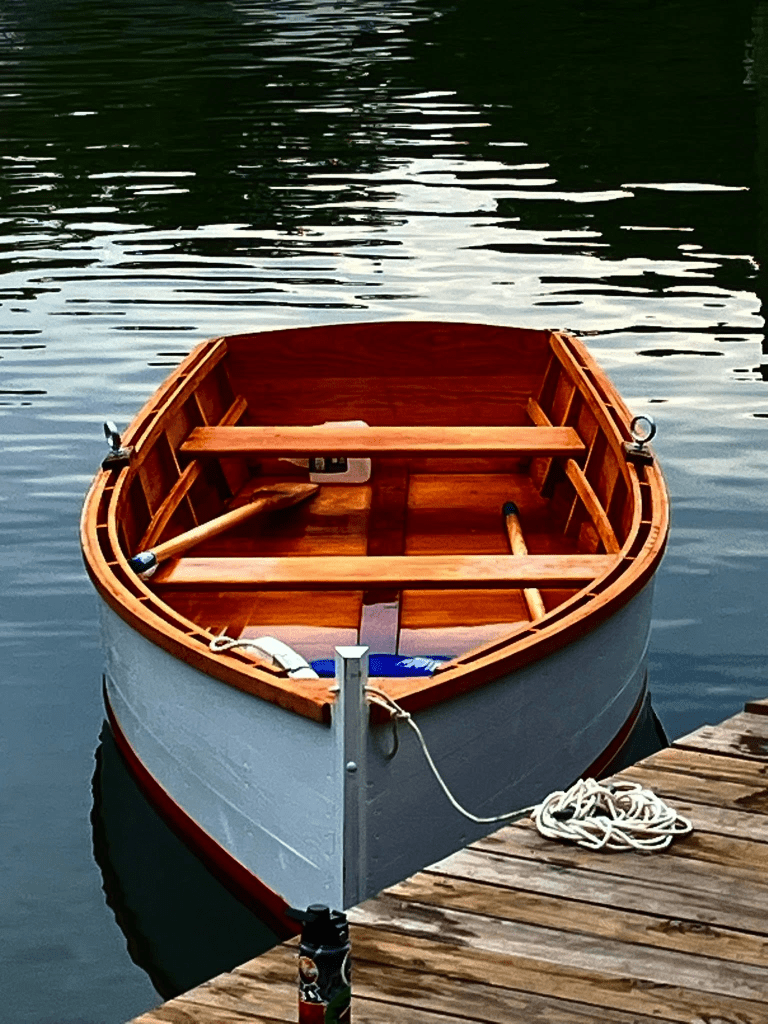
My son and I built a boat last week. Took about four days. It’s a fourteen-foot Wright Skiff with three benches, bumper rails, and other cool things which have nautical terms. We named her Santiago, after the city we reached on our pilgrimage along the Camino de Santiago in Spain, and after the Old Man in Old Man and the Sea, whose skiff looks just like ours, minus the sixteen-foot marlin carcass strapped to the side.
Still, we followed instructions printed out and had a half dozen expert boatbuilders on hand to walk us through it all. This stands in direct contrast to my life as a writer where every day I begin with a blank page and toss some verbs on there to see what happens. I rarely reach the same or even similar results. But we built our boat—Michael actually did the work—along side seven other teams and the boats all mostly look the same save some cosmetics and bad measuring of the floorboards (them, not us, I think). It reminds me of how far apart math and creativity often are. Follow the instructions, follow the formula, the builders begged of us. You can’t do that in writing (unless you’re James Patterson or EL James).
Of course, it wasn’t about the boat. We spent a week working together, switching on and off, recognizing each other’s strengths, helping, encouraging, laughing through it all. It is one thing to find out what you’re capable of; it’s an entirely other milestone to find out what you’re capable of with someone else, particularly your adult son.
I’m certain I cannot follow instructions for the next level craft—my forty-one foot Morgan Outisland or my aircraft carrier. But I’m equally certain I can do more than I thought I could just a week ago.
There’s another difference in the arts vs construction conversation. My last book, for instance, has a dozen different versions with various misfires along the way, and from them I tried something else, tossed more than I should. The book before that had originally been written as a series of twenty-three letters to my father. At some point someone I trust in the writing world asked why they were letters and I couldn’t answer her, so I rewrote them all as one long narrative. It is better. It is different. I’m not sure. But stray from the guidelines in the Skiff Manual and not only will six experts make it perfectly clear you are screwing up, they’ll cut and clamp and tighten until you are right back where you started. Consistency is the value of learning a new skill, except writing. Maybe.
Still, last night I walked to the dock and looked at Santiago floating patiently, and I glanced across the creek to another skiff where she rested calmly. They’re not the same at all, I noticed. I immediately saw my muscle-taut face holding two planks of wood together as Michael drilled a pilot hole followed by a screw, then another, and another, until we moved to the next board, satisfied. I saw the rising adrenaline each morning on the way to the boathouse, the growing confidence, the sense of accomplishment from perseverance.
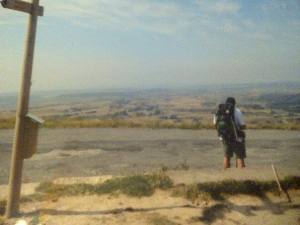
I stared down at Santiago and saw us in the Pyrenees talking quietly as we moved across dozens of kilometers every day. The heat of Galacia, the wonder of entering Santiago and continuing to the end of the world, Fisterra, and back. I saw us crossing fields of hope and dreams in Siberia, and I could see back even further, staring into our skiff we build this week with no prior knowledge at all of building even a Lego boat; I could see Michael at fivewhen we first started walking these docks, taking pictures of sailboats, and later when we bought a canoe and sculled the Rappahannock and creeks.
At some point we don’t think we’re capable of anything. Writing a book, climbing a waterfall, driving a car, being a father, building a boat. But with the right advice and a lot of patience, we move forward, half the time thinking we’re making it up as we go, and the rest of the time knowing we’re just following instructions.
It’s good to find out we’re capable of more than we thought. It’s good to build a boat. It’s uncanny where that little skiff has already taken me.
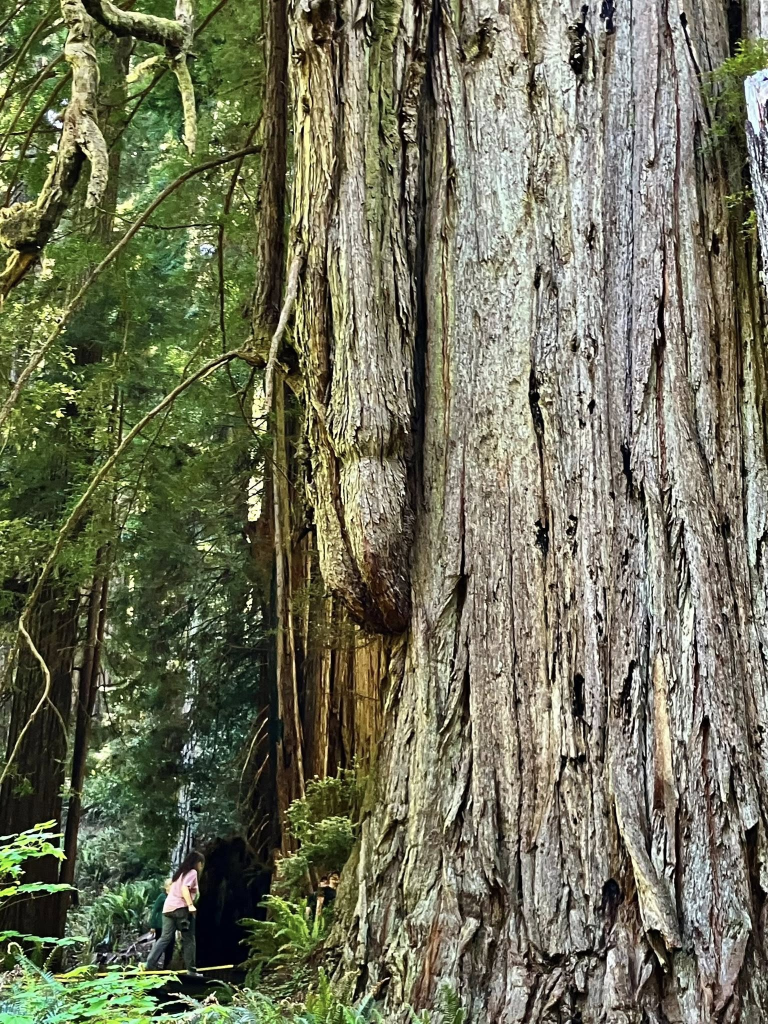
This picture shows only half the width of the tree
We walked around a tree so wide I could have parked a few cars in the trunk. The sapling of this Redwood broke ground no later than about the time of St Francis of Assisi and as early as the time of Christ. So when I was born, the tree had already been on the planet between eight and twenty centuries.
It isn’t the biggest one out there.
The waves which carve the Devil’s Cauldron and other such monoliths and stone formations along the west coast have carved the rock for millions of years, crashing in the same current we watched from the side of the Pacific Coast Highway. Understand, I’ve lived along the ocean my entire life and during my teens spent as much time in the water as I did out, but the Pacific has a different and very separate vibe, like it pulls itself out of the Mariana Trench every morning and explodes across the world toward the California and Oregon coast. It moves with seeming purpose and focus. This Pacific World is permanent, the infinite motion, the endless ebb and flow.
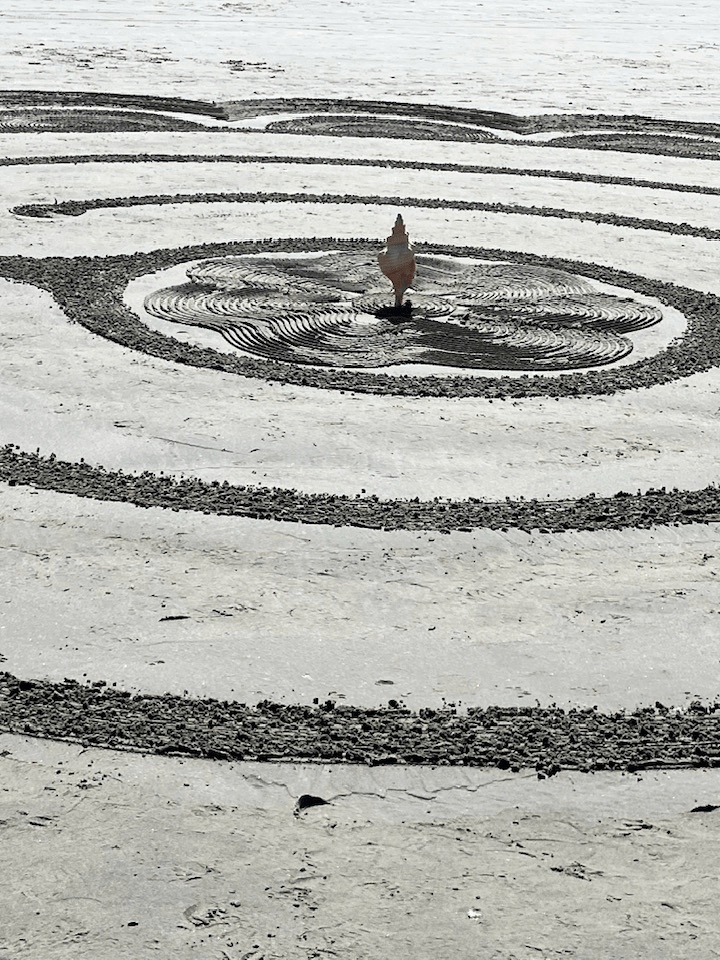
Along the reach in front of the Sunset Beach Hotel groups of people come and rake designs in the sand; circles and flowers which at first appear from a hundred feet above as individual and unrelated efforts, but they eventually join as volunteers meticulously shape the paths and designs, and in the center of each they place shells or other marine findings. When it is finished (or even before they are through) people line up or jump the line to follow the paths around like a sand labyrinth, seldom cheating, seldom hurrying others along. It is meditative to follow a brand new path no one has walked, and then to watch the incoming tide slowly swallow the western edges of the design, reaching up further each time, waves like hands reaching up and erasing the sand, smoothing it out, establishing for us all the impermanence of life, ironically through the rhythmic tides which are as old and permanent as the earth itself.
Then we looked for sand dollars and sea glass.
I have far less years ahead than behind. My last book is a memoir of an event I can remember like it happened this morning, yet it takes place forty-five years ago. Life in the past seems so swift because we can recall a moment instantly and transport ourselves to that event with a blink. It leaves the illusion that time went by fast, which of course it did not. To make matters more complicated, two people can perceive the same event, in the words of someone I know, completely differently. But the future is much more predictable for its absolute mystery. When we think ahead no one knows what will happen, how we will get there or even if we will get there, so we think ahead in slow motion, watching the mysterious and unrevealing turns in our lives. Ten years from now seems like a long ways away; ten years ago happened just before lunch. We are permanent; we are passing through.
The world is a mess. The events happening now have curbed my ability to travel to so many places, and the ripple effect is depressing by degree. But out on the Oregon Coast, those places of turmoil and the tyrants who cause the chaos no longer existed, and even the East Coast version of me seemed to slip away, leaving only the part of my life that understands the tough balancing act between the permanence of the ocean and the brevity of the lines we make in the sand.
For all of the eternalness of the ocean and the trees, at least from our perspective as they certainly precede and last longer than us, it is our own mortality which makes even the oceans seem to be here but for a moment. Funny how some things in life you once thought of as permanent turned out to be a phase, proverbial ships in the night. At the same time there is a certain comfort in those transient moments which keep returning and again returning which make life tolerable. Love, at its very core is as eternal as the elements, yet can appear fleeting. It isn’t. It is always there, just below the surface, still growing from what was once a sapling, a chance encounter. Still pulling itself together from some place deep inside and far away, rushing across the surface of our years to our lives now. And like the deciduous redwoods which go dormant each year despite their longevity, often who we really are remains quietly below the surface waiting, just waiting.
But that’s vague and ethereal, which goes over my head more than often than not.
So listen: I only know this: I am alive now, awake and aware of my mortality and my chance, still now, to live life on my terms, at my pace. It took very little out west to make me feel completely aware and in the moment; I had no cravings for things or special meals or information–especially not for information. I learned again, for I have learned this lesson as many times as I have watched the waves pound the sand, to be present, aware of who I am, who I am with, without worry of words or silence or formality of casual moments. Absolute comfort without even understanding the transition.
And that’s all I know.
I was that rarest version of me: me one hundred percent myself without the need to “present” myself anything other than who I truly am; something which I no longer thought was possible. Allowing myself to relax and let go made me aware of how those times which squeeze our soul are as transient as the wind, and all that was left was who I really am. I have learned that lesson many times along the shores of the Atlantic and rivers around the world, but this time I had all the ingredients to understand. Time is not so persistent that it doesn’t allow us to learn more about ourselves at this point in life. One can be as old as the oceans yet as young as its waves.
That sounds really good but I’m not sure it means anything.
The truth is everything it seems is as old as the redwoods, including me, and everything as temporal as the paths we make in the sand as the tide is rising, including, of course, us all. There are certainly battles along the way. The Redwoods have fought fires, floods, typhons, earthquakes, and more, and for our part, there are personal battles which often make us feel like no wave can wash away our pain. But, of course, we survive and move on, a little closer to who we will eventually become if we just allow ourselves to, with apologies to Dan Fogelberg, “Be who we must.”
Grandma Moses was right: Life is what you make of it. Always has been; always will be.
Bob Marley was right as well: Everything’s gonna be alright.
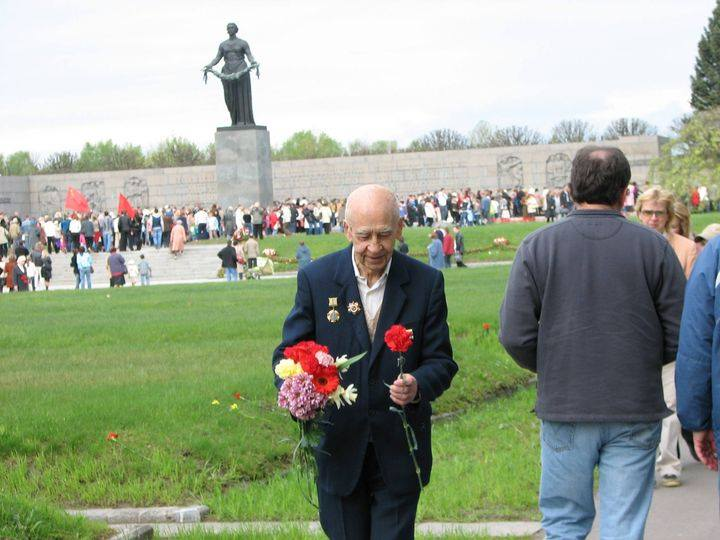
For more than two decades I traveled to St. Petersburg, Russia, to teach, to write, and to lead Study Abroad groups. In that time I had the privilege of celebrating Victory Day a dozen times in the city on May 9th. During the day I would attend memorial services at the Priskarevskoe Cemetery, where three quarters of a million people–mostly women and children–are buried. I was there when Bill Clinton was in attendance, and George W. Bush, and Vladimir Putin. It is a somber place, and Shostakovich and Pachelbel play on the speakers while thousands walk around and pay respects to the vets in attendance. Then that night a million people fill the streets and drink and watch fireworks and remember that Hitler, despite his demands to wipe the city from the face of the map, could not defeat the “Defenders of Leningrad.”
This is their story as related in a chapter from my book The Iron Scar: A Father and Son in Siberia. Thank you for reading.–BK
*********
Persistence
(from The Iron Scar: A Father and Son in Siberia)
Bob Kunzinger
This evening I sit in the dining car somewhere in eastern Siberia, writing, drinking tea, and the only other passengers are an elderly man and his son, also drinking tea. They’re quiet and both glance at me from time to time. Eventually, I walk to their booth and ask if I can join them—the younger of the two speaks broken English and he waves to the empty spot next to his father. He introduces himself as Dima; and the elderly man, Sergei, wears two or three medals on his green shirt, and I ask if one particular medal is the same as another I had seen in St. Petersburg, given for bravery during the siege of Leningrad. It is.
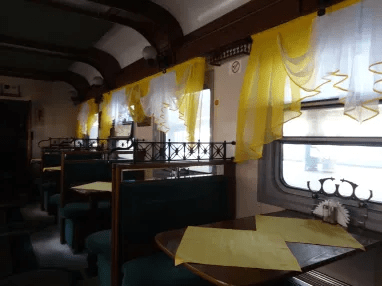
The dining car on the trans-Siberian railroad looks much like old Airstream-style diners in America, with booths along both sides, full size windows at each one with small curtains, and all are kept clean, with flowers, a napkin holder and place mats. At one end of the car is a bar with well drinks as well as a small variety of more expensive liquor on a higher shelf, and a generous selection of domestic and imported beers and soft drinks. The menu rivals the most common pub at home. Grilled chicken, hamburgers with French fries and other sides are available, as well as more complete dinners and some appetizers. Caviar, too, and salmon slices with toast, borsch, and traditional fare such as cabbage and sausages for tourists like us who wish to feel part of the landscape, and for locals whose daily diet includes such items anyway.
The prices are about the same as they would be at stateside diners, but Russians for the most part can’t afford that and usually buy their food from the babushkas at the stops along the way. Seeing as how there are so few tourists, the booths are always available, so Michael and I spend much of our time here, playing chess, eating, and working.
Paying attention to this sudden mixture of cultures is the tender. This always smiling woman sits at her own booth near the bar with several pads spread about which apparently need her attention. From time to time she looks up, partly to see if we need anything and partly, it seems, to catch what she can of our conversation. She normally likes to play traditional music on the player whenever I sit down, but when she sees me join this veteran and his son, she puts on Shostakovich. We all recognize it immediately and the old man smiles. Composer Dmitri Shostakovich wrote his Seventh Symphony, the Leningrad Symphony, in the forties and performed it for the first time to a packed theater in his besieged city of Leningrad. Despite the rattle of Nazi bombs exploding in the background, no one left the performance. Today in the memorial cemetery in that city where nearly 700,000 people are buried, Piskaryovskoye Cemetery, it is still played while thousands of people pay their respects. I have spent many Victory Days there, meeting veterans, offering them a carnation in thanks for their work in the war, so it is an honor to share tea with this veteran.
It would be negligent of any traveler, foreign or domestic, to make this journey without learning about and acknowledging the Blockade in Leningrad, the horrors of the Great Patriotic War, and the incomprehensible courage displayed by the citizens of what is now St. Petersburg, which was bombarded by the Nazi’s for 900 days in an effort to complete Hitler’s desire to “wipe Leningrad from the map.” That history is this old man’s youth; and the fact he survived and went on to raise a son is nothing short of miraculous.
This is where this great railway and Russian history collide.
Some background:
The original name in Russia for the railway was the “Great Siberian Way,” and it was only in the west we called it the trans-Siberian railway. At the World’s Fair in Paris in 1900, the railway was an exhibit with the most extravagant interior cars on display and promoted as the ride of Czars. While it was true the line from St. Petersburg to Yekaterinburg was indeed the rail for Czar Nicholas II and his family to seek refuge in their palace on the Iset River, the promotion at the Fair was misleading since from the start this railway mostly carried people to war. When Czar Alexander put his son Nicholas on the project, he did so with the assistance of Sergei Witte, a minister in the Russian government and confidant of the Czar. The heart of the empire was, indeed, in the western third of the country. St. Petersburg and Moscow were, and still are for that matter, the center of the Russian universe, and from the time of Peter the Great’s ambition to create a “Window to the West,” the powers-that-be focused their attentions there. But in the late 1800’s, the government noted the potential resources available in the east, thinking Siberia might be an economic boon instead of simply a destiny for dissidents. At the same time, St. Petersburg had its eye on parts of Manchuria and moved forward with the rail to that destination under the pretense of trade; the truth is they eventually occupied the territory, a move which aggravated Japan who also wanted control of the area. Japan saw the TSRR as a tool of expansion and eventual invasion, which, of course, it was. Hence, the Russo-Japanese War in 1904. But the tracks weren’t finished yet, and troop movement in the area where roads even today are poor, meant ultimate defeat for Russia.
Still, they had their rail, which a few years later was completed to the Pacific port of Vladivostok. But Japan had its day, and instead of Russia using the railway to dominate the eastern Asian region, Japan did just that by defeating Russia’s Pacific fleet and controlling territory they long wanted. Their rise to power anticipated the conflict in the Pacific which would be that part of the globe’s World War Two.
During World War One, the United States had many economic interests in the region, not the least of which was a ton of weapons strewn north from Vladivostok along the rail. To protect those interests, President Wilson sent eight thousand US troops to the region—the only time US soldiers were stationed in Russia. The War in Europe would not be over for another three months, but in Russia, change was constant. The Mensheviks had ousted Czar Nicholas and replaced him with Kerensky, who the Bolsheviks quickly ousted, so the allies had no one with whom to work in eastern Asia. But it was during that short and welcome reign of Kerensky that the US took over the operation of the trans-Siberian railway, a move supported by the allies in Europe and seen as the spread of democracy the western world had hoped for. At the same time, however, the Bolshevik Revolution swept east literally following the tracks all the way to Vladivostok. The United States withdrew their interests and in a few short years the noble ambitions of the entire empire would quickly derail.
Josef Stalin took over the Soviet Union in 1922, a post he would hold for thirty-one years. He longed for a railway across the polar region of Russia to expedite travel to the Far East. This “Dead Road” was built by “enemies of the people” of Russia. It is estimated that 300,000 prisoners worked on this project with a third of them dying in the brutal northern winters. The entire project proved short-lived, however, when the short part of the line which had been completed sank into the ice and snow. But Stalin understood the value of rail transport, and the pogroms started by the Czar to relocate Jews to eastern Russia were continued under his rule with the aid of the Trans-Siberian railway further south. It was no possible to purge entire towns, exile anyone who so much as spoke about him without praise, as well as those who outwardly opposed the oppressive government. In fact, not many people during those years rode the railway by choice. It was a means for guards to get to work or to send prisoners east. The rail between St. Petersburg and Moscow remained a crucial route between what is considered the cultural capital in the north and the political capital an eight-hour ride south. And the cross-continental railway in post-coup Russia became a means of transport for workers heading to and from a job, families going to a dacha, and the rare and idealistic tourist heading to Beijing or Vladivostok.
Aside from so much death associated with this transport, there is one glaring and essential exception when rail travel was, in fact, a lifeline in Russia: The Great Patriotic War. World War Two. A separate rail from the trans-Siberian route was built by hand every single winter during the war across the frozen Lake Ladoga just to the east of Leningrad to try and bring in supplies and bring out citizens of the city, which was besieged from September 8th, 1941, until January 27th, 1944. During that time nearly one and a half million people in the city—mostly women and children—died of starvation. The people of the city to this day are most proud of the fact that, despite nine-hundred days of bombardment, the Nazi’s still couldn’t defeat the “defenders of Leningrad.” And because of the invading Germans, factories were moved from the western part of the country to the most eastern reaches of European Russia, in the Ural Mountains, where more than three hundred plants were rebuilt close to the railway, mostly by the prisoner population.
Before me now, however, is a man who refused to leave Leningrad. I mention my understanding of his courage and struggle, and the old man smiles. He places his hand on my wrist and says, yes, he could have ridden the rail across the lake during that first winter—he was just a young teenager, and no one would have questioned it. But he chose to stay and help transport whatever food he could to the front line, which during the blockade was in every direction.
The tender brings a plate of salmon and bread which they share with me, and we drink more tea. Sergei dips some bread in his tea, and his son offers me salmon.
We speak for quite some time about the trail, about Michael and I and our wild idea to see Siberia, and about their present journey to a Dacha to spend August. Eventually, I ask about his medal, about the war, and how much he remembers. Sergei takes a long bite of his bread and nods toward the plate of salmon. “Food was the most significant issue,” Dima translates as he looks in despair at his father, clearly knowing what comes next. “Leningrad’s population of dogs, cats, horses, rats, and crows disappeared as they became the main courses on many dinner tables. Nothing was off limits. People ate dirt, paper, and wood. The vast majority of casualties were not soldiers, but women and children.”
This much I know already: The siege of Leningrad is political history as well as military history, yet it is also personal. It is the story of a child living on a few grams of bread, his mother making sure he only takes small bites throughout the day for fear if he eats it all at once he will surely starve to death. He will anyway, and the history of the siege of Leningrad must include the story of these women who survived, these sorrowful mothers, who had to grasp whatever sliver of hope they could that they would win in the end so to save their beloved Mother Russia.
The siege is one of the chapters in books about 20th-century atrocities; yet it is also the conversation over beers in a corner pub, where as late as the nineties when I first started coming here, most veterans still held back their emotions against the questions of the curious’. Some allowed others to cross the line into their world, allowed them to suffer the starvation through stories and tears because they knew it might be the only way these great heroes, the defenders of Leningrad, will be remembered.
Me on right after giving the carnation to the veteran (photo by Kay Debow)
I recall a conversation I had once with a woman in St. Petersburg’s Palace Square. She was fifteen during the siege when she had to pull a sleigh carrying the body of her sister, who had died of starvation. She made it to the graveyard and left her sister on the pile of bodies. Another there, Alexander, remembered how he would cut up a piece of bread once a day for his brothers. His parents had died of starvation some time earlier.
Nearly three million civilians, including nearly half a million children, refused to surrender despite having to deal with extreme hardships in the encircled city. Food and fuel would last only about two months after the siege began, and by winter there was no heat, no water, almost no electricity, and little sustenance. These citizens still had two more years of this to endure. Leningrad is roughly at the same latitude as Anchorage, Alaska. It gets cold.
During that first January and February, 200,000 people died of cold and starvation. Because disease was a problem, the bodies were carried to various locations in the city. Even so, people continued to work in the deplorable conditions to keep the war industries operating. When they were not working or looking for food and water, they were carrying the dead, dragging bodies on children’s sleighs or pulling them through the snow by their wrists to the cemetery.
One man said, “To take someone who has died to the cemetery is an affair of so much labor that it exhausts the last strength in the survivors. The living, having fulfilled their duty to the dead, are themselves brought to the brink of death.”
But the people of Leningrad would not surrender. I met a woman named Sophia in a graveyard on the north side of the city. She had been an adolescent during the reign of Czar Nicholas II and thirty years later lost her husband and son during the siege. We sat on a bench, and she told me of her life, of her family, as if time had turned it into a hazy event she had heard someone talk about years earlier. Her hands were transparent, and she spoke of Leningrad as being a prisoner of war, with no rations and no electricity and little hope. The city became a concentration camp, its citizens condemned to death by Hitler.
But thousands of people were evacuated across Lake Ladoga via the famous frozen Doroga Zhinzni, the Road of Life. During warm weather, some were boated across, but in winter they were carried on trucks across the frozen lake under German fire and moved via the railway. Heading north was pointless; the Finnish Army, allied with the Germans since the bitter Winter War with the Soviets in 1939-1940, held the line there. But once across the lake, this very train took people further east until the rails simply could not run. When we stand between the cars and rumble along, listening to the clashing of metal beneath us, it is hard for me not to think of the thousands of starving citizens transported east, listening to the same sounds.
“We simply had nothing to eat.” Yes, starvation was the Nazi’s objective. The blockade was a time during which one gauged success by being alive or not. Some survivors, however, tell of encounters with people who had such severe mental illness from disease and starvation that it had become unbearable. The accounts are sometimes spurious, but too many narratives contain too many parallel events to write them off as exaggerated. Several wrote of what became known as “blockade cannibalism,” including the story of a boy who was enticed to enter someone’s apartment to eat warm cereal
One woman used one of her dead children to feed the others.
For nearly three years, Leningrad was under attack night and day, and almost half its population, including 700,000 women and children, perished. The Germans left the city of Peter the Great, his “Window to the West,” in ruins. Still, the Nazis could not defeat Leningrad.
The likes of that bravery and sacrifice will never be seen again.
During those years as well as a decade before and past Stalin’s death in 1954, Soviet industrialization moved many citizens to the region stretching from Omsk to the Pacific, and the vast majority of these people worked in towns built for the sole purpose of some factory. But the most infamous use of the railroad during this dark period was to transport prisoners to the Gulag system. Prisoners in the penal system in Russia were tapped to exploit the natural resources in the mineral-rich east. It started officially in 1929, but just five years later, nearly half a million Soviet citizens with a prison term of three years or longer were loaded on these railcars and transported to the Gulags. Five years after that, the camp population totaled more than two million. Some eighteen to twenty million inmates, while suffering the most inhumane conditions, facilitated the exploitation of timber and minerals in remote areas in slightly more than two decades. They also laid railroads which branched off of this one, constructed roads, secured dams, and worked in the factories and on the farms.
The veteran looks around and says more quietly as his son again translates, “Every single person on this train is connected to the war; either a grandparent or parent was killed, or less likely, survived. Everyone on this train is fortunate to be alive because of citizens of Leningrad under the most horrific conditions. I played a very small part, but I am glad I survived to be able to raise my own family.” He smiles at his son, who places his own hand on his father’s sleeve.
Today, war monuments dot the landscape. Most of them honor veterans of the two World Wars, but many as well for those who served in Afghanistan, the most notable being the Black Tulip memorial in Yekaterinburg, named for the ship which carried home the Soviet deceased. The monuments to the Siege of Leningrad, or the “Blockade” as Russians refer to those dark nine-hundred days, are numerous in St. Petersburg, of course, but they also spread surprising far to the east, following the tracks taken by those souls who managed to get out of the city under cover of a cold, dark winter. The same chance Sergei turned down, as his medal clearly shows.
I grew up during the age of the Evil Empire, the Red Menace. Siberia and Irkutsk might as well have been on the moon—I was never going. All I knew of this land when I was young was from playing RISK with my older brother. He usually won but I had fun moving my armies around the board, sometimes skipping from Alaska to Kamchatka, proving to me capture of the Russian coast was key in controlling the outcome. When Michael was growing up we did the same thing. But it wasn’t until I was much older that I learned something valuable: that miserable game screwed up my sense of geography. Siberia is not a country or a state, it is a region, like the American West or heading out to the Plains. Ian Frazier wrote Siberia is more of an idea than a place. Irkutsk is not a country but a city, and Yakutsk is not east of Siberia it is in Siberia. The Ukraine does not take up most of map, doesn’t run from the Arctic to the Med, and doesn’t replace Russia, which that Soviet era game completely left off the planet. Still, those faraway places in beautiful colors with brightly colored armies became mythical. In the end, I didn’t have to move armies to travel to Siberia; no opponents waited across Parker Brother’s boundaries. I didn’t roll doubles. I didn’t pick the wild cards. I just came, and in doing so I wiped out decades of ignorance about these people over a cup of tea and some salmon slices.
The old man looks out the window into the dark evening, and I can sense his mind has recessed into some sharp and tortured memories. His son leaves his hand on his father’s and nods to me, indicating he sees I understand. We sit quietly like this for a long time, drinking tea, as the train rolls forward through history.
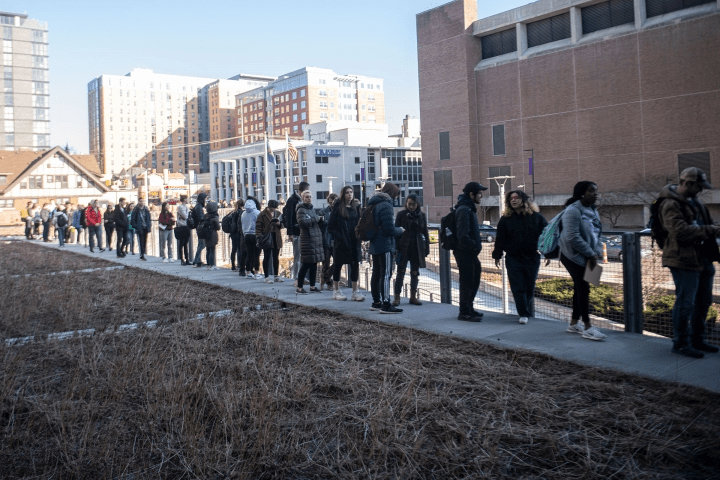
I miss the last millennium. I miss when students had to register by coming to the college and meeting with an advisor or faculty member or dean. The day registration opened, a line would form around the admissions building by six am, and some would be there for hours on end hoping to get their schedule. When I was a student, we all showed up to the basketball arena where tables were set up with members of various departments holding cards for each class. We’d be called down by seniority, and on the floor I would walk first to the Journalism faculty where one of the profs would give me a card for their course. I remember distinctly going to the Earth Sciences table where I asked for a card second semester senior year for a class I should have taken freshman year. The professor gave it to me and laughed. “When did you figure out you can’t put this off any longer?” he asked. “I’m still working on it,” I said, not kidding.
But in those seats waiting to be called to the floor, or in line wrapped around the buildings and often clear out to the lake on campus, students talked to each other with time enough to have deep conversations about where they’re from and what they are hoping to do with their lives. Friendships were made. My first day freshman year I came out of the dean’s office and a beautiful woman my age in a tie-dyed t-shirt and cut-offs leaned against the building trying to figure out her schedule. She looked up and said, “Hi, I’m Liz. Did you just see Dr. Jandoli?” I said I had and she asked for help. We talked for a few hours and I suggested some courses she might need to take, and the following Monday she found out she was in every single one of my classes. That was forty-seven years ago and she is still one of my dearest friends. The thing is, we talked, and by the time classes started I had a half dozen relationships already underway. And likewise at the college where I taught, I’d walk into class that first day and everyone was chatting away the time, having met and bonded while waiting in line. There is value in waiting, in having no device to occupy your time. But those days are gone now.
I miss those days in that long ago millennium when I might not see a friend or relative, or often enough a sibling or a parent, for weeks or months at a time, and when we did finally see each other again having not had the ability to communicate in any way other than what was not yet known as snail mail, we would practice the lost art of “catching up.” We’d sit into the small hours of the morning and swap stories about people we met and what others we knew were doing. We’d talk about mishaps and adventures, about what we missed and what we discovered. There was tremendous value in being out of the loop for months on end. You found out just how much you missed someone, you found out just how much you can handle on your own.
If the devices available now were available then I might never have lost touch with some people, one for twenty-two years, and we would have remained close and never learned just how much we value in each other, we never would have discovered how much we needed to learn on our own. Friendships can be destroyed by overuse. Certainly they can burn out. But in the last period of the second set of a thousand years, you looked for payphones, your asked directions, you waited in line for coffee, for meals, for God’s sake for everything. You understood the need to yield to others, you waited for the green, you waved someone else in, you had long periods of absolute silence. Silence is dead now, and when I asked my students how many minutes a day were they in complete silence other than what is heard outside such as cars or birds, only a few had any silence at all and even then for only a few minutes.
I miss the last millennium for the music I discovered by sliding up and down the radio dial while a friend drove us absolutely nowhere in particular. I miss the need to go to a theatre to see a movie without the option to simply stream it at home. I miss having no idea where I’m going and needing to ask for directions, during which I found out more about where I was and where I should go. Before GPS a friend of mine and I were doing readings in Cornell, New York. We got lost and discovered Vladimir’s Book Barns which could contest the most historic of bookstores anywhere, including Strands. Vlad suggested we find Dave’s Fish Fry to eat, which we never would have found on our own or, for that matter, online. By getting lost and not having a cell phone for directions or assistance, I have met indigenous people in the Sonoran Desert, talked for an hour to a Gambian in line at a post office in Senegal while waiting to use a phone, and wandered around a Virginia Beach college campus looking for a phone to call AAA to come get my car and ended up with a job.
We have lost the art of getting lost, of asking for help from others. We stopped stopping people on the boardwalk to ask them to take our picture only to find out where they’re from and what we might have in common. I have friends all over the world, and the vast majority of them are because that’s what we did during the last millennium–we talked to strangers, we hitchhiked (that’s an early form of Uber where you didn’t have to pay anyone), we walked inside Chick-Fil-A and Starbucks, we turned to the student next to us and asked her major, where she was from, her name. I once asked my students during the last week of classes what the names were of the people sitting next to them and not a single one knew anyone else’s name.
We may not have been nearly as technologically savvy during the last semester, but we were human, and we could use more humanity these days.
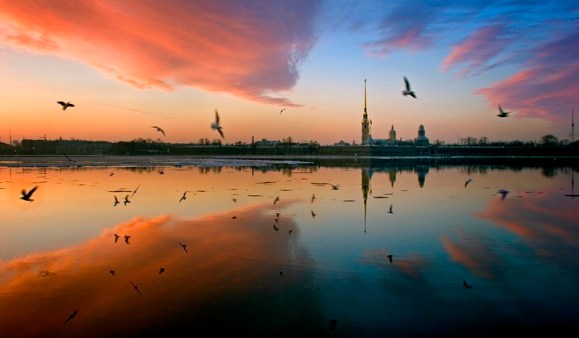
It’s mid-April and the semester is nearly over. I’m in a café near the Bay thinking how I’d love for this place to be open at night, late, like 4am, and sit and have beers or wine and talk to strangers about where they’ve been, literally and figuratively. It kind of reminds me of a place I used to go to that burned down in Russia. I’ve been thinking a lot about St Petersburg lately as it is.
Then this past week in class we talked about the students’ lives–what they’re into now, what they hope for, what they have planned and what they can’t yet fathom.
“Did you always want to teach college?” one student asked.
“I NEVER wanted to teach college,” I answered, and they all laughed. I didn’t.
“Funny,” I said, “but I’m working on a piece right now about how few extraordinary things in life ever are the result of ordinary pursuits.” I thought about the jobs I’ve had, the places I’ve been and some of the people I have been lucky to know. “What do you remember?” I asked.
They stared at me.
“Tell me a story about something extraordinary in your life.”
“You start,” the student said.
Okay.
“There a bar in the woods in Russia. We called it The Shack because it had no name.”
This happened about twenty eight years ago.
Just off the Gulf of Finland not far from an exclusive hotel but well in the woods was one of this world’s coolest bars—a dive really—a place to drink and sing and meet people you’d never want mad at you. It was small, with broken-down shed-like walls and windows which barely kept out the storm blowing off the Baltic one May night in the nineties. It was well after midnight and we ordered a bottle of Georgian Merlot and several plates of shashleek, a Russian shish kabob dish. A gypsy band showed up, including a guitar and violin player I’d met before along with a friend of theirs, a woman singer. Hours passed as we sang and drank. There were four of us, three of them, a waitress, the owner and his cat, and we sang and drank while what must have been that hurricane from The Perfect Storm slammed to shore. This duck blind of a building sat under birch trees, but that simply made me more aware of the weather, wondering when one might topple through the roof. It was exhilarating, an adrenaline rush that had nothing to do with the wine. It was being alive, right then at 3 am, with total strangers, live gypsy music, Georgian wine, and shashleek, that kept us awake. It felt dangerous, subversive, but it was just a bar in the woods.
The band took a break and came to our table and we spoke in broken Russian and English about the storm and how we hoped it wasn’t high tide soon since the water was just a few hundred feet west, maybe less. Then Alexi, a two hundred eighty pound drunk Russian who hated Americans started screaming at us like he had the first time I ever met him, the first time I walked in the place a few years earlier. He had kept to himself mostly since then, sometimes talking to me, mostly not, but this night something got under his skin and he screamed at me like he did that first time, “I hate Fucking Americans.” He startled me, but he had a drink in front of him, and another regular customer, a friend of the gypsy band, was sitting with him and told him to quiet down so he did.
But then I saw his eyes. They were deep and vacant, like he’d seen a ghost, and when he saw me watching him he stood up and said, “I hate fucking Americans!” and he tossed his beer at me. Sasha, the guitar player, stood up and yelled at him in Russian. But just then thunder, with a sound like the sky opening up and dropping two tons of hard earth on our shack, rattled the walls and ceiling and we all cringed. I thought for sure one of the birch trees cracked and was going to kill us all. I went down on the floor with my friends and the gypsy band, and Alexi cursed and fell against the back of his chair. He suddenly looked so small, and the thunderclap crashed on us again, this time blowing open one of the windows, and rain and wind sheered a path across our booth and against the other wall. Dima put his violin under his coat and our shasleek flew off the table onto the floor. The shack cat went for it but the wind and rain chased him back under the bar and into his bed.
Another flash of light lit up the shack and Alexi was trying to hide under his table but he was too big, and just as he glanced out the window on his way to the floor, he stopped and stared. I was watching him, and he looked out the window for some time, then looked at me, and with a nod he said, “Horosho. Horosho” which means, “okay. It’s okay.” And he looked out the window again when the window slammed back and forth. He grabbed it before it hit him and he held it a second, staring out over the Gulf. He looked at me as if to ask me to come see but he didn’t know how. Instead he closed the window and latched it again and turned and sat down. He nodded to me, “Horosho. Edeesuda.” It’s okay, come here. A few of us gathered and sat at his table, and Dima took out his violin. Alexi smiled at me, looked out the window and peered with a stoic face, then turned and smiled again. He looked at the waitress and said “pivo,” beer, and he motioned to us all so she brought us all beer. The rest of the night we laughed and sang songs. I asked Alexi what he saw outside but he just nodded at me and said, “I hate fucking Americans,” and we laughed and toasted and Dima played, then Sasha joined in and then the woman singer, and the beer tasted good. Alexi sat quietly the rest of the night.
“The storm passed and the sky quieted down. So here’s the thing,” I said. “I almost had stayed at the hotel that evening, turned in early, read in bed. Those are all good things, quiet ambitions which keep me grounded and invested in whatever happens next. But that night I didn’t. Like the time we went Ghost Hunting at midnight at the Saint Augustine Lighthouse, or when my son and I sat up all night in the town square of Portomarin, Spain, because we couldn’t find a place to stay. One time a friend of mine and I hitchhiked to Niagara Falls and it took no longer than it would have to drive, but coming back wasn’t so lucky; we walked for eight hours along dark roads through small towns. But if we had been given a ride right away, I’m not so sure I’d remember we even made the trip to begin with. I rarely remember the path; I remember the sudden left turns, the spontaneous jumps.
Sometimes you have to stay up until dawn to understand what’s hiding behind the night. It’s the rest stop at three am with two truckers and a couple of local high school kids farting around; or the sound of wildlife in the desert brush, or tall pines scraping together in winter in the woods with no light but the moon. It’s walking up an Arctic Path at four am in snow-deep March with Northern Lights bouncing past like a bull whip; or lying on my back on a cot in a compound in Africa beneath more stars than could possibly exist, the distant sound of someone chanting the Koran. It’s walking out of a shack in the woods after a storm passes, the sun just lifting over the raised bridges, ears buzzing from loud live music.
On that night, we stood for a second in the quiet morning light, the four of us, and we watched the sun rise over St Petersburg, then we walked home and started an ordinary day.
The students stood to leave. I said, “I’ll leave you with a quote from the philosopher Dan Fogelberg: ‘Be who you must, it’s part of the plan.'”
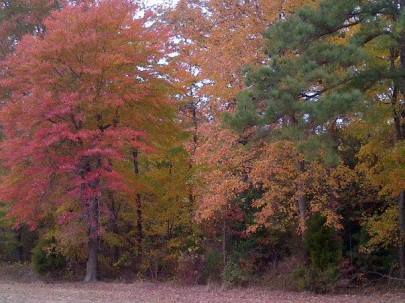
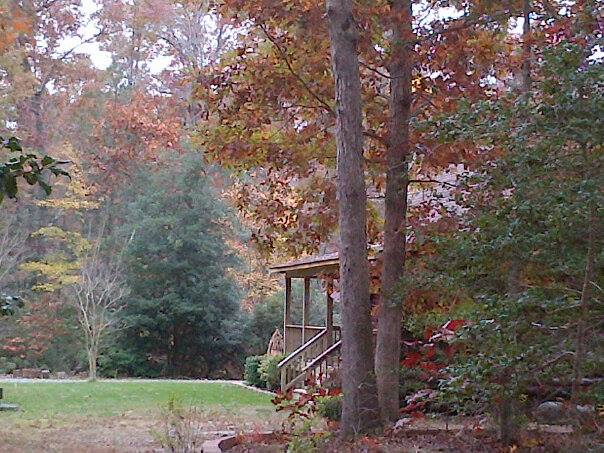
It occurred to me one day on my porch while staring at the surrounding woods, that at some point less than one hundred years ago none of those trees were there. The land has beautiful eighty foot oaks, some maples, tall thin pines and various other hardwoods including black walnut trees, which I am told can provide the ingredient necessary in the liqueur, Wild Spiced Nocino.
The branches protect birds as diverse as red-tailed hawks, downy woodpeckers, and countless chickadees, and they are habitat to other wildlife including one flying squirrel we spotted a few years ago when his tree fell. The squirrel was fine and found a new home in a white oak.
But a hundred years ago this was just land, sandy land, edged by the running Rappahannock River and backed by equally treeless farmland. A century before that these nearby plantations provided food for the region at the expense of slavery, and some slave descendants remain, selling vegetables at food carts out on the main road, or working the bay as watermen, telling stories about how the Chesapeake is just about farmed clean every season by crabbers at the mouth or the headwaters leaving nothing left for those working the midland shoals.
This area hasn’t changed much in one hundred years.
It is like this everywhere, the coming and going of things. In Manhattan a few hundred years before the wild construction on bedrock, coyote and deer were common. It was hilly (Manhattan means land of hills), and where the United Nations stands once stood grand oaks. The Lower West side was a sandy beach, and ecologists say if left to do what it wanted, most of the upper west side would be covered in trees and vines, shrubbery and wildflowers inside twenty years.
I can’t imagine what my house would look like if left untouched. When I don’t mow the lawn for a few weeks it looks like a refuge for timber wolves.
But these trees weren’t here a century ago and I sat on my porch and wondered if there had been other trees or if this land was barren, or was it used by the Powhatans, or was it home to some former slave family, or just a dumping ground. Evidence is scarce, buried beneath the roots of this small forest.
This happens to me everywhere I lived; I like to imagine what was on that spot one hundred, two hundred, a millennium earlier. The house I rented in Pennsylvania was used as a hospital during the civil war. Before that it was a farm. Now it is a Real Estate office. The maples which lined the road and shaded the living room are gone. Someone planted new ones but it will be decades before they mature. My house in Massachusetts was a fish market a century earlier. Purpose moves on with time. Maybe that’s why I’m so mesmerized by the Prague hotel I always stay at. It was the same building seven hundred years ago that it is now. But here on my porch I realize this house is the only place in my life I’ve lived for twenty years, and I was curious if five times that score of years ago I could sit on this spot and see right out on the water, or were there trees then as well, different ones which died or were timbered to make room for crops.
The house is made from western pine forested on land which I assume is either now empty of trees or filled with young pines waiting to become log homes. What will be left a hundred years from now? Will someone sit on this same porch and look right out toward the bay once these oaks have long fallen? I know this house, this land, is a “hotel at best” as Jackson Browne despondently points out. “We’re here as a guest.”
Wow. Wrote myself into some sad corner there. Thanks Jackson.
I know nothing is as permanent as nature, despite the constant changes. It simply isn’t going anywhere. We are. So I like to remember that a century ago farmers sat here and talked about the bounty in the soil, or talked to 19th century watermen about the changing tides. And I like to realize that a hundred years before that the nearby swampland, now home to so many osprey and egrets, was a major route for runaway slaves. They’d have been safe in these woods, if there were woods then.
I like to do that because it reminds me a hundred years from now perhaps I will have left some sort of evidence of my passing through; even if just in the cultivation of language, the farming of words.
So I sit on the porch and listen to the wind through the leaves. It is now; it is right here, now. Sometimes at night we stand in the driveway with the telescope and study Saturn, or contemplate the craters on the moon—both here long before us and in some comforting way, long after we’re gone.
In spring and fall the bay breezes bring music even Vivaldi would envy, and I’ll listen to his Four Seasons, written nearly four hundred years ago, and listen to the wind through the leaves of these majestic, young trees reaching eighty feet high, and be completely, perfectly in the moment.
Despite the warming trends, the extreme tendencies of weather, the fragile ecosystem which sustains life, nature is still the only place I have found that really doesn’t change. It never has. Ice ages and dust bowls will alter it, but eventually some seed will take root.
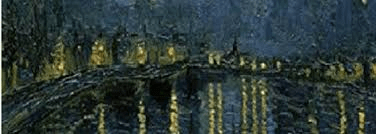
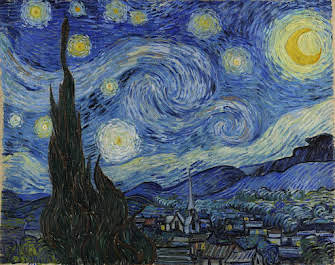
The following is an excerpt from my 2018 bookBlessed Twilight: The Life of Vincent van Gogh; however, the words are his from a letter he wrote to his brother Theo in 1888. Often, an artist who excels in one genre dos so in others as well; Vincent was no exception. I believe his writing to be as artful as his paintings.
Vincent van Gogh: March 30, 1853-July 29, 1890
From a letter to Theo:
It certainly is a strange phenomenon that all of the artists, poets, musicians, writers, and painters are unfortunate in material things—the happy ones as well. Maupassant is a fresh example of that. It brings the eternal question: Is the whole of life visible to us or isn’t it rather that on this side of death we see one hemisphere only? Painters, taking them only, dead and buried, speak to the next generation and very often several after in their work. Is that all or is there more besides? In a painter’s life, death perhaps is not the hardest thing there is.
The earth has been thought to be flat. It was true, and is today, that between Paris and Arles, it is. But science has proven the world is round and nobody contradicts that nowadays. But notwithstanding all of this people persist in believing that life is flat and runs from birth to death. However, life too is probably round and very superior in expanse and capacity to the hemisphere we know at present. For my part, I know nothing of it. But to look at the stars always makes me dream as simply as I dream over the black dots of a map representing towns and villages. Why, I ask myself, should the shining dots of the sky not be as accessible as the black dots on a map of France? If we take a train to get to Rouen, we take death to reach a star. One thing undoubtably true in this reasoning is this: that while we are alive, we cannot get to a star any more than while we are dead we can take the train. So it seems to me possible that cholera and cancer are the celestial means of locomotion just as steamboats and railways are the terrestrial means.
To die quietly of old age would be to go there on foot.
I feel more and more that we must not judge God on the basis of this world; it is a study that didn’t come off. What can you do in a study that has gone wrong if you are fond of the artist? You do not find much to criticize; you hold your tongue. But you have a right to ask for something better. It is only a master that can make such a muddle as this, since then we have a right to hope that we’ll see the same creative hand get even with itself. And this life of ours, so much criticized and for such good and exalted reasons—we must not take it for anything more than what it is and go on hoping that in some other life we’ll see a better thing than this.
I’ve run out of words. Out of ideas. Out of patience and interest and desire. I’ve run out of stories to share and any sense that any of those stories are remotely worth writing about to begin with. I’ve grown tired of getting it right, of editing, of restructuring and developing and trimming down. I’m over the clarity thing, finding the right noun, the more specific verb, eliminating obtuse modifiers, over the placement of pronouns and split infinitives.
I’ve said what I wanted to say.
Except to say this:
Every instance is miraculous to me. Every nuance of life, the breezes and stillness of a summer night, the aroma of honeysuckle, lavender in the air, the yellow of forsythia, the hints of orange and rust low on the horizon. All of it and more of it strikes me speechless and as often as I’ve tried to write about this I couldn’t do it justice. Time and again I ripped up or deleted the prose out of protest to my own lack of focus and ability. I should have been a photographer, bought the equipment and peddled my pictures to magazines and couples on the beach just before dawn–you know the shot, two people in the sand leaning against each other watching the sky lighten in the east. Before cellphones, couples remembered the moment by their presence, but now the moment is ever present because of the picture from the phone, so they no longer know if they recall that moment or simply the endless stream of “love this picture of you two” comments which flood their feed. But what of the shot from behind? The one of the two of them three feet from the water’s edge when the quick ray of dawn hits that small solstice space between their otherwise entangled lives. I could have done that instead of writing about dead relatives and other love songs.
It turns out what I’m best at is simply being present, watching the river run past, a heron searching for minnows and the osprey teaching her young to fly. I have mastered the art of taking it all in and the constant state of miraculous now which engulfs us every moment. But I tried writing instead because I couldn’t make money simply being alive, though I came close; but I could make money writing, teaching about writing, showing people some places I’ve been and what happened along the way, hoping they would sit back and say, “Yes, I know what you mean.”
Instead, I’m out of stories. I am starting to believe my last book took forty years to write not because it was so difficult but because I knew once that story was told I would have nothing left to say.
The story is told and I was right: I have nothing left to say.
Except to say this:
I have been working on a book about teaching. Well, it’s not about teaching, it’s about the best of and worst of what happens when you spend thirty plus years with twenty-year-olds and some of them go on to wonderous things while others die by their own hand, or their ex’s hand, or the random drop of evil. So I’m dealing with a publisher about that manuscript, but my mind is entangled in something that is a bigger deal to me, and that’s the “who gives a damn” factor which plagues writers from time to time, only this time the plague has spread into sentence structure and transitions and now its damned near everywhere. Even the pronouns are complaining; it’s always “I hate” this and “You suck at” that. And I’m also stage-deep in a play, a tragic play about the glory of hope, a one person play which I’m planning to premier in upstate New York but I ran into the “this kind of sucks” part of the writing process and if the book were not out I’d totally use the play as an excuse to avoid the book and most likely would finish the play, but instead the book is out and the play is pointless now. And my book about traveling, about the philosophy of being somewhere for a week or a month and being 100 percent present so that years later we remember every moment—that book, it is out there waiting for me to gather all the words and slap them into the correct order. But not today. It’s rainy and windy and there’s a possibility of tornados today, so maybe next week after coffee one morning.
You see what I mean? It just might be that all the other books and essays and readings and articles I’ve done in the past thirty plus years was a way to avoid finishing the book, and it worked, but now that that the book is done and out, everything else seems to have been a distraction from what I wanted to do originally, before the writing, before the planning and scheming and blind ambitions of a teenager, and that was simply to “live in the world, not inside my head” with thanks to Jackson for the line—to just take it all in at this rest stop as I pass through nature. Wordless. Anonymous. Present.
Maybe I’ll just head back to Spain.
After I get back from Oregon of course.
And Paris.
I feel as if my point—if I ever had one—has been made so I have no reason to go on with these unalphabetically disorganized letters.
Except to say this:
Everything I do seems to be prep work for something that I have not yet figured out. Or, to return to Jackson again, “It seems I’m just a day away from where I ought to be.”
Letty’s birthday would be Wednesday. Dave’s next week. Mom’s and Dad’s in two months, Dan’s a month ago, Cole’s in ten days. I’ve written about all of them. And about Joe, whose birthday was the day my last book, the one about him, kinda sorta, launched. So it can often feel like I’m all out of words, but this time it’s extreme, like the alphabet hasn’t even been invented yet.
But then a hawk flew by my window here at Aerie, and I read something about the Oregon coast, and I saw a clip of Lady Gaga singing “La Vie en Rose,” and I woke up. See, there’s no such thing as writer’s block, there’s only the lack of wind and the empty sails and that sense the doldrums are a permanent state of being. Then, softly at first like a fragment, like a clause, the wind picks up, then more, and suddenly you’re sailing wing on wing through compound sentences and everything, I mean all of it, falls into place and, as Dan notes, “There’s nothing left to say but come on morning.”