Special Edition/The Iron Scar

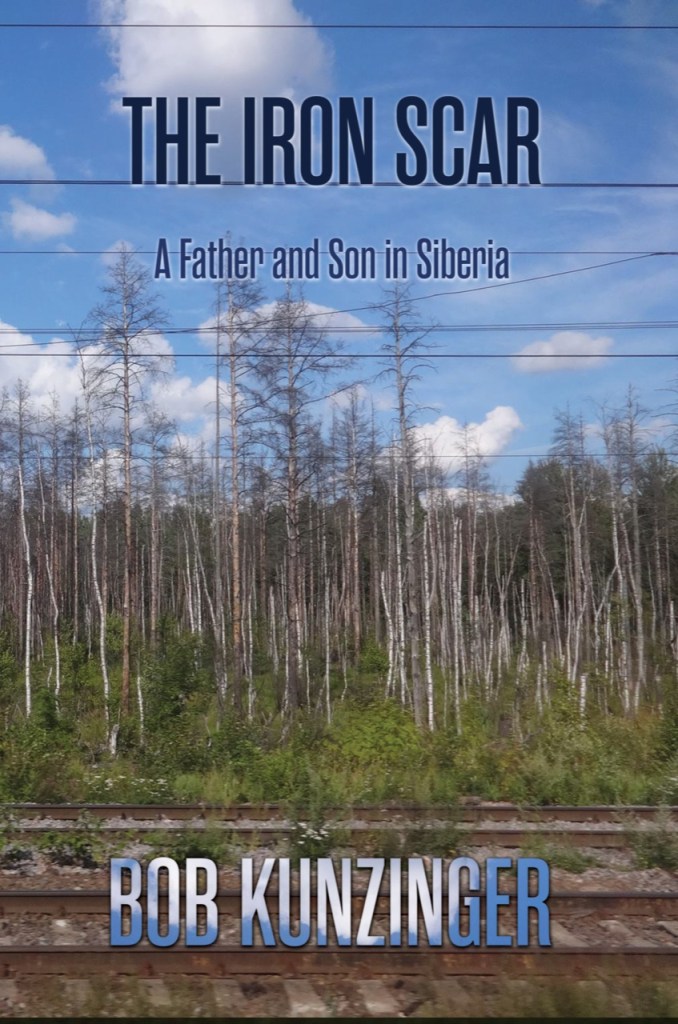
I’m excited to announce here on A View from this Wilderness, the release of my ninth book, this time a memoir; The Iron Scar: A Father and Son in Siberia.

The official release date from Madville Publishing in Texas is April 22nd, though word on the street is it will be available in March at the Associated Writers Programs conference in Philadelphia. And I’ll be there for that.

It is difficult to promote a book without sounding like one is bragging, but the reviews have been beyond my expectations. From Martin Sheen (actor, author of Along the Way: The Journey of a Father and Son, written with Emilio Estevez) to Tim O’Brien (writer, The Things They Carried and Going After Cacciato) to Sam Pickering and more, it has been a true journey that did not end in Vladivostok.

Mostly, I’m excited and proud of this book because not only was my then-twenty-year-old son (now turning twenty-nine), Michael, along with me for the entire journey, venturing out, exploring the world, but as a professional photographer I used him and his talents for the brilliant Photo Gallery within the book. Talk about proud.

This is about traveling across Europe and Asia by train, of course, but it is also about fathers and sons, about feeling like you’re starting brand new whether you’re in your twenties or your fifties. My father is very present in these pages, and the book is dedicated to him and Michael.

You can order right now and for the next few days by clicking here: inscribed copies directly from me for $20 each, which includes shipping, and when the books arrive on my doorstop I will sign them and send them right off to you (or wherever you’d like them to go); or you can order directly through the publisher at Madville Publishing once the site is ready to accept pre-orders.

I’ve made many trips to Russia–nearly thirty–but that trip, that summer, meeting new friends, playing chess, sharing meals and drinks, walking the streets of Irkutsk and Yekaterinburg, of Vladivostok and St Petersburg, walking the hills near Chersky Rock high above Lake Baikal, nearly getting completely stranded on the edge of Siberia, inching over a once-in-a-100 year flood in tiger-saturated taiga region of eastern Siberia, living for several days in a cramped cabin with a large, mostly drunk, boisterous Russia, playing chess against a gang of four chessmen, negotiating for food on platforms, talking about movies, about music, about the rain all those countless times just the two of us stood between train cars, and on and on

I hope you take this ride with us. It is an exciting place to be. If you wish to support the arts, writers, photographers, all in one shot, head up to that link above and order some copies for you and your friends.

Here are some reviews:

From National Book Award Winner, Tim O’Brien:

I just finished again– it’s wonderful.  I wish every book and manuscript I’ve read over the past two months had been as moving, gripping, and/or loaded with fascinating information about a huge swath of our planet.  Your relationship with Michael leads the way, of course, and binds the journey into an emotional and thematic whole that transcends the standard “look what I saw” travel book.  The chess, the harp, the photography, and the desire to take a 7-time-zone journey with his dad — wow, what a son to have.  And bravo to you for risking it, especially the whole language problem, which would’ve stopped me in my tracks, pun intended.  So many things stick with me.  The czar and Alexi and their fate.  I’ve read a book — read it twice — about the ending days, execution, disposal, and eventual recovery of the Romanovs, or what little was left of them, so I didn’t go into it blind with your book, but I felt the father-son, sharing-death connection much more powerfully.  Boris (Alexander Ivanovich, that is) was a memorable character portrait in all kinds of ways, and your descriptions (along with the photo of him) certainly match my memories of the cartoon character!  Moscow time.  What a nightmare.  What a miraculous ending to the nightmare.  The royal blue station shacks, the birches with no tops, the meat and potato  pastries — if pastry is the correct word — the smell of onions, the vodka, the wheel tapping, the once-in-hundred-year flooding, the vast vacancies of human presence, the moving village of the train, the Leningrad hero, the Leningrad ghosts, the ungraspable Leningrad numbers . . . Just so much. Well done, Bob.  My congratulations.  And thank you for a pleasurable few hours.

From Actor and Author, Martin Sheen:

The Iron Scar brought me on a journey that unexpectedly and artfully had me thinking about my own father and my sons throughout the book, as well as introducing me to the wild, warm, and colorful world of Siberia. Thank you for bringing me onboard with you and your son.

In Vladivostok at the end of the line (photo by some French guy)

The Literary Journey of The Iron Scar

cover photo by Michael Kunzinger/Cover design by Jacqui Davis

The actual journey took about a month in 2013. We left Williamsburg, Virginia, by train to New York, spent precious and never-enough time with my late dear friend Fr. Patrick Brennen Fitzgerald, and laughed all night with my cousin Roy and his wife Patty, two of my favorite people. We ate our way through Manhattan, and the next day flew to St. Petersburg where we boarded the famous trans-Siberian railway. Actual travel time on the train was about a week, but we disembarked for exploration several times, ending about three weeks later in Vladivostok.

I knew from the inception this was a writing project, and my son, Michael, was along to take thousands of photographs. They would be our primary souvenir, of course, and used to trigger memories and tell stories. But they would also go on to be used in solo art shows he displayed as well as for use in a myriad of articles for print and online journals. The book has a healthy selection of Michael’s photographs.

While the text has just over a dozen chapters, various versions have been printed in different combinations of content, style, format, and with or without artwork. Usually with. I knew I didn’t have the authority or expertise to write historically or with any accurate social commentary about Russia or the rail, and others had already done so with more skill than I could have anyway, including one of my favorites, Ian Frazier (Travels in Siberia). David Green, too, of NPR, wrote specifically about the ride in Midnight in Siberia. I had no intention of duplicating these men.

Being the son of a father who was almost ninety years old at the time, and the father of a son who was about to venture out into his own life at the time, I found myself deep in the narrative of middle-age, of letting go, of contemplating what’s next, and of trying to balance planning ahead with my natural tendency toward spontaneity.

So to include my father on the journey, the early stories were framed as letters to my father from the dining car of the railway. I like them; I like personal approaches to writing so long as the reader recognizes herself in the piece as much as the characters on the train. This was going along swimmingly and a handful of journals published the pieces with this format.

Then I went to Ireland and participated in a workshop with the deeply talented Jacki Lyden and Elizabeth Rosner. It was Liz who casually asked when reading a story of mine about floods along the Amur River, “Why the hell is this a letter? Who would possibly, during a once-in-a-century flood sit in a dining car and write a letter?”

Damn. She’s good.

So I took all the pieces published that way and rewrote in standard narrative form and discovered how much more I can do that way, and still include my father in the content without the reader mirroring Liz’s sentiment.

So I republished them all, some in various forms including other essays wrapped into them and some abbreviated and some much longer than other versions. In fact, a few anecdotes ended up in nearly all the stories published. In the end, there are about fifteen chapters rewritten and combined nineteen different ways published in twenty-one magazines and journals. But that’s not the book. The book is not a collection of essays, and I never intended it to be published as such. The Iron Scar is a narrative, one long story from New York to Vladivostok, covering more than ten thousand miles, seventeen times zones, and about two hundred pages.

I must, however, give thanks to those publishers who found something worth sharing in my stories.

Including:

The Maine Review   “On the Occasion of that Inevitable Conversation with my Son”              

Kestrel: A Journal of Literature and Art “Tracks” “Checkmate” “Off-Track”

A View from This Wilderness  

Blue Planet Journal

Warfare Journal  

Ilanot Review       

Connotation Press         

Olive Press “Dissidents”

Foliate Oak Journal      

World War Two History Magazine “Meanwhile in Leningrad”

Columbia Journal   “Tiger, Taiga”

Southern Humanities Review  “Leningrad Story”

Nowhere Magazine   “Exiles and Dissidents”              

Litterateur Magazine

Wanderlust Journal      

All Nations Press           

Silver Birch Press

Foreign Literary Journal               

Adirondack Literary Review

The Alabama Literary Review  (December 2021)         

The Virginian Pilot “It’s Not Their Fault”

My last book, A Third Place: Notes in Nature, was published by Kim Davis of Madville Press in Lake Dallas, Texas. She did a beautiful job and I enjoyed working with her and her team. An editor at a significant publishing house in New York read several of the pieces above and asked to see a more complete manuscript, which I promptly sent to her. Her editorial staff enjoyed the work, loved that it is more about fathers and sons and moving on than it is about Russia or Siberia or trains, but the marketing department said they simply cannot market this book—it is much too niche, and it isn’t worth it unless I had a reach like Frazier or Green. I don’t. I can’t even reach them.

I knew I would be in great hands at Madville, and Kim had shown interest in it before, so I signed a contract. I actually don’t think it has a niche audience, and I believe it can, with the proper marketing and publicity, touch anyone who is a parent, has an aging parent, wonders what the hell to do with their lives.

But for me, this book is a diary, a journal, a remembrance of a time when my son and I rode the railway across two continents one summer, on a journey that continues still.

The Iron Scar: A Father and Son in Siberia is scheduled for release in April 2022.

At the station in Vladivostok