My Parents’ Desk

siberia-phone-316

When I was in fourth grade I wrote a book. It was called “Flight” and was about two boys who built a spaceship and traveled through the Milky Way. They talked about what they saw along the way and seemed in no worry for want—if they got hungry they had plenty of Milky Ways and Mars bars to eat, and one of the two had stuffed his pockets with “Now and Laters” for that long stretch between Mars and Jupiter. I write all this in past tense since I have no idea what happened to it. I can picture the construction paper cover, and I typed it on a small manual typewriter I also used to write letters to my friend Charlie in the old neighborhood.

We had just moved to a new area surrounded by the Great South Bay and the Connetquot River. We had also just watched Neil Armstrong walk on the moon and I was obsessed with space travel. I had a brown jacket with patches on it and memorized all the astronauts and their flight assignments. All of it. I was also enthralled by writing. So naturally, I wrote about space travel.

My mother made me a small desk from a folding tray with a placemat on it, and I used it in the den and would carry it to my room, my first room I had without my brother, so I was able to leave my “manuscript” out all the time. This was fourth grade and I had pneumonia so missed a chunk of school, which allowed plenty of writing time. That small folding-tray table desk got a lot of use.

I also typed a poem about Christmas, inspired by C. Clement Moore. I don’t have that anymore either, but I still remember some of it:

Christmas is coming, it’s coming soon

But not that soon since it’s only June

So I’ll sit here and watch the moon

With all my Christmas plans in ruins.

Kind of dark. I was ten. And I recall the “s” at the end of ruin bothered me. But, man, I wrote it at my own desk. How cool was that? 

I’m fifty-seven-years old and a writer now (thanks Tim O. for the line), and I’m sitting in my new home office, which is an old desk on a throw rug on the wood floor in the front half of my bedroom. I’m looking out at acres of oak trees with bare branches. The area is surrounded by the Chesapeake Bay in one direction and the Rappahannock River in another. A little while ago a hawk was on one of the branches, no doubt looking down and sizing up the doves and cardinals at the feeders and frozen birdbaths on the front lawn. It is absolutely peaceful here with osprey and deer. The closest town is four miles to the west and even that is little more than a bank, a convenience store, a hardware store, and a vet. The busiest of them all is the vet, not just for dogs and cats but the myriad farm animals nearby, particularly horses. Behind me about a thousand yards is the Fountain Green Farm which looks like something out of a movie, or at the least something from western Kentucky. I know nothing of horses despite having more of them as neighbors than I do people. But I know Alice Walker was right when she wrote, “Horses make a landscape look more beautiful.”

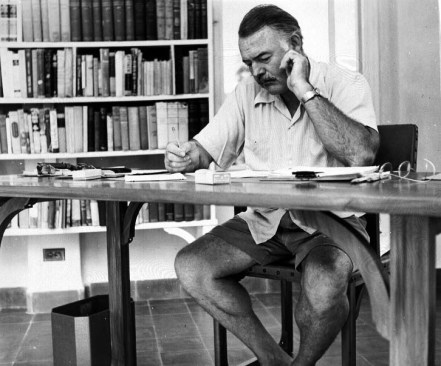
I want to spend more time inside now at this desk, which is new to me, though not unfamiliar as it belonged to my parents since the mid-seventies. They purchased it when we moved to a new house. And now it is mine, and I’m behind it looking out at the oaks; scatterings of notes cover the mahogany desktop.

I feel like this will be a good working spot. In fact, ironically, the project I’m in the middle of and which will be the first for me to work on here is a book about traveling in Siberia, structured as a series of letters to my father. It’s as if I should be able to open the bottom left drawer and move something such as a stapler or an old folder only to find a stack of letters from me to him, bound by a string, postmarked Vladivostok. But the drawers are empty.

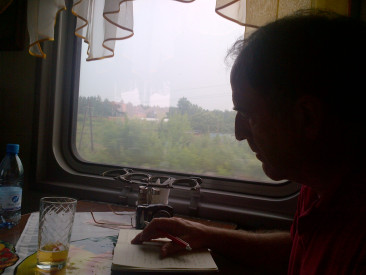
It is impossible to predict where the best place to write might be. The journals these letters come from I wrote at a booth in the dining car crossing Russia. The car was mostly empty so I was always able to sit with my papers spread about, a cup of tea, or, later in the morning, a beer or two, and work away while outside the glass-plate window birch forests dominated the hemisphere. Years before that I once did a great deal of writing in a bar, and these days for the most part I work well in a cinderblock office. I have a friend who writes poetry in coffeeshops or museums, and another who writes in her “writing room” looking out at the quaint houses on the beautiful street in her small town.

For me, the writing occurs when I walk, or when I’m driving, and disjointed, seemingly irrelevant events slam together in my mind. I might have spent time with family, and then went for a walk along the bay, and later had something to eat with a friend, and somewhere in the following days my caffeinated mind wanders between these events, amazed at the connections between stories of ancestry followed by the persistent pounding of waves, followed by the complete absorption in the enjoyment of the passing of time. And as the hours pass the connections become more obvious, the balance between childhood memories shared with my siblings now that we’re all AARP members, and how time can often tease us with occasional flutters in our linear perception. Between old stories of younger days and the eternal ebb and flow of tides as I walk on the beach, and the suspension of all measure when talking to a friend, the writing begins, the mostly futile attempts to capture something of this passing. Maybe I’ll have more luck at this desk.

I don’t ever remember seeing my father or mother sit at this desk. In fact, despite the passing of more than forty years with it in the family, I might just be the first person to actually sit at it and do work. It had always been primarily aesthetic by location and, as a practicality, a storage area for their important papers and checkbooks. And I am positive no computer has ever been atop it as mine is now. Everything is repurposed eventually. Even us.

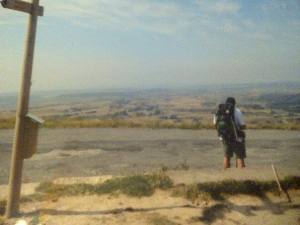
I’m happy with my new work area, though I still will do most of my editing at the oyster shack or the café by the bay. I added this to my possessions at the same time I’m getting rid of so many, many things. I’m selling most of my art, giving away parts of my past, and thinning out my souvenirs. I’m sure part of it is my post-pilgrimage epiphany that our most precious possessions are the moments spent along the way; the backyard games on the Island with my brother and sister, the dinners with my parents, laughing and crying with friends at college, and of course, the love and loss and heartaches along the way since. I don’t need souvenirs of Tuesday nights when Dad and I drank Scotch, or early morning conversations with my mom at the breakfast table. Nor do I need “things” from the past two and a half decades—the hours of evening conversations with my son, our shared cabin on a train to the other side of the world, and our month-long journey side by side on the Camino. Come on, what possible souvenir comes close? Oh, I have pictures of all these times, of course, and I cherish them and look at them often. But I have never been able to find a trinket worth keeping.  

But that’s not entirely accurate.

I sit at this desk as I have sat at others before it, and write stories about the journey. And these small stories, while irrelevant to others, are my possessions. Like some glance at the curio cabinet, I sit at this desk and open a file and write about memories. Like how Dad and I used to watch the Super Bowl together every year at his house. We’d have wings and shrimp my mother would put out, and drink beer—a side-step from the Scotch since football calls for beer—and talk about the players and the missed opportunities. We laughed at commercials but never watched the half-time show. Dad didn’t care and I would rather talk to him. He would have rooted for the Eagles. He would have been happy this year.

And in the bottom right drawer of this desk which I’ll probably always refer to as “my parents’ desk” are copies of the last edits of my work about Spain, where Michael and I both wrote in our journals, almost always in a pub.

Souvenirs fall short of experience. We know that. Words come closer but they remain little more than some form of shorthand to remind us of the complete narrative. Even pictures for all their emotional tugs remain stagnant, moments more than memories. No, the only true way to enjoy the memories is to make them, to push away from my parents’ desk and go canoeing with my son, or have dinner with my mom and siblings when they’re in town. Pie with Jack. Lunch with Tim. Writing comes close, for me anyway, like writing music might for my friends Jonmark or Doug, or painting might for Mikel.

But the arts are irrelevant without life. Life must come first. Living must come first. Many years ago when Facebook was new my niece Erin updated her status to read: “I’m too busy out living my life to post about it on Facebook.” I never forgot that. I’m grateful to sit at my parents’ desk to do my writing, but their much more treasured gift to me was my desire to live life to begin with, to have something to write about.

But I do enjoy coming up to sit down and gather my thoughts, put on some old Jackson Browne, and tie together seemingly irrelevant happenings, sometimes discovering the serendipity in the world. And later in the evening my son will call up and ask if I want to join him outside to use the telescope and gaze at constellations out across the bay, another of our normal routines.  So I’ll save some document, push away from the desk, head outside and find Mars above the horizon, and remember some story somewhere about two young boys traveling through the Milky Way.
hemingway_scrittoio

My Senior Moment

a a a (2)

I spoke to a group of senior citizens about the Camino de Santiago. About eighty people ranging in age from mid-sixties to late eighties attended the slide show/lecture. I read excepts from my new book, talked about the nuts and bolts of walking the pilgrimage, and told stories which had us all talking and laughing. It was a great time, a really fine time.

Their questions surprised me. Not because they asked about experiences or meaning or significance or the people, though they did and I was sorry Michael wasn’t there to help answer some from his perspective; no, they asked about cost, time, sleeping conditions, safety, difficulty.

They wanted to know how to do it. A large portion of these mostly septuagenarians came to my lecture because they want to walk the Camino.

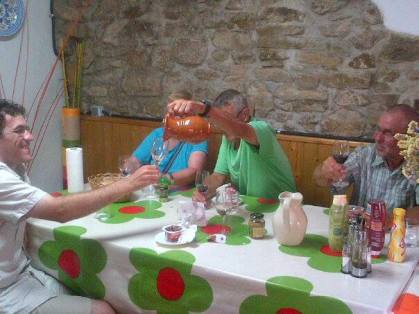
I told them about two men we met several times. They were from Germany and had already walked 2800 kilometers by the time we shared dinner at an albergue near Pamplona; both were about seventy-years-old. We spent the afternoon and evening drinking wine from clay pitchers and discussing the blisters on our feet. One of them introduced me to German sandals, noting he never had blisters. The other talked about their lack of concern for the distance covered each day.

I told my audience at the university about the lack of need to carry much; that the albergues have laundry facilities, comfortable beds, delicious food, and plenty of coffee. I mentioned if they wished to jump a difficult section of the Camino, they just had to hop on a bus for two hours and cut out about six or seven days of walking.

It turned into a riot, a gang of rambunctious, excited potential travelers no longer raising their hands or waiting for me to finish my response to other questions, but all calling out inquiries, talking to each other, laughing, making plans of when, and encouraging each other to join each other. They talked about Emilio Estevez’s movie, The Way, and how Martin Sheen was about their age, ignoring the fact he didn’t actually walk the Camino. I pointed that out and we laughed, but then one man asked, “But could he?”

It was rhetorical. Clearly this crowd knew about pilgrimage. They already decided he could and they could and they would and, perhaps most importantly, they should. They absolutely should. I saw more life, more excitement, more potential, and more determination in that room then I ever have in teaching twenty-year-olds the same information.

At some point we understand we don’t need to worry about as much as we thought; at some point we look back and see we tried to carry too much baggage. Usually, however, that realization doesn’t happen in our twenties.

But it happens. And for this group of retired men and women, some of them retired more than twenty years—longer than the life span of my average-aged student—they don’t see a finish line. They pulled out their phones and looked up the brand of sandals, costs of flights, regulations on carrying walking sticks on flights. One woman looked up books about learning Spanish. She is in her early eighties.

I love when we discover our mission here on earth isn’t complete as long as we are alive. Some people make excuses. Some make plans.

One woman asked me to point out if a trip like this is a realistic possibility. I pointed out they’d spend more in a week in Disneyland than a month on the Camino. I pointed out if they can walk four or five miles a day, they can at the very least do a portion of the Camino for a week or two, which is how must pilgrims plan anyway—few people have the time to do the whole journey in one shot. I pointed out they can skip the difficult parts, that it isn’t a competition or challenge.

Then I left.

I didn’t tell them about the memorial markers.

People have died along the way. Some travel there aware that their lives were at the end and they wanted their last steps to be on the sacred grounds along the Camino, dying in the footsteps of saints. Others didn’t anticipate the strain possible by not pacing themselves, or weren’t aware to begin with of a heart condition. Spain can be very uphill. I didn’t mention the possibility of dying along the Way because no one asked, and no one asked because by the time we reach that part of life we are quite aware of the rapidly approaching end of it all; no one needs to remind them they could die. In fact, it is because death is relatively imminent to begin with that they came to the meeting, asked the questions, and are making plans. They can’t control when the journey will end, but they all prefer to walk toward it, even if ever-so-slowly, than to sit still and wait for the end to come to them.

I walked to my car and wondered how I’ll handle being in a group like that when I’m their age, which is just a quick two decades from now. Less. Will I be thrusting my hand in the air, or, more likely, calling out questions without filters? Will I be taking notes, wondering how I can make some adventure with some new friends, saying, “yes” to invitations to try something new when so old? Then I thought how hopefully I’ll never go to one of those meetings. Hopefully, I’ll already be out there, further along this pilgrimage I’m on. Slower for certain, but moving forward.

084b (2)

I Found an Old Key

1457028348365

I found an old silver key while cleaning my closet floor. I’ve been on a “get rid of it all” spree lately, especially since twenty-nine years at the college means accumulating crap beyond measure. Still, sometimes the small things stop me and take my mind on some time-loop ride.

Like this key. For years it must have escaped my glance, fallen perhaps from pants pockets or a winter coat. I can’t recall losing a key or changing locks. And anyway, it doesn’t resemble any key that I know of for the college.

Maybe it opens some old house I once lived in. Or our first apartment when we moved to the area and I started working here. That place was small but filled with potential. We’d sit for hours and talk about our yet-to-be-born son. It was on the second story near a river, and we loved the shade from the pine just off the porch and how it protected us from the mid-day heat. Still, I think this key is older. Maybe my old farm house in Pennsylvania I rented while working in Hershey where the only sound outside were cows and the occasional car. I remember once I came home to an entrance of new plants and flowers for my birthday. The plants outlasted my stay there.

No. it’s old so more likely my first house in New England where the door stuck in winter when the frame froze. I’d spend hours shoveling my steps and those of the old woman across the street who delivered mail. She brought apple pie for my efforts, or would leave one for me with Sam at the Deacon’s Bench Antique Store next to the small shack of the post office. But that key was gold and I gave them to my friends who moved right in when I moved out. If I did keep that key I never would have lost it, never.  

Now I think this one some souvenir from my childhood home on Church Road, the two-story colonial where I owned my first house key though I never needed it since after playing ball or riding bikes all day along the Great South Bay or through Timber Point Golf Club, I’d run through the back door full stride and laugh the way childhood makes you laugh for no reason at all. I can see myself keeping that key, moving on with some small remnant to make me feel like I could go back if I wanted.

But no, I can’t recall now what this silver key might be for, though I’ll keep it; resist the urge to throw it away as evidence shows I clearly resisted before.

Of course. After all, it still opens doors to places I never thought I’d go again.

bigger-old-worn-black-shiny-key-oak-wooden-dusty-cellar-door-close-up-above-daylight-wine-there-bit-cut-dry-53864494

Let the River Run

IMG_1098 (2)

I’ve lived on the water most of my life. Most significantly I spent my high school and college summers on the ocean where my friends and I would bring coolers to 77th Street and sit on blankets or swim or just hang out listening to music and talking. Now I walk along the same beach every week and while I’ve changed the ocean looks the same and probably always will. When I was young I’d stare across the waves and wonder about places—Spain, Africa, Russia. Now I look across the waves and I see it differently, almost with a tinge of sadness. I have experienced those places now and the acute sense of anticipation has ebbed. Reality is never what we hope it will be, though it has been fun.

I went to college on the Allegheny River where my innocence was obvious and my courage was not lacking. I’ve been back since and see the river now more of a time from my past than a place in my life. The Allegheny River for me will always be 1980, and when I recently walked the path behind campus and looked at the shallow waters, I remembered the boy I was who had such plans. Many came to fruition, so it is not a melancholy glance, but there will always be something missing. Of course. There should be; it’s what keeps us moving forward.

I like that. Sometimes leaving something incomplete guarantees a reunion of sorts. In Russia they say, “Leave something for next time so you have a reason to return.”

And now I live near the Chesapeake, along the Rappahannock River. The water in the Chesapeake when the tide is rising and fills the Rappahannock will have an identity crisis as it moves past the mouth of the river and floods the marsh at the end of my road messing with the salinity. Still, it adapts. The water moves and swirls and flows and floods; it finds new ways to cut crevices in sand and even rocks. And the water running past my calves on a warm May afternoon might have once cut its way through limestone up river near Luray and will slap against a fishing boat out beyond the continental shelf towards Bermuda.

When I was young I fished on the Connetquat River on Long Island, only catching eels, and in winter we would skate out toward Oakdale across the water. And just a few hundred yards to the south sat the Great South Bay where I learned to comb the beach.

“I am haunted by water,” wrote Norman MacLean, and so am I.

71 percent of the earth is water. Babies are born about 78 percent water, and that drops to about 60 percent by adulthood. Of all the water in the world, only about 2.5 percent of it is fresh. And 68 percent of the fresh water is found in inaccessible ice caps and glaciers. If you’re out looking for any though, the best place to fill your canteen is Lake Baikal in Siberia, which contains about 20 percent of the world’s fresh water (the unfrozen non-glacier type, except in winter). That’s changing, obviously. In fact, right now only about 30 percent of fresh water can be found in the ground. This means of all the water in the world, only a small fraction is drinkable.

I dehydrate very easily so I am always drinking my share, and probably your share. I like water. It energizes me. I can do that. But about 1.5 million children die every year because of lack of water or having access to only low-quality water.

Water is life. Even when searching for life on other planets, it is actually water they are looking for. At the same time, water kills. My brother lives southeast of Houston, Texas, and through some combination of miracle and excellent planning on his part was not flooded by the rising waters. But too many people to count lost their homes, lost their lives. It isn’t hard to understand why the number one weather-related cause of death in the world is floods.

Michael and I hired a car and driver along with a translator in Irkutsk and headed north out of the city to the villages along Lake Baikal. It was a foggy day, the air wet but warm enough, and we walked to a dock where an older man was getting in a small boat to fish. He stood next to us describing the waters, the countless tributaries coming into the lake from the frozen north, but only one river out, the Angara, which heads south into Mongolia. Then he leaned over and told us when the water is still as it was that day, you can see a dozen meters into the water, and it isn’t unusual to see seals swimming by deep in the lake.

We were surrounded by water; clear, deep, pure fresh water. We were as far from having anything nearby as you can get. GPS doesn’t work there. Cell phones are pointless. We stepped over the edge. World history there has more blank spaces than perhaps anywhere else on the planet. For many of the residents in some remote sections of Siberia, Columbus never set sail, the Wright Brothers never took off, and Neil Armstrong is a myth. I understand why the Czars in St. Petersburg and leaders in Moscow considered exile there to be punishment enough. It simply doesn’t exist unless you are already there. To the rest of the world, the landscape is a mystery and the people are all ghosts. And we are not so much travelers as we are brief shadows in the land of the midnight sun.

A few weeks later we arrived in Vladivostok on the Sea of Japan where we were cautioned against drinking tap water. The Fukushima nuclear disaster caused by an earthquake and tsunami  had occurred just two years earlier, and there was some concern the contaminated deluge might still be swirling through the Pacific. I drank beer instead.

And when we returned I made my normal, post-remote-world visit to the doctor and cardiologist, who said I needed to keep my blood pressure down, so he prescribed a diuretic to reduce the fluid in my body.

Yes, I am haunted by water.

man on lake baikal

Migration

canada geese in corn field for web

Nearly every evening in winter just before dusk bends to night, in those moments after twilight when I have to let my eyes adjust to the lack of light, a few hundred geese land in the pond, some on the river, and a few in the field nearby.

I can hear them for quite some time before they actually fly into sight from beyond the trees to the west. The air is so clear this time of year I can hear them honking in groups, joining in like a chorus which starts with just a few voices and adds another rafter until they reach some crescendo. At first it might be only a flight of a dozen or so based upon the muted sound from the distance. But over the course of five minutes or ten I hear another group, then another, and more. They fly in a “V” to be able to see each other clearly for protection and create just a little draft, but the closer they come to landing, the faster the formation falls apart.

Eventually the first group is already in the pond when the last group crests the bare branches of the oaks and hundreds settle into the field or onto the river. One time some years ago a bit earlier in the evening thousands of geese, no kidding—thousands—landed on the plowed cornfield just down river. Their honking continued for an hour that night, and just as the sounds of these geese slowly softens and, finally, quiets, so did theirs so that from my porch I could tell they had all landed safely.

But every single time awhile after the large group arrives, two or three geese come in late, alone, as if they stopped at another farm over near the bay and had to regroup and find their flock.

I don’t want to disturb them, but I always want to watch. So when I walk along the river at that hour and the skin on my face is tight from the cold, and my nose runs a little, and the muscles in my back are also tight from the cold, I keep my hands thrust into the pockets of my coat and walk along the soft shoulder of the tiny dead end street so that my feet make no noise. I can usually get to the narrow strip of sand at the river from where I can see both it and the pond, but not the field so well. Their call increases in a burst of warnings to the rest that I’m around. It quiets quickly though as I remain absolutely still and sit on the cold rip rap running along the river and blend into the rocks and am no longer a threat.

On winter nights the water is almost always calm, a slow methodic lap at the rocks and sand. The sky is all stars, and sometimes just after dark in January you can still find the center of the Milky Way in the southwest. With no unnatural lights for more than twenty-miles in any direction except from the scattered farmhouses or buoys, the sky is a carpet of constellations.

It isn’t by chance my Canada friends find respite here. They need grass for food, they need water, and they need to be able to see great distances to anticipate danger. That’s why they’re here on the edge of the bay with open fields and ponds. It also explains why they love airports and golf courses. The abundance of geese isn’t an accident either; they travel in gangs, often the younger geese are forced into the gang, so that traveling is safer and they can better dominate areas like this.

But their coolest trait is their honk. They keep that up as a form of encouragement so the lead geese will maintain their speed and not give out so easily. Basically, the ones in the back are telling the ones up front to “Go! Go! Go! Go!” and move their asses. And when the lead gets tired, she moves to the back and gets to badger the others for a while. And they do this their whole lives—about twenty-seven years.

And just after twilight when dusk is making its brief appearance, and the water is like a mirror, the call of the geese from well across the treetops is musical, somehow eternal. When this land was unbroken, Canada geese called to each other, rushing for the open fields and waterways, settling down here. Powhatan heard geese here, and John Smith, and Washington just to the north at his birthplace on the Potomac, and Jefferson not far from there. Through the centuries the flyway from the St. Lawrence down across the Adirondacks and Catskills to the Susquehanna south into Virginia to the mouths of these five fair rivers spilling into the Chesapeake has been their home.

And they love dusk, just before dark, as it is the best time of day for them to recalibrate their internal magnetic compass to cross continents; to come here year after year.

We have something in common; we’re both very migratory.

I guess that’s what also attracts me to the passing flocks of geese. The peace in such sounds late on a winter’s evening definitely touches my soul, settles me somehow beyond my ability to explain. But also I sit on the rip rap and blend into the rocks and watch them in the water and contemplate their distance from the central regions of Ontario and Quebec, across Hudson Bay. My entire life I’ve been drawn to migration, to some sense of movement from one place to another, particularly the seeming randomness of such order. They know where they are going every time, and yet they move south without boundaries, schedules, or maps.

When I was young my father bought me Robin Lee Graham’s The Boy Who Sailed Around the World Alone. It was the first book I remember inciting in me a sense of adventure, travel and exploration. The sea seemed to have no borders or barriers. Graham’s goal was circumnavigation, but his schedule was wide open. Peter Jenkins, too, in his A Walk Across America, knew where he would end up, he just didn’t know when or how; and along the way the adventure was in the places he paused for food and water, with an open view of life around him. Ironically, I like the consistency of this migration; the predictable return, surrounded by friends, a quiet night.

I suppose all dreams are migratory, both in hopeful destinations and their transience with the changes in our responsibilities and circumstances. At times I take flight, abandon my flock and push off for awhile. But I look forward to coming home to settle into some sense of domesticity, which I can accommodate briefly at best, because eventually I think about the dreams of my youth as I fly toward my twilight years. They call to me to “Go Go Go Go” as my life moves further along, pushing at the edges of dusk.

And now in winter when night falls completely I walk back to the house and always a few more geese find their way to the flock long after dark. Only once did I experience the return to the sky of so many all at once. I was walking from the river to the house past the field where hundreds that evening had settled, and either something or me or the ground disturbed them, or it was simply time to move on, but in great waves they took off, honking. I heard them calling, waves of them into the sky, honking, great waves of honking geese calling ahead to the ones already in flight, as those behind fell in line and they swept from horizon to horizon blocking out the moon and headed out over the trees running down the bay, and I stood and watched them until the last honking geese were gone.

And everything was silent and I found myself, oddly, alone, like a young man left on the sand while his friends all pushed off to sea to head for distant lands.

jan 18th 018 (2)

Ages Hence

article

I think most people at some point stand still and look back at the path they took, even if just briefly, before continuing the pilgrimage. I have spent the better part of this blog questioning everything from the passing of time to the value of doubt, but this particular small and relevant-only-to-me word dump is solely a note of appreciation to remind myself how thankful I am for the ride it has been.

Next week I begin my final semester at Tidewater Community College. It’s been quite a run. During my tenure at TCC, I’ve roughly (very roughly) done the following:

1360 Credit Hours

8500 Students

26 Different courses

8 Years Assistant Division Chair

26 Years full time faculty

3 Years full time adjunct

12 Grants to write articles and to teach at universities in Russia, Prague, Norway, and Amsterdam

16 States for conferences and readings

4 College presidents

4 Provosts

8 Deans

27 Humanities Department full-time colleagues left during my years

6 new buildings/3 redesigned

5 US Presidents/8 terms

1 MFA

2 offices.

1 officemate.

1 son

1/2 my life.

The last time I was not full time at Tidewater, in the summer of 1992 when I was first told I had the full-time job after three years of being an adjunct, I was sitting on a bench behind the humanities building humming “The Reach” by Dan Fogelberg. My son would not be born for another six months, George H. W. Bush was in office, and we were still using DOS.

When news came of 911, I was in an office on the other side of campus. My officemate Tom Williams and I walked back understanding the sudden irrelevance of collegiate minutia. I wanted to quit.

When my father died I was teaching Creative Writing. It was a Wednesday night.

The first class I ever taught was in an auditorium in the library. There were about 25 students scattered about the room. I had arrived before anyone else and sat in one of the seats halfway up to review my notes and see the podium from their perspective. Time slipped by and I found myself surrounded by students before class, but since I was twenty-nine, I blended in and everyone talked freely about their expectations. This was clearly pre-cell phone, pre-computer, when interactive meant meeting the person next to you and technology was an overhead projector.

I listened to their comments, their jokes and anxieties. Someone a few seats away said, “I hope this guy isn’t an asshole.” When I rose to head to the podium I could hear him gulp, I honestly heard him gulp. I put my notes down and said, “I hope I’m not an asshole too. Let me know if I tend toward that way, if you would.”

I had no clue what I was going to talk about. I still thought of myself as a student with some writing skills who just hadn’t applied himself. My previous job was a bartender. Before that I worked for Richard Simmons. Before that I’d rather not talk about. Now I stood to teach College Composition One. I had no background—none, zero, no experience in any way to teach college or discuss college comp. My history of standing in front of others was limited to exercise classes and playing guitar in college. My writing experience was journalism.

Spontaneously, I said: “Everyone write 200 words about what they’re doing here.” They did. Fifteen minutes later I collected the papers and said, “If I had told you I’m only going to grade the five that really catch my attention, and the rest fail, would those have been better?” They all said yes, they would have been better. Then I added, “So if I had said the five that really catch my attention each get a thousand dollars on the spot, would they have been even better than that?” Everyone laughed and nodded and talked to me and each other and God about how they would have been excellent if that had been the case.

I was quiet a moment. I was making this up as I went. Then I said, “Okay. So you can do better; you just can’t be bothered. That’s what you just admitted to me.” Everyone was silent. “Why is it we have a tendency only to apply ourselves if we can see some immediate reward?” I tossed their papers in the trash and said, “Okay, let’s start again.”

32,000 College essays

64,000 Rough Drafts

2200 Humanities exams

1250 Student Presentations

475 Classes

8350 or so Lectures

28 Convocations

200 or so Division Meetings

12 or so Student Complaints

6 or so Grade Appeals

20 or so Students dropped for Plagiarism

12 or so Students kicked out for behavior problems


There was the guy who threw a desk at me and started to cry when I caught it.

Or the Russian exchange student who stood up and started running around the room and cursing in Russian who, when I yelled at him in Russian to get out, ran out the door and out the building and never came back.

There’s the guy who plagiarized an article about 911 from the local paper and turned it in for one of my assignments not knowing I was the one who wrote the original article.

There’s the former surfer in a wheelchair who was hit by his own board and was paralyzed from the waist down, who said it saved his life, that he was on a collision course with drugs and he could finally get on with his life.

Or the girl who became known as “Spaghetti” who would randomly scream out thoughts in the middle of lectures.

One student came to my office to say he was dropping the course because I don’t like him. I said it was only the second day, that we’d never met, and I have no idea who he is, and he said, “See?” and dropped the course.

My office has 272 cinder blocks and no windows. 1 desk with three drawers. 1 file cabinet with four drawers. 3 bookshelves. 1 desktop computer. 1 refrigerator. A bunch of art.

It became my refuge on campus. It is absent windows except for two photographs my son took of windows; one in Spain from inside a pub overlooking the Atlantic, and the other in Siberia from inside the passage between train cars. Both are quite realistic and I spent many days leaning back in my chair lost in their vistas. But mostly I was able to enter my little cinderblock office, put on some music and disappear from the noise in the hallways and the classrooms. With my headphones on I could write, and write and write, recreating my time in Russia or Prague or Spain. Sometimes I’d even write about teaching, trying to explore the reason for so much failure, narrowing it down to three primary causes: the students, the teachers, and the administrators. So writing became a way to vent my anger, my confusion, and my frustration; and when that didn’t work I would write about the places I’d been to somehow get there again, using words as locomotion to transport me to, well, wherever the hell I wanted. And somewhere along the way on this collegiate journey to become a better professor, something defining happened: I became a writer.

8 Collections of Essays

6 dozen articles in journals and other publications

100’s of pages of works in progress

1 Poem.

I’m not going to criticize this professional experience. I’m not going to negatively evaluate and assess, make notes and analyze about how things could have been different. While it is true I never had a desire to teach and I fell backwards into this career, I have had a great time and it has treated me well. I am aware more than I care to admit that I’m not a great professor. I work with great professors; people like my colleagues Robin Browder and Tom Williams and Joe Antinarella, and I even have great professors in my family, like my brother-in-law Gregory Urwin at Temple, and I am nowhere near their caliber. Their attention to detail and thoroughness of the material is beyond my attention span, or, to be frank, interest. What I have been excellent at—what I’ve mostly been best at since I’m nineteen or so—is keeping people’s attention. My attendance numbers rarely dropped, and while in the room I could make them want to be there. I was less a professor than I was an entertainer. To my credit the best material in the world is irrelevant if no one is paying attention; still, I know plenty of professors who can both keep students’ attention and communicate the necessary material. But I believe that through the years my students were for the most part better prepared for their other classes because of the lessons I passed on to them. I feel good about their ability to do excellent, focused research; their ability to structure college essays for other professors; and, hopefully, their residual ability to apply those writing skills to everyday life.

In the end I am better at writing about humanity than teaching the humanities. And I’m even better at exploring humanity. Every once in a while through those years of teaching I knew something with absolute certainty: I always could do better—I just couldn’t be bothered.

I’ll tell you what I’m really good at, I mean I have mastered this ability: wandering around the world and meeting people. I’ve had that down since I’m a kid. My father liked to point out how all my elementary school teachers—none of whom knew each other since I went to four different schools by eighth grade—all wrote on my report cards, “Robert pays too much attention to those around him.” Well, yeah. I still do.

And the truth is my life at the college is what allowed my life in the world to occur. As a result of my position I’ve been able to travel extensively and meet some unforgettable people, some who have remained friends.

And I’ve learned a few things:

The philosophy of why we learn what we do in college is often more valuable than the lessons themselves, otherwise the lessons are quickly lost.

Showing up and making mistakes is more valuable than sitting quietly and assuming you’ve got it right.

Just because a faculty member is qualified to teach a particular course doesn’t mean he or she should be teaching the course (or teaching at all for that matter).

All success must start with passion.

Grandma Moses was right: Life is what you make of it; always has been, always will be.

George Elliot was also right: It’s never too late to become who you might have been.

College is too accessible and the bar is set way too low. It should be a privilege to attend college, to be a scholar, and to earn a degree, not an expectation.

Most of my students came to college too soon after high school. Many came for all the wrong reasons.

As for me, here’s what is left of my career at the college off of Princess Anne Road in Virginia Beach:

16 Weeks

6 Classes/3 Courses

18 Credit Hours

148 Students

4 Division Meetings

Many thanks to Tidewater Community College for tolerating me since just after Reagan left office. With Jimmy Buffet appropriately playing in the background right now, I can confidently quote him: “Some of it’s magic and some of it’s tragic, but it’s been a good life all the way.”

Bob Kunzinger

Associate Professor of Humanities

Tidewater Community College

1700 College Crescent, Pungo 141

Virginia Beach, Virginia 23453

757-822-7294

“If you have built castles in the air, your work need not be lost; that is where they should be. Now put the foundations under them.”

– Henry David Thoreau

19366050_10212037825648416_6507770553819536005_n
Only picture of me at TCC

Resolutions

popular new year goals or resolutions - colorful sticky notes on a blackboard

I once heard an interview with Billy Joel. When asked what was the worst part of his childhood, he said it was that his mother made him take piano lessons. All his friends were out playing in the streets and laughing all summer long but he was stuck inside practicing at the keyboard for hours and hours. “I hated it,” he said. Then he was asked what was the best part of his childhood, and he laughed and said, “My mother made me take piano lessons.”

I had been thinking about how 2017 absolutely sucked. I won’t bother with the details, but it was challenging; thankfully, not nearly as much as it was for most other people, including some loved ones, but challenging just the same. And yet, here I am at the end of it both metaphorically and literally as 2018 is sitting right in the path just a few feet ahead of us all.

Interesting, I don’t find myself beaten down or discouraged; no, just the opposite. I feel a sense of resolve. We usually don’t notice during the trials of life that they can also be wake-up calls, preparation in a way for what’s next. I am faced with new beginnings and I really don’t mind. It’s as if I was given the materials to build new wings then pushed off a cliff and told to figure out how they work on the way down.

Well it usually does take a shove off the cliff to get us to fly. We are so resistant to change, aren’t we? I mean, theoretically we welcome change, we enjoy the variety and new experiences; but realistically it is scary, especially when rocketing toward fifty-eight years old. Still, with a little contemplation and retreat, plus just the right amount of caffeine, I’m able to see how I could only arrive at this place I find myself by suffering through the scratching and peeling that occurs when shedding an old skin. And now that I’ve had a moment to regroup, process, rationalize, and meditate—I believe I’ve come up with some basic resolves.

First though, in making these resolutions, I had to reach back into some former motivational training. There was a time I was paid very good money to assist people with their resolve to change. Thanks to lessons learned from my old boss Richard, I’m acutely aware that we don’t lose fifty pounds by losing fifty pounds. We lose fifty pounds by losing one pound, then another, then we gain a few back and then lose a few more than that, and eventually we realize we’ve made progress. So my list must be patient; it must not contain bravado or climatic moments at every turn.

Second, my list must be tempered by experience. One of my favorite character traits revealed in The Great Gatsby is when his father, after Jay’s death, is reading the list of resolves his son wrote when just a boy. In one of them the young Jay had written, “Save $5.00 (crossed out) $3.00 per week.” We learn Jay has ambition but understands his limitations. My list must show hope without setting myself up for discouragement.

Third my list must not bring me down the old paths I’ve walked aimlessly hoping to bump into something good. Nothing falls in our lap; we will not win the lottery, talent without effort is as common as corn, and the famous truism is as true as ever—the definition of insanity is doing the same thing hoping to reach different results. No, my list must be specific, take advantage of this clean slate before me, appreciate the challenges I still carry, blend my talents with a determined work ethic, and be unabashedly honest.

It is how my resolutions should have always been of course no matter my circumstance, whether one of comfort or not. I would tell the health club members that a list of resolutions can be created any time of the year, from any point of momentum or despair. And while obviously I know that, my past resolutions were often lofty and quickly abandoned, and I almost always waited until either the New Year or my birthday to implement change.

And finally, I must appreciate those aspects of my past which worked, which I rely upon to know who I am, and which I refuse to abandon. It is brilliantly acceptable for a list to include, “I will continue to…” several times. Many things in my life, after all, worked out fine and I have no intention of resolving them away. So any successful list must include not only new approaches to the old failures but reliance upon tried and proven traits which keep me sane.

In the end, this year is no different but for one minor aspect—my future is completely unpredictable for the first time in three decades, and the attention I pay to these resolves will be the difference between making the same mistakes or making it all worthwhile.

So here I am at the break of this New Year, and I came up with a short but solid list with which I can move forward with confidence and hope. I do like the New Year best for these sorts of things. We just spent a week, at the least, consuming sugar, being lazy, not working, and just about any other vice we can squeeze around the Holy Day celebration. So now I sit here on Boxing Day feeling beat to death by 2017 and over-consumption during these last few days, and I’ve come up with a very specific list of goals.

Before that, though, two items to rule out of resolution lists: First, no more weight loss plans. Come on, I’m not an idiot. How hard is it to know what is good for me and bad for me? A primary way to not have to worry about changes in health care laws is to attempt to avoid the need for health care at all, and one of the two ways to do that is to eat right. No sugar, no salt, no late night eating, etc. We all know the list so there is no need for it to be on our “resolution list.” Just freaking eat right, Bob. Second, exercise. This is yet another way of avoiding doctor’s visits, and we know this. Oh my God we all know that if we move around we stay healthier. This isn’t rocket science. To include it on the list is to imply I’ve got the attention span and discipline of a five-year-old. Exercise and healthy eating have no place on the resolution list of anyone who can think clearly. The exception to this would be legitimate addicts (which also would apply to the group dedicated to quit smoking and drinking). If you are not an addict then just be disciplined and stop making excuses. If you are, then the resolution should be to seek professional help immediately so the New Year begins with a program to move away from old habits. Besides, many rehabilitation programs already have the greatest resolution list ever created: To accept the things I cannot change and to change the things I can. I don’t attempt so much for the wisdom part.

Something else I like to do with the list is tell someone I trust to be honest with me, someone who isn’t afraid of me becoming irritated by the reminders and nagging. But most importantly, the list cannot be thought of as “goals for the year.” It has to be a list of resolutions for today, just for today. That’s it. So taking exercise and healthy eating as examples since neither should be on the list anyway, we must not think in terms of “this year I am going to…” but instead, ‘Today, I will…” and do that every morning. And if need be, make it, “For the next hour I will (or will not)….” This is how people achieve success in all fields; they certainly have an ultimate goal in mind, but they almost unanimously work in terms of the “now.” As time goes swiftly by—and it does go by swiftly—the hours and days add up to new ways of life—and before you know it you build your wings and you learn to fly.

So the list:

51730546

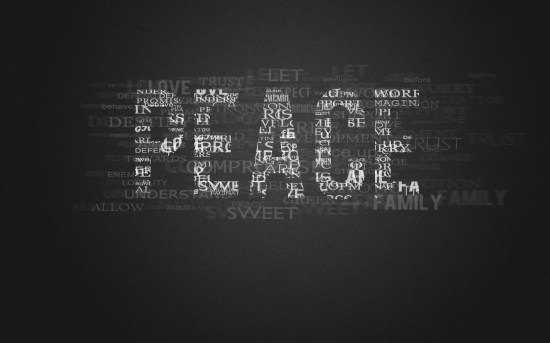
Peace, briefly

Peace-Typography-Wallpaper-Widescreen-HD

Christmas is the time of year we look for the familiar, the consistency in our lives we lean on to support all the craziness life has become. We recall stories from our youth, we talk about old times and of things to come. We share food and clean up and drink wine and laugh telling the same bad jokes and counting on the same silly family members to keep the mood light. Whoever cooked the stuffing will worry there is too much spice, and someone is going to insist you have just the last bit of wine in the bottle. The game might be on or music—at some point there will be music—and eventually everything will settle to the Norman Rockwell painting it should be. Some people will read new books, some will sit near the fire and have a drink and talk about those who have left us. The last thing everyone will say before heading off to bed is “Merry Christmas.”

It is the same in all homes though to varying degrees of comfort. Some living rooms are sparse, some will celebrate in shelters, and some under bridges somewhere praying for a warm night; the peace of Christmas is not dependent upon income or position. It is Christmas and some undercurrent of peace permeates our thoughts, our intentions. We want it to last. We are glad for what we have.

I do not understand why everyone doesn’t celebrate Christmas; I really don’t. I understand the ones who shun Easter; Easter, after all, is what makes Christianity what it is with the Resurrection as the foundation of the Faith. It is Easter, after all, that set the whole Religion in motion. So if you don’t buy into the resurrection part, well then Easter is not for you.

But Christmas is when we celebrate the Birth of Someone—Son of God, Messiah, Prophet, call Him what you will based upon your Faith, or lack thereof—who is literally the personification of peace. It is not the season to directly recognize His divinity; Christmas is decidedly about His humanity. The Man preached absolute peace, encouraged us to love our enemies and forgive them, reminded us to remember our own shortcomings, and insisted on love as the basic tenet of life. Who can possibly have a problem with that?

It seems a lot of people.

I have one friend who hates Christmas. Despises it. Absolute contempt. Though to be fair, he feels that way about everything and everyone. But this time of year he is especially hostile. I don’t know why except he believes not believing in the divine means you shouldn’t believe in the humanity. That makes no sense to me. Shouldn’t we start with humanity? Isn’t that the point to begin with? If you don’t comprehend the mystery of the resurrection, you can at least understand the life of this Rebel who stopped history in its tracks.

He cracked history in half so that even those who crucified him must be dated relative to His life. Christmas Day is a chance to remember the one Person who had perhaps the greatest effect on all of humanity.

Some don’t like the shopping, the carols, the crowds, and the commercialization of Christmastime. I never understood that either. If you don’t like the commercialization and crowds and shopping then don’t buy anything. But to put a positive spin on it all: it is the season when retailers do well enough to keep the prices down, when even the most tight-assed co-workers buy a tray of food for the luncheon, and strangers greet you with something other than disgust. It’s like a big, seasonal “time out” where everyone gets to pretend to get along. And some of those naysayers prefer to point out the hypocrisy of the season, noting the phoniness of pretending to be nice one day, saying “Merry Christmas,” and not giving you the time of day the next

Okay, but listen: if you have the choice of those around you being nasty only eleven months of the year instead of twelve, wouldn’t you take it? And since when is your peace of mind and happiness dependent upon what someone else says or does? If that is true then there is no better time to pause and contemplate the peace that is the season. That WWJD wristband so popular for a short time some years ago makes perfect sense. Here is The example of how we should act toward other people; here is The Ideal—a Birth that happened only one time in the history of ever—surely it isn’t a bad idea to take one day to recognize His time here on earth. Have you read His bio? Go ahead, Wiki Him, and then tell me His Birth isn’t worth celebrating.

My incoming seventeen-year-old freshmen will be the first group of students who were born after 911. They have known nothing but war, nothing but hostility, insecurity, terrorism, and fear. Surely now is a good time for some peace, even if ever so briefly.

How about this: make dinner and invite friends and family and tell stories of days long ago—like something out of a Norman Rockwell painting. Put some extra spice in the stuffing and make sure someone finishes off the wine. Put the game on, sit near the fire and have a drink and remember those who can’t be with us any longer. They’re missed, especially this time of year.

Peace my friends.

And Merry Christmas.

charlie-brown-christmas-i-can-tell-you-what-christmas-is-all-about

Get Back

widget-news_tcm7-211939

The earth was frozen here this morning, and as I walked along the sand at the ocean’s edge, I didn’t leave footprints. I moved along as if on pavement, and so I moved along quite a while despite the freezing temperatures and the winds from the northwest. The water was relatively calm, and it seemed almost an effort for the waves to run too far past the break. A few fishing boats moved out from the inlet, and several dolphins barely broke the surface fifty yards out.

This is my constant. This is any time of my life standing here in December, too early for the sun, watching some planet just above the horizon dim then fade to a brightening sky.

We are inundated with information, and most of it is negative, or contradictory, or frightening, or simply pathetic. From presidential tweets to congressional shenanigans, to civil-war-like partisanship, to murders and terrorism, to racism and hypocritical judgments; to financial fears for graduate students, middle class workers, young graduates, seniors on fixed incomes; to the awakening of brave women exposing the horrific trend in society of men—particularly those in positions of power—to blatantly or subtly offend others. My mind is saturated with information, and little of it is positive, none of it is healthy.

And the worst part of all of this is the lies and backstabbing. It has filtered down (or started, perhaps?) to the workplace. I swear to anyone who doesn’t understand, it has become impossible to know who to trust right in my own hallway.

What a hell of a race. Honestly, I simply cannot wrap my head around how a species with such potential can be so destructive on so many levels, from ridicule to greed to mass-annihilation. What the hell happened? Really, if God’s coming back, now’s good. Is God already here? Is that why no footprints in the sand this morning? I hope not; I truly would be quite disappointed to know that. I prefer this mess we have made is all from freewill. I can believe in that. Still, there doesn’t appear to be a plan, does there?

I understand this is an oversimplified view of world events and situations, and an idealistic reaction concerning what we are capable of. In fact, it crosses decidedly into triteness.

But one of the tenants of productive human behavior is to surround yourself with positive people, to step away from the negative ones, the complainers. To remain healthy, creative people should engage with other creative types, and planners and visionaries should be working toward new advances with other like-minds. Of course. But these like-minded individuals are getting harder to find. Or maybe—maybe—they’re still out there, they’re just harder to recognize for the cloud of unknowing coming from the media, from the meetings, from the droves of people speaking out of both sides of their mouths.

Perhaps I’m just tired. For the most part it has been a long, bad year. I just turned in my final grades and was reading some blogs here, and I thought how negative I’d become this year, how, well, tired I’ve become. On this blog I tried to justify writing about the college and politics and the world at large by noting that it is all a “wilderness.”

Until, that is, I stepped off the boardwalk and moved to the waves which didn’t make it much past the break, and the sand was firm like pavement, and my feet didn’t even leave imprints, and the cold wind coming from the northwest kept me decidedly in the moment. It all seems predetermined out there.  When was the last time you went for a walk outside in very cold weather? Not to the car, or from the car to the mall. I mean a walk without destination, absent of headlines and voting results. It is the ultimate in the immediate; it remains the only evidence of permanence I can find.

Out on the horizon this morning, well before the sun broke through, some thin clouds ran the length to the south like jib sails running out front heading to the Outer Banks just to the south. The water was warmer than the air, and sea birds kept diving by me as I walked hoping I had food. One landed near my feet disturbing a few sandpipers I was sneaking past.

The pier is closed for the season, and the lights running down the boardwalk were still on so I could clearly see no one was around but a few military out for an early run. One old man wrapped tight in a parka walked his dog.

But at the water’s edge all I could hear was water, and even that so gently I could sometimes also hear the dolphins’ fins break the surface. It was that calm. No hypocrisy. No backstabbing or negativity. It is the ultimate definition of truth. It remains the most honest experience I have found.

And so I came to work and I turned in my grades. It is time to head back to my small patch of woods at the river.

You’d be surprised. There’s so much to be done. “Count all the bees in the hive. Chase all the clouds from the sky.”

25399130_10213546157915780_7049320998632355963_n


Acknowledgements

1414083349-7-ways-entrepreneurs-master-self-awareness

I’ve been messing with this piece for a long time. I acknowledge now it is time to let it go

I’d like to acknowledge a few people without whom none of this would be possible. My parents, of course, and God, I’ve got to acknowledge God, it’s required of these kinds of things. I’d like to thank the friends that got me here, like Eddie and Steve, Mike and Dave, Sean and Tom, Tom and Tim, oh I could go on, yes I could go on. I’d like to thank those that influenced me: Tim and John. The Muppets and the Velvet Underground. Jackson and Bruce and Billy and Eric, Jimmy and Neil—the other Neil. I can’t forget the places from where I would not end up here: the Shack and the dives along the way. The Club and the Bull and Finch. The Golden Tiger and the Blue Door Blues and Jazz club where they don’t play blues nor jazz and the door is brown, but really that makes me thank them more. I’d like to thank those who took a chance on me and then broke up with me; those that said I was worthless and forced me to do something valuable out of spite. I’d like to thank Spite. God Bless Spite.

I’d like to acknowledge the people who left impressions on me that cannot be repaid. The profs and elementary school teachers. Mr Kingston for caring; Mrs Guidice for understanding we were only five years old.

I’d like to acknowledge that I’m impatient; that I’m intolerant of people who repeat themselves; that I’m lazy; that I’m prone toward wandering instead of being focused. I have to acknowledge right here that I’d much rather have taken more time after high school; and then after college instead of ending up in Mexico headed to New York. I’d like to admit it was simply a matter of thinking something would simply drop in my lap.

I’d like to acknowledge that I am irked by people who use sentences in the form of a question when they’re not really asking anything. I’d like to acknowledge I’m as curious as to what happens to the assholes who I’ve taught as much as I wonder about the honor roll members, who often, I must admit, are equally assholic.

I’d like to thank my son without whom I would not, to the best of my knowledge, be a father. I’d like to acknowledge it might be the only thing I never tire of doing. I’d like to admit right now I tire of doing everything else really pretty quickly.

I’d like to have known my grandfathers.

I’d like to thank Camus for making me question everything and Indiana Jones for making me think I know everything. I’d like to acknowledge the people who pick up the cigarette butts most people flick out the window because they’re too-lazyass-bark-at-the-moon stupid to use their ashtray.

I’d like to acknowledge Aaron Sorkin and the writers of West Wing and Newsroom for some of these lines.

I’d like to thank Kathleen who I knew when I was five. And Kay, of course, and the early morning calls of cows in the distance.  I’d like to thank Essie. I’d like to thank Lynn and Kathy and Michele—not that Michele the other Michele—and Mary and Joan and Margo and Lisa. I do not wish to thank Stacey. Freak.

I’d like to acknowledge people like Albert Schweitzer and Mother Teresa and other contemporaries of ours for making me realize I’ve really done nothing at all.

I’d like to thank my inexperience in starvation, my ineptitude in homelessness, my warless neighborhood, and the plague-less road I’m on.

I’d like to acknowledge rest stops and urinals. Or trees, I acknowledge both equally. I’d like to take some time right now to acknowledge the passing of time, the quickness of life, the fleeting moments during which we are truly passionate, the ability, the possibility, and the stability. I’d like to recognize my ability to know when it is time to move on, to let go.

I’d like to thank myself for not hurting anyone. I’d like to thank those I might have hurt for dropping my classes. Ironically, I’d like to acknowledge I’ve hurt way too many people. I’d like to take it all back. I’d like to give it all away. I’d like to leave it all on the playing field. I’d like to go back and run one more time on the south shore beaches where my grandparents lived, where we’d walk along Freeport Avenue smack dab in the middle of the road where the cement slabs met along long strips of soft tar, and we’d press our toes into the tar as we made our way to the ocean, and be two behind my sister, one behind my brother, in front of some cousins, and later we’d go back to the house and explore the ancient attic. And we’d drive home late and in the morning I’d wake to the sound of foghorns drifting up from the Great South Bay. I’d like that a lot. 

download