DNA Grandma: A Memory


IMG_3608
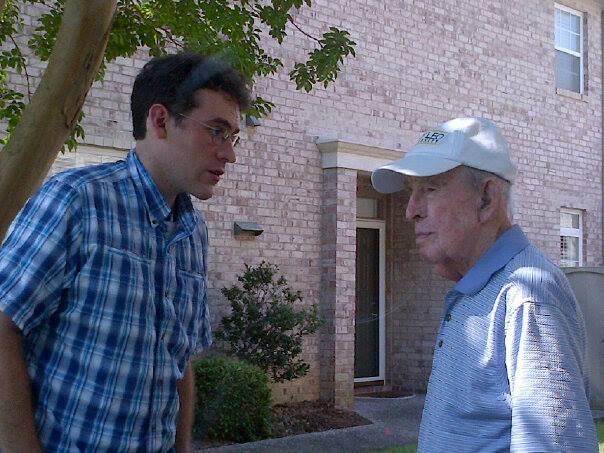
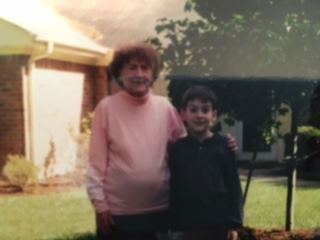
Michael with “GG”       August 23, 1913-April 15, 2005

My grandmother lived long enough (I was in my forties when she died) for me to know her well, and for my son to meet her several times. Not long before she passed away, he and I drove to New York to visit her. This previously published memory is from that trip. 

*****

We drove east on the Southern State Parkway on a clip out to eastern Long Island to visit my ninety-one-year old grandmother. Traffic backed up by Kennedy Airport an hour earlier, but that all thinned out until finally, after a quick stop at Stanley’s bakery in East Islip, we slipped out along Montauk highway, the October morning sun still in our eyes, and we swept past villages where islanders hosed down sidewalks and set up sale tables all along the main streets of every town from Oakdale to Montauk. In West Sayville my son said he was hungry again, so we ducked into some coffee shop for buttered rolls, crumb buns and juice. Some newbie teen wearing an “I’m hot on the Island” t-shirt gave away free bakery cookies, and Michael waited for those while I bought breakfast. We just wandered east and west until we headed to the hamlet of Oakdale.

At my grandmother’s, I knocked for five minutes, could hear the television streaming out from her second-story window. She didn’t answer so I called her on my cell from the sidewalk.

“Oh, you’re downstairs. You know, I thought I heard someone knocking so I looked out, and I thought it looked like you, but I wasn’t sure, so I watched TV for a while longer.”

“You knew I was coming at this time, right Grandma?”

“Is that Michael next to you? He’s so tall, how old is he now?” We talked from sidewalk to window, looking at each other.

“Grandma, can you buzz us in?”

She buzzed us in. We talked a while and I stared at the same furniture, same knick-knacks, same pictures she had around her since I was a child. She got rid of the plastic that covered the furniture when she lived in Queens, but I sat on the same like-new chair, her and Michael sat on the same sofa she had since the Kennedy Administration.

“How old are you now, Michael?” she asked.

“Eleven.”

She raised her eyebrows. She’d not seen him since he was three. “Is he your only one?” she called to me three feet away.

“Yes. He’s it.”

“Oh, Michael, that’s wonderful. Thank God you’re the only one—you’ll get everything. How old are you now?”

“Eleven.”

“He’s eleven. Oh my, I haven’t seen him since he was, what? Five?”

“Three.”

“Oh! Imagine. Is he the only one at home?”

“Yes, he’s it.”

“That’s something, Michael. Thank God you’re the only one at home. You have the house to yourself. How old are you now?”

“Eleven,” he answered, as if for the first time. He has more patience than I do.

“Eleven! Imagine. Is he the only one at home?”

“Yes, Grandma, I killed all the others.”

“Oh, Thank God you’re the only one at home—you’ll get everything!” she said, again. Twenty minutes of this. We talked. We remembered. I told her about the time she watched my siblings and me when our parents were away, and how I loved to call her weekly when I was in college. I’m sure she didn’t remember, but she always acted as if she did. She motioned toward the flowers on the coffee table and we said how pretty they were, and a few times I noticed her enjoy the breeze through her window. I looked at pictures on the walls and she told me who everyone was and when the picture had been taken, and I was happy to know at ninety-one-years old she still remembered.

“You’ve got a great memory, Grandma,” I said. “Better than mine!” She laughed and waved her hand.

“Oh there are many things I’ve forgotten,” she said, laughing quietly. Even now I can see her shoulders fold briefly in humility as she laughed.

We ate ham sandwiches on white bread and drank tea. We talked more about my mom, and she asked a lot about how my siblings were doing. She mentioned some cousins, and we talked about Michael and how she remembered being with him at his grandparents’ home in Virginia Beach. It was a pleasant morning and afternoon, and it made me wish I had spent more time with her when I was younger. We do that though, we appreciate people only after the time to spend with them runs thin.

Eventually, we left. Before we did, though, my grandmother asked Michael if he wanted anything.

“Take whatever you want. Anything, just take it.”

“Oh, no thank you though,” Michael answered politely, scanning the room.

“Oh, come on, take something. Take something from that shelf there—there’s some good stuff there,” she called out, sweeping her hand toward the dining room. I gave Michael a nod, let him know taking something in this situation might be a compliment, a way to let Grandma know we appreciate her. He picked up a bowling trophy my mother had won years earlier. Perfect. Later, in the car, he told me he chose that because he wanted to give it back to his own grandmother who had won it.

A few days later my grandmother called my mom and wanted to know who took the Goddamn trophy.

It is So Hard to Tell, Sometimes

chapel-rain

A steady rain fell throughout the day. The grass and trees remained still, and when the rains let up, birds moved about. It was one of those rains I remember from my childhood, when it rained all day and I spent it stretched out on the floor watching black and white movies or westerns, and I waited for the weather to pass so I could go outside, where a soft steam rose from the wet streets. Today was like that.

Along the river the rain made the water seem as if it was simmering, or schools of fish teased at the surface. Someday when I look back instead of ahead, it will be days like this I will miss. It was a peaceful day.

At an art show today in which Michael participated, across from his display sat a young woman, a girl of about sixteen, sitting alone at a small table with a display for an organization to help women who have been victims of abuse. She sat quietly looking out at the rain, sat there for four or five hours, reading, not checking her phone, just reading, talking to only a few people who stopped by to pick up information or make a donation. She seemed quite relaxed, watching the rain, reading.

I wondered if people didn’t stop so as not to be recognized as seeking help. It is a very small village and clearly many of the attendees knew each other. I considered perhaps being such a small village in rural Virginia not far from the Potomac and the Chesapeake, abuse was not that common. But I guessed that wasn’t true either.

I wondered if the girl was only a volunteer or was this mission perhaps something more significant to her. She sat so peacefully watching the rain, reading, and talked to the few who came to pick up information. I watched one woman walk away from the table, a brochure in her hand, and it was her last stop before leaving the area. It might be possible the young woman saved someone’s life today. It might be very possible. It is difficult to determine how what we perceive as small actions might be salvation for someone else.

I’m guessing the young woman knows this.

Peace is not easy to identify. Tim O’Brien once wrote of the beauty of Vietnam, staring into the languid green forest, dreamlike in its beauty, before going in to kill or be killed. And anyone who has been near water long enough understands the tow that can drag someone out to sea and drown him lies deep beneath the calm surface.

No wonder tranquility is difficult to come by. Most of us can adjust to the troubles in life so well that we hardly recognize peace at all, so that the slightest relief seems as a tremendous respite. But real peace, the kind that makes us feel safe from harm, is not easy to recognize if it ever comes along at all.

I’ve been fortunate. I have known such peace so often for so long. I have indeed been mercifully fortunate. Sometimes I know where to go to find it, like those early mornings when my son and I head to the water to watch the sunrise; it is a given. Other times it takes me by surprise. Like today, when I walked behind a building, standing under the overhang, and stared across a field of deep green lawn with trees in the distance, and a steady rain fell, not unlike the rains of my youth when worries were still decades away. I was caught off guard; I had been thinking about the young woman, wondering how she came to be at that table, reading, handing out brochures only to those who asked, and then I walked to the back and watched the rain.

Tonight it is raining still, and the steady sound on the skylight has a lulling effect. It was a good day, it was such a peaceful day. But not for everyone.

IMG_3535

Here. Now.

download

It is the most sobering of realities that the further from humanity I step into the palm of nature, the more I am aware of humanity’s tragic state.

When I am in the towns and villages, and even more when I am on city streets, it is not difficult to look for and even find value, and without much difficulty or distraction. From the city parks where children play, from the new skyscrapers saving space and housing homeless, from the missions feeding the hungry, from the colleges and universities professing that perpetual discourse, from the street artists given the chance to shine, from the monuments reminding of heroes and saviors, from the church cross, the mosque dome, the temple star, the marches and parades and processions, hope exists and again and always chisels away at apathy, at lethargy. We see it just by looking around.

But then I step away and, from some distance, witness what simmers across humanity’s horizon. Defensiveness shifts to aggression, diplomacy turns toward ridicule, compassion is swallowed by greed, and understanding is absorbed by narrow-mindedness. Insignificant fissures when seen from a distance seem massive crevices no longer navigable. I step into the wilderness and turn back from where I walk and see little more than a conglomerate of desperate attempts to win without compromise. John Nash wrote that we must do what’s right for ourselves only if everyone else benefits, or we are destined toward demise. The voices of the Mother Theresa’s and Albert Schweitzer’s and Martin Luther King’s of this world are suffocating beneath the rising wave of ridicule, resentment, and retribution. We must help others not because of who they are but because of who we are. But from this vantage outside the city gates, winning is no longer defined as progress to benefit humanity, but the defeat of another. It seems the idea that someone must lose in order that one win has shrouded the reality about our species: we are tethered by truth. The progress of one is wholly and unequivocally dependent upon the progress of every one.

So I prefer nature. Its truths are absolute. It relies upon respect, it has no subjective approach, and it shows no favoritism. Its instinctive bend is respect.

I am not smart enough to understand the causes of a crumbling society, and I have not nearly the ability to keep pace with comprehending the effects of racism, ridicule, greed, and power. But from this view in the wilderness, society is slipping away from any ideal it may have once pursued, and the climb back is not easily traversed. Then I turn toward the waters and wild lands still unblemished by the body politic, and I have that hope again that there is balance, that some guardrail of reason will keep us from straying too far.

download (1)

Drawn

33472148_10214825475857929_1973836389350899712_n

Without air conditioning in the house for the past ten days and another seven more to go, nature has been very present. The windows are open all the time, and the bay breeze helps a bit; well, as much as it can in 100 plus heat-index temps. Fans in the house keep things circulating, and it isn’t that bad really.

But the significant result of this primitive life style is the sounds. Birds have always surrounded the house, filling the woods here at Aerie like the nest it is named for, including hawks and the occasional bald eagle. But right here, on the porch, in the apple trees and the shrubs around the back, is an abundance of birds, including Carolina wrens, cardinals, finches of all types, indigo buntings, gnat catchers, thrushes, robins, blue jays, bluebirds, tufted titmouses, and more. I suppose the home has always been the resting spot in this aviary of woods, but with the windows open, the birds are more present, and their songs filter through the screens like the sounds of music from radios on neighboring blankets on the beach.

Since the air inside remains more stagnant, even with the fans, than the open air outside, I spend most of my daylight hours wandering around the trails and along the river. The growth from the rains of this past spring is deep with laurel along with the deep ground cover of fern keeping the woods cool. And the garden has become my preferred place to retreat. There, cherry tomatoes, cucumbers, and eggplant not only grow well on the vine, the unmistakable aroma of the vines from the cucumbers and the fragile limbs of the tomato plants identifies summer to me as much as the temperatures.


I don’t need to remind myself how fortunate I am to be here, to be surrounded by beauty in virtually every direction. People spend a great deal of money and time to head out of the cities to places just like this. Yet most of the time I sit here with the windows closed, the ac blowing, oblivious to the graceful presence of life just outside. To be fair to myself, I do spend more of my waking hours outside and I always have, but there’s something about changing the view a bit which awakens in me some sort of new appreciation.

This morning I went to the bay like I always do and watched the sunrise. A line of clouds sat just above the horizon, delaying the sun’s appearance a bit, but also increasing the beauty of the dawn with its red and orange hues. Normally I am not there long before rushing to the gym, but this morning I sat a long time, listening to the water hit the rocks. It was gentle but fast, moved ashore with the help of Hurricane Chris some three hundred miles to the east, far enough away to not affect us except for the pace of the current. Osprey landed nearby and gulls dove for food. And a rare sight this morning, some river dolphins fed just at the mouth of the river. I’m glad I didn’t sleep in. I’m glad I didn’t rush off.

We all seek some sort of foundation, some “cushion” we rely upon for our definition of psychological comfort. Financial advisors come up with numbers for retirement to “maintain” the lifestyle we have become accustomed to. For me, the value of my life has always been and I’m sure will remain how close I can keep with nature, whether it be on the trails of Northern Spain or the paths here at Aerie, to hear a river run, or the call of countless birds, or the breeze moving leaves making for an orchestral accompaniment to the wrens and finches. Yes, I am well provided for.

As I step away from the daily grind of critical thought and argumentative structure, as I turn away from the pointless commentary regurgitating from screens, as I move away from the stagnant presence of prefabricated comfort, I come to life and it is as if for the first time every single day.

14390843_10209455138722857_5153586685275969290_n

Somebody’s Ringing the Bell

Peace-Typography-Wallpaper-Widescreen-HD

My uncle would bring fireworks and Dad would grill Italian sausages and burgers on the grill. All our relatives came, and we swam in the pool. I can still smell cut cucumbers in the kitchen, and at night, just around dusk, Uncle Bob would set off fireworks and neighbors all sat on stoops and at picnic tables and on the grass in our yard and watch.

It’s easy to look back fifty years and see events differently, like looking through the smoke from bottle rockets, but some things are clear.

Like the music, which sometimes was probably Sousa and Cohan, but I recall more often it being the thin tin sound of a transistor playing late sixties music of the day, like the Beatles or the Beach Boys. Over at the beaches of Point Lookout the hot sand was spotted with blankets and the smell of Coppertone, and radios played and I lay still with my eyes closed. They burned a bit from the sun as I listened to a dozen different conversations of surrounding ladies in beach chairs. I can hear someone say to someone else she thought I was asleep, and then something about how the sun can tire you out and the waves too can tire you out, but that wasn’t it. I was just listening and smelling the lotions and pushing my heels into the sand.

In the ice chest we had hard boiled eggs and Tupperware with salad, some sandwiches and potato chips. I was young though, very small, and I don’t recall much more.

But on the Fourth at our house we had fireworks at night and neighbors and relatives sat around clapping as fireworks exploded above us. The screen door was in constant motion, and everyone was talking to someone else. It was the Fourth and flags flew everywhere. It had been less than ten years since they added the last two stars to the grand old banner, and the country was not nearly at rest—race riots and war protests ran rampant. Johnson or maybe Nixon was in the White House, but all a kid my age cared about was the food, baseball, the music, and the sounds of friends and family laughing, remembering.

It was as if on this particular day, everything was going to right itself; no one was starving and no one was at war, just for the day. At such a young age it was easy to believe that everyone everywhere was having sausages and hamburgers and clams, and everyone was listening to the Beach Boys and playing ball. What an illusion that was, what a beautiful spin.

And yet it is the very backbone of this day, that illusion, that idea that we might still hold those same truths to be self-evident. And despite a fading memory, it was that belief then which has survived—that we wanted to share this day, this idea, with everyone. We honestly and with declaration wanted everyone to sit at our table and share in that feast, sit back and watch the rockets’ red glare. We were together on that, yes, we were together. Families, sharing the day—together, and we knew, I mean we knew it so well it wasn’t even discussed, that this is how it should be for anyone who wants it to be that way.

Man how I’d love to share this, the idea of this day, at picnic tables everywhere, families together who want to be part of this, sitting together, reunited at picnic tables listening to music, laughing, having Italian sausages and hamburgers and clams, some chips, and knowing no matter the struggles sometime faced, they faced those struggles together, equal, in pursuit of some greater happiness they don’t even know yet but dream of, hope for.

Today I’ll grill, watch some fireworks tonight out over the River above Yorktown, where the dream was secured so long ago. And I’ll listen to music, like Paul McCartney, who right now in the background is singing, “Someone’s knocking at the door, do me a favor, open the door and let ‘em in.”

36585228_10215105608501070_756293279254839296_n

Feels Like

IMG_3168

Today there is a heat index of 108. The actual temperature is about 97. For my friends in dryer climes, that means while where you live 97 feels like 97, which is already pretty hot, in areas of high humidity where the air takes the heat and boils it a bit to make it more interesting, it feels to us like you would feel if it was 108 outside. Or, as Lewis Black likes to point out: Then it’s 108!!

This weekend it is the same temperature inside since my air conditioning is broken and they can’t get out here to fix it until Monday at the earliest. I have fans going, windows open for a cross-non-breeze, and, well, I’m sweating a lot. I really don’t mind. I’m working in the garden where I know it is exactly 82 degrees right now but will spin quickly into the mid-nineties. I always know the temperature in the garden. Also, I’m doing a lot of other outside work, I’ll hose myself down, do more, then drive to the market in the village to sit in the car’s ac for a bit. Also, I bought lime ice pops.

I remember once when I lived in Tucson and the temps were in the mid one hundred teens, I called my dad and was talking about it and he said, “Yes, but that’s a dry heat.” Yeah. So’s a blow torch. I parked my car outside a mall in South Tucson for the day and when I came out a portable plastic clock I had on the dashboard melted.

It’s so hot that swimming in the Rappahannock with water temps around 80 feels cold.

Still, it is what it is. I’m of the philosophy that complaining about it, or ever mentioning it to be honest, simply makes me more aware of it and, therefore, makes it worse. It is what it is. I’m going to go work in the yard and lose a few pounds by clearing out part of a trail I have been wanting to work on, and tending to new flowers I’ve planted which, apparently, deer don’t like. And I’ve got plenty of water. It’s like the time Michael and I walked from Sanguesa, Spain, to Javier, Spain, about 8 miles, on a desert, uphill, no trees, road. When we paid attention to the amazing vistas southeast of Pamplona, I forgot all about the heat. I took a picture of my son next to the sign welcoming us to Javier, and he is dripping in sweat, but has a look on his face, as did I, that said there is nowhere else on the planet we’d rather be.

I even said to him this morning, “108 today.” His reply? “It’s June.”

Yeah. Have another lime pop.

The physical effects of weather are said to be among the strongest memory triggers we possess. When a cold wind blows in January I’m immediately transported back to Rich Stadium in Buffalo, or Freeport, Maine, one disturbing February afternoon. And when it is hot like this, I remember the small patio outside my parent’s condo. Dad and I would sit out there and talk about work, about sports, about nothing at all as he sipped a beer and watched the thermometer on the fence. He loved to tell me when it was about to hit 100. Some days it would make it to the mid-nineties and he’d say, “I really thought it was going to make it today, but it didn’t.” He never, ever. Ever. Complained about the weather.

The thermometer is hanging on the back of the shed in the middle of my garden letting me know what the real temperature is; I have to figure out the “feels like” part on my own by just adding fifteen degrees and subtracting one lung.

But later I’ll go out and listen to the Mets on the radio while I tend to some plants and remember what it was like to sit on the patio. And it will be hot, obviously, and I’ll sweat a lot and glance toward the thermometer waiting for it to hit 100. But I won’t complain. It is what it is.

10494607_10203730069799712_2632277734938169416_n

Greetings and Salutations

van gogh's letters

Dear You,

I’ve started to write letters again. Emails, yes, but letters as well. On actual paper. I sit at one of the tables here at Aerie and cover my iced tea from flies in the hot summer air, find the spot where the shade hits the table and place my pad down, and write. I write about my garden, about the bay, about travel plans or family matters, depending upon who I’m writing. I don’t write about writing. I try not to write about anything negative, and I never have and never will write about politics in a letter.

When I was young I wrote a lot of letters. On summer vacation from college I wrote friends in other parts of the country, and even after college kept a close written communication going with a few people. One is a woman I’ve known since we were freshmen, and another is a priest who I remained very close to through the years. I still have some of those replies, and some I recently sent back so my friend can see what was on her mind thirty-five years ago. I wrote probably a few hundred letters to someone in the air force back in the 80s. Here’s how far we have come since then: At that time I would have to address the envelope with her full name, followed by her full social security number—right there on the front of the envelope. I still remember it, actually.

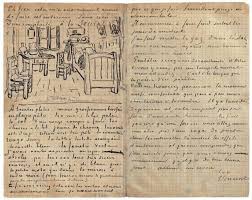
Letters used to be the sole source of communication. Vincent van Gogh wrote more than two thousand pages of his thoughts to his brother Theo, a sister, as well as fellow artists. Thomas Jefferson and John Adams letters to each other famously expose the thoughts of our forefathers, and even as far back as the early Christian era we have Paul’s letters to the Corinthians. I just want to write some stuff about my garden and mail it in an envelope to my friends.

I learn so much when I write letters. Simply by telling other people what I’m doing, I’m reminding myself how I spend my time. It also allows me to sit in nature, slow down, and take my world one word at a time. In an age that is spinning at Mach 6, writing is like sitting on a stage coach, but that’s okay. Remember those days when we would anticipate mail from a friend or a lover? It seems like a long time ago now, but I recall the satisfaction of dropping a thick envelope into a mailbox, or opening mine to see that marvelous white rectangle of someone thinking about me.

My sister found letters our dad wrote to his mother when he was eighteen. When I was in college my Great Uncle Charlie, who was in his early nineties at the time, wrote me letters and often included poems he wrote. This was a man who fought in France during World War One. And when I was in my late teens he was still writing letters and poems and dropping them in his local postal box. I don’t know what happened to those; I moved around so much. Also lost are letters from my childhood friends on the south shore of Long Island. During the first year or so after my exodus, we wrote religiously. I am back in touch with a few of those people from that time, but I wish I still had those epistles of what we were like then, our hopes, our plans, our fears, and our indescribable confidence which time has eroded along with our penmanship skills.

I know the problems in resurrecting such an ancient art form: besides the “slowness” of letter writing, there is the “I don’t really know what to write about” aspect my mother used all the time when I was away at school. Then there’s the “I don’t have time” factor which is just a crock. Sitting down to do anything for ten minutes is not an Olympic feat. And can we please just stop with the “it’s just easier to email” laments. Yes, it is. Write anyway. My favorite avoidance mantra is “I think faster than I write and I can’t slow down to do it.” Geez if you don’t think faster than you write than you’re probably legally brain dead. As Neil Diamond wrote, “Slow it down. Take your time and you’ll find that your time has new meaning.”

As for the upside, it helps me remember what is important in life that I want to write about it, and it reminds me that since I spend the vast amount of my time doing things I don’t deem worthy of including in a letter, I should appreciate the small stuff through the day as much as the grand letter-worthy events. It really does slow me down, helps with my blood pressure, my stress, and sometimes I might sit back while writing a letter to listen to the wrens or the cardinals, or leave it all on the table and wade in the river a bit before returning to finish. Mostly though, it is instigating a physical presence in another’s life in a completely non-threatening way; it is my DNA sealed and sent to another state.

I wish I had written back and forth with my father, or kept in written contact with some friends from Spain. I’d love to have heard from my grandparents, or to read a collection of letters from ancestors from another land. They are treasures; they are history, humanity, emotion and time, all in one stroke of a pen. 

Despite the losses of valuable letters from loved ones through the years, I still have some I cherish. I have a few from Leo Buscaglia, one from Martin Sheen, and one from Michele Obama. I have some from friends in Germany, Russia, and various other distant places. When I was young I remember my brother had a pen-pal in Germany. I would love to start a correspondence with someone far away, someone I’ve never met. According to the data page of WordPress, this blog has readers in seventeen countries including India, Japan, and Australia. If anyone is reading this, drop me a line, hand-written, to PO Box 70, Deltaville, VA 23043. I will reply, Promise.

I’ll even stick a leaf in the envelope to send along a small piece of Aerie. It really is peaceful here; a place to write home about.

Always,

Bob

siberia-phone-316

Words, and Fathers and Sons


download

for Thomas and Frederick

Right from the start I should have seen it coming. The predictable phrasing, the expected lighthearted laugh. I read you again last night, thinking of fathers, thinking of sons. I know your work. I know you know I know your work; the repetition, the subtle humor, the this-was-my-life-too reaction. Was it Ode to Your Father? Maybe. Or maybe Mosaic. Doesn’t matter.

I should have seen it coming.

The casual start, the familiar tones. The narrative rise, the trademark dialogue. The way you write is the way we talk at lunch at that oyster joint. I know the style the way I know the lady with the drinks is going to comment about our return, offer us menus, tell us the specials, not write down our usual order. It’s routine.

Yet I never see it coming. This last time it took two pages of standard stanzas before you made that turn, me tagging along like some newbie waiter. Like the time we talked about our dads, and how tragically humorous it all is, how funny and horrific it all is, and we swapped stories until we couldn’t breathe from laughing—predictable, anticipated. Then somewhere just after she cleared the dishes and asked if we wanted dessert, you remembered a cologne, or was it his robe, and we sat a long time in silence, tried to digest the reality of it all.

Always, you shift gears and make that turn, move us away from where we thought we were going. And I know you will take us there the way you always do, but I always forget, always think this time it will be different, it will stay the same. I never see it coming until it comes, and then I wonder how I never saw it coming.

A bent perfection, the way it makes sense in the end, the way you take us around your elbow and past your ass without a glance back, how you seem to let go all the while keeping it tight; and every time is the same, the way it’s always different. The well-timed turn: predictably unexpected.

Like when you said sometimes he forgets what is real and what is less than real, like westerns or how tall you are. I said for me it was the lucidity, that last time, how just before the end it felt like the beginning again, and he was young and so was I, and then he let go and just left me there, alone, completely expecting him to stay even though I knew, I mean I knew because I saw it coming, was warned it was coming, that he had to go. Nothing prepares you for the turn, no matter how often you sit there knowing, waiting, anticipating, prepared. We had been talking about where he was and why he was there. He made a joke and we both laughed while the clock spun back two or three years. The nurse came in, asked if he was okay, and the sorrowful tone returned, the distance and incomprehension.

And I cried, just like I thought I would, and it caught me off-guard, and I left. Outside the October morning crawled into my spine, stiffened me against the cold. It was clear, that day, and I could see to the horizon and beyond the horizon, all the deep October blue that was beyond the horizon that morning.

On the radio the weather called for rain.

23031196_10213220771541324_2334011600534418472_n

Fathers and Sons


9f010263688c2bc786ba57174ab05fc7--haunting-photos-railroad-tracks

(the following is an excerpt from the manuscript about Siberia; part of this except is adapted from a previous work of mine which ran in Kestrel and went on to an anthology. The rest is new, but all of it is an abbreviated form of one of the chapters I want to share today, Father’s Day)

Dear Dad,

Before we boarded the train in St. Petersburg, we waited at the station for several hours. I wanted to get there early so I could painstakingly decipher the Cyrillic letters and figure out where the hell we were supposed to go. That didn’t take nearly so long since our next stop was Yekaterinburg, a few days ride, which on the boards doesn’t look much different than had it been in English. So Michael got something to eat and I stood watching what appeared to be a father and son, about your age and mine, sitting on a bench talking.

I guess they were deciding what to eat. There are many father/son combos here, Dad, and they all seem to be eating or about to. I couldn’t understand them so I simply did what we all do when we see a familiar scene: I remembered.

I miss meeting you at the mall. We always sat on a bench near the food court you always asked if I wanted something to eat. Always in your marvelous deep voice you would ask, “Would you like to get something to eat?”

The conversation was always the same:

“No thanks, Dad, I’m good. Unless you want something.”

“No, I’m fine. I had lunch with your mother and I’m sure we will eat soon after I get home.” It was always about two or three in the afternoon.

“You sure? Some fries or something?”

“No, but go ahead. You have to teach so you’ll be hungry.”

“No, Dad I’m fine, really.” Then I’d change the subject to the places in the food court and which were my favorites, and you always agreed. We have the same taste. Or you would add how much you like the chicken sandwich at one spot.

That routine of you asking if I wanted something to eat started when one time we sat on the bench and I actually did want something to eat, so after that you always asked. If I did occasionally buy something I always got fries with it whether I wanted any or not. Did you know that? I did because it was the one food you would share. You would lean forward and say, “Maybe I’ll just have one of your fries,” and laugh and take one gracefully. I was always glad when you did. I always hoped you would.

The food court here is small, in fact the entire station is not that large but is busy. There’s a soccer game on the televisions, and so naturally I’m thinking of you and our walks at the mall and the baseball games. I love how even when it was empty Dad, you didn’t want to take a table from someone who perhaps might wish to sit and eat. The one exception is when the television at the information booth in the court showed a baseball game; then we would sit at the table near there and watch for a short while. In fact, during the summer it was the first place I would check when I came in the mall looking for you between my day job and my night job. When it was a Mets game on television we wouldn’t walk at all but instead sit for a bit and watch the game and share some fries. I liked those days. When I think of us watching the game at the mall it helps me forget how much we slow down, walk more slowly, with more purpose.  When the Mets won, however, we both felt young and the walk back through the mall to your car was swift and light.  I was sad when the Mets lost but not because of the game.

Michael sat down with me and is looking through the only guidebook available in English about the Trans-Siberian Railway by Bryn Thomas. I wonder if people notice this father and son from another world working their way across the continent, and I’m still watching the father and son across the platform since they got up to walk a bit, and I’m concerned for the old man. He doesn’t look steady, Dad, and he has no cane and his son is ten feet ahead of him. Poor guy. I’m going to teach Michael how to walk with me when I’m your age. Maybe I should go over to this old man’s son and explain to him what I learned through years of practice when I would “accidentally” run into you at the mall between my jobs. I’ll bring Michael with me so he can hear and know what to do thirty-five years from now.

I’m going to do it. Dad, I’m going up to my Russian counterpart while your counterpart is still ten feet behind him, and I’m going to tell him:

Sir, first of all, he’s walking, you’re joining him. Don’t stop if he doesn’t. Don’t keep walking if he doesn’t. You are a shadow, an imitation only.

People should know how to walk with an older man.

Stand on his side where he can better hear you. If he can’t, repeat yourself as if for the first time, no matter how many times. Never say “never mind.” When he tells you something, you have never heard that story before, even if you can repeat it word for word. When he tells you about the baseball games with his Dad seventy years earlier, they are new stories, and your response must sound genuine. When he tells you about the time he went swimming at camp with his friends, and how when they went to retrieve their clothes from under a boat they found a snake, be amazed again, ask what happened. Laugh again since he will laugh.

When he pauses in front of a store, don’t question it. At that moment, allow that his sole purpose in pausing is to look at whatever item is in that display. He might mention how he used to own that tool, those pants. Let him know you remember; do not make a big deal that he remembered. He needs you to know he didn’t stop “to rest”—he stopped to look at the display.  Talk about his grandchildren. Talk about the rain. Do not talk about old times. There’s no need to recall the time he drove you to the airport for a flight to college, and you saw him hours later waving to you on-board the plane. Avoid bringing up the time just the two of you spent the day at an amusement park when you were a child. Instead, ask about the game and if he happened to catch it last week. You know he did. Let him tell you about it.

When he seems tired but doesn’t want you to keep stopping, stop to fix your shoe, to read a sign; look for a bench and suggest you sit and talk. He’ll ask about your son; he’ll ask about work. Have something to say other than “fine, Dad.”

Do not look at your watch. Do not check your phone; most definitely do not check your phone. Leave both in your bag. Do not indicate in any way he is keeping you from anything. No other time is relevant anymore. But you will grow tired and restless. If he senses this, he will insist you leave. He will say he knows you have a lot going on, and he’ll say he’ll see you later, and he’ll do whatever he can to make you feel he is completely fine with it. Stay anyway. Then sit a bit longer. Do not ask about the doctors; the walk is to forget about the doctors. Do not quiz him on medicine or schedules. He is out for a walk, you joined him, it is something about which he will tell others—that he went for a walk and his son was there and joined him. Do not let his story end with “but he had to go.”

When you leave be near him as he steps from the curb, but do not help. He will be fragile and unstable. The step from curb to parking lot is a leap; he used to do it with you on his shoulders and two others running out front. Let him step down on his own but be ready. He bruises easily and a simple scrape is a trip to the doctor. Have the patience he had when your childhood curbs seemed like the Ural Mountains.

Don’t say “I guess I’d better get going.” Don’t make plans. Don’t make any comment to indicate he did well or that it was a “good walk.” He didn’t do well and it wasn’t a good walk. He’s older now. He’s slower now, but he knows this. Really, once the walk is done, the time spent together always seems to have passed faster than we recall. He knows this as well.

The man my age is now too far out front. I’m not sure if his English is good enough, but I still think he’ll understand. Fathers and sons have a universal understanding, and this railway is all about fathers and sons. Mine is right next to me now. And he reminds me so much of you, making you ever-present. 

Always,

11037118_10206560973490535_2296163056617574444_n

Oh Canada! Please be Patient

41WwBT-k+cL

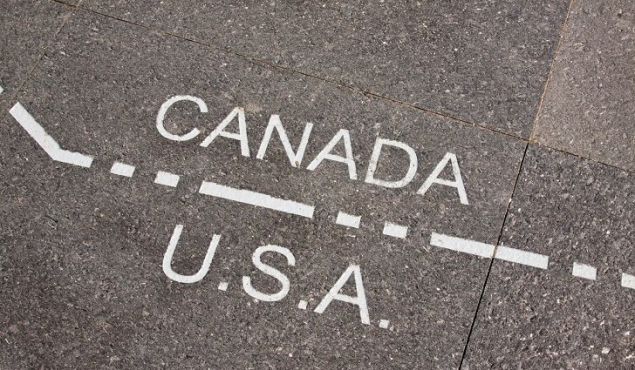
You’ve always been a patient nation. You don’t get pissed off when we win the Stanley Cup with mostly Canadian players; you understand when the average American can’t name half of your provinces; and you don’t seem to mind that we’ve pretty much claimed Michael J Fox as one of our own. But we are nervous; you’ve never been tested like this before, and there are few Americans who don’t sympathize with you, who don’t want to stand on Peace Bridge and scream north, “We know! We Know! We’re so sorry! Honest to Ottawa, we’re so freaking sorry!”

Politics aside, trade agreements aside, we apologize (and yes, I’m speaking for all Americans because this one is so blatantly clear) for djt’s rudeness, flippant attitude, crass words, irreverent approach, cowardly tweets, moronic understanding of relations, childish approach to discussions (patience please, I’m almost done), bullying tactics, short-sighted understanding, well…you get the point. We are sorry.

It is frustrating to see Mr. Trudeau act with such professionalism, such grace and diplomacy, and know had any single other human been in the office of the president, things would be fine. Anyone—honest, throw a snowball across International Falls and anyone it hits would have been better. We can sense your frustration as well. Mr. Trudeau is acting with obvious restraint because he knows in just two years we can purge this pathetic piece of moose dung out of office and reboot our relationship.

But at this point on the close side of the summer of ’18, the fall of 2020 seems impossibly distant, as long as a Yukon winter. So, please, we implore you to be patient just a little while longer. In the meantime, please understand most Americans have not lost our admiration for your people and your peaceful ways.

America hasn’t changed our desire to be best friends with you. Truly. We just are going through a phase right now—to put an elegant title on this dark period of our country, let’s call it the “years when this embarrassing thug of a cowardly piece of crap was president” time. It will be over soon and we can again appreciate how important we are to each other and how we won’t take you for granted again.

us-canadian-border