Progression

10468353_10204719160166353_5446898596181867433_n

I remember Dad was a coach for my Little League team, and I was not a good hitter. I could play outfield just fine, but at the plate I panicked. He offered me ice cream every day for a week if I hit a home run, and I did. He knew just what I needed for incentive. To be fair, I hit a line drive over the second baseman’s head which then rolled between the legs of the right fielder; several throwing errors later I scored. I asked the manager if he could mark it as a home run instead of a double with extra bases, and he said yes. Dad just laughed and did, in fact, buy me ice cream every day for a week. We’ve all got stories like that. We all remember moments like that. 

Then there was the time just he and I went to Jolly Rogers Amusement Park on the Island. Maybe I was eight. I don’t remember. But I wasn’t tall enough for some of the rides, and it was just the two of us. When you come from a family of five, time alone with anyone is rare. With Dad it was usually my brother and me with him, playing golf mostly. I like how most of us have several sets of memories—me with Dad; me with Dad and my brother; me with Dad, my brother and my sister. And of course all five of us. Those categories create different memories of various personalities. Dad was different when all three of his kids were in tow—more responsible, more reserved. Crazy how three kids can have completely different memories of the same event, the same person even, but put them all together and it’s a life, a home. 

Dad taught me to drive, how to come out of a curve, how to anticipate what all the other drivers might do, how to expect the worst. I remember how when I was a senior in high school, he’d let me have his car. He and I, twice a week, would go to a local Dunkin Donuts and have coffee (juice for me) and donuts (double chocolate glazed for me) and then I’d drop him off at his carpool and I’d head off feeling way older than my seventeen years. And in the decade that followed I traveled all over the country, and because he had a toll-free number at his desk, I would call a couple of times a week to say hi and update him on my whereabouts. He was always interested, and I must say, now that I think of it, I don’t remember him ever—ever—not taking the time to talk. Like the time I called from Massachusetts to tell him I was going whale watching off the coast of Maine. He was so excited, I can still hear his baritone “Oh boy, that will be something!” But I lied. I was actually in an airport when I told him that, and I was flying back to Virginia along with just about every relative we had to surprise him for his sixtieth birthday. When he and my mom walked through the door to a thunderous “SURPRISE!”  he said, “I thought you were going whale watching!” I swear I’m pretty sure he was disappointed I was there and missing that boat trip. I assured him I’d be going when I returned north. We all remember that party, I’m sure. That’s how I recall it; that and the mostly naked woman who showed up to sing Happy Birthday, compliments of one of my uncles. Mostly I remember Dad asking about Maine. He did his fair share of traveling in his life, but he loved to hear about all of our adventures.

I happened to start teaching college just before he retired, but Mom was still hard at work, so Dad would show up at my office around lunch time once he knew my schedule (to his last days, despite a fading capability to remember most things, he always remembered my schedule), and about once every two weeks we’d go to some fish joint around the beach.

Then Michael was born and since we lived just a mile around the corner from my parents, I’d walk Michael to their home during the week while Mom was at work and Dad and I would kind of talk—mostly I watched television while Dad held Michael or played with him, or walked him to the water to show him the ducks. I have more pictures of my son and my father together than either of them with me.
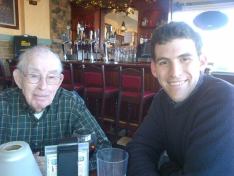
603239_4773049811633_2022425257_nMy son reminds me in just about every way of my father—quiet, patient, deeply kind—and that spills over into their passions for history and golf. The best times were when my brother came to town and the four of us would play, but even just the three of us was always fun. And always my father and my son would talk about books and about golf and whatever else there was to talk about. And they’d joke around. 

73923_1645228338051_8104227_n

My father’s feet, however, were never really strong, so he couldn’t join Michael and me in Busch Gardens with our season passes. At first Michael wasn’t tall enough for some of the rides, but that just meant we spent more time playing games until he had so many stuffed animals that we had to bag them and donate them to a children’s hospital. He still has a big blue fish around here somewhere. Since we live just a few miles from a beautiful golf course, we played a lot as he grew, and he always brought his camera along.

And then when my son was in his teens, I taught him to drive, how to come out of a curve, how to anticipate what all the other drivers might do, how to expect the worst. I wonder if when Dad taught me to drive, he thought about the same thing I thought about when I taught Michael—that what I really just taught him was how to leave home. I remember telling him about being in college and while other students in my dorm would spend twenty dollars on beer at the skellar, I’d borrow someone’s car and spend twenty dollars on gas and head to Niagara Falls or Lake Chautauqua. He got it right away. I remember how he figured out the highlander got about twenty-five miles per gallon, and how a gallon cost about $2.50 at the time, so he knew ten bucks would get him a hundred miles. I said to him, “So you’re asking me for ten dollars?” He looked past me for a second, figuring, and said, “No. I’ll need a hundred and sixty.”

Funny how now he can travel anywhere in the states and call me for free, tell me about his adventures.

But there’s one significant break in this progression of DNA—the gap between my father’s generation and mine was significant. His was World War Two, the Andrew Sisters, dressing down was loosening the tie, he and Mom had their friends and did their thing, and I had mine and did my thing, and never the twain did meet. But there is very little gap between my generation and my son’s. For the most part we listen to the same music, watch the same movies, and being in your fifties now isn’t nearly as settled down as being in your fifties forty years ago. 

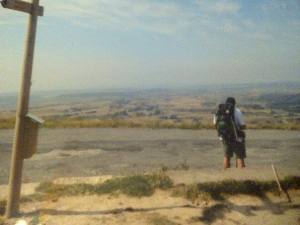
So when I headed to Siberia, Michael came along. And Spain was our trip together from the start. And through it all he would read everything, wanting to know the history, amazed at the details. 10389195_10203789585847576_5770525491992648158_n

These days, when Michael isn’t out at art galleries, he works in a library. And sometimes when I’m home I’ll drive down and see if he wants to get lunch at one of the fish places around, and he’ll tell me of his plans to ride his bike from Pittsburgh to DC, or to go do another artist residency on one of the Aran Islands in Ireland, and I tell him, with a tinge of envy, I’m as excited as he is, and I’ll probably be just as disappointed as he if he doesn’t go.

But he’ll go. It’s what son’s do.

23593430_10213325021347504_1335445623277996913_o

Passing Through

45671297_10216063551729052_8094733482770563072_o
Peklo Restaurant, Prague

There is history in all men’s lives

                                –Shakespeare

I am not a history buff by any means, though I have toured many historical sites around the world. Some of my favorites include Sagamore Hill—Teddy Roosevelt’s home on Long Island where I first went when I was in sixth grade and the last time when my son was about the same age I was then. I have a picture of me with classmates on that porch and another of Michael near the same spot. Very Cool. Another is Monticello—Thomas Jefferson’s home. Historical sites abound here in Virginia.

In Europe and Asia, too, I’ve found myself surrounded by history. In Prague, for instance, my favorite restaurant is Peklo, which six hundred and fifty years ago was a wine cellar where King Charles IV would occasionally indulge; they make an amazing duck. And all across Russia I’ve been able to experience history from the homes of the Czars to the train stations used by soldiers during World War One and the Russo-Japanese War just before that.

But make no mistake—I sucked at history in college and high school. Still, my own sister earned a doctorate in history from Notre Dame and has written extensively about American history, including her definitive book about Arkansas Governor Winthrop Rockefeller (Agenda for Reform). Her husband, too, received his Ph.D. from there and is a leading historian at Temple University, author of countless award-winning works about military history, and it isn’t unusual to see his familiar face pop up on the history channel as commentator. Even my father knew so much about history he could have taught the subject, and at St. Ephram’s School in Brooklyn eighty years ago, he won a history award for his abilities.

Me, not so much. I am a hands-on guy fascinated by items that survived time and war and neglect. I need an object, a talisman of sorts, to bring history to life to keep my attention. The irony is I have made so many trips to Russia for the purpose of experiencing culture that I became heavily steeped in history by virtue of immersion. Russians are deeply rooted in their tragic and beautiful past. In Prague it is the same. When there, I always stay in a building built almost 700 years ago, but I have little interest in reading about those times. I like to be in the present, walk the same hallways with someone like my sister or brother-in-law to tell me what happened while I half listen and half focus on the immaculate trajectory of time, like an arrow, like a beam of light, like a falling star. Time remains relentless, and I simply prefer to lean against a wall in Prague or sit in a pew in a Spanish chapel prayed in by Charlemagne and contemplate the immediate reality that we are on the same line, standing between them and what’s next, isolating this moment. I am nobody, to be sure, but I am here, part of the conspiracy to keep those ages alive. Time can be like a relay that way. Observers grab the events of the past and pass them along to whoever’s next, and on. But while my sister and her husband are direct descendants of Herodotus, I like to consider myself the descendant of the barkeep who served up some honey mead for the evening gatherers who stood around and told stories and tried to pick up eunuchs.

History would be well served to have a bartender’s version of events. We could bypass the normal reference material like dates and plans and titles and influences, and keep track of what they really thought, their insecurities, their ambitions. Who wouldn’t want to pour another hekteus of wine and listen to Aristotle rattle on about which Sophocles play bored him to death and which sent him reeling to his corner table after intermission to contemplate the center of the universe? What tender stood by with the bottle of chianti that got Galileo hammered, relegating him to the courtyard at three am on his drunk ass with a dizzy head, and as he lay on his back he looked up at the stars and thought, “Whoa, hang on here.”

I do have one object which acts as transporter sending me back to the late 1800’s every time I hold it in my hands. It is a porcelain cup made in Russia in 1896. It is about four inches tall, white porcelain interior with blue and red markings. On the side is the seal of Czar Nicholas II and Alexandra, and “1896,” the date of his coronation. A history professor in St. Petersburg gave it to me. The “coronation cups” were made for that occasion and were to be filled with beer and passed out to the masses of commoners outside the Kremlin walls so they could celebrate along with the aristocracy. The military training field where half a million people gathered for the souvenirs of cups and various food and clothing items was already a dangerous place to walk for all the trenches and mud pits. But things quickly went south when a rumor spread that each cup had gold in it and there were not nearly enough of them to go around. A stampede ensued and left over 1700 people trampled to death. The cup became known as the “cup of sorrow,” so called by Alexandra herself, but it is more often referred to as the “cup of blood,” and this tragedy on their Coronation Day seemed a bad sign for things to come during the reign of the last Czar. I own one of only five hundred or so of the originals from that very field. When I hold the cup, my mind wonders what they were talking about before the stampede, what music were they listening to, was it an exciting time or, because of the conflicts already underway throughout the empire, was it subdued and the cup distribution simply a brief diversion. Who made the cups? For me, owning one is a way to reach through a rabbit hole and pull out some nineteenth-century reality. Though an argument can be made that it might be considered moronic to have it in my possession and I should probably sell the damn thing on Ebay.

When I hold the cup in my hands and turn it over, I wonder which guard, swarmed by people, handed it out, which peasant held it in her hands. I turn it over and realize the likelihood is that it was stepped on in the mud or smuggled away quickly by some young worker who managed to escape the tragedy. It is one thing to listen to a history lecture about the event, and something else entirely to go to the Kremlin and hear the tour guide explain the events as you look out over the parking lots and office buildings on the once barren land, and imagine the droves of Russians pushing for the gates, their comrades crushed just for the cup, this cup.

As the Raiders of the Lost Arc character, French archeologist Rene Belloch, notes, “We are simply passing through history; this is history.”

I think I’ll let the others write history. Instead, I’m heading to this small hundred and twenty five year old oyster shack I know and have a dozen Old Salts and sit in the same place oystermen sat while Teddy Roosevelt was pounding up San Juan Hill, and I’ll talk to some fisherman about changes in the tides, and how some Bay islands used to be so much larger, before the storm of ’33, and before the one in ’03, and if you paddle out to them at low tide and work your way through the mud, you can still find hundred-year-old hand crafted beams and abandoned hand-made oyster traps. When I was a child on Long Island, we would find arrowheads. The Native American culture on the Island wasn’t only learned by reading history lessons in schoolbooks; it happened as well when lying around in the sand and marshes of the south shore.

If I drink enough at the oyster shack, I might stumble out to the patch of grass on the river and fall on my back and stare up at the stars and think about Galileo and Copernicus and who else lay still in the quiet of night, the faint sound of water lapping the shore nearby, who was it that first saw Orion’s belt or the Pleiades spread out like buck shot. Then I might go back inside and sit a few stools down from the cook sitting alone in the corner, and then lean into the tender and ask, “So what’s his story?”

cup-of-sorrow

Those Moments, and Love

11

I eat almonds, wild berries, artichokes. I consume legumes, fiber, and avoid fast food. Last night, I passed on New York style Pizza, the thin kind where oil drips off a folded slice, and there’s just enough cheese to cover the sauce. You know the kind. Like Vinny’s on Seventh Avenue or that place in Queens that sells pies for half price on Wednesdays. We used to bring home the coveted white box, held hot in the passenger seat, that most unique smell filling the car, combination of crust and toppings, making everyone hungry. Then we’d pull the slices apart, glad for the way the pizza guy slammed the round blade onto the pie and spun it four times to make the slices even. Sometimes I’d order an entire small pie for myself and sit and watch the game, drinking ice cold coke.

But last night I passed on the slice my friend kindly offered. Ate instead a plate of lettuce which looked a lot like weeds I pulled from the garden and tossed onto the overturned lid of a metal can to carry into the woods, only this had oil and vinegar. You see, I’m not trying to lose weight, though I should; and I’m not trying to save my heart from heavy foods, though, there too, I really must pay more mind. What I’m trying to do is act my age. Guys like me, you see, those for whom the graph in the shape of a pie is about two-thirds colored in, we have to spread out the years a bit more, make it last.

Sometimes after a day filled with too much news and not enough hope, I feel like I’m just trying to make it to the end of life before anything bad happens to me or the world. I don’t remember feeling this way as a kid. Hell, I don’t remember feeling like this four years ago. I remember when I was little picking up garbage on Earth Day and thinking at that moment everyone in the world was picking up garbage. That applied to all aspects of my trash-free existence. If it rained it rained everywhere. Snow. Everyone on the planet on Saturday mornings watched Underdog. Of course.

So a few weeks ago I sat on the flatbed table in the doctor’s office and he listened to my heart. “You eating right?” he asked. “Sure.” “How about exercise? Are you getting enough?” “Absolutely.” “You really shouldn’t eat pizza so much you know.” “Hey, when I was in college I ate it all the time.” “You were twenty; you could eat linoleum and your body would be fine.”

I went outside into the grey morning sun and sat in the car. Most of us live roughly the same length of time, give or take a dozen years. Most of us are roughly the same height give or take, possess a relatively small variety of features like eye or hair color, have nearly identical operating systems for intake and evacuation, and suffer cold and heat, pain and comfort, desire and illness roughly the same.

So what separates us from each other I wondered as I drove off to find a Duck’s Donuts. My dad’s generation were “doers.” Survive the depression; fight the Nazi’s, build a house and raise a family. They took the punches and kept moving forward. My son’s generation waits for things to happen. They are raised in a paranoid, post 911 world where you never know when the next shoe is going to drop. Mine is the Earth Day generation. We were going to clean up the world; we stood together anti-nuke, anti-oppression, anti-war, pro-environment, pro-conservation dreamers with an absolute conviction we would be successful. We had Dylan. We had King. We had time. I suppose the environment in which we are raised has a heavy hand on the scale; the era, the latitude, the world-at-large. My era was the emergence of Earth Day, granola bars, Rocky Mountain High. I’m not sure when the hope started to erode like it has, but it has. Except for those moments when hope is like iron, like space. Those moments. You know the ones I mean…

Two dollars and fifty cents for a fucking donut. I paid the woman and took my small, custom-made lunch to an empty park and wondered why no one was outside playing. “Are you getting enough exercise?” the doctor asked. Honestly, I am, and long-distance hikes aren’t unusual for me; way more exercise than most of my twenty-something-year old students, to be sure. And, actually, I normally do eat really well.  But sometimes I wonder if the three months or so longer I’m going to live by eating right and doing Yoga is worth the amount of pleasure I must cut out of my life to get there.

I finished eating and got on the swings. Eating right? Yeah, sure I am, I thought, and moved over to the slide and slid right down to the bottom with ease, landing plump on the dirt. I put my palms down on the ground and tilted my head back and stared at an emerging sun, the clouds quickly dissipating.  Act your age, I thought, looking around. Part of me was glad I was alone in the park—made me want to climb the monkey bars. And another part of me wondered why the place wasn’t packed with senior citizens, pumping donuts into their mouths and giving the see-saw another workout. Hell, that’s what I’m going to do when more of this metaphoric graph gets filled in. It is, after all, my life. I brushed my palms against each other and the dirt smelled good, fresh, and some salty air drifted in from the Atlantic. Then all at once I felt young, but it wasn’t the swings or the slide or the monkey bars. There, right there, the dirt and the ocean’s salty air, and the sun cracking the day in half, these things, right there, the visceral life we have at our fingertips, right then I remembered is nothing short of miraculous.

Late last night and early this morning it snowed. Not much, couple of inches, but enough for the university to say stay home, and enough for my son and I to head out and walk the trails on the property. The woods here are filled with holly, and the holly are all covered in snow since there was no wind to speak of and the snowfall was light, dusty. The little out there packed under our heels to that well-known winter sound of shoes compacting snow, leaving tread marks, pulling up small chunks. I made the mistake of walking under a tall, heavily snow-laden holly, and instead of throwing a snowball at me, Michael aimed for the branches above my head, and pounds of snow fell on my head, down my neck, covered me perfectly. The cold on my neck and down my shirt on my back felt—and I don’t mean to simplify this adjective—white. That kind of cold wetness on the neck feels white. Melting white. The crisp, clear air stung at my face and my eyes watered a bit from the cold and the air and the brightness of the sun on the snow. We took pictures as proof, and cardinals passed moving from a holly to the porch rail to sift through safflower seed. This all before eight am.

That, too, felt ageless, as if fathers and sons everywhere this morning walked through the woods, and snow fell gently, and none of us anywhere had any promises to keep.

Back on that first earth day, when I was just a child, I remember thinking—or maybe someone said it, which is more likely—if people didn’t throw trash everywhere, we wouldn’t have to pick it up. Ah, prevention! How elusive you can be!

…but eventually it all makes sense, because eventually you understand that it is all about those moments; we simply don’t have enough of those moments when we love out loud; when we spend time with those we need nearby, laughing, telling stories, remembering when, watching the sun paint a lonely reach, listening to other people’s voices far off across the way laughing at some far off story only they will know. And we start a fire and open wine, and we all go for a walk, three or four separate conversations mixing, tumbling back on each other, so that we don’t know anymore which comments we are laughing about. Someone suggests ordering a pizza and everyone sits around the fire having a slice and everyone comments how it is the best pizza they’ve ever had, though they’ve had it before, but not like this, not at all like this.

Then, right then, you’re glad you listened to the doctor, glad you did your part in salvaging this magnificent planet, glad you tried, anyway, and glad you are still here. Because right then everyone everywhere is sitting around a fire, laughing, the whole clean and peaceful planet right then is sitting around telling stories and laughing, and your eyes swell at such beautiful transient thoughts.

And later, when it is quiet, and someone says there is no point in stoking the embers—it is late, or early—and someone might have already fallen asleep nearby while two others talk with more control and less style about the swiftness of time, about uncertain moments, about unrequited dreams, and it will get quiet, and the air might have a chill. And eventually, one of the two will say while the other just nods, “But look, we are here now, and who knows for how long, so let’s be here.” And right then I know, if I’m among the mix, I know for certain that I’ll look out across the distance and think of Frost:

“Earth’s the right place for love; I don’t know where it’s likely to go better.”

a a a (2)

The Fact of the Matter

download

I tell my students on their first day that the most important question professors will ask any student throughout college from the start to their PhD is, “Where did you get your information?” That’s it. That’s the whole B.O.W. (Ball of Wax, come on). If the answer to that question is vague or first person or convoluted, they fail. But if the information they provide is excavated from the works of experts, and the students make that clear every single time—every single time—they introduce a subjective thought, they will gain the respect of their readers until the students become the experts and, as a result, the source for future researchers.

“Where did you get your information?”

Okay. Tonight’s View is from the professor/j-major in me.

According to the Pew Research Center and the Washington Post’s Fact Checker Poll, the most trusted news sources are predictably partisan. The vast majority of Republicans trust Fox News for their information followed closely by conservative talk radio, while CNN takes the top for the majority of Democrats followed closely by NPR and MSNBC. Both parties found little use for the other party’s choices. Go figure.

Fine. Let’s take a look at from where they get their information, shall we?

Sean Hannity is a conservative host who discusses political topics and influences millions. His education? He dropped out of NYU and Adelphi. It was his radio experience that enabled his charismatic presence to cover for his lack of expertise in anything he discusses. In the world of Mass Communications, he is not a journalist, though he plays one on TV. If any student comes remotely near this man on a works cited page, they fail.

Rush Limbaugh was another conservative talk show host discussing political topics and influencing millions more than Hannity. His Education? He dropped out of Southeast Missouri State University. His radio experience enabled his smooth voice and sharp wit to cover for his lack of expertise in anything he discusses. Again, cite him and I’ll laugh at you in front of the whole class.

These two have absolutely no background or degrees in journalism and how to verify information properly, or political science, or any experience in either politics or journalism beyond being disc jockeys with opinions.

Here is a disturbing example: conservative radio host Mike Savage has written multiple best-selling political books supporting his commentary on his syndicated talk show, though his three degrees are in botany, medical anthropology, and nutrition. He is not a journalist, not a political scientist, and not funny.

Thom Hartmann, as well, is one the most successful progressive talk show hosts as well as a business mogul, but his degree in Electrical Engineering from Michigan State didn’t qualify him for the multiple best-selling books he has written about politics. Come on! How is it possible anyone with a brain and a concern for this country takes advice from these people? “I’m really concerned about international relations and the effects of treaties on trade and military bases around the world. I think I’ll ask a botanist.”

And these same DJs are the same people who lead the masses in knocking Main-Stream-Media. Let’s have a gander at a couple of the more popular commentators these frauds have attacked: Chris Cuomo is a lawyer who is the brother and son of NY State Governors. Megyn Kelly, most famous for being ridiculed by President-elect DJ Trump when she was the only qualified person at Fox, has a political science degree from Syracuse and a law degree from Albany. If you want to know what might have the worst effect on your future when congress changes laws, who do you consult? The engineer? Two college dropouts with no experience in either law or politics but managed to stretch a college DJ gig into a career because they have good voices? Or a lawyer with a political science degree; another lawyer whose family has been in the governor’s house for decades?

Where did you get your information? Think about this before you answer, I tell them after I rant about these examples and more. I like to also point out that there is a chasm between News and Commentary. There is, in fact, very little “news” anywhere; that is, the objective presentation of indisputable facts. The majority of airtime is dedicated to talking heads chatting about “possibilities” based upon how they “feel” about something, each (both parties) bringing with them their own prejudices, ignorance, and agendas. Before anyone talks, and long before any student attributes information to a source, I’d better know their degrees, their experience, their qualifications to be considered an “expert” whose opinion is worthy of weighing.

And another thing: there is also a difference between an expert and a participant. An expert has all the information about the bigger picture, understands the cultural and historical context, has digested and contemplated the multiple facets of the topic through education, experience, and consultation with other experts. A participant was there. Bring in the soldier who fought in Iraq for his commentary about what we should do in Iraq; bring in the businessman for his commentary on what we should do in international relations; bring in the English professor to discuss what are the best teaching methods at the college level–do any of these three, and you fail. All any of these three can tell us is how “they” would do it; none can say with expertise that they know exactly how it should be done. These three or in the mix; experts are above it all, observing and taking notes.

Thank them all for their service and give them raises, and if I ever want to know what it is like to be in Iraq, I’ll ask a participant, just as I’ll ask a college professor what it is like to teach English. But they’re not experts at all. Students need to discuss problems in military strategy in Iraq or outcome results for college compositions with the respective experts. Am I nitpicking? NO. I’m ensuring that the information provided is as indisputable as possible.

To teach at a university you must have a terminal degree in the field you teach. I teach writing, as such my undergraduate degree in journalism, as well as my terminal degree in research methods and creative writing non-fiction directly informs my instruction. This is a no-brainer. My brother-in-law, for instance, is a well accomplished tenured historian at Temple University and author of multiple definitive volumes in history. He is one of the most respected people in his field. But he can’t teach chemistry. No one no one no one at all, no one at all, anywhere—no one—questions this. And education is not the only occupation which requires employees be learned in the areas they work. To be more specific, he even specializes in particular areas of history, and while he is extremely learned in just about any subject in the field, he will be the first one to pass along a question about medieval history, for example, to someone whose expertise lies there. I am qualified on paper to teach literature, to be sure. But my “area” is writing, and colleagues send students my way who are interested in such, just as I will recommend someone else to those who wish to learn Shakespeare.

Experts are generally pretty specific.

Can you imagine an entire staff at any business or office where none of the staff has direct experience in the field? Inconceivable. Can you imagine what would happen if the people consulted for the most important decisions were not experts in research and investigation but instead radio personalities or billionaires with experience in a completely unrelated business? You get the picture.

They fail.

The Fourth Estate demands expertise. “Fair and Balanced” is an amateur attempt at a quick Brand. It makes no sense. Real news is often not fair. Real news covers the facts, the verifiable facts, the indisputable facts no matter where they lead, and if they only lead in one direction then we all head that way. That is journalism. That is fair. Fairness is found in the research to unearth the absolute facts, not in the reporting. And balance has nothing to do with results.

In my Research Methods course, we discuss the best sources and how to eliminate the false ones, how to validate the authority of the source, and how to ensure a phony source isn’t presenting itself as an authority. This is a challenge in a world where verification before publication is nearly non-existent. Then we discuss the significance of knowing how to do this. On a practical level, I tell them it’s so when they’re looking for the right company for which to work, or the best investment for their income, or the best advice on health and medical issues, they know they’re not being misguided by incomplete information from unqualified sources.

But on a more immediate level, it also helps when listening to pundits pontificate about what’s best for our country, our families, and our children. I don’t want advice from my neighbor who “also had that condition” on what medicines to give a family member. I prefer a, you know, what do you call it? Oh right, a doctor.

And yet, honestly, most people are doing just that: taking advice from people who are more qualified to grow vegetables than they are to suggest who should run our country. These fools have thrown a damp blanket over true journalism, which insists upon validation of all sources. In essence, the most popular disc jockeys in the country, they call themselves commentators, are making everything up as they go.

So how do we understand the dangerous trend in recent years to dis an individual’s outstanding qualifications for something more appealing to the eye and ear, for someone who makes up facts to suit the listeners’ desires, which leads to higher ratings, which leads to twisting rationalization so far you have to go around your elbow to get to your ass? Get ‘em while they’re young; freshmen, high school juniors, middle-schoolers. Get them then and teach them the difference between a fact and an opinion, between an opinion and a belief, between a belief and a prejudice.

Well, the fact is facts never used to be so pliable; truth came after excruciating research and triple-checked sources. Informed individuals stood down when that research showed them wrong. Trust was a given.

This much is reality: the criteria used by many people in this country to choose a president would not get them a passing grade on a research paper in my freshman composition course. Misinformation is childish. Incomplete information is embarrassing.

And inexperienced, uneducated, unqualified commentators are not journalists, they’re not advisers and they’re not looking out for our best interests. They’re simply dangerous.

images
“Hey, let’s ask the guy playing with his leaves who should be president”

I Dream of Rivers

59698281_10217375927377623_8959660727052795904_n

At the very least there are those moments in the morning I make it to the water and watch the sun surface out on the horizon. It is a moment of extraordinary optimism, when the terrors of just a few hours earlier slip away, and I have no worries about what’s next, no concern of financial obligations and diligence to my work. The hauntingly disturbing barrage of news–issues with the government and election, the temperatures in Antarctica, the fires, the floods, the shootings, the viruses–can be shut away, even if briefly. The point is, out there, for those moments, I control the intake; I regulate the volume.

But it doesn’t last long.

The sunrise is no hypocrite, I can promise you that. It may deceive us at times, but it is there without fail, even if behind clouds. This is obvious and I might be in danger of dipping into something conspicuously trite if it wasn’t for a new thought: it is only when I am alone in nature that I can truly, and without subjectivity, face myself. In town, in the city, I am a myriad personas: The professor who is not nearly smart enough for that life. The writer who doesn’t ever have the confidence things are going well no matter the success. The father who will always wonder a million thoughts about parenthood, as all parents do. The contradictions flow like the tide, sometimes filling me with such depression, other times leaving me saturated with hope. Life isn’t always extremes, of course, but it can feel that way at three am, and I can only find balance at dawn, when I make it to the water and watch the sun surface out on the horizon and stand for a moment bathed in that sense of hope.

This morning, the glass-like bay worked as a mirror held by a child for me to face myself and challenge my seemingly quixotic existence. And I saw such sad hypocrisy:

–I want to be healthier and have been trained in proper nutrition, but I don’t eat well

–I want to be in better shape and know what needs to be done and how to do it, but I don’t do it

–I have three writing projects that need to be completed by yesterday and I know where I want the narratives to go, but I don’t work on them because I’m terrified they’ll resist

Am I the only one like this? Probably not, but it feels that way at 3 am.

But it doesn’t feel that way at dawn. So I keep going back every morning for my booster shot. This morning, the clouds and sun took turns until the sun won out, and the rays on the bay took my depression from me and cleansed it, handed it back to me and said, “Keep coming back and I’ll clean it off again.”

But this isn’t about personification or faith or depression. It’s about nature at dawn, it’s absolute adherence to something naked and pure, unblemished. Why wouldn’t everyone want to be out there instead of listening to the same filth flowing from the news? You know, I think that depresses me even more; the conspired desire to feed that unhealthy flow.

While the calm, cool face of the river might have at one time asked Langston Hughes for a kiss in his persona’s “Suicide Note,” it does the opposite for me; it says, “You are the one who stood on edge of the Great South Bay and dreamed of Russia. You are the one who swam the Allegheny River and dreamed of Africa. You are the one who stood on the Rappahannock and dreamed of Spain.” And here I stand on the Chesapeake at dawn, as the thin slice of today reveals itself between the pages of last night and this morning, and I can tune out all which troubles me and the world and focus on something larger, something with more promise. And my soul feels settled again, and I know it has grown deep like the rivers.

Somehow I have found something essential in an otherwise troubled and challenging time: peace. And all I really need is to look for it. Every. Single. Day.

44544455_10215935631291121_1706898408058388480_n

20 Percent

images

Today I woke with an increased level of stress and not just a little downturn on my emotional swing. On my way somewhere else, I stopped at the bay and tried to let it all just dilute into the morning breeze, burn off with the rising sun; but the internal grip wouldn’t let go. We’ve all felt this way. The sun had just surfaced and spilled some red-like/orange hue across the waves all the way to the break. Watermen in their deadrises had dropped anchor hours earlier, and a light-blue mist right then began to burn off. Beautiful, yes, but apparently not stunning enough to snap me out of whatever mood I was packing this morning.

So I turned on the radio, and on cue, right then, Marley’s “Redemption Song” came on, took a hold of all that had been bothering me, and cast them off. Gone

For an artist, the work of art is most beautiful before it is created; when it remains an inspirational spark, still predominantly driven by emotion, before the intolerable pace of creation starts. A work of art is, with a bow to triteness, the pit in the stomach, the lump in the throat. It’s the need to hold back tears at the way the sun clips the tops of trees just before dusk; the way someone does something kind for a complete stranger; the way someone you love sends a note at just the right moment reminding you of who you really are. An artist stands and absorbs these events to the point of saturation, then and only then will they return to a blank page or a canvas or a guitar and try to squeeze out every drop to share it with someone else, anyone else. But it’s never right. “You should have seen how beautiful it was before I started working on it,” they might say. For an artist, the measure between experience and creation is the ultimate example of, “You had to be there.”

Like this morning. More than the sight were the sounds. Some gulls off to the south feeding on something passing by, one-foot waves breaking on the beach, “Redemption Song” filling the spaces from behind me, the low hum of a diesel engine out on the water.

John Denver once said, upon being told “Annie’s Song” was the most beautiful song he had written, “You should have been on the ski lift with me when I wrote it; all my senses were alive and full!” Exactly. That’s the problem. We almost always leave eighty percent of those senses at the top of the mountain.

One thing most art forms have in common is their absolute focus on just one of the senses. For a writer, it is sight (or hearing if the work is read aloud). For a painter, sight; a musician, hearing; a chef, taste (though they’ll insist sight as well since “presentation” is part of the plan). We have five senses all working at once on the front-end, experience part of the work, before we attempt to translate that experience into a medium. This morning just before dawn I stood with the misty taste of salt on my lips and the coolness of the morning on my skin. Some of the sand worked into my shoes and the wet grains so familiar to me slid beneath my heel. I took off my shoes, climbed the slippery rocks and let the water work under my feet. I can still taste the salt, the slight hint of something like shellfish. I can describe the physical sensation, of course; anyone can. But imagine reading about it if you’ve never been to the beach. It reads like quite the annoying experience. It is a task to funnel experience into words which will be the solo gateway into someone else’s eyes and imagination. Thank God for imagination. Even now, my memory allows me to still see and feel and hear what happened, but the reader remains, and shall remain, only in the visual world. Words alone. 

We experience the pre-creation part of the work at one hundred percent of our senses, but we must communicate that work almost always at just twenty percent. It helps if the one we share it with has been to the bay, has ridden the ski lift on a crisp, sunny Colorado afternoon, but that more or less limits the audience. How can I translate the aroma of the sea to someone who has never been? I can smell some gas from the boats nearby, but more so the fresh catch of crabs and recently-dredged oysters in traps and baskets on the decks, and at low tide the gentle smell of brackish fresh and salt water in puddles in the mud of low-tide. The burden of experience is on the artist, then, to keep adding and subtracting until the work comes as close as possible to its point of origin. Point of fact: It never really gets there.

But some come close. For me:

Robert Frost’s “Birches.” Aaron Copeland’s “Appalachian Spring.” Van Gogh’s “Café Terrace at Night.” Tim O’Brien’s The Things They Carried. Steven Spielberg’s Schindler’s List. Mary Oliver’s “Wild Geese.”

Bob Marley’s “Redemption Song.”

As for emotion, I can write about death pretty well. It is a very visceral topic, and it is nearly impossible for a reader to not feel it with all the senses, but I always feel like that’s cheating, tapping into baggage the reader brought to the work. Some writers will argue that’s exactly what we should be doing. Okay, and there is certainly value in that definition of art which includes the ability to point at something that was already hanging in the air and entice others to take another look from a new perspective. Art has always done that; highlighted the values and breakdowns of society. It is all about perspective. Common ground always benefits the artist and makes the enjoyment better for those paying attention. It is why the modernists had so much trouble being accepted. That must have depressed the hell out of them. Maybe I’m a modernist. 

Every time I return to the senses I feel like I’ve hopelessly failed, and the mood drops and even Marley at just the right moment can’t help. It passes, of course, but perhaps that’s why I find myself more with the desire to live the art—wander through a forest or along the beach; stand waist deep in the water, looking for manatees, hoping for time to slow the whole thing down; sit on rocks on the coast of Connemara, drinking wine; climb to the top of a haunted lighthouse at midnight—more of a desire to be part of the art rather than attempt in any way to reproduce it for others.

In the end my strongest desire is always to say, “Come with me. See for yourself. Meet me at the rocks just before dawn. Come see for yourself a work of art none of us can ever reproduce.”

80892057_10219703998937957_781853226633789440_o

Next

30739603_10214554803251283_6796824465050173440_o
The board

The View, this time, is from behind.

When I knew for sure I was leaving my job I held for nearly thirty years, I started to focus not so much on what was next as much as how fast, how so very fast it all went, and I realized that about the same amount of time to come would put me at nearly ninety years old. Sigh.

I cleaned out my office—slowly at first, then with much more indifference. I carried piles of books to a common table in the building’s lobby, I moved file cabinets and other useless furniture into a storage area for someone else to claim and configure to their job the way we do with all things in our lives—we mold them to fit in the corners of our growth and accomplishments. Yeah, I was done with all of it.

And outside my office I took down all announcements and office hours and lists of readings from my bulletin board so that all that was left was black construction paper. It looked clean, like a slate, and I absolutely loved the metaphor of it all, but I also thought I should take a piece of chalk and write in some demanding font, “Outta here.”

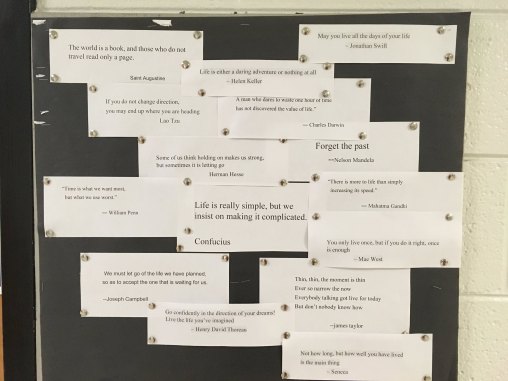
Instead, I typed up a favorite saying of mine, “Life is really simple, but we insist on making it complicated,” by Confucius. I stapled it to the middle of the board, smiled, and went about my business of unraveling three decades and finding my way to that diversion Frost wrote about with such eloquence.  

Next to my office was a classroom, and students often leaned against the wall (and my door) while waiting for another class to empty before entering. A few noticed the saying and commented to me when I returned to my office. “I like it,” one woman commented, “because it makes me think about it.” I liked that. I wish she had been one of my students.

The following week I added another quote to the board. This time Lao Tzu, one of my absolute favorites: “If you don’t change directions, you may end up where you are going.” Just stapling that to the board punctured a ball of emotion that spilled out across the rest of that day. How many times have I preached, I thought, about the dangers of getting caught in the currents and letting the world around us carry us through instead of pulling ourselves out of the stream and deciding for ourselves where we are going? Students had the same reaction, and I know they were wondering just who is it that decided going to college right then was the right thing to do. Often there is absolutely nothing wrong with where we are going; this is not a rebellious statement, I don’t think. I believe Lao was just indicating it can’t hurt to get a glimpse of what’s ahead every once in a while to see if you really are okay with the path you’re on.

Well, the board caught on and people started asking when the next quote was going up, gathering around my door on Tuesdays after they figured out I didn’t work Monday’s and that I must have posted them early Tuesday mornings, which I did. Up went James Taylor, Mae West, Seneca, St Augustine, and Jonathan Swift. More than a few passing people commented on how motivating the sayings were, and how they looked forward to them. Well, motivation was always my profession anyway, not teaching. For those thirty years it wasn’t English I was there for—hell, I was barely qualified for the first fifteen of those years. It was that I knew how to get them to find significance in it all—the work, the direction, the balance of dreams and reality, the math necessary to never forget life is a line segment, not a ray. My job in New England after college was to motivate people, and I learned it well. So when my car broke down and I ended up teaching college, I knew instinctively that it really doesn’t matter how much I know the work, if they aren’t engaged—if they don’t feel motivated—I’d be speaking to the walls. Plus, I think my board was an extension of what I knew was about to end, and I started in those last months to motivate myself.

William Penn. Herman Hesse. Helen Keller.

Thoreau.

Darwin.

Then it was the first week in May at the start of my last week ever on campus. And I found this: We must let go of the life we have planned so as to accept the one that is waiting for us—Joseph Campbell.

I typed it up, printed it out, moved Thoreau a bit for balance, and stapled Joseph to the board. That one was for me.

One of my most vivid memories from Spain was being in Santiago after more than a month of walking at about two or three miles an hour, sitting in cafes, crossing Roman bridges noting each step, each breath—essentially more than a month of barely moving to cross a nation—and then seemingly suddently we were boarding a train for the six-hour ride–just six hours–back to Pamplona. Six hours. It took four weeks to go from Pamplona to Santiago, and six hours to get back. On top of that disturbing reality check was that after a month of barely moving, we were suddenly barreling along at sixty and seventy miles per hour. It simply felt wrong. I leaned against a window looking at the landscape and when I saw pilgrims walking the opposite direction toward Santiago, holding their walking sticks, their backpacks strapped and the sun beating down as they walked and laughed, talking to other pilgrims on the road, I got a pit in the center of my stomach, a nauseous pain, like a child on a school bus for the first time who sees his parents outside walking the other way. I wanted to get off; I wanted to pull back the doors between the carriages, toss my pack out onto the trail and tumble out like a character in a movie. Writing that just now brought the pit back; it was that real, it is that real.

I’m a pilgrim, not a passenger.

Sometimes that happens. You’re riding along, caught up in the mainstream, barely noticing where you’re going because you’re engaged with everyone else in the stream barely noticing where they’re going, and you catch a glimpse of some shadow of yourself just out of reach. And you know that’s where you should be, of course, or at least you dream that’s where you should be, but the trouble, the pain, the expense, the sacrifice, the explanations necessary, the possibility of failure, the probability of doubt all slide in front of you, each holding you back just a little, all adding up to a gravitational force of “now” and “comfortable” and “responsible” that’s harder to break free from than the strongest of currents.

Well I’m here to tell you, when you do jump, it’s terrifying. The pit returns in a different fashion, this time pulsating, “Oh my God, what have I done?” You’ll never lose the pit, one way or the other.

But then you turn around and look back down the stream where you were headed, where everyone else is laughing and engaged and are all still heading, and finally, from this vantage, you see what you couldn’t from the stream, and you know, I mean you know it like I knew I should have been out on the Camino heading west instead of on the train heading east, that no matter where you go next you had been heading in the wrong direction.

Anyway.

I cleaned out my office, and I walked outside the door that last day and for a moment I thought about leaving the quotes there, or maybe replacing them all with just one quote in the middle of the black construction paper, saying, “and this bird you cannot change—Ronnie van Zant,” but I changed my mind and took them all down and gave them to my friend Jack. Each week he’d come by my office and we’d talk about the latest quote and what it meant to us. Then on that last day when I was about to throw out the last folder of teaching materials, I found another passage, typed it up and stapled it to the board.

I’d like to believe it is still there:

“If a man in the street were to pursue his self, what kind of guiding thoughts would he come up with about changing his existence? He would perhaps discover that his brain is not yet dead, that his body is not dried up, and that no matter where he is right now, he is still the creator of his own destiny. He can change this destiny by taking his one decision to change seriously, by fighting his petty resistance against change and fear, by learning more about his mind, by trying out behavior which fills his real need, by carrying out concrete acts rather than conceptualizing about them, by practicing to see and hear and touch and feel as he has never before used these senses…We must remind ourselves, however, that no change takes place without working hard and without getting your hands dirty. There are no formulae and no books to memorize on becoming. I only know this: I exist, I am, I am here, I am becoming, I am my life and no one else makes it for me. I must face my own shortcomings, mistakes, transgressions. No one can suffer my non-being as I do, but tomorrow is another day, and I must decide to leave my bed and live again. And if I fail, I don’t have the comfort of blaming you or life or God.”

                                                                                                                    –Joseph Zinker

12140843_10206985963235013_8819103812513984303_n


Watch Closely Now

IMG_9245

Some years ago I read for a group of senior citizens at a retirement community on the bay in Virginia Beach. I’ve done this at the same place a few times. But that last time was memorable for the activity at dinner before the reading.  My host, Bill, and I were eating dinner in the facility restaurant when halfway through the meal a woman at the next table fell out of her chair and died. Or she died and fell out of her chair. Either way, she was dead on the floor just a few feet away, and Bill said, “Oh I hate when everyone stares when this happens! Why can’t they just do what they are doing?!”

Well, to be honest, my first problem was that I was one of the ones who looked perhaps longer than I should. When she first fell, I jumped up, but Bill said to sit, that the medics on staff would be there in seconds, and he was right. They came out of the kitchen faster than a cook answering a complaint. She was a small woman, at least ninety, and her demise seemed more of a prank fall then a heart attack or choking incident. It was almost as if she were already dead, but a few seconds earlier she had been talking to her friend, who I might add, was polite enough not to stare. The friend sat with her hands folded until the paramedics escorted her to a different table. Which leads me to my second problem: It felt very much as if upon moving in everyone had been told: “If you are eating with anyone, and they die, do not help, do not get up. Wait for someone to move you to the next available table.” Even the way Bill immediately protested, “I hate when everyone stares,” implied this happens often, and people usually, rudely of course, gawk at the corpse. Perhaps the exertion necessary to attend dinner or a function pushes some over the mortal edge. I don’t know, but the way the medics immediately arrived with screens to surround the poor woman, and the way everyone else returned to their meals in unison made me believe I did not happen upon an unusual evening at ye ‘ol facility. I had the salmon and Bill had the prime rib. I sipped my wine. Pinot Noir.

After the reading (which continued without comments concerning the corpse and was well attended by quite jovial people) I thought about Bill’s expectation that no one should stare. There was a corpse closer to me than the basket of bread on my table; I stole a glance. I looked longer than I should, and while I’m sure there is some relevant etiquette, I am equally sure no one in the room was looking at me anyway.

When I was a child, probably about eight or nine, my mother taught me two things: look at people when they talk to you, and don’t stare. These are two seemingly contradictory life lessons for a kid; this is a fine line to walk, especially at nine years old. Mom brought me to the library on Long Island to check out books. We stood in the stacks and I asked the librarian a question, and while she answered I looked at the books instead of her. My mother quickly corrected me: “Look at someone when she talks to you, Robert. Look in her eyes when she talks.” I did and obviously I never forgot that lesson. But later that day when I watched a neighbor struggle her way out of her chair, my mother told me not to stare. I was confused. Look but don’t stare. I knew immediately I needed to work on my timing for the proper etiquette. When someone is done talking, a quick glance away to disengage eye contact is necessary, unless you’re hitting on someone and the chemistry is strong, then holding the stare a bit longer allows the other person to know you were staring, blatantly staring, because you couldn’t look away from her beautiful eyes. The problem there, of course, is if you stare too long you are in danger of crossing that line to psychopath. If she does look away you have to figure out if she looked away because she is completely uninterested or because she is afraid of revealing her deep rooted passion to plow over the table at you. Hard call.

Now imagine one of you is dead. The rules change.

It seems staring isn’t the issue as much as being misunderstood. It is an art form. One thing I always admired about my father was his absolute eye contact when he talked to someone. He was not an intimidating man in the least, yet he somehow commanded respect, and I believe it was because of his eyes which so clearly let people know they could trust him. He looked right at you when he talked or when you talked. And he knew when to let it go. He was the master of the look-stare genre. I picked up on some of his ways, but my profession has altered my opinion about the timing of it all.

As a college professor people stare at me all the time, and when I am talking or about to talk, it truly doesn’t bother me. But often, especially on the first day of class before the lecture starts, they just sit there and stare at me. I suppose they’re sizing me up: do I look mean, aggravated, am I an easy A or a piping bastard? But as I watched the years roll past and students have come and gone, they don’t stare as much. Part of it is because they’re looking at their phones; part of it is because the latest vacuous zombie-obsessed generation doesn’t make eye contact at all, I mean, you know, like, ever?

Some people look, some stare, some have a gander, some a look-see, people peak, they glimpse, behold, gaze, and leer; they survey, observe, give the once-over, and keep watch.

Look, I am not so self-conscious that I care what people think when they scrutinize. I just prefer they get their timing down. Personally, I don’t ever want to stop staring. There is too much to see, too many faces to commit to memory. I’m glad I stared a long time at my father’s face, my grandmother’s eyes. I can recall them now upon demand. I can still see a friend’s brown eyes one spring day nearing some gardens where we worked. I can still see another friend’s blue eyes, I mean blue, over chocolate cake. The old axiom is that a person’s eyes are windows to their soul, but I think they’re transoms to my own life, my own fears and loves and longings.

“Look at people,” my mother said. Absolutely. Like the time a college friend, Lori Baum, and I were at the mall when we saw an old professor from the classics department, where she worked. His wife stopped him and straightened his tie, and when she was done, she pat his chest, and his eyes opened wide and he smiled so that I remember it now, forty years on. Lori grabbed my arm and said, “Did you see his eyes?!?” I did. I still do.

The time two friends from high school whom I hadn’t seen in thirty five years showed up at a reading, and when I looked out across my pages and saw their eyes, I felt seventeen, instantly.

I sit in the room before class and not only is no one making eye contact, they’re not even talking. Everyone—I mean everyone—spends those pre-lecture moments on their phones, and I wonder who is sitting next to someone that might change their life, change their plans for the weekend. It just might be the easiest thing we can do to bring peace wherever we go—to look into someone’s eyes.

Hang on: This is science here:

When you look someone directly in the eyes, their body produces a chemical called phenylethylamine. This wonder drug we can generate with a blink acts as a central nervous system stimulant, it stimulates the mind enough to encourage us to try new things and is a wonder-element at lifting us out of depression.

It does not, however, raise the dead, no matter how long you stare.

I wish, oh, I wish I had made more eye contact, held the stare a bit longer, let go a little sooner, maybe understood better that, as Einstein said, he who can no longer pause in wonder and stand rapt in awe is as good as dead; his eyes are closed.

images

Hello/Goodbye

download

The Wilderness today is Civility

Brad and Jennifer talked to each other. They each smiled when the other did well at the Screen Actors Guild Awards, and they spent a few minutes laughing, touching each other’s hands as they did so. Then they went their separate ways.

And America is enamored. It doesn’t take much, does it?

The Today Show, CNN, and other supposedly respectable outlets spent a fair amount of airtime dedicated to supposing, whatifing, maybeing, and the hosts of these morning shows all gushed. Several viewers tweeted or commented live that this is historic, one declaring her grandchildren will be talking about this moment. I thought she was being sarcastic, but she was crying.

Oh, hell, I don’t need to elaborate—you’ve all undoubtedly seen what I’m talking about. I’m not a fan of either; that is, I like them, I’ve seen a few Friends episodes and it is good, she is good, and I still believe one of Pitt’s best performances is his work in A River Runs Through It. That deserved a nomination. Other than that, I couldn’t really care less.

But…(of course, but…)

Something essential and disturbing lies in this national attention toward two exes who are now good friends laughing together and congratulating each other at a very special occasion: it doesn’t happen anymore. I can’t remember the last time I witnessed reconciliation, mutual respect despite differences, two parties who moved beyond their troubles and managed to treat each other, eventually, humanely and with love. Ellen and W? Maybe, but look at the intense criticism she took for getting along with the former president because people thought she shouldn’t be friends with him. djt and Kim Jong Un? Perhaps, but that doesn’t really count because neither was, in fact, getting along with the other in earnest but solely for self-fulfilling purposes.

People being nice to each other when we are used to them fighting has become news. That’s the state of humanity; that’s the condition of what was once a strong and dependable morality. No longer do people step up to the plate and send a positive, forgiving or confessional stand; not unless they believe something positive will be reciprocated. The old Japanese saying, “Just because the message is not received doesn’t mean it is not worth sending,” is no longer acknowledged. The Golden Rule is dead. Am I exaggerating? I hope so, but based upon the news, the flood of matter growing out of the Big Bang of media frenzy, the new standard is negative comments and disparaging tweets. So much so that two people who had once loved each other, then despised each other, who now get along really well, makes headlines. The attention thrown on Megan and Harry is different: He’s stepping away from his birthplace, his position as grandson of the longest reigning monarch ever, the great-great whatever grandson of Queen Victoria, descendant of world history in persona. His cordiality matters a bit in British relations. But Brad? He’s just a guy who is friendly to his ex, and look now, one fan commented, “I don’t know what this means? What will happen to their partners now?”

It seems one of the symptoms here is that way too many people have no life and think how others interact somehow vicariously excuses our own behavior, so when they act cordially, well, that might simply be too much pressure. We hold grudges far too long; we don’t stop and earnestly offer congratulations to those we otherwise may no longer support; we don’t call old friends who’ve fallen away and apologize for being out of touch, no matter whose fault it is. This current of pessimism and the wireless negativity which permeates the atmosphere has compromised human decency, made it impossible to separate those ideas with which we disagree from the rest of someone’s possibly good-natured soul.

I didn’t mean to lose touch with a very old friend of mine and I really need to call him. We are polar opposites politically, and I’m sure if I even cross his mind, he might believe it’s his fault we’ve lost touch, but that simply isn’t true. It’s just that neither of us have picked up the phone to say hello. It isn’t expected anymore. Life doesn’t bend that way anymore.  

I tried this recently. About a year ago I contacted someone I knew from my last full-time job, and we had a great time catching up, he said we have got to do this more often and that he’d call, and I never heard from him again. Maybe it is my fault, I could have reached out—again—maybe he just isn’t the type to take the initiative though he really is glad to get together. I don’t know—I never heard from him. But we are all guilty of that, all of us, to some degree. It isn’t unusual for us to say at some point, “Geez, I’ve called the last three times; clearly he’s not interested in being in touch.” Well, in fact I did try again about two months ago and received a positive, hopeful reply and a promise to make plans. Then—nothing. Maybe he is simply too polite to tell me to feck off and he’s thinking, “The man can’t take a hint!” Maybe that’s my problem: people spend far too much time “hinting.”

But I’ll try again soon. Who wants to be the one known for remaining pissed off, the one who holds the grudge? Who wants to be the one that didn’t apologize or accept someone’s apology? Wouldn’t it be just fine if we could all know we can go to our graves as being the ones who tried?

I hope the news media does not win out. I hope they don’t reiterate to whatever the next generation is called that two people who didn’t get along once should remain that way or remain together forever; apparently only one or the other sells on television and some sort of middle ground is completely unacceptable; maybe we are too used to binary, obvious, and easy to determine relationships. “We love him!” or “We hate him!” has become the cattle call of the masses, politically and socially. What a shame since such middle-ground relations is how we acknowledge forgiveness and maturity. Brad and Jennifer should not be news simply because that interaction should be standard, expected. It caught this nation’s attention because we are in the age of extremes.

Well, I can only do my small part. So I have a new plan: Every time something is negative on television, every time someone disses someone for thinking differently than they do, I’m going to contact someone I’ve not heard from or seen in a while to offer a quick hello, a brief “I was thinking of you.” Judging by the rate of negative news and absurdly poor behavior and personal attacks from so many leaders these days, I should be in touch with everyone I’ve ever known in no time at all.

n4qxvNA6u7UpeYE5n93MVxjMHZi

art·ist /ˈärdəst/ noun • a person who practices any of the various creative arts, such as a sculptor, novelist, poet, or filmmaker. • a person skilled at a particular task or occupation.

images

Artists engage in a daily battle between the belief their work is worthy—that it can stand the scrutiny of those who know better and it will be well received by critics and customers alike and is ready for publication or presentation; and the conviction that it is a complete waste of time—that it is predictable or trite or tiresome, will sit on shelves or in bins without so much as a glance, and a dozen better ways to approach the topic will become apparent while the brutal reality that no other creative work will ever emerge remains crystal clear.

Artists, writers, work for free, hoping, praying, someone, anyone, will order the book just out of support, just out of curiosity. There is no health care, there is no retirement plan, there is no guarantee the time invested wasn’t simply folly. There is no yard stick to measure how well it is going, how much longer it will take, which parts need attention, and which deserve to be deleted. Often, artists stare at the medium for hours, fiddling around, snacking, cleaning, engaging in any form of distraction and avoidance. On a good day, a writer may have a good page, sometimes three or four, and every once in a while, lightning strikes, but an artist lives with the strong possibility of waking up the next morning and chucking the whole project. Artists have panic attacks, breakdowns, and bad habits. They drink. They swear. It is the creative version of coping, of loosening the tie, but the work is never finished, unless one buys into Rembrandt’s insistence that a work is finished when an artist realizes the intentions.

Few occupations demand the tenets of faith like that of an artist. If they agree with Kahlo and paint their own reality, then artists demonstrate daily the belief in things unseen, constantly starting from scratch, always inventing, and always—by definition—always searching for originality in a world flooded with ideas and blogs and podcasts and books, and still the artist works in one of the original exercises of pure faith, well knowing that Gauguin was right, that art is either revolution or plagiarism.

An artist wants to scream “buy my book,” “purchase this painting,” “please listen to my music.” An artist wants to balance the need to promote her work with not wanting to come across as egocentric when in fact the very act of creating something from nothing under the conviction others will want to make it part of their lives is a level of egoism few professions demand. An artist deals with these tugs of war between humility and pride. The tug of war, as Merton writes, of finding oneself and losing oneself at the same time.

An artist keeps working because it is a race against time to not “die with the music in you” as Wayne Dwyer noted, with stories on the cusp of creation, with unfinished work, with incomplete manuscripts, because two things are absolute: one lifetime cannot accommodate the ideas and works and starts and restarts of an artist, and they will die sooner rather than later and it is coming on fast, no matter how long they will actually live, because perception is different for an artist, hence the need as James Baldwin insists, to vomit up the anguish.

An artist cries because so much time is wasted. An artist cries because it is impossible, it is just impossible to capture the turmoil in humanity, but the artist tries to abide by Pollock and paint “what he is” by sketching another river, writing another digression, composing another score where an oboe comes in high and slow in some minor-key attempt to capture the sadness which, anyway, a true artist well knows she will never aptly express, because all artists know that Rodin was right—the main thing is to be moved, to love, to hope, to tremble, to live.

If one does not have a bestseller, a gallery, an audience, people consider the art a fleeting phase, never completely understanding the difference between art and commodity. An artist wants sales, of course, but only for the purpose of having the time to produce more art. An artist is disturbed by negative reviews and criticism, of course, but works anyway.  If a benefactor bestows funds for an artist to keep working without the stress of financial burdens so common in the creative world, that artist will produce. But for certain if no such benefactor exists, the artist works anyway, finds the freedom necessary anyway, producing the same work anyway, because the artist knows what Monet knew, that the richness comes from nature—the true source of inspiration. The world is graced with art because some people must create as certain as they must exhale, as certain as Chagall’s belief that the artist simply picks up where nature left off.

Artists are not amateurs, they are not hobbyists. An artist will spend hours figuring out the necessity of one word, an artist will step back after two months work and scrape off the paint of an oak to move it one inch for a better composition, an artist cannot eliminate a note or a phrase. An artist wants to leave a mark, believes, as did Trotsky, that art is not a mirror to hold up to society but a hammer with which to shape it.

Artists are shooting for something else, and in the end the art is merely a symptom of their desire to express the inexplicable. Because in the soul of an artist is the deep understanding and resignation that, as van Gogh insisted, the true artist works not with brushes and canvas but with flesh and blood, believing first in humanity.

An artist is never quite certain of her mental stability but has complete faith that how she behaves is perfectly normal. Virginia Woolf, Eugene O’Neil, Beethoven, Keats, Tennessee Williams, Vincent van Gogh, Hemingway, Sylvia Plath, Michelangelo, Charles Dickens all lived with mental illnesses and any artist worth his salt will insist if any element of these great souls had been more regulated, more controlled, we would never have heard of them.

Georgia O’Keefe was right: Whether you succeed or not is irrelevant, there is no such thing.  Making your unknown known is the important thing, that is success. Something is that was not but for an acute thought, some simmering neurosis only settled by the act of creation. Hence poetry, literature, paintings, symphonies, and all.

An artist can quench the stress and anxiety of bill collectors and illnesses, of hunger and sleeplessness, by producing two or three decent pages, by catching the color of what will forever be last night’s sunset. An artist makes beauty permanent, makes our deepest emotional reactions permissible.

We walk that tight rope spanning obscurity, balanced only by a pole of phrases and transitions, of oil and acrylics, minor keys and crescendos. Walt Whitman had his Leaves of Grass, but an artist has a blank sheet of paper. This leaves the advantage with the artist. Everyone knows the work Whitman wrote and how it still grows in the literary field, but an artist has the uncriticable blank sheet of paper, and with the right choice of words, he may harvest his own Grass. To be an artist, Henry Moore said, is to believe in life, and life is mystery, and mystery is the flint which ignites creativity, without which, as Rene Magritte points out, the world would not exist.

0731-BKS-AuthorsNote-articleLarge