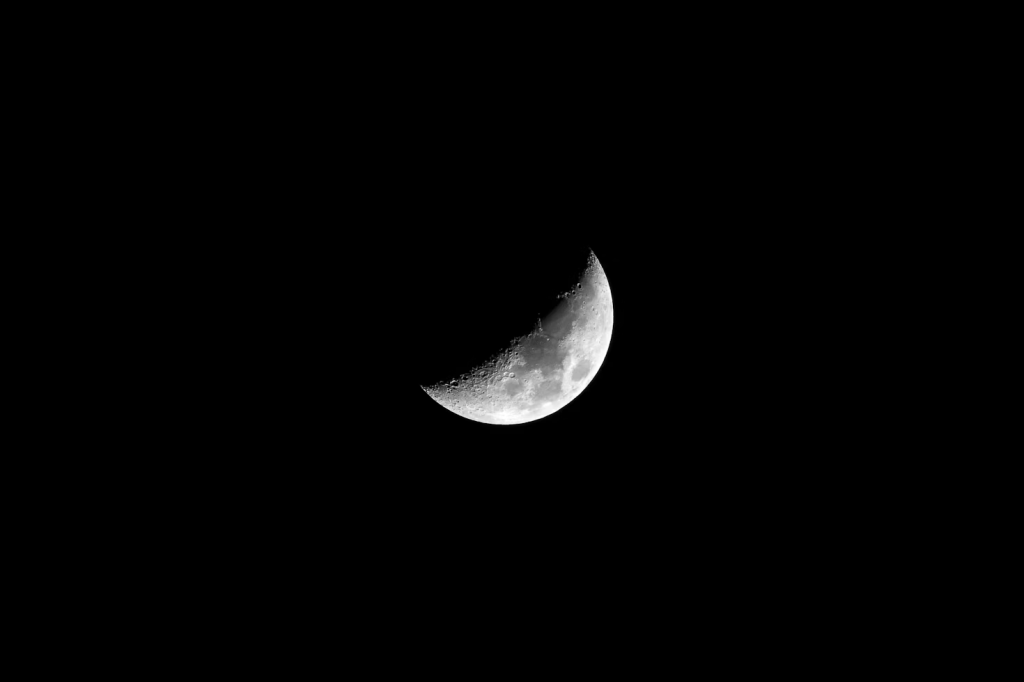
The moon last week through the telescope looked like a golf ball, the dimple-craters and the bright white side imbedded in the mud of the dark side. We looked at it a long time with the perspective Apollo 8 must have had when it orbited the place, moving around it like Tiger Woods circling his next putt.
It’s cold, but still, and the air off the bay bites a bit, and some rustling in the leaves makes me think the fox is around tonight, or a cat from a house through the woods, but it is how it should be–we seem to look at the stars most in winter because it gets dark so much sooner, the air is cleaner, the humidity low.
But last week despite the bright half-moon, the sky was dark and the telescope picked up an amazing nebula all ablaze not far from Orion, shining out from billions of years ago. It is the middle star on the belt and the brightest nebulae up there. I’ve needed perspective lately. When “the world is too much with me” and “life is like a pathless wood,” it is good to look at the same stars as did Copernicus and Galileo and ancient astronomers who saw bulls and crabs and horseheads where I can only see a random sampling of bright dots, like dots on a map.
And the top half of a golf ball stuck in the mud of space.
“Why, I ask myself, shouldn’t the shining dots of the sky be as accessible as the black dots on the map of France?” wrote Van Gogh to his brother, Theo. “Perhaps we take death to reach a star. We cannot get to a star while we are alive any more than we can take the train when we are dead. So to me it seems possible that cholera, tuberculosis and cancer are the celestial means of locomotion. Just as steamboats, buses and railways are the terrestrial means. To die quietly of old age would be to go there on foot.”
I like that, the illusion that death is another mode of transportation, and those we love and lose here are simply on some galactic pilgrimage. I have several books about the stars given to me by my brother, by my son, and I’ve read them, returned to them for reference, for maps, and I have such trouble remembering the names of space stuff. I mostly use my cellphone app, point, and then say with absolute authority, “I’m nearly positive that’s Avior. I think it’s a star in Corina if I’m not mistaken.” But I swear ten minutes later if anyone asked me to repeat it, I couldn’t.
So I’ve started making up my own star names, like the International Star Registry, only specific to Bob. Deep in the Pleiades I can see “Cole,” leaning into the other stars, preaching, pushing them into agreement about the colors he should use to paint Jupiter with all her moons. And what used to be Lesath in the Scorpio constellation according to my Backyard Guide to the Night Sky is now “Eddie.” I can almost hear some Janis wailing from his band of Red Dwarfs. “Dad” is clearly Polaris, my North Star, up there to guide me if I wish, follow him when I’m lost. I wish I had turned to him more when I couldn’t find my way.
Now, I know from these books from my brother and son that the brightest star in the night sky should be Sirius. Orion’s belt points right at it, yet more than a few times I’ve mistaken it for her sisters, like Vega and Canopus. So I’m saving her, putting a sticky note on Sirius. I have a special name for her I’m keeping to myself and will send to the Star Registry—though I doubt they’ll change the name of such an important celestial body; but I will, if only in my mind. And I’m going to memorize her location so I can go outside on a clear night and talk, reminisce, find a bit of permanence in an all too temporal existence.

 a view from this wilderness