
Sometimes you have to stay up until dawn to understand what’s hiding behind the night. It’s been a tough two days, and I need a significant diversion. For me, anyway, I find hope in the same time of day that can push me over the edge; late night, early morning, just after the tigers come out but too early for the sun.
Like a rest stop at three am with two truckers and a couple of local high school kids screwing around, or the sound of wildlife in the desert brush, or tall pines scraping together in winter in the woods with no light but the moon. It’s walking up an Arctic Path at four am in a snow-deep March with Northern Lights bouncing past like a bull whip; or lying on my back on a cot in a compound in Africa beneath more stars than could possibly exist, the distant sound of someone chanting the Koran. It’s walking out of a shack in the Russian woods after a storm passes and you see the sun just lifting over the raised bridges, ears still buzzing from loud live music. That’s when you know it’ll be okay.
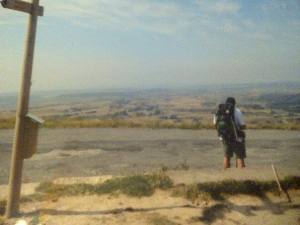
In Portomarin, Spain, one night, my son and I stayed up as long as we could because the rooms were all filled. We hung out in a small café until one am and then walked around the misty, cooling waterfront. Then we settled on the town square with covered walkways running next to a medieval church. Against some storefront we pulled together folding chairs and wrapped ourselves in whatever we could and tried to sleep in rapidly dropping temperatures. A kid on a bike did tricks on the steps of the church until three am which anyway kept me amused. But for a brief time after that, it seemed like dawn would never arrive, like I totally screwed up, and I couldn’t believe I would put myself and, worse, my nineteen-year-old son in danger. But at 4:30 we got out our flashlights and headed west. You can see a million stars in Spain at 4:30 in the morning, and the darkness makes the silence nearly sacred.
If I can make it past the tigers, I’m usually just fine. Better than fine.
That shack in the Russian woods was just off the Gulf of Finland—a dive really—a place to drink and sing and meet people you’d never want mad at you. It was small, with broken-down shed-like walls and windows which barely kept out the storm blowing off the Baltic one May night in the nineties. I use past tense since sometime just after 911 it burned to the ground. But back then, it was well after midnight, closer to dawn than dusk, and we ordered a bottle of Georgian Merlot and several plates of shashleek, a Russian shish kabob dish. A gypsy band showed up, including a guitar and violin player I’d met before, along with a friend of theirs, a woman singer. I played with them for thirty minutes or so, and hours passed as we sang and drank. I long ago forgot what night-terror sent me walking into the Russian night, let alone up the beach into the woods and this shack, but I did, and we sang and drank while what must have been that hurricane from The Perfect Storm slammed to shore. This duck blind of a building sat amongst birch trees, but that simply made me more aware of the weather, wondering when one might topple through the roof. It was exhilarating, an adrenaline rush that had nothing to do with the wine. It was being alive, right then at three am, with total strangers, live gypsy music, Georgian wine, and shashleek, that kept me awake and okay.
But those are extremes, aren’t they? Right before that, you wake up in a sweat and your heart is racing and your mouth is bone dry, and you know everything is going to fail. The hot water heater blows out and you can’t afford the five grand for a new one, the car needs work, the dentist is waiting for the call back, things are tight, and your chest gets tighter. You are at that line, the one some use as an excuse to check out, the one that can terrorize others into submissive acceptance, but the one some simply cross. I keep thinking of that line from Dar Williams: “And when I chose to live, there was no joy it’s just a line I crossed.”
.It doesn’t have to be a broken down bar or some desert hike. It could be a porch, and you sit there with tea and note the coming of the first birds, and you have an hour on the sun. And whatever it was that shoved a hot blade into your chest just thirty minutes earlier has been doused by the deluge of the new day, the sky, dark blue, then pale yellow.
There is no miracle. It is something on the other side of hopelessness; the place too many people I know could not hold out long enough to find.
One night in Virginia Beach some years ago when someone dropped a brick wall right in my line of trajectory, I could not sleep so I went to the oceanfront, walked on the pier I have walked out on since I’m a teenager, and sat listening to the surf in the still-dark night. A fisherman walked up the pier on his way to try his luck and he stopped to adjust his bucket and gear. I asked if the water seemed flat enough for good fishing, and he said he didn’t think so, but he added, “I ain’t got no other reason to get up, so I’m here. I guess I’ll find out.”
We laughed, but not really.
When a hot water heater breaks it sounds like the surf; it wakes you up, sends you ankle deep on hardwood floors for mops and valves and towels. And you know you can’t do a damn thing about it, and you know it’s going to be a long time before you can, so you go back to bed telling the tigers to go ahead, have at it.
But the whippoorwill is doing her thing, and a few house wrens have come out of the nest. If it’s early enough you grab a bottle of cab, head to the café table on the front porch and fill a small glass, and you look east, out over the bay, and wait for that sliver of light. It’s not so bad you tell yourself. You don’t need help you tell yourself. And you remember some story that was told to you to hold on to for just this moment. Like this one: When I lived in the Sonoran Desert, I would spend a lot of time at the San Javier Mission down Route 19 toward Nogales. There I learned that the Navajo used to run toward the sunrise every morning to visit and welcome the spirits who watch from the sky over their people below.
When the priest at the mission told us that story, a friend of mine said she thought it was beautiful how they ran toward the sunrise, but I couldn’t help but wonder what they were running from. What tiger’s grasp did they narrowly escape, barely pushing across that line?
If you ever see a picture I have taken of dawn, the sun slipping out of the water on the horizon, you’ll know I ran there, narrowly escaping some grasp, to welcome the new day.

 a view from this wilderness
My Rasta friends down island used to say “some days just be dat way.” Sorry, friend.
LikeLike