…the Fozzie pillow my sister made me,…

I have a lot of shit.

Books I’ll never read again, clothes I don’t wear, boxes of frames and a stack of artwork I’ll never hang leaning against the wall next to the bureau. I have enough pottery to supply a small restaurant, enough reusable grocery bags in my house and in the trunk of my car to carry away the frozen food isle of Kroger, and a shed full of tools I didn’t use when both me and them were newer.

I have scribbles of notes for articles and essays, folders of rough drafts for books and short non-fiction I never read or even attempted to get published, sixteen previous versions of a book which comes out in a year that doesn’t resemble any of the first fifteen variations.

Even when I get away from it and go for a walk down the hill to the river, I have too much stuff. I have obligations both financial and professional that weigh heavily, an overwhelming desire to call Letty or Dave or Dan and just talk like I did every few days for three, four, almost five decades, and sometimes a powerful flash of memory of my father so real I can hear his voice next to me. Those moments can be debilitating, and I just want to swim away. When that happens, I carry it all home and sometimes write about it, sometimes lay down and try and sleep. I lay down and not sleep at all a lot.

A few days ago my son and I took the ferry to Tangier Island, eighteen miles into the Chesapeake, and we walked the historic, tiny slab of sinking land. It was good to slap the world’s largest estuary between me and my stuff, walking around, talking, noticing the birds, the friendly residents, and watching the watermen do their thing the way their ancestors did since Cornish settlers arrived in the 1680’s, more than fifty years after John Smith rowed by and took note. A lady in a golf cart next to Lorraine’s restaurant where we had fresh soft shell crab sandwiches spoke to a friend of hers in a Cornish accent the islanders are famous for.

And we had ice cream.

But all of that was all I needed to clear my head and not carry around the volumes of concerns back on the mainland. I was in the moment, which is quite a rare thing for anyone these days. I have noticed that when I travel—Prague, Ireland, Spain, especially all those trips to Russia, even the pond of lily pads across the river where my son and I often stop to listen—I am completely present, uber aware of my surroundings, the people, and my memory sharpens so that I can write about it sometimes years later and still smell that moment, still hear a veteran’s voice telling me about “the time that…” Absolutely present.

And I come home after those moments and look around at the stacks of magazines I won’t read again if I ever did, the boxes of ornaments too many to hang them all, grade books from my early teaching years, relics of a time I wish hadn’t happened to begin with never mind reliving it, and I wonder why I still have it all.

When we walked the Camino de Santiago, it took about a week to shed the sense I was forgetting something, to ease up on the worry that something needed to be done. It took only a few more days to remind myself that at all times I am indeed here, breathing in and out, moving along, celebrating the passing of time, and everything else is needless no matter how sentimental we are about stuff. We rarely stop and appreciate the fact we are actually alive to begin with, standing here, able to negotiate the next moment however we desire. I forget this most of the time, and I wish I didn’t.

Many, many years ago I went to a wedding reception on the shore of Lake Erie in the small village of Angola on the Lake. I stood looking out across the water not unlike I do almost every morning when I head to the bay at Stingray Point and stare east, and Fr Dan, who had celebrated their marriage, walked to me and we talked. I remember he said I seemed quiet. I told him I wasn’t sure what to do with my life. He told me the normal Fr Dan stuff like God will show me the way, and I’m young and have so many options, and more of what I’ve heard him repeat to me and others in the nearly forty years since then, but I knew all that. So I said something to the effect of, “I suppose just knowing no matter what else all I need is ‘me,’ alive and functioning, to start over if things don’t work out in whatever direction I choose and to truly enjoy the ‘passing of time.’” He laughed and put his hand around my shoulder and said how right that is.

But we don’t really mean that. We work hard, we gather memories and even though we stack them next to the bureau or on closet shelves, we need them there to glance at once in a while to know there was some reason and rhyme to our pilgrimage until now. Of course I can land on my feet and start in a new direction at any time, knowing that in about a week that routine will realign my anxieties and I’ll be fine, and all I’ll need to carry with me are memories of those I have loved. Yes, that is all true.

But I like my shit. The funky photos Valentine took in Russia, and the photo Letty had framed for me of four ladies on a bench; the stacks of brochures and pamphlets from state parks and museums my son and I have hiked and visited for nearly thirty years, the signed books from authors I have had the pleasure to talk to and read with, the tins of pins from Soviet shops and Czech artists’ studios. The sloth birthday balloon and a crazy little light-generated cat from someone who can finish my sentences for me, the folders of drawings from my son’s youth, the small bottle of absinth I never opened.

The miter box my brother bought me and the rug of seascape my sister made when I was in college. My mom’s large Dopey Doll. Shells from a walk with a friend on the Gulf of Mexico and a nutcracker my son painted when he was young.

I have so much stuff, but it all reminds me of what an amazing pilgrimage it has been.

In two years I’m going back to St. Jean Pied de Port, France, to start walking again, south to Pamplona then west to Santiago. I’ll carry a pack with just enough to know I’ll be fine. And if I should stumble upon mementos to carry home, I am sure I can find someplace to put them.  
Pando

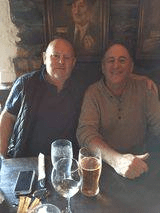
“Baby” John Walsh and me

I sat against the wall in Durty Nelly’s, an old Irish pub next to the Bunratty Castle near Shannon, Ireland. The bar was packed and next to me was the only available place to sit: a wide, stone windowsill looking out over the running creek below as the place had been a mill at one time. The window has bars on it, otherwise the drop is straight down about fifteen feet. A short, quite Irish-looking Irishman sat on the sill and drank his beer. It was loud from music and talking so that even my companion and I had to yell to hear each other.

The Irishman leaned toward me, his legs dangling above the floor. “Last time I was here I drank too much and fell out the window into the creek. That’s why they put bars up!” He toasted the air and drank, and it was easy to believe him even though the scenario was unlikely. He came straight from central casting, acting all the part of Barry Fitzgerald in The Quiet Man.

After I spoke, revealing my Yankeeness, he asked where I was from and what we were doing there. “Connemara!” he exclaimed. “The wild west!” We laughed as his response was common and I had previously noted that the Wild Atlantic Way which runs through the western portions of County Galway and all of Connemara were indeed rustic, scenes from Banshees of Innisfree shot there, as well as The Quiet Man and others. I told him my ancestry is Irish, Connacht, and in particular County Galway, noting Connemara specifically. He asked the relative surname.

“Walsh!” I screamed over the noise. “There’s some McCormick and others for sure, but Walsh is the Galway connection.

He stood up, set his beer on our table, pulled out his wallet, removed his license, and handed it to me. “Baby John Walsh is the name! Nice to meet you cousin!”

When I returned home, I thought about how connected everyone really is; how I could make trips to Bavaria or Sicily and have similar experiences, pushing out the concentric circles of my DNA. Actually, we do that socially all the time. In one family we usually break down the “lines” by aunts and uncles. Outside the family such as here in the village near Aerie, the families of many watermen have been here since the 1600’s and so when you talk to natives in town you slim down where you are “from” by creeks. “Oh he’s from over near Broad Creek.” “He’s from Mill Creek.” “Her family is down on Stove Point.” But if I head up-county, I simply say I’m from Deltaville. They wouldn’t know the Duck Pond near Parrot’s Island. When I’m down at the college, I note I live “up on the Middle Peninsula.”

You see where it goes.

When traveling as I just did to western Maryland, “I’m from Virginia” suffices. In Ireland, I usually don’t need to expose my already obvious “United States” origin, but for those who know our country, I’ll add the state.

I suppose if we ever end up on Triton, I’d pull out my license and signify to some other-worldly writer that I’m from Earth, just past Mars on the right.

What captivates me about this is the closer our ancestry is to others, the more likely we are to get along. John Walsh and I would have talked anyway since we drank beer next to each other, but once we realized we shared that name the conversation grew deeper, and I learned he wrote restaurant reviews, and he did, in fact, fall out the window into the creek on several occasions.

My brother spent time with Kunzingers in our ancestral village of Lohr a. Main, Germany. I’m Facebook friends with two Michael Kunzingers. One is my son, and the other a mathematician in Austria whose great great great great something or other is the same GGG as mine, back in the early 1800s. It’s just that his line of family never left the old world as mine did in the 1850s.

We all have the same roots no matter how far apart we grew up and eventually branched out, stretching our posterity across distant ideas.

I’m reminded of what now seems like a trite mentality from perhaps the sixties when those coming of age declared against the supporters of the Vietnam War and later the threat of Nuclear War, “We are all one family! The Human Family! We are one race!”

But it’s true. We are. And if nothing else we often drink the same beer, choose the same corner of some obscure pub and maybe bump into a distant cousin.

John Edgar Wideman wrote that everyone needs two parents, four grandparents, eight great-great grandparents, then sixteen, then thirty-two; and that’s just five generations back. He acutely notes that less than two hundred years ago, sixteen men and sixteen women made love. None of the couples most likely knew any of the other couples, living as far apart as Kings County, New York, and County Galway, Ireland, and never met any of the others in their lives, not knowing what would eventually be true—that it was all part of some grand conspiracy to set in motion the DNA which would eventually create you.

We are rooted in our past, which means we are truly rooted in each other to some degree. I understand that doesn’t mean we will get along. Tradition tells us the first two brothers certainly didn’t.

But we are here. Together on this world. At the very least we can have a beer and compare notes I should think.

Pando. The world’s largest tree.

Uncomplicated

30739603_10214554803251283_6796824465050173440_o
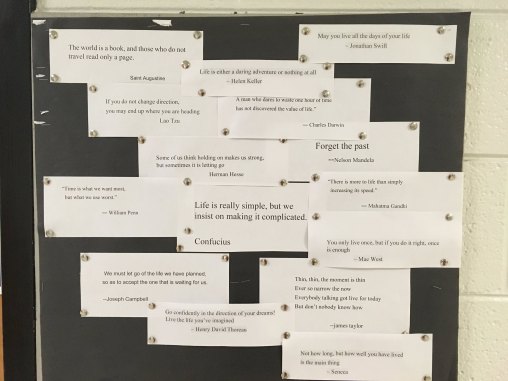
The board outside my former office, May 2018

Some years ago when I knew for sure I was leaving my job I held for nearly thirty years, I started to focus not so much on what was next as much as how fast, how so very fast it all went, and I realized that about the same amount of time to come would put me at nearly ninety years old.

I cleaned out my office—slowly at first, then with much more indifference. I carried piles of books to a common table in the building’s lobby, I moved file cabinets and other useless furniture into a storage area for someone else to claim and configure to their job the way we do with all things in our lives—we mold them to fit in the corners of our growth and accomplishments. Yeah, I was done with all of it.

And outside my office I took down all announcements and office hours and lists of readings from my bulletin board so that all that was left was black construction paper. It looked clean, like a slate, and I absolutely loved the metaphor of it all, but I also thought I should take a piece of chalk and write in some demanding font, “Outta here.”

Instead, I typed up a favorite saying of mine, “Life is really simple, but we insist on making it complicated,” by Confucius. I stapled it to the middle of the board, smiled, and went about my business of unraveling three decades and finding my way to that diversion Frost wrote about with such eloquence.  

Next to my office was a classroom, and students often leaned against the wall (and my door) while waiting for another class to empty before entering. A few noticed the saying and commented to me when I returned to my office. “I like it,” one woman commented, “because it makes me think about it.” I liked that. I wish she had been one of my students.

The following week I added another quote to the board. This time Lao Tzu, one of my absolute favorites: “If you don’t change directions, you may end up where you are going.” Just stapling that to the board punctured a ball of emotion that spilled out across the rest of that day. How many times have I preached, I thought, about the dangers of getting caught in the currents and letting the world around us carry us through instead of pulling ourselves out of the stream and deciding for ourselves where we are going? Students had the same reaction, and I know they were wondering just who is it that decided going to college right then was the right thing to do. Often there is absolutely nothing wrong with where we are going; this is not a rebellious statement, I don’t think. I believe Lao was just indicating it can’t hurt to get a glimpse of what’s ahead every once in a while to see if you really are okay with the path you’re on.

Well, the board caught on and people started asking when the next quote was going up, gathering around my door on Tuesdays after they figured out I didn’t work Monday’s and that I must have posted them early Tuesday mornings, which I did. Up went James Taylor, Mae West, Seneca, St Augustine, and Jonathan Swift. More than a few passing people commented on how motivating the sayings were, and how they looked forward to them. Well, motivation was always my profession anyway, not teaching. For those thirty years it wasn’t English I was there for—hell, I was barely qualified for the first fifteen of those years. It was that I knew how to get them to find significance in it all—the work, the direction, the balance of dreams and reality. My job in New England after college was to motivate people, and I learned it well. So when I ended up teaching college, I knew instinctively that it really doesn’t matter how much I know the work, if they aren’t engaged—if they don’t feel motivated—I’d be speaking to the walls. Plus, my board was an extension of what I knew was about to end, and I started in those last months to motivate myself forward. I was absolutely projecting.

William Penn. Herman Hesse. Helen Keller.

Thoreau.

Darwin.

Then it was the first week in May at the start of my last week ever on campus. And I found this: We must let go of the life we have planned so as to accept the one that is waiting for us—Joseph Campbell.

I typed it up, printed it out, moved Thoreau a bit for balance, and stapled Joseph to the board. That one was for me.

One of my most vivid memories from Spain was being in Santiago after more than a month of walking at about two or three miles an hour, sitting in cafes, crossing Roman bridges noting each step, each breath—essentially, more than a month of barely moving to cross a nation—and then seemingly suddenly we we boarded a train for the six-hour ride–just six hours–back to Pamplona. Six hours. It took four weeks to go from Pamplona to Santiago, and six hours to get back. On top of that disturbing reality check was that after a month of barely moving, we were suddenly barreling along at sixty and seventy miles per hour. It simply felt wrong. I leaned against a window looking at the landscape and when I saw pilgrims walking the opposite direction toward Santiago, holding their walking sticks, their backpacks strapped and the sun beating down as they walked and laughed, talking to other pilgrims on the road, I got a pit in the center of my stomach, a nauseous pain, like a child on a school bus for the first time who sees his parents outside walking the other way. I wanted to get off; I wanted to pull back the doors between the carriages, toss my pack out onto the trail and tumble out like a character in a movie. Writing that just now brought the pit back; it was that real, it is that real. It was the only time in my life I compared side by side the notion of getting somewhere and going somewhere. They’re not the same.

I’m a pilgrim, not a passenger.

Sometimes that happens. You’re riding along, caught up in the mainstream, barely noticing where you’re going because you’re engaged with everyone else in the stream barely noticing where they’re going, and you catch a glimpse of some shadow of yourself just out of reach. And you know that’s where you should be, of course, but the trouble, the pain, the expense, the sacrifice, the explanations necessary, the possibility of failure, the probability of doubt all slide in front of you, each holding you back just a little, all adding up to a gravitational force of “now” and “comfortable” and “responsible” that’s harder to break free from than the strongest of currents.

And even if you do jump, you’re immediately inflicted with that same pit in the stomach, only this time it pulsates, “Oh my God, what have I done?” The things is, you’ll never lose the pit, one way or the other.

Anyway.

On that last day back then, I cleaned out my office and walked outside the door, and for a moment I thought about leaving the quotes there, or maybe replacing them all with just one quote in the middle of the black construction paper, saying, “and this bird you cannot change—Ronnie van Zant,” but I changed my mind and took them all down and gave them to my friend Jack. Each week he’d come by my office and we’d talk about the latest quote and what it meant to us. Then on that last day when I was about to throw out the last folder of teaching materials, I found another passage, typed it up and stapled it to the board. I’d like to believe it is still there.

I know now how much I need that motivation again. But there are two types of motivation: Internal and external. That external one is easy: do the work or don’t get paid. Clean the room or don’t eat dinner. But the internal motivation that drives us from somewhere deep inside, that contradicts the currents, that learns how to turn on a dime, I need that once again. I’m surrounded by people retiring and settling their affairs, haunted by others who slipped off the stage too soon, and it simply creates an indefinable stagnation.

But today while walking along a street in a small village on the Rappahannock River, I remembered that last quote, and it felt right, deep in my stomach it felt right:

“If a man in the street were to pursue his self, what kind of guiding thoughts would he come up with about changing his existence? He would perhaps discover that his brain is not yet dead, that his body is not dried up, and that no matter where he is right now, he is still the creator of his own destiny. He can change this destiny by taking his one decision to change seriously, by fighting his petty resistance against change and fear, by learning more about his mind, by trying out behavior which fills his real need, by carrying out concrete acts rather than conceptualizing about them, by practicing to see and hear and touch and feel as he has never before used these senses…We must remind ourselves, however, that no change takes place without working hard and without getting your hands dirty. There are no formulae and no books to memorize on becoming. I only know this: I exist, I am, I am here, I am becoming, I am my life and no one else makes it for me. I must face my own shortcomings, mistakes, transgressions. No one can suffer my non-being as I do, but tomorrow is another day, and I must decide to leave my bed and live again. And if I fail, I don’t have the comfort of blaming you or life or God.”

                                                                                                                    –Joseph Zinker

12140843_10206985963235013_8819103812513984303_n

Forthcoming

Allegheny River

I had an unconventional youth. Specifically, I did not lead the normal life of a nineteen-year-old away at college. While my floormates were drinking heavily and sleeping until noon, I was at classes early to get them out of the way so I could head out to the Allegany River, or up to Niagara, or out to Chautauqua Lake, canoeing, listening to fascinating stories from a friend of mine, helping him plan his return to the Congo River for an adventure I couldn’t possibly contemplate prior to then.

I have two books coming out next year. The first, Office Hours, is a “Sedaris-like story-telling” of thirty-five years of college teaching. The second, Curious Men, is about that time back then in college myself, planning the Congo trip, turning a first semester probation they said was due to grades but I knew was due to complete indifference, into an honor-roll semester due to my sudden acute interest in absolutely everything. A friend of mine used to ask, “You mean that year you were on crack without ever touching a single drug?”

Yes, that year. Nineteen.

Memoir writing is a challenge for the need to engulf yourself in the emotions of a time that was apparently significant enough to warrant a book, yet absent enough of those same emotions so the reader can find the bigger picture of the narrative, the part that must reach up and out of itself into their lives, show them their emotions instead of displaying my own.

I brought this up because I just finished it, the book, Curious Men: Lost in the Congo. As a point of reference, though, and in full disclosure, I started it forty years ago. I’m a slow writer.

But the primary question publishers, publicists, agents, and–what do you call them? Oh yeah, readers–ask is, “What’s it about?”

So that needs to be split into two answers. Most people mean “What happens” when they ask what it is about. And that’s fine and not too difficult to answer: A friend asked me to help him plan a canoe trip—solo—on the Congo River. I did, and he went, and he never returned. Eventually, I went. But I returned—most of me anyway. This might be of interest to readers, particularly those who have enjoyed my writing in the past, or those who like adventure, distant places, rivers. Mysteries, even. Possibly psychology. But that “what happens’ response makes it all seem very 1981ish, and little more.

Which means there must be a second answer for this to work. And that is the true response to “What’s it about?”

In this case, it’s about being nineteen-years-old. It’s about being on my own for the first time, out from under the parental umbrella only to be thrust into a world where countless adults want to know my plans for the rest of my life, my major, my summer internship possibilities, my “declaring” of a focus for my entire career before I’d even taken a single class, all the while living with someone I’d never met on a floor with ninety guys I’d never met who seemed to insist I drink despite my desire not necessarily to not drink, but not to drink because they insisted; and all of us with two bathrooms, one payphone, and honestly little guidance to navigate. This wasn’t the military where some sergeant told us what to do when to do it how to do it but never why. We were paddling out in the deep-end, completely solo. Hence, the drinking and the need to join the pack. Just because I didn’t end up face down in the stairwell every night doesn’t mean I didn’t understand the draw of the need to do so. It’s just that I found my own alcohol of sorts.

I found another outlet, something well outside the box, and in doing so ended up with a working knowledge of a few African languages, an understanding of the fauna of equatorial Africa, a comprehension of diseases, some knowledge on how to temper loneliness, and a taste of a particular lesson I couldn’t find in my mass comm classes: outrageous adventure is simply a matter of deciding to do something and following through. I discovered that I didn’t need to follow some template to be alive. I learned that maybe it was everyone else who didn’t fit in. At least that’s what I told myself at the time as a defense mechanism.

But something changed over the years. You see, I’ve been staring at nineteen-year-olds for thirty-five years now and that alters the narrative some.

In the end, Curious Men is not about Africa, it’s not about the Congo or anyone in particular; it is about being nineteen and scared, and how that has changed in the decades since I ate sun-dried fish while bantering in Lingala, and most importantly, learning how to jump, knowing, absolutely understanding, that once you jump, you’ll either land on your feet or you’ll learn how to fly. Unless you don’t. Then you need the “What’s it about?” to step to the plate. Sure, it takes place in rural western New York and ruraler central Africa, but the narrative and the theme often divert.

Indeed, I’ve been staring at nineteen-year-olds for thirty five years now, and students today are no less timid then then, no less adventurous, no less interested. The difference is they are infinitely more distracted, bending toward convenience and accessibility, seeking and finding adventure on a screen, through gaming and TikTok, and I don’t doubt that if I were nineteen today the rivers I sought out would be virtual from the safety of some Virginia Beach bedroom. Maybe I was born at the right time, back when you sat around some diner eating wings and talking until some spark ignited, and you drew maps and made lists on the back of placemats, and then, most importantly, you followed through.

Curious Men: Lost in the Congo, is, as S.E. Hinton (The Outsiders) wrote, “A story that should be a must read for all teenagers—and adults alike for that matter.”

I’m just deciding now on the dedication. That’s a tough one. In ten books I’ve ever only dedicated one; The Iron Scar: A Father and Son in Siberia is dedicated to my father and my son. I’m not sure yet I am going to do so this time, but I’m leaning toward this, a variation of sorts of something Richard Bach once wrote:

To the nineteen-year-old who lives within us all

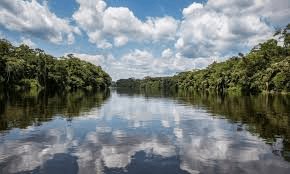
The Congo

Love. And Time.

It’s Fourth of July week and I’m about to get older, and I’m in a café on the Bay thinking how I’d love for this place to be open at night, late, like 4am, and sit and have beers or wine and talk to strangers about where they’ve been, literally and figuratively. I’m sitting here thinking about the the past four or five decades. “Fortunate” doesn’t come close to describing this pilgrimage; but something is different lately. I’m just turning sixty-four and I’m outliving so many people I know. This makes me curious about what’s next, about this brief span before me. I thought I’d grow tired by now, start to unwind, but curiously I find myself gaining momentum.

Here’s a decidedly oversimplified explanation of what runs through my mind on an almost daily basis: We are going to die, of course, but we have no idea when, and even if I live to my mother’s age of ninety-one, that’s just twenty-seven years form now. That’s nothing. And after that we close the door behind us and slip into that nothingness of never being this way again, through the eternal and infinite future of all futures. My point is, to be trite, “Today is my moment; now is my story.”

And today while sipping a cappuccino and after talking to a couple who are sailing down the bay to cross back to the Netherlands, I felt awake, like that crystal-clear awake you have sometimes after it rains. Like all of my senses were cleansed and rebooted. Happy Birthday to me.

To be sure, I’ve had my share of everything: I’ve had a lot of chances to travel. I’ve walked across Spain, trained across Siberia, drove around North and Central America, stood in rivers from the Connetquot to the Congo, and I’ve followed a herd of moose through the woods in Northern Norway. But still it simply isn’t enough; not on this abbreviated timeline. There’s not enough time, never enough love, too much wasted energy, too many spoiled days and nights, not nearly enough love.

In looking back, the moments that stick out most in my mind are the ones where I stepped out of my comfort zone and risked being embarrassed, rejected, and humiliated. Sometimes those things happened, to be sure, but those times are still better and more memorable than sitting safely at home watching reruns of an old show, watching other people live still other people’s lives.

Oh there have been moments. And they all have one thing in common; my memories are of the people I was with completely engaged with each other. It might have been my son in Spain and Russia, or just us taking pictures down at the river. It could have been sitting on a beach in Florida or drinking champagne while watching a sunset on the Great Salt Lake.

Sitting around a club I ran in Massachusetts after hours and swapping stories, laughing, eating pizza from down the road after all the people left. It’s the one am stop at Ocean Eddies on the pier in Virginia Beach in the late ’70’s for a drink and a talk with someone from somewhere else, nothing but the sound of waves crashing under us.

One Fourth of July I was in Massachusetts and drove to Boston to watch the fireworks and I stopped at the Bull and Finch Pub, made famous for being the model for “Cheers.” I sat at the bar and had a beer and got talking to someone who was there to play music. I told him I had played and he asked me to play a short set during one of his breaks. Okay, so this is an example of knowing as sure as I’m sitting here that ten minutes after I said no I’d be absolutely pissed at myself, so I said yes. Rarely am I 100 percent in the moment, not distracted by next or was, but moments like that I am present, completely present–like on the Camino or the Train or the Lake or the river. I said yes and risked being myself. I even had the balls to play “Please Come to Boston.” When I got home to my house on the reservoir that night, I got out my guitar and played while my cat Huey sat on my knee and listened.

Alive. I was so freaking alive that night. The next day friends came by for my birthday and I told them about it and they were excited for me but like with most things in our lives, you absolutely had to be there. I was.

Geez I’ve been fortunate.

But there was one night in particular which stands out a bit more than most of the others. It took place in a bar which long ago burned down. We called it The Shack because it had no name.

This happened about twenty-five years ago.

Just off the Gulf of Finland not far from an exclusive hotel but well in the woods was one of this world’s coolest bars—a dive really—a place to drink and sing and meet people you’d never want mad at you. It was small, with broken-down shed-like walls and windows which barely kept out the storm blowing off the Baltic one May night in the nineties. It was well after midnight and we ordered a bottle of Georgian Merlot and several plates of shashleek, a Russian shish kabob dish. A gypsy band showed up, including a guitar and violin player I’d met before and had played with there along with a friend of theirs, a woman singer. Hours passed as we played and sang and drank. There were four others, three of them, a waitress, the owner and his cat, and we sang and drank while what must have been that hurricane from The Perfect Storm slammed to shore. This duck blind of a building sat amongst birch trees, but that simply made me more aware of the weather, wondering when one might topple through the roof. It was exhilarating, an adrenaline rush that had nothing to do with the wine. It was being alive, right then at 3 am, with total strangers, live gypsy music, Georgian wine, and shashleek, that kept us awake. It felt dangerous, subversive, but it was just a bar in the woods.

I had been in my hotel room, ready to call it a night since the next day we were all going on a river cruise, but I got dressed to head back up the beach to The Shack and have some wine. I didn’t want to wake up the next morning and wished I had gone. The storm hadn’t yet kicked up. But it was coming; you could see it in the haziness of the midnight sun.

The band took a break and came to our table and we spoke in broken Russian and English about the storm and how we hoped it wasn’t high tide soon since the water was just a hundred feet west, maybe less. Then Alexi, a two hundred eighty pound drunk Russian who hated Americans started screaming at us like he had the first time I ever met him, the first time I walked in the place a few years earlier. He had kept to himself mostly since then, sometimes talking to me, mostly not, but this night something got under his skin and he screamed at me like he did that first time, “I hate Fucking Americans.” He startled me, but he had a drink in front of him, and another regular customer, a friend of the gypsy band, was sitting with him and told him to quiet down so he did.

But then I saw his eyes. They were deep and vacant, like he’d seen a ghost, and when he saw me watching him he stood up and said, “I hate fucking Americans!” and he tossed his beer at me. Sasha, the guitar player, stood up and yelled at him in Russian. But just then thunder, with a sound like the sky opening up and dropping two tons of hard earth on our shack, rattled the walls and ceiling and we all cringed. I thought for sure one of the birch trees cracked and was going to kill us all. I went down on the floor with my friends and the gypsy band, and Alexi cursed and fell against the back of his chair. He suddenly looked so small, and the thunderclap crashed on us again, this time blowing open one of the windows, and rain and wind sheered a path across our booth and against the other wall. Dima put his violin under his coat and our shasleek flew off the table onto the floor. The shack cat went for it but the wind and rain chased him back under the bar and into his bed.

Another flash of light lit up the shack and Alexi was trying to hide under his table but he was too big, and just as he glanced out the window on his way to the floor, he stopped and stared. I was watching him, and he looked out the window for some time, then looked at me, and with a nod he said, “Horosho. Horosho” which means, “okay. It’s okay.” And he looked out the window again when the window slammed back and forth. He grabbed it before it hit him and he held it a second, staring out over the Gulf. He looked at me as if to ask me to come see but he didn’t know how. Instead he closed the window and latched it again and turned and sat down. He nodded to me, “Horosho. Edeesuda.” It’s okay, come here. A few of us gathered and sat at his table, and Dima took out his violin. Alexi smiled at me, looked out the window and peered with a stoic face, then turned and smiled again. He looked at the waitress and said “pivo,” beer, and he motioned to us all so she brought us all beer. The rest of the night we laughed and sang songs. I asked Alexi what he saw outside but he just nodded at me and said, “I hate fucking Americans,” and we laughed and toasted and Dima played, then Sasha joined in and then the woman singer, and the beer tasted good. Alexi sat quietly the rest of the night.

The storm passed and the sky quieted down. I almost had stayed at the hotel that evening, turned in early, read in bed. Those are all good things, quiet ambitions which keep me grounded and invested in whatever happens next. But that night I didn’t. Like the time we went Ghost Hunting at midnight at the Saint Augustine Lighthouse, or when my son and I sat up all night in the town square of Portomarin, Spain, because we couldn’t find a place to stay. One time a friend of mine and I hitchhiked to Niagara Falls and it took no longer than it would have to drive, but coming back we walked for eight hours along dark roads through small towns. But if we had been given a ride right away, I’m not so sure I’d remember we even made the trip to begin with. We talked a lot that night, and I wish I could walk like that with more people, and talk, and just walk quietly too.

Sometimes you have to stay up until dawn to understand what’s hiding behind the night. It’s the rest stop at three am with two truckers talking about the next town; or the sound of wildlife in the desert brush, or tall pines scraping together in winter in the woods with no light but the moon. It’s walking up an Arctic path at four am in snow-deep March with Northern Lights bouncing past like a bull whip; or lying on my back on a cot in a compound in Africa beneath more stars than could possibly exist, the distant sound of someone chanting the Koran. It’s walking out of a shack in the woods after a storm passed, the sun just lifting over the raised bridges, ears buzzing from loud live music. It’s the perfect silence on a salt bed and the music of family talking about old times, talking about now. My new year needs to start not just remembering the beautiful path it has been so far, but what made it beautiful to begin with. Its enjoying the passing of time, as JT wrote.

On that night on the gulf after the storm, after the music and the wine, when I stood in the quiet light of morning and shook hands with Alexi as we went separate ways, most likely for good, I began to understand that this crudely brief life of ours is best punctuated with those we love.

Drive

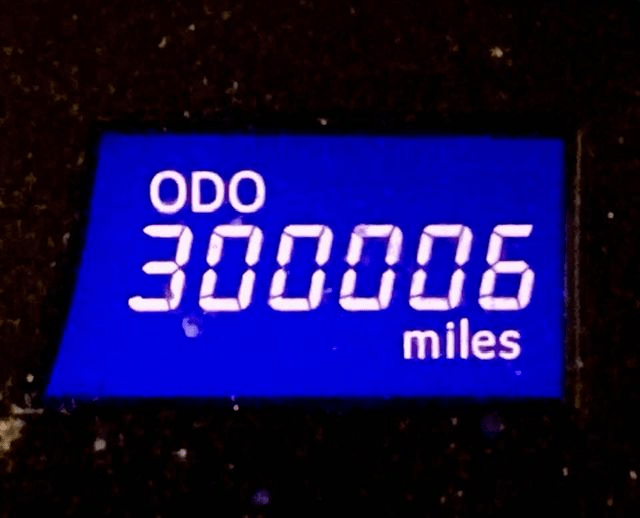
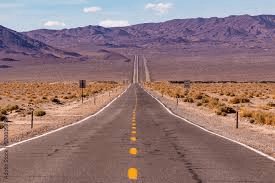
The odometer on my Toyota Camry just flipped to 300K. My mother gave me the car when her neuropathy prevented her from driving any longer. She bought it new in 2014 and when I took it over in late 2017, she had racked up 14K miles. Yes, it was literally driven by an elderly woman just to go to church. Since then, I have been to Florida a bunch of times, western New York several times, Ohio, Utah several times—no wait; I flew there. Prague once, but, again, by plane. Still, my math tells me I could have driven to Prague thirty-three times round trip, or Nogales, Mexico, one hundred and twenty-nine times.

I drive a lot. To steer Paul Simon into this, “If some of my homes had been more like my cars, I probably wouldn’t have traveled so far.”

Working backwards, my Toyota Highlander is still going at 430K miles; my son took it over and is careful now to only drive in on short trips; but, hey, Toyotas rock. I traded in the Hyundai Santa Fe when it reached 180K, and I had the Jeep Cherokee towed to Doc’s Auto Parts in Hartfield, Virginia, when it turned 225K miles old. When that car had just 8000 miles on it, someone rammed me from behind at 55 miles per hour and sent me 100 feet into a ditch. Ultimately, the car was repaired, but they could never fix the gas needle and for the rest of its life empty was full and full was empty.

Out in the driveway but not running right now is a 2000 Infiniti G20 with 325K on it, and while it needs a new battery and fluids replaced, and new tires, and maybe a good de-molding inside, my mechanic in the village says it’s still a great little, sporty car that runs well, and which a propane delivery driver once offered me $3K for without knowing anything about it.  

I bought a POS from a colleague for a few hundred dollars, and while the felt roof kept falling in, the trunk floor had a hole in it, and this Dodge Lancer Turbo had no reverse gear at all for the last two years of its life, I personally put 150K more miles on it than it had when I bought it. My son grew up in that car–not literally–and it was laid to rest at the Goodwill Donation Center in Virginia Beach, Virginia.

My red Chevy Spectrum spent some time in Pennsylvania and more time in Virginia, but that crappy little car kept me cruising for 180K before I swapped it out for a Toyota Corolla, which rolled over roads for 140K miles.  

My first car was a Chevy Monza, and like my current car, had been my mother’s for just 10K miles before it was mine back in the early 80’s. That car gave me geography lessons for many years, pulling this restless soul across country, out to LA, down through Mexico more times than I can count, its trunk packed tight with blankets and Kahlua, across Route 10 through the fifteen-thousand-mile wide state of Texas, to New Orleans, up through Nashville, up through Ontario and Quebec, through years in New England and endless trips to Boston and the Cape; it spun out of control down an icy hill in Worcester and slammed into a tree above a graveyard and the poor little guy fractured a few bones and ruptured a lung. After it had recovered, Richard Simmons rode in that car, and just a few weeks later Huey the Cat came home in the backseat to my reservoir house; it climbed Mt Washington, Mt Wachusett, and once broke down not far out of Manhattan after a museum trip to the city, but I was sick as a dog and my friend Liz had to drive us home after we changed the flat tire and discovered the smoke pouring out of the car was from lack of oil. I had no idea. That car of mine moved my shit from Massachusetts to Hershey, Pennsylvania, where it sat downwind from the chocolate factory on East Chocolate Avenue, then to a small village in the middle of nowhere.

The day that power-blue Monza died I had packed it full of an old girlfriend’s clothes and odds and ends to drive to her mother’s house forty-five minutes away when, symbolism not lost on me, the engine exploded and fell out just outside Annville, Pennsylvania. A friend picked me up, helped me finish my delivery that day, and then I sold it for two hundred dollars to a car guy I knew from the bar next to where I had lived in Hershey. On that day it had 255K on the dial and two Mexican blankets still in the trunk. I carried them home.

Not including rental cars, my Dad’s Nova which I drove from 1975 to 1983, and friends’ cars in college, I’ve driven roughly 2,171,000 miles, or 77 trips around the world, in forty-one years. That’s over thirty-six thousand hours behind the wheels.

I don’t know a damn thing about cars. I never had any interest, and when they broke down I had them fixed by people who do have an interest. I’m not mechanically inclined by design; I never cared. But I did the vast majority of this driving before GPS, before cell phones, before anything more than paper maps and bad road signs, when asking directions led to conversations, and sometimes to friendships. When getting lost was the most beautiful part of life and finding a phone to call for help could be a several-hour ordeal, especially if you’re west of Tucson at three am where wild boar wait for idiots like me. Man, the stories I could tell. Do people even have stories anymore? Everyone knows exactly where they are going, and that’s a shame.

We have lost the art of getting lost, of driving down strange roads in unfamiliar places, like the Sonoran Desert, or western Mexico, or Georgia. We have slipped away—too far away—from throwing a backpack in the trunk of the car, swinging by AAA for a few roadmaps, and heading out of town a few hours before the sun comes up, and then just after dawn you stop for coffee and breakfast at some roadside dive, and you ask where you are, and you ask where they think would be a good place to go.

We have left behind the immediacy of pulling over to figure out which way to drive and seeing some roadside attraction sign and stopping for an hour. I love rest stops, truck stops, scenic overviews where on some late afternoons you can see the highway below running off into the distant mountains, disappearing into the hazy dusk, sometimes music on the radio, sometimes the windows open and nothing but the sound of wind and somebody’s truck tires whining up ahead.

The car, that highway, that distant anywhereness of driving, is what keeps some people from giving up completely. It’s the hope of somewhere else; it’s the promise that can come from leaving a place and heading to another place you don’t yet know.

“Sometimes I get this crazy dream that I just take off in my car,” Harry Chapin wrote, followed by, “But you can travel ten thousand miles and still stay where you are.” Yeah, that’s true. But I’d rather have done the two million and ended up where I started then never to have left to begin with.

Smuggler

Border between Nogales, Mexico, and Arizona

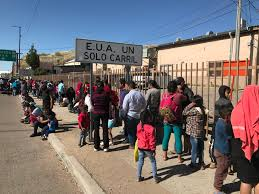
I found the streets of Nogales, Mexico, on Google Earth, or whatever one lets you watch it live, now, immediately. The streets are crowded these days, and the crossing is packed with people trying to walk or drive through to Nogales, Arizona. I’ve crossed that border at exactly that spot dozens of times, albeit forty years ago. Yes, there were migrants wishing to make it to the United States back then; after all, we invited them. We put up a big lady who literally said to come here, and we pushed our excellence in the marketplace every chance we could. If you build a huge ice cream shop and flash it in front of everyone who has no ice cream at all, a line will form; mayhem will follow. Either feed the poor souls or take down the “Give us your poor” statue.

Anyway. Nogales.

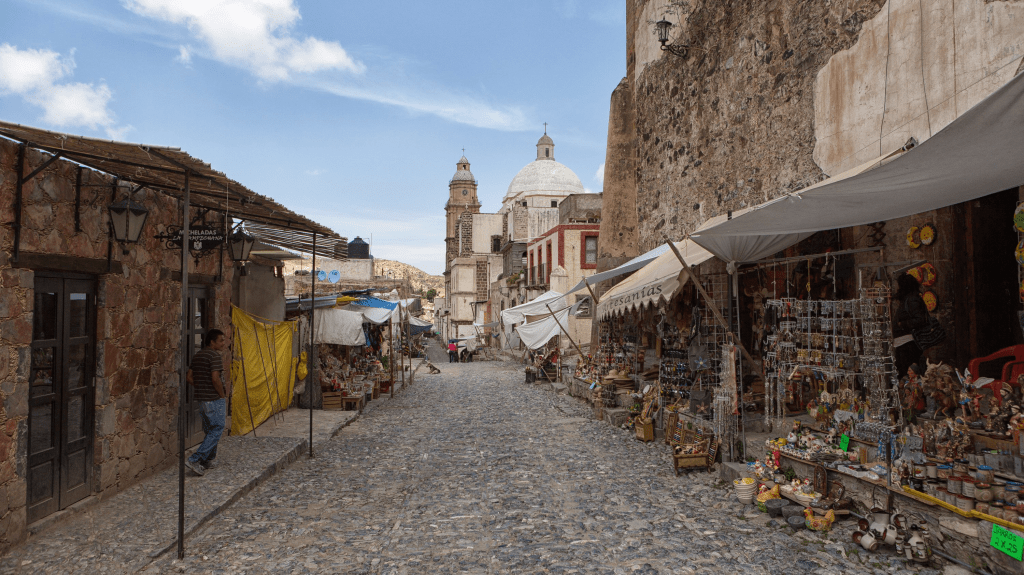
I used to eat at a small café there called La Caverna. They served cold Tecate and a burrito with jalapeno sauce and salad. One afternoon after lunch while standing on the dusty Mexican village street, an old man approached me. “You want to buy some blankets?” he asked in Spanish. His face was sun-carved and his thin frame as prickly as the saguaro cactus at the edge of town.

“How much?” I asked, knowing I only had about twenty dollars left.

“Two dollars,” he said. Now my Spanish was pretty decent, but I still stopped to figure if he meant two, or twelve, or twenty-two.

“How much?”

“Dos. Solamente dos mi amigo.” I agreed and he walked me down a few streets and a few back alleys. I was nervous, anticipating being jumped by younger, athletic guys who would steal my wallet, my car keys. Instead, we approached a small shed and Diego unlocked a padlock and opened the door. Stacked from floor to ceiling and throughout the 12×14 or so room were blankets of every color, with just enough room to step in and then crawl up the mounds to look for different kinds.

I looked at my twenty. “I’ll take ten,” I said, and left for my apartment in Tucson with my arms full. At this now-famous border, the guard asked if I had purchased anything. I had just graduated from college, drove a small Chevy, and hadn’t cut my hair or shaved in some time. The odds were high I had bought at least a few ounces of something illegal, though I hadn’t.

“Just those blankets,” I said, motioning to the back seat.

“How many?”

“Ten.”

He stared at me then let me go. I brought them to my Tucson apartment noting the unusually cold weather. A neighbor called to me, “Good thinking; it might be cold at the game tomorrow.” We lived across from the University of Arizona. He helped me carry the blankets inside and asked how much I paid.

“Twenty dollars,” I said. He thought I meant each.

“I’ll give you twenty-five.”

“Sure.” He gave me the cash and chose a green blanket with tan stripes. Very Mexican. “Hey, my buddy Paul will want one,” he said. “Can you sell another?”

I decided I could sell all of them and before night I’d done just that, pocketing two hundred and fifty dollars. The following week I went back, had lunch and found Diego. We backed my car up to his shack and loaded one hundred blankets.

Mexico then had a simplicity to it that seems to have been hijacked by drug cartels and border crashers. Not that these things were absent in the early eighties, but they certainly weren’t covered as closely by media, and the impact on people like me just bouncing around Mexico was nearly non-existent. Back then people who lived in southern Mexico, Guatemala and Nicaragua certainly knew of the promise of a better life in America–in particular for those pressured by the rising drug cartels and street gangs, but the lure was not as present. There was no internet to push them, not social media or other methods of communicating for Coyotes to build a small human-smuggling empire upon. The vast majority of migrants traveled in small groups and weren’t scrutinized by media–which had only just reached the now-antiquated level of “Cable TV.” Surveillance cameras were non-existent. Commentary on American radio stations or by political operatives was minimal at best. It was simply easier. I could train to Mazatlán, hitch to villages, and even drive my car deep into the interior without worry. Even when someone did approach me, whether to sell me something, check out what I had, or simply seek a ride North, the only consequence was time, and a few times I made friendships which lasted a little while anyway.

At the border, a different patrolman approached my car. “About one hundred,” I said somewhat nervously, even though I cut my hair and shaved.

“Then you’ll have to pay taxes,” he said, not moving away from the car.

“But they’re for my family.” He smiled. “I have a big family,” I added. We both laughed.

He stared at me. “Open the trunk.”  Very colorful, really, all that wool shoved into every corner of the Chevy. “Sometimes college students will distract us by buying a lot of one thing and smuggling something else. Like drugs.” This was true: More than ninety-three million cars crossed the border between the US and Mexico that year and not all carried blankets.

I laughed. “Oh hell, I hadn’t thought of that.” He smiled but I don’t think he believed me.

“Why buy one hundred blankets?”

I thought about my answer the way I think when I’m pulled over for a ticket and the cop hasn’t reached my window yet. What angle should I take? I gave in completely. “Look, I’m broke,” I said. “These cost me two dollars each and I can sell them for twenty-five bucks each at the UA game this weekend.”

He looked at me awhile, then back at the car, pulling up a few floor mats. He didn’t seem to be concentrating, though, and then I found out why. “I need ten,” he said.

He wanted a bribe. El Duh. “That’s a two-hundred-fifty dollar loss,” I said.

“No, that’s a twenty-dollar loss.”

“Cost, yes. But not profit. I mean, the taxes can’t be that high.”

“No, they’re not,” he said. “But the paperwork can take forever to finish.”

I stared at another agent ripping the panels off of some guy’s car doors.

“Ten blankets,” he repeated.

“Done.” He chose ten blankets. I got back in the car and he carried the blankets to the office where he put the “confiscated” goods and returned. “Next time, buy one hundred and ten blankets, Si?”

“Si, gracias,” I said, and started to drive off, but stopped. I backed up and he came to my window.

“When do you work?” I asked. I wrote his schedule on a napkin in black marker and in no time at all we became friends. That winter I made a ton of money and made a few good friends just south of the border. Decades later, I still have a few blankets. For me they represent time and place. Going to Mexico meant more than crossing into another culture; when I hear the word “blanket,” I sense the dust of a quiet road and the taste of cold Tecate, I hear the rough tones of Diego’s voice. It turns out there is a thin line between what we buy and where we’ve been. Souvenirs are more akin to snapshots than presents. They are narratives and conversations; they are moments, not mementos. And I learned more about where I am from by crossing the border than had I stayed home, like what true “need” is, the value of simplicity, and the restlessness that comes with a desire to improve. I had never thought about what it “takes” to grow, to improve my life; at home we didn’t really need to do more than keep moving forward. But in Mexican villages I witnessed first hand the work ethic and determination which makes improvement possible to begin with.

And really, once I saw the line someone else drew in the sand, how could I not cross it? I made a dozen or more trips for the sole purpose of buying blankets. By the last one in January of ’84 I was picking out ten blankets myself for the guard and simply handing them to him before driving on. During one of my last trips to Mexico I wasn’t going for the blankets. The line through the automobile gates was long, so I parked and walked across the border, ate one more lunch at La Caverna, bought some Kahlua and talked to Diego for a while. I brought him a University of Arizona Wildcats sweatshirt and we talked a long time. It was only then I learned his family actually lived in Mexico City. He had come to the border to try and make it to Tucson and work, and would send for his family later. He got as far as the border, like so many do, especially today, who make it to the southern edge of the United States, and no further. I asked him what will he do since he had been selling blankets at that point for a few years. “I’ll head back to Mexico City this summer,” he told me. The following year was one of the worst Earthquakes in history, virtually destroying a large portion of Mexico City. I thought of Diego then, and his family. I think of him when I open my trunk where I keep one of the blankets–it is indigo blue with tan and red stripes and has been everywhere with me for four decades now.

I walked to the turnstile gates that last time, nodding to my agent friend, who waved not knowing I’d never be back. I stood in the short line and wondered if I would have what it takes to leave absolutely everything I know–all of it–at a time when contact was primitive and I would perhaps never talk to or ever see my friends and family again, so that my life, and that of my kids and descendants would be better. For all of our wealth and their poverty, I learned that for the most part, my friends in Mexico, and those I only passed crossing the border one way or the other, value life itself much more than we do. I did carry some of that north with me.

Aerie is surrounded by farms worked by mostly migrant workers who speak little English. On more than one occasion while waiting to buy coffee in the early summer morning at 711, I’ve translated the order of a frustrated worker from Mexico living for the season in Deltaville. Inevitably, the conversation moves outside, and they ask how I know Mexico, and I tell them about my time there, back when “Coyotes” were animals. I tell them that I can recall quite clearly sitting on the porch of a café there, sipping beer and watching people walk by, and the faces of those heading north for the first time were alive and filled with promise. And just beyond them, through the gates on the other side of a few guards, was the literal line in the sand, and what I always saw as the southern border of my own country, they all knew as the front edge of hope.

From This Green Hill

This article, the most shared of any I’ve written, originally appeared in the Washington Post, May 29, 2016.

From This Green Hill

by Bob Kunzinger

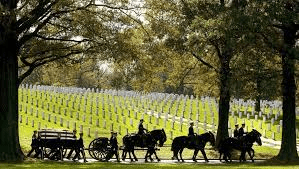
I was at Arlington National Cemetery and stood near a small wall on a tranquil hillside, and I could see Washington, D.C., the Washington Monument and other memorials to our Founding Fathers.

The unobstructed view looks out upon our nation’s capital, where for almost 250 years some of these souls have challenged the balance of power. A few of our former leaders lie just feet from this unassuming spot: an eternal flame for John F. Kennedy, a small cross for his brother Robert and, for their older brother, Joseph, one of the hauntingly familiar headstones. Across these green fields in all directions stand thousands upon thousands of marble markers, all carefully carved with the names of veterans and spouses, their birth and death dates, battalion or division and rank and conflict, a cross or a star, variations of both. A flag.

From this protected promontory I could see century-old oaks. Magnolias and dogwoods shrouded headstones like commanders keeping their soldiers safe. The Tomb of the Unknowns, mausoleums, small, singular sarcophagi and miniature monolith monuments stood scattered across acres of fields of fallen men and women who once stood as strong as those very stones that mark their last battle.

From this green hill I could see wildlife. I watched brave birds feed at an arm’s length away and then scatter to the safety of a nearby branch. Starlings perched upon headstones, and striking red cardinals gazed from the low branches of a tall maple. It was theirs, once, as were all the battlefields and all the cemeteries from Winchendon, Massachusetts, to the Texas Coastal Bend, before these battles took their toll, and men — boys — were buried in this wilderness.

From this tear-soaked soil I could see Vietnam, its rivers and forests where death kept too close to birth, whose beauty and wilderness taught men to pray and made brothers of them all. I could see the village battles between unknown enemies and blameless boys who should have been home riding bikes and reading books. I could see the more than fifty-thousand Americans never to become authors or professors, scientists or librarians, gathered beneath this field where their legacy is our common charge.

Beyond the Potomac, I could see Korea, the Philippines and New Guinea. The voices of spouses still crying for a husband to come home, women, standing alone too young, holding the small hands of children starting their fatherless flights toward tomorrow. I could see the medals and markers, veterans hugging veterans above a brother’s eternal assignment, saying, “It should have been me.” “He gave it all.” “He saved my life.” “He was too young.”

From this hallowed ground I could see Normandy. I could see the parachutes falling under the cover of night. I could see rows upon rows of men who marched side by side through shallow, blood-filled, mine-laden water toward the only hope left. I could see the hillside and the secured toehold. I could see the American flags on Omaha Beach and Utah Beach. I could see the graves of those forever beneath foreign soil and the ships returning with thousands of heroes. I could hear taps, the prayers of priests, the commanders’ thank-yous, the nation’s solace.

From this sacred spot I could see into France, the sacrificial fields, the trenches that saved the lives of our great-grandfathers. I could see the muddy, barren no-man’s land where brave men crossed only to lie here, now, beneath crosses too many to mention.

From this vantage I could see the heirs of Lexington and Concord. I could see Saratoga and Yorktown. I could see the battle for freedom, the commitment to integrity, the promise to defend. I could see the fight for the greater good. From this spot on a green hill I could see a small group of men standing like stone walls against England and claiming with absolute clarity and without compromise that we will be free. We will stay free. We will not fail.

From that green hill, from that perspective on such honorable sacrifice, I could see what bought our freedom. I could count the crosses, the sum of which cannot be measured, whose cost cannot be calculated.

That Student

Its the end of a semester, finishing up today, and I sit and remember one of my favorite moments as a professor; ironically, it was a day I encouraged a student to quit school. Honestly, not everyone belongs. Not yet.

A student comes to see me. He says he can’t handle the pressure of school. I tell him I think he’s a good student and he says yes, he can do the work, he just can’t stand it. He hates it, he says. He gets bored fast. It’s a good conversation, honest. Had we been somewhere else we would have talked over beers. He looks at his watch and says he has to work in a few hours and sighs. He runs his own roofing company but hates that too. He has six grand invested in equipment and no help and he just dreads doing the work now. He says he’s at some fork in the road, two paths that look the same so he’s frozen, easier to just stay put. He gets quiet and stares at a photograph on my wall of a village in Africa. Looks nice he says, like he wants to say anything to forget what he’s really thinking about. Then he remembers and sighs again. He’s quiet for some time and I find myself drifting.

I worked at a bar. Good money and mindless work; the kind of work where if you don’t think too much about what you’re doing, you can keep on smiling. I know I spent a few years there but it seems like it was always winter, all grey and bone-cold. One morning I woke on a bench near a lake in a state park near my country house, but I didn’t know how I got there. I had to work a few hours later but never made it. I drained my accounts, stuck a little aside, then bought a ticket to Africa. Turns out changing my life, kicking my own ass out of the same ‘ol same ‘ol, was as easy as jumping off a cliff knowing you’re either going to land on your feet or learn how to fly. Boring disappeared from my life.

But this student has trouble talking about it, so I talk: I tell him I get that feeling in my chest too. Tight, constricting, difficulty breathing. You know what I’m talking about. It’s the sense that something needs to change. It’s the Philosophy class with five minutes left of three hours and the prof starts another chapter because there are still five minutes left; it’s the meeting you can’t tolerate but you’re in a row of seats with too many people on both sides so you can’t leave; it’s that this-homily-is-way-too-long feeling. It’s the feeling you’re just one day away from something else, but then that day comes and you find yourself one day away from something. It’s the Whitman poem about astronomy; the wide awake at three am feeling and you can’t move so you stare at the alarm clock. Exactly, he says. I’m always staring at the clock, he says. I’d love to know what you’d do, he says.

I tell him about that bar somewhere I didn’t belong. I remember working and then not working but I don’t remember what happened between the two. I just recall waking up one day in the peace-of-mind of another world, centuries away from being behind bars; like I could finally breathe on my own. I let him know I remember dreading the moment between what was and what was next so I just kept pouring drinks, and he nods. He knows. Then I say that one day I didn’t. It was that simple. He looked at me like I was looking in a mirror. Then he says he’s going to work and he leaves. I went to class slightly high on remembering, still somehow slightly down, suddenly lethargic.

Six months later he sends me a postcard from Australia. Don’t know when I’ll be back, it says. When I am, let’s get some beers and talk. I look forward to it but, of course, way leads on to way, and I doubt he ever came back.

Between the Lines

37.5531° N, 76.3403° W

It’s raining today along the river, and the puddles running along the roads and the edge of the woods are yellow, covered in the pollen which until early this morning hung in the air and on my body and in my lungs. It is the time of year when I most welcome the rain. Right now, I’m standing at the Chesapeake Bay where it is rainy and peaceful. I don’t get phone service when I’m out along the road near the bay, and I like it that way; I like how I’m on the edge of the continent, lost in the four thousand miles of water between here and, well, as it turns out, Sicily, where my maternal great-grandfather was born. When I’m out here out of service I feel more in touch with everywhere else, everything and everyone else, and my imagination takes control of the helm.

If my eyes could bend directly east along this vantage, I’d see through Athens where I almost went almost forty years ago and on into Tabriz, Iran, where a student of mine never came home from thirty years ago. Past there I’d move through Uzbekistan, a place I’ve never been but whose food I know well having eaten many dinners at an Uzbek restaurant in St Petersburg, Russia, where we’d spend four hours taking our time with each course and hot bread and samovars of tea, belly dancers and hookahs, and the most delicious entrees.  I had no idea all these years standing waist deep in the Chesapeake at Stingray Point, I was watching distant Uzbeks.

I’m standing on the imaginary line that runs just a sliver south of the 38th Parallel, closer perhaps to 37.5, or if you speak to any one of the watermen in this village, they’ll tell you 37.5531° N.

So, close enough. Let’s go further:

Passing Gansu, China, famous for its water-pipe tobacco out into the Yellow Sea almost directly through Baengnyeong Island, which means “White Wing Island,” so named for the resemblance to an Ibis in flight, and home of intelligence communities because of its proximity to North Korea, which brings me to the most famous spot on the 38th Parallel—the 38th Parallel. Of course it runs around the entire planet almost directly under my feet, but when most people hear “38th Parallel,” they think of the Koreas, of course.

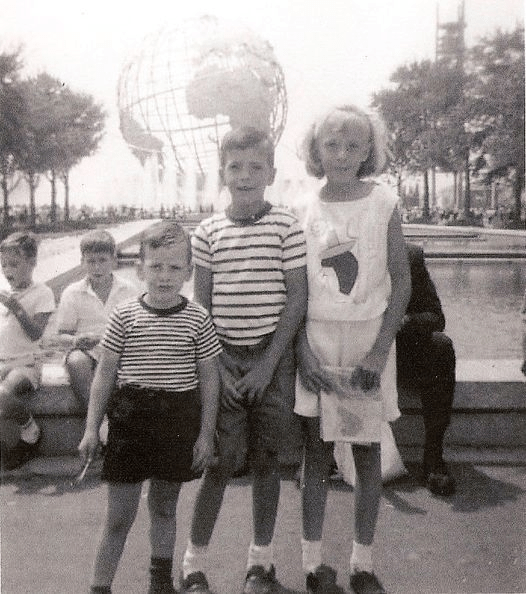
I’m on the same white line as Canyonlands National Park, Utah, and Newton, Kansas, passing right under the counter at Gurty’s Burgers. Evansville, Illinois, too, but it makes me think of the tragedy of the 1977 plane crash which took the lives of the entire University of Evansville basketball team. I’m two and a half hours east of Charlottesville, Virginia, and just south of Chincoteague Island where the horses still swim. And when I was five with my siblings at the World’s Fair in Flushing, New York, standing in front of the famous huge globe with its metal longitudes and latitudes, who were my neighbors then? Are they still out there, following different lines? Searching away? Searching toward me?

But since I find myself at the proverbial crossroads in life yet again, I can’t ignore my northern and southern neighbors—since isn’t that what we are? Neighbors? I mean, if we are going to James Webb our way into the distant galaxies and black holes, I think we’ve reached the point where we can all consider each other neighbors, relatively speaking. If “neighbor” is someone with whom we have some physical closeness compared to others more distant, than astronomy has moved us all on this sphere into the category of “neighbors” to be sure, reliant upon each other, part of each other both as particles and participants.

And those north of here include the North Pole, of course, since all longitudes meet eventually, twice actually. But closer to home is Ellesmere Island, Nunavut, Canada, the world’s tenth largest island and home to Victor’s Seafood which has curbside pickup when you don’t want to get out of the car. And Prince Charles Island, also in Nunavut, of course. This line runs south from there through Ottawa and into my birth state of New York, into Pennsylvania, into Maryland, and down through the Chesapeake Bay to this rainy little piece of Longitude. But wait, I’ve always been drawn to the tropics. Here’s why: I’m standing, I mean I find myself smack dab on the same streak that runs just west of the Bahamas and right into Holguin, Cuba, its fourth largest city and cradle of Cuban Music. But here’s the crazy part: It goes on, this longitude, into Colombia, Ecuador, and San Bartolo, Peru, on the Pacific Ocean, famous for its beach-going tourists and surfers. That’s what nearly exactly attracts people to Virginia Beach, just a notch southeast of here and where I attended high school; and where I learned in geography everything about this world except that New York and Virginia were due north of the west coast of South America. Yes, here standing on North America’s east coast and staring out toward the Atlantic, I am due north of the west coast of South America where people are staring out on the Pacific Ocean. But further still, the Southern Ocean (which I don’t remember even being a place when I was a kid) and right into the northern cliffs of Charcot Island, Antarctica, with its crabeater seals and Adelie penguins. Right here, but south.

Deltaville is at 76.3403° W for those keeping score.

This one spot, here, this mark on my mental map is tied, distantly I admit, but tied just the same to people being born and raised and looking out, wondering. It’s kind of our own little “Double L” ranch, only really thin and exceptionally long. If we coordinate correctly, we could all plant flowers on our line, though somewhat problematic headed north and south as my daffodils might not grow in the Nunavut tundra or the desert of Patagonia, but we are neighbors; we work together on these things.

We have been nomads since the nomadic days, and while we might be “from” somewhere, we rarely stay any longer, following our songlines, chasing something unknown. Since I’m a child I have wanted to follow those latitudes and longitudes, since I read Robin Lee Graham’s Dove, since Joshua Slocum, since St. Brendan.

I want to meet our neighbors before I sail on to different coordinates. Ireland, of course, and Prague. Spain again, and the Netherlands, for certain. It turns out these lines are everywhere, like a grid, like graph paper, like those moving walkways in airports leading us to the next terminal.

My first experience with Longitude and Latitude Lines on the globe at the World’s Fair in ’65