Aerie: noun: 1. A Hawk or Eagle’s Nest. 2. Bob’s Home.

It’s colder today, and a strong wind blows out of the northeast, off the water, and the last of the leaves are letting go. It’s desperately Autumn here along the Bay. Yesterday the colors were brilliant, at their “peak,” and today they are muted. Tomorrow the leaves will mostly have fallen. I walked the paths just now here at Aerie, and the skin on my face feels tighter, the back of my neck is cold.

The sound of dry leaves and the wind is immediate. The clouds are low and dark—steel blue—layered deep clear past the horizon, as if they’re keeping out the rest of the world. They threaten, of course, but somehow they protect as well. It only took a few turns around the property and a meander past the duck pond and river to let go of the world for a while. Genocide cannot find me here; bombings will not find me here. Invasions and deficits and brashness and ridicule cannot locate me when I’m here at Aerie, and the sky is low like this, and the only sounds are the leaves in the wind and the water pushing back on the rocks, and the geese over the recently harvested fields.  

I left home far more than I should have. It was always interesting and exciting to come home after a month somewhere else and see how so much had changed; leaves either completely fallen or fully alive. I am glad for the places I’ve been and the people I’ve grown close to in my travels. But in retrospect it seems I was mostly out there looking for something allusive, some semblance of peace, perhaps. And today walking up the hill from the river I realized it might be the kind of peace I find here at Aerie. I almost find it here in Spring, working in the garden, osprey calling above while teaching their young to fly; and in Summer when we scull out on the Rappahannock, up the inlets to the west, stopping for oysters at a small grill near the bridge. In Winter, when deer and fox come closer to the house looking for food, finding apples, and I can sit on the steps for hours teasing one fox closer, and then closer still, and she eats a few slices before taking a large core in her mouth to bring back to her den to share with her young.

But it is Fall, of course, when I come closest, and the smell of leaves is deep, and white oak burns in the fireplace, and we heat up apple cider and I can sit on the patio at night for hours, bundled against November, working on something in my mind, remembering the reach from some other time.

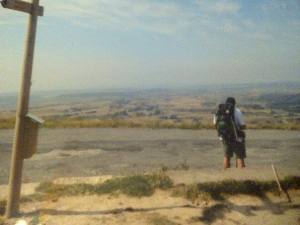
Last week I walked to the river and a bald eagle stood in the field to the east where corn had been just a few weeks ago. It never fails that every time the eagles return this time of year, I remember a song by one of the primary influences in my life for my love of nature–John Denver. He wrote, “I know he’d be a poorer man if he never saw and eagle fly.” I always knew it to be true; I just never dreamed it would happen from my front porch. I have hiked in the Rockies, and I’d hike there every day if I could. And I’ve walked across the Pyrenees, through the Berkshires, along the Camino de Santiago where I must return to truly unearth that peace. Yet here where the Rappahannock meets the Chesapeake is where all my songlines converge.

It’s colder today, and grey. The paths are covered in leaves, as they should be this time of year, and my son is baking biscuits and heating up apple cider downstairs. I have some serious metaphorical hills still to climb, but today, outside, I can hear squirrels arguing, and the driveway is covered in acorns. A close friend of mine pointed out recently that to him Autumn is hope, it is life tucked away for awhile giving us a chance to start over in a few months. He’s right, of course, but I wish I could slow the whole thing down. I don’t want things to change so fast anymore. I like the sound of the leaves as I walk the paths, the colors as I lay in my hammock and watch them fall. I find peace in the carpet of stars at night, out early enough in these winter months for me to spend hours looking up, wondering. My anxiety settles down when I sit on the patio at night and hear rustling in the woods as the fox comes to call. I have lost so much faith in humanity it is difficult to write about. I need a breath; I need to be restored. It seems that despite our potential to banish the evil in the world, we continue to falter. But here at Aerie on the eastern edge of Virginia’s Middle Peninsula, something eternal is happening even as life let’s go and settles softy around me, marking time like decades.

Passing through Nature to Eternity

there’s a house in there, swallowed by the growth

It’s raining, and the air is cooler than it has been, which brings with it, for me anyway, a soft undercurrent of sadness. You see, I love summer. I love the heat and the stillness of it, the hot sun on my face and shoulders, the sand under my feet, the water—oh the water. So when I wear long sleeves or shoes with socks, or when the water can no longer be waded into for no reason at all other than slant of earth and distance to the sun, I get melancholic (as if listening to Jackson Browne right now might not already be responsible). And today was like that, but more so because of the rain.

This week’s work involves adding random details from my younger years to a one-hundred-and-eighty-page manuscript to set a sharper tone to a time that was above description, beyond anything that could be limited by diction. This editing stage sends me back to a place I would, both at once, relive again in a heartbeat and never want to think about in my lifetime. But it was so long ago I have trouble remembering some details and I get lost in the weeds of long ago. So to clear my head, I went for a walk to keep myself present, keep my mind on the here and now. Rain can certainly do that. This can be a Herculean task at times—keeping things clear. More so for me when the air is cooler, and the sun is not so hot anymore. It made me realize how much simply fades from our lives if we stop paying attention to it.

Writers have various ways of dealing with ghosts. Some watch Pirates games, some watch movies. Some drink and some play with their dogs in open fields. I walk.  

Down the road is a track of wooded land with an old colonial house. At one time, even since I built here twenty-seven years ago, the house was completely visible and well admired. It sits recessed on the front edge of beautiful, forested land with hardwoods, which this time of year are starting to show their colors. The house is white with a wrap around porch, hedges, and a front lawn more akin to a rolling, green field where deer gathered every day at dawn and dusk to sip the dew. I loved walking by and think about sitting on the porch, drinking tea on a day like this, watching deer and listening to something gentle, like piano music, while rain kept meter on the porch roof.

You can no longer see the house. The front lawn has grown deep in weeds and small trees after just a half dozen years of no one caring for it. Nature has reclaimed the entire property, and the house, if you walk up the no-longer-navigable driveway far enough, is covered in vines and mildew. Several porch slats are caved in, and while the windows remain in tack, portions of the siding are simply gone. I don’t know who owns the place, but the man who rented it and lived there with his dog has gone back to Richmond an hour from here and, presumably, has no connection to or obligation for the place. For all I know the owner is dead. That happened elsewhere nearby. One house not far from here has been so reclaimed by nature it is absolutely impossible to tell there is a structure there except for a slight glimpse on a sunny day of a car bumper and an old boat appropriately named “Prozac.”

It happens sometimes when there is a lack of heirs in a community where restrictions are limited and property size is usually somewhat sweeping. The once lived-in and celebrated home is a house being swallowed by the earth, as all eventually will be. It makes me wonder if Mars at one time had a suburbia which a billion years of burning sun and negative-Kelvin ice storms vaporized into nothingness. That’s what crosses my mind when someone doesn’t mow their lawn very often.

There was a time, though, when someone oversaw the construction of the beautiful place, measured twice and cut once, new owners backing up a moving van and carefully designing the rooms, children running up the steps to their bedrooms, leaning against the window on days like this to watch the deer out front. The place might have filled with the aroma of turkey in the fall, soft sounds of football from the television in the den in the back, with the double doors that looked out over the marsh to the east. Geese frequent the area, and from the porch the kids would have sat in the chairs when relatives visited and watched the birds land in the fields across the road.

The kids grow up and leave, for Richmond, for DC, for another place. The parents can’t take care of it as well as themselves, so they move to a smaller place in the village, or in with one of their kids, and the paid-for-house sits alone and silent. Taxes only run a few hundred a year, so they’re easily paid and then forgotten. Then they rent it to a man with a dog, but he leaves too, and the owners die, and the kids let it go, hoping to take care of it someday.

Or maybe they had no kids, like the Prozac house. It just sits there until nature, which always wins in the end, wins.

I wonder if I’d run through that entire scenario if it wasn’t raining. Autumn is proof, I suppose, like old, uninhabited homes, of the passing of time.

Back at Aerie, I sit on the porch, drink tea, listen to a football game, and can smell turkey drifting out from the kitchen. I have some planting to do for the fall—bulbs mostly, but the back trails have gone untended for far too long. I’ll do that, this week probably. The area behind the shed needs to be cleaned up as well, and I need to get an estimate on stripping and restaining the house; I’m way overdue on that. I don’t have the energy I did when I built the place twenty-seven years ago. Then, all winter long I came and helped stack the logs, met sub-contractors while my then three-year-old son sat watching his home rise out of the dirt. While the roofers worked or the electrician figured out how to install wires in a log home, he’d ride on my shoulders as we walked down the hill to the river and we’d talk about what we’d do here–a pool, of course, and a basketball net. We’d play football in the yard, and we’d throw the baseball, of course. Come that early Spring I built the inside; all the interior walls, the cabinets, the stairs, the rest. The rest of life was still a distant curve after a still-to-come lengthy journey, and this place was forever. Come spring, we moved in, and the wood smelled so fresh, plus outside honeysuckle and lilacs.

The leaves are changing colors early this year, and I can feel the fall in the chill of the wind. The bay breeze helps keep it seasonal for now, but the winds will shift soon to the north, shutting down summer completely.

I don’t mind fall; it is beautiful. My time in western New York and especially in central New England spoiled me for how intensely beautiful autumn can be. But summer for me has more hope, still holds just enough promise for everything to work out fine in the end. It is the time when we keep building our lives instead of stepping aside and letting nature run its course.

Does everything eventually bend the way of the once-white colonial? Is even Aerie headed someday to the condition of the Prozac house? We like to think not.

And anyway, for now, I am here, sitting and drinking tea. Tonight the fox will come by the side of the house for apple pieces, and the birds flitter between the crepe myrtles and the porch-rail feeders. Life is everywhere right now, even while summer fades. I can hear the geese headed toward the field.

The rain has eased, and I think I’ll walk again, down past the farm, past the unseen, recaptured house, and to the river, which will hold its own for eras beyond everything else, as waters have done since the start. But then I’ll need to cut the grass. If I have the energy, I’ll also trim the hedges.

“And while the changing colors are a lovely thing to see,

if it were mine to make a change I think I’d let it be.

But I don’t remember hearing anybody asking me.”

–John Denver

Aerie

Obscure Christmas Songs

I’m crying here. The last three songs in particular will first grab you by the heart, then get you to laughing, then get you thinking. Please watch these. I promise–I really do–they are exactly what Christmas is about.

Honestly, if this season is about anything, it is about humanity; these lesser known scores bend that way.

Everyone plays the standards: Bing, Elvis, Bruce, Perry Como, Andy Williams, The Carpenters, and on and on, adding new classics each year.

But some songs simply get left behind in the wave of music that avalanches onto the airways each winter.

Allow me to present for your listening pleasure Bob’s Seven Obscure Christmas Songs. Feel free to share, forward, follow, sing along:

Do Listen. Warning: Number seven is technically not a Christmas song, but is perhaps more about the very truth of Christmas than any other song ever written. Truly.

Obscure Christmas Song #1

Jackson Browne: The Rebel Jesus

Obscure Christmas Song #2

Paul Simon: Getting Ready for Christmas Day

Obscure Christmas Song #3

John Denver: Christmas for Cowboys

Obscure Christmas Song #4

Bob Dylan: Christmas Island

Obscure Christmas Song #5

Trans Siberian Orchestra: Christmas Eve/Sarajevo

Obscure Christmas Song #6

The Piano Guys: Angels We Have Heard on High

Obscure Christmas Song #7

Ralph McTell: Streets of London