Ten Books of Note

IMG-20170424-02498

Last week was the Old Dominion University Literature Festival. I spent some time discussing with my writing students how what they read when they were younger informs who they are now.

Then I gave them my list:


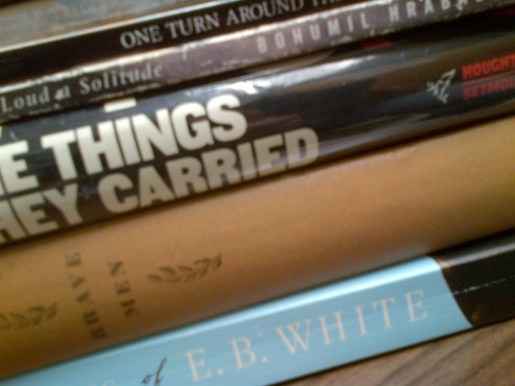
Tim O’Brien The Things They Carried.

Tim Seibles One Turn Around the Sun

Ernest Hemingway Old Man and the Sea

Bohumil Hrabal Too Loud a Solitude

Carlos Fuentes Old Gringo

Ernie Pyle Brave Men

Roberto Bolano A Little Lumpen Novelita

E.B. White Here is New York

Frederick Douglass Narrative

Lieve Joris Mali Blues

 ——

When I was in college a professor asked us to list ten books we loved so he could explain what he figured out about us from the list. Except for the minor detail that I wasn’t sure I had even read ten books, I thought it an interesting assignment.

The above list is from my perspective as an adult. But looking back my book list in college included Stephen King, Woody Guthrie, Robin Lee Graham, Woodward and Bernstein, and most likely Mark Twain’s personal narratives. I don’t remember much of the professor’s analysis except what was clear to anyone, I liked adventure and bent toward non-fiction.

When I decided to use this assignment with my students, I knew that I needed to make my own list. Thus, the ten books above are what I consider the most influential or memorable or re-readable books I can recall. I didn’t head to my bookshelves to come up with them; I simply put my head back and thought about books.

I ask my students to list “observations” of their compilation. Some observations of my own list:

  • I still like adventure and have a bend toward non-fiction.
  • Five of the books are non-fiction though O’Brien is thinly disguised fiction (Read If I Die in a Combat Zone for reference)
  • Seven of the books are pretty short
  • Only one was written by a woman despite some heavy influence from women in my writing including Alice Walker, Frances Harper, and Virginia Woolf.
  • Three were not written in English.
  • Seven do not take place in the United States, though The Things They Carriedis debatable since much of it does but much of it doesn’t. So six and a half.
  • Five of the authors are also known as essay writers.
  • Seven somehow wrapped themselves into the narrative.


Tim O’Brien’s The Things They Carried is simply one of the greatest books of the 20th century, and while it takes place in Vietnam, it is not about Vietnam anymore than Tim Seible’s One Turn Around the Sun is about astronomy. In O’Brien’s book, along with Hemingway, Hrabal, White, Douglass, Pyle, and to a lesser degree Joris, the author either writes directly to the reader or involves the reader in some way.

Seibles’ book is about his parents and age. In fact, the passing of time is a common theme for Hrabal, O’Brien, Guthrie, and Pyle. I heard Tim Seibles read from the book long before it was published, have talked to him many hours over lunch about our parents and time and age, and admire his diction and phrasing perhaps more than that of any writer I know. He is a giant in the poetry world and this book is his best. Read it from start to finish; don’t jump around. Too many people think that because poems or essays are short and seemingly unrelated, they can flip around for pieces to read. Well, that’s true—but don’t. Please read the stuff in order. There is, in fact, order.

I love how Old Man and the Sea is about an old man at sea whose pride is simply too strong to let the damn marlin go and focus on the smaller fish around him. And then when I read it again it was really about pride in general and who we are and what we learn as we mature. And then when I read it a third time I realized the entire story is the Passion of the Christ. I like how Hemingway never lost his journalistic tightness and how he uses repetition as an art form. Also, the book is really short and I generally run out of steam at about 100 pages. When he wrote, “It was an hour before the first shark showed up” just a dozen pages from the end, I was already hoping the boat would sink.

Susan Sontag once said Czech writer Bohumil Hrabal is one of the finest writers she has ever read and Too Loud a Solitude is one of the finest books. I’m with her on that. It took me several reads to understand how this crazy-ass little book is a compact version of all the greatest philosophies in history, and the “compact”ness of it is a metaphoric spin from the lead character who compacts trash. It is funny as hell and poignant. To top it all off it happens to be parallel in so many ways to The Things They Carried that I could teach a seminar in those two books. As an aside I should say that Tim told me once he focused on Czech language and literature for awhile, years before he wrote The Things They Carried. Go figure.

When I was at Penn State I spent a lot of time reading all of Fuentes’ work. He seems so much like Hemingway and uses a classic narrative structure. I read his work more because of his locales than the story, and also I was trying to fine tune my Spanish, but Old Gringo is my favorite. If anyone likes Hemingway, he or she will like Fuentes.

Ernie Pyle’s work was introduced to me by Professor Pete Barrecchia at St. Bonaventure. Since then I have not met a journalist who was not at least somewhat influenced by Pyle. He is, to be certain, above all other war journalists before or since and Hemingway once said if Pyle had not been killed at the end of World War Two, it is unlikely anyone would know of what Hemingway wrote after that. Google “Ernie Pyle Normandy” and read his piece about walking the beach at Normandy. It is easy to see how Hem and O’Brien both took much away from this great journalist, particularly O’Brien.

Last year, Tim Seibles gave me a copy of Bolano’s book and I read it start to finish without stopping; a nearly impossible feat for me except it isn’t that long. I had given him a copy of Too Loud a Solitude and he said that crazy-ass book reminded him of this one and when I was through we laughed about how neither of us could explain to anyone what the hell it is about, but it simply keeps you from start to finish. It sent me to the rest of Bolano’s work. I still can’t explain what happens but I love how it happens.

I was already familiar with EB White’s excellent essay work outside of his famous grammar book when I tuned into “Selected Shorts” and heard someone reading “Here is New York.” It stands alone for work that is less “about” New York than it is about the state of “being” in New York. If I were born earlier, I think I’d like to have been EB White.

I love Douglass’ writing style—very journalistic in approach—and his description is honest and raw, made more revealing by his first person experience. But there is something else that makes this one of my favorite all time books and Douglass my greatest American hero—his Character. Frederick Douglass is an inspiration not only for his accomplishments against the greatest odds in an evil system, but for his mostly firm moral compass through it all. He is simply a tremendous example. The Narrative of Frederick Douglass should be required reading in every single school.

Joris’ Mali Blues about a musician in Mali and his life not only in his village but as an international celebrity is captivating from the start and she walks a new line between personal experience and reporting. This is also a work of journalism. I am pleased that after majoring in J and never pursuing it as a career, my favorite writers were either journalists or at the very least have adopted that style of writing.

These are not the most influential writers for me as a writer—that is a different list, though there is some crossover. To the point—O’Brien, Hemingway, Pyle, and Hrabel make both lists, but the rest do not. These four for one reason or another “inform” how I write—sometimes by outright theft. The other two writers who influenced me as a writer are first Aaron Sorkin, who I think is simply one of the finest writers working today, though he is wholly a screenwriter and playwright, but that makes him a master of dialogue. And finally Jackson Browne. His early emotionally-driven work sets tone for me better than any writer I know. Obviously part of it is hearing a minor key come in for something like “Sky Blue and Black” or the musical phrasing of “For a Dancer.” As I get older, poetry for its diction has become more important, and I’m still trying to find the patience to be meticulous in that regard. But for tone, the music of Browne or Van Morrison or just the right rendition of Canon in D can light fire under my work way faster than the classic writers. Often even faster than caffeine.

I have read many books beyond this list, including a stack my son keeps adding to saying “this seemed like a book you’d like.” He has already read more books than I have in my life. I am not sure why I have an aversion to reading; I think it is because I try to spend as little time as possible reading about what other people have done and spend that time doing something. It could also have something to do with the tens of thousands of student essays I’ve read in the past thirty years. When my colleagues in the writing world get together and talk about our peers work and what they’re doing, I generally slide out of the conversation and find someone who wants to talk about something more relevant to me, say like goats or the beach. Part of it is I hate talking about writing; but the larger issue is simply I do not read that much. I write or I do things. So when I do come across a book that takes me in and takes over my mind for a while, I want everyone to read it.

After they finish reading all my books, of course, which shouldn’t take long; they’re short (the books, not the readers, I think).

What about you? What makes your list?

download

Remnants

10925477_10205414237302847_5616740111726914403_o

It was ninety-six degrees yesterday. I cut the grass, raked a bit, pulled up some dying and long-ago dead garden plants, and then went inside to switch out some summer clothes for sweaters. Not all of them though–summer doesn’t really escape this area for another month or so. But the dropping humidity and prediction of highs in the low seventies tomorrow means a slight diversion toward long-sleeve tees at night despite the continued donning of my flip flops. 

I love fall–many do–the colors of the trees, the blowing leaves, and the faint odor of something fresh in the wind. I loved it even more when I lived in New England and western New York, but even here along the Bay we are far enough north to notice the changes. Still, despite the preparation and anticipation, those changes always take me by surprise. I believe it is the absence of that sensation of hot sun on my arms and neck, the sweeping away of gnats near the river at night, the stillness of a humid morning on the bay. 

For a writer, or any artist I suppose, this is the same sensation when finishing a project. At some point complete immersion and acceptance occurs, and that work is a way of life. It isn’t “something else do to,” or an activity to occupy empty hours–even when not doing it we are doing it, thinking it, breathing in the mistakes, exhaling the edits; it gets on our skin, sometimes like the warm sun, bathing us, and other times like an allergy, and it crawls around nagging at our ability to focus on anything else. But in the end, that immersion is thrilling and gives us life, fights off depression and helps us relax. Then, at some point none of us is ever truly sure of, we are done with the project, at least physically, and we let it go–send it out, mail it, pass it along, bury it in the woods–but done, and that moment is always a surprise. The letting go and moving on means putting on something new while still wearing something else. 

You get the point. I’ve beaten down that metaphor for now.

But tomorrow it will be cooler. Colder. In the mountains to the west they’ll have a frost warning, and here along the bay the breezes will somehow be both cooler and balmy. Such is October.

Such is life. Right? The balance of what has been hanging on a little too long blends with the new stuff which edges its way into our psyche?  The big changes are obvious and predictable, despite their strange surprise-factor. Seasons, New Years, birthdays, anniversaries, birth, death, employment, retirement, and on and on. Sometimes it is the small stuff which affects us: Ever finish reading a book and wish it had continued? wondered what the characters were up to next? Part of you can’t wait for the next book; another part wishes you had read the last one a bit slower. 

Yeah, it’s like that, autumn… 

…like that last sip of wine, or tea on a cool morning, that last wave after a good time with family, with friends, that next day after returning home from vacation, after watching an exciting game, after the reunion, the birthday party, the quiet evening looking at the stars…

“Summer will be gone soon,” said Gatsby. “Makes you want to reach out and hold it back.”

Nick looked across the bay. “There’ll be other summers.”

nature-forest-park-trees-leaves-colorful-road-path-autumn-fall-colors-walk-leaves-autumn-nature-tree-road-forest-park

To and Fro

800px_COLOURBOX20668217

I was born in Brooklyn but I have no memory of the place; at least not as a child since we moved away almost immediately. I know some of the streets and subway stations from a small slice of time I spent there in my twenties, and of course from stories my parents told. So when people ask where I’m from, I don’t include Brooklyn other than a quick disclaimer, “Well, I was born in Brooklyn, but…” or I simply start with Long Island. That’s where I’m from: the Island. 
But I have known Brooklyn. My father’s trips to Ebbetts Field, the neighborhood and park my mother knew as a child. I know about my grandfather’s glass company, and the Knights of Columbus council where he was a Grand Knight before becoming State Deputy for New York. I know there’s a room at that council with his name above the door. I can tell you of St Ephraim’s where my father went to school and Our Lady of Angels where I was baptized. There used to be a butcher shop owned by my great-grandfather, and another owned by his father who came with his brothers from Germany. 
At this point it starts to feel like an ancestral home, if we only go back to the 1850’s. How far back must we trace our DNA before we can call it an “ancestral home”? Most of my blood flows from Ireland, a good deal from England, only then does Germany enter the mix right next to Italy, with a spot from Spain as well. “Where are you from?” can be a complicated question for anyone, more so perhaps for Americans. 
Last week my son and I were at the docks in Deltaville when someone asked him how long he has lived there. “All my life,” he answered, which is pretty much true since he was three when we moved to our home. I’m certain he will never say, “I’m from Sentara Norfolk General Hospital,” or even Virginia Beach, where for a couple of years we walked everywhere together. Then the man turned to me and asked how long I have lived there, in Deltaville. “All his life,” I said. That’s pretty much true. 
Except for college, I haven’t lived in New York for forty-five years. I’ve lived outside of New York for three times longer than I ever lived there. 
“Where are you from?” Geez, New York, Virginia, Arizona, Massachusetts, Pennsylvania, Virginia–again. 
or
Ireland. England. Germany. Italy. Spain (or, more accurately, Iberia somewhere). 
This morning I went outside about four and stared at the half-waning moon and what I think was Jupiter. Definitely Orion was in the mix. I wanted to wake my son and say, “Come on, the sky is crystal clear; get the telescope while there’s still time!” But I left instead, driving to Norfolk. We look at the stars quite often, and I’m particularly fond of the half-moon, where the craters along the edge of light are more pronounced. I place stargazing just below sunset/sunrise watching on my list of favorite things to do; those times when I feel most at peace, completely at home in my surroundings. We’ll get up really early–we’ve done so since he’s a toddler, and head to the bay to watch the sunrise cut through the clouds. Or at night one of us will look out the window to the west and call if it looks like a good one. “Get your camera” one of us will say as we head out to the river to stand for an hour, watching the sun settle down, see some gulls or egrets scatter across the marsh, finishing the day in a fashion that can often sweep away whatever issues arose earlier. 
This is where he is from. Not Norfolk, and while his ancestral lines link him to Brooklyn and places far away, where he is from has more to do with spirit than spitting into a test-tube. It’s why we can sit in a cafe in Spain and say, “I feel completely at home here.” He’s about to spend a month in Ireland, in Connaught, County Galway, in the heart of his “ancestral home.” Been there; it’s pretty. But it doesn’t have the same sensory pull as the wetlands of the Chesapeake. Call it “distant.” 
Maybe where we are from is not nearly as relevant as where we are, where we are going next. I have traced my DNA backwards, of course; it is how they do it. But my mind, my heart, the soul of my existence I must trace forward to completely understand where I am from. At this point in time it is the reason those Great-Greats from Germany and England and Ireland and Italy ever existed at all. 
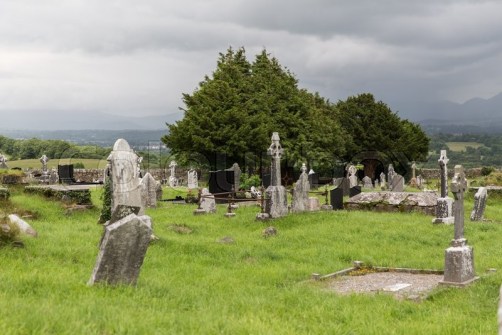
I am from Brooklyn, of course. Like some human sourdough starter, a piece of that place will always be in me and come from me. I like to think it will not be diluted with the passing of generations. And sometimes it rises from me like mist on the river, reminding me of my roots, surrounding me with its ethnic presence. In Ireland I felt at home, and I spent more than a few hours walking the paths of Connemara imagining my ancestors there, gazing across the North Atlantic, dreaming of a different life. It was good to feel their ambitions still hanging in the air like breath on a winter’s morning. Oh, if I could live several lives…
Tonight I’ll be home and we will get the telescope out one last time before Michael head’s to Galway. The Pleiades is present now, and on a clear night we can look up for quite some time in silence and wonder where we came from, where we’re going.
download

Dawn, Like an Angel

59698281_10217375927377623_8959660727052795904_n


Johnny Carson once asked George Burns if it was true that he only slept about four hours a night. Burns replied that it was, in fact, true. Carson seemed surprised and asked him, “What in the world do you do then, when you can’t sleep??” Burns shrugged and said, “I get up.”

It took me some time to appreciate the simplicity of that response, to let go of some sort of expectation that I “should be” tired or I am “supposed to be asleep right now.” I’m not tired, like this morning when I woke at four. I wasn’t groggy, I wasn’t overly occupied by imposing thoughts. So, I got up.

I headed south and then east and arrived at the oceanfront about a half hour before the sun, as if we agreed to meet for breakfast, me carrying my bottle of water, the sun pushing an awakening Atlantic before it. I checked the weather app and saw our appointment was for 6:37; I was early, though I can see the sun’s foreglow coming across the horizon, so I knew it would be on time. I walked the sand for a while.

This is so simple, I thought as I walked my way up the beach at the water’s edge. This clearly didn’t take planning, didn’t demand money or rearranging of responsibilities, and the only consideration I had was how long did I have before I needed to be somewhere else. This morning: about an hour. Experience reminds me and anticipation informs me this is likely to be the most peaceful hour of the day; it is packed with hope and possibility, like the glimmer of light just cracking the dark blue sky, the just-waning moon fading in the west, the passing dolphins and gulls and osprey and pelicans who know nothing of being “late” to anything. I am convinced that dawn has swept in and saved me more than a few times. 

These mornings remind me how often I create my own stress by not pacing myself better, by not taking a few extra moments. My son and I have risen early at home several times a month to take in the sunrise at the bay, before even the watermen have made their way out past the reach. And at night, well, at night we have seen more sunsets together in the past two decades than I can possibly count. Not one of them was redundant, not one disappointing, and never did I think I should have been doing something else.

I am not avoiding responsibility; I am pushing the edges out just a little, just a very little, to fit perspective into the fold, to allow for the purpose both coming and going to reveal itself to me.

I swear sometimes at the end of the day when we’re standing on the sand at the river and the yellow, then orange, then something like deep maroon seems to sink below the western strand, I almost hear it whisper “Thank you for noticing.”

12552985_10207528806325751_531358727225209771_n

0300 hours

shutterstock_556754704

I need to stop thinking about things at three in the morning. Nothing good can come of it. I’m not going to solve any problems at that hour, and, in fact, can easily take current ones and open the deepest, most vile aspects of what might only be minor inconveniences during the day.

But it is three am and I’m awake anyway, and I’m not going back to sleep now since I planned to get up at five to make an hour and a half drive before rush hour. So I’m up, and my mind races right toward a few issues which I know, I mean I’m convinced, will be just passing thoughts after breakfast. At this hour the cut on my ear is a rare form of some deadly disease, my income is dried up to nothing and I can maybe sell the wicker furniture I never use and use the money to buy spaghetti, and the bee I saw yesterday circling on the grass is an indication of one of the state’s largest hives just below the surface of the front lawn, and it’s going to cost thousands to hire an expert to move them to some other place.

I have a love/hate relationship with three am.

On the one hand in just a few minutes I’m usually conscious enough to remind myself I’m not yet fully conscious, and I can maybe understand that a weak mind prone to depression can relegate the best of who we are to some dark corner of the brain just to let the pessimistic angels have a free-for-all on the frontal lobe. On the other hand—and this might be the creative writing professor in me—dreams, whether while sleeping or only kinda sorta sleeping, often reveal some darker truths which need addressing but which get smothered by the forward motion and sun-infused, vitamin D stimulants of the day.   

But those truths—health, money, yellow-jackets—might need to be addressed and might be what wakes me up at three am to begin with.

Some people, I am told, always have complete control of their minds. I am not among them. Usually, of course, I am at the helm, even when the headwinds are seemingly unbearable and the seas seem rough. But there are times when some shadow-like mental glaucoma glazes over my mind and it simply goes where it wishes. This is the baggage carried by creative people, those who fight depression—chemical or situational—and those who didn’t get enough done on some project the rest of the world deems superficial, but which others count as essential to being able to breathe in and out.

And all of this bounces through my head while I sit here at my desk and it is now 3:35. I’ve dressed, too, and showered, and I’m going to head out early. 7/11 is not far, so caffeine-induced full consciousness is not far, clarity, the ability to put life in perspective and delegate these issues to their proper importance.

Sometimes I forget I live in the country near a river and a bay so there’s nothing but natural light at 3:45 am.

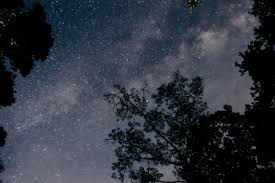
I step off the porch and am immediately taken aback by Orion, by the Pleiades, by the vast distance between stars and the immeasurable possibility that can be found in hope. There is no pharmaceutical that can replace this stimulant; no amount of caffeine can disrupt this majestic truth of night.  

I love waking at 3 am. Clearly, I pay a price; I must dive first into the dark waters, but when I brush aside the clouds of unknowing, I am awash with possibility again.

download

The Weather is Here

images

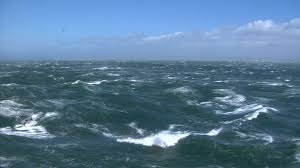
It’s windy out this afternoon, and the sky has turned grey. The bay is pounding the rocks and has become choppy enough to keep most watermen ashore. Just to the southeast about 120 nautical miles, storm surge and high tides continue to lash out at Kitty Hawk and Jockey’s Ridge, and just a few fathoms from there Hurricane Dorian has imposed her destructive ambitions along the southeast coast. This far north on the Chesapeake will be spared this time, though by this time tomorrow, the high tides combined with tropical force winds and torrential rain will make for a tense afternoon.

But this is life. This is primetime for those who live this close to the water. That’s just the way it is. For me, though, being out there, feeling the wind and rain, close to the currents as the waves come ashore, is, well, exhilarating. I’m not ignorant to the dangers—just the opposite; I’ve been around hurricanes the better part of my life. It’s just that when it is bad, but not that bad, it is good to be outside, touching life with wet hands, feeling the energy in the pounding surf.

Hang in there. I’m not out of my mind.

Van Gogh wrote, “There is peace even in the storm.” I understand that. When it rains hard, or the wind is fierce and I can hear branches snap, as long as I am safe it all simply reminds me that I am alive to experience this weather, this turn of currents, this atmospheric screwball, and I feel somehow calmer and even more alive. Of course I love the perfect weather, the calm day with low humidity and pleasant sunshine. But equally, to experience the rain on my face, getting drenched, reaching out and being a part of the earth and nature instead of it simply being something “around” me or something “outside” or on the news, floods my senses and elevates my awareness to keep everything else in perspective. For those of us who spend so much time in nature, it is the next natural digression.

So when severe weather arrives, we shift our thoughts to survival mode and pray no one gets hurt and our property is spared, and above all else that we come out of it alive. And when some system swirls off the African coast and creeps its way up the Saffir-Simpson Scale, it throws our lives into a whirlwind of measuring value and understanding perspective to “finally” discover what is essential in our lives, in our hearts. Hell, just a little rain should do the same thing, shouldn’t it?  When impending storms send everyone into “I’m just glad for what I have” mode, I understand with absolute clarity how the mundane repetition of everyday life induces coma-like observation of life around us and our place in the world, our brief and expedient place in the world.

The tragedy of life is its persistent subtlety. Days pass without notice; I forgot what day of the week it is; geez, is it Sunday already?

Life changes like the weather, and the weather is constantly changing, and so are we. The storm will pass, of course, as does time. And while it is tragically true that in the wake of this treacherous weather too many poor souls have been lost, far too many lives have been crushed, the reality of this whirlwind life we live on this spinning globe is that no one is going to survive—no one—despite the fact that how we apparently live our lives points discouragingly to the contrary. Don’t be hard on the passing storms; for some it’s the only time they even notice life at all.

1

The Sounds of the Day

download

I’ve been working at my desk all day, and for the first time since early June the temperature outside during the hottest part of the afternoon never got above 75, with a breeze coming off of the bay and the skies overcast enough to keep even the August sun from seeming strong. I had to clean up some last minute details on a project I promised would be in the mail tomorrow, however, so inside I stayed against my natural instincts. 

I opened the windows, though, which look out over a couple of acres of woods, and all day long–sometimes in the distance beyond my attention which was focused on the computer screen, but also often overtly present, literally on the sill just inches from the window screen–a variety of birds sang me through the hours. I don’t know their names, so I certainly can’t tell you which call came from which bird, but it was like sitting in a chair in an aviary, unnoticed by the occupants. A few cardinals and robins–those are easy to spot–and one last goldfinch before she heads south. They’re my favorite; yellow ones are my favorite. 

These birds surround me all the time, but they so often compete for attention with the mower or radio or work I’m doing outside which scares them anyway, or the blasts from whatever farm equipment my neighbor might be working on. Today though, with the lower temps allowing for open windows, a neighbor who is apparently away, and a soft breeze, I found such peace as I worked. It was a unique chance to work “in” nature without actually nature knowing I was there. Maybe my tapping on the keyboard sounded like pecking birds. Doubtful. Don’t care. They came and they stayed and sang to me all afternoon. 

Tomorrow I’m starting a couple of writing courses at Old Dominion University, in the city, in a nine-story building next to a boulevard, just on the other side of a four-story parking garage. I anticipate a lack of wildlife, and while birds might abound on campus, they won’t be outside my window because where I’ll be doesn’t HAVE a window. Such contrast. Earlier I received an email from the university asking if I have everything I need for the semester. 

Birds, I thought. I could use a couple of thrushes and perhaps a house wren or two. 

The truth is, I need so very little. A view of some trees or a river or bay, a soft breeze, or, lacking that, the hot sun on my neck, the call of a gull from above. I’ve not yet figured out how to do only that: write and be surrounded by nature–non-judgmental, deep-truth nature. Someday. Maybe I wouldn’t appreciate today as much as I do if I wasn’t headed toward what awaits in the city tomorrow. I’m certain that is true.

But I must learn the sounds of the birds. They bring me such peace, like the sound of a soft wind coming off of the river, or the water pushing at the shore. It reminds me of who I am, and reminds me of who I’m not when I’m elsewhere, which can be equally valuable. I think there was a time I got lost in who I wasn’t because I never took the time to discover who I am to begin with, an anchor of sorts to tug me back home. 

Okay, one just called and I know that one; it’s an osprey. They’ll be leaving soon as well, for South America, but the bald eagles will come in their stead for the winter–eagles are much more stealth. They just sit and stare out like they’re thinking of something else. I bet they have really low blood pressure. 

I’m more eagle than osprey; more cardinal than wren. 

60512123_10217461808404595_7088310984758001664_n

The Interview

A Demented Edition of A View:

Last March I wandered my way from Casey Key to Tampa to Tallahassee to Alligator Point, Florida, a small hook of a peninsula which drops down off the panhandle just west of the curvy part. That’s where one of my closest friends, publisher, cohort in all things writing-conferences, and master of the blues harmonica (no kidding, he’s amazing) Rick Campbell resides with his trusty dog Jasper.

The three of us hung out on his porch and this interview, more or less, emerged, even though the actual interview part of the interview transpired through emails several weeks later. 

The Florida Review and Aquifer published it to coincide with the release of our new books from Madville Press of Texas (Thanks Kim Davis!)

Writers, for the most part, do not like talking about writing, and that goes double for me. But Rick and I have such similar sentiments about the creative side of our world, it was fun to open up just a bit. 

The following is the result. Thanks for Reading: 

The Campbell/Kunzinger Interview

Accidental Melancholy


64688222_10217672760358262_7200867302898663424_n

My father just told me about Herbie Clapper. Herbie was a neighbor of my dad’s when he was young who was a pilot and would buzz the neighborhood when he was nearby. Herbie was Jewish; this was the thirties and in just a few years would be in the war. Herbie’s sister married a Jewish man from Europe who was able to come to the United States and stay. Apparently, Herbie’s father owned seven stores until the depression, but had managed to save enough money to see them through it. Herbie’s father and my grandfather got along well, Dad said, my grandfather also being a successful businessman right through the depression.

We sat in my parent’s living room at their condo and talked about travel. It’s a video my son shot from where he sat across the room; it was 2013, and Michael and I were about to leave for the trans-Siberian railway trip. Dad pointed out how the only reason his father’s generation traveled to Europe was for World War One, and before that everyone was emigrating from Europe. We talked about how my parents did get the chance to travel to Europe when my brother lived in England, and how our generation has made traveling a habit, and the next generation—my parents’ grandkids—don’t think twice about heading overseas, three of them living there for a few years.

Mom’s in the video as well, laughing and interjecting. When I said in a few more generations people will be beaming themselves around the world, she quipped, “That’s the only way you’ll get me to travel that far again!”

I just found these videos. I was looking for some information about the train for work I’m doing, and I knew Michael had taken some videos while we were there, so naturally I thought this flash drive marked “Siberia. Videos” was it. It isn’t. It’s dad. It’s the first time I have heard his voice in almost four years. I’m still shaking. Sometimes you miss someone too much to hear their voice.

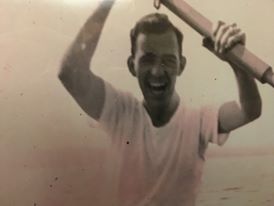
After college I lived in Tucson and my roommate was a dear friend of mine from St. Bonaventure—Tom. At some point after we’d pretty much hiked the hell out of the Sonoran Desert but before I discovered the financial gains of Mexican blankets, Tom moved back east to complete his degree at Bonas and would eventually become a dentist and live on a farm in New Hampshire. We’re still close all these decades later, despite rarely hearing his voice. But back then, I had four pictures in frames. I can’t remember now who was in the pictures, but I specifically remember a conversation about why I only had four when somewhere else in the apartment was a box of hundreds of photos of friends and family. I told him the memories they bring alive for me are so strong, so real and immediate, that I couldn’t handle more than four, that they would occupy my melancholic mind too long and I was too young to look back that long. We laughed because he understood, and before he left I wrote a poem on the back of a painting I had done (the only painting I have ever done) about the four pictures. I don’t remember it, but it seems to me I haven’t changed much since then. Looking around my office here at home I have a picture of Michael and me in front of a church in Spain, another of him and me on the flume ride at Busch Gardens when he was young, one of Dad and me–a black and white–at an outdoor cafe at the beach (my favorite picture of the two of us), a picture of my parents, and one of Dad on my parents’ honeymoon, him in a canoe holding a paddle above his head and laughing, looking young and strong and full of excitement for what would become more than sixty years with the woman taking the picture.

I have others scattered about the house, but mostly I have Michael’s abstract art hanging. I like abstract art, there’s something ethereal about it, though if I’m tired I think about how much fun we have had walking the docks while he takes pictures like that. I have a problem with time; it keeps screwing with me. For instance, watching the video of Dad made me think, just briefly, I might call him tomorrow. When I was young and drove around the country, I could always call Dad at his office on his toll-free number. It was very convenient, and to this day on those rare times I spot a payphone, I think of him.

Anyway.

Those weren’t the videos I was looking for, so I moved a box to find the handful of files from that trip when I spotted a stack of VHS tapes I still haven’t transferred to DVD. There are a few of a colleague and me in Russia, some of us in Norway, but several of Michael when he was young. One in particular I know I’ll never watch: he’s walking around the porch when he was five and had lined up all of his dinosaurs on the rail. In the video he picks up each one, explains what it is and when it lived, and makes some witty joke. Watching that one would be suicidal for me.

I don’t think I’m the only one like this; I’m just glad I am keenly aware of my emotional limitations. Ironically, I don’t live in the past and I am not a hoarder of artifacts of my life by any means.

It’s just sometimes I really miss my dad and hearing his voice tonight was just a little too much. I’ll find those files tomorrow. Tonight, I’m going to watch the Mets instead. They’re amazing right now.

12063306_10207030426106557_3199067376729529480_n

In Defense of Decorum


Etiquette.


“If you ask me what I came here to do in this world,

I, an artist, will answer you: I am here to live out loud.”

                                  –Emile Zola


The “great experiment” that is America has been challenged many times in the last two centuries, but all those attacks, both foreign and domestic, from the Civil War to Civil Rights, desegregation to suffrage, Iran-Contra to 911, had one thing in common which enabled transcendence of such tragedies—decorum. Even when disagreements arose, those at battle remained armed with respect for each other’s love of this country and maintained dignity in the presence of world media in an effort to demonstrate that America can handle its problems without digressing to schoolyard banter and behavior, and all sides insisted upon an absolute respect of the facts.

Some pundits assure us that “the Republic will survive, don’t worry.” It used to be easy to believe this; it used to be clear that our differences as citizens did not outweigh our love of this nation, and when the powers that be respectfully followed the rule of law and accepted the common denominator of truth, while not everyone would be happy with the results, the dissenting opinions at the very least knew those results were not attained for spiteful and personal reasons.

Listen to John McCain defend former President Barack Obama’s character to a voter who despised McCain’s opponent and verbally, wrongfully, abused him. Listen to the courtesy and respect for service to our nation shared by candidates Nixon and Kennedy in their debates. Listen to just about any two candidates in political history who, while they may find great fault with their opponents’ stance and sometimes even their character, knew to remain like an adult and maintain the presence of mind to understand basic human behavior.

The absence of that decorum will be the death of this nation long before any particular amendment or Supreme Court decision. Recently, a woman in North Carolina has been celebrated by her peers for refusing to apologize for a barrage of racial slurs thrown at a minority on the street. She is not alone as citizens abuse our first amendment rights to expose their decidedly prejudiced points of view.  This has been occurring with more frequency only since such classless behavior was demonstrated by the president dating back to his candidacy. Leaders who lower themselves so far as to speak in such uneducated terms will, in turn, as German native and American businessman Michael Kuhnert points out, elevate the egos of their followers by giving them some perceived superiority over all other groups based on race, nationality, religion, and gender. This is a primary method of fascism.

The conflicts caused by this growing trend to degrade those different than the mob is not about policy, and oddly enough it isn’t even about the allegations of criminal behavior on the part of either the president or members of congress; it is entirely possible previous political leaders were just as crooked, just as underhanded. Instead, it is about creating division in this country, again, based solely upon race, religion, ethnicity, and sexual preference, and that division has ignited a war of words not grounded in any form of valid debate but rather in the banter of street gangs and enraged mobs. It isn’t solely that such rallies persist with chant such as, “Lock her up!” and “Send them back!” but that those to whom we are supposed to look up to, those who are vying for the right to lead us and our country, stand idly by, which merely encourages the crowd.

The United States position as a world leader is clearly in question. The dependence of the world on this country in the wake of World War Two is long over, and countries will find other trading partners; they will build relationships with other nations, and they will not lose a beat as they write new treaties without the involvement, let alone the leadership, of the United States. And it isn’t beyond possible that they’ll discover they’re better off without the foul-mouthed, unpredictable commentary from Washington. Once gone, reestablishing those relationships might just be meaningless for them. No foreign power brought us down; no violation of treaties, no declaration of war, no natural disaster or terrorist attack broke the spine of this nation: we did it to ourselves with our blatant and repulsive hatred of our own citizens, and by demonstrating a severe lack of class in how we relate to each other.

The leaders of this country have become the most undignified group of leaders this land has ever seen, and that will break our endurance as a great nation more than any disagreement over policy.  The poison which runs through the marrow of this nation is not political dissent, it is not historically divisive issues such as abortion or gun control, it is pure hatred; the repugnant, immature, ignorant hatred displayed by the president and members of congress for our country’s own citizens.

This, then, is an appeal to my artist friends. Despite our quiet voices in this sea of noise, it has always been the task of the artist to expose inequity, injustice, and fascist tendencies. It was Thomas Paine whose small, seditious pamphlet Common Sense instilled in the citizens of the colonies the ability to move forward. It was David Walker in the early 1800s who called upon his Black brethren to resist. It was Thoreau’s Civil Disobedience; it was Carl Sandburg; it was John Stuart Mill and Richard Wright; it was the writings of Woody Guthrie and Bob Dylan.

It was—it is—the artists.

President John F. Kennedy said, “When power leads man toward arrogance, poetry reminds him of his limitations. When power narrows the area of man’s concern, poetry reminds him of the richness and diversity of existence. When power corrupts, poetry cleanses.”

The writer, despite his isolation, has it in his or her power to put voice to what others wish to say but cannot, but once they hear it said, they sing along with the harmony of their generation. Ginsberg wrote, “Poetry is the outlet for people to say in public what is known in private.” And the beloved Robert Frost said, “A poem begins as a lump in the throat, a sense of wrong.”

The artists of our nation must combine our talents with our grief, blend our anxiety with our refrain, and we must risk exposing truth to say in whatever way we can, with whatever genre we must, that we used to be better than this, and we will not allow the loud voices of hate drown out the insistent chant of respect. 


trump_grumpy_meme_site