The preorder is over, and Amazon will not start shipping books until April, but Kim, my publisher, sent me a carton of the ever perfect number 42 books, and I can ship you one signed, (or not signed) to anywhere you’d like, this very afternoon.
Here’s the link: Send $20 to this link and that includes shipping, and email me the address at bobkunzinger@yahoo.com and I’ll mail the book today.
“Graveyard” by James Cole Young (author’s collection)
Note from Bob: This piece was originally written as “One Deer Running” for a seminar at ODU in 1998 with Mike D’Orso, then updated some years later and published in various journals and eventually in the collection, Borderline Crazy. I miss Cole, our long, late-night/early morning conversations. For reference, when we were hanging out together, Lennon’s “Double Fantasy” album had just been released and American hostages were being held in Tehran. I was 19 or 20, played music, and little else mattered but art, whether visual or otherwise. Then again in the late 80’s, and again from 1999 to his premature death in 2005. I’m finishing an entirely new essay about Cole and his work for an artist magazine, so he is very much on my mind. I won’t be publishing here pictures of his most brilliant work most of which remains in his daughter’s possession until the forthcoming artist’s magazine piece.
One Deer Running
for Cole
In autumn of 1987, I wandered into the Fishback Galleries off 57th street in Manhattan. The elevator leading to the studios had violet wallpaper with deep yellow flowers and dark green carpet. Spacious abstract paintings of some west coast artist filled the gallery. Large paintings with gobs of primary blues and reds drew me in, just paint on canvas, lines and circles forming predetermined direction with no apparent purpose.
When the curator approached, a notebook in her hand and clearly a lot on her mind, I felt out of place. But I asked anyway. “Do you still have the works of Cole Young here?” I thought I sounded artsy, as if I tossed out the names of landscape artists everyday over espresso at Raphael’s and Michael’s Pub. “James Cole Young. I think he had a show here last spring,” I explained.
“Yes,” she said, scanning a bookshelf for a specific title. “Two in the back office are all I have left.” She pulled out a thick volume and fingered the index. “You may spend a few minutes looking about at our current artist if you wish.” By the time she finished speaking, she had already returned to her desk‑‑a long virgin‑white graphics table covered with neatly stacked manila envelopes and coffee table books.
I followed her.
“Did he do well? I mean‑‑how did the show go over?” The glare of her cobalt blue eyes told me How did it go over? was not a phrase heard often in these titanium-white walls.
“He did well,” she said, turning back to her book. “He was one of our most successful artists. Some fine clients secured his works.”
Fine clients.
Martin Scorsese; John Reed, CEO of Citibank; Walter Shipley, CEO of Chase Manhattan, Wilson Greatbatch, the man who invented the pacemaker.
Fine, indeed.
“What paintings are left?” I asked.
Again, she raised her eyes, more slowly this time. Her Indian red skirt lifted toward her yellow hue thighs. She wore black heels. I wore jeans, long hair, and the scent of poverty. “A cloud scene,” she said, this time with a sigh. “And,” she added, “‘Homage to Cole’.”
“Homage to Cole.” I couldn’t believe it.
“Can I see that one please?”
“Please,” I went on. “Would you mind? I was there when he painted that. I was in the studio, smelling the paint. I remember when he moved a few things because they didn’t look right.” Her book slipped from her fingers, and she lost her place.
“I’m sorry,” she said. “That wouldn’t be possible. It is locked up for a buyer.”
Someone bought it, yes. The sale had been secured for tens of thousands of dollars and the painting eventually hung in a second-floor lobby of the World Trade Center.
The afternoon was waning as I stepped back onto 57th Street. The slate blue sky had darkened, and the sun had turned pale, a yellow oxide. They didn’t have his self portrait, I thought. We studied his self‑portrait in his class once, I remembered, as I walked toward a street vendor for dinner. I can picture it. He has no shirt and is standing sideways in front of a window. I think there was a dead bird on the sill.
And “Homage to Cole” painted in respect to one of the most influential artists in Cole’s life, Thomas Cole. Cole Young loved the way after painting landscapes most of his life, the most beautiful work Thomas Cole did was of the sky, where the Hudson School painter found “grace and expansive energy.”
Allegany, New York, is almost as far from the Fishback Galleries as the New York landscape allows. The small village on the state’s Southern Tier counts just six thousand residents. The town and its larger neighbor, Olean, are surrounded by the Allegheny Mountains while the Allegheny River S‑curves its way through, shallow enough to wade across. Pennsylvania lies just beyond the valley to the south, and Buffalo, about 75 miles north, is the closest town of any sprawl. In the midst of these “Enchanted Mountains” is St. Bonaventure University, which boosts the community’s head count another 33 percent.
It’s an old campus, dating to 1858, founded by Irish settlers and Franciscan Priests. Most of the buildings are surrounded by forests of gold and red and dark green and yellow trees and sprawling lawns. One of its older buildings is St Francis Friary which once housed priests and seminarians. In the mid‑seventies it was converted into a dorm with its own dining hall, chapel and majestic views, still students back then would shy from its remote location: It stood alone, accessed either by road or a walk through the woods on a narrow trail. When the University started its art program in ’75, the former friary was perfect. In the basement was an old storage room‑‑great for a teaching studio. Beneath it, deep in the ground, hid an old library once used by Franciscans ‑‑perfect for an artist’s studio.
Administrators never brought dignitaries here. The art studio and classroom were not on the campus tourback then‑‑someone might have run into Cole Young. At twenty-five, with long hair, mustache, and lanky limbs, Cole bent forward when he taught his classes, making sure his opinion, which bent to the left, was clear and understood.
“I can smell dead priests here, man,” he told me once. In class back then, students moved about—painting, drawing, modeling, seemingly on their own yet under Cole’s eyes, and even more, his preaching.
“Trust yourself,” he told a self‑conscious student with a pencil and a large pad. A nude female sprawled across an indigo blanket on the floor. The student was supposed to draw her without looking down at his own pad.
“Let go. You know what her hair looks like. Let the mind and the hands work together.” His head would thrust with each verb, for emphasis. He’d throw words at his students, desperately afraid they wouldn’t get it‑‑not the drawing, but the metaphor of it all. “You’ve been doing things without looking your whole lives,” he called to everyone. They all stopped. Cole was preaching.
“You tie yourshoes without looking sometimes, right? Button your shirt? Pee?” He turned back to the student. “You can find your pecker without looking, right? Know where it is?” Cole backed off. He made his point, albeit with the abrasiveness of a van Gogh brushstroke.
Then he taught. “Do it man, you can. Trust your hand. No, it will not look like a photograph. No, it may not look like hair. But it will be movement. It will be information.”
Then to everyone: “It is all information. Right? Talk to me. Tell me what her hair looks like. Tell me where it turns and darkens and falls freely. Give me all the information you can.” Music played when he taught. Dylan. Lennon. Van Morrison. Old Jackson Browne.
He and I would hit Perkins Pancake House at three am after some painting, music, and ranting. Everything was an issue for Cole. Some kid came in wearing a Nike shirt and Cole revved up. “You work for Nike?” he asked. The kid who seemed either on his way to or from being drunk said no. “Then why are you promoting Nike? You get paid to wear that shirt? We’re billboards! We’re being sucked in by the swoosh.” The kid just ate his eggs looking confused.
Cole once bought a van and demanded the dealer’s metal symbol on the back be taken off. “I don’t work for them. They want it on there they should pay me.” They took it off.
He was a skinny version of Harrison Ford when he smiled, his hair somewhere between auburn and light brown, long, near his shoulders. And his eyes would dart about the room while teaching or lock into another’s when one on one. Cole played his game and if you couldn’t play along, leave, take economics where no one gets it. Get off the freaking bus. Drop out. “Life, man. That’s all this is this whole education thing. Life. That’s it.”
Cole and his wife, Sharon, moved to a farm in Allegany. It was so far off the beaten path, you had to want to go there‑‑and most people who ended up there were usually lost. Still, Cole spent most of his time in his studio beneath the art classroom in the old friary on campus, about seven miles away.
Most mornings while I was a student, we’d be in the studio till three am, Lennon on the stereo, Cole smoking pot, working on something that looked like a valley beyond a secluded scenic overview. Pictures taped to the walls represented nature’s original inspiration for this work. Smoke filled the studio. Hours passed and he still worked on a rock. Same rock he had been working on for a week.
“Shit.” He put down his brush. “There isn’t enough detail in the trees.” He looked at the pictures. “See? I have to move the rock.”
The fine detail in “Homage to Cole” is laborious painting. A stick in the brush, fallen from the sugar maple in the foreground, was a week’s work. The birch tree, which gave him trouble in the painting, took even more time. It was done between classes, during lunch, late at night when no one was around, in the early hours while talking about John Lennon and listening to music. We’d be quiet for a while when he’d blurt out “‘life is what happens when you’re busy making other plans.’ Geez. Lennon’s a freaking genius.”
This was about the time of the Iranian hostage crisis and pictures of starving children in the third world poured in on network television every night. Cole was pissed. “No one in this country is going to give a damn until that kind of terrorism happens here, in America. Then they’ll wake up.” His anger produced two canvases, both set in New York City, and both of tall buildings ablaze after a terror attack. This was twenty years before 9/11.
Cole Young’s paintings have been compared to JMW Turner and Caspar Friedrich. One critic wrote that his work has the passion and range of Friedrich: The “calmness that evaporates into furious motifs in nature,” carried out with one of the most varied palettes in contemporary art. To Cole, rocks are not brown or slate or tan or white. They are a composite of colors. To use one color of oil to represent that rock is, to Cole, to focus on vague images instead of scrutinizing the scene. In the 1800’s, Friedrich used similar colors and approach. He too would labor over color, layering one on another and mixing and scraping until the right tone was achieved. I once pointed out that van Gogh said to leave the obvious vague. “Van Gogh was an asshole,” Cole responded. So it was.
Friedrich’s contemporary, Turner, whose work hangs in museums throughout the globe, mastered the turmoil in nature as well, particularly clouds. “Cole Young’s work,” one Buffalo art critic wrote, “is not unlike… the early paintings of Turner.”
With that remark, exhibitions began to emerge. So did his work. The volume of work in his studio grew. Three walls were blocked by large canvases in progress, balanced on cinder blocks, lit by huge mercury lamps to insure perfect color. All about each canvas were books‑‑Friedrich, Turner, Constable and pictures and studies of subjects. All are landscapes, though that term‑‑”landscape artist”‑‑was not right, not to Cole.
When his class studied a “landscape artist,” he’d say, “It sounds like he’s working for a garden center. It’s just a tag. What gross information does ‘land‑scape artist’ carry? Huh?” He smiled. “He’s a painter. He paints nature.”
“And damned well,” he’d add, and everyone laughed. Cole didn’t like to offend people, though he knew he did. “I’d rather offend some of you,” he told his class, “to wake you all up, than be oh‑so‑damned‑polite and have you not get it.”
What Cole got were acclaims in the art community and New York’s Fishback Gallery opened his one‑man exhibit. And he sold well there. Fine clients bought his paintings. But Cole sank into a deep depression, a lethargy he couldn’t explain, couldn’t control.
Nine years of complacent monotony later, in the spring of ‘96, during a brief period of what Cole later said was false energy, he painted two small canvases. They are both called “Graveyard.” In these paintings, he “ties nature directly to the human impulse to acknowledge and commemorate its dead.” It is a row of dead trees seen close and from a low vantage point from within the “decayed woods.”
The observer is inside, looking up. The view is “locked directly to the shredded, peeling bark and broken limbs of a few pitiable stalks. There is a hint of color in the brush, and the sky is neither threatening nor inviting.”
He also painted one large painting. A 4’ x 7’ scene in autumn woods, but the emphasis is on a bubbling, dark blue cloud. It is called “Difficult Cloud.” These three paintings head to the Buffalo State University Art Exhibit, win top awards and critical acclaim. “Difficult Cloud” sold for eighteen thousand. Still, these moments were patches of blue in an otherwise apocalyptic sky. Teaching, painting, nothing could keep Cole young anymore. He was a student staring at his hands because he didn’t trust himself. “I’m holding cigarettes where a brush should be,” he told me once.
In the late nineties, his daughter Dylaina encouraged him to join a smoking-cessation seminar. It was late and we sat on the porch of his farmhouse. He told me about the first night at the seminar and how it still gives him chills. On the way to the high school while driving along the upper end of 5th Street in Allegany, Cole saw a deer running across a field. At twilight‑‑too early for headlights, too late for the sun‑‑he watched the grace, the stretched limbs, the beauty. He also noticed that the deer, on its present course and speed, would have run into the side of his van.
He slammed on the brakes and old oil paint tubes flew out from the back with cans and bottles. The deer veered into the woods. Cole loved to philosophize, though, and he sat there a long time considering the collision of beauty and death. He lit a cigarette to calm his nerves.
That night, he sat among twelve other men and women in a room at an Olean High School. He waited silently. The director of the seminar walked in and talked. “You start. You stop. You will. You won’t. You’ll quit on your birthday. You’ll quit New Year’s. You’ll slow down. You’ll quit for lent. Listen, just quit smoking or drop the whole fucking issue,” the guy said. Then he left, telling them he’d be back in ten minutes.
Cole smiled. “Ingenious,” he had told me. To a participant that night, Cole said, “The man is brilliant. Don’t you get it, man? Christ, this is freaking ingenious. Don’t you get it?” He drew the whole room in, some talking, but most listening to Cole.
Cole finally got it. He returned to the studio with the enthusiasm and persistence of ten years earlier. He painted, he contacted the galleries again all eager to pick him up, all still a bit hesitant to commit to an artist who might drop out of sight again. Do it, don’t do it, whatever, but shut up and paint—that became his new philosophy. He stormed back into his studio. He traveled again, sketching landscapes and taking pictures in the Smokey’s, in the Adirondacks, in New Hampshire at a friend’s farm, at Mt Washington. He asked me to bring him to Russia. He worked. But our trip never materialized. A few years later, he suffered the chemo and operations to abort lung cancer about the same time he created large room-size canvases of clouds above New Hampshire’s Mount Washington. He was running as fast as he could toward a collision he knew was approaching, but he did it with grace. His later paintings show his mastery of color, especially of the sky, and the luminous clouds rise on endless canvases.
In September of 2001, when the towers fell, Cole heard it all happen from his studio down under the Manhattan Bridge Overpass. He didn’t think right away about “Homage to Cole,” one of many expensive pieces of art vaporized when the towers tumbled. He thought of the two canvases of terrorist-attacked buildings in Manhattan from two decades earlier, and chills ran up his spine.
Cole’s hero, landscape artist Thomas Cole, died young after a short illness, but his five-painting series TheCourse of Empire, painted in 1836, exposes the progress of a society from its savage beginnings to the apex of luxury and success and finally its demise and extinction. Later, he looked upward, detailing the colors and beauty of the sky. Both Coles loved symmetry.
Despite his illness, the energy in his voice didn’t fade. He called me, exclaiming, “I want to go to China. Let’s go to China and head down to the southern provinces where you can write and I can paint a lifetime of work in one month.” It was as if he was a teenager again when he sold his first drawing to the Saturday Evening Post. “China, Bob. You’re going. I can’t do that alone, it’s not in me but life is finally opening up,” he said. He wrote the next day to expound further about China, and he said he felt alive again, he said lifehad finally exposed itself to him, and he finished with, “I hope your journey on this planet reveals itself to you.”
I never spoke to him again.
When Cole Young died that November, I walked out and stared into the brilliant autumn sky. It was neither threatening nor inviting. High clouds reached across the horizon. I can see him leaning into me, preaching, telling me about the allusiveness of clouds, about their very temperance. Cole had always been a composite of colors, and what ignited him most was when someone looked at him, or anything, on the surface only. “We were born with energy and depth, man. Use it.” What energy he had. What remarkable energy his paintings generate; proof that sometimes the simplest and most fragile brushstrokes can create the most vibrant scenes.
quick artist sketch while hiking (author’s collection)
It occurred to me one day on my porch while staring at the surrounding woods, that at some point less than one hundred years ago none of those trees were there. The land has beautiful eighty foot oaks, some maples, tall thin pines and various other hardwoods including black walnut trees, which I am told can provide the ingredient necessary in the liqueur, Wild Spiced Nocino.
The branches protect birds as diverse as red-tailed hawks, downy woodpeckers, and countless chickadees, and they are habitat to other wildlife including one flying squirrel we spotted a few years ago when his tree fell. The squirrel was fine and found a new home in a white oak. And of course the fox which frequents the lawn.
But a hundred years ago this was just land, sandy land, edged by the running Rappahannock River and backed by equally treeless farmland. A century before that these nearby plantations provided food for the region at the expense of slavery, and some slave descendants remain, selling vegetables at food carts out on the main road, or working the bay as watermen, telling stories about how the Chesapeake is just about farmed clean every season by crabbers at the mouth or the headwaters leaving nothing left for those working the midland shoals.
This area hasn’t changed much in one hundred years.
It is like this everywhere, the coming and going of things. In Manhattan a few hundred years before the wild construction on bedrock, coyote and deer were common. It was hilly (Manhattan means land of hills), and where the United Nations stands once stood grand oaks. The Lower West side was a sandy beach, and ecologists say if left to do what it wanted, most of the upper west side would be covered in trees and vines, shrubbery and wildflowers inside twenty years. I can’t imagine what my house would look like if left untouched. When I don’t mow the lawn for a few weeks it looks like a refuge for timber wolves.
But these trees weren’t here a century ago and I sat on my porch and wondered if there had been other trees or if this land was barren, or was it used by the Powhatans, or was it home to some former slave family, or just a dumping ground. Evidence is scarce, buried beneath the roots of this small forest. One guide at the Mattaponi center not far away told me this had always been hunting ground for the Powhatan. I’m glad it wasn’t a burial ground. I’ve seen Poltergeist.
This happens to me everywhere I lived; I like to imagine what was on that spot one hundred, two hundred, a millennium earlier. The house I rented in Pennsylvania was used as a hospital during the civil war. Before that it was a farm. Now it is a Real Estate office. The maples which lined the road and shaded the living room are gone. Someone planted new ones but it will be decades before they mature. My house in Massachusetts was a fish market a century before I sat at the kitchen table looking out at the Wachusett Reservoir and wrote a book about Vincent van Gogh.
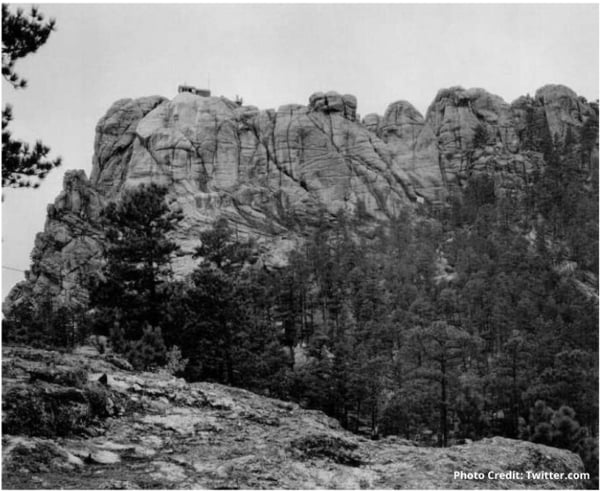
Purpose moves on with time. Maybe that’s why I’m so mesmerized by the Prague hotel I always stay at. It was the same building seven hundred years ago that it is now, only then it was used by servants for the castle. In Russia most of the lands upon which St. Petersburg is built were not lands at all, but marsh, and Peter the Great filled it with stones to create his “Venice of the North.” And a Lakota medicine man, Nicholas Black Elk of what is now South Dakota had a dream in which he saw “Six Grandfathers,” for the directions–North, South, East, West, Up, and Down– and his dream was the vision of a mountain that was to be left alone to symbolize kindness and love and wisdom, as present in human grandfathers, and it was to be carved only by wind and rain, and so it was. Until 1927 when Gutzon Borglum “began his assault” on what became Mt. Rushmore.
I like knowing but I like not knowing too, like accepting truth, like unearthing reality, like facing our fears.What was on the land where you are now? What will be? What traces of us will linger, offering a hint of now to some other now?
This house is the only house which ever stood on this former hunting ground, and is the only place I have lived for this long–twenty-six years. The house is made from western pine forested on land which I assume is either now empty of trees or filled with young pines waiting to become log homes. What will be left a hundred years from now? Will someone sit on this same porch and look right out toward the bay once these oaks have long fallen? I know this house, this land, is a “hotel at best” as Jackson Browne despondently points out. “We’re here as a guest.”
I know nothing is as permanent as nature, despite the constant changes. It simply isn’t going anywhere. We are. So I like to remember that a century ago farmers sat not far from here and talked about the bounty in the soil, or talked to 19th century watermen about the changing tides. And I like to realize that a hundred years before that the nearby swampland, now home to so many osprey and egrets, was a major route for runaway slaves. They’d have been safe in these woods, if there were woods then.
I like to do that because it reminds me a hundred years from now perhaps I will have left some sort of evidence of my passing through; even if just in the cultivation of language, the farming of words.
So I sit on the porch and listen to the wind through the leaves. Itis now; it is right here, now. Sometimes at night we stand in the driveway with the telescope and study Saturn, or contemplate the craters on the moon—both here long before us and in some comforting way, long after we’re gone–all of humanity.
In spring and fall the bay breezes bring music even Vivaldi would envy, and I’ll listen to his Four Seasons, written nearly four hundred years ago, and listen to the wind through the leaves of these majestic, young trees reaching eighty feet high, and be completely, perfectly in the moment.
Despite the warming trends, the extreme tendencies of weather, the fragile ecosystem which sustains life, nature is still the only place I have found that really doesn’t change. It never has. Ice ages and dust bowls will alter it to be certain, but she has mastered the art of adaptation, and eventually some seed will take root.
I’ve had a lot on my mind, which for some of us leads to tunnel vision, followed by anxiety, followed by…followed by… Last night about four a.m. I wrote a few emails and lay awake understanding just how easy it is for the deepest of rivers to unexpectedly change course and for priorities to slip. So I went to my desk and looked through some old work I have in folders everywhere, thinking about Richard Bach’s Illusions, in which he finds just the answer he’s looking for by opening the nearest book and reading the first passage he sees.
So I did, and when I finished reading, I returned to bed and slept fine.
We don’t get up early enough. We don’t play with the kids enough. We don’t walk on the grass enough; we worry too much about losing. We don’t throw the ball enough, hike through the woods, climb the low trees, eat fruit off the vine, go for a drive. We don’t tell enough stories, listen to records, dance for no reason at all. We don’t call old friends who are hard to find, aunts and uncles who made us laugh, staylonger with our parents talking about the times we had, talking about the rain. Not talking at all. We don’t journey enough to places close by, we don’t find beauty in what there is plenty of, we don’t appreciate what is common, we don’t celebrate what is in our grasp. We’ve lost the art of contemplation, of solitude, of fasting, of quiet walks. We forget the world exists in each step, that the philosophers walk with us, whisper about the temporal state of life, the immortal flight of a bird.
Life is not the fleeting fears at three a.m. Life is not the struggle for money, the loneliness of night, the sense of loss. No.
Life is the way we sit around and laugh until two. Life is the feet on the coffee table, the tie undone, the kids asleep in their beds. Life is the sound of water in a pool, the sound of tea poured into China cups, the sound of distant thunder at dusk. Life is walking with a lover, an old friend, a familiar soul. Life isunwrapped gifts, cards in the mail, the smell of bacon on Sunday morning; drinking beer with friends on Friday night, the first cold day in autumn we need to wear a sweater, life is the spring grass showing beneath the melting snow. It’s the mother in the door waving to her youngest child moving away. It’s the father at the observation deck waving to his son on the plane. It’s the letting go of small hands. Life is the distance between a falling leaf and the ground.
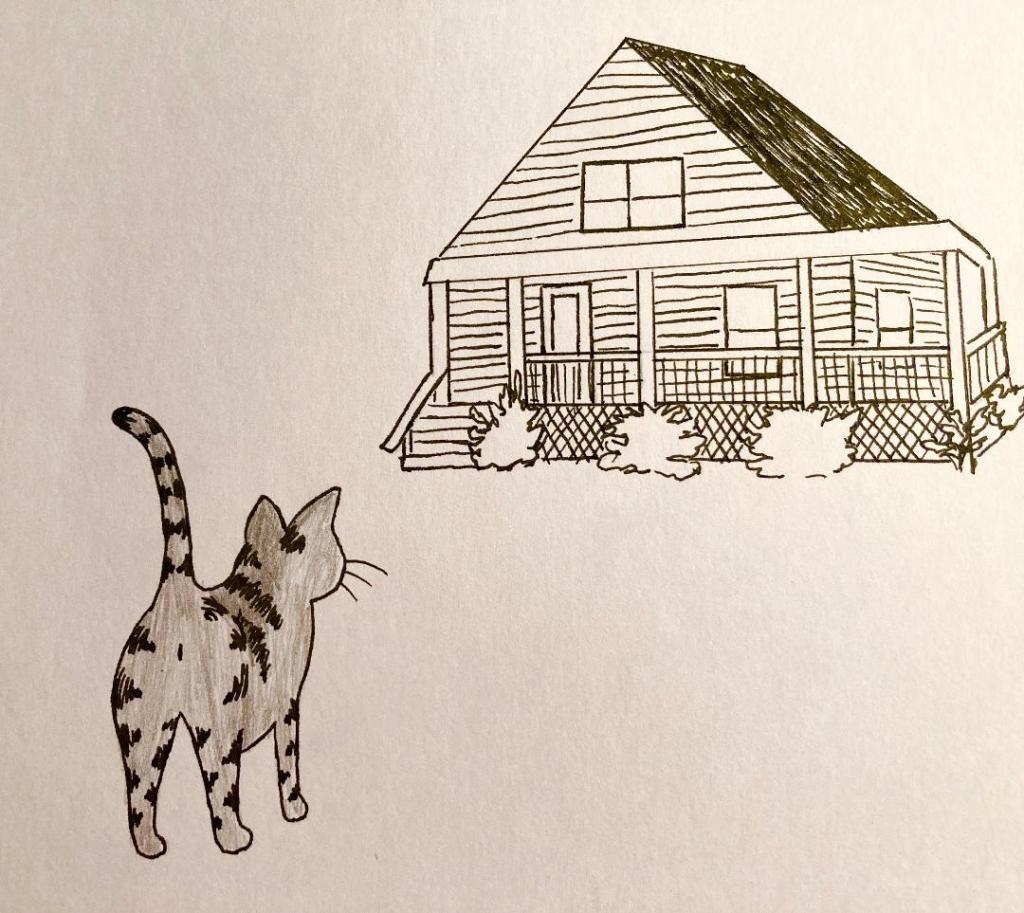
We had a cat when my son was small; Colette, though we later discovered she was a he, Cole, but that was a close friend’s name, so Colette it remained, though more often than not he was simply, “Hey kitty, come here Kitty.”
He was the Snoopy of cats; there simply weren’t any felines cooler than Colette “Joe Cool” the Cat. Even Pete the Cat would acknowledge this truism. Living on four acres surrounded by dozens of more acres of woods, he was an indoor/outdoor cat in the best sense. He’d go out in the morning to explore, return for food and to sleep, go out again, but mostly no further than the perimeter of the property immediately around the house and be in at night.
To come in he’d jump onto the the front porch rail, turn, then leap onto the door or window screen, hanging by his claws, head turned, looking out of the corner of his eyes, and meow. He’d hang until he saw one of us get up or come into the room and head for the back door, at which point he would push off, land on the deck, and run around to the open door.
I just did what he wanted, that’s all. Sometimes if it was early morning he’d leap from the end of the logs running up the corner of the home until he reached the porch roof which happens to run just under my bedroom window. He’d sit outside my window looking in and mouth “meow” until I got out of bed and he watched me get to the door, at which point I could hear him leap from log-ending to log-ending to the rail to the deck and by then I made it to the back door for the squire.
Once I sat in the living room and looked out to see him leap to the rail, turn and get ready to leap to the top of the screen door to hang there and look in, but I had taken the screen door off and before I could stop him he leaped. I watched like he was in slow motion, then I heard him smack the front door, his claws flailed wildly as he slid down to the ground, and he took off for the woods on the far side of the property. I didn’t see him for three days. When he returned he stood against the front wall looking in the window until I opened the back door. As he turned into the house he looked up at me like he was thinking, Asshole.
He used to sleep in the crook of my arm on the couch when I watched movies. When Michael and I were outside in the pool or playing horseshoes or whatever we were doing, he’d come with us and stretch out right across whatever it was we were doing. He just needed sunglasses and a guitar to be completely cool.
I grew up a dog person, but Colette won me over.
It’s going to be 27 degrees tonight here on the Chesapeake. A friend in Syracuse tells me it is single digits, and out in Indiana, in the teens. Worse, the snow has covered all the wild food sources for even the wild animals. In Florida it is so cold that lizards were freezing and falling from trees. True story.
Last night an estimated seventy million homeless cats wandered woods, dumpsters, alleys, sewers, and warm car engines to find warmth, food, and sleep. Only two percent of those cats are fixed, so the problem is growing exponentially. If a pet cat gets lost, only two percent find their way back home, either through their own internal radar or monitoring. Just five percent of the entire stray population will end up adopted. And a lack of space and supplies results in the euthanizing of about three million cats every year. And of the cats that wander aimlessly, they kill an estimated one to three billion birds annually. In fact, over the years, cats have contributed to the extinction of sixty-three species.
I was in Utah last week and one afternoon went to Furever Friends Animal Oasis and, well, sat down. A half dozen kittens quickly came over and found in me a comfortable place to rest their heads. They covered my lap, my arms, my legs, they purred, meowed, and licked my salty skin. The grey one asked quite politely if I would be willing to take her home and whenever I started to apologize to them they meowed and purred louder like a kid who doesn’t want to hear an answer so he sticks his fingers in his ears and says, “nah nah nah nah” over and over. That’s them, to me, that day.
“Please take us home with you,” said the adorable grey kitty.
“I can’t I’m sorry…”
“Meow meow meow”
“...because I don’t have the…”
“MEOWMEOWMEOW!!”
Honestly, I did not want to leave the place. I looked around at this massive complex truly thinking “Hell, I could build one of these on my property.” Except this one has a team of volunteers, a vet who runs the place and does operations, and a steady stream of donations (never enough, no, never enough).
I stood wishing I could stay but more wishing everyone could see this, meet these beautiful friends, and understand that according to one study, cat owners are thirty percent less likely to not have a heart attack, have lower stress levels across the board than any other pet owner because of the increased personal contact, and forty-one percent of cat owners are reported to sleep better (though I don’t believe the study was conducted on those who have four cats living with them). And as for allergies, according to Marshall Plaut, M.D., chief of the allergic mechanisms section at the National Institute of Allergy and Infectious Diseases, “High pet exposure early in life appears to protect against not only pet allergy but also other types of common allergies, such as allergy to dust mites, ragweed, and grass.”
but whatever; we adopt a kitten because it is cute, friendly, curls up on the couch with us while we’re watching bird shows, and makes us smile. These shelters need help to protect the cats which are otherwise abandoned, born feral, or run away. The benefits to the kittens are quite obvious; the benefits to the planet less clear, but the benefits to us are incalculable.
plus this:
There has always been a clear abyss between humans and the lives in the animal world outside. Domestication started roughly ten thousand years ago with goats and sheep, followed some time later by horses, oxen, and cattle. But none of them–truly, none–curl up on your lap while you’re watching Netflix. Cats and dogs followed with cats noted to have been domesticated about 7500 BC, though revered in Egypt for a few thousand years before then.
It is not known when they began wearing stupid looking outfits and appearing in Youtube videos.
Nature is outside, home inside. Plants may come closest to bringing the world around us inside, providing life and something organic to our life within walls, but cats bridge the abyss, they are independent enough to be left alone, to wander at will, to search the woods and climb trees, to hunt, to battle if forced to; and yet they can come close to humans in affection, caring, in sensing when someone is down, is alone. The natural world is alive and well and stretching her back in that spot in the sun in the middle of the living room rug, bringing thousands of years of the untamable wilderness into our laps.
You want to help this feline world? Seriously, it takes very little to make a huge difference. Contact whatever humane society or refuge is near and see what they need, spend some time helping them, or just donate a few dollars for food.
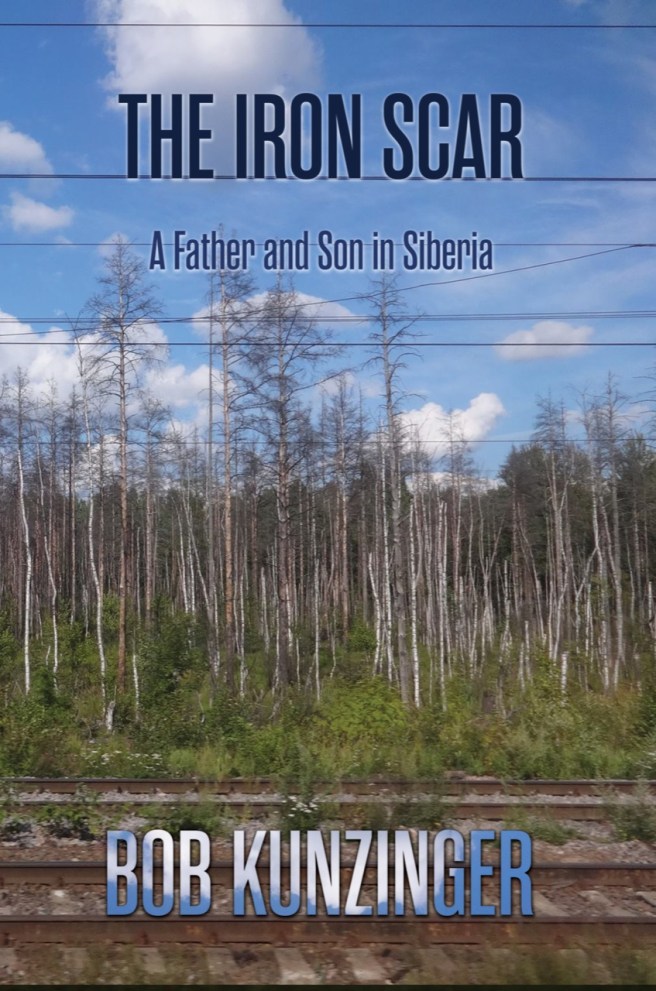
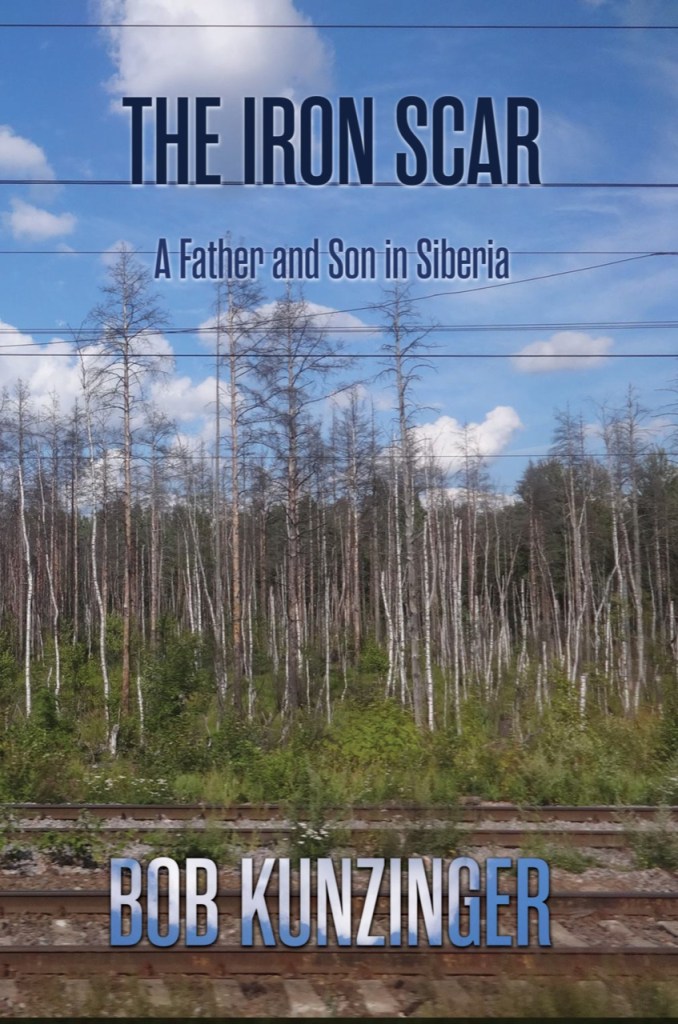
I’m excited to announce here on A View from this Wilderness, the release of my ninth book, this time a memoir; The Iron Scar: A Father and Son in Siberia.
The official release date from Madville Publishing in Texas is April 22nd, though word on the street is it will be available in March at the Associated Writers Programs conference in Philadelphia. And I’ll be there for that.
It is difficult to promote a book without sounding like one is bragging, but the reviews have been beyond my expectations. From Martin Sheen (actor, author of Along the Way: The Journey of a Father and Son, written with Emilio Estevez) to Tim O’Brien (writer, The Things They Carried and Going After Cacciato) to Sam Pickering and more, it has been a true journey that did not end in Vladivostok.
Mostly, I’m excited and proud of this book because not only was my then-twenty-year-old son (now turning twenty-nine), Michael, along with me for the entire journey, venturing out, exploring the world, but as a professional photographer I used him and his talents for the brilliant Photo Gallery within the book. Talk about proud.
This is about traveling across Europe and Asia by train, of course, but it is also about fathers and sons, about feeling like you’re starting brand new whether you’re in your twenties or your fifties. My father is very present in these pages, and the book is dedicated to him and Michael.
You can order right now and for the next few days by clicking here: inscribed copies directly from me for $20 each, which includes shipping, and when the books arrive on my doorstop I will sign them and send them right off to you (or wherever you’d like them to go); or you can order directly through the publisher at Madville Publishing once the site is ready to accept pre-orders.
I’ve made many trips to Russia–nearly thirty–but that trip, that summer, meeting new friends, playing chess, sharing meals and drinks, walking the streets of Irkutsk and Yekaterinburg, of Vladivostok and St Petersburg, walking the hills near Chersky Rock high above Lake Baikal, nearly getting completely stranded on the edge of Siberia, inching over a once-in-a-100 year flood in tiger-saturated taiga region of eastern Siberia, living for several days in a cramped cabin with a large, mostly drunk, boisterous Russia, playing chess against a gang of four chessmen, negotiating for food on platforms, talking about movies, about music, about the rain all those countless times just the two of us stood between train cars, and on and on
I hope you take this ride with us. It is an exciting place to be. If you wish to support the arts, writers, photographers, all in one shot, head up to that link above and order some copies for you and your friends.
Here are some reviews:
From National Book Award Winner, Tim O’Brien:
I just finished again– it’s wonderful. I wish every book and manuscript I’ve read over the past two months had been as moving, gripping, and/or loaded with fascinating information about a huge swath ofour planet. Your relationship with Michael leads the way, of course, and binds the journey into an emotional and thematic whole that transcends the standard “look what I saw” travel book. The chess, the harp, the photography, and the desire to take a 7-time-zone journey with his dad — wow, what a son to have. And bravo to you for risking it, especially the whole language problem, which would’ve stopped me in my tracks, pun intended. So many things stick with me. The czar and Alexi and their fate. I’ve read a book — read it twice — about the ending days, execution, disposal, and eventual recovery of the Romanovs, or what little was left of them, so I didn’t go into it blind with your book, but I felt the father-son, sharing-death connection much more powerfully. Boris (Alexander Ivanovich, that is) was a memorable character portrait in all kinds of ways, and your descriptions (along with the photo of him) certainly match my memories of the cartoon character! Moscow time. What a nightmare. What a miraculous ending to the nightmare. The royal blue station shacks, the birches with no tops, the meat and potato pastries — if pastry is the correct word — the smell of onions, the vodka, the wheel tapping, the once-in-hundred-year flooding, the vast vacancies of human presence, the moving village of the train, the Leningrad hero, the Leningrad ghosts, the ungraspable Leningrad numbers . . . Just so much. Well done, Bob. My congratulations. And thank you for a pleasurable few hours.
From Actor and Author, Martin Sheen:
The Iron Scar brought me on a journey that unexpectedly and artfully had me thinking about my own father and my sons throughout the book, as well as introducing me to the wild, warm, and colorful world of Siberia. Thank you for bringing me onboard with you and your son.
In Vladivostok at the end of the line (photo by some French guy)
I am recycling an old post because what it contains is suddenly fresh and nudging my psyche into somewhere new, or, maybe, somewhere I haven’t been in a long time.
It’s like this: When I knew for sure I was leaving my job I held for nearly thirty years, I started to focus not so much on what was next as much as how fast, how so very fast it all went, and I realized that about the same amount of time to come would put me at ninety years old. Sigh.
I cleaned out my office—slowly at first, then with much more indifference. I carried piles of books to a common table in the building’s lobby, I moved file cabinets and other useless furniture into a storage area for someone else to claim and configure to their job the way we do with all things in our lives—we mold them to fit in the corners of our growth and accomplishments. Yeah, I was done with all of it. I absolutely knew I needed to redefine “accomplishment.”
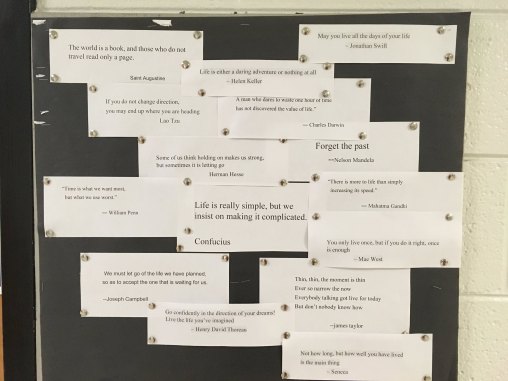
And outside my office I took down all announcements and office hours and lists of readings from my bulletin board so that all that was left was black construction paper. It looked clean, like a slate, and I absolutely loved the metaphor of it all, but I also thought I should take a piece of chalk and write in some demanding font, “Outta here.”
Instead, I typed up a favorite saying of mine:
Life is really simple, but we insist on making it complicated
–Confucius.
I stapled it to the middle of the board, smiled, and went about my business of unraveling three decades and finding my way to that diversion Frost wrote about with such eloquence.
Next to my office was a classroom, and students often leaned against the wall (and my door) while waiting for another class to empty before entering. A few noticed the saying and commented to me when I returned to my office. “I like it,” one woman commented, “because it makes me think about it.” I liked that she said that. I wish she had been one of my students.
The following week I added another quote to the board, one of my absolute favorites:
If you don’t change directions, you may end up where you are going.
–Lao Tzu
Just stapling that to the board punctured a ball of emotion that spilled out across the rest of that day. How many times have I preached, I thought, about the dangers of getting caught in the currents and letting the world around us carry us through instead of pulling ourselves out of the stream and deciding for ourselves where we are going? Students had the same reaction, and I know they were wondering just who is it that decided going to college right then was the right thing to do. Often there is absolutely nothing wrong with where we are going; this is not a rebellious statement, I don’t think. I believe Lao was just indicating it can’t hurt to get a glimpse of what’s ahead every once in a while to see if you really are okay with the path you’re on.
The board caught on and people started asking when the next quote was going up, gathering around my door on Tuesdays after they figured out I didn’t work Monday’s and that I must have posted them early Tuesday mornings, which I did. Up went James Taylor, Mae West, Seneca, St Augustine, and Jonathan Swift. More than a few passing people commented on how motivating the sayings were, and how they looked forward to them. Well, motivation was always my profession anyway, not teaching. For those thirty years it wasn’t English I was there for—hell, I was barely qualified for the first fifteen of those years. It was that I knew how to get them to find significance in it all—the work, the direction, the balance of dreams and reality, the math necessary to never forget life is a line segment, not a ray. My job in New England after college was to motivate people, and I learned it well. So when my car broke down and I ended up teaching college, I knew instinctively that it really doesn’t matter how much I know the work, if they aren’t engaged—if they don’t feel motivated—I’d be speaking to the walls.
Plus, I think my board was an extension of what I knew was about to end, and I started in those last months to motivate myself.
William Penn. Herman Hesse. Helen Keller.
Thoreau.
Darwin.
Then it was the first week in May at the start of my last week ever on campus. And I found this:
We must let go of the life we have planned so as to accept the one that is waiting for us
—Joseph Campbell.
I typed it up, printed it out, moved Thoreau a bit for balance, and stapled Joseph to the board. That one was for me.
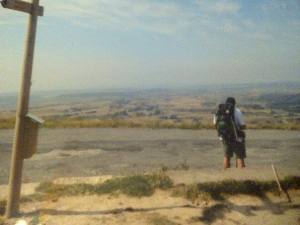
One of my most vivid memories from Spain was being in Santiago after more than a month of walking at about two or three miles an hour, sitting in cafes, crossing Roman bridges noting each step, each breath—essentially more than a month of barely moving to cross a nation—and then suddenly we were boarding a train for the six-hour ride–just six hours–back to Pamplona. Six hours. It took four weeks to go from Pamplona to Santiago, and six hours to get back. On top of that disturbing reality check was that after a month of barely moving, we were suddenly barreling along at sixty and seventy miles per hour. It simply felt wrong. I leaned against a window looking at the landscape and when I saw pilgrims walking the opposite direction toward Santiago, holding their walking sticks, their backpacks strapped and the sun beating down as they walked and laughed, talking to other pilgrims on the road, I got a pit in the center of my stomach, a nauseous pain, like a child on a school bus for the first time who sees his parents outside walking the other way. I wanted to get off; I wanted to pull back the doors between the carriages, toss my pack out onto the trail and tumble out like a character in a movie. Writing that just now brought the pit back; it was that real, it is that real.
And what I learned on that train ride east I am relearning now: I’m a pilgrim, not a passenger.
Sometimes that happens. You’re riding along, caught up in the mainstream, barely noticing where you’re going because you’re engaged with everyone else in the stream barely noticing where they’re going, and you catch a glimpse of some shadow of yourself just out of reach. And you know that’s where you should be, of course, or at least you dream that’s where you should be, but the trouble, the pain, the expense, the sacrifice, the explanations necessary, the possibility of failure, the probability of doubt all slide in front of you, each holding you back just a little, all adding up to a gravitational force of “now” and “comfortable” and “responsible” that’s harder to break free from than the strongest of currents.
Then you jump. And when you do, it’s terrifying. The pit returns in a different fashion, this time pulsating, “Oh my God, what have I done?” And you come to accept that you’ll never lose the pit, one way or the other.
But then you turn around and look back down the stream where you had been going, where everyone else is laughing and engaged and are all still heading, and finally, from this vantage, you see what you couldn’t from the stream, and you know, I mean you know that no matter where you go next, you had been heading in the wrong direction. No one will ever understand that but you. No one.
Anyway.
I cleaned out my office, and I walked outside the door that last day and for a moment I thought about leaving the quotes there, or maybe replacing them all with just one quote in the middle of the black construction paper, saying,
and this bird you cannot change
–Ronnie van Zant
but I changed my mind and took them all down and gave them to my friend Jack. Each week he’d come by my office and we’d talk about the latest quote and what it meant to us. Then on that last day when I was about to throw out the last folder of teaching materials, I found another passage, typed it up and stapled it to the board.
I’d like to believe it is still there:
Life is what you make of it; always has been, always will be
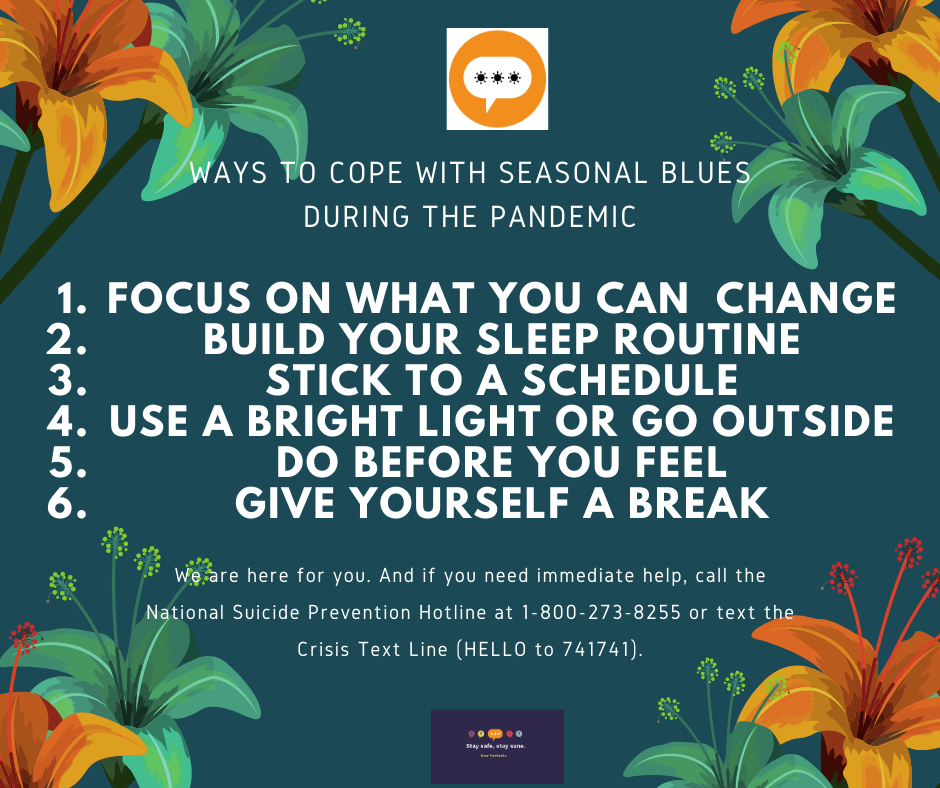
My last blog was about Seasonal Affective Disorder, SAD, and two people I care about asked me if I was okay, noting this particular entry at A View from this Wilderness was a bit dark; and it was, they’re right. I tried to write that piece in second person in an effort to point the diagnosis out toward the reader, but it was difficult to remain in the background on a subject close to my life. Their simple inquiry brought to light something common: often we don’t even realize we’ve slipped into a dark place, a malaise, a lack of presence. It just happens while we’re hyper-focused on something else. Then someone says, “Hey, you okay?” Wow, how much that means, and most people have no idea that those “little, nameless, unremembered acts of kindness and love” as Wordsworth called them, can quite literally save lives.
It takes only that for the ones in the dark to shake their psyche and take a breath and return to some form of balance.
It really does work, you know. The dollar to the dude with the sign, a nod to a stranger standing outside a store in winter, looking in; holding the door, saying thank you, the small things, the activities of a person who is present, who is awake each moment. It is so easy considering it is so rare; Rousseau said the most important lesson any child can learn is simply this: “Never hurt anybody.” Okay, and then throw in a few kind words and really make an impact. I promise you, the one who seems fine might very well not be; but more than this is how little it takes to absolutely grab a soul who is down without knowing why and set them right again. No kidding, it is so easy. The funny thing is when you do these things, recognize others, it lifts your spirits as well—imagine, two people pulling each other up in a matter of moments because one of them was present enough to acknowledge the other. Blaise Pascal wrote that “kind words cost nothing but accomplish much.” Yep.
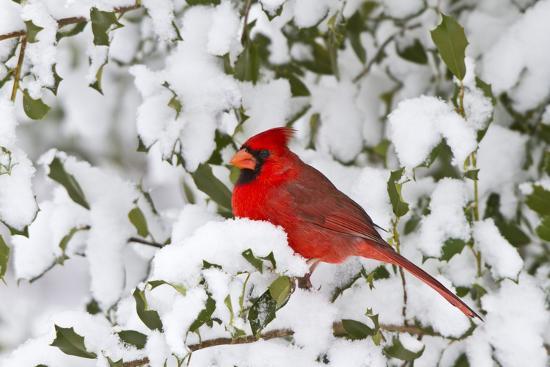
It’s snowing again, and a bit of sleet. Tomorrow night will be one to three inches, which for most of the reading world is laughable as “accumulation,” but for those of us in coastal Virginia, we understand the lunacy on the roads when locals head to 711 in the same driving fashion they use in summer after watching a NASCAR race. But it is beautiful, to put it mildly. The holly and laurel green are covered in white, and cardinals looking for food find refuge in these and the evergreens. A friend just wrote that there’s something about a cardinal in a pine in winter that fills his soul—yes, exactly.
And this is what I’m talking about: the simple things, the generous offerings of natural beauty, the deep-woven connections of conversations and laughter with friends or family. Whatever depression or indifference one may carry without obvious cause, without visible scars, can so easily be chased to the margins by the simplest of moments and the seemingly fleeting kindness of others. They have no idea, they really have no idea of the impact they have on one floundering. Some think it takes hours of therapy and years of acclimation, and perhaps it does for so many, but equally it takes seconds, and most of us know that, but we forget.
You know someone in a nursing facility? A quick call to say, “I can’t stay on but I was thinking of you and wanted to say hi,” can illuminate the darkest of afternoons. Bertrand Russell said to “remember your humanity, forget everything else.”
This must be true now more than ever, when isolation is standard, when even a hug is seemingly forbidden, and we can’t even smile at each other when masks are in play. Sometimes I get so down I forget to look up on a clear night and remind myself how easy it is to find beauty, but also how easy it is to be kind, and to remind myself that as Emerson said, “To know even one life has breathed easier because you have lived, this is to have succeeded.”
“Are you okay?” These words are oxygen, they’re pain relievers, they’re anti-depressants. What can be a normal phrase to one person is an umbilical to new life for someone else. We too often don’t even consider common concern to be uncommon, but it is.
I’ll be down again, indifferent, and completely unambitious, but not right now, not the least of reasons being two people asked how I was. And, recalling Sophocles who wrote that “kindness gives birth to kindness,” I made a few calls, held a few doors—was human, that’s all, but for so many who don’t even realize they’re slipping into somewhere else, somewhere darker, that’s everything.
My doctor hit me with the normal “How are you doing?” and then asked, because I’m on some BP cocktail, if I get depressed.
“Yes, of course.”
“Do you ever feel suicidal?”
“Some semesters, sure.” Turns out doc doesn’t really have a sense of humor. “No, never.” We talked some more and he said, “Well we may want to check into having you talk to someone to see if you have Seasonal Affective Disorder. SAD.”
“Isn’t it possible I simply don’t like winter? When it is cold I shrivel up. I miss my flip flops and shorts and the hot sun and the salty water. It’s Winter. I’m going to be bleh until well into Spring. I mean, I like snow, I really do, it’s just that it sucks.”
He laughed and told me to take care and come back in six months and I assumed he meant when my mood improves, and we talked some more but I knew something he couldn’t possibly know about me: humor is my go-to response when I really don’t know what to say.
Sometimes you can sense some sort of lethargy this time of year revealing itself in blatant ways, like not wanting to go to work, not filling out some forms or editing some article, not bothering to return important calls completely out of a sense of avoidance, as if you might be able to wait long enough and all of this will pass—this stuff that brings you down, and to be honest, you’re not really sure what that stuff is. The idleness of society maybe, the constant sense of impending doom reported in all forms of media about democracy, about pandemics, about weather, about climate, about the economy, about depression and isolation. You have no reason to take any of it personally, but some people can’t let it go, and it weighs heavy, so you aim for avoidance, which unfortunately ends up a heavier burden.
Sometimes the withdrawal is subtle. You can sense yourself not trying as hard or caring as much, like eating whatever is around instead of thinking it through, not going for a walk because you don’t want to be bothered putting on a coat or dealing with any sensory change. You’re sitting; you’re comfortable, and you’re numb. It works.Numb is good.
In both situations you are absolutely aware of it, like an alcoholic staring at a glass of whiskey and saying to himself, “This is a really bad idea.” But he drinks anyway because not drinking means “dealing” with a life that just doesn’t seem to have any silver lining. The irony? Going for a walk helps. Filing out the forms, returning calls, all help by providing a sense of accomplishment and forward motion, like checking things off the to-do list, it leaves you with the hint that if you keep going there’s something worthwhile on the other side.
There’s the rub. It seems you keep reaching the other side and there’s still nothing there to lift the spirits, not this season anyway—more hostility in the east, more pessimism in our government, more variants on deck ready to step to the plate after Omicron smacks a triple into right field. So you try a little less at one task, and it spirals from there. You realize your handwashing time has dropped to about 12 seconds. It’s not depression; it’s ghosting, it’s, well, yeah, it’s depression, but not in the deeply caving sense; in the “whatever” sense.
The problem with this type of malaise is it can be debilitating to you without being scary to others if you are not suicidal. The truth is, the vast majority of people who deal with depression are not contemplating suicide and will never kill themselves, which is what most friends fear most, and when those friends learn that is not part of the equation, they feel better. But that can often make it worse since the objective is for you to feel better, not them. But that’s fair since you know what they don’t: that a different suicide exists, a slow erosion of sorts, which anonymously eats away at ambition and accomplishment, takes the edge off of energy and momentum. It’s the guy sitting at a bar nursing a beer, nowhere to go despite having a million things to do. It’s the one on the park bench watching people walk by but not noticing a single one of them; it’s the inability to concentrate, the disinterest in listening, the short responses to questions, the inability to make it through the most basic of activities. Rational thought has nothing to do with it. “Knowing” what to do is not relevant. Your mind is suspended, your thought process withdraws into some elementary state.
On the one hand it’s situational—financial problems, relationship problems, blizzards. But it can also be chemical if you don’t have medical help. It’s addiction without restraint. It’s a combination of these, and it is unpredictable because the same thing that leaves you in bed staring at the ceiling feeling hopeless can drive you to your feet to tackle whatever it is that left you prostrate to begin with. It is a conundrum that plays handball in your brain.
“They say the first step in dealing with a problem is admitting you have one.”
Yeah, okay; no one I know in this situation has much of a problem admitting it.
But what’s step two? Because the guy at the bar with the beer, the woman in the park, the man at the river watching the tide roll out, all know exactly what the problem is. But their brains are aflush with fog, their anxiety has disabled their decision-making capabilities, and their strongest assets and most celebrated talents that normally keep them going the rest of the year, are no longer applicable since they carry a sense that those traits are probably what brought them to this place to begin with. They sit and wonder what if. They sit.
“Maybe if I had just…”
“Perhaps I should have…”
“Fuck it.”
At some point it seems you stop fighting altogether and are either not afraid to hit bottom, or you hope to use that bottom to bounce back, not afraid to fail since it can’t be worse than this. It is extreme but that is part of the diagnosis—extremes, polar reactions—sometimes both in one day. Sometimes within one hour.
More often than not, the guy on the corner holding the cardboard sign didn’t “decide” to quit, didn’t give up, but “felt” a pressure that he no longer could handle or define, caught in some stream of disconnect and hopeless confusion. Sometimes the one who does, in fact, tragically go that last fatal step didn’t “decide” to do anything at all, and that is the point. Suicide is not a decision. It is one step beyond decision making. The vast majority of people who deal with depression have that in check, less so in the dead of winter, of course.
But that’s not you. Truly. And that is the problem; you really aren’t suicidal at all. And when suicide is not part of the equation, others feel that you must be “okay,” or “going through something right now.”
Yeah, winter, you’re going through a snow bank. This is the worst time of year for many people with depressive issues. Seasonal Affective Disorder is real and feels like all of the above. Nothing helps but time, but time to some people sounds like the slow drip of icicle melt.
Other people try to help so they talk about the weather or sports or anything at all with enthusiasm and a sense of caring, but it often makes it worse, only emphasizes that others get excited about the minutia while you can no longer find value in a sunrise.
But the disguises are nothing short of cunning. I’ve known people fighting depression who on the outside resonate as the very poster image of Carpe Diem. I’ve been friends with people who contemplated overdosing on Monday while making plans for Tuesday, who loved others more than the average soul but only wanted their puppy nearby at checkout time, and people who fought depressive ways by pushing adventure to the limit, and beyond. “What a lust for life!” people exclaimed. They had no idea.
It isn’t exactly depression, by the way, though it is easier to simply call it that because it certainly wears the same eyeshadow as depression. It is indifference; it is a vague inability to muster the energy to lift your spirits enough to give a damn about anything. It’s not like you woke up depressed so you decided to stay on the couch all day; you simply don’t care that you’re on the couch to begin with. Complete apathy. You’re not down about anything; you simply don’t care.
Ironically, for most of these afflicted people, life is amazing, every half-beat is a moment of “miracles and wonder” which is why you cannot comprehend the misuse of time. The abuse of time in so short a life, you think, is as suicidal as the abuse of substances, and that can be depressing as well.
It is the time of year when you wake at three am knowing nothing is going to work, and you’re going to lose your house and your sense of security and no answer makes sense, no way forward seems rational. Equally, the dawn can come with new ideas and hope, and if you push those moments far enough into the morning, you just might be able to make a day of it. But January has 285 days. And February is several months long. March? Well you well know that March is merely a tease. April comes and breathing is easier. May, and nothing stands in your way. You know exactly what I mean.
On the outside you seem to be fine. On the inside you’re grasping the thin rope of enthusiasm with clenched fists, pretending all will be well, but your insides—much against your will—are shredding at the thought of what to do next.
You “hang in there.” You “get through it.” You suffer the trite suggestions of others who simply can’t understand what the big deal is. That’s okay though, you think. Really. There are no solutions, per se. Just more questions. And “hang in there” is at the very least an acknowledgement you really aren’t trying to dismiss your very existence; it just happens sometimes.
This afternoon I went to the river where a bitter breeze is pushing down from the west. There’ll be ice tonight somewhere, and snow, but I sat reminding myself I have been there, touched that ring of undefinable despair, and I’ve moved through it, sometimes with difficulty, often with ease, always with the knowledge that I’ve had one freaking incredible life so far, and time enough left, I hope, to continue my pilgrimage well into the next mood swing. But there are moments, collisions with frustration at the gap between the way things are and the way things should be, that catch some people off guard.
Eventually you remember that the seasons, like everything else, change. And love, despite its bad reputation, is holding the other end of that thin line you’re grasping.
I teach a sophomore level critical thinking and writing class—basic argumentative writing and research. It is one of my preferred courses since my specialty other than writing is research, and in these days where the Fourth Estate is more often dissed than referenced, I like to show the students the path toward accuracy.
The other course on my schedule right now is basic Freshman Comp, which unlike many of my colleagues in the past thirty-three years at three colleges, I truly enjoy teaching. Of course, I start the course by explaining it might be the most boring course they are going to take, but I quickly justify it by adding it is also the most important because of writing being the communication skill most necessary to succeed to college.
This semester on the first day I planned to give my standard lectures for the first day, about the psychology of writing, the motivational tools necessary for even the most advanced writers, and the steps necessary to get through the brainstorming stage to rough draft. I was going to remind them to stop treating me like a professor who “has” to read the paper and think of me like an editor who “may or may not” read the paper, and their writing will improve immediately.
I had the normal three-decade-old bag of tricks.
I arrived early and watched students walk in quietly, masked, heads down, silent. We had about five minutes. Out of nineteen students, one said hello. The rest sat looking down, some at phones, most at the laps, like schoolchildren waiting to be told what to do.
I asked how they were doing. Nothing.
I asked one person directly how she liked ODU so far. Fine.
I asked another what his major is. Shrug. Undecided? I guess, he said.
Back Story: Over the course of thirty years I’ve seen classroom chatter pre-lecture go from boisterous to casually friendly to non-existent. This, of course, is in direct proportion to the introduction of technology, but I have also noted that even without the phones or laptops—for example, this class, where only one student was looking at his phone—the concept of communication with unknown peers seemed non-existent, as if they have spent their entire lives only communicating by text, and, yes, they have.
It isn’t a matter of poor social skills; these are today’s social skills. Since most of these students are freshman, asking them to put the phone away, or indicating that they should be taking notes, generally receives a positive response. But any question is answered with as few words and as little eye contact as possible. This has been slowly coming on for some years now. In early spring of 2020, it was a bit easier to get them to respond with more than a grunt or a monosyllabic answer, but then Covid came and extracted whatever scattering of manners was left when gathering among others.
I asked one young woman where she was from. NOVA. What town? Alexandria. Why did you choose ODU? There are some great schools up there and in DC. Shrug.
I asked one whom I know is an athlete with absence accommodations what his major is. Mechanical engineering. What made you choose that? Shrug.
Time came to start class. I stood up and they sat up, the one put his phone away, a few took out notebooks, but most did not—people stopped taking notes some time ago, expecting me to post them on Blackboard (a program to communicate with students).
Well, we are here to learn to separate accurate and verifiable information from the tons of crap that cover it up, distract you, trick you into believing what they have to say is true and real and essential when it is simply, well, crap. We’re going to learn to know who the true experts are and who present themselves as experts but are simply loud personalities. And then we’re going to learn how to write about it. Let’s start with this: How many people here would rather class be online during this Omicron surge and return to face to face when it settles down?
Nothing.
I asked the athlete. Shrug.
I asked the woman from NOVA. Shrug.
What the fuck are you people doing here???!!! I thought.
What am I doing here?!?! I thought further.
I sighed, pulled my chair to the front center of the classroom, and sat down. Outside, a full-grown magnolia stood in all its majesty, reaching against the windows on this second floor, and in the distance a deep blue sky. I wondered if the herons and buffleheads were at the river. I thought about how the cold feels on my neck when walking on trails. Or the heat.
I thought about Spain.
I smiled at a woman in the front row who accidentally made eye contact. I asked and she said she is from Fredericksburg. She decided on here instead of Mary Washington University in her hometown, but it seemed too much of a subject to approach at the moment. A crow landed on the magnolia then took off. I could see this but none of the students could. I wondered if the classroom had been reversed with the windows behind me instead of them, would they still have not seen it.
“So…” I said…
If you weren’t in college, where would you be right now? I mean, I know it is hard to say, but use your imagination, be idealistic for a moment and imagine you left high school and instead of college you and a friend decided to….what?
And one guy mentioned probably the military.
And another said working for his father who owns a store in Richmond.
I said I’d take off. Get a job in Florida or Martinique or Ireland for the summer—tend bar, wait tables, not make up my mind about what the next sixty years it going to be like while my head is still spinning from high school where I was still friends with the same people I knew before my voice changed. They laughed, some sat up.
Then this:
Guy in the back row said he wanted to drive across the country and live with his brother in San Diego but his father insisted on college. Another said she is the first one in her family to go to college and she wants to make them proud. Another said he had nothing better to do so might as well work toward something instead of wasting time wasting time. People laughed. I nodded toward him and said, “You’re going to do well.” He thought I was joking, so I said it again. “Really.”
We talked for a half an hour, laughing, I told a few quick stories about college, a few about classes I had taught in the past, my first one as a professor and how terrified I was, almost the same age as my students, having no clue as to what the hell I was talking about.
They talked about their decisions about going to college, about their majors, about being away fromhome for the first time. We talked about the impending football game that night for the National Championship; we talked about social media, we talked about which place was best to eat in the neighboring Ghent area of Norfolk , which lead to some funny conversations about types of food.
We agreed we eat out too much, we drink too much coffee, we don’t spend enough time outside, and we are too attached to technology. Even the Computer Science major said this.
I stood up and wrote on the board: What has it been like to be in college so far? 500 words.
I don’t want you to do this, I said, but if I did ask you to, could you?
All said yes.
I mean, you’ve been speaking English for almost two decades now; certainly you can string some thoughts together about this, right? They laughed and agreed.
Then I said, “If you did this but I said the five people whose work really caught my attention will automatically get A’s on their first essay, would you do a bit better? They laughed—we were used to laughing now which made answering questions in front of others so much easier—and agreed theywould. Then this—I’ve written about this before in this blog and in the Chronicle of Higher Education, but it works so I use it when I can, but the timing must be right or they’ll call BS on me, and the timing was just right: Okay, if you guys, that includes you I said to the one who preferred pizza from 711 over the good pizza place in town, and everyone laughed, if you guys were to do this assignment but I had told you the top five get a thousand dollars each right on the spot, would your work be better?
They all laughed almost in unison and responded in various degrees of “hell yeah!”
I sat back down. The crow came back to the magnolia, and I thought about the crows at home and how they often keep the hawks away but not the eagles, and not the finches who despite their size have got some serious food-gathering game. The crow lifted and left again.
“So look at you now,” I said. They remained silent. “You just admitted it to me.”
They shrugged.
“You always could do better. You just couldn’t be bothered.”
Maybe if I paid you, then you’d put more of an effort in. Otherwise, whatever. You just presented to me the proof of why you aren’t doing as well as you could be—you can, you just admitted it—you just don’t bother.
I get it, I told them. In my example, the reward is clear, is obvious, and is immediate. But in a freshman college class the reward is vague, distant, and seemingly irrelevant, but in this class in particular, it’s worth way more than the grand you were going to work for. We are so caught up on immediate satisfaction and reward we have lost the art of sacrificing now for benefits later.
A couple of people still knew who Billy Joel is so I told them how when asked what it was like growing up he said the worst part was the piano lessons, how he could never understand why his mother made him practice three hours a day while his friends were outside playing. Then he was asked what was the best part of growing up back then, and he said the piano lessons and how his mother made him practice three hours a day.
We talked more about football and pizza.
Don’t come here because it is “required,” I told them. Don’t show up next time because you don’t want to lose points for being absent. Come because you just met some new people to hang out with, new voices to listen to and talk at. Come because I am going to constantly remind you that being here is worth way more than you know right now, and I need you to trust me. Come because that crow keeps coming back to the magnolia and I can’t figure out why.
And everyone turned around and laughed and we spent the last few minutes speculating about what the bird could possibly be doing out there.








 a view from this wilderness