and I, I chose

a vew pic 6


I’ve been reading Frost again. He’s a good diversion.

Of course sometimes I wonder if what I’m doing is what I should be doing; I mean in the big picture. Who doesn’t? Here I am ages and ages hence and occasionally I think back with a sigh and briefly consider whether or not the “other path” really would have been just as fair. Honestly, we spend the better part of three or four decades almost entirely in one profession before we retire. I can’t possibly be the only person busting down the path full speed who would love to return from the dead five or six more times to live out all the careers I dreamed about. I’d come back as a musician for certain. Then maybe open soup kitchens everywhere. After that I’d do a spin as an architect; maybe one round as an athlete. Cooking would be cool.

Back at the start just before I graduated from Penn State while working at a bar, my brother sent me a job-listing for adjunct professors at the community college in Virginia Beach. My brand new graduate degree qualified me for English, humanities and art, so I sent my application. Still, I had already secured a position teaching journalism in the Chesapeake high schools. A few weeks earlier I had interviewed there and got the job. They just hadn’t figured out which of the schools would be mine.

When I went that August to claim my position, human resources informed me they lost my paperwork and hired someone else. After some brief words with the director which pretty much insured that they never again would consider hiring me, I drove toward our beach apartment, but a traffic jam on the interstate sent me through back roads. Just as I worked my way to the southern part of the city, my car rattled and coughed so I pulled into the first safe area I could find, and my car promptly died—in the community college parking lot.

This is pre cell phone so I walked toward a building to make a call. It was just before fall semester and few offices were staffed, but I found one with a phone and a lovely woman named Eleanor and her boss, Bill. AAA put me on hold, of course, and while I waited Bill walked from his small office to Eleanor’s desk and said in his distinct southern accent, “Eleanor! We still need someone to teach humanities on Wednesday nights!”

I had planned to get the car working and go see a friend of mine who owned a hotel on the beach and ask to work with him again. Instead, I lowered the mouthpiece and said, “I can do that.”

Bill looked at me. “Who are you?”

Eleanor explained my car situation. I added the master’s in humanities part and that I had sent an application a few months earlier on my brother’s advice. Bill asked me to come in his office when I was off the phone. I hung up. AAA could wait.

Within a week I had five courses to teach. Two years later they hired me full time. Almost three decades later I work in the same building, teaching the same courses, still staring at rooms filled with twenty-year-old people. My world has not aged, though I have. It is an odd existence to stare at twenty-one for twenty-six years. Earlier this week I taught Robert Frost’s “The Road Not Taken,” and today I wondered what I would have done if they didn’t need someone on Wednesday nights. Or if my car hadn’t broken down, or if they hired me to teach Journalism in Chesapeake, or if my brother hadn’t sent the ad and I hadn’t sent in my application.

So it’s my brother’s fault that I teach college. “Either/or” decisions fill our lives like trodden leaves. We constantly move forward constantly leaving “unknowns” behind, constantly believing we can “go back” and give it a go someday, and constantly delude ourselves.

I was going to be an astronaut, but I was ten at the time. Then an architect; a race car driver; a tennis pro; a musician; a hotel owner; and the list goes on. A cook, a left fielder, an ice cream man, a pilot, a performer. I am not attention deficit; I am restless. But none of those dreams pursued me with the passion that a true vocation demands. In the end, traveling the world was the only occupation that rattled my soul, but the counselors had no idea what to tell me. “You can be a travel agent,” one of them said when I was a senior in high school. “I want to travel, not send other people,” I told her sarcastically. Based upon her advice of where I should go next, she would have made a lousy travel agent.

So traveling it would be and since I liked to write, I figured majoring in journalism might afford me the opportunities to be on the go, albeit most likely war zones. “How are you going to pay for this?” a friend in college asked when I stared at maps. I told him I would find “a good paying job that gives me a lot of time off.” We laughed a while, and I graduated, and followed a series of bizarre jobs from blanket smuggling to health club management, all with the primary goal of making enough money to quit and move. Throughout my twenties I always felt like I was “just a day a way from where I ought to be,” as Jackson Browne claimed.

Then my car broke down, and now I owe my brother a boatload of thanks; teaching college has allowed me time off to travel more than I ever could have imagined. It all worked out. That’s what we say, isn’t it: “It all worked out” or “It’s fate” or “Everything turned out the way it was supposed to” or my favorite, “It is all in God’s plan.”

Back to the two diverting roads in the yellow wood: What might have happened if I didn’t throw a dart at a map senior year and hit Tucson? What if it had hit New York? What if the crazy red-headed exercise freak didn’t like me? What if I had just gone to Monterey? What if I hadn’t gone to Pennsylvania to begin with and instead tended bar in Peter Trimbacher’s 800-year-old castle in Austria? What if we had never left New York? I obviously could go on, as we all can, splitting hairs and making ourselves feel better by reminding ourselves “It is for the best” and “How grand everything turned out” and “I wouldn’t have it any other way.”

Ha. I would, of course. There are certain particulars I’d totally change. You know who you are.

I like to think the Almighty allowed us to make a few choices of our own, like what to do with our lives. So a few weeks ago I traveled to a cabin in the mountains of western New York to think about it all. I met some friends there, we drank some wine, and I hiked around the snowy trails filled with diverting paths. A few days to get some perspective seemed a good idea. And here’s what I figured out; if tomorrow I had to tend bar again I’d be okay with that. My psyche bends that way most of the time anyway. Sure, sometimes I think to myself, Wow! I’m a freaking college professor; the second most respected profession on the planet behind doctors. But I quickly remind myself that is my career only because of a bad alternator. What if I had learned how to fix cars? See how things turn on a dime? What would life have been like if I had driven past the college, or straddled a chair in front of twenty high school journalism students. I think we have a habit of backing into opportunity, despite the desire and ability to “choose” our destiny. Kids have conversations with counselors about their future, which is chosen more often than not based upon what major might lead them toward the most likely employment or the highest paycheck. Sure, someone might ask them to define their “passion” before choosing a major, but why? Most teenagers haven’t yet stumbled upon their passion, or if they have it is for something that isn’t taught in college.

Traveling was the one occupation that occupied my long-range forecasts from my adolescence to adulthood. I wanted to see the world and write about it and explore and connect to civilizations outside the confines of our small town. Sometimes we get lucky and bend our careers around our lives instead of adjusting our souls to accommodate a career.

Is it possible my brother knew that if I got the job I’d see the world? It is more likely no matter what livelihood I stumbled into I would have figured out how to manipulate some frequent flier miles out of it.

Still, thanks Bro. Buen Camino.

fred and me as kids

Sir Michael the Knight


I’ve told this story before. michale in frog shirt

When Michael was about three or four, he used to play “Sir Michael the Knight.” Sometimes it would be on the sand in the yard of a beach house we rented one winter where we would build elaborate castles and he’d be Sir Michael and I was the dragon inevitably slain by the knight, culminating in my plunging death into the castle. Most often he occupied himself on rainy days when he would don his shield and sword and cardboard helmet and then barrel around the house. One time he ran through his grandmother’s home in Pennsylvania, cardboard sword before him, through the kitchen to the living room to the dining room and back into the kitchen, several times always calling “Sir Michael the Knight is going to slay the dragon!” or “You can’t get away from me dragon!” as he passed again, his voice fading in some Doppler effect as he disappeared into the kitchen, emerging around the corner seconds later. On one turn he was mid-sentence running into the dining room when his shoulder clipped the table and his feet flew out before him and his entire body slammed to the floor in perfect professional wrestling fashion. I jumped from the couch when I heard his head hit the ground, but he only lay there a second before he said, “Sir Michael the Knight hurts himself bad.” He got up and kept running.

He is still running. Michael turned twenty-three today.

When I was young my father brought my brother and me to play golf. We really didn’t talk about anything other than the round of golf as we played, and often we finished with hotdogs at the grill. But it was bonding time, a chance for us to be together somehow knowing just the time together was more than enough; we didn’t need long, deep conversations. I can recall those times as clearly as if they happened yesterday. In the later years Dad and I would have Scotch together every Tuesday night. I’m not a fan of Scotch but of course that wasn’t the point. We’d sit and talk about baseball or teaching or whatever movie might be on, and we’d slowly sip the single malt.

Still there was always that gap that separated his generation from mine. For my dad’s generation “dressing down” meant loosening their ties. They listened to news on the radio and more often than not for most of them the first trip out of town was World War Two. Their music came from crooners and orchestras and nearly all their relations lived relatively close.

But the generation gap between my age group and my son’s is much less evident. We listen to the same music, dress the same, share the same adventurous spirit for travel, and communicate through social media more often in one day than I might have communicated with my father at all in a month. There are differences, of course and thank God, but the gap today is more of a small ravine with a variety of bridges compared to the canyon which stood between “the Greatest Generation” and the baby boomers.

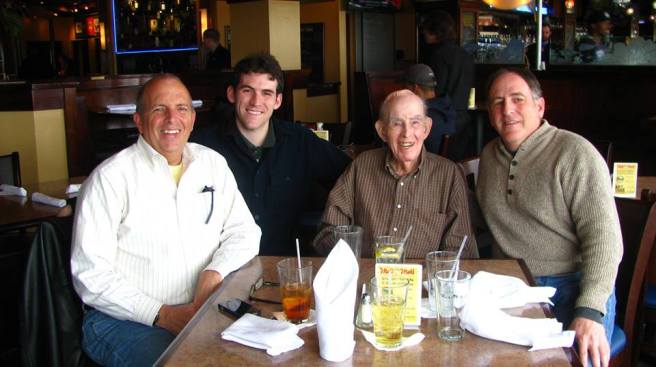
I’ve been especially privileged to spend time with Michael. It isn’t unusual to find us at a local oyster bar splitting a dozen and drinking hard cider. Together we’ve ventured to various east coast spots like Long Island and the Outer Banks of North Carolina, trained across Europe and Asia on the Trans Siberian Rail Road, and walked across Spain. We’ve been around the block together, and we’ve seen more together than most fathers and sons get to experience in a lifetime. I am constantly aware of this and deeply grateful.  

But none of those journeys compare to the pilgrimage we make to the river every evening when we’re both home to take pictures of the setting sun and we wander around in silence to listen to the water and watch the wildlife. One of us might mention a colorful cloud formation or the approach of an osprey, but mostly we take pictures and point out the peacefulness. This has been a steady routine since he was four; the picture taking started just a few years later. In the summer the sand fleas can be unbearable but we tolerate them, swatting our legs and faces determined to remain at the river a bit longer. In winter we bundle up ready for whatever wind whips down the Rappahannock toward the bay. Over these nearly two decades we must have taken thousands of pictures. I prefer to point my camera up at the ever-changing cloud formations picking up the last bit of light from the fading sun. I try not to allow anything “earthbound” into the frame, including trees or even the water. I like the fluidity of clouds, how beautiful they are ever so briefly before they dissipate. Michael aims at the surface, seeing hues and shapes that swirl and gather and disperse as fast as he can find them, capturing just the right combination of color and design before the tide takes over.

It is about perspective. When people my age get older, we are “getting older.” When a man Michael’s age gets older, he is “growing up.” Twenty three years ago today I can tell you exactly what I was doing, where I was, how I felt, what I was wearing, what I ate, and the temperature outside. That was a lifetime ago; it was moments ago. Twenty-three years ago I was someone else entirely, a character in a story. Today it is almost as if I should find Michael coming around the corner, cardboard sword pointed toward an imaginary dragon.

These days I prefer to look forward so I don’t slam into anything. I am not sure where Michael’s going next but wherever it is and for whatever reason, I am confident it is with faith, a sense of humor, and an instinctive ability to be kind to people. I am as excited as he is about what’s over the horizon.

Happy Birthday, Sir Michael.

Etiquette

kafka's eyes


Next week I am reading for a group of senior citizens at a retirement community on the bay in Virginia Beach. I’ve done this at the same place a few times. In fact, last time just before the gig my host and I were eating dinner in the facility restaurant when halfway through the meal a woman at the next table fell out of her chair and died. Or she died and fell out of her chair. Either way, she was dead on the floor feet away, and my friend said, “Oh I hate when everyone stares! Why can’t they just do what they are doing?!”

Well, to be honest, I was one of the ones who looked perhaps longer than I should. When she first fell I jumped up but William said to sit, that the medics on staff would be there in seconds, and he was right. They came out of the kitchen faster than a cook answering a complaint. She was a small woman, at least ninety, and her demise seemed more of a prank fall then a heart attack or choking incident. It was almost as if she were already dead, but a few seconds earlier she had been talking to her friend, who I might add, was polite enough not to stare. The friend sat with her hands folded until the paramedics escorted her to a different table. It felt very much as if upon moving in everyone had been told: “If you are eating with anyone, and they die, do not help, do not get up. Wait for someone to move you to the next available table!” Even the way William immediately protested “I hate when everyone stares” implied this happens often, and people usually, rudely of course, stare. Perhaps the exertion necessary to attend dinner or a function pushes some over the mortal edge. I don’t know, but the way the medics immediately arrived with screens to surround the poor woman and everyone else returned to their meals made me believe I did not happen upon an unusual evening at ye ‘ol facility. I had the salmon and William had the prime rib. I sipped my wine and William watched me, like he was processing the information. Odd.

After the event (which continued without comments concerning the corpse and was well attended by quite jovial people) I thought about William’s expectation that no one should stare. There was a corpse closer to me than the basket of bread on my table; I stole a glance. I looked longer than I should, and while I’m sure there is some etiquette concerning corpse staring, I am equally sure no one in the room was looking at me anyway.

When I was a child, probably about eight or nine, my mother taught me two things: look at people when they talk to you, and don’t stare. This can be a fine line to walk, especially for a kid. She brought me to the library to check out books. We stood in the stacks and I asked the librarian a question and while she answered I looked at the books instead of her. My mother quickly corrected me: “Look at someone when she talks to you, Robert. Look in her eyes when she talks.” I did and clearly I never forgot that lesson. But later that day when I watched a neighbor we visited struggle her way out of her chair, my mother told me not to stare.

I was confused. Look but don’t stare. Timing is everything with etiquette. When someone is done talking, a quick glance away to disengage eye contact is necessary, unless you’re hitting on someone and the chemistry is strong, then holding the stare a bit longer allows the other person to know you were staring, blatantly staring, because you couldn’t look away from her beautiful eyes. The problem there, of course, is if you stare too long you are in danger of crossing that line to psychopath. If she does look away you have to figure out if she looked away because she is completely uninterested or because she is afraid of revealing her deep rooted passion to plow over the table at you. Hard call.

Now imagine one of you is dead. The rules change.

It seems staring isn’t the issue as much as being misunderstood. It is an art form. One thing I always admired about my father was his absolute eye contact when he talked to someone. He was not an intimidating man in the least, yet he somehow commanded respect, and I believe it was because of his eyes which so clearly let people know they could trust him, which was not a small thing for a stock broker. He looked right at you when he talked or when you talked. And he knew when to let it go. He was the master of the look-stare genre. I picked up on some of his ways, but my profession has altered my opinion about the timing of it all.

As a college professor people stare at me all the time, and when I am talking or about to talk, it truly doesn’t bother me. But often, especially on the first day of class before the lecture starts, they just sit there and stare at me. I suppose they’re sizing me up: do I look mean, aggravated, am I an easy A or a piping bastard? But as I watched the years roll past and students have come and gone, they don’t stare as much. Part of it is because they’re looking at their phones; part of it is because the latest vacuous zombie-obsessed generation doesn’t make eye contact at all.

Some people look, some stare, some have a gander, some a look-see, people peak, they glimpse, behold, gaze, and leer; they survey, observe, give the once-over, and keep watch.

Look, I am not so self-conscious that I care what people think when they scrutinize. I just prefer they get their timing down. Unless, of course, there is some cross table-plowing involved. Personally, I don’t ever want to stop staring. There is too much to see, too many faces to commit to memory. I’m glad I stared a long time at my father’s face, my grandmother’s eyes. I can recall them now without the need for photographs.

“Look at people,” my mother said. Absolutely, though she probably didn’t mean the ones on the floor at the restaurant. There are definitely flaws in the whole “look/stare” methodology, but I’m working on it.

Unreceptive

unreceptive art


People make fun of my cell phone, excuse me, Blackberry, for being so small (forget the fact we used to make fun on any phone larger than a credit card while today we strap laptops to our hip) and its outdated features. Still, I’m sure if used correctly I could run NORAD. I just make calls, check email, and text people. Sometimes I take pictures.

I was confident when I first owned a phone which resembled Captain Kirk’s transponder that I’d not forget some basic etiquette rules, the most obvious being to look at people when they talk to me. But I’ve been teaching college long enough to know the generation which occupies the seats today have never not known cell phones, so eye contact was never really an issue; they just don’t.

I also know how addicting technology can be so I decided to update my cell phone policy for my course outlines. I never had to do that when I first taught. Students sat and the closest they came to distraction was with each other, or the weather outside, or sleep. You remember–non-device diversions. Today, we live in a world where we need to put up signs to tell people not to throw garbage out the window. We are so mentally preoccupied that we actually need a law requiring posted signs to remind workers to wash their hands after they wipe their butts. And now we need policies to suggest to students they actually pay attention to the professor. So at some point the collective collegiate community found it necessary to establish guidelines for technology. I created my first phone policy from various college handbooks and it read something like this: 

Cell Phone Policy During Class Hours: (early 2000’s version)

Cell phones or other electronic devices are prohibited from use in the classroom unless the professor or a recognized counselor approves such use. Neither should students disrupt the class by leaving to respond to a call.

How pleasant. I thought it made me sound affable, maybe even approachable in a distant sort of way.

I had a student once sit in the second row and lean down behind the student in front of her to talk so I wouldn’t notice. I noticed. One student answered his phone during class and talked in a regular voice to someone from work. When I stopped teaching to protest, he put his hand up, covered the mouthpiece and said, “Excuse me but I’m a master chief.” That was the last day he ever attended one of my classes. One student politely excused herself to talk on her phone outside the class, which is fine, until she was just two feet outside the room and told her boyfriend in a not so quiet manner, “I’m in class you dipshit! Oh that’s right, you’re too stupid to read the schedule I put on the fridge! I should have put it on my sister’s ass where you would’ve seen it!” True story. While I pointed out she should have left the building to answer that one, I excused her for originality.

Some students read their texts and tell me they’re taking notes. They’re not and I know that because their excited expressions don’t align with my desperately boring discussions. Some tell me they’re checking the time. One guy actually admitted he was playing a game because he was bored. I asked which game and he said “Sonic the Hedgehog.” I told him my son used to play that game and he looked up all excited like we had made some connection; when he made eye contact he saw how much we hadn’t.

It’s irritating. Not because I don’t understand; I do, I really do. I can multitask; I can totally listen to a lecture while scanning my phone to see what emails came through and who is texting me. In fact I might even argue it is a good thing since it teaches students the reality of multiple people talking to you at the same time at just about any workplace. And if it’s done discreetly, it really doesn’t disrupt the class. I’ve sat through more than a few faculty meetings during which I wanted to text colleagues across the room, “If I were the man I were five years ago I’d take a flamethrower to this place!”

But most students miss the point. They don’t get how disrespectful it is. They’re more like the master chief, or, worse since their sense of entitlement wasn’t earned but instead  nurtured, they simply don’t understand why they can’t do exactly what they want when they want to. Therefore, at some point a stricter notation seemed necessary. So as technology advanced, so did my cell phone policy.

Again, I updated the outline:

Policy Update Concerning the Use of Cell Phones During Class: (2010 version)

Put away the damn phone you miserable no good dirtbag! What makes you think you’re so important that whoever calls or texts you needs an answer immediately because your thought is so essential to civilization that it can’t wait ninety minutes? If it’s that big of an emergency they should call 911. If it’s not you can wait until I’m done talking and by the way while I am talking look at me and not at your phone because that is how vertical homo sapiens are supposed to act! Essential? Bullshit. Shove your ego aside and accept the fact you’re talking to your girlfriend or on Facebook or checking updates or seeing the score. Here’s the score: Shut the fuck up or put the phone somewhere so far removed you’ll have too fart to answer it!

Faculty senate refused to approve that one.

When I was in college we talked face to face. Today I get to class early and absolutely no one is communicating with each other. It wasn’t too many years ago when the class was alive and people learned about each other, shared stories and made futures together. Now most maintain an umbilical to friends at home or from high school, preferring “facetime” before class. Ironic, actually. It’s not hard to find the advantages to the pre-tech days when we spent more time around picnic tables or fires talking to each other, never being interrupted or excusing ourselves. We were present, one hundred percent, and between the money we saved and the time we spent driving to a friend’s house, or the convening on the corner at night beneath a street-light to have a conversation, we savored friendships, never deleted each other’s final thoughts.

Perhaps advantages exist I haven’t begun to fathom. Maybe lifelong friendships can be continued which in my day faded, some friends forgotten by distance and silence. Sometimes when I see a young woman laughing at her phone, messaging back to someone she has known since seventh grade where they might meet that night, I’m sorry I lost touch with parts of my youth, and it makes me want to reach for my phone and do a quick search of the names of old friends. With that in mind, I knew despite my age and decades teaching, it was time to update my technology policy one more time to accommodate a changing generation:

Policy Update Concerning the Use of Cell Phones During Class: (Today’s draft)

When using your cell phone during class, do not plan to type texts or emails, but use the time for reading incoming messages, as that is less disruptive. If you have a backlight turned “on,” please turn it off during movies so you can read the text but the illumination doesn’t distract from the film. The west side of campus is Sprint and T-Mobile friendly; however, the east side of campus is best for Verizon users. All of this is questionable during storms, of course. Please refrain from verbal and even facial reactions to incoming texts while I am lecturing, and perhaps read only the good messages, and not from someone you are fighting with as that might also disrupt the class. If you do find the need to call or text someone back, please do so during “group work” where the interruption is less noticeable. In the event your battery should die or you chose to use data which might drain the device during class, I will provide power strips at various locations in the class for more efficiency. If you have any questions, please consult the cell phone technician now located at the entrance to each building on campus.


June 18th, 1975

Heckscher State Park, Long Island


I’m cleaning closets and donating clothes and other items I no longer need. Some are just old collectibles in boxes shoved beneath beds and in the attic. If I could fit junk in the crawl space under the house I probably would. I have too much stuff. Soon, most of it will be gone, but it isn’t easy deciding what to keep. I can easily make a case for retaining every item. Sometimes it is comforting to pull out an old trinket and tell stories about what happened. I have an ashtray from a resort in Palm Springs from when I was fifteen, but I can’t mention it without my mother reminding me how I wandered alone for hours in rattlesnake country in the San Jacinto Mountains. I’m keeping that one. There are postcards and paperweights from family vacations and solo trips out west. Most of it is going. I can remember what happened without a cheap plastic prompt. And if I can’t remember then the item is a waste of space.

But last night I came to what I call the “Long Island Box.”

At fourteen years old we moved from my childhood home on the Island to Virginia—that was over half a century ago; so far in my past I am closer to ninety than I am to then. And so much has happened since those days to make those first fourteen years little more than a title page; at best a brief introduction to the rest of my life. In fact, it seems that boy might easily be someone else save one particular item: the baseball my friends signed and gave me when I moved. On the rare days I pick it up it connects us across time and distance. I can look at the ball as proof I actually knew those people, and if I were to go back to Long Island, I’d almost expect to see them in their youth. Memories trick us into thinking of some places as special when, in fact, it is usually a particular time we relish. The truth is, when I hold the ball I don’t want to go back to New York; I want to go back to 1975.

When we were young we played baseball; we listened to music; we hiked the woods of Heckscher State Park; we skated across the Connetquat River and waded well into the Great South Bay. We hopped the fence of the Bayard Cutting Arboretum and camped out and kept secrets; we built forts and fought over stupid things. We came of age during the Vietnam War, and music was part of our blood. Now as if to symbolize all those days, I have the baseball. The names have not faded even while most of the faces have, though I certainly can conjure up the idea of who they all were. Over the years I’ve been back to New York, but never saw those friends again. Still, when I return I say I’m going “back” to New York, not “up,” as if New York will always be a time more than a place.

When those friends gave me the ball that last day, I wanted to stay in that town and finish growing up with Steve and Todd, Eddie and Paul, Janet and Lisa and Essie and Norman and Mike. So the ball remains my sole possession from life before the fall. I have wondered if we had stayed would I have pursued my burning desire to play baseball, or would the music and restlessness that eventually took over my life catch up with me anyway. Smack dab in the middle of my youth, in a small idealistic town, in a time when my friends and I were pushing the limits and planning our exit strategy, I got traded to another existence five states away. I have no regrets at all, but I have the baseball, and it teases me toward the proverbial road not taken.

Now I’m thinning out my collections of books and art, pawning off possessions and boxing up souvenirs. I have no emotional connection to many of these things other than the people I met along the way. But now I also have my own books and journals for when the memory fades. The further through life I paddle, the more I’m interested in what I can enjoy at the time, not stow away like pirate booty. How many times do we buy things while traveling, bring them home and display them, and eventually replace them with new souvenirs? Even if I do take the items out and look at them or show people, the significance eventually ebbs. I have stories and memories, and sometimes I have a longing to return, but I quickly realize that an object is not a memory, it is a symbol, a window through which we can watch our youth. I can hold the ball and see us in Steve’s backyard, yelling as we ran the bases, and I can still smell the marsh near the river that time we found an old shack for duck hunters and carved our names in the walls. The ball is proof I was there and it all happened. Souvenirs play an important role in moving on. They keep us from carrying the guilt of complete abandonment. Once in awhile I pick up the ball and can hear their voices calling across the yard, across the years.

Sometimes I get this crazy idea that we’re all going to meet at a pub, probably on the Island, and hug and laugh and drink and tell stories of then. It will be across the river in Oakdale, on the water, and we’ll get tables on the deck. Eddie and I will make fun of Todd for the way he used to follow us through the marshes and kept cursing whenever he stepped in the mud. Steve will talk about baseball and the terrifying afternoon I hit a fly ball right at the sliding glass door on the back of his house. We’ll both remember at the same time how we used to see who could hit the ball over the roof, and then we’d retrieve it from the street and see who could throw the ball the farthest. And right at that moment I’ll pull the ball out of my pocket and show them how bad their signatures were when we were young, and we’ll laugh and pass it around, but in the presence of these people the ball will suddenly seem irrelevant. We’ll break into a chorus of the Zombies “Time of the Season” like we used to while walking to the deli. Then we’ll order more wings and beers and someone will inevitably have to leave early because of family obligations. Still, for a few short hours we’ll gather and maybe convince the bartender to play some early seventies music like the Beatles “Let it Be” album. And Todd and I will tell everyone how we were sitting in his room listening to the radio when the story came through that they broke up. It will get quiet and someone, probably Janet, will say she has to leave, so we’ll all stand in the parking lot and shake hands, and hug, and say we must do it again. They will drive off but I’ll wait, because that’s how I see this going down. I’ll stand there four decades after seeing them last and wonder how it is possible to live this long and still remember details. I’ll be glad I went back, but I’ll remind myself I really must move on and simplify my life, so I’ll turn toward the river and wonder just how far I can still throw a ball.

We didn’t drift apart; we grew up. The ball will go back in the closet, and my friends will go back to their faraway towns scattered from Long Island to Florida. All of us probably keep neat houses with boxes stowed behind stairs just beyond reach. Even this house I’m organizing and which I built twenty years ago is little more than a hotel to occupy as long as possible before I check out and others make themselves at home. Maybe someone will find my baseball behind a cabinet, and the names will be worn off when the kids here take it outside and toss it around. Anyway, it’s a ball; it’s probably how it is meant to be used.


(photo of the Great South Bay at Heckscher State Park)

Sitting In

I sit in my green writing chair my father gave me years ago and look past my books and paintings into the wilderness which surrounds my home. The birds could not find food in the morning’s snow so a slow spread of seed across the porch rails brought nature as close as possible without opening the windows. House wrens, warblers, robins, cardinals, downy woodpeckers and others all winged in from the apple trees to the rail, grabbed some seeds or stood and ate them there. Next to the porch is a larger than me thorn bush covered in red leaves which the birds use for hiding. They popped in and out from the bush to the porch and back to grab more of the only food around. Eventually they all work their way back to the woods by dodging from tree to tree like soldiers moving forward on a night raid. The thorn bush first, of course, followed by a quick flight to the first holly. From there the apple trees, despite their dormant branches, are fine for resting because of the snowy limbs. The last leg is a short one to more holly at the edge of the woods. Once there they seem to pause, look back as if they are wondering if they had enough, or if they forgot anything, and then they disappear into the high branches of dense forest. Later they’ll return.

I have found two ways to experience nature. First by moving through her: Sunday drives, evening strolls, afternoon hikes, morning runs, and any average commute. We take in what we can, view the variety of colors in spring and the fall foliage. But I’ve driven the route to work enough times in two decades to really not see it at all anymore. Are the trees taller? I assume they must be, but a change cannot be noticed by one who watches it grow. I cross three bridges along the way and two of them have been rebuilt since I started. Still, my mind is elsewhere when nature simply rests there sixty-five miles an hour slower than me. We can’t always be aware of nature; I understand this. But I’m not fully sure I know what it is that distracts me to begin with. There are other means to move through nature: A few years ago my son and I trained across the vast empire of eastern Russia, across the Steppes and hills of Siberia, and to the pacific coast. Along the way we saw thousands of acres of birch forests and hundreds of small, curious shacks all painted royal blue. I could never drive across Siberia, so the train would have to do, but the journey left me with more questions than answers. Who works out there? Are the dilapidated gulags we passed empty or just in ruins? What kinds of wildlife did we pass, mostly at night, just beyond the trees away from the tracks? Surely a grizzly or two stood and watched us roll along.

As if extremes exemplified my existence, the following summer we walked the medieval pilgrimage route from southern France to Santiago, Spain, on the Camino de Santiago. The Camino is five hundred miles long, and at just about three miles an hour or so means every Basque slug, meseta insect and Galacian fly could be personally experienced and known by name. We watched the colors of the sky change and stood still every few kilometers to take in the vistas, drink some coffee, and walk the rocky paths again. To drive that distance takes roughly eight hours. It took us five weeks. One sees more when moving slowly. It is simple physics. But in the end we are still moving through.

Which leads me to way number two to experience nature: Sit still.

I took pictures of birds outside my window, and then I put down the camera and watched. They tilt their heads when they eat, as if they can’t see the food unless their eyes face down. Most varieties get along well, but the chickadees are little bastards. They’ll chase away or dare anyone, squirrels included. Yellow warblers are neurotic and Cardinals look pissed off though I think they really just want to be left alone, like old writers.

I can’t remember the last time I simply stared at the bare brown branches against the gray sky. Somehow the white snow on dark green holly leaves brought the yard to life. I have lived here for twenty years but it seems I never before sat and stared at trees, at birds’ wings just inches away, at the patches of green grass surrounded by a dusting of snow. Even walking across the yard would have chased away these observations as quickly as the birds would have scattered into their hiding spots. As if my Siberian questions needed the balance of answers, I looked about the yard and witnessed more in an hour than I had for three weeks on the rails. Usually it is in Spring that we pay attention to the trees, when bare branches give way to buds, which give way to new life. Or in the autumn when we calculate our driving times on Sunday afternoons for when the leaves will be at their “peak.”

Today I sat perfectly still, doused in the narration-free documentary playing out before me, and discovered something phenomenal: Trees are always at their peak.

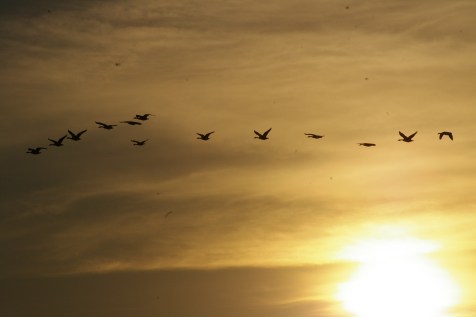
They stand strong like church steeples. The thick brown branches reach up, shirts off, muscles taut, every bone exposed, wrestling, bent at the elbows, visible like some skeleton x-ray against a low, gray sky, or a deep dark blue sky, or a snowy dirty white sky, and these trees don’t balk, they don’t flinch. They dare every aspect of deep winter weather. The wind moves through unnoticed, and snow catches crevices and freezes further growth for months. What wonder it is to watch their stern and steady rise, proof of decades, sometimes centuries, dug in for winter, standing guard in forests and backyards, unable for a while to block the sun, bare enough for us to listen at night to the geese. Starlings settle on naked limbs, thousands of starlings like leaves land, rest awhile, then leave, the trees once again alone waiting out winter, as if to say they’ll let winter leave when they’re damn well ready.

I used to think time went by so fast. I remember my dad sitting on the porch in our backyard watching birds outside the screened-in porch. He was a relatively quiet man but loved to watch the birds. One time he and my mom watched a pair of cardinals teach their young one to fly. They watched it fail a few times until it finally took to the air, making it to the nearest branch, not far from the porch. I never had time for that when I lived there. I wonder if my parents, maybe like the cardinals themselves, were both thrilled to see me leave the nest but sad at how fast I found my wings. Now I sit in his chair watching a robin work through the seed on the rail, and I realize it isn’t time that moves too fast—it’s me.birds from my chair 017