This is Part Three of a Five Part Series here at A View.
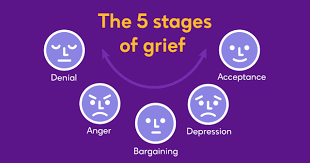
The five stages of grief based upon studies and writings, such as Elizabeth Kubler-Ross’ On Death and Dying, include Denial, Anger, Bargaining, Depression, and Acceptance.
Essentially:
- Denial: A natural reaction to loss, denial can help people slow down the grieving process and avoid feeling overwhelmed. It can also be a way to try to understand what’s happening.
- Anger: A common reaction to the frustration of no longer being able to live in denial, anger can feel like an emotional outlet as people adjust to a new reality. It can also provide temporary structure and a connection to the person who died.
- Bargaining: People may try to change the circumstances that are causing their grief, such as hoping that things will improve if they take certain actions.
- Depression: A stage of grief
- Acceptance: A stage of grief where people find control and figure out how to proceed
PART THREE:
Bargaining:
At the end of The End, an obscure Burt Reynolds movie with Sally Field and Dom Delouise, after spending the entire film trying to die due to his terminal illness, Reynolds finds himself drowning in the ocean and decides he wants to live after all, bargaining with God. “Please God, if you save me, I’ll donate all of what I have to the church!” he screams as he tries to swim to shore. The closer he gets, however, the smaller the percentage. “Really God, save me, and thirty percent of everything…twenty….yes, fifteen percent of everything!”
We’ve all done this. “I’d give anything if…” That’s bargaining. We’d trade our right arm for one more day. Even Willie Nelson would trade all his tomorrows. “Let her live at least until July and I’ll never again…” fill in the blank.
Bargaining is as much a part of living as death. It serves a purpose; that a loved one’s death was not in vain, and how we live our lives can change as the result of that death.
The following diction is all negotiation:
Honestly, I’d give anything to be back in Hechscher State Park on the Great South Bay walking through the trails with Eddie, climbing the now-gone ruins of the old beach cabana along the water. How I’d kill to be back in some small café with Dave at two am having eggs and toast and laughing. One night Dave grew depressed because “even musician George Benson had become violent” he exclaimed as Benson’s song “Give me the knife” blasted from the speakers above us. Dave was so serious and maudlin about it I couldn’t stop laughing. Finally, I explained he was singing, “Give me the night,” to which Dave burst out laughing at himself. Geez. Yeah, give me that night, one more time. Give me one more morning at the radio station, Dave ripping headlines off of the UPI machine to read on air, all the while talking to me about his family in Buffalo. One more time, God, Buddha, whoever. Just once more.
And need I suggest that if I had riches, I’d trade them right now to spend another day walking with Letty to the farmer’s market? One more—damnit—just one more evening watching a Mets game with my dad. I’d head down to the crossroads and negotiate my soul for that one.
But bargaining is more than some ridiculous quid pro quo we try and slip in without anyone noticing, as if it can bring someone back to life, or sometimes bring ourselves back to life. It is how we keep our lives moving forward after someone dies. “From now on I’ll be kinder to people,” we say. “From here on out I’m going to let people know I love them,” we promise ourselves. But do we? So many negotiations are empty.
I don’t think I consciously slipped into the role of negotiator. But I know—I mean I happen to know for a fact—that the morning a high school friend of mine took his own life, he tried calling me in my office, but I didn’t bother answering as I was tired. Give me that moment back, of course. But why? Would that stop his determined mind? Who do I think I am that I entertain the idea that picking up that phone would have kept him out of the garage? But that’s not the point of Stage Three. We say and think those things as a method of imposing control over something we have no control over. It helps us say, quite astutely actually, I can’t save my friend’s life, but I can save mine.
We do that because it allows us to believe in things we would never accept under normal circumstances. If Eddie had left work even twelve seconds later, we would have had lunch that Christmas and reminisced about all those years hiking the trails of Heckscher. And I won’t say it, but until I am seventy I’ll think how I would have done anything to know Dave was dying so I could have taken my guitar to Tampa and sat at his bedside, and we would have sung that damn song about being seventy, just seven years early. It would have been a dream fulfilled that I could have carried with me for both of us. What would I have to do to make that happen? I would do it.
That’s Stage Three. It somehow reminds my subconscious that even though Eddie is gone and Dave is gone, our plans are still here, and their deaths do not necessarily mean my death. Stage three is the bridge from loss to that adjustment we must make to move on without those we love.
The day before Fr. Dan unexpectedly died, my mother had been in the hospital, and it didn’t look good for her. I texted him her condition, and he texted back. A few minutes later he called. He told me he had an appointment the next day but to call that following night and we could talk when he had more time.
When I retrieved my phone after work that next night to do just that, messages came through informing me of Fr. Dan’s death. That brings us to the “if only” part of life, that is bargaining with ourselves. Never again will I put off my friends, never again will I not help a friend who needs my help, never again.
But we do, don’t we? We put them off and we stop helping or even stop calling. As a society we promise we will do better after every damn school shooting, after every war, every natural disaster, we will do better to protect our children and our allies and our neighbors. It makes us feel better about ourselves and what we can do while we are still alive, and it helps us negotiate their deaths as something other than pointless.
I should point out that grief and grieving does not have to be about death, but when it is, it is called bereavement.
Well I’m focusing on bereavement grief, because I’m holding to the notion that if the ones who cause your grief are still alive you are still able to love, to forgive, to move on or even sometimes go back. So, sure we can call that grief the same way my mother used to take a deep sigh and say, “Why do you kids give me so much grief?!” But grief from death is directly related to the finality of the incident. She’s gone. He’s gone. They’re all just gone, dust, ashes floating in the Med, a corpse in some Florida graveyard.
Kris Kristoferson wrote, “I’d trade all my tomorrows for one single yesterday, holding Bobbie’s body next to mine.” Yeah, negotiation, Monday morning quarterbacking.
Regret.
The thing is, there might be no better time for regret than those days surrounding the death of a loved one. Yet people say, falsely I believe, “I have no regrets.” Well, hell, I do. Tons. They keep me sharp, make me evaluate my actions so I can avoid those same mistakes, they remind me to call people who are still alive knowing I regret not calling those who are gone, I’m talking forever gone, stardust, ashes in some Russian picture frame, ashes in some Southern Tier Franciscan Friar cemetery. Gone.
Yes, I cherish my regrets as emotional sticky notes reminding me to keep in touch, sometimes even to wear my heart on my sleeve.
E Ross suggests most of the bargaining taking place is with death itself, negotiating a longer stay in exchange for some vague and inconclusive adjustment to one’s lifestyle. “Just let me live long enough to see my kids be able to take care of themselves” is a good one for several reasons. It is fair to want that, but it leaves off the trade. It is a bargaining with ourselves to explore what is important in life. I don’t care if I die before the next James Bond film comes out, but let me live long enough at least for “this” to occur.
But I need to let Ms. Kubler-Ross speak for herself on this one:
Before a loss, it seems like you will do anything if only your loved one would be spared. “Please God,” you bargain, “I will never be angry at my wife again if you’ll just let her live.” After a loss, bargaining may take the form of a temporary truce. “What if I devote the rest of my life to helping others. Then can I wake up and realize this has all been a bad dream?” We become lost in a maze of “If only…” or “What if…” statements. We want life returned to what it was; we want our loved one restored. We want to go back in time: find the tumor sooner, recognize the illness more quickly, stop the accident from happening…if only, if only, if only. Guilt is often bargaining’s companion. The “if onlys” cause us to find fault in ourselves and what we “think” we could have done differently. We may even bargain with the pain. We will do anything not to feel the pain of this loss. We remain in the past, trying to negotiate our way out of the hurt. People often think of the stages as lasting weeks or months. They forget that the stages are responses to feelings that can last for minutes or hours as we flip in and out of one and then another. We do not enter and leave each individual stage in a linear fashion. We may feel one, then another and back again to the first one.
Right. For example, stirring those memories to write about Stage Three brought me right back to Stage One, denial. I like it there and it seems to have taken to me as well. I’m too rational to not know I can negotiate for decades and never bargain Letty back to life, never compromise Dave back to his wife or Fr. Dan back to be able to call that following night to ask about my mom. It’s not going to happen. I know this, and yet somehow bargaining helps us pretend, like kids playing in the yard, that we can make things alright if we “just do this one thing.”
If only it were that easy, Liz. If only.
One last thought about Eddie A. Radtke, musician, friend. We were rarely apart throughout our youth on Long Island. Then I moved to Virginia—pre cellphone pre computer, pre anything. But we wrote letters, and he would send the want-ads from the NY Times and Newsday for me to give my father along with real estate listing from Great River. Our youthful brains insisted we could make this work. It didn’t, obviously, and we both indicated how we would do anything to erase my move south. Eventually we lost touch. Then after more than forty years, social media brought us back together. It turns out we had everything in common; in particular, music. We spoke on the phone often for a year or more, and then finally we made plans to meet right after the holidays, but one December evening he was struck and killed by a car when he was walking out of work.
I’d give anything to have had the dinner a month earlier, to sit one more time and sing “Cats in the Cradle” together like we did in our youth, laughing at how we used to call each other in early mornings and sing as loud as we could, “There’s got to be a morning after!” from The Poseidon Adventure, and we’d laugh our way down the street to one or the other’s house. Give me that once more.
Seems all I’ve been doing lately is negotiating.
“It’s not too late, not while we’re living. Let’s put our hands out in time”

 a view from this wilderness