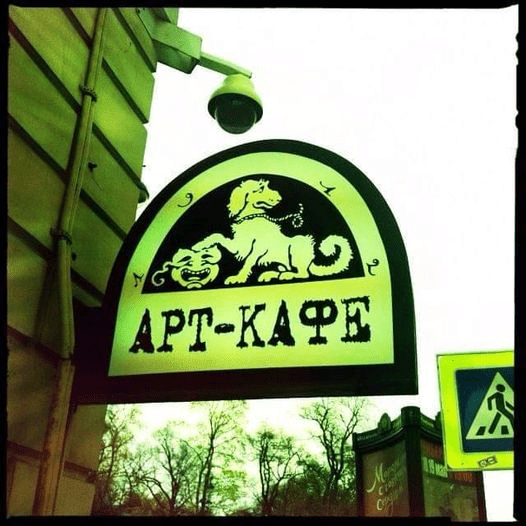
Eleven years ago I read a not-so-subversive piece called “Driving Under the Influence” at St Petersburg, Russia’s, infamous Stray Dog Café, where in earlier years Pasternak had read, and before him Mandelstam, who died in a gulag near Vladivostok for his threatening words, and also Anna Akhmatova, and a string of dissidents who risked their lives so their prose and poetry might be read and heard.
We sat at a long table, and while everyone listened to my innocent story of teaching my son to drive, I imagined the whispers and quiet conversations in those same corners about the Czar, who walked the hallways of the Winter Palace a few hundred yards away. What a world it must have been, I thought, but also, how good those days of revolution and dissidence were in the past. The city in 2013 was alive with artists, writers, photographers, musicians, and mostly legal political opposition to everything, with St Petersburg University students free to protest, complain, object, and support whatever they desired. As a result, no one needed to so much. It’s the greatest value of freedom; when people are free to choose, fighting and uprising recede. The horror of seventy-five years of Soviet oppression, preceded by three centuries of Czarist rule, was finally over.
My Russian friend and photographer Valentine shot pictures of old women, survivors of the siege, and of his children, his “Butterflies,” and laughed through a cloud of vodka, ever ecstatic at being able to express himself in marketplaces, newspapers, and galleries. Full of life and hope, these artists pushed their mediums to the max and shared stories of “darker” times when pointing a camera at anyone meant a possible sentence in Siberia, just east of Irkutsk, not far from the archipelago of dead poets. Not any longer, Valentine told me again and again over shots of Russian Standard and tables of photographs that just a few years earlier he had to hide those photographs inside the lining of books. “You should write here, Bob,” he told me. “You’d be free to write here,” he said. “Those dark days of Soviet Russia are dead.”
That was then.
The truth has once again folded up her tables and left the marketplace; transparency has turned away in shame. The Russia that Valentine came to love for three decades, and the only one I ever knew firsthand, is gone. It is gone. The citizens still attempt to navigate the streets of Peter the Great, the backroads of their “Window to the West,” but they are once again driving under the influence of a Neo-Stalinism, Vladimir Putin’s Fascist Regime.
Russia needs dissidents again. It is a time for poets. The Stray Dog should be crowded again with college students and artists listening to new poets risk everything for a few stanzas of truth. A contemporary Mandelstam, a modern-day Pasternak, should come out of the corners of the university classrooms and set ablaze a bonfire of observations and digressions. Because nothing ignites writers more than the attempt to extinguish truth.

 a view from this wilderness