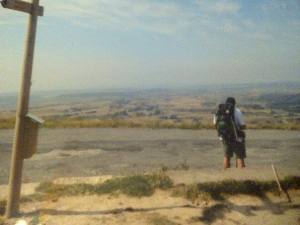

I don’t know the symbolic signs of winter. I see woolly caterpillars and I think that means something, but I also think it doesn’t mean anything at all. They’re just woolly. Squirrels are gathering nuts, but, again, they do that every year and not every year is cold, so who the hell knows? Wayne at the convenience store in the village complained his knee hurt and said that generally happens when it is going to turn cold, and to be honest I trust that forecast more than most others. In fact, that was a few days before the temperatures dropped and the ground this morning was slightly frozen for the first time.
I welcome the changing seasons, but I do so mostly just out of lack of options; healthy options anyway. The cold takes me up north, and it’s easy for my mind to wander for hours through New York’s Southern Tier or the villages of central Massachusetts, walking familiar paths from four decades ago. In my mind I can feel the cold on my neck back then just like I did when I stepped outside today. I can even hear Dan Fogelberg’s haunting version of “In the Bleak Mid-Winter,” or, of course, “Same Old Land Syne,” which played constantly this time of year when I sat at my small kitchen table in the yellow house on the Wachusett Reservoir. The water often froze over, and geese walked to the pools of melt. I’d sit at that table listening to Dan, the bang of the radiator keeping the small place pleasant. Aromas from the cider mill in Sterling drifted down through the village. I didn’t mind winter so much then.
Something about life now is different though. More muted. I used to think it was me and some internal battle I’d dealing with, but lately I think it’s more than that. Some minor key is running behind life these days. Maybe it is the endless chill in the news of the war in Ukraine, the war in Gaza, the death of thousands of innocent people, civil unrest. I don’t know, but it seems as if any longer people simply hate each other. They despise the idea that other people don’t agree with them, don’t think like them, don’t look or act or believe like them. Death is normal, violence is expected, and the anxiety level running through the streets is unprecedented.
Attention spans have quickened to literally minutes on average, TikTok videos have replaced conversations, we no longer need to figure out anything; not finances, not directions, not phone numbers, nothing. We don’t have to contemplate a problem, we just need to find the solution online. We all, all of us everywhere, carry in our pockets electronic devices which use airwaves to transmit and receive, and we’re always on, the Wifi always searching or linked, so that the air between us, above us, everywhere, is always vibrating with transmissions going everywhere from everywhere so that if those transmissions were water we’d drown. The air is always, absolutely always, vibrating with some form of transmission.
This has to be disturbing our minds.
We are angrier than we have ever been in human history. Seems that way, anyway. I can’t speak for the Visigoths or the Tartars. But we have less patience, seek out more revenge, than ever. More people are on blood pressure, anti-anxiety, anti-depressive drugs than ever. More people are being shot, dissed, made fun of, than ever. Candidates are being charged with countless felonies, making fun of others, mocking how they speak and how they look. And the people at large don’t care. It feels an awful lot like people don’t care about anything anymore. I know that’s not true; I mean I see the evidence of hope in my students, in soup kitchens, in playgrounds. But I really have to search it out anymore.
So I wonder if I simply didn’t listen to enough news back then when the Cold War brought us to the brink of nuclear disaster? Was I half asleep?
Maybe. But I also understand something more disturbing which comes from noting the differences in my life now from then and the changes in the hundreds of twenty-year-olds I spend time with now compared to thirty years ago: Contemplation is dying. Thinking is ebbing, replaced by devices that think for us. Gone are the days where people might go for a long walk and daydream, absorb the peacefulness, contemplate the distant reaches of the northern plains, the vast everything that is out there.
Right before the end of the semester I had my students in two different classes do this assignment: Take out a sheet of paper (yes, I brought a stack as only a few people ever have notebooks with them). I wasn’t interested in laptops or cellphones where bells and whistles might distract their already buzzing brains. Everyone had a sheet of paper and a pen. For fifteen minutes I had them sit quietly, look out the window, walk around the room, whatever, but they absolutely could not talk to each other or check any device. Then I asked them to sit and write whatever is on their mind for about 200 words.
After ten minutes of them writing I had to stop them. Some cleared five hundred words using both sides of the paper. One student asked for another sheet. They found philosophy; they found questions they didn’t even know they had. They found a brief period of peace in a whirlwind of a life that never seems to unplug, ever.
My fifteen minutes? I remembered a retreat.
It was early November my freshman year of college and fifteen of us went to a cabin in the mountains of western New York. We had the normal circles of discussions and walks through the woods, and group dinners and breakfasts. We sat around the fire while music played and a guy who had a hearing-impaired sister signed all the music for us, and it made us cry when he signed “The Rose,” by Bette Midler. But at the end of three days there we talked about how we would carry this seemingly new-found peace back to campus, back to the dorm where keg parties disturbed the nights. We wondered how long it would be before we slipped back into the current of keeping up instead of taking the time to push pause, step aside, and contemplate ourselves, each other, life.
We blend too easily, no matter how much we would prefer to somehow rise above the grind of it all. “Back to reality,” we would always say. That has been my primary problem for my entire adult life: I feel obligated to live in a reality I’d simply rather not be a part of at all.
So, as Paul Simon once noted, “My mind wanders; it seems mindless, but it does.”
I’d like to believe I’ve shown my students a little trick to escape their TikTok lives, even briefly. I’d like to believe that fifteen minutes a day doing nothing but watching the geese out on the ice might just have saved my life, shown me there is something more than crosswires and catapults.
Anyway, I went for a walk earlier this morning, and the ground is frozen for the first time this year, and the cold bit at my neck and face. The bay is calm today, and a small, white foam from temps just above freezing formed at the break. It will be warmer tomorrow, and then warmer still, but winter is coming.
I don’t know all the signs of winter, and certainly not the foreshadowing found in nature, but it is coming. My plan to handle the change this time is to take ahold of the narrative. Maybe I’ll walk along the river every morning, bundled against whatever bone-wet cold the wind carries, and look for the peace that might be found in contemplating such a few visceral moments.
It just might be the only way to gain control over how we spend our time, the only way to take control over what we do with our own minds, is to step aside and let them go.

 a view from this wilderness
Thanks, Bob. I hope you don’t think you write into a void. I enjoyed this piece of reflection about reflection or lack of, the cold nature of nature and humans, and the strangeness of our days. I also like what you say about reality. That’s how I always felt when I closed Wordsworth or Byron or Blake and had to rejoin life. (I use past tense sadly, but that’s on me). Take care.
LikeLike