Great River
We had a dog. Sheba. Briefly. She and my mother were terrified of each other.
And a pool in the back on the edge of the woods where honeysuckle grew, and where we built a small fort out of scrap lumber repurposed from building sites down our road. Before the pool went up, my siblings and I had to pick the stones out of the dirt so they wouldn’t rip the liner. In summer we barbecued in the stone fireplace on the patio and swam with visiting cousins. When I smell honeysuckle, I remember that pool. I remember working on the fort with my friend Eddie who told me one night before heading home when the streetlights came on to watch out for lunatics. I said I didn’t know what a lunatic was, but he left. A few minutes later when I walked past the pool, he jumped out and screamed and scared me to death. We laughed and I called him crazy, and he said, “that’s a lunatic.” When I smell honeysuckle, I think of Ed.
We were protected by our parents’ forcefield, and secure in our innocence. But it wasn’t innocence, was it? Everyone was in tune then; the music did that. It kept us informed about what was going
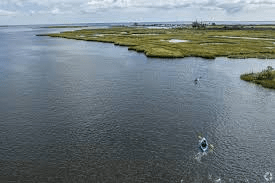
on in the world; in Ohio, in Vietnam, in Watts; indeed, for what it’s worth, the music was a constant reminder that there was something happening somewhere, even if what it was wasn’t exactly clear. We knew all the words, and the words were ours to build with in the woods, or hike with along the Bay, through Timber Point Golf Course, and along the river to the reeds where an old duck blind was our morning refuge.
Geez, we were twelve. When you’re twelve everything is brand new and it’s all yours, and nothing, absolutely nothing isn’t feasible. That was how life was in Great River in the late sixties and early seventies. An idealistic village surrounded on three sides by an arboretum, a state park, and the Great South Bay. The fourth side was the main road, Montauk Highway, but it was so far removed from us we could wander the woods and streets for hours and never consider heading that way. Only at six pm when Walter Cronkite arrived did news like Vietnam sneak into our consciousness.
At home, Watergate remained a presence because my sister was a history major focusing on politics, and she constantly quizzed me about the players. “Who is John Mitchell?” “Who is G. Gordon Liddy?” This wasn’t history though; it was current events during my junior high years. I had no way of knowing that a half dozen years later I’d sit with Liddy alone in an office at college. When I hear about him now, though, I don’t think of our conversation. I think of our kitchen table in Great River and my sister.
Mitchell was the Attorney General.
Dad grilled Italian sausage when family from the city or friends from the old neighborhood came over, like Joe and Rose Fontana. Or when cousins came. They didn’t come too often though, other than those who lived four miles up the road. No one back then would make the drive from Nassau County ALL. THE. WAY. OUT. to the South Shore of Suffolk County. Forget about it. Recently I looked it up. The distance from the inconceivably far reaches of my old neighborhood to the new house in Great River was a pilgrimage of twenty-two miles. Seriously, that’s how far it is now from my house here at Aerie to the first stop light. Back then it might as well have been in Kansas. We weren’t going back.
We never do go back though, do we?
Every Thanksgiving my aunt and grandmother would visit. My dad’s mom would play some piano, and Mom would be in the kitchen making everything you’d imagine she would make on Thanksgiving, while Dad and my brother watched football. Sometimes, especially in the early years in the house, my brother and I would toss the football, or tackle each other, or play whiffle ball. We built the first fort together; an outhouse looking thing. And we played Risk and some sports card/dice game about baseball I can’t remember anymore, but I can picture perfectly. We knew everything—absolutely everything—about baseball. We moved in the same year the Mets moved to first place, and everything in life was working. The Jets were winning; the Rangers and the Knicks were winning. Armstrong walked on the moon. And I learned about the music being played just upstate at the village of Woodstock.
We were one of the first homes on this road, and very quickly other twelve-year-old’s moved in. We’d walk to the deli and the post office. We’d walk to the docks at the Connetquot River. Everything was improving.
That’s just the way it seemed back then.
The way friends came and went, and I don’t remember—I mean I have no recollection at all—of ever being inside unless it rained, and even then. We simply stayed outside. Steve and Todd and I played baseball, and Eddie and I marked every trail of Heckscher State Park. For years we stayed outside, even in winter, bundled to the bay breeze. I loved how we were then. Early in the mornings in spring and fall I could lay in bad and hear the fog horns of the fishing vessels headed out toward Montauk or across to Fire Island.
But it was baseball that dominated my summers. The way we always played in Steve’s backyard, and the fence to the Campbell’s yard was a homer. The way I couldn’t hit to save my life in little league, but there on the property I slammed so many balls over that damn fence I felt like Ed Kranepool or Tommie Agee. The way we never tired and we’d quit mid-day and pick it up at twilight. The way even then I’d walk back up Church Road and through the side door to the kitchen where we always, always, had dinner together when Dad got home. The way Cathy would quiz me. The way Fred would talk about what interested him at school and about his trip to Mexico, or to the camp out past the Hamptons that one summer.
When we prepared to move south, my friends all signed a baseball. Steve Delicati, Todd Long, Craig Long, Camille Villano, Lisa Villano, Frank and Richie and Tom and Paul. And Eddie, who never liked baseball.
When people ask where I’m from, I never know how to answer. New York? Virginia? Deltaville? When they ask where I grew up, though, I say Great River. Because we moved there when I had just
turned nine and we moved out; well, I suppose part of me never did. I can picture every square foot of that house, can name every road in the village, remember the trail that ran along the back of the town to the creek, and remember where the soft spot in the fence was at the arboretum that allowed Eddie and I to explore the old Bayard estate.
Sometimes when I think of that town I imagine if I were to drive the four hundred miles north to the end of the Southern State Parkway, and head down Timber Point Road, make a left on Leeside Drive, and another left onto Church Road, I’d see us all, young, laughing riding monkey-bar bicycles with banana seats, and chasing time like it was never going to end.
That town is in my blood, and just a couple of years ago, Eddie and I made plans to return there to eat at the old Great River Inn, which had become an Italian Restaurant. That was the plan, anyway. Maybe someday I will. I’ll park outside the old house and walk, wonder what happened to the old folks, what happened to my old friends, and I’ll get a table in the back and raise a glass to my childhood, to growing up, to innocence and coming of age. And to Eddie’s memory.
We will always be twelve-years old, Eddie and me.

 a view from this wilderness