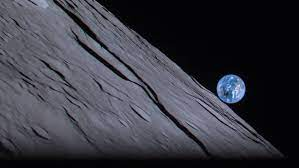
And today I learned that the moon is slowly drifting away from Earth. Like I really needed this with everything else going on. Last week it was one excuse after another from students; this week I picked up a new bottle of an old prescription but instead of it being 50 mg per dose, the pharmacy accidentally gave me 200 mg per dose. Yeah, yesterday sucked. The good news is I survived. Today I learned that the moon won’t.
The truth is we won’t really have to worry about losing our lunar brother. By the time it slips out of this planet’s gravitational hold, the sun will have already swallowed up most of the solar system anyway.
There’s a positive spin for everything.
This reminds me of Woody Allen’s movie Radio Days. The parents of a kid about ten take him to the psychiatrist because he refuses to do his homework. The doctor asks why he won’t do his homework and the kid replies, “I learned in school that the sun is going to die in four billion years.” “So??” the doctor says, and the kid replies, “So what’s the point?”
I know it is extreme, but I get this. I mean, I TOTALLY understand this. Especially yesterday with 150 extra milligrams of drugs in my blood. We put forth great efforts to make some contribution to the world, add our “verse” to the “play,” as Whitman wrote and which I’ve often quoted, yet even the greatest humans in history become footnotes. Friends die, parents, relatives die, or worse, fade away and stop calling or stop returning your calls, which can be even more painful, and you wonder what was it all for. What good amid these people, these trappings of life, am I, to cop another Whitmanism.
Answer: The moon.
The very orb whose drifting I learned about which caused not just a little sadness circles back to play the role of savior. I mean, just look at it, the most common object for all of humanity, the one—and other than the sun, the only—object we all share, stare at, dream about, write poems and prose about since the origins of humanity, the one object we’ve relied upon since humans looked up, save the sun, and even more so, actually, since we often look right into those cold, white crater eyes of the lunar surface but shy away from the retina-burning sun.
At night, at the river, I watch the moon shimmy on the surface of the bay, or catch a gull in flight and watch her wings spread out over the reach of the fullness of the moon. It has stood witness to wars, to famine and plight, to self-destruction and sacrifice, to suicides and celebrations; it has hung peacefully above pilgrims and plane passengers traveling overseas overnight; it illuminated safaris and caravans of refugees, guided Marco Polo, Magellan, my son, now, in Spain, fumbling home to his hotel.
There’s the Wolf Moon, the Worm Moon, the Snow Moon, the Pink Moon. There’s the Flower Moon and the Buck Moon.
In my life I have counted on it, hanging out there over the Great South Bay, over the Allegheny River, hung just above Merton’s Heart, over the Sonoran, the Sahara, the Chesapeake.
There’s a moon over Brooklyn, Anne Murray sang, and it’s coming into view. It was certainly in view the day I was born in Brooklyn, as it was a waxing gibbus, with more than ninety percent of its surface illuminated that July night. The Bob Moon it was called.
The sun on the moon makes a mighty nice light, wrote James Taylor.
She comes more nearer earth than she was wont, and makes men mad, Shakespeare said.
It’s the small step. It’s the giant leap. It’s one of three things with the sun and the truth that Buddha reminds us cannot be hidden.
I walked once, many moons ago, along a mountain path in Norway, and I watched the moon shiver in the wake of the Northern Lights bouncing around my head like lace curtains lifted by a breeze through an open window. I glanced at Brother Moon as an old friend as if to say, “Are you seeing this?” He was.
It’s a harsh mistress.
It’s the friend, Sandburg tells us, all the lonesome can talk to.
It’s made of cheese.
It knows far more secrets than Sister Sun. Of course. People have less to confess in the light of day, which by its sunny nature brings out our hope, pulls from us some sliver of possibility. But the moon catches us at the witching hour, it remains sole witness to our suffering when those tigers come and taunt us, tug at our fears and anxieties that keep us awake. He’s watching; promising us, if we stop crying long enough to notice, that we’ve been this way before, and we will again.
We have been there, to this moon of ours, for it is ours for now. It was simple science. Jim Lovell once noted that we now live in a world where humans have walked on the moon; that it wasn’t a miracle; we just decided to go. I once wanted to go, when I was nine or ten and Neil and Buzz were blemishes on its face. As I grew, I knew I’d never get there, but that was okay. I started to contemplate people instead, and fixated on Merton’s inquiry as to what can we gain by sailing to the moon if we are not able to cross the abyss that separates us from ourselves.
Now I’m depressed again. Time for some moonshine, head outside to talk to some neighbors, and if we drink enough we’ll moon people in passing cars.
But I digress. I’m sorry; sheer lunacy.
***
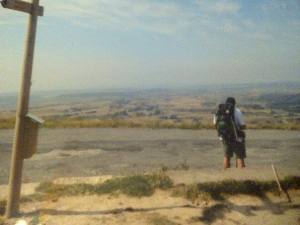
Some years ago my son and I walked across Spain. Sometimes we got up before the sun, like we did in the village of Ponferrada, and followed the moon down a trail west toward Santiago. We talked about breakfast and new friends and old ways. We talked about other places to see and the last village we stayed in. We were that rarest of all things—absolutely and completely present, walking beneath the moon, talking.
We drifted away from the village and the lights and the people ever so slowly, wondering if we remembered everything, but then letting it go, moving away from the city’s gravity and into our own space, just the two of us, knowing full well, as did Lennon, that we all shine on, like the moon and the stars and the sun.
Drift away as you must, Brother Moon. I’m not going to let it bother me tonight. You’ve gotten me through some seriously long nights before, and you certainly will again.
Let’s take it one night at a time, shall we?

 a view from this wilderness