Last night I had dinner with seven other writers at an Italian restaurant (manicotti, meatball, salad with blue cheese dressing, chianti). I never before met the two women on either side of me, or a few of the others for that matter. We talked about weather, of course, and about the food. Where we’re from, what genre we write in (most of these people are poets). The talk turned to “what we’re working on,” and that’s when I ordered the wine. I’m not comfortable talking about what I’m working on unless I, a. know you very well, and even then, b. will change the subject. I’m not alone in this. One of my closest friends for twenty years is a poet and in all of our lunches or dinners through the years we only ever talked about writing when we read together at some event, and even then we don’t. Rick, another very dear friend, was there last night and we sideswipe the writing conversation nearly all the time. We’ll send each other drafts for comments, but don’t really talk about it
I never saw the point. I’m interested in what they’re working on, sure, kinda, but I’d rather really just read the final copy. If they do mention it, I’m really looking for little more than, “A collection about warts” or the like, no details. Peek my interest and step back. And who am I kidding; I’m not going to ask what anyone is working on, particularly people I don’t know. I don’t think it’s rude; I’m more comfortable with my work if it goes from brain to screen without getting blown around in the air between other people. I don’t mind the question; I get it all the time. But my answer will be little more than “some work about teaching,” or “several things going right now,” which doesn’t answer the question at all, which works best.
I find it revealing that the writers I know well also simply don’t really talk about it. We’ll talk about the process, or the stages of publication, or past work (ugh), but what’s on the front burner now is simmering and it’s best not to get too close.
It might be different for poets, or even novelists. But then those monikers right there in the previous sentence explains a lot–they are, in fact, “poets” and “novelists.” I’m neither, and what I do do does not translate to such a label. “Hi, I’m Bob, I’m a non-fictionalist.” Memoirist comes closest, I suppose, but most of my writing is not (my last book and my next book excepted, since both are full-length manuscripts about a certain time and place in my past). I write essays, or observations. A book slated for 2025 is a Sedarisest-style book about teaching; it’s not a memoir, so in that case I could be called an essayist, but that’s not accurate either since, it’s very memoiry, but, well, never mind.
The point is the manicotti. Growing up my mother always pronounced in manigaut (I’m not even sure how to spell this, but assume it is said as might an Italian who doesn’t speak English–without offense to my Italian cousins, and you know who you are). I was old enough to order my own food when I pronounced it that way and some server somewhere looked at me for a minute and replied in all her Virginian perfection, “OH! ManiCATTi!” Okay. Last night I heard a lot of menu items pronounced by the staff in a very non-West Virginian way of saying it, so when I knew I was going to order this dish (avoidance there, thank you), and when our excellent server, Jaimie, asked what I would like, I replied, as might my mother fifty years ago, “Manigaut.” She looked over my shoulder for a few seconds at the menu and replied, “Oh, the manicAtti, excellent.” Sigh.
Do you say what is the proper way to say things or do you say what they simply need to hear, are used to hearing? “I’m working on a piece about being nineteen years old.” “I’m working on a group of short essays, really nearly flash non-fiction, about stages of life, the patience we need when our children are very young and the patience we need when our parents are very old.”
That usually gets an accepting “Sigh. That sounds so good.” But it sucks, so I can’t agree, it might be good later, maybe tomorrow maybe in a dozen years by someone else. And that’s why I don’t talk about it.
Another writer I’m very close to is working on quite an involved work of fiction and is already nearly 100,000 words into it, and does not mind talking about it. But it helps, I believe, that writer clarify all the various aspect of this work, so talking about it somehow sharpens the mind about it. And I truly loved hearing about it.
But that’s not me. I don’t do small talk to begin with, and certainly have more trouble with it when even I don’t know what I’m talking about yet. So I’m more of the grunting type. “What are you working on, Bob?” “A book.” “Nonfictional stuff.” “Being nineteen.”
I was honest and as thorough as I could be. Jaimie returned and asked if I wanted anything else. I was about to order another chianti but hesitated. In America, shouldn’t that be che ante, hitting the ch, instead of the keeantay, pronouncing it as it should be in Italian? And if not, then why are we calling it ManAcotti? It’s Managaut.
It’s foggy across the river and bay this morning, and out on the bridge a heavy mist blanketed the area so that even seeing the sky-blue girders above us was difficult. A foghorn sounded from the mouth of the river, presumably menhaden boats out on the Chesapeake, perhaps an oyster workboat. It’s chilly, but not too bad. That could be a description of my head, but it’s not. It’s outside my head I’m pretty certain.
The view from this desk is only slightly better. The woods are misty, but the fog lifted. I can see pretty deep into the trees, and the skylight above my head is wet.
Sitting before me is a to-do list. I need to record a few art lectures for a university in Ohio, send edits of a piece to a journal, read proposals from capstone writing students in West Virginia, make a topic list for my writing students down in Norfolk, rewrite twenty pages of the monster—twenty pages about a time in my life when absolutely nothing happened, but something should have happened and that is the point of nothing happening, so that the reader will feel like something should have happened all the while nothing happens at all. Wow. That sounds like a metaphor for life. But it’s not. It was life, once.
And I need to send emails to a bunch of people who I was supposed to send emails to a few weeks ago but then college happened. And deadlines. And basic malaise. Luckly, the Kahlua bottle behind me is still full.
Alternate plan: Sail down to the Gulf of Mexico, teach online from the aft cabin, grab the guitar, play someFogelberg and Cat and Van around a beach bonfire with friends and Malibu rum. Forget finally that social mediahad ever been invented. Go back to wondering how everyone is instead of knowing constantly. I miss wondering, I miss “catchingup,” telling stories about things that others don’t know about yet. But we don’t. We value our homes and the lives we built; we asses and measure in terms of security and balance instead of whim and ideals. Of course. It’s called being mature, something I have rarely been, I suppose. I don’t know why; a design flaw, perhaps? Too much daydreaming when I was young? Not enough classical music?
So naturally I’ll need to stick with Plan A for a while. I wonder why, of course. Not enough nerve? Gummies? Too many responsibilities?
First, though, I need to complete a self-evaluation for the college. It’s a once-a-year thing, not difficult, which includes understanding what I did right, what I might change, how I respond to criticism of others, particularly students, what I’m going to include or exclude in the future, and some sort of game plan. It sounds more involved than it is, and it won’t take long. And after thirty five years of these things, I can clearly see how they have helped fine-tune my work.
Yet recently I realized I should have been doing one of these self-evaluations about my life all along. Five pages about the year, perhaps. Five written pages about what worked, what didn’t, what I need to do differently and proposals of how I might get there. This time five pages might not do it; I messed up in some big ways simply by not doing things, which should be part of any evaluation: what didn’t I do that I should or could have?
Do you do this? Maybe schedule a drink with a significant other or close friend next to a fire, talk a bit, then do self-evals with each other. It’s what I like about the assignment: At least a few other people are going to read it, so I need to be clear, concise, constructive. And so the “life-evals” should be too, whether oral or written. In both cases, honesty is essential. In both cases, brevity is dangerous. The college assignment is two or three pages of actual written self-analysis. That’s just short enough to bullshit with the best of them, which is why I believe it should be five pages; then I’d have to come up with some serious details and examples to maintain info about the man in the mirror for that long. Plus my writing is foggy and misty for the first two pages, even in rewrites, but by the time I’m moving into page four, everything is clearer, and you can see even my metaphorical trees far into the woods.
She’s a 41’ Morgan Out Island, spacy aft cabin with a queen size bed, long and wide main cabin with a navigator’s table which converted makes an excellent writing desk, another two cabins up front and two heads, one forward and one aft. The stove is a good size, and the refrigerator holds more than a few bottles of Kahlua.
What would you do?How do you write this into your self-evaluation? Truthfully.
I guess we’re not always so honest with ourselves after all, are we? I need to finish preparing the week’s lectures, send in the rewrites to the journal, and clean up the monster, clarify I wasn’t doing anything when I was hoping to be doing something.
I went into class Monday and asked who had read the only assignment for the day, Kate Chopin’s “The Story of an Hour.” One person out of thirty. I want to be clear about this: the story is barely two pages long. I moved my chair to the center in front, sat, and said, “Okay, let me get the straight:” I had Morgan Freeman’s voice in my head. “You graduated high school, applied to colleges, decided to come here, went through whatever financial mess you had to go through from parents to grants to loans, found out what classes you need, packed your life and moved here, came to class, found out what you needed to do, which, again, was to read a couple of pages, and just didn’t bother. Isn’t that a little like hitting a home run but after you round third, you think ‘Ah, screw it,” and you walk into the dugout without touching home plate?”
“You just got here, and you already gave up.”
I’m not making any of this up. One person out of thirty read a story that is about half the length of this blog post. What do you do with that? They’re nineteen years old, on their own for probably the first time in their lives, living with strangers, trying to figure out from everyone else what their lives will be about, and I asked them to read a story written more than a hundred years ago about a woman who’s glad her husband is dead. But they don’t know that because they haven’t read it. I talked about the symbolism, the setting, and the internal monologue. I sighed.
It already hadn’t been a good day. Or week. Or, well, weeks anyway. I’ve been deep in the rewrites of a manuscript which has been bleeding out of my right ear for more than forty years; I started the damn thing during the first Reagan administration. I’ve abandoned it, tackled it, trashed it, and started over, published portions and rewrote all of it a dozen or more times.
A month ago, just as the winter season had kicked in strong here along the bay and I could see the long, moody haul to next spring, which, for some comes with another set of issues, I knew that I wanted this manuscript, this “monster in a box” as Spading Grey once called a work of his, released into the wild. Hell, there are only two characters, so you’d think it wouldn’t be all the difficult.
I tell my writing students that if you have trouble writing something, write something else. I don’t believe in writer’s block; I think that is the result of trying to drain something of value from something that should be passed on altogether, or at the very least addressed some other time. Sometimes there is a piece missing and you simply don’t know it, so instead you blame “block” or distractions or the story itself for being lame. You have no way of knowing that what it needs has not been born to you yet and in time it will materialize. That has happened with this monster several times. No longer.
About three weeks ago when I had been lifting portions of an introduction from writing by Beryl Markam to use in this work, I realized that the narrative is not about either of the two characters: it’s about being nineteen years old. The one hundred pages turned into one fifty. Then two hundred. It is now roughly two hundred and twenty pages long. It’s not War and Peace, grant you. But it’s at least Peace.
And I just received an endorsement for the manuscript from a very well-respected writer in Oklahoma.
And that’s where it’s at as I continue to tweak, manipulating the middle a bit after hearing back from my long-time writing muse in Ohio. She nailed what is missing in the exact spot something is missing but I couldn’t figure out what. Geez I love when that happens. Writing is decidedly not a solo sport.
So I went into the week feeling pretty good. I made a fun video about art of the renaissance for my art history course, and another about the art of the Islamic world. I had some good conversations with my senior creative writing students about their final projects before graduating, and I felt pretty damned good. Yep.
Then Kate Chopin happened. Mrs. Mallard shows up with her not-dead-after all husband and the joy that kills, only to be abandoned as if the story had never been written to begin with.
They’re nineteen, I reminded myself. You just spent a lot of time writing about how hard it is to be nineteen. Give them a break.
“Okay,” I asked, “You knew the assignment, yet you didn’t do it, so why?”
I got the usual responses.
“Okay,” I said. “How’s this”: I mock-typed on a dead keyboard on the front desk, and said to everyone, “Dear Potential Employer, Graduate Director, Grant Reviewer: He can’t even read a two page story he had a week to complete. Nuff Said.”
Everyone laughed.
“My guess is if I had assigned a novel of some length, you’d have at least started it; but this was too easy to wrap your minds around as a collegiate assignment.”
One guy spoke. “I didn’t even look to know it was only two pages. I would have read it. I just assumed that it would be really freaking long.”
Fair point, I thought.
So I cut them some slack. I talked about the story. Symbolism, setting. We talked about Chopin. We just talked. I explained why I chose the story, and I tried to explain how it is relevant to us for knowing what to look for when we analyze something. I looked at the course outline and saw that they needed to read Baldwin’s “Sonny’s Blues” in two days. Baldwin is one of my favorites.
“What do you guys read? I mean beyond TikTok.”
Crickets. I could hear my officemate on the next floor eating her lunch. They all checked out, mentally gone.
“When I was nineteen one of the books I had to read was All the President’s Men by Bob Woodward and Carl Bernstein about the fall of Nixon and how two reporters from the Washington Post brought him down, exposed what we now know as Watergate. I was a journalism major, so I found it interesting, and it was easy reading, but something else was different when I was your age. What do you think it was?”
Same guy spoke up. “Your story wasn’t about a lady glad her husband is dead?” I suddenly liked this guy.
“It wasn’t, no. But I didn’t know that until I READ THE THING!” We laughed.
I told them:
No computers. No games. No phones, texting, TikTok, Instagram, Starbucks, Redbull, fast food joints everywhere, no fantasy sports, no Fortnight. No Cable TV.”
“Booorrrring.”
I laughed but this time to myself. I didn’t say anything because I didn’t want to continue to sound like an old geezer.
“Yeah, in parts. The whole thing was boring for some people. I think we had less anxiety than you do. Less pressure from all sides to keep up with the latest…”
I tried to think what we might have done when I was that age that we would need “the latest” version of. All I could come up with was music. And that really doesn’t bore many people.
“Okay, Professor,” a student asked. She plays for the basketball team and seems focused, listening to whatever I say. “So then when you were nineteen, what did you spend your time doing?”
I checked out.
I thought of my monster. I remembered being that age and how I had infinitely more energy than could fit in chair long enough to read a two-page story about a wasn’t-on-the-train-after-all husband and the now-dead wife he oppressed.
“Get a reading group together.”
They stared at me.
“Get a group together to meet once or twice a week to read the story. Once the conflict kicks in on the longer ones, you’ll want to finish it. But then you have others to keep your attention instead of your mind wandering wondering what others are doing. And you can take turns reading the story out loud, be expressive.”
“Sound stupid,” said the one I liked briefly but no longer did.
“Yeah, it does, but just meet for an hour. That’s not long.” I replied, thinking of all the times I embarrassed the crap out of myself when I was young. “I’m just some old guy to you,” I said to the same one, laughing so he knew it was okay.
He laughed and said, “Yeah a bit,” and we all laughed.
“You know what?” I stood up, gathered my things, and I thought of the monster and of that time, back then, and what happened and how I carry it still, picture it still like it all happened last Tuesday instead of 1981, and I said, “I did nineteen really well. I was really good at being nineteen. Now I’m doing this age. You’ll get here if you’re lucky.” I looked at the kid. “How are you doing nineteen? Hmmm? You nailing it? or are you trying to slide through without having to do too much?”
After about sixty minutes of this, I left and walked to my car more convinced than ever that it is definitely time to let the monster go.
This work originally appeared in Susurrus Magazine, with portions published in various other journals.
Happy New Year. Sort of. I can’t keep track anymore, what with shifts and adjustments through the ages. Hell, I can’t even keep track of the days of the week. Last Monday was Christmas, which made Tuesday feel like Monday, but my son works on Mondays and Wednesdays so being around all day made Monday feel like Sunday or Thursday, until Wednesday came and it felt like Monday again. Next week I’m certain to go through this once more, with Monday being a holiday, and Tuesday feeling like Monday, and to add to that I’ll still date everything 2023, though, really, what difference does it make?
It’s only time after all.
Time Piece
The truth is, if we made lists of all the reasons why we need to know the days of the week, those lists would not be that long, nor the reasons to remember the year for that matter. It’s all relative, and they can be as irrelevant as they are essential to our lives, existing in the extremes.
No calendar can keep measure of how much time has passed since my father died; I can argue it was a month ago, I can claim it decades ago. And my childhood on Long Island ended about fifty years ago, but when I recently spoke to a friend from then, my adolescence seemed to have happened on Tuesday. No education I can conceive can inform how I feel when I stand on the sand along these beaches in Virginia before dawn, quietly watching the surfacing sun as buffleheads swim by and oyster boats churn out to sea; it is timeless in its immediacy. Einstein’s relativity metaphor aside, nothing says “it depends” more than our references to time—sweet, delicate, ethereal time. Certainly, calendars keep track of the days of the week, the months, but they can never measure moments, they cannot calculate how long we love, how long we have mourned.
Which makes the measurement of time as problematic now as it was in pre-recorded history, when sundials and seasons were used instead of Big Ben and Prague’s Atomic Clock. Still, they managed to mark holidays and celestial changes with the most primitive tools. Some people had that rare ability to look up to the stars, do a double-take, and say, “Shit. I think it’s Friday,” and then things change.
New Year’s Day, for instance, is New Year’s Day for a reason. Since my tenth birthday on a warm Fifth of Quintilis, in 1970, I have wondered why the New Year often starts smack dab in the middle of a blizzard. Simple, actually: First of all, ancient Romans had a God for everything. One of them held the key that unlocked that “passage” between what is and what is to come; or, metaphorically speaking, this particular God was the key master that opened the way for new things to occur.
His name was Janus. He was also the God of doors, by the way, which makes sense. New Year’s used to begin in March, but in 46 BC, the world’s most popular Caesar and favorite orange drink, Julius, decided the calendar needed reform. He was right, actually, as the Roman calendar already in place for six centuries followed the phases of the moon, and that totally screwed with people over time as the seasons seemed to “shift.” Worse, the politicians who oversaw the calendar kept adding or subtracting days to affect the length of their terms one way or the other.
So JC met an astronomer named Sosigenes who convinced him to trash the lunar module and follow the Egyptians’ lead—they followed the sun. To balance it out, JC added sixty-seven days to 46 BC, which put the solar calendar on track, and the first New Year’s Day of the Julian calendar fell on the First of Janus’ month, January. Mr. Sosigenes also instructed that a true “year” around the sun is six hours longer than 365 days, so JC decreed that once every four years an extra day be added.
We know most of this. Let’s leap to the good part.
After JC was killed, his successor, Mark Anthony, changed the name of Quintilis to “July” to honor him. But JC and Professor Sosigenes had miscalculated slightly, so by the end of the first millennium there were seven extra days, fifteen by the time Prague was founded in the fourteenth century. The Czechs were royally confused. And to add to this cluster of cloistered calendar decision makers, a monk, Dionysius Exiguus, figured out in the early 500s that Christ was born about 753 years after the founding of the city of Rome, so he called that year “zero.” Up until then, Roman years from 753 BC forward were numbered from the founding of the city, making what we call 753 BC, they called zero (founding of Rome). So according to Brother Dionysius, Christ was born in 753 Ab Urbe Condita: “after the founding of the city.” The monk decided, conveniently during a time when Christianity was sweeping the empire, to call that year “zero,” but it was not widely adapted until the eighth century just as the Roman Empire was becoming the Holy Roman Empire, so that nearly until the time of Charlemagne, people mostly counted time Ab Urbe Condita. Once more then, what we call 800 A.D., people at the time mostly called it 1553 Ab Urbe Condita, or AUC.
All of this speculation was finally confirmed in the 1740s by Jacques Cassini with his astronomical skills, and it was only then that the Roman years before Brother Dionysius’ declared year “zero” were labeled “Before Christ.” If it wasn’t for Brother D and Dr. Cassini, New Year’s this Janus the 1st would be the year 2774 AUC.
There is more; hang in there.
With all that timeline information, we cut to the 1570s, about the time St. Augustine, Florida, was beginning to flourish. St. Gregory the XIII noted the days were still not accurate based upon both the lunar and the solar measurements, so he hired a Jesuit astronomer named Chris to fix the damn thing once and for all and get the dates aligned with the sun, and he did so by dropping ten days from the calendar for that year only—a realignment, if you will. Thursday, December 21st, 1581, was followed by Friday, January 1st, 1582, the first day of the Gregorian calendar. You know they partied hardy that New Year’s Eve. Honestly, I have awakened on January First with some serious hangovers in my years, but I have never thought, “What the hell happened to the last ten days?”
And while most of the time I’m not really sure what day of the week it is anyway, I do know of one consistency through the ages from 753 BC through some hot summer Quintilis afternoons, and on past zero to today: people from kings and popes to paupers and astronomers made resolutions and promises, and maintained the hope that life would not pass them by. Most certainly, for all of these January Firsts, people resolved to spend more time with those they love, go for more walks in nature, stare at the moon, wake up with the sun, sit and talk to their dad, tell him how much he is loved, how much he is missed, and not one of them could imagine how swiftly life would dissolve.
‘We mark time, humanity; calculate how long it has been, how long it will be. We measure and subtract, add, and subsequently deduce that we know what time it is according to astronomical wizards and Holy Texts. Yet we can’t grasp the speed of the fleeting lives of those we love and lost.’
Now let’s assume you follow the Chinese calendar, which follows the moon, with an extra month every three years, and it dates from 2637 BC, when Emperor Huangdi started counting. This worked for farmers, and the fact the emperor “knew” the astronomical cycles made him a bit other-worldly (with thanks to his astronomers). In the seventeenth century, Jesuits introduced the Gregorian calendar in the east, but the tradition of the Years of the Monkey, Rat, Ox, Tiger, Rabbit, Dragon, Snake, Horse, Goat, Rooster, Dog and Pig continue.
The Hebrew, or Jewish, calendar is the official calendar of Israel and is used throughout the world to determine religious holidays and readings from the Torah. The clock started ticking in 3761 BC, which, according to the Old Testament, is the date of the creation of the world. It is also the oldest calendar in use, dating back to the ninth century BC.
We mark time, humanity; calculate how long it has been, how long it will be. We measure and subtract, add, and subsequently deduce that we know what time it is according to astronomical wizards and Holy Texts. Yet we can’t grasp the speed of the fleeting lives of those we love and lost.
For some years before his death, my dad and I drank scotch. Dad always liked blends to which he probably became accustomed early on. On special occasions he drank Chivas, aged just right. And on Tuesday nights we poured two glasses on the rocks. Routine is important when one pushes ninety years of age, so I’d always try and get there about nine and was no sooner in the door when he’d jokingly say, “My coaster seems to be empty,” or something similar with a laugh and a welcoming smile. I would put down my things and offer to pour, and he would insist he was just fooling and didn’t mind at all getting our drinks, which was true. He would walk in the kitchen, and I could hear the cabinet and the ice and the heavy bottle he put back in the cabinet, never leaving it on the counter for more because we never had more. He’d return steadily and slowly and hand me my glass, and we’d raise them to toast and he’d say, “Well,” nodding his head politely at a loss of words, aphasia setting in some time before those last months, and I’d interrupt and say, “To your health,” to which he would again nod and with his deep voice reply, “And to yours.” Then we watched baseball, not really talking much. It was late. He sipped his scotch.
But I don’t like scotch, so I preferred to pour. When I went in the kitchen everything was the same, but instead of scotch in my glass I had mostly water. Dad’s eyes had faded in those last few years, and he wouldn’t have noticed the lighter tint of my drink. And anyway, it wasn’t about the scotch; we would sit together a long time those Tuesday nights and he would always turn once and say, “Boy this is good, isn’t it?” and I would agree. Sometimes I felt guilty and would pour a bit more for myself as well, but usually only when it was the Chivas. After a while he would head upstairs to bed. Then I would sit alone in peace after a long day, but inevitably I’d wish he had stayed up longer even just to sit quietly. I’d promise myself that the next Tuesday while drinking scotch I’d make more conversation, talk more about the baseball game or about my day or anything really, since he wouldn’t have minded even turning the game off, but the following week would come and, like clockwork, I’d be exhausted and silent and he would get tired and go to bed.
My father aged well and sitting with him on those nights was the purest time I had during those days. When I get home late and stand in the driveway on a clear, cold night, it is too real to think about, and I know Virgil was right when he said that time passes irrevocably. But memory tosses linear time to the wind and leaves us with years which shift positions from our perspective, and we come to understand what Elie Wiesel meant when he said, “In the end, it is all about memory.” Death, perhaps, is the consequence of time, but so is memory, whether that time be linear or ephemeral.
Even before he died, time slipped out of joint those last few months, passing quickly, moving slow. And our calendar certainly needed adjustments along the way. Of his ninety years, I was alive for fifty-five of them. Of those, I was out of his life, physically, for thirty-five of them, and of the rest he worked and I played or went to school.
It was only those last years, the fleeting ones which cannot be calculated by astronomers or priests, when we truly bonded. In the end, I would give anything to add that extra day, set my world right again, realign my time with his.
I wish we could design our own year, like some magical date book we get for Christmas that comes with a special pen, and we sit near the fire, pour some wine, a bowl of gummies. and start with January, marking away at how the year will go. And, whoosh, it just happens.
It used to feel that way, didn’t it?
But lately as I get closer to the New Year, I feel more like a first-time marathoner dragging my tired ass across the finish line. I used to hold that C.S. Lewis wasn’t far off when he said, “There are better things ahead than any we leave behind,” but not so much lately.
I don’t like feeling this way.
It’s the last week of December and the full moon is on its way out with the old year. It is beautiful, and the air is chilly, but still, and quiet, and clear across the river to the north and the bay to the east is nothing but the same peace. The few lights of Windmill Point are faint, and the stars fill the sky despite the bold, recessive moon. It’s hard to imagine anyone anywhere is awake. I am absolutely alone, save some ghosts. It’s not as depressing as Frost’s darkest night of the year; poor guy. No, though too many of us will do anything, as Jung suggested, “to avoid facing their own soul.” But I’ve learned to embrace three a.m. I’ve taken to these internal battles between what I need to get done and what I need to never do again.
I won’t rehash the news here; but we demonstrated this past year just how far below the angels we truly are. The human race has mastered the art of being inhumane. It is hard to get up some mornings, for me anyway. I certainly hope the hostility and sheer madness and genocide of 2023 doesn’t hemorrhage into 2024. Lao Tzu is on a loop in my head: “If we do not change directions, we may end up where we are heading.”One truth is absolute for me: I’ve spent way too much time accepting the things I thought I couldn’t change only to discover later through time and self-analysis that I got it wrong; I totally could have changed it.
So tonight in this indescribable, beautiful stillness of peace, and with a calm soul, I’ve decided this year to open the magical date book and make note of what the next year will be, and what it won’t be. I’ve talked it over with my other selves who tend to gather around this time of late night/early morning, and we all agree—if I work together on this, I can turn things around. It seems time to listen to some long gone old friends still whispering at this hour, telling me to trust myself, and not to forget that we can’t do a damn thing about the world at large; each of us is a constituency of one.
This coming year some of my hopes are based less upon what I want to happen and more focused on what I don’t want to happen anymore. But where in the list of resolutions does one make note of something that won’t ever happen again? Where do you put that on your calendar?
When I was working at a health club in New England, the owner and I talked often about how the most promising members of the club–that is, the ones most likely to stick with it and go the distance–were the ones who came with what we called “a quiet resolve.” We didn’t know what drove them, and they didn’t post signs or make announcements; they didn’t have mini celebrations along the way; they didn’t make it something separate from their life that needed to be tackled or climbed or conquered. If there had been social media then, these driven individuals would not have posted a single word about their accomplishments. They simply came in, did their thing–sometimes a little more each time–wiped off the sweat and went about their business.
That is not a resolution. That is resolve. There is a difference. One is a statement; the other is a way of being.So, the question is do I have the resolve to quietly yet decisively change the things I can? I’m not going for the wisdom to know the difference; not this year. Maybe 2025.
It’s a beautiful late night here along the Chesapeake, and these early morning stars reach beyond my imagination. Perhaps some of us need to forget about that “to do” list we tend to create this time of year, and simply “let the old ways die,” as Jason Isbell noted. That just might be the solution to a lot of issues that wake me up to begin with.
I have spent the better part of the past two days working solidly on a manuscript I started, no kidding, forty years ago. At the time it was just notes in a few journals, thoughts about certain events in the narrative which I would find out much later quite literally changed my perspective, in turn, changing my life. It is for me the quintessential example that sometimes we don’t know the effects in our life until many years later.
How do you work on something that happened so long ago that remembering the events can be concern enough, let alone the details? Well, in this case, I can picture every aspect like it’s playing out before me in some hologram, and once again I’m reliving it. Some things are too real to remember, and writing them down is painful, second only, perhaps, to not writing them down. Often it hurts to let things go.
So I needed a break; I needed to clear my head and stop thinking about travel to distant lands and the dreams I had before I was in a position to follow through. I walked to the river bundled to the bitter cold coming down from the west.Nearly every evening in winter just before dusk bends to night, in those moments after twilight when I have to let my eyes adjust to the lack of light, a few hundred geese land in the pond, some on the river, and a few in the field nearby.
I can hear them for quite some time before they actually fly into sight from beyond the trees to the west. The air is so clear this time of year I can hear them honking in groups, joining in like a chorus which starts with just a few voices and adds another rafter until they reach some crescendo. At first it might be only a flight of a dozen or so based upon the muted sound from the distance. But over the course of five minutes or ten I hear another group, then another, and more. They fly in a “V” to be able to see each other clearly for protection and create just a little draft, but the closer they come to landing, the faster the formation falls apart.
Eventually the first group is already in the pond when the last group crests the bare branches of the oaks and hundreds settle into the field or onto the river. One time some years ago a bit earlier in the evening thousands of geese, no kidding—thousands—landed on the plowed cornfield just down river. Their honking continued for an hour that night, and just as the sounds of these geese slowly softens and, finally, quiets, so did theirs so that from my porch I could tell they had all landed safely.
But every single time awhile after the large group arrives, two or three geese come in late, alone, as if they stopped at another farm over near the bay and had to regroup and find their flock.
I don’t want to disturb them, but I always want to watch. So when I walk along the river at that hour and the skin on my face is tight from the cold, and my nose runs a little, and the muscles in my back are also tight from the cold, I keep my hands thrust into the pockets of my coat and walk along the soft shoulder of the tiny dead end street so that my feet make no noise. I can usually get to the narrow strip of sand at the river from where I can see both it and the pond, but not the field so well. Their call increases in a burst of warnings to the rest that I’m around. It quiets quickly though as I remain absolutely still and sit on the cold rip rap running along the river and blend into the rocks and am no longer a threat.
On winter nights the water is almost always calm, a slow methodic lap at the rocks and sand. The sky is all stars, and sometimes just after dark in January you can still find the center of the Milky Way in the southwest. With no unnatural lights for more than twenty-miles in any direction except from the scattered farmhouses or buoys, the sky is a carpet of constellations.
It isn’t by chance my Canada friends find respite here. They need grass for food, they need water, and they need to be able to see great distances to anticipate danger. That’s why they’re here on the edge of the bay with open fields and ponds. It also explains why they love airports and golf courses. The abundance of geese isn’t an accident either; they travel in gangs, often the younger geese are forced into the gang, so that traveling is safer and they can better dominate areas like this.
But their coolest trait is their honk. They keep that up as a form of encouragement so the lead geese will maintain their speed and not give out so easily. Basically, the ones in the back are telling the ones up front to “Go! Go! Go! Go!” and move their asses. And when the lead gets tired, she moves to the back and gets to badger the others for a while. And they do this their whole lives—about twenty-seven years.
And just after twilight when dusk is making its brief appearance, and the water is like a mirror, the call of the geese from well across the treetops is musical, somehow eternal. When this land was unbroken, Canada geese called to each other, rushing for the open fields and waterways, settling down here. Powhatan heard geese here, and John Smith, and Washington just to the north at his birthplace on the Potomac, and Jefferson not far from there. Through the centuries the flyway from the St. Lawrence down across the Adirondacks and Catskills to the Susquehanna south into Virginia to the mouths of these five fair rivers spilling into the Chesapeake has been their home.
And they love dusk, just before dark, as it is the best time of day for them to recalibrate their internal magnetic compass to cross continents; to come here year after year.
We have something in common; we’re both very migratory.
I guess that’s what also attracts me to the passing flocks of geese. The peace in such sounds late on a winter’s evening definitely touches my soul, settles me somehow beyond my ability to explain. But also I sit on the rip rap and blend into the rocks and watch them in the water and contemplate their distance from the central regions of Ontario and Quebec, across Hudson Bay. My entire life I’ve been drawn to migration, to some sense of movement from one place to another, particularly the seeming randomness of such order. They know where they are going every time, and yet they move south without boundaries, schedules, or maps.
When I was young my father bought me Robin Lee Graham’s The Boy Who Sailed Around the World Alone. It was the first book I remember inciting in me a sense of adventure, travel and exploration. The sea seemed to have no borders or barriers. Graham’s goal was circumnavigation, but his schedule was wide open. Peter Jenkins, too, in his A Walk Across America, knew where he would end up, he just didn’t know when or how; and along the way the adventure was in the places he paused for food and water, with an open view of life around him. Ironically, I like the consistency of this migration; the predictable return, surrounded by friends, a quiet night.
I suppose all dreams are migratory, both in hopeful destinations and their transience with the changes in our responsibilities and circumstances. At times I take flight, abandon my flock and push off for awhile. But I look forward to coming home to settle into some sense of domesticity, which I can accommodate briefly at best, because eventually I think about the dreams of my youth as I fly toward my twilight years. They call to me to “Go Go Go Go” as my life moves further along, pushing at the edges of dusk.
And now in winter when night falls completely I walk back to the house and always a few more geese find their way to the flock long after dark. Only once did I experience the return to the sky of so many all at once. I was walking from the river to the house past the field where hundreds that evening had settled, and either something or me or the ground disturbed them, or it was simply time to move on, but in great waves they took off, honking. I heard them calling, waves of them into the sky, honking, great waves of honking geese calling ahead to the ones already in flight, as those behind fell in line and they swept from horizon to horizon blocking out the moon and headed out over the trees running down the bay, and I stood and watched them until the last honking geese were gone.
And everything was silent and I found myself, oddly, alone, like a young man left on the sand while his friends all pushed off to sea to head for distant lands, never to return.
I write mostly personal essays or memoirs, so my work bends toward the lengthy; it isn’t unusual for an essay to run fifteen pages. When I started doing public readings, it took about twenty minutes or more to read one piece, but this was not an issue as I would either read alone or with someone else who would do all their work at once and then I’d do mine, block style.
But then my dear friend, poet Tim Seibles, suggested we read together, that is, on stage at the same time, alternating pieces. We did a series of twelve readings for roughly two-hundred people each time at the now defunct Jewish Mother in Virginia Beach, Virginia. The Jewish Mother Sessions forced me to write short pieces so that when we alternated on stage, he didn’t read a four-minute poem followed by me reading a thirty minute essay; we’d have been there all night.
So I took fragments of long pieces, and then I started to write dedicated short work a la Kate Chopin’s “The Story of an Hour.” I’m not a poet, but I threw a couple of lame attempts in there as well later in the evening after the crowd had been drinking a while. As a writer, I loved the exercise of telling a story, or more often just a piece of story, in a flash. Hence, “Flash non-fiction” entered my world, and since then many were collected in my book, Fragments: Flash Non-Fiction.
The individual pieces had been picked up by some journals, including Kestrel, Matador, Sand, and more. I wrote about animal names, about health conditions, about 911 and art. A few pieces got some legs, like “Instructions for Walking with an Old Man at the Mall,” originally written for our readings, picked up by Kestrel, reprinted in Fragments, and then anthologized several times. This piece, “Small Talk,” is one of my favorites for self-explanatory reasons. I’m certainly more comfortable after a glass of cab in front of a few hundred people who have had several gin and tonics than I am in front of a small camera in a small space. But as my mother says in a phrase she is convinced she coined, “It is what it is.”
I learned from Tim to STFU and just read. So, here, from my office at Old Dominion University a few years ago, is “Small Talk.” Thank you for tolerating my face and voice for a few minutes.
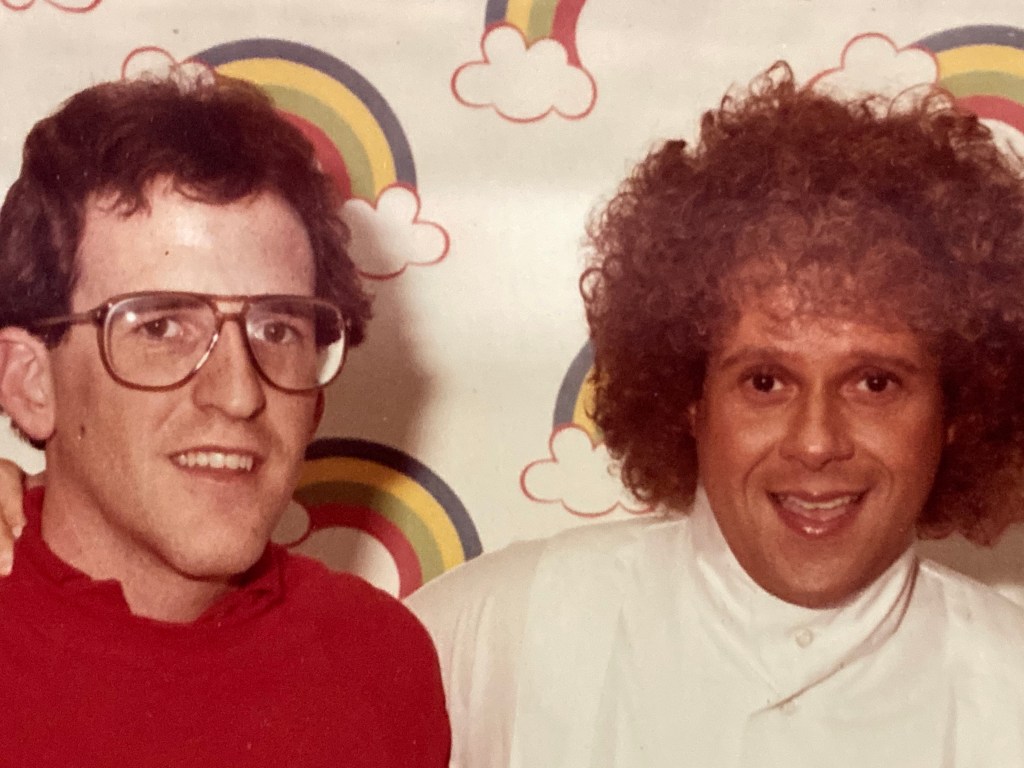
I suppose when I worked at the hotel when I was young, I could go home and leave work at work. It wasn’t my hotel, after all. Certainly, I’d get calls at various times since I was manager, but not often since the owner was often on site. And when I worked for Richard Simmons, it was a similar situation. As manager, I’d get calls at home if there was a significant problem, like when the other manager, Andrea, slammed her finger in a metal door and couldn’t work for several weeks. But overall, when I went home, work stayed at the studio.
This was less true as a college professor. Certainly before computers and cellphones I was able to compartmentalize my papers into office-hours work, and if I planned things well, I could get everything done for my normal eighteen teaching hours at one college, twelve more at the university, each semester. It was an insane schedule I maintained for almost three decades, including summers. But the luxury of making my own schedule, remaining primarily responsible for when things were due, allowed me to keep some sort of retentive check on everything, so, once again, when I was home, so was my mind. Sure, there were times the stack of essays followed me to my porch, sat down next to me, and would not stop babbling until I finished them. But mostly not.
Yet I have another occupation, one which chose me, therefore I cannot simply quit, lay down some sort of guidelines, and go about my business. As a writer, my mind does not clock out, ever. I have many writer friends who can do that, but I simply can’t and I’m not sure why. It might be one of several conditions, or it could be one of several medicines, or perhaps it is simply my inexplicable need to describe and highlight the miraculous beauty of life juxtaposed with the insistently rapid pace of life. But I cannot turn off my mind. I see narratives and characters, I hear stories and elements of distress, and the dynamic moments of everyday life can be overwhelming.
I actually and literally feel completely better when I’ve written something. The fact is this very blog started as an effort to relieve my mind. I know Van Gogh was like this as well, and Hemingway, and Jake the plumber at the hotel who could not rest if there was a pipe that could be fitted just a bit better, but after a solid attempt, even if he fell short, he could rest. Vincent wrote often about how his mind is eased either by absinthe or a good day of painting. My poison is nature and a few moments of trying to say something right.
But I remember fondly the days when I’d go home from the club and absolutely nothing felt undone or needed to be reworked. I could watch a football game and have some drinks with friends and never once glance at a somber face and need to make notes. That’s gone. Maybe that’s why I’m always searching for some peace of mind.
I was in a local store earlier and someone said to someone else, “No I haven’t been able to find him. I’ll call later.” That’s it. But that was enough and for the past three hours my mind has been beating the hell out of a piece I’ve been working on for far too long. This morning my son mentioned he might make biscuits today, and “process” stayed with me like a bad song that won’t leave your mind, and I either need to write things down or dive into some waves, let the cold ocean saltwater wash across me and make me present.
Nature can do that for me, more than anything else, really, make me present. A few months ago I was hiking the mountains in Utah and found myself nowhere else. Nowhere. I wasn’t writing in my mind, I wasn’t rewriting, or making notes. I was hiking. Yesterday I sat at the bay legs in the water to my calves and I watched two egrets fish for dinner. When I walked away I knew I’d spend time with them again late at night on these pages, finding that peace again on the page that I found on the bay. But at that moment, it was just me and them, kin.
I haven’t had a day off since I started working on a book about Van Gogh more than thirty years ago. Wine helps, though more often it can just fuel the flames. Lollipops certainly help. But my mind is growing tired lately. I’m always writing, even when I don’t mean to be. Still, I’ve come to terms with that. My friend Linda used to tell me, “Don’t die with the music in you.” This keeps me going. As long as I have some endless swirl of vocabulary beating at the exits of my mind, I should be fine. Maybe I never needed medicine to begin with. Just a notebook.
Painters see colors and perspective even when walking their dogs. Musicians hear that quartertone in the cardinal’s call, and writers, well, we keep indenting and backspacing, even when trying to eat a bowl of fruit loops.
I teach a sophomore level critical thinking and writing class—basic argumentative writing and research. It is one of my preferred courses since my specialty other than writing is research, and in these days where the Fourth Estate is more often dissed than referenced, I like to show the students the path toward accuracy.
The other course on my schedule right now is basic Freshman Comp, which unlike many of my colleagues in the past thirty-three years at three colleges, I truly enjoy teaching. Of course, I start the course by explaining it might be the most boring course they are going to take, but I quickly justify it by adding it is also the most important because of writing being the communication skill most necessary to succeed to college.
This semester on the first day I planned to give my standard lectures for the first day, about the psychology of writing, the motivational tools necessary for even the most advanced writers, and the steps necessary to get through the brainstorming stage to rough draft. I was going to remind them to stop treating me like a professor who “has” to read the paper and think of me like an editor who “may or may not” read the paper, and their writing will improve immediately.
I had the normal three-decade-old bag of tricks.
I arrived early and watched students walk in quietly, masked, heads down, silent. We had about five minutes. Out of nineteen students, one said hello. The rest sat looking down, some at phones, most at the laps, like schoolchildren waiting to be told what to do.
I asked how they were doing. Nothing.
I asked one person directly how she liked ODU so far. Fine.
I asked another what his major is. Shrug. Undecided? I guess, he said.
Back Story: Over the course of thirty years I’ve seen classroom chatter pre-lecture go from boisterous to casually friendly to non-existent. This, of course, is in direct proportion to the introduction of technology, but I have also noted that even without the phones or laptops—for example, this class, where only one student was looking at his phone—the concept of communication with unknown peers seemed non-existent, as if they have spent their entire lives only communicating by text, and, yes, they have.
It isn’t a matter of poor social skills; these are today’s social skills. Since most of these students are freshman, asking them to put the phone away, or indicating that they should be taking notes, generally receives a positive response. But any question is answered with as few words and as little eye contact as possible. This has been slowly coming on for some years now. In early spring of 2020, it was a bit easier to get them to respond with more than a grunt or a monosyllabic answer, but then Covid came and extracted whatever scattering of manners was left when gathering among others.
I asked one young woman where she was from. NOVA. What town? Alexandria. Why did you choose ODU? There are some great schools up there and in DC. Shrug.
I asked one whom I know is an athlete with absence accommodations what his major is. Mechanical engineering. What made you choose that? Shrug.
Time came to start class. I stood up and they sat up, the one put his phone away, a few took out notebooks, but most did not—people stopped taking notes some time ago, expecting me to post them on Blackboard (a program to communicate with students).
Well, we are here to learn to separate accurate and verifiable information from the tons of crap that cover it up, distract you, trick you into believing what they have to say is true and real and essential when it is simply, well, crap. We’re going to learn to know who the true experts are and who present themselves as experts but are simply loud personalities. And then we’re going to learn how to write about it. Let’s start with this: How many people here would rather class be online during this Omicron surge and return to face to face when it settles down?
Nothing.
I asked the athlete. Shrug.
I asked the woman from NOVA. Shrug.
What the fuck are you people doing here???!!! I thought.
What am I doing here?!?! I thought further.
I sighed, pulled my chair to the front center of the classroom, and sat down. Outside, a full-grown magnolia stood in all its majesty, reaching against the windows on this second floor, and in the distance a deep blue sky. I wondered if the herons and buffleheads were at the river. I thought about how the cold feels on my neck when walking on trails. Or the heat.
I thought about Spain.
I smiled at a woman in the front row who accidentally made eye contact. I asked and she said she is from Fredericksburg. She decided on here instead of Mary Washington University in her hometown, but it seemed too much of a subject to approach at the moment. A crow landed on the magnolia then took off. I could see this but none of the students could. I wondered if the classroom had been reversed with the windows behind me instead of them, would they still have not seen it.
“So…” I said…
If you weren’t in college, where would you be right now? I mean, I know it is hard to say, but use your imagination, be idealistic for a moment and imagine you left high school and instead of college you and a friend decided to….what?
And one guy mentioned probably the military.
And another said working for his father who owns a store in Richmond.
I said I’d take off. Get a job in Florida or Martinique or Ireland for the summer—tend bar, wait tables, not make up my mind about what the next sixty years it going to be like while my head is still spinning from high school where I was still friends with the same people I knew before my voice changed. They laughed, some sat up.
Then this:
Guy in the back row said he wanted to drive across the country and live with his brother in San Diego but his father insisted on college. Another said she is the first one in her family to go to college and she wants to make them proud. Another said he had nothing better to do so might as well work toward something instead of wasting time wasting time. People laughed. I nodded toward him and said, “You’re going to do well.” He thought I was joking, so I said it again. “Really.”
We talked for a half an hour, laughing, I told a few quick stories about college, a few about classes I had taught in the past, my first one as a professor and how terrified I was, almost the same age as my students, having no clue as to what the hell I was talking about.
They talked about their decisions about going to college, about their majors, about being away fromhome for the first time. We talked about the impending football game that night for the National Championship; we talked about social media, we talked about which place was best to eat in the neighboring Ghent area of Norfolk , which lead to some funny conversations about types of food.
We agreed we eat out too much, we drink too much coffee, we don’t spend enough time outside, and we are too attached to technology. Even the Computer Science major said this.
I stood up and wrote on the board: What has it been like to be in college so far? 500 words.
I don’t want you to do this, I said, but if I did ask you to, could you?
All said yes.
I mean, you’ve been speaking English for almost two decades now; certainly you can string some thoughts together about this, right? They laughed and agreed.
Then I said, “If you did this but I said the five people whose work really caught my attention will automatically get A’s on their first essay, would you do a bit better? They laughed—we were used to laughing now which made answering questions in front of others so much easier—and agreed theywould. Then this—I’ve written about this before in this blog and in the Chronicle of Higher Education, but it works so I use it when I can, but the timing must be right or they’ll call BS on me, and the timing was just right: Okay, if you guys, that includes you I said to the one who preferred pizza from 711 over the good pizza place in town, and everyone laughed, if you guys were to do this assignment but I had told you the top five get a thousand dollars each right on the spot, would your work be better?
They all laughed almost in unison and responded in various degrees of “hell yeah!”
I sat back down. The crow came back to the magnolia, and I thought about the crows at home and how they often keep the hawks away but not the eagles, and not the finches who despite their size have got some serious food-gathering game. The crow lifted and left again.
“So look at you now,” I said. They remained silent. “You just admitted it to me.”
They shrugged.
“You always could do better. You just couldn’t be bothered.”
Maybe if I paid you, then you’d put more of an effort in. Otherwise, whatever. You just presented to me the proof of why you aren’t doing as well as you could be—you can, you just admitted it—you just don’t bother.
I get it, I told them. In my example, the reward is clear, is obvious, and is immediate. But in a freshman college class the reward is vague, distant, and seemingly irrelevant, but in this class in particular, it’s worth way more than the grand you were going to work for. We are so caught up on immediate satisfaction and reward we have lost the art of sacrificing now for benefits later.
A couple of people still knew who Billy Joel is so I told them how when asked what it was like growing up he said the worst part was the piano lessons, how he could never understand why his mother made him practice three hours a day while his friends were outside playing. Then he was asked what was the best part of growing up back then, and he said the piano lessons and how his mother made him practice three hours a day.
We talked more about football and pizza.
Don’t come here because it is “required,” I told them. Don’t show up next time because you don’t want to lose points for being absent. Come because you just met some new people to hang out with, new voices to listen to and talk at. Come because I am going to constantly remind you that being here is worth way more than you know right now, and I need you to trust me. Come because that crow keeps coming back to the magnolia and I can’t figure out why.
And everyone turned around and laughed and we spent the last few minutes speculating about what the bird could possibly be doing out there.