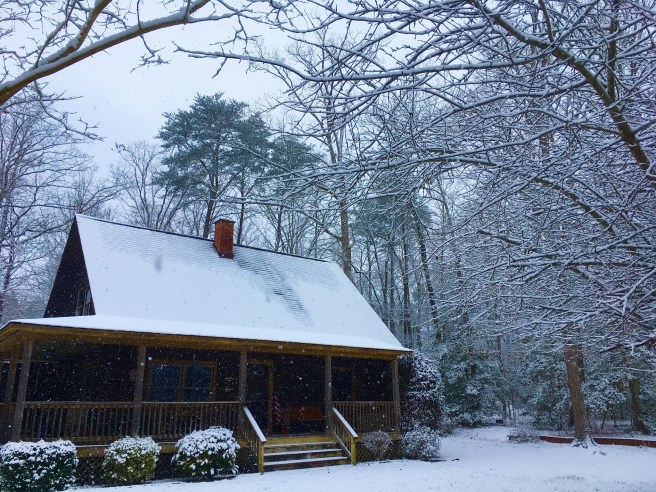
I found an old silver key while cleaning my closet floor. For years it might have been there shoved in the corner under the lip of a log, fallen perhaps from pants pockets or my winter coat. I don’t recall losing a key or changing a doorknob. Perhaps it opens some old lock on the old all-glass door on the side porch. At the start back then strangers would meander down the winding driveway through the woods to the house and cup their hands against the reflections on the door windows to look around. I replaced that door with a solid one and put a no-trespassing sign up front.
Older, I think; the place in Wellsville, Pennsylvania, where I came home one July morning to find plants and flowers in the entrance and at the top of the stairs for my birthday. It was the first place I lived where I gave someone else a key. Or it might be from my first house in New England, where the door stuck in winter when the frame froze. I’d spend hours shoveling my steps and those of the old woman across the street who delivered mail. She’d bring apple pie for my efforts or leave one for me with Sam at the Deacon’s Bench antique store.
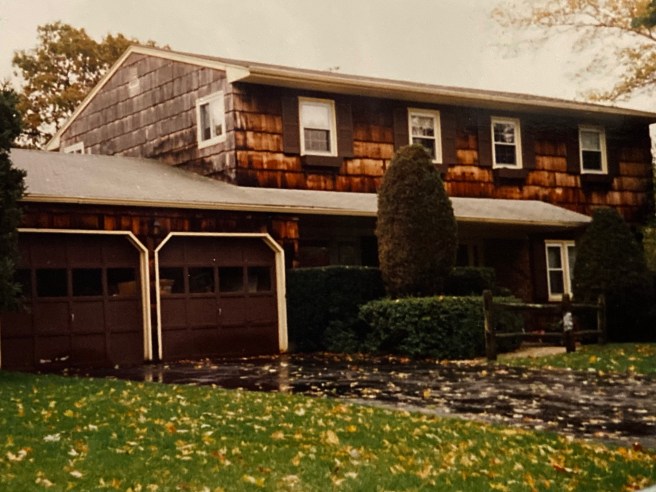
But that key was gold. Now I think this one some souvenir from my childhood home on Church Road, the two-story colonial where I owned my own first house key though I never needed it since after playing ball or riding bikes all day along the Great South Bay, I’d run in the back door full stride and laugh the way childhood makes you laugh for no reason at all.
I can’t recall now what this silver key might be for, though I’ll keep it, resist the urge to throw it away as evidence shows I clearly resisted before. After all, it still opens doors to places I never thought I’d return.
Every semester about the second week of classes I pull my chair into the center of the room and ask them how college is going so far. I ask what it’s like, the challenges and changes. It takes little imagination to guess the various yet typical answers, which tend to start with generalizations, such as “Going great. Love it,” and as I push for details they become more specific, such as the food in the dining hall or the dorm noise they’re not used to.
It’s a writing class so I keep the conversation casual but at times relate their responses back to essay development, demonstrating the combination necessary of personal experience and universal understanding. Eventually everyone enjoys this day’s discussion and contributes, laughs, argues, agrees. They start swapping stories about roommate issues and the volume of music while trying to sleep.
This happened Tuesday.
I won’t digress into the inane concept that they’ve been here for three weeks and most couldn’t tell me the names of more than three people, or how when I ask them what they do when not in class they say, “Nothing.” They go to the dining hall or the food court, then back to their room to log on. Getting this much information from them has become increasingly difficult. The student body as a whole has grown quieter, more introverted. Some of it is technology, some of it the fact these are Covid Kids, moving through middle and part of high school isolated at home. Part of it is being a freshman at college without any preparation or clue as to what to say when a professor asks these types of questions.
But I did and they answered, and it grew better as they talked and laughed and swapped stories about floormates. It was loud and active, and it felt good, it seemed classic, like a class out of my early career when a lack of cellphones and laptops forced everyone to talk to each other.
But one young quiet woman mumbled to herself when I asked how they felt when they got here. No one else noticed or heard as they were already involved in the group conversation, but I noticed. Quietly I asked her what she said so she could repeat it to me and not the class or she already would have, but she just said, “Nothing. Forget it.”
“Seriously,” I said. “I’m just curious, that’s all.”
She stared at me for a long ten seconds and said, “I’m terrified.” I nodded to her. She put her head back and I could see her eyes welling up. “I’m just fucking terrified!” she said louder, and the room quieted down. She ran her hand through her hair, sat up, and shrugged us off. “Forget it, just forget it.”
We were quiet just long enough for her to talk again. “I’m just terrified. I don’t know anyone and when I try and meet them they shrug me off. They do that to everyone. Everyone does it. I don’ t know how psycho these people are! I try and meet them but they never come out of their room! I’ve never been lonelier surrounded by so many people!“
One compassionate classmate, whether she meant it or not, said, “I feel the same way. Every single night.”
The first one said she can’t keep calling home. She said her advisor said to her, “You must have some idea of what you want to major in; what you want to do with your life.” Her voice broke at the end of it, and she moved like she was going to add more, but she just looked out the window, her eyes red and swollen.Then to herself, she said, What I want to do with my life?! Are you serious!?
The others contributed the expected comments: They also don’t know what they want to do, and they also call home way too much, but something about this girl told me something the others couldn’t possibly know: I was her.
I fell into a hole first semester freshman year. My roommate and I got along fine and I got heavily involved in music and the radio station and the newspaper. I kept busy, but at night in the dorms it was like a barracks and I simply did not fit in. I wasn’t terrified of anyone or anything in particular, but I was absolutely terrified I simply made a bad choice about what was the most important decision of my life to that point.
So I said that. I said one of the scariest things I have ever known, and it has happened on several occasions, is the absolute terror that I made a bad decision and there was no way out of it.
She sat up and stared right at me, then said, “Everyone in my life either wants answers to these huge questions or they want to be left alone completely. No one just wants to get a cup of coffee and sit quietly. She cried fiercely now, and several others became emotional.
“I think,” I said, “there is nothing more difficult to do in life, nothing more challenging…nothing more…misunderstood, than moving out on your own for the first time surrounded by total strangers and then having the authority figures nearby demanding answers you simply do not have. It’s absolutely insane and often unbearable for anyone.”
I pushed. “Let’s break this down.”
“If you’re not sure what you want in life, what are you doing here?”
She wants to be a nurse.
“You could have gone elsewhere.”
This school with its sister nursing school is the best.
“You could have waited until you had better perspective.
I don’t want to wait.
“Geez, you have a lot of answers for someone who doesn’t know.”
She laughed. It’s just at night, she said. She gets scared at night. She wakes up in the middle of the night with desperately bad panic attacks.
“I do too,” said one of the others.
Really?
“Yes, I’ve already called my mom more than a few times at three am.”
Her mom would kill her, she replies.
I walked to the front of the room and everyone straightened their desks. One girl finally asked the other’s name. It was the first time in several years I have heard someone ask someone else their name. She asked if she wanted to go get coffee after class, and they did.
I said, “Well, anyway, that’s what it’s like to be in college I suppose.” And we all laughed.
I added one thing: “What terrifies me is the student who isn’t scared. That scares the crap out of me. To move through like everything is just right and never think about it, never feel in your gut the questions about what you should be doing? That’s terrifying. Waking up at three am in a panic that I’ve made all the wrong decisions is exactly what I want to happen; not some complacent, mindless acceptance of the status quo. I need those emotional checks and balances. I just don’t want them to derail me.”
They didn’t move. They just sat though I was halfway to the door. So I stopped. “Here’s a quote for your Discussion Page musings: It is from a man named Denys Finch Hatton. “I don’t want to wake up one day at the end of somebody else’s life.”
They left talking to each other. I love when they leave still talking to each other.
Tim and I had lunch a few days ago and talked about Salt Cay and the donkeys. About the heat and the isolation, which is for some of us a chance to breathe. We talked seriously about some friends we’ve lost, and then we laughed about what it costs to die. There are few things the two of us do not laugh about. Sometimes irreverence keeps us sane.
Not for nothing but for many years I had a map in my office of a bike route from Williamsburg, Virginia, to Coos Bay, Oregon, Sixteen-year-old Bob was going to do that ride but never did. I kept the map though. It is good to have something slightly out of touch to think about. Some sliver of purpose to sift through.
Anyway, today I called Dee and we talked long about Fr. Dan, about what happened, and about one person’s ability—his—to influence so many through time and space and his presence never seems diluted, not at all. She isn’t feeling well, though, Covid, and her already devastated immune system laid her up for a while, but she’s feeling better than she had been, coughing less she told me. I told her that’s the Italian in her, and she laughed. She has a great laugh that her mom and dad cherished. She sent a picture of herself with Timmy—a 17-year-old cat—and neither looked healthy at all. The eyes. You can tell.
The bay was a lake this morning. The river ran fast. The sun bust its ass to get above the low clouds out over the Eastern Shore this morning, and tonight it settled behind a new bank of storms hovering over the Piedmont. It’s muggy; like rain is coming. Like it did that summer with Isabel. Tim said he was told that sometimes when a storm blows through down there, a stream forms right through the middle of the tiny Island, splitting it in two.
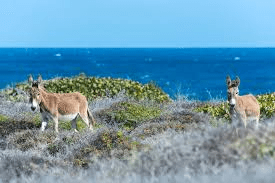
I told Tim I’d like to spend a month at Salt Cay. With the donkeys and the small bar the size of a Jeep Cherokee, and boat the forty-five minutes to Grand Turk for food. A full month. I feel phrases simmering already and I haven’t even had drinks with the locals yet. But someday. The donkeys wander in the yard to chew on the cactus-like leaves, sometimes two or three, sometimes eight or nine, wild donkeys just grazing the cay.
When I look out across the bay to the Eastern Shore in the morning, I often think of my friend Sheri who has a place in Cape Charles which is right there but for fifteen miles of water, but she’s mostly in South Carolina now. But I think of her and how we’d laugh in the halls at the college. I had her sign one of her books once I found at a used book shop for a quarter and in the book she signed, “I can’t believe you got this for a quarter!” I thought of that this morning and about talking in the hallway and how that might have been three books ago, but the current keeps moving, doesn’t it? The current keeps moving.
Tim said the two of them stood out; like there were just the forty-something residents of the Cay and them, and I told him the trick is to stay long enough that you disappear into the landscape, and they stop seeing you as new and maybe even start wondering how long you’re going to stay, which can lead to conversations, which lead to friendships, which is why I want to go but not for a week like them, but for a month. Long enough to name the donkeys.
There are geese on the river tonight, a small flock. They’ve been around for a few weeks but for some reason tonight they felt more present, as if I realized that now that’s happening, and I remembered a post by my cousin Jack just the other day who wrote, “The Geese are heading South; summer is over.” I suppose. He lives just a dozen or so miles from Dee but they don’t know each other. Doesn’t it sometimes feel now like everyone you know knows everyone else you know? Facebook probably caused that. I once wrote a post that my friend Sean responded to which Kay responded to, and then Eddie laughed at that and commented in kind to which Mike made some hysterical retort. None of these people have ever met. None live in the same state, and none are even from the same periods of my life, but right there in one post—one picture—people from all my decades were conversing like we all met at a bar and swapped a few jokes while drinking a few beers. It lasted only a few comments, but it neatly tied up my entire existence right there next to the HIMS ad.
Yesterday my Facebook memory suggested a post of a sunrise I had taken some years ago, and of the six people who made a comment on the picture, five of them are dead. Time is out of joint. All my Bobs are floating on the surface when I really think I’d be better off if the old Bobs would just sink again, disappear again out to sea, drift over to Cape Charles, and let just one of me land a small Cessna on Salt Cay, flaps down, flying south before it gets too cold, just the one of me.
We had Princess Anne sandwiches, which are vegetarian, both Tim and me, and we talked about current projects, which we rarely do, but we also talked about the growing sense of urgency to get things out, to not die with some unpublished works still buzzing our brains at three am. We’re not popular enough for posthumous work, we decided, so everything is going to have to be moribundus at best.
Go ahead, look it up. It means “near death.” Perhaps a book of essays someday about all the people I have loved who left too soon. “Moribundus” by Bob Kunzinger, with an introduction by TS, still chasing donkeys on Salt Cay.
Dee’s voice was weak but way stronger than a few week ago. I have great admiration for people who fight. They take the “it is what it is” concept and push back on it. I hope I’m like that. I know I haven’t been.Part of that is I’ve been lucky, but a bigger part of it is I’m kind of disturbed. I’ve accepted that. Anyone who wants to spend a month on Salt Cay with donkeys has issues that even the poets won’t touch.
Anyway.
This morning at the Bay I almost called a friend of mine I hadn’t spoken to in long time but didn’t. I had no idea what to say. “What’s new?” he’d ask. “Not a lot,” I’d say, which is desperately pathetic when you think about it. It’s not like I saw him this morning; it’s been years. “How about you?” Nothing he’d say, maybe mention a new grandkid. We’d be silent for a minute with a few “it’s so great to hear your voice” comments, until I broke some silence with “Oh, I’m thinking of living with goats.” I like that I know he’d understand.
Listen: I have had one bad fucking month. Two months really. But you know what I remember? You know what surfaces when I let my consciousness stream over the days and weeks? A couple of calls from some old friends, from some people excessively important to me to just talk and laugh, to talk about music, about cats, about the sound geese make at dusk, about farms in Indiana and bears in Utah and Iowa’s Mississippi; about the beaches of Alligator Point and the long reach into the Great Lake out off of the North Coast. I like that that’s what I remember, because at night when it’s quiet, at three am when the tigers come and start gnawing on my stomach and sit their ass on my chest, It helps to know I might talk to someone again tomorrow.
I can tell them about the donkeys of Salt Cay and my plans to know them. Or about Coos Bay and how I can’t believe I was ever sixteen years old. It’s just not possible.
I was nineteen, Dave Szymanski eighteen, and Fr. Dan Riley thirty-six years old. I met Dave because I simply met him; I’m not sure where or when but we were both J majors and worked for both the campus newspaper and radio station, WSBU, 88.3 FM. I met Fr. Dan when just weeks into my freshman year I caught the Russian flu and ended up in the infirmary, and he’d come by every evening and sit bedside and we’d talk; instant friends.
Early that fall we started a radio show. Dave and Fr. Dan were hosts and I was the producer and engineer. “Inscape” aired every Saturday morning for an hour, with open discussion about spiritual matters, a deeper conversation with a new guest each week, and a musical artist for interludes. The guests included Fr. Mathias Doyle, college president, Charles Osgood, CBS newsman and St. Bonaventure favorite, author Fr. Roy Gasnick, an expert on St. Francis of Assisi, and Fr. Irenaeus Herscher, campus librarian and archivist, close friend of the late Thomas Merton, and namesake of what would become Mt. Irenaeus (yes, named after the good priest, not the saint himself).
One fall day in 1979, Fr. Dan and I met early for breakfast at Mary’s in Allegany, and we walked in the chilly air for an hour and talked about hopes and fears, about friendships and families, and we continued that conversation consistently until July 23rd, 2024—two days ago, and the day before he died. We talked, we texted, we emailed, snail mailed, shared writing—he sent copies of my book Penance to a dozen friends of his, I sent copies of his book Franciscan Lectio to a dozen friends of mine. I have piles of letters from Dan spanning four decades. We consulted each other. When Dave died a few months ago, his widow asked me to call Fr. Dan. When he answered the phone before I could speak, he said, “Bobby! I’m glad you called! I don’t like you anymore and I don’t want to be friends with you!” and despite his eighty-one-year-old frailty, he laughed the laugh he is known for by tens of thousands of students across five decades. He added, “Brother Kevin is sitting right here, and I want to tell him something. Kevin, it’s Bob. We don’t like him anymore,” and they both laughed. Then I said, “I’m not calling you for a good reason” and he slipped right into Franciscan-priest mode, his voice going deeper and more serious, and I gave him the news of Dave’s death. For some time we remembered those innocent days in the Fall of ’79.
Jimmy Carter was president, the Iranian hostage crisis (kids, watch Argo to understand) was underway, and Inscape—a Merton term for escaping within—was on the air, and one of our early guests was Fr. Irenaeus, the featured music was from James Taylor. The theme music for the radio show which lasted for two years was by Dan’s fellow Rochester native, Chuck Mangione’s “Hills Where the Lord Hides.” Reference: This was forty-five years ago this fall. Dan, Dave, and I with a dozen others were about to go on a retreat to a place called “Vic’s Cabin,” and it would be the first of many retreats in various mountain areas over the next four years while he looked for a permanent location for spiritual retreats for students.
On that show, the three of them talked about retreats as Fr. Irenaeus spoke softly and with such kindness about how his friend Fr. Louis—Thomas Merton—thought retreats were essential to the human soul, and the same of St. Francis. He said he personally believed a true retreat, however, was about community as well, where people can be alone, yet with others, in silent prayer but in living gospel. Fr. Dan smiled wide, his brown mustache stretching to his ears, him nodding, repeating, “Yes, exactly.” After the show we walked Fr. Irenaeus back to the friary. A few days later he was hospitalized for several months and died not long after that. Fr. Dan and I walked back to the dorm we both lived in and sat in his apartment on the fourth floor and talked about the retreat scheduled for early November.
I graduated. I moved about: Arizona, Massachusetts, Pennsylvania, all the while exchanging letters with Fr. Dan, and in early May of 1989 I drove to what had become Mt. Irenaeus near West Clarksville, New York, to spend the weekend talking to him, helping out around the two-hundred or so acres. Construction on the Holy Peace Chapel had begun, but only the frame was standing at that time, and Dan and I worked on a small stone edging of a path to run through the woods to the chapel entrance. It was in the upper sixties and we laughed and talked for hours, noting the beautiful spring day and the budding trees. On Saturday morning I woke to his bellowing laughter and walked into the small hallway of the original house of peace for the mountain. He walked me to the door and pointed—it had snowed six inches overnight.
Everyone left over the course of the next few hours, but I stayed by his insistence to enjoy the weekend and write—I did, and the journal by my side now is called “These Days: The Weekend Alone at Mt. Irenaeus” but I’ve never published it. Still, I noted many of our conversations from the previous day, including Dan’s fear the Mount would become too big to handle; too popular to remain personal.
No one was there and they had not stocked the pantry yet except for cereal, so I spent the next two days eating Captain Crunch and walking through the pines in snow, surrounded by absolute peace, taking advantage of the chance to inscape.
But everyone who knew him, which was everyone who went to St. Bonaventure University since the mid-seventies, has stories about time with Fr. Dan Riley. The first time I met his family, they kept calling him Billy (Fr. Dan’s birth name is William) and I joked “I’m going to start calling you Fr Billy from now on,” and he quipped—with his dark eyes peering across his glasses at me to demonstrate his seriousness, “No. You’re not.”
When my son had a solo show of his abstract art at the Quick Center for the Arts on campus, Fr. Dan let Michael know his old friend, Tony Bannon, former director of the George Eastman Museum of Photography and the oldest photography museum in the world, thought Michael’s work was one of the best and most unique catalogs of photography he had ever seen. Fr. Dan seemed so proud, and so energetic about all people and the moments we shared. Not long ago on the phone he recalled how he enjoyed telling Michael what Tony had said.
But listen, everyone who knew him has stories. It is what raises Fr. Dan up from the status of “friend” to the realm of mentor, truly, without equal, the seeming recurrence of St. Francis of Assisi himself in virtually every way, for Fr. Dan’s influence on students, community, and faculty of the university helped him almost single-handedly, like Francis, rebuild the church in the hearts and souls of us all.
Late one night a couple of years ago he and I sat in the House of Peace drinking Baileys and he nodded toward a poster on the cabinet entering the kitchen. It says, “Ending World Hunger Starts Here: Please Don’t Waste Food.” “I remember when you had those posters made,” he told me, “and when you started the World Hunger Committee on campus your sophomore year.”
“Yes,” I said. “I told one of the Wintermantels—I think Dan—what I wanted it to look like and we made thirty of them. I’m glad one survived to be here at the mountain.”
“Whenever I look at that or think of the outreach programs for the hungry, I think of you,” he told me, and I realized how far I had strayed from those days. It was then I understood why Dan and the mountain remained a place that I needed to return to from time to time to understand who I am at the core.
***
My mother is very ill as I write this, and a few days ago we learned we would be setting her up with Hospice care, and I texted Fr. Dan. He called me and we talked awhile, laughing of course, and he said he would pray for her, naturally. I told him I had a reading up North the end of September and planned to come by the mountain to visit if he would be there.
He said, “Yes, Bobby, I’ll be here. I’ll always be here for you.” When I hung up, I received this text: “I certainly will be remembering your mother in prayer. Probably Kevin is coming by and I’ll ask him to have the community hold her in prayers as well. Your memory of her certainly will bring you comfort even though eventually when someone you love dies there is great pain. Peace, and all good my dearest friend. Dan.”
Yes, memories bring comfort despite the great pain. I wonder often why we lose our innocence to such a damaging degree that we need to go back to find it. At retreats back then–particularly that first one at Vic’s Cabin, we talked about how to carry that peace with us instead of looking for it out in the world. One night not long later I was depressed for what could have been a dozen reasons, and I wandered to Dan’s room where three of four guys were hanging out talking, and I joined them. Eventually, they left, and I told Fr. Dan how much better I felt just sitting and talking, and I wondered why. Dan smiled and said. “Bobby. You brought the peace with you this time.”
Amen.
I imagine now Dan is off in the hills where the Lord hides.
At Mt. Irenaeus the day we worked on the path to the chapel
At Mt Irenaeus House of Peace the night we drank Baileys and remembered
The poster at Mt Irenaeus, originally hung in the campus ministry in 1980.
I found the streets of Nogales, Mexico, on Google Earth, or whatever one lets you watch it live, now, immediately. The streets are crowded these days, and the crossing is packed with people trying to walk or drive through to Nogales, Arizona. I’ve crossed that border at exactly that spot dozens of times, albeit forty years ago. Yes, there were migrants wishing to make it to the United States back then; after all, we invited them. We put up a big lady who literally said to come here, and we pushed our excellence in the marketplace every chance we could. If you build a huge ice cream shop and flash it in front of everyone who has no ice cream at all, a line will form; mayhem will follow. Either feed the poor souls or take down the “Give us your poor” statue.
Anyway. Nogales.
I used to eat at a small café there called La Caverna. They served cold Tecate and a burrito with jalapeno sauce and salad. One afternoon after lunch while standing on the dusty Mexican village street, an old man approached me. “You want to buy some blankets?” he asked in Spanish. His face was sun-carved and his thin frame as prickly as the saguaro cactus at the edge of town.
“How much?” I asked, knowing I only had about twenty dollars left.
“Two dollars,” he said. Now my Spanish was pretty decent, but I still stopped to figure if he meant two, or twelve, or twenty-two.
“How much?”
“Dos. Solamente dos mi amigo.” I agreed and he walked me down a few streets and a few back alleys. I was nervous, anticipating being jumped by younger, athletic guys who would steal my wallet, my car keys. Instead, we approached a small shed and Diego unlocked a padlock and opened the door. Stacked from floor to ceiling and throughout the 12×14 or so room were blankets of every color, with just enough room to step in and then crawl up the mounds to look for different kinds.
I looked at my twenty. “I’ll take ten,” I said, and left for my apartment in Tucson with my arms full. At this now-famous border, the guard asked if I had purchased anything. I had just graduated from college, drove a small Chevy, and hadn’t cut my hair or shaved in some time. The odds were high I had bought at least a few ounces of something illegal, though I hadn’t.
“Just those blankets,” I said, motioning to the back seat.
“How many?”
“Ten.”
He stared at me then let me go. I brought them to my Tucson apartment noting the unusually cold weather. A neighbor called to me, “Good thinking; it might be cold at the game tomorrow.” We lived across from the University of Arizona. He helped me carry the blankets inside and asked how much I paid.
“Twenty dollars,” I said. He thought I meant each.
“I’ll give you twenty-five.”
“Sure.” He gave me the cash and chose a green blanket with tan stripes. Very Mexican. “Hey, my buddy Paul will want one,” he said. “Can you sell another?”
I decided I could sell all of them and before night I’d done just that, pocketing two hundred and fifty dollars. The following week I went back, had lunch and found Diego. We backed my car up to his shack and loaded one hundred blankets.
Mexico then had a simplicity to it that seems to have been hijacked by drug cartels and border crashers. Not that these things were absent in the early eighties, but they certainly weren’t covered as closely by media, and the impact on people like me just bouncing around Mexico was nearly non-existent. Back then people who lived in southern Mexico, Guatemala and Nicaragua certainly knew of the promise of a better life in America–in particular for those pressured by the rising drug cartels and street gangs, but the lure was not as present. There was no internet to push them, not social media or other methods of communicating for Coyotes to build a small human-smuggling empire upon. The vast majority of migrants traveled in small groups and weren’t scrutinized by media–which had only just reached the now-antiquated level of “Cable TV.” Surveillance cameras were non-existent. Commentary on American radio stations or by political operatives was minimal at best. It was simply easier. I could train to Mazatlán, hitch to villages, and even drive my car deep into the interior without worry. Even when someone did approach me, whether to sell me something, check out what I had, or simply seek a ride North, the only consequence was time, and a few times I made friendships which lasted a little while anyway.
At the border, a different patrolman approached my car.“About one hundred,” I said somewhat nervously, even though I cut my hair and shaved.
“Then you’ll have to pay taxes,” he said, not moving away from the car.
“But they’re for my family.” He smiled. “I have a big family,” I added. We both laughed.
He stared at me. “Open the trunk.” Very colorful, really, all that wool shoved into every corner of the Chevy. “Sometimes college students will distract us by buying a lot of one thing and smuggling something else. Like drugs.” This was true: More than ninety-three million cars crossed the border between the US and Mexico that year and not all carried blankets.
I laughed. “Oh hell, I hadn’t thought of that.” He smiled but I don’t think he believed me.
“Why buy one hundred blankets?”
I thought about my answer the way I think when I’m pulled over for a ticket and the cop hasn’t reached my window yet. What angle should I take? I gave in completely. “Look, I’m broke,” I said. “These cost me two dollars each and I can sell them for twenty-five bucks each at the UA game this weekend.”
He looked at me awhile, then back at the car, pulling up a few floor mats. He didn’t seem to be concentrating, though, and then I found out why. “I need ten,” he said.
He wanted a bribe. El Duh. “That’s a two-hundred-fifty dollar loss,” I said.
“No, that’s a twenty-dollar loss.”
“Cost, yes. But not profit. I mean, the taxes can’t be that high.”
“No, they’re not,” he said. “But the paperwork can take forever to finish.”
I stared at another agent ripping the panels off of some guy’s car doors.
“Ten blankets,” he repeated.
“Done.” He chose ten blankets. I got back in the car and he carried the blankets to the office where he put the “confiscated” goods and returned. “Next time, buy one hundred and ten blankets, Si?”
“Si, gracias,” I said, and started to drive off, but stopped. I backed up and he came to my window.
“When do you work?” I asked. I wrote his schedule on a napkin in black marker and in no time at all we became friends. That winter I made a ton of money and made a few good friends just south of the border. Decades later, I still have a few blankets. For me they represent time and place. Going to Mexico meant more than crossing into another culture; when I hear the word “blanket,” I sense the dust of a quiet road and the taste of cold Tecate, I hear the rough tones of Diego’s voice. It turns out there is a thin line between what we buy and where we’ve been. Souvenirs are more akin to snapshots than presents. They are narratives and conversations; they are moments, not mementos. And I learned more about where I am from by crossing the border than had I stayed home, like what true “need” is, the value of simplicity, and the restlessness that comes with a desire to improve. I had never thought about what it “takes” to grow, to improve my life; at home we didn’t really need to do more than keep moving forward. But in Mexican villages I witnessed first hand the work ethic and determination which makes improvement possible to begin with.
And really, once I saw the line someone else drew in the sand, how could I not cross it?I made a dozen or more trips for the sole purpose of buying blankets. By the last one in January of ’84 I was picking out ten blankets myself for the guard and simply handing them to him before driving on. During one of my last trips to Mexico I wasn’t going for the blankets. The line through the automobile gates was long, so I parked and walked across the border, ate one more lunch at La Caverna, bought some Kahlua and talked to Diego for a while. I brought him a University of Arizona Wildcats sweatshirt and we talked a long time. It was only then I learned his family actually lived in Mexico City. He had come to the border to try and make it to Tucson and work, and would send for his family later. He got as far as the border, like so many do, especially today, who make it to the southern edge of the United States, and no further. I asked him what will he do since he had been selling blankets at that point for a few years. “I’ll head back to Mexico City this summer,” he told me. The following year was one of the worst Earthquakes in history, virtually destroying a large portion of Mexico City. I thought of Diego then, and his family. I think of him when I open my trunk where I keep one of the blankets–it is indigo blue with tan and red stripes and has been everywhere with me for four decades now.
I walked to the turnstile gates that last time, nodding to my agent friend, who waved not knowing I’d never be back. I stood in the short line and wondered if I would have what it takes to leave absolutely everything I know–all of it–at a time when contact was primitive and I would perhaps never talk to or ever see my friends and family again, so that my life, and that of my kids and descendants would be better. For all of our wealth and their poverty, I learned that for the most part, my friends in Mexico, and those I only passed crossing the border one way or the other, value life itself much more than we do. I did carry some of that north with me.
Aerie is surrounded by farms worked by mostly migrant workers who speak little English. On more than one occasion while waiting to buy coffee in the early summer morning at 711, I’ve translated the order of a frustrated worker from Mexico living for the season in Deltaville. Inevitably, the conversation moves outside, and they ask how I know Mexico, and I tell them about my time there, back when “Coyotes” were animals. I tell them that I can recall quite clearly sitting on the porch of a café there, sipping beer and watching people walk by, and the faces of those heading north for the first time were alive and filled with promise. And just beyond them, through the gates on the other side of a few guards, was the literal line in the sand, and what I always saw as the southern border of my own country, they all knew as the front edge of hope.
In the beginning. That which doesn’t kill us makes us stronger. To be or not to be—that one just six letters. Jesus wept—seven.
It is what it is—six.
I can’t write, my students say; my mother said; my very own demons say when something needs to be said but I’m at a loss for words. The history of English has turned and spun back on itself, argued with endings and double negatives, trampled meaning, treasured nuances, made murderers of us all, and unearthed muses to slipknot a string of letters, tie together thoughts like popcorn for a Christmas tree, individual kernels only able to dangle dutifully due to one common thread.
I do. Rest in Peace. Go to Hell. I quit. I miss you; I love you—7 letters both.
The alphabet was not alphabetical at first, made that way in the 1300’s on Syria’s northern coast. Today, we slaughter its beauty with a cacophony of sounds whose aesthetic value is lost in translation while simultaneously softening hardened hearts with poetry and prose for the ages. For nearly a millennium this alphabet. whose letters lay the way for understanding in multiple languages, has dictated decrees, is uttered by infants one syllable at a time until by age five they’ve mastered the twenty-six consonants and vowels. What circles of wonder are children’s faces when someone’s tongue pushes out “toy” “treat” “your mommy’s here” “your daddy’s home.”
Plato said, “Wise men talk because they have something to say, fools because they have to say something”; Socrates said, “False words are not only evil in themselves, but they infect the soul with evil.” The sins of our fathers forever condemn us to hell but for confession, penance, and absolution.
Forgive me father for I have sinned—14 letters.
Of all the languages on the planet, English has the largest vocabulary at more than 800,000 words, all from those same 26 symbols.
There are roughly forty-five thousand spoken languages in the world, about 4500 written today but almost half of them are spoken by less than a thousand people. English, though, is the most common second language on Earth—translated or original, the Magna Carter, The Declaration, The Bible, the Koran, the Torah, the tablets tossed by Moses and a death certificate all reassembled versions of the twenty-six.
I have a dream—eight letters.
Ask not what your country can do for you; ask what you can do for your country—fourteen.
We the People–seven
Teeter-totter—four.
Mooo—two.
Billowy is one of only a few seven letter words whose six letters remain alphabetical. Spoon-feed is the longest, at nine letters, whose seven letters are reverse-alphabetical.
We can talk, us English. We can spin a yarn, chew the fat, beat the gums, flap the lips. We have the gift of gab, we run off with the mouth, we can spit it out, shoot the breeze, talk someone’s ears off, or just talk shop, talk turkey, talk until we’re blue in the face, be the talk of the town. We can, for certain, at just seven letters, bullshit.
My point (7 letters) is that (3 letters) sometimes, despite our skills (4 letters) with the English language (6 letters), we are often left, at just six letters, speechless.
What are the odds on a planet of nearly eight billion, the vast majority of us would comprehend each other because of twenty-six characters, small symbols.
The first time we meet we say hello (four). And then we love (four). And all too soon later, with the misery of six letters, “Goodbye.”
And because eight characters is simply too much sometimes; sometimes too painful, we knock it down to three with RIP.
Some of this I’ve written before, But some is new. I’ve started to write letters again. Emails, yes, but real letters as well on actual paper. I sit at one of the tables here at Aerie and cover my iced tea from flies, find the spot where the shade hits the table and place my pad down, and write. I write about my garden, about the bay, about travel plans or family matters, depending upon who I’m writing. I don’t write about writing. I try not to write about anything negative, and I never have written and never will write about politics in a letter.
When I was young I wrote a lot of letters. On summer vacation from college I wrote friends in other parts of the country, and even after college kept a close written communication going with a few people. One is a woman I’ve known since we were freshmen, and another is a priest who I remained very close to through the years. I still have some of those replies, and some I recently sent back so my friend can see what was on her mind forty years ago. I wrote probably several hundred letters to someone I obviously cared very much about to write that many words who joined the air force back in the 80s. Listen: here’s how far we have come since then: At that time I would have to address the OUTSIDE of the envelope with her full name, followed by her full social security number—right there on the front of the envelope. I still remember it, actually. The former maintenance crew who emptied the trash at Lackland Airforce Base probably does as well.
Letters used to be the sole source of communication. Vincent van Gogh wrote more than two thousand pages of his thoughts to his brother Theo, a sister, as well as fellow artists. Thomas Jefferson and John Adams letters to each other famously expose the thoughts of our forefathers, and even as far back as the early Christian era we have Paul’s letters to the Corinthians. I just want to write some stuff about my garden and mail it in an envelope to my friends. Thought I’m tempted to write a large group like Paul did: Letters to the Czechs perhaps. Or the New York Mets.
I learn so much when I write letters. Simply by telling other people what I’m doing, I’m reminding myself how I spend my time. It also allows me to sit in nature, slow down, and take my world one word at a time. In an age that is spinning at Mach 6, writing is like sitting on a stage coach, but that’s okay. Remember those days when we would anticipate mail from a friend? It seems like a long time ago now, but I recall the satisfaction of dropping a thick envelope into a mailbox, or opening mine to see that marvelous white rectangle of someone thinking about me.
My sister found letters our dad wrote to his mother when he was eighteen. When I was in college my Great Uncle Charlie, who was in his early nineties at the time, wrote me letters and often included poems he wrote. This was a man who fought in France during World War One. And when I was in my late teens he was still writing letters and poems and dropping them in his local postal box. I don’t know what happened to those; I moved around so much. Also lost are letters from my childhood friends on the south shore of Long Island. During the first year or so after my exodus, we wrote religiously. I am back in touch with a few of those people from that time, but I wish I still had those epistles of what we were like then, our hopes, our plans, our fears, and our indescribable confidence which time has eroded along with our penmanship skills. My closest friend from then has since died, as have several other close friends through the years, and those letters would have brought their voices to life. When I read a letter I don’t simply look at it, I listen to it as well.
I know the problems in resurrecting such an ancient art form: besides the “slowness” of letter writing, there is the “I don’t really know what to write about” aspect my mother used all the time when I was away at school. Then there’s the “I don’t have time” factor which is just a crock. Sitting down to do anything for ten minutes is not an Olympic feat. And can we please just stop with the “it’s just easier to email” laments. Yes, it is. Write anyway. My favorite avoidance mantra is “I think faster than I write and I can’t slow down to do it.” Geez if you don’t think faster than you write than you’re probably legally brain dead. As Neil Diamond wrote, “Slow it down. Take your time and you’ll find that your time has new meaning.”
As for the upside, it helps me remember what is important in life that I want to write about it, and it reminds me that since I spend the vast amount of my time doing things I don’t deem worthy of including in a letter, I should appreciate the small stuff through the day as much as the grand letter-worthy events. It really does slow me down, helps with my blood pressure, my stress, and sometimes I might sit back while writing a letter to listen to the wrens or the cardinals, or leave it all on the table and wade in the river a bit before returning to finish. Mostly though, it is instigating a physical presence in another’s life in a completely non-threatening way; it is my DNA sealed and sent to another state.
I wish I had written back and forth with my father, or kept in written contact with some friends from Spain. I’d love to have heard from my grandparents, or to read a collection of letters from ancestors from another land. They are treasures; they are history, humanity, emotion and time, all in one stroke of a pen.
Despite the losses of valuable letters from loved ones through the years, I still have some I cherish. I have a few from Leo Buscaglia, a few from Martin Sheen, and one from Michele Obama. I have some from friends in Germany, Russia, and various other distant places. When I was young I remember my brother had a pen-pal in Germany. I would love to start a correspondence with someone far away, someone I’ve never met. According to the data page of WordPress, this blog has roughly 2000 unique weekly readers in twenty one countries including India, Japan, and Australia. If anyone is reading this, drop me a line, hand-written, to PO Box 70, Deltaville, VA 23043. I will reply, Promise.
I’ll even stick a leaf in the envelope to send along a small piece of Aerie. It really is peaceful here; a place to write home about.
Always,
Bob
writing a letter to my father while in the dining car of a train in eastern Siberia
Those brief piano notes that start “Scenes from an Italian Restaurant.”
How “Bob” and “Mom” sound so much alike in a busy mall.
A drink being poured over ice in a glass.
Ice in a glass.
An oboe coming in high, one note falling in slowly like silver rain, fading away and handing the note off to a French horn.
The way my friend Zhora stood on the rocks of the Gulf of Finland and played his flute for us, the Beethoven notes slipping off across the water under a midnight sun. The whispers of everyone about his playing. Champagne.
A few days ago, chickadees hatched in the birdhouse near the woods. When I am at my desk upstairs, I can hear them chirping away for the mom who seems to be in constant flight from the small hole in the eave of the birdhouse to the lawn and then back. They’re hungry. And they’re loud.Almost as loud as hummingbirds’ wings.
I have pretty good hearing.
Snowmelt dripping from a branch. The muffled sound of tires on a winter street. Rain on a canvas awning. Rain on the skylight above me.
A racquet solidly making contact with a tennis ball. Someone turning pages at a table in a library.
Geese in flight at dusk headed for the river.
My father’s deep voice. My mother’s laugh, which is more of an inhale.
Burgers sizzling over coals.
Rigging.
Some mornings there would be some leakage from my left ear. Could be anything, they said.I heard them clearly; they could have whispered. Three doctors in two weeks; well, two, one two times. I have an acoustic neuroma. “Shouldn’t I be losing my hearing?” “No. Well, I suppose it could rupture, but not always.” Not always.
When I’d watch television with my father, whose own hearing had diminished in his final years, he’d keep the volume at 35-40. For perspective, when he left the room, I lowered it to 5, and even then, it still seemed loud. The joke was I knew which episode of Law and Order he was watching when I turned the car onto his street. If I’m trying to get work done at my desk I put on headphones just to muffle the noise coming up from the river or down from the highway or in from the trees where squirrels scatter and chase. When they are scared they sound like a ball pein hammer, and herons sound like they have something stuck in their throats and they’re trying to hack it out. Osprey and hawks have their own similar high-pitched sound, and eagles take it up an octave.
Some surgeon makes an incision above the ear in the skull bone, uncovers the internal auditory canal, and removes the neuroma. Takes about the length of the entire production of Gizelle, or the extent of all Shostakovich’s Seventh Symphony. I tell my doctor I don’t want to only be listening to John Cage’s 4’33” the rest of my life, but I don’t think she heard me.
Water talks to me too, usually at night. The river is calmer in the evening and the slow, methodic lap at the land is nearly imperceptible but lasts a while as the dripping lip of the water bends on itself, running down the beach. I sit on the rocks sometimes and listen as it folds away, holding on, eventually giving in to one last break. On the marsh shore peepers are chanting their own scripture.
Acoustic guitar strings, a piano, pool water splashing, the voice of an old friend, waterfalls, foghorns, a baseball slapping into a mitt, a cat’s purr, children aimlessly laughing. And odd sounds too; a dryer spinning, a plow, a lawnmower starting up, cups and plates hitting each other in the kitchen of a diner. Swirling conversations from people on beach blankets, kids calling, music floating on the breakers. Champagne glasses meeting on some western salt bed at twilight, and a small plane moves along the dry lake about what sounded like a mile or so away.
It’s a gumball. It’s basically a small sack of nothingness camped out deep inside my ear canal. I was supposed to fly next month, and I was told in no uncertain terms not to do so until at least sixty days after it is removed. It is benign, but if it explodes (they say rupture, but we’ve taken to calling it an explosion, with images of ear canal parts landing on the person next to me on the plane. I suggested she wear a smock; she suggested I wear a football helmet), I could go deaf, at the very least in my left ear; more likely both.
When I am reviewing my work, I read aloud to myself; I can hear the cadence, the meter, how lyrical it sounds, much more accurately than if I just read it on the page.
Because writing, when it is done right, is music; it can be recited and sung like hymns by choirs; it should hang in the air like winter-breath, and it should worm into someone’s mind and play in there all day, birthing ideas and pressing them into some new direction, ever present, a small presence you don’t even know about but is there, waiting.
That’s my friend Dave Szymanski. He died Tuesday, May 14th. RIP my brother. We laughed so much that now just laughing at all often makes me think of him. We were going to get together when we both turned seventy and sing “Bookends” on some park bench. No kidding; it was part of the plan. We wanted to belt out to whatever audience was out walking their dog, “How terribly strange to be seventy!” Well, that won’t happen. Still, I am absolutely certain if I make it that far I’ll most definitely do just that, but alone, crying, laughing. I have so many stories about Dave you’d think we were twins. But those are mine now–Dave and I agreed to have joint custody of the stories of those times, but since he is gone now, I’m assuming full ownership. Unfortunately, they fall squarely under the category of “You had to be there,” so there’s no point in sharing them.
This is not likely to go where you believe it might go.
I’ve been thinking about what I can best call the start of some independent consciousness–that is, the time when I was first aware I was a growing, independent thinker/dreamer, mentally unattached to others, my thinking not entirely tethered to parents or siblings or teachers. I guess I was in what we then called Junior High, now Middle School, and at thirteen or fourteen years old life was still idyllic. That’s the point I think I started to think of myself as an individual. I have no idea if that is late, early, or disturbed. We lived near the Great South Bay next to a State Park and an arboretum, a golf club, and I was surrounded by friends in the village of Great River. I have memories before that, and possibly even dreams, which at that time were to either be an astronaut (Apollo 11) or play baseball during the summer (Miracle Mets) and be an ice cream man in Florida during the winter. But those were the “in the immediate” aspects of life; that is, things you thought about and said to friends but then forgot nearly instantly. But realism crept into my view somewhere around seventh grade when more realistic plans surfaced, like sailing around the world or riding my bike across the country, or being a musician or a writer or a tennis pro. All seemingly real plans at the time; those things which you no longer imagine and pretend but which you pursue, even if fruitlessly and without much talent.
No one save his family knew Dave was sick, so most of us didn’t have the chance to take the time to reminisce. It’s important; we always say, “Tell people how much you care about them because you never know if they’ll be around next week,” but we rarely follow through. We know it is true, and we know it is real, but we just don’t. But if we really did know it was the last time we might talk, the last chance to say something, like how much you appreciate the long conversations in the radio station at five in the morning, you picking out albums, him tearing UPI articles for the news; or how the three am pancake house runs were more important than final exams; or how the weekly texts through the next forty years kept you going, you’d tell him. Listen: Please, make sure if something happens and you know you’re going to be checking out, do not keep it a secret; some of us have a few things to say.
Anyway.
A few days ago someone asked me for my favorite picture of Dave. I went searching deep both on and offline, but I do not have many at all since back when we spent a lot of time together we rarely walked around with a camera and film. But I looked, all the while sifting through tons of other photos of the scattered years throughout my life, and at some point I stopped and simply sat remembering, and I realized something close to lifesaving during an otherwise heartbreaking week: What an amazing ride this has been so far.
I’ve mostly taken the paths of least resistance, I must admit, but apparently someone was up ahead clearing it for me, because it’s been outrageously fortunate. And I finally figured out what the pictures are for. Not only to reminisce, but to remind myself when I get lethargic or depressed, lonely, or tired, that I’m still walking this brilliant Camino, and to remind me of the words of Virgil when he wrote that Death twitched his ear and whispered, “Live….I’m coming.”
Not knowing when someone is going to die, or even that they are sick, is a cold reminder that we don’t know when we’re going to die, or when we might fall ill, and the truth is we just might have a few things to say to those we will leave behind. Speak now or forever…
I normally try to not write too directly only about myself, choosing instead for a digression into some common ground. But not this time. Honestly, this one is for me. Just a few findings from the journey so far:
Sandy. My best friend forty-five years ago.
My yellow house in Oakdale, MA. I lived for a few years on the first floor/basement behind the hill. The water is the Wachusett Reservoir, and up the road to the right was an apple mill, then up the mountain to the ski slopes, Princeton, Massachusetts. I loved it there and never should have left. 100 years earlier the house was a fish market.
My siblings and me (in the middle) in Massapequa Park on Long Island, where we lived from just after I was born until I was nine. It was a great place to be; Dad worked his tail off so we had great childhoods. My siblings are two of my five heroes.My friend Michele during high school. One day I borrowed Dad’s car to go to Michele’s for “about an hour.” Instead, we drove to the end of Knott’s Island on the Carolina border, drove onto the ferry, and headed down the coast of the Outer Banks. Neither one of us wanted to turn around. If we hadn’t we might well still be driving.In Senegal where I spent some time before headed somewhere else in Africa. A few months earlier my life had completely changed, so I decided to change it further and ended up there. My college friend Claire and me with a village jeweler on the left. We had no clue who the dude on the right was. He just jumped in the picture.I lived in this cabin in northern Norway for March of 1995 with my colleague Joe and American teacher/writer John Slade while we taught at the Bodo Graduate School of Business. We filleted cod caught by our seventy-five year old neighbor, Magnus. A Russian guitarist, Max, and I spent evenings in the cabin dueling folk tunes from the US and Russia. One night I fell through the ice on a lake but only to my ankles. Another we felt we had to duck from the swirling bands of the Northern Lights. Another we chased moose up a hill. Other stories for another time.This old guitar saved my life. Coffeehouses kept me from falling through some proverbial ice during those years. And what stories from those gigs, like the time when 150 people sat to watch us play and at one point we opened the curtains behind me (there’s an Olympic size swimming pool on the other side of the windows) at the exact time a swimmer climbed out of the pool and his suit had slipped to his knees. We all waved. He dove back in the pool.The Great River house my father had built and where we lived until moving to Virginia in ’75. When people ask where I’m from it is a difficult question to answer, but as I get older I say “Great River” and it is listed that way on my FB page. I live in Virginia. But I’m from Great River. Hard to explain. My advisor and mentor, Pete Barrecchia. He was one of the true journalists of this country and the source of my first and greatest writing lesson. When someone in editorial writing class complained about not knowing how to start and where to put in the research and on and on and on, he put down his cigarette, grimaced, and said, “Oh just write the fucking thing.” It worked. One of my escapes during college; Letchworth State Park. My escapes were either music or nature. Sometimes just the smoke-filled art studio beneath a dorm on the other side of campus. But escape was always important for me. Hard to explain. My boss in the mid-eighties. One of the finest humans I’ve ever known. Yes, that’s him.Village chief. And his wife. My Great Uncle Charlie Kunzinger and Aunt Jane. Time note: He fought in WW1 in France, and when I was a freshman in college at St Bonaventure, he was still writing me letters and sending poetry.Mike Bonnano and Kermit when idealism was still okay to sing about, and where no one cared how bad you were.My friend Tim O’Brien who most know for his prose writing but few know is an extremely accomplished magician. True story.
Michael and me in mountains of eastern Quebec many years ago. We’ve been literally around the world since then, and we’re still going. With apologies to Maya Angelou, “I wouldn’t take nothing for my journey now.”
Call someone. Tell them something. Anything. Forgive them. Ask them to forgive you. Tell them you’re sorry you didn’t answer the phone that last time they called and said they felt like talking. You planned to call them back but just didn’t “feel” like it yet. Now you can’t. Go ahead, call someone and say you wish you were as good a friend to them as they have been to you. Don’t be embarrassed. It’s only life, you know. That’s all.
Its the end of a semester, finishing up today, and I sit and remember one of my favorite moments as a professor; ironically, it was a day I encouraged a student to quit school. Honestly, not everyone belongs. Not yet.
A student comes to see me. He says he can’t handle the pressure of school. I tell him I think he’s a good student and he says yes, he can do the work, he just can’t stand it. He hates it, he says. He gets bored fast. It’s a good conversation, honest. Had we been somewhere else we would have talked over beers. He looks at his watch and says he has to work in a few hours and sighs. He runs his own roofing company but hates that too. He has six grand invested in equipment and no help and he just dreads doing the work now. He says he’s at some fork in the road, two paths that look the same so he’s frozen, easier to just stay put. He gets quiet and stares at a photograph on my wall of a village in Africa. Looks nice he says, like he wants to say anything to forget what he’s really thinking about. Then he remembers and sighs again. He’s quiet for some time and I find myself drifting.
I worked at a bar. Good money and mindless work; the kind of work where if you don’t think too much about what you’re doing, you can keep on smiling. I know I spent a few years there but it seems like it was always winter, all grey and bone-cold. One morning I woke on a bench near a lake in a state park near my country house, but I didn’t know how I got there. I had to work a few hours later but never made it. I drained my accounts, stuck a little aside, then bought a ticket to Africa. Turns out changing my life, kicking my own ass out of the same ‘ol same ‘ol, was as easy as jumping off a cliff knowing you’re either going to land on your feet or learn how to fly. Boring disappeared from my life.
But this student has trouble talking about it, so I talk: I tell him I get that feeling in my chest too. Tight, constricting, difficulty breathing. You know what I’m talking about. It’s the sense that something needs to change. It’s the Philosophy class with five minutes left of three hours and the prof starts another chapter because there are still five minutes left; it’s the meeting you can’t tolerate but you’re in a row of seats with too many people on both sides so you can’t leave; it’s that this-homily-is-way-too-long feeling. It’s the feeling you’re just one day away from something else, but then that day comes and you find yourself one day away from something. It’s the Whitman poem about astronomy; the wide awake at three am feeling and you can’t move so you stare at the alarm clock. Exactly, he says. I’m always staring at the clock, he says. I’d love to know what you’d do, he says.
I tell him about that bar somewhere I didn’t belong. I remember working and then not working but I don’t remember what happened between the two. I just recall waking up one day in the peace-of-mind of another world, centuries away from being behind bars; like I could finally breathe on my own. I let him know I remember dreading the moment between what was and what was next so I just kept pouring drinks, and he nods. He knows. Then I say that one day I didn’t. It was that simple. He looked at me like I was looking in a mirror. Then he says he’s going to work and he leaves. I went to class slightly high on remembering, still somehow slightly down, suddenly lethargic.
Six months later he sends me a postcard from Australia. Don’t know when I’ll be back, it says. When I am, let’s get some beers and talk. I look forward to it but, of course, way leads on to way, and I doubt he ever came back.