Stopping by the River on an Icy Morning

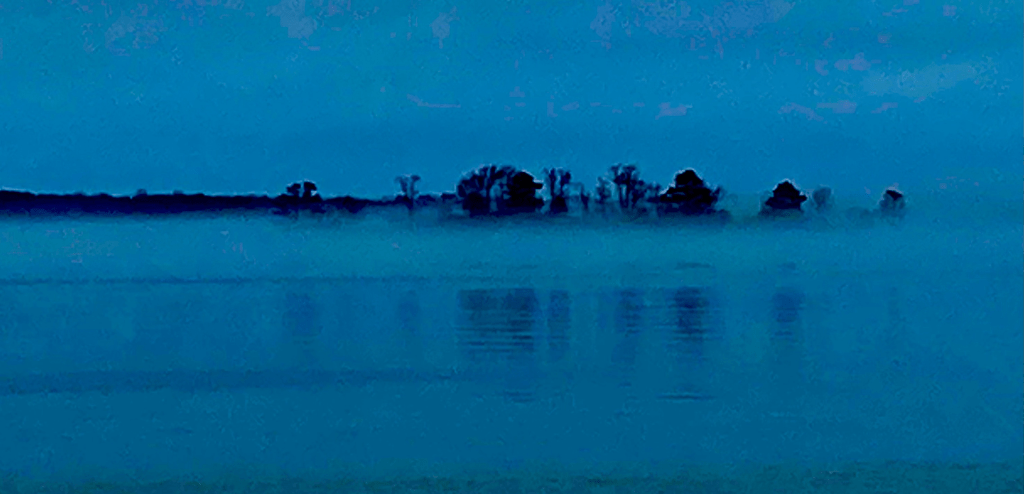
The tide is lower than I’ve seen in some time, mud flats running into the river easily one hundred feet or more. Fiddler crabs scurry about and seagulls land to grab them in the same place they normally would dive from on high into water three or four feet deep. This ebb is unusual.

Where the water does lap at the mud, foam formed from the icy cold winds, with temps in the upper twenties and lower thirties early this morning, and the winds pushing down from the northwest drop those another eight degrees or so. It is cold, and damp, so I feel it in my bones.

I like this. I mean, no, not all the time. But every so often I need some visceral reminder that I am alive now, not tomorrow when I have a laundry list of things to do or yesterday when some punk in my college comp class complained because I didn’t pass his plagiarized paper. Now, I am aware of the cold, the mudflats and panicked crabs, and my skin is tight, my eyes water from the wind, and my breath is frozen. It cleanses my entire world. I move about, which gets my blood flowing, and that not only warms me but awakens my senses even more. My mind, too, is clear, as if the winds and the cold blew off the soot that settled all semester.

Then the obligations seem fleeting, the problems which yesterday boiled my blood from the sheer weight of such minute interruptions, are cooled and dismissed by the ripple of foam running down the beach to Locklies Creek near Rappahannock River Oysters.

Here’s what is important, that I am still here. Alive, but more so, aware that I am alive, here, along this river today, and the cold pulls tight the skin on my face.

I thought of Richard Bach this morning and his work Illusions, in which the protagonist says almost as an aside, “Here’s a test to see if your mission on this earth is complete: If you’re alive, it isn’t.”

Hard to know sometimes, though, what that mission might be, isn’t it? You’d think by my age it would not only be second nature, but nearly complete, but I’m just waking up to the fact I should probably do something with my life. To do that I’m going to have to suppress the cold reality that I’m not young.

Except today, when what could have been some stagnant morning happened to turn kinetic because of the cold. My energy returned like a flood tide, and I stood on the sand wondering how to channel it. I think we do that sometimes; we have ambition, energy, even a wave of hope, but we simply don’t know what to do with it.

And for the first time in a long time, I understood my immediate response:

Nothing. Do nothing.

See the day, walk along the river and watch the eagles find food, and the lingering osprey who has not yet left for points south, dive for his meal. The most essential elements for life go ignored, or worse, aren’t even considered, for our need to be “productive.” But is it any less productive to walk on a leaf-covered path and watch cardinals move from holly tree to the ground and back? Is it any less productive to look east across the bay or the Atlantic and contemplate the waves, their calm and their power, as they approach and recede?

It is the same in summer for me, the blazing heat on my neck and face insist I remain present, the sweat on my forehead somehow similar to the tears from the cold wind, catch me and hold me tight in the moment, and I welcome it because at some point it will no longer be, or, better said, I will no longer be.

But not today. Today a dozen geese came in low across the duck pond and settled on the river just to the west, their honking subsiding, their journey paused for now. It doesn’t end exactly, not yet, but they take a moment and rest before they need to continue their flight.

And maybe they discover their purpose is in these moments, aware of the peace around them when they’re not rushing from one place to another, leading a flock or following the same. For geese, it is when they land and rest that it is impossible to tell who was in charge and who fell behind.

I came home, eventually, made some tea, organized my thoughts, responded to a few inquiries, but I did so with added calm I didn’t have before. I have a sense of peace now, of some sort of presence I can’t quite define, which is good, since I still have more than a little to do in front of me.

Yes, much more to do still in front of me.

The Day After Tomorrow

At the store in the village this morning, Mark, a waterman I know, told me he didn’t head out today. “Waves are five to seven, wind chill out toward Tangier at best below zero, close anyway,” he said.

It’s been cold here, single digit wind chills two nights ago. The weather is a dominant force in the employment of most of the people here at the end of the peninsula. Watermen, farmers; even my friend Mike’s flying enterprise over at the field is airborne or grounded based upon the weather.

Mt Washington had wind chills of nearly 100 below yesterday. I remember in Massachusetts one January when the pipes at the health club froze. Another time I sat in the bleachers at Rich Stadium in Buffalo as some Lake effect took off layers of my face for three hours.

For weather, I have better stories about the heat than the cold; the Sonoran Desert in ’83 when my car broke down near the mission toward Mexico. In Senegal where the temps were in the 110’s in the shade and the air was heavy. When I collapsed from heat exhaustion while building a brick wall here at Aerie twenty something years ago. Yet for some reason I don’t mind it. I can do sweat.

But for cold days (literally, not metaphorically) in my life, there is only one story:

My friend Joe and I arrived in northern Norway to spend a month teaching at a university. We lived in a cabin owned by an American there, John. It had three bedrooms, views of a fjord, a neighbor, Magnus, who brought over codfish, and a massive fireplace always burning. It might be one of my fondest memories. And while the cabin had a beautiful, normal, modern bathroom, John had it shut down and we were all to use the outhouse, fifty feet behind the cabin, just up a path with snow piled to the side higher than our heads.

The first night I sat up at 3 am and had to go. It was serious, so simply peeing out the window was not an option. The temps were pushing twenty below outside, and I sat contemplating whether or not I could make it to the University the next afternoon.

No, I could not. And I was going to be there a month so I knew I simply had to get this over with. I spent fifteen minutes getting dressed in six layers of clothes, lacing up my boots, strapping on my neck covering and hat, gloves, and moved up the path like a polar bear, pulled on the handle—locked. Then from inside, Joe called, “I’ll be out in a minute.”

I waited inside, he came out, I went in, discovered the origin of the phrase, “Froze my ass off,” and returned to the mudroom just inside the cabin.

So here’s the thing: When you are fully dressed to go out at 3am in negative temperatures, you are awake—blood awake, no-going-back-to-sleep awake. Behind the cabin were woods and a wide, snow-covered path running well up the hills overlooking a lake.

“We’re dressed anyway,” Joe said. So we went back out, heading up the path.

This is what happened, though my prose falls desperately short of the experience:

Green bands of light bounced down the fjord and across the lake, touching the hills and rolling off like a green curtain in the wind, lifting, holding, then falling and bouncing again. I had heard of the beauty of the aurora borealis but never saw it. Better said, never imagined I’d be under it, literally under the green bands of northern lights, so that a few times we almost ducked.

We walked further when further up the hill two moose slowly walked out of the woods on the right and stood in the path staring down at us. They moved slowly to the left, into the woods, and a few more followed.

And the stars, the carpet of endless stars, a shooting meteor, all breaking through the northern lights. It was like standing on the moon. We seemed suspended in space, in absolute, deep canyon, liquid silence.

By the time we returned about four thirty, our neighbor, seventy-five year old Magnus, a fisherman his entire life, pushed his skiff into the water to motor out into the bay for cod. His small engine sounds filled the canyon and echoed well into the fjord, and later he would return—red face, red hands—to give us the cod. He will have already cut out what he wanted; namely, the liver. And I’d stand in the warmth of the kitchen to clean and filet the fish for dinner.

When we got back it took ten minutes to get all the outer wear off, and as I moved up the stairs to my room I noticed, was completely conscious of the fact, that I never thought once about the cold. It was not even “the price you pay for the experience.” It simply wasn’t part of the evening’s vocabulary.

When I think of Norway, now almost thirty years ago, I think of that night, and of the next day and a ferry ride out to the Lofoton Islands, of teaching at the college and walking the fishing piers of Bodo, of Joe and I starting a fire in the snow to cook some red potatoes we brought on a hike, of falling through the day-melt layer of ice on the lake to my calves one evening, of playing guitars with a Russian musician, Max, of so much, so very much.

But I don’t think of cold. I don’t remember that part of it.

Norway, 1995