Some years ago while working at a different college, I wrote this essay loosely ripping off an essay by Tim O’Brien. I’m not ashamed. I found it recently and thought about how I still neglect to complete the very assignment I encouraged my students to complete as often as possible. . Something needs to change.
What Have We Learned
Older students are better than those just out of high school. The big dude with the pierced face and tattooed eyelids is probably a great writer. Many students would rather pull a lower grade than have a professor look at a rough draft. Students who take copious notes don’t always fair as well as students who just listen intently. If it happened before they were born, it really doesn’t have any affect on them and therefore they shouldn’t be required to learn about it.
Hamlet is boring; Oedipus is stupid; statistics is tedious; bio lab is too long; developmental classes are a waste of money; introduction to literature is a waste of time; history is not relevant; philosophy has no practical application; psychology is disturbing and the instructors are disturbed; text messages are read more than text books; face to face communication is obsolete; and the only source of information is the internet.
Here’s the great irony of education: While we should become smarter as time goes by because we’ve been given the answers through the centuries, watched the lessons played out on the battlefields and in seminar rooms, we’re actually ignoring more, learning less, and not really keeping tabs of our decline.
Maybe if I text my lectures they’ll pay attention. Phones go off in class, in the hallways, in their backpacks. They reach in to quickly shut it off because they “forgot it was on,” and spilling out onto the floor are the books they need, a few small notebooks, and various articles of clothing. They carry more in their bags then in their minds.
The science and math books are ten-pounders, and the anthologies aren’t lightweights either. For lab they need their lab equipment, gloves, goggles, special notebooks, dead animals. Rough drafts, final copies, required journals, various books read besides the textbook, art supplies, tape decks, language discs, keys, wallets, games and personal items. Some have staplers, toothbrushes, condoms, aspirin, medicine bottles, and hand soap. Some carry crayons and cookies because their kids come to class sometimes when elementary school is out or cancelled, or when the kid is sick but the Prof told the parent if she missed one more day she’d fail the course. They carry medicine for those kids, bi-polar, attention-deficit, hyperactive. They carry the same for themselves, medicine for their own ADD, ADHD, OCD, diabetes and manic-depression. They carry a lot. They need to remember when papers are due, when tests are scheduled, including their math tests, their physics test, algebra, pregnancy, special needs tests, mammograms, CT scans, and various other tests they’ve got on their mind and written down in their notebooks at the bottom of their parcel.
They carry cell phones with various rings, various friends calling during class, right before class. They have small machines attached to their ear so they can remotely answer the phone without having to move their arms or lift their hands. They have the numbers of everyone they know automatically programmed in. They no longer have to walk to see anyone, walk to find a phone, remember any numbers, lift their arms, or turn their heads.
Once someone’s phone vibrated during class. The vibration on the desk was as loud as a ring, but she politely excused herself. Some professors insist the phones be off during class, and they won’t even allow them to be turned to vibrate. But this student came back in and said she was sorry and that she had to go, that was her babysitter calling and someone from her husband’s command post was at her house waiting for her to come home. A week later I discovered her husband had been blown up at a roadside bombing on the airport road from Baghdad. Another student’s brother was on television. He worked for Blackwater in Baghdad and she watched her brother’s charred body swing from a bridge in Iraq.
One student shot himself in the head because he thought the paper was due and he thought his medicine wasn’t. True story. A colleague of mine listened quietly one day to a near-suicidal student explain why her paper was late and how her daughter was going through depression and they were bringing her to the doctor to see what was wrong, and it weighed so heavily on her mind that she couldn’t really concentrate on the paper and would the professor mind the paper turned in a few days late, and she agreed. Students knew this about her—she would work with anyone. A few days later my colleague hung herself in her kitchen because her medicine was fucked up.
This is the American Community College. These are the trenches, in the city; some of these students come to get ahead, knock off some basic education classes before transferring and paying more at the university. But some come here instead of jail, or to bide their time, or to hang with old friends and maybe hook up with new ones. Some come to keep off the streets; it can get dangerous these days. But some of these students come from real war-torn areas. My student Deng walked across Somalia to Ethiopia twice looking for safety. Before he found it at ten-years-old in a Red Cross camp, he was given an automatic rifle and taught to kill. Now he tries to write about gun control and crime in seven hundred words, making sure the grammar is right. His mother was raped and hacked to death in front of his eyes. His father “disappeared.” He was a Lost Boy. Sometimes he didn’t concentrate. Yeah, okay, sometimes he didn’t pay attention. But when he came to my office we talked about politics and survival. We talked about Africa and faith. We talked about ideas, and he told me Chinua Achebe knows Africa. He told me how Sartre would not be popular in Somalia but Descartes would. He knew the differences, understood the gentle nuances that separate philosophy and politics. I didn’t ask about his scars. He didn’t ask about mine. Deng came here with an education the likes of which we can’t possibly conceive. He told me he as soon as he found the camp he knew he needed to leave. I said I understood. He said it was too much, and he wanted to die so badly and that’s when he knew he just had to get out. I didn’t answer. I had nothing left to say to him.
What I know now is this: all the lectures in all the classrooms from all the professors in the world will not prepare us to be anything of value if we don’t find any value in what we do and how we live our lives.
Of course we would all do things differently; even just a few small moments. I’d never have left Massachusetts. I’d have gone to Monterrey anyway. I would have passed on the Trout in Prague, the oysters in Asheville. When I left Tucson that last time I’d have headed west instead of back east.
We are always in pursuit of ourselves, aren’t we? Even if we don’t consciously consider such notions day to day. In class one morning I asked my students if there was anything they would have done differently in their short but tech-dominated past. They all laughed and had answers that ranged from staying off-line to trying harder in high school to treating a loved one better while she had the chance. They talked for a bit; they got quiet. They thought a while. And I added this: What are you doing now that five years from now you will wish you had done differently?
They looked at me for a moment with just a little confusion and some wonder about their future, and they waited for me to talk.
The Infamous Stray Dog Café where I read with Anna Akhmatova and others (not at the same time or in the same century)I had just given this carnation to the WW2 vet on Victory Day3 am at The Shack, my hang out for years where I met locals and played music in the woods on the beach of the Gulf of Finland
I’ve traveled all over the world with friends and family: To Ireland, Prague, France and Spain, Norway and Amsterdam. But Russia has been on my mind the past few days as it and the war in Ukraine seems to have been drowned out by the noise coming from the Middle East. For quite some time I had quite some time there. I dined in palaces while quartets played for our private group, and I’ve paid off people guarding graveyard gates so we could explore the backstreets of St Petersburg. I’ve brought friends to apartments of artist and writer friends of mine, sat backstage during rehearsals at the Conservatory, had private concerts at the home of Rimsky-Korsakov, and read my work at the famous, dissident occupied Stray Dog Café as well as Dostoevsky’s flat. I know the streets of that city better than any other place in the world, including places I’ve lived. It has something to do with that heightened, acute awareness we experience when we travel. It also has something to do with going back dozens of times.
The city today in this post-Ukraine-invasion world, I fear, more closely resembles the city it was when I first arrived just after the coup. I thought those times were dead and buried, covered by the fresh grass of several new generations who know little else but freedom and capitalism. But it took one sick man to throw it all back thirty-five years.
In 1994, the streets of St Petersburg were dank, a monotone of browns absent of advertising, neon, or anything other than some Soviet style atmosphere. The only placards placed in random spots on Nevsky Prospect—the city’s Fifth Avenue—were Marlboro signs, the only western clothing of note worn by the suddenly displaced masses was Adidas warm-up suits. It appeared a parody of itself as presented in 1970’s and ‘80’s anti-Soviet movies. For seventy-five years the country, and Leningrad, moved in darkness under the Soviet leadership, and for centuries before that under the long reach of the Czars.
When I first arrived to teach American culture to faculty at Baltic State University, the first of what would end up being more than twenty-five trips in thirty years, democracy had found the streets of Leningrad, which had just changed its name back to the Imperial “St. Petersburg,” and Russians struggled to figure it out. The first week there, I stood in line for two hours at a bakery, and when I pointed this out at the college, my colleagues shrugged and said, “Da. Canushna.” Yes, of course. I explained that in the States, a new bakery would open across the street and be faster, charge less, offer discounts. Then I had to explain discounts and why, explain that the cashier who stood outside smoking while twenty people were in line would be fired. This led to a conversation about capitalism, and everyone was suddenly enthralled to hear about businesses and learn how to make money, the advantages of choices, the value of options. The men of the previous generation on through to the college students present when I first taught in the city, simply understood service to their country as paramount; it involved time away from family, but also provided pensions and a chance to protect their living conditions.
But after the coup, and certainly in the few years which followed leading up to 1994, it was a brand-new way of existence, and the long, cold winter of communism had finally ended. Things changed—and this is where it got tricky. At first everything was different overnight, like their currency, living conditions, international relationships, and availability of goods. But then the changes slowed to an immeasurable pace. People couldn’t find jobs or food, or they had to work for some organized crime group. Old folks lined the metro begging for money or selling items—shoes, loose cigarettes, empty bottles. But within a few years they figured it out. One afternoon that first year I went to the market behind a cathedral in the arts district. It was a park area with tables covered in tourist items: matryoshka dolls, the famous Russian wooden bowls known as khokloma, pins, small wooden toys bears. Scarfs, shawls, icons, amber jewelry. The following year the market built small booths in long rows instead of random tables. A year or two later, the booths had roofs over them, then lighting was put in for night shopping, and by the 300th anniversary of the city in 2003, the entire market was covered, gates out front, a veritable mall filled with all the previous items, but also fine art, expensive purses, technology, and food were added to the shelves. The Russians were figuring it all out, and many made more money in a month than they had in a year under the Soviet regime. Organized crime groups took over and took a cut, and the city streets once filled with just Russian-made Ladas were now lined with black SUVs.
A friend of mine in the marketplace, photographer and artist Valentine, remained my source of all things business, and the changes almost became too much for him to handle. In 1995, I went in the Catholic Church nearby to find piles of rubble where an altar used to stand eighty years earlier, and the walls had been painted black, on the floor lay statues without heads. The priest, Fr. Frank Sutman, explained it had been used as a storage facility for motorcycles since the Great Patriotic War, World War Two, but the church took it over for the first time since 1917. By the turn of the millennium, the grandeur of the marble floors and beautiful walls had been restored. Across the street was a small shop. In the early years, I had to point to the item I wanted on the shelf behind a counter or in a glass case, and if I liked it, I took a handwritten receipt to the cashier who figured out the total on an abacus (no kidding), gave me a new receipt which I took back to the first worker to retrieve the items. This is how it was in the few grocers, the pharmacies, the bakeries. Only in the tourist market did one deal directly with one person.
Years pass.
A supermarket opened with cashiers at the end of conveyor belts who rang up your items, bagged them, and you walked out like you just left Walmart. The discovered calculators, paper bags, and the shelves were stocked with European goods. And on the streets, neon signs dominated the avenue: KFC, McDonalds, Pizza Hut, clothing brands, cigarettes, alcohol, appliances, cars. Except for the language I could have been in my native New York. The once empty streets were filled with people, all on their new phones, all taking pictures, all donning expensive jackets and shoes.
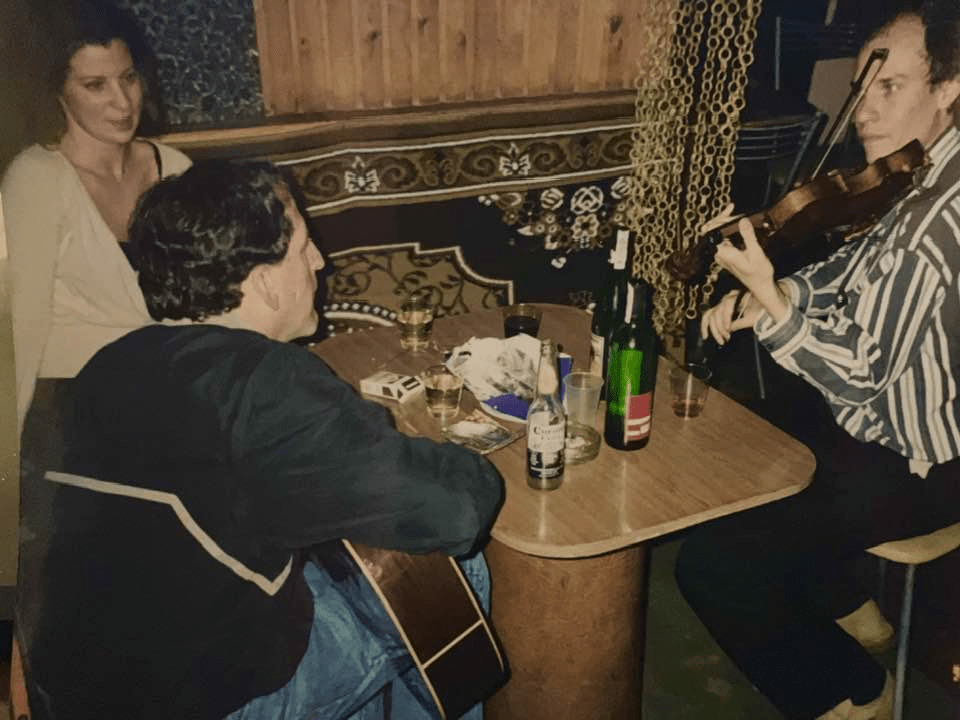
These were the years of tourism, of an entire generation and the next growing up without memory of Gorbachev, even of Yeltsin. Today no one under forty-five would remember communism. For thirty-years we went on canal rides and took videos, wandered through neighborhoods and graveyards. I went to Victory Day a dozen times, talked to Vets of the Great Patriotic War, who loved to share their experiences, and I talked to the women—St Petersburg became known as a city of old women since the men mostly died in the war and children starved to death—about the changes, often as they swept the streets with brooms made from birch branches. I played guitar with a gypsy band in the woods and danced on stage with a folk group with no inhibitions at all. I have absolutely successfully embarrassed myself behind the former Iron Curtain.
We went to the Kirov Ballet, the opera, folk shows, and soccer games. We dined in restaurants from Germany, Italy, China, and played music, danced and drink at The Liverpool, a Beatles bar.
Peter the Great’s dream of a city of culture, his “Window to the West” as he called it, had come to fruition. Over those decades I have written three books and dozens of articles about my experiences there, and the experiences of the World War Two veterans.
By 2014, after twenty-years of going to Russia, anyone thirty or thirty-five years old and younger only new this new way of life. By 2025, the Soviet system was foreign to anyone under fifty. The very notion that the government would dictate what they could and could not do was as foreign to them as it is to us in the west. Students graduated from college and set up businesses, tech companies, they traveled freely and often to Portugal, the United States, Hong Kong, Sicily, everywhere. After almost a century of needing to walk everywhere and live with two other families in small communal apartments, they now owned cars and nice apartments. The once common practice of tourists bringing Levis or other western brands to trade for Russian trinkets was not only over, but laughable, with malls opening up with shoe stores, clothing stores, phone, sporting goods, and music stores, all filled with western brands.
Again, it’s crazy to realize that the “old country” of Russia had so modified over the course of just two decades, one had to be in their forties to remember the Soviet system. What the average Russian citizen could not know, of course, was that the modifications made in palaces throughout the country, but in particular St Petersburg, was paid for by organized crime to increase tourism and international trade. The city where I could in those early years buy items for a few dollars, quickly figured it out and charged twenty or thirty dollars for the same items. Restaurants appeared everywhere with prices for those driving the SUVs, not for the Lada crowd.
My friends from Russia adjusted. A tour operator learned business well and built a company that dealt with tourists from all over the world. My artist and writer friends found new freedom in being able to take pictures of anything and anyone they wanted without recourse. They criticized the Yeltsin administration without worry of harm. For seventy-five years, the notion of dissidence, which not only included those who wrote against the government, but those who simply didn’t always write positive things about the government; particularly Stalin, had in just a few shaky years, slipped into history. Going to St Petersburg became simple. There was even talk for a while of dropping all the VISA requirements. I wouldn’t call it democracy, as such, but communism was dead. Gone. Lenin’s statues which had been everywhere in the early ‘90s were much more difficult to find. It became simple for a Russian to leave home and travel to the United States. And the did, gladly, relishing in being a part of the world, finally. This wasn’t simply détente; this was the start of a beautiful relationship.
In 2013, my son and I rode the trans-Siberian railway from St. Petersburg to Vladivostok, across more than six-thousand miles, and seemingly across decades as we retreated into the previous century the further east we traveled. In Yekaterinburg the western influence was still obvious, but in Irkutsk, another few days east, Soviet style practices still appeared common. The one fortunate thread remained the people, all deeply rooted in new democratic, even capitalistic practices. They drove Kias and Toyotas, they wore Levis and Ray-Ban sunglasses, and they spoke of their vacations in Australia, the Canary Islands, Florida. If I had not been already in my fifties, there would be no basis of comparison to the old, Soviet ways I grew up learning about, fearing, hating. Nothing I had learned about these people was true, even in the early nineties. The propaganda machine, practiced just as efficiently in the west, had turned out to be shallow, and that was with a generation of Russians whose experience had only ever been Soviet or Czarist. This new generation, those already well into their careers, families, homeownership, and substantial investments, just two decades old, was the dominant population across the country, and they knew less about living under a fascist regime than I did.
Until Vladimir Putin.
He came in early and soft, almost friendly, certainly acceptable. He was a man with a vision for this new country who followed the floundering Boris Yeltsin, and as Putin’s power and wealth increased, he rebuilt his native St. Petersburg. He saved the former Soviet Union from ruin and the economic disaster of the Yeltsin years, which left a rampant homeless and starving population to fend for themselves. Right after the coup to end communism, the nationalization of all businesses and housing ended, but so did the pensions. Housing privatized and if the residents couldn’t afford the new rent they were kicked out. Hospitals quite literally rolled patients out the door and left them near churches to fend for themselves. Putin moved from the city’s Vice Mayor up the ladder to President on the promise he would “clean up” the homeless problem, “employ” people willing to work for anyone, and made business deals that brought unprecedented wealth to the nation. Russians welcomed him; so did western leaders. And the population which benefited the most were under forty, tech-savvy millennials who worked their way up, drove expensive cars, and lived in large sweeping apartments on Nevsky Prospect with beautiful dachas in the countryside or Ekaterinburg. Tourists who visited St Petersburg discovered open palaces with gourmet dining rooms, clean hotels with five-star service, shops with icons, malachite and amber jewels, and all-things-fashion. Russians, too, became tourists able to see more than the dachas they shared with other families. They traveled to Italy, to Portugal, France, and the United States. Satellite television common in the nineties became fast internet service enabling partnerships and communication with anyone anywhere.
Then Ukraine happened.
Those same students just out of communism and thrust into capitalism are now in their late forties, at least, and their children, raised in nothing but a mostly free-capital society with all the advantages and freedoms we understand here in the States, are being drafted into an army to attack a country they spent their entire lives visiting on vacation. When the news speaks of “Russian military,” this is who they’re talking about; men and women whose only reference and background was freedom of choice, of employment, of wandering, of economic wealth. Their only requirement was the possibility of two years mandatory service before they turned twenty-seven. Piece of cake; their billets ranged from one end of the earth to the other. So while their parents may not have been surprised to have been called to service in Afghanistan in the seventies for the Soviet government, these men and women dreading duty in neighboring Ukraine had anticipated their best-laid plans to pursue personal ambitions, and went to schools which had been teaching them international relations and economics, until the hope they had for life was disturbingly aborted for reasons beyond their comprehension or desire.
Then western sanctions hit and the country shut down, banks stopped all business outside the borders, foreign companies which lined Nevsky Prospect with signs and tables and parties were suddenly gone. The streets once again seemed grey, empty of life. Employment disappeared and no pension waited by to save them, so the army promised to pay their bills, which they did for a short while, and when word spread that the truth is they could barely feed their soldiers, let alone pay them wagers a fraction of what they had been used to, many fled.
Back in the mid-nineties, a friend of mine would write complaining about Yeltsin, about the lack of support from the United States, about the homelessness and difficulties dealing with “Old Russians,” who knew Soviet Ways, and how the “New Russians,” assume they have a right to whatever they can get. The anecdote which circulated then was how a New Russian in a Mercedes SUV waited at a stoplight when an Old Russian in a Lada with no brakes hit him from behind. The Old Russian got out of his car terrified, but the New Russian simply said, “Aren’t you glad I’m here to stop you? Otherwise you would have run out of control and killed yourself.” That was the propaganda which took hold and brought this nation to life; this nation now isolated and quite possibly on life support.
In the last few months, after a year of no word from friends who still live behind this new Putin Curtain, I heard from the friend who twenty years ago spoke openly of the problems in the city, back when the place was starting to shine. This time he speaks only of pleasantries, of how beautiful the weather is, and how he loves his city. No word of Putin; my friend remains uncharacteristically quiet about all things governmental. Another friend in Europe tells me his own family in St. Petersburg reports the lines are back for the purchase of many goods, like before the coup thirty-five years ago, and families are once again forced to move in together to save money, and he cried knowing his family whom he could visit whenever he wanted and who came to see him often, no longer has the ability to travel anywhere, nor the means even if they could leave. And he spoke as if this was the early fifties and Stalin was still in charge, that “to speak negatively about President Putin is to be thrown in jail.” And today come reports that anyone with dual citizenship with the US and Russia who had been contemplating going back to Russia should not do so lest they be detained indefinitely in Russian “holding” areas.
Maintaining control over the population of the Russian Empire after the Civil War following World War One was not difficult; the people had never truly known freedom as we understand it; Czarist Russia ruled for nearly a millennium. Russians appreciated the promises made by the Bolsheviks, and despite many of those promises never coming to fruition, most people abided by the Soviet system, even out of fear. And following the fall of communism in the late eighties and early nineties, Russians welcomed the opportunity to break free of the limitations of their previous government, but when almost a decade passed and things got worse, not better, it was not difficult for someone like Putin to convince them a little more government control, “like it used to be,” was a good thing. For a while, he maintained a perfect balance of top-heavy government—albeit one on the take to the tune of billions of dollars—and the personal freedom to come and go, grow and expand, as one pleased. This lasted until February 24th, 2022, when Russia invaded Ukraine.
But something is different this time. One hundred years ago the people had only known an oppressive government, as was the case thirty-five years ago, so leading them down the path the new leaders desired was not difficult. But now, two generations into a country used to most of the freedoms we have in the west, the population, despite the Russian propaganda to the contrary, is displeased with their government’s bombing of an innocent nation, ending the freedoms of the people of both countries. When the war began, Russia had 360,000 active troops. In the past years, well more than 315,000 of them have been killed or badly wounded, only to be replaced by new “recruits.” According to the UN, that amounts to 87% of their numbers at the start of the war. In the Ukraine since the world changed two years ago, more than 30,000 soldiers and civilians have been killed or wounded. When the communists took over from the Czars, the people only knew submission, but this time they need to be threatened to fight. Things are different indeed. Like Weimar Germany, Russia between Gorbachev and Putin was a fine place to travel, to live, and to have hope. It’s gone, at least until Putin is gone, and the people who remain remember that time of peace and prosperity and can on with their lives.
The Russia I knew is dead. I miss my friends, Valentine, Igor, Sasha the guitar player, and Dima the violin player. I miss the atmosphere, the storied example of perseverance that was the St Petersburg I knew, filled with veterans who miraculously survived the siege of their city for nine hundred days in World War Two; a siege and destruction of people which one of the city’s own, Vladimir Putin, once exclaimed must never be allowed to happen again, until he did just that. The promise and beauty of the Russian artists, the teachers, and the children, are simply gone. And in Ukraine with a history deeper, older, and more beautiful than even Russia’s, a civilization has been annihilated. Historians will not point to a myriad of reasons for this incomprehensible tragedy; studies will not have to be undertaken to better comprehend the causes of the invasion. The brunt of this brutality falls squarely on the shoulders of Vladimir Putin.
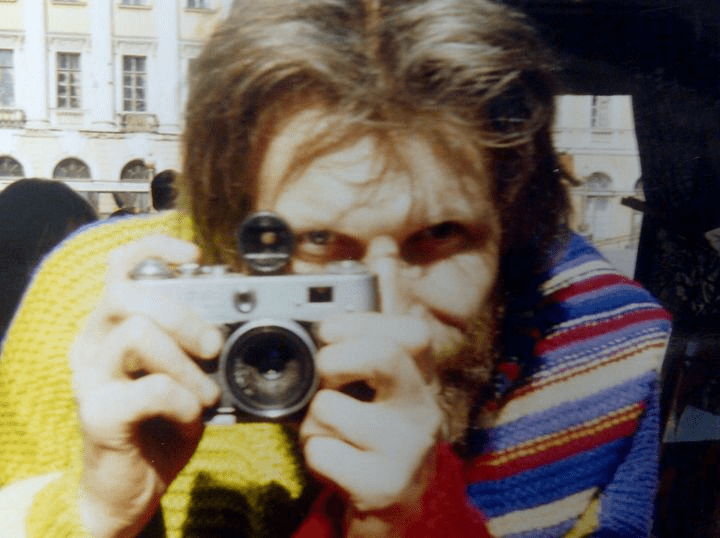
Valentine
Valentine loved Ukraine and took many pictures there
According to the stats page of WordPress, the platform I use for A View from this Wilderness, more than four percent of the weekly readers view it from Israel. None from Gaza. I have been in support of and have promoted the work of Israeli writers for four decades now, including both the journal Ilanot, based in Tel Aviv,which has posted more than a few of my works, and my late friend, best-selling Czech author Arnost Lustig. On the other hand, I have no personal ties at all to Gaza or anyone living there. This is not pro-anyone. This is not anti-anyone. Honestly.
But…
I am not a fan of needless, widespread, pointless killing. Call me quirky like that. So if anything about the following numbers, acquired from the Jerusalem Post, the UN and the WHO, bothers you, you either have difficulty facing the truth or you’ve not done your homework. I have; these are the undisputed numbers.
Killed in attack on Israel October 7th: 1139 people.
Israelis killed since then, 700, nearly all soldiers. Roughly 6000 wounded.
Palestinians killed in Gaza since then: more than 25,000
Including 10,000 childrenkilledin Gaza.
Another 1,000 children in Gaza had at least one limb amputated.
62,000 people in Gaza wounded in life-altering ways.
96% of water in Gaza is unfit for human consumption.
90% of people in Gaza in life-threatening situation from lack of food.(“If your enemy be hungry, give him bread to eat, and if he be thirsty, water to drink! ” ~~ Proverbs (Mishle) 25:21)
16 hospitals still remain out of the 36 pre-October 7th. Of those 16, none have power from more than a generator, and all are “critically close to zero” of medical supplies.
85% of the people of Gaza have been displaced beyond any ability to return home.(“Who is a hero? The man that turns an enemy into a friend.” ~~ Avot Derabbi Nathan)
Honestly, the moment anyone starts defending Israel’s right to kill 10,000 children their argument falls apart.
No one I am aware of has ever spoken against Israel’s right to retaliate after the senseless and horrible attack by Hamas on October 7th, 2023. But their mission has slid definitively over the line from retaliation to annihilation. Simply put, with numbers like those above, the military’s mission is to obliterate not only the citizens of Gaza in their attempts to destroy Hamas, but also to eradicate future generations of Palestinians. Why else on earth would anyone have any reason to kill children—10,000 of them.(Please be clear; this is a reference to the leaders of the government and army in Israel, not the Israeli population at large or Jewish people anywhere).(“They shall beat their swords into plowshares and their spears into pruninghooks; nation shall not lift up sword against nation, neither shall they learn war any more.” ~~ Isaiah (Yesha’yahu) 2:4)
That’s it. If anyone disagrees that the only recourse for Israel was to kill more than 25,000 people including 10,000 kids,I have no interest in a conversation with you.Get your own blog. (“Even on the threshold of war, we [Jews] are bidden to begin in no other way than with peace, for it is written: “When you draw near a city to fight, first offer it peace.”” ~~ Midrash Leviticus R. 9)
So many people talk about war, about poverty, emigration, about nuclear fallout and political discourse. The news is now riddled with bullet point reporting about stranded soldiers, homeless families, courageous politicians, and psychopathic leaders. You’d hardly know they were talking about humanity. You’d never guess they were talking about us.
The top of the hour take on today tells me a few million people must live elsewhere, most likely forever, that the cost of gas is so high it is no longer cost efficient for minimum wage workers to work unless they bike or bus. The cost of food will rise, as well as the price of everything trucked, shipped, or flown to somewhere else to consume.
Covid is still killing people, and controversy concerning restrictions consumes organizational meetings and town hall events. Two people were shot and killed in Worcester, Massachusetts, last night, and those late souls were just two of two hundred and seventy others in the last twenty-four hours.
The view from this wilderness is discouraging.
So many people talk about sanctions and retaliation, about cyberattacks, about drone warfare, about soldiers looting and soldiers who have no idea what they’re doing there to begin with. So many people talk about inflation and recession, about climate change and burning swatches of America.
The headlines have gone bold on a daily basis, largest type of the fattest font, that bold type normally reserved for assassinations and declarations of war, set aside until Dewey Defeats Truman, is constant, morning edition, afternoon edition, online version, all full bold above the fold in your face headlines about how many dead, how many fleeing, how many floundering in some nether land on their way to Poland or Germany or Alabama or anywhere that’s somewhere else. Headlines about a leader misleading his nation, another leader leading by example, and a little girl singing a little girl song in a shelter. She holds a kitten.
Some people will believe anything. Some people need to believe in something. Some people believe that if you believe you’ll be fine.
This is not how I wanted my fourth quarter to start. It’s been a good game, mostly. I’ve had some incredible, once-in-a-lifetime plays, well more than once, but I’ve fumbled as well, threw my share of interceptions. But it’s been amazing. I trained across two continents; I walked across a country; I reconnected, resigned, regrouped, then remembered what it was I wanted out of life to begin with. And it’s not to listen to so many people with no expertise decide exactly what’s wrong and who caused it; it’s not to listen to so many people bend toward the fight instead of negotiation, lean toward aggression instead of forgiveness. This is not how I want the fourth quarter to play out. Clearly I have more comforts than the vast majority of this world; I’m not “sitting on the cold floor of a train station” as some random posts remind me, insisting that since I’m not destitute and homeless I should shut up. I agree completely with this sentiment; I’ve no reason to complain. But this isn’t about empathy; this is about my inability to absorb anymore disappointment with a species with such capabilities as to create miracles on a daily basis yet falling faster into a vacuum of violence from which it doesn’t seem possible anymore to escape.
I’ve tried switching my meds, I’ve tried exercise and eating differently, I’ve tried laced lollipops and tiny bottles of Baileys.
I’ve tried. But still, I need to try something else. So I remember that...
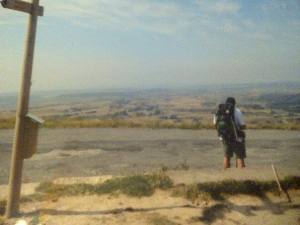
when you walk five hundred miles, you note each step, your life slows to some equatorial pace, and you can feel the air move around you, the subtle brush and lift of a soft breeze come across a field. Every day is an eternity, each moment you find yourself exactly where you should be with whom you should be with. Each person crosses your path for a reason, and each reason evaporates with the next step, like a constant stream of rebirths, an endless loop of beginnings.
This is how I escape the persistent pounding of chatter, the numbing talk shows filled with nothing more than speculations. This is how I keep from falling: I wonder, would anyone notice if I just walked away, headed south along the coast, hitchhiked, bussed, trained, away from here? Would anyone notice if I ended up in Pied de Port, France, looking out toward the Napoleon Pass across into Spain, out of reach of the rising tide of so many people?
I’d like to believe that the view from this wilderness is always optimistic, and so many people have commented on the beauty of this wilderness, the sunrises and nightfalls, the slow glow of dawn sweeping gently across the bay and stealing the day, but the true wilderness that must be explored is within, always first and last the wilderness within, and that is very difficult to do with so many people talking about so many people dying.
I wish that I could slow the whole thing down. The world is changing again, and it’s not looking like a strong narrative is headed this way, but there are still so many people I want to spend time with, so many places I’d like to see.





 a view from this wilderness