The following is an excerpt from my 2018 bookBlessed Twilight: The Life of Vincent van Gogh; however, the words are his from a letter he wrote to his brother Theo in 1888. Often, an artist who excels in one genre dos so in others as well; Vincent was no exception. I believe his writing to be as artful as his paintings.
Vincent van Gogh: March 30, 1853-July 29, 1890
From a letter to Theo:
It certainly is a strange phenomenon that all of the artists, poets, musicians, writers, and painters are unfortunate in material things—the happy ones as well. Maupassant is a fresh example of that. It brings the eternal question: Is the whole of life visible to us or isn’t it rather that on this side of death we see one hemisphere only? Painters, taking them only, dead and buried, speak to the next generation and very often several after in their work. Is that all or is there more besides? In a painter’s life, death perhaps is not the hardest thing there is.
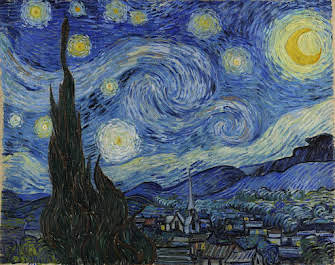
The earth has been thought to be flat. It was true, and is today, that between Paris and Arles, it is. But science has proven the world is round and nobody contradicts that nowadays. But notwithstanding all of this people persist in believing that life is flat and runs from birth to death. However, life too is probably round and very superior in expanse and capacity to the hemisphere we know at present. For my part, I know nothing of it. But to look at the stars always makes me dream as simply as I dream over the black dots of a map representing towns and villages. Why, I ask myself, should the shining dots of the sky not be as accessible as the black dots on a map of France? If we take a train to get to Rouen, we take death to reach a star. One thing undoubtably true in this reasoning is this: that while we are alive, we cannot get to a star any more than while we are dead we can take the train. So it seems to me possible that cholera and cancer are the celestial means of locomotion just as steamboats and railways are the terrestrial means.
To die quietly of old age would be to go there on foot.
I feel more and more that we must not judge God on the basis of this world; it is a study that didn’t come off. What can you do in a study that has gone wrong if you are fond of the artist? You do not find much to criticize; you hold your tongue. But you have a right to ask for something better. It is only a master that can make such a muddle as this, since then we have a right to hope that we’ll see the same creative hand get even with itself. And this life of ours, so much criticized and for such good and exalted reasons—we must not take it for anything more than what it is and go on hoping that in some other life we’ll see a better thing than this.
This blog is about reading some of the most motivational writing you will find while helping fight Parkinson’s Disease.
So here’s what happened: About four decades ago I put together a book called Vincent which my former advisor at Penn State, Eton Churchill, and I published. It did okay and had rave reviews for its simplicity combined with insightfulness on the part of the author. I did not write this book; I pared down more than 2000 pages of letters that Vincent van Gogh wrote to others–mostly his brother Theo, but also other artists. The book became about 160 pages of startlingly beautiful first person prose in which Vincent tells his own life story including his turmoil with depression, his passion for life, his visions in art, his relationship with God, and his relationships with women. It truly is captivating writing.
In 2017, a real press picked it up and reissued it as Blessed Twilight: The Story of Vincent van Gogh, with a gorgeous cover and more wide-spread distribution. especially since the release coincided with the release of the movie Loving Vincent. It did incredibly well, but eventually went out of print as the publisher in Florida shut down and the people in Ohio who took it over also closed their doors.
The overstock of these books floated around the east coast and the mid-west, and with great generosity on the part of the people in Ohio, arrived at my door yesterday.
I am selling them and all the money is going to aid in the fight against Parkinson’s Disease.
These make fantastic Christmas gifts or just reading material for yourself. I can’t overstate how everyone who reads this book is captivated by Vincent’s philosophy, perspective, and passion. I can compliment it since I only organized the material, Vincent van Gogh did the writing.
Order copies for yourself and your friends. They are $25 a piece including shipping, or 5 for $100.
You can:
Venmo: @Robert-kunzinger
Zelle: rskunzinger@gmail.com
or send a check made out to APDA (American Parkinson Disease Association) and mail it to me at Bob Kunzinger, PO Box 70, Deltaville, VA 23043. ALL the money (except postage) will go to assist the research for Parkinson’s.
“There’s nothing more truly artistic than loving people“
So here’s one I wrote and let it go. It’s partially told in a piece in my short collection Howl at the Moon (Cuty Wren Press). It came to mind this morning because I’m leaving in a few days for Amsterdam, and I’m sure there will be cheese involved.
I was in the Netherlands about twenty years ago, maybe twenty-five. I lectured at the University of Amsterdam and talked about art and Van Gogh and death. Normal stuff. In class one day, which was open to visitors and in which everyone was required to speak English, an older woman whose late husband was an artist sat in for the lecture, and afterwards she gave me an etching her husband did of a local cathedral. When she learned I was going to find a way up to the Zuider-zee, she offered me her son’s motorcycle for the day. Students gathered to talk about Van Gogh and about America and more. While the woman and I spoke, they talked amongst each other. One guy asked another if she was working that night and she said no, but the next night she was. He told her he’d come by. Another said it hurt to speak in English, and the young woman said it’s good for him to learn, that she wants to learn as many languages as she can. They all talked about van Gogh’s art.
That night on my way back to the hotel, I walked through the Red Light district to use a computer at a Brown Café to tell my officemate about how it was going so far. The windows of the district display scantily clad women, select lingerie on the floor, a couch, maby velvet, sensual surroundings and lighting. They move about tenderly like flesh and bone mannequins, and when a prospect passes, they urge him to pause, consider coming in for a quick turn. They whisper to them in Dutch, in English, French, German. There’s a back room for the business end of the exchange. I kept walking.
The next morning was one of those movie-set days with a perfect temperature, ideal soft breeze, postcard tulips and windmills, dikes running roadside holding back calm waters. I rode out to a Volendam café on the docks where som sailor just back from the states finished washing down his ketch, and we talked about his Atlantic crossing, about the Chesapeake Bay where he had been, and about the cheese he had on deck which he shared with me. We went in the café for a beer and the waitress offered some Gouda and bread with eel and herring. She said the cheese was from a small factory just a few miles away and that I should go, so I did.
Inside the cheese factory—a small barn-type building—a young man and woman stirred a vat of vlaskaas cheese which was sharp, and they told a half dozen of us how gouda is made and molded into wheels and how we shouldn’t refrigerate it, and how healthy it really is, being a hard cheese, including aged, smoked, and toasted. I bought two wheels for fresh gouda and stacked them in my pack and walked outside where a few other travelers from a bus sat at a picnic table.
A Dutch girl about twenty-five eating cheese and drinking white wine asked me to sit with her, and when I told her she looked familiar she said she had been at my lecture, and she swept her blond hair behind her ear and that’s how I knew her—she did that the entire reading, it kept falling forward and she kept sweeping it back and I thought Geeze just tie it back already. I told her simply I recognized her.
She offered me a glass of wine and retrieved a plastic cup from inside, and I shared her cheese. Her name was Abby and she came up to get a few wheels for her family and one for her. After about thirty minutes and a glass of white, the bus driver called for them to go so she left and said she’d hoped to see me again, and I walked toward the bike to leave. The cheese was heavy but I was glad to have it, and the perfect day made me not care so much.
That night I packed for my trip home the next day and decided to head back to the Brown Café to write again to my officemate back home to tell him about the ride out to the North Sea and the sailor and the hair-sweeping blond. I did so on the upper level of the first café I came to where the open door swept the smoke from the hash up to the internet café section so that by the end of my email I couldn’t spell anything correctly.
I left the café and strolled around the district where people drank espresso and the aroma of various smoke filled the narrow streets and top-shelf women worked the windows, and if you can see this coming you must believe me that I certainly didn’t see it coming at the time: I turned a corner and glanced at a blond in a prime-site window, and it was her, Abby, the hair girl with the cheese, and she motioned to me like I was just another passerby, but then recognized me and sat up more from where she had been prone on some pillows and her white lingerie lingered just a bit behind, and she pulled her strap back on not trying too hard to do so, and she pressed against the glass and urged me to come inside, motioning toward the door on the left. I thought about just walking by but that thought didn’t hold so I went in just to say hello. She cut me a slice of the cheese she had bought that day and she pointed that out, that it was the same wheel of cheese that we shared earlier, and that thought seemed to connect us closer than I cared, but it hung there between us. I had one slice of the vlaskaas on the table and said I didn’t want her to lose business on account of me, and that I really had no intention of patronizing her profession, and she smiled and said she understood. I left, and on the way out I passed the guy from class who had asked her if she was working that night. He glanced at me and I laughed. This is not like the colleges at home, I thought.
On the way home I walked by the Van Gogh museum one more time. It was quite in that part of town, and I stood in the cool night air, the sweet aroma of flowers everywhere, and remembered Vincent’s words about Sien, a prostitute who lived with him for a while with her young daughter. About her he wrote to his brother, “I believe there is nothing more artistic than to love people.”
Next week I’ll be there, at the museum, at the village where he lived a while with his parents, and along the canals. Just look at how everything in our lives moves on, grows and changes and, eventually dies. We age and hold out hope that some of who we used to be remains, knowing, of course, that is true only for a little while. Since I walked those streets last, friends and loved ones have died and my world has changed time and time again, but this week I’ll walk along that avenue and the hallways of the van Gogh museum where his work remains on permanent display, and I’ll think about the man who was nothing more than a peasant who lived with a prostitute, didn’t make any money in his last ten yers, lived off of his brother, was disliked and consdiered a leech and a failure by everyone including the best artists of the day who for the most part said his work had no hope. And I’ll think about that as I pass people sleeping on benches in the park and wonder which ones are artists and which ones of us merely pass judgement.
Vincent van Gogh was born on March 30, 1852, and died at birth. His parents buried him in the entrance to the graveyard in the church where his father was an Episcopalian minister. Exactly one year later to the day, the couple gave birth to another boy and named him after his dead older brother. Vincent van Gogh was born March 30, 1853, and spent his youth seeing his name and birth date on a headstone when he went to the church.
He tried working in a bookshop, as a tutor, an art dealer, and a preacher in the mines of Belgium. He spoke multiple languages, read Hugo in French and Dickens in English. He fell in love with his cousin and lived for some time with a prostitute and her daughter. For the last ten years of his life he lived entirely off of his brother, sold only a painting and a scattering of drawings, fought with every artist he knew and rarely paid his bills. He was belligerent and sick with syphilis, manic-depression, and epilepsy. He was considered a bum by every contact he made, and only two art critics thought he showed any promise at all. At thirty-seven he shot and killed himself.
That was 135 years ago this July. We’re still talking about him.
By today’s standards, he would be outcast and dismissed as a man who wasted his life pursuing a passion with no hope of even making a living at it, let alone gaining any success. He would be quickly forgotten.
A few years after his suicide, Vincent began to be recognized for his innovations in art, his vision as an expressionist, and his deeply-moving letters to his brother about life, love, God, hope, art, and death. Today he is considered one of the most influential artists in history.
I’m going to the Van Gogh Museum in Amsterdam next week followed by a reading I’ll be doing at the Van Gogh Library in Neunen, Netherlands.
It started when I was a freshman in college, and a dear friend, the late artist James Cole Young, gave me a three volume set of letters Van Gogh wrote to his brother and other artists. I mostly ignored it for a few years, until in Massachusetts when I went home after work each night and read them several times, intrigued by two seeming contradictions: One, he wrote extensively about his inability to gain any attention at all in the art world and other artists’ bad opinion of his work, yet he became one of the greatest artists of all time; and two, he stated often his thrill for being alive, for life itself, for everyone, and he wrote of the insane idea of taking one’s own life, yet he did just that. So I looked further. As a graduate student, I wrote a one man play as one part of my Masters in Arts and Humanities at Penn State and performed it at the Olmstead Theatre in Pennsylvania, under the direction of the late playwright Eton Churchill. Eventually, my work Blessed Twilight: The Life of Vincent van Gogh was released in 2018.It is all first person from Vincent’s letters.
In just over a week I get to hang out where he lived and wander aimlessly down the same streets of Neunen. Perhaps I’ll even drink some absinth
Most people love Vincent’s art. But I like his writing.
Like this:
In a painter’s life, death perhaps is not the hardest thing there is.
The earth has been thought to be flat. It was true, and is today, that between Paris and Arles, it is. But science has proven the world is round and nobody contradicts that nowadays. But notwithstanding all of this people persist in believing that life is flat and runs from birth to death. However, life too is probably round and very superior in expanse and capacity to the hemisphere we know at present. For my part, I know nothing of it. But to look at the stars always makes me dream as simply as I dream over the black dots of a map representing towns and villages. Why, I ask myself, should the shining dots of the sky not be as accessible as the black dots on a map of France? If we take a train to get to Rouen, we take death to reach a star. One thing undoubtably true in this reasoning is this: that while we are alive, we cannot get to a star any more than while we are dead we can take the train. So it seems to me possible that cholera and cancer are the celestial means of locomotion just as steamboats and railways are the terrestrial means.
To die quietly of old age would be to go there on foot.
I feel more and more that we must not judge God on the basis of this world; it is a study that didn’t come off. What can you do in a study that has gone wrong if you are fond of the artist? You do not find much to criticize; you hold your tongue. But you have a right to ask for something better. It is only a master that can make such a muddle as this, since then we have a right to hope that we’ll see the same creative hand get even with itself. And this life of ours, so much criticized and for such good and exalted reasons—we must not take it for anything more than what it is and go on hoping that in some other life we’ll see a better thing than this.
The following is an excerpt from my 2018 book Blessed Twilight: The Life of Vincent van Gogh; however, the words are his from a letter he wrote to his brother Theo in 1888. Often, an artist who excels in one genre does so in others as well; Vincent was no exception. I believe his writing to be as artful as his paintings.
Vincent van Gogh: March 30, 1853-July 29, 1890
From a letter to Theo:
It certainly is a strange phenomenon that all of the artists, poets, musicians, writers, and painters are unfortunate in material things—the happy ones as well. Maupassant is a fresh example of that. It brings the eternal question: Is the whole of life visible to us or isn’t it rather that on this side of death we see one hemisphere only? Painters, taking them only, dead and buried, speak to the next generation and very often several after in their work. Is that all or is there more besides? In a painter’s life, death perhaps is not the hardest thing there is.
The earth has been thought to be flat. It was true, and is today, that between Paris and Arles, it is. But science has proven the world is round and nobody contradicts that nowadays. But notwithstanding all of this people persist in believing that life is flat and runs from birth to death. However, life too is probably round and very superior in expanse and capacity to the hemisphere we know at present. For my part, I know nothing of it. But to look at the stars always makes me dream as simply as I dream over the black dots of a map representing towns and villages. Why, I ask myself, should the shining dots of the sky not be as accessible as the black dots on a map of France? If we take a train to get to Rouen, we take death to reach a star. One thing undoubtably true in this reasoning is this: that while we are alive, we cannot get to a star any more than while we are dead we can take the train. So it seems to me possible that cholera and cancer are the celestial means of locomotion just as steamboats and railways are the terrestrial means.
To die quietly of old age would be to go there on foot.
I feel more and more that we must not judge God on the basis of this world; it is a study that didn’t come off. What can you do in a study that has gone wrong if you are fond of the artist? You do not find much to criticize; you hold your tongue. But you have a right to ask for something better. It is only a master that can make such a muddle as this, since then we have a right to hope that we’ll see the same creative hand get even with itself. And this life of ours, so much criticized and for such good and exalted reasons—we must not take it for anything more than what it is and go on hoping that in some other life we’ll see a better thing than this.
A thirty-seven-year-old man has not held a steady job since he was twenty-seven, and he was fired from the six jobs he held until then in his adult life. He has fallen out with his father, lived with a pregnant prostitute and her daughter, and his younger brother gives him every dime he needs for food, housing, and supplies so he can paint. He claims (after saying he wanted to be a preacher, an art dealer, a tutor, and a bookstore clerk) he wants to be an artist, but every artist save one believes he simply isn’t at all good at it. The critics dismiss him as an amateur with no control over his craft, and everyone believes him to be a bum, a vagrant, a freeloader. He has a handful of maladies such as syphilis, bi-polar, manic depression, and “fits of dismay” we can today label as seizures, but in his day was simply considered signs of insanity. Four months after turning thirty-seven, he still has no job, sold no paintings, received no sign of hope from critics or artists, and has been rejected by women from his cousin to his landlord’s daughter.
Then on July 27, 1890, he shoots himself in the side (yes, he did it, not some teenager in town, not some unknown soul, he did it), and two days later on the 29th he dies. There seems every reason to consider this poor man has thrown away his life and took advantage of those he loved for some foolish “obsession” only he seems to believe in.
Yet, within a few dozen years he becomes one of the most influential, inspiring, and successful artists in the history of western culture. His letters found later reveal his passion to show others the humanity so overlooked in the poor and destitute of the world. In his day, this greatest of artists was considered the least of our brothers.
How many of us would pay attention to such a character, listen to what he has to say, get close enough to understand what bothers him, motivates him? How many of us would simply walk past this man?
Iam not suggesting we are surrounded by genius disguised as misunderstood, downtrodden individuals. But it seems believing in others even when no one else does, especially when no one else does, can change a person’s life, and who knows what kind of ripple effect that might have.
“I feel that there is nothing more truly artistic than to love people.“
–VVG
Friends of A View: Watch this. Trust me. You’ll cry:
You can now order books direct from me at my book page. Think summer reading. Think early holiday shopping. For the Van Gogh lover, for the traveler, for the fathers and sons, the ones who walk, the ones who pray.
Order the books then email me (bobkunzinger@yahoo.com) the titles and addresses for inscription.
Thank you for supporting freelance writers, small presses, and the arts in general:
Go to the “books” link in the menu above, or tap “Continue reading” in the box below




 a view from this wilderness