There Ought to be Clowns

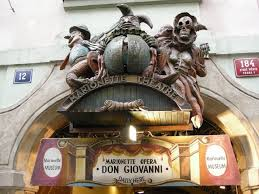
I was in Prague when a Czech girl about twenty held a heavy sign outside a ticket booth.  “Stop by the National Marionette Theatre for a Show,” it said. An arrow pointed up some stairs. She wore a clown suit. Ten AM, no later, she started—I saw her there four hours later, five hours, six, she stood supporting her sign and handing out leaflets to lead me to the “National Marionette Theatre’s Production of Don Giovanni.” I thought of the Statue of Liberty people hawking tax filing; and of giant chickens handing out coupons in the mall. This one is a national marionette theatre. This Czech girl pushed puppet shows on people.

Perhaps passing out flyers pays well. Or her parents preside over the theater, and this is punishment for tangling the marionette strings when she was five. Naturally, I couldn’t support such delayed abuse.  I might have taken a look if this person in my path performed with a puppet or two. But no; she just stood there. Maybe she holds the heavy sign in exchange for free admission to any performance she prefers. Tonight, Mozart: The Marriage of Figaro. They’re puppets, though. I’m not easily fooled.

To be fair, exposure to these arts is rare and the ransom of holding a heavy sign eight hours a day in a clown suit is worth it. Still, when she handed me the leaflet, I declined. Taking it, I thought, would provide false hope of my attendance. Perhaps she’s paid per person, and upon entering we must say, “The twenty-year-old girl in the clown suit sent me,” and she’d expect her cut of my admission. That money, added to the rest from other guilt-ridden tourists, might be enough to buy the Bohemian bracelet at the boutique near Charles Bridge. She might, while on break, charge the jewelry having counted on money from her promised patrons. She would eventually pay for it knowing she had income from my gracious acceptance of her leaflet. But I pulled my hand away. You see, when the theatre is mostly empty, and puppets bounce to Swan Lake, she might notice my absence, my lie, my blatant mockery of the marionette art form. I could not walk along Karlova Avenue again, not past that theatre, that clown suit holding that sign, in angst over her noticing me. I know no flier to this theater is handed out without strings attached. Especially if dangling from her wrists, beneath the puffy sleeves, I might hear the clanging of the bracelet still not paid for. I could not bare it.

So, of course, I didn’t take the leaflet.

Fliers about music, however, I accept. The string quartet playing Pachabel and Vivaldi at St George’s still stirs in my mind, or the symphony at St Martin in the Wall. One student once stood between me and the Literature Café after I had been teaching and was thirsty. He pushed Bach on me, motioning toward some small space in the next building. Outside a cello player performed for free, teasing us, baiting us without charge so we’d get hooked and go for the harder, move complicated compositions inside. Good marketing, I thought—the whole Literature Café crowd could conceivably fill a concert hall for Bach. Still, I declined and tried to glide around him.

Unfortunately, leaflet pushers in Prague promote their papers to blind eyes, throwing themselves in harm’s way to deliver the news, the message, the memo that something is about to happen that simply can’t be missed. I see smoke rising on cold evenings from the myriad chimneys across the rooftops and imagine these Czech people, instead of going to the show, walk the streets and collect leaflets to burn for warmth at night, the ashes of theatre and museum bills billowing into the cold Czech evening air.

Hawkers hand out leaflets for museums, tours to other cities, walking tours of the castle, Kafka’s Castle, Havel’s castle; walking tours of the Golden Way where Kafka wrote in a small blue house, walking tours of the Jewish Quarter with its cemetery of headstones strewn about like fliers in a parking lot on a windy day. Leaflets of art museums in Old Town near the atomic clock, tours to the Golden Tiger where Hrabal drank beer and wrote novels; sheets of paper promote discounts at restaurants, coupons for strudel, Monrovian wine tasting, and more music. No guidebook is needed for Prague; no online sources recommending what to do on a Tuesday night in March. Just walk up Karlova Street, or Nerudova, and flier clowns keep information flowing like hot wine in the Bohemian cafés.

One guy one night one year handed me a leaflet for a pub he said was near, right around the corner, an Irish pub, and the next night was St Patrick’s Day, and if I walked that way with him he’d tell me what to order, what foods are best, and if I took the flier with me, I’d get a discount and he’d get paid, and I knew then I was right in not taking that clown’s flier, that she, too, depended upon commission. So this guy walked with me that March 16th, late, through tunnels, up steep streets, and half-way up one narrow medieval way was an Irish pub, and I relaxed, no longer worried about being led into some torture room out of some Tarantino film. I walked in grasping my flier, had Guinness and potato cakes when a large Irish man invited me to his place for a St Patrick’s Day party the next night. “His place” turned out to be the Irish Consulate, and there turned out to be a few hundred people. We drank beer and listened to the Chieftains and to rare Van Morrison, and to the Wolfetones. We ate and laughed about Dublin versus Manchester United, which I had seen in a pub after someone handed me a leaflet for happy hour to watch the football match. The ambassador talked about his love of Prague and one of the guests talked about the cathedrals, when everyone began to talk about the music, and that flier brought it all home for me; the spontaneity that fliers provide. Guidebooks usually are married to planning or at least engaged to thinking ahead, but the almighty flier with its primitive shoving into our faces while heading somewhere else is the ultimate in tangents, the epitome of carpe diem. This is, after all, Bohemia.

“Here’s a flier—do it now—don’t think” is what those hawkers truly hail.  

One guy gave me a flier for a free strudel. I don’t turn down free anything, particularly food, particularly strudel. It was warm, with ice cream, and a pot of Irish Crème Tea, and I know the purpose was so I might purchase the pot of tea. Okay.

It is the unanticipated beauty of the immediate. It is the hard left turn. It is the unexpected now when moments of “what’s next” so often occupy our present ones. Sometimes life should be more akin to a pinball game: Instead of pulling our hands in, away from the tugs and tears at our sleeves from friends offering a last-minute road-trip, or family who knock unexpectedly, we should reach out and grab the opportunity. In Prague passing out leaflets prior to the Velvet Revolution indeed meant possible prison and accepting a flyer likely the same sentence. Indication of how important those fliers can often be. The power of the 8 1/2 by 11 sheet of paper can be immeasurable.

But more than that, they remind us that at any given moment, if we take our hands out of our pockets, we can discover a whole new train of thought, turn a whole new unanticipated direction. Little in our lives is designed for spontaneity; no, instead grand design proves itself with calendars, schedules, voice mail reminders, alarms and wake up calls. The places promoted on fliers are most often in back alleys or misunderstood. They’re the commoners’ billboard.

Once out near the Strahov Monastery, a dirty young woman with a dirty young child lay in the dust and filth of some alley not far from a nice restaurant where I used to drink fine wine, and she handed me a flier written in Czech. Her todler sucked on the crusty edge of his shirt. A passing stranger told me the flier read “Give me some money please. It won’t change your life but it might change mine.”

I did. It did.        

Leaflets have been around probably since Gutenberg. But as a means of persuasion, they most likely hit the mainstream during World War I when the British air-dropped leaflets throughout France to communicate with the German army. The Nazi’s dropped anti-Jewish leaflets during the 1930’s and the early part of the 1940’s, Lee Harvey Oswald handed out pro-Cuban leaflets, and just before the bombs were dropped on Hiroshima and Nagasaki, the United States showered Japan with more than five million leaflets warning the citizens of the imminent attack. It began, “Read this carefully it may save your life or the life of a friend or relative. In the next few days some or all of the cities named on the reverse side will be destroyed by American bombs.”

The Velvet Revolution in Prague in 1989 gained momentum behind the guidance of then play-write and eventual president, Vaclav Havel. The movement gained so much support, however, they couldn’t meet in the streets anymore and designated the Magic Lantern Theatre as their headquarters to organize. The dancers—out of work for the strike—would run leaflets around the city.  It was from there propaganda flowed. They passed out bread, they collected money, and they made and distributed leaflets to gain support from students and workers alike under the guise of the theatre.

So naturally while contemplating the clown at the National Marionette Theatre, I rethought the whole puppet thing; maybe I was wrong to walk by so fast. If she did get a cut, and I did attend, then she’d be happy, her bracelet paid for, and I’d attend what might turn out to be an amazing performance of Don Giovanni, albeit by sophisticated Pinocchios. So the next morning I vowed to go. Perhaps my attendance also supported some revolutionary agenda, even if her own. Clearly, it’s happened before.

The next day at the foot of the castle steps a man gave me a flier for the Torture Museum. “Just tell people to walk up and down these stairs,” I joked, but he didn’t understand.  I walked across Charles Bridge, up Karlova, and looked for the clown. The twenty-year-old was still there, and I walked close enough for her to hand me the paper.

Don Giovanni, or Don Juan, was written by Mozart and he first performed it here in Prague; Casanova himself collaborated on some of the scenes. In fact, in imagining Don Giovanni, Casanova said, “My life’s been filled with adventures, and truths often become larger than life when they’re retold. I never correct the tales that are especially hard to believe. It would be unkind to those who want to believe in them.”

Sometimes you just need something to believe in.

I sat in the back and enjoyed the marionette show. It was only later I realized I never saw a single string, not one wire.
Just a Good Stretch of the Legs

On the rainy walk on the Renvyle Peninsula

It’s raining at Aerie today, a heavy wet rain which if it wasn’t sixty-five degrees outside would be snow, the kind that weighs down pine branches and snaps the limbs of the smaller trees.

The sound of the rain is relaxing on the skylight above my head, and out the window the woods are foggy with a mist which looks cold but isn’t. It’s a good day to walk. When I was getting ready to do the Camino ten years ago this Spring, I walked in all kinds of weather from the rare snowstorms to the common downpours. Only lightning keeps me at bay; I don’t do lightning. Even inside I prefer to not sit under this skylight during a lightning storm.

But today is okay, with the rain and the warmth and my work for the colleges all caught up. I’m arranging some material for Ireland, figuring out a trip to West Virginia and Ohio, dreaming about Spain. I often dream about Spain. Remembering Ireland.

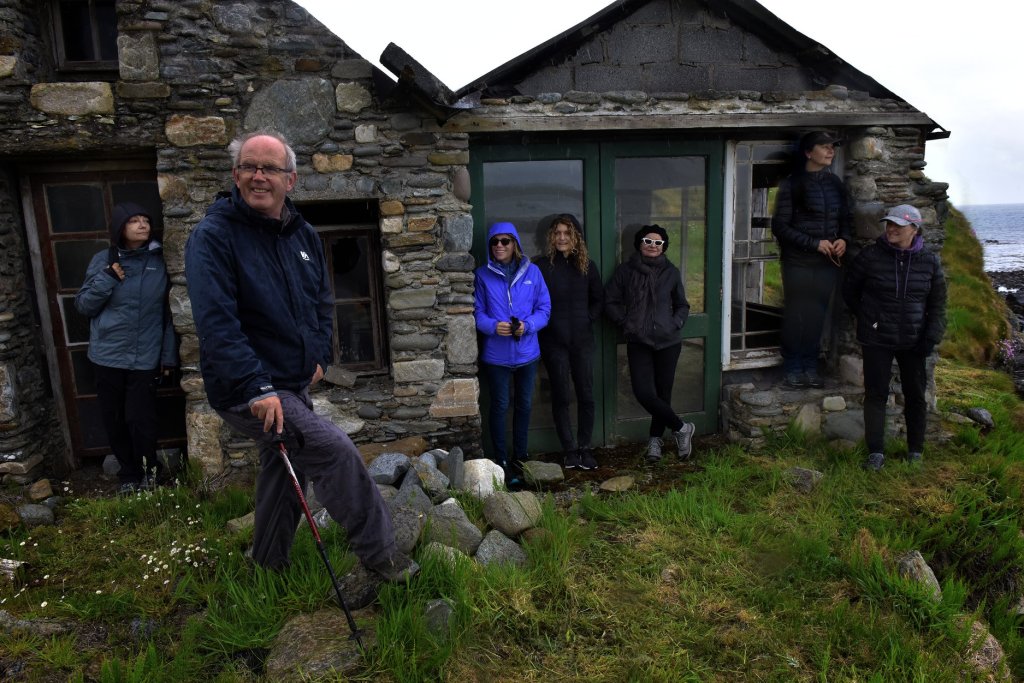
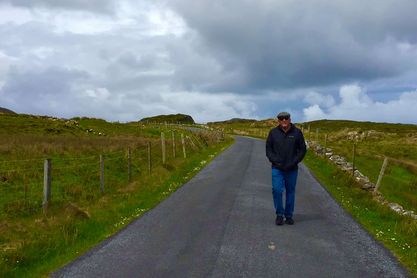
The last time I was in Connemara it rained one day, one out of about eleven days. That was in June that year, and the rest of the days were sunny and pleasant. It just so happened, however, that the one day it rained was a scheduled hike throughout the Renvyle Peninsula with famed archeologist, Michael Gibbons. Of course, being in Ireland, and him being one of the fine personalities of Ireland who jumps into bogs to show how dangerous they are and has a sense of humor which directly lines up with mine, none of us minded the rain. We walked through the crumbling graveyard of the Seven Daughters, took a break from the weather in an abandoned house overlooking the ocean, wandered for miles in the wide “wild west” of Connemara, along roads stretching past ladder farms and peat fields, and stood and listened to Michael talk about Standing Stones standing right in front of us, and dilapidated famine homes, and the Twelve Bens—mountain peaks stretching to the north, and curious customs he told us about with endless hysterical anecdotes. In all of my travels, that day, with Michael and my companions, was one of the most memorable.

With Michael Gibbons (foreground) et al, taking a break from the rain.

But I was going to say before the walk about Connemara came to mind and all the matter-of-factness about the rain, as Frost might have said, that today is fine here along the Rappahannock, and the rain won’t keep me from meandering to the water, listening to the foghorns on the fishing boats coming back from the Bay.

I was talking to someone earlier this week about Ireland, about the Renvyle Peninsula where we go, and he asked if I was from there, my ancestry that is. I was proud to answer yes, that in fact a large swatch of my DNA hails from County Galway, in Connacht, and while everyone who travels there automatically feels right at home, I felt some connection we all sense when returning to a place our forefathers come from. I felt it in Brooklyn, too, the first time I returned as an adult and walked the streets where my father and my grandfather grew up, and my great-grandfather too. It was like that in Ireland, in Connemara. I didn’t know my great-grandfather of Brooklyn any more than my ancestors of Connemara; I am as connected to them all.

Looking toward the start of the Twelve Bens

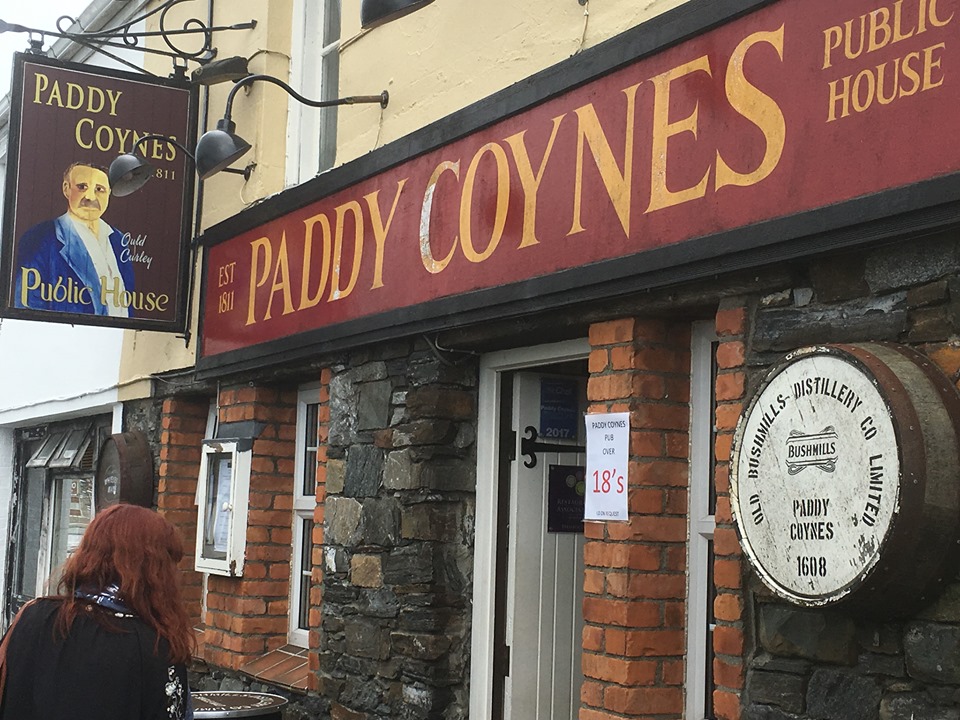
One evening we all went to dinner at Paddy Coynes in Tullycross, about two miles away. It dates back to 1811—new for Ireland—and is one of the popular pubs in western Ireland. We swapped stories, had oysters and lamb, whiskey and beer, Irish coffee, and readied to leave when I told everyone I had decided to walk back. A few protested, particularly Jacki who knows the roads better than anyone and whose roots run deep in the area. The roads are curvy and lined to the edge with high hedges, and traffic flows on the opposite side than what we are used to. Plus, it would be getting dark soon. Will, whose family is from the neighboring county, seemed more pleased than worried.

“It’s only two miles, and besides if it gets dark it is easier as I can see headlights and simply saunter from one side of the road to the other.”

They stood around talking about the meal we had just completed, and I left. The first mile is fine, with a wide road and wide shoulders, knee high walls and fields stretching clear to the east. On the west side of the street, houses sat back from the road behind Irish gates and Irish lawns—green of course.

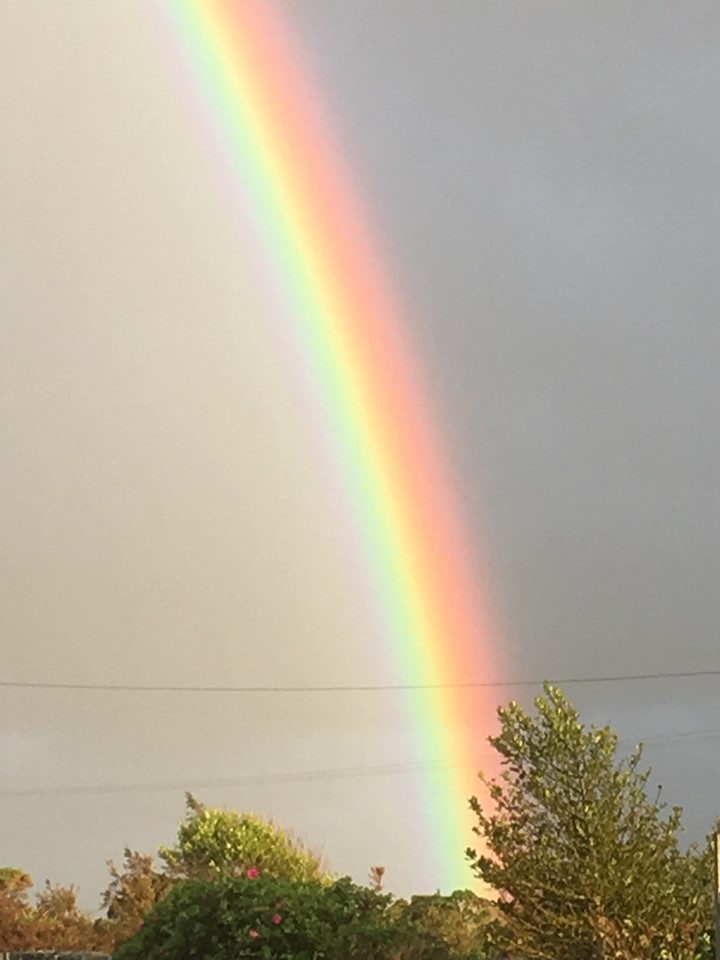
The rainbow over Tullycross

At the one mile mark I came to a crossroads with some houses and a pull-off area. I turned to look for the van, which had yet to pass in the time it took me to walk the mile, when out across the reach was one of the most beautiful rainbows I had ever seen, bold, and welcoming me to the Republic in fine Irish tradition. A car pulled over and the driver got out and took pictures, and then he and I talked a bit about rainbows and Paddy Coynes and Renvyle and America and writing and, finally, Guinness, and we sat on his nearby porch and continued our conversation for an hour, drinking beer and swapping stories. When it was time to leave, I decided to walk the last mile along the beach, this awesome Wild Atlantic Way, which I imagined my ancestors might have walked as well, dreaming perhaps of America.

Here’s what I did not know:

  1. The stretch of beach does not go straight down the coast to Renvyle House, but instead jetties out into the Ocean and then winds back, making the one mile walk about three and a half.
  2. There are cliffs—not high, about twenty feet, along the water, with a rocky beach; rocky like baseball and softball size rocks everywhere.
  3. The tide was coming in.

I was about forty-five minutes into my walk when I realized I could no longer see lights anywhere. I enjoyed the walk though, albeit on wet rocks while I was wearing slick-soled Vans more appropriate for standing on the deck of a boat. A few times the waves crashed close enough to wash up my legs to my thighs, and it was only when I turned a bend and the closest lights I could see down the coast, hoping it was Renvyle, were still well more than a mile away.

I slipped once and landed on my butt in the sand, my pants wet but my phone safe. I checked and had received a text from a friend back at the house: “Where are you? We’re all in the lobby! We didn’t pass you coming back.” I quickly replied. “Walking home now, slowly. I met a local man who invited me for beers on his porch.” Okay, I knew that sounded way more planned and carefree than my impending very possible dragging out to sea by a rogue wave on the rocks of Connemara.

Eventually, I could no longer walk along what was no longer a beach—excuse me, rocky path—and I looked up at the cliff and realized it was easier to climb than I had thought. A sheep looked down at me, almost as if to say, “You know we’ve been watching you this whole time. You’re a moron.” I moved up the sandy and grassy side of the cliff with relative ease as there was plenty to hold onto, and I made it to solid ground, a grassy field spotted with cattle and sheep, and in the dark distance a house, presumably the hand who owns these herds. I walked freely, sheep moving out of the way, me moving around cows, and climbed over several small fences and kept walking another thirty minutes, climbing fences and dodging livestock until I could see the lights of Renvyle just a few hundred yards away.

I made it to the beach near our place, and I walked to the front door and walked in to find most of my friends hanging out, drinks in their hands, listening to music, warm by the peat fire in the large fireplace. Will looked up from his camera to ask how it was. I told him about the beers, and he said it was the perfect Irish experience to have, and he was happy for me. Then I quietly told him I walked down the beach instead of the road, and he said, “Yeah, I figured.”

“I think a sheep called me a moron.”

“I know that sheep,” he said, and we laughed.

the peat fire at Renvyle House

A friend of mine says since I was born in a water sign, it makes sense that I’d be more comfortable along the Atlantic coasts on both sides of the pond than anywhere inland. Sure, part of me buys that, but just as much of me understands I’ve been coasting along sandy beaches since I’m nine years old and feel more comfortable doing so than in any hallway I’ve frequented.

But another part of me, the DNA part, likes to believe I followed some ancient path my great-great forefathers followed when they dreamed of America, wondered if they’d ever get there, wondered if they could simply ride the tide out past the Twelve Bens, past Achill and Inishturk, across the North Atlantic.

Yes, the actual sheep who laughed at me

The Russian Arc

Trinity Cathedral inside the Nevsky Monastery

The following is the longest blog post to date at A View. It is the result of news today that going to Russia is dangerous even for Russians with dual-American citizenship. I miss the place, the people, the endless laughter and outrageous stories from decades of travel. The country has come full circle in that time. For anyone wondering what the hell happened, here’s what happened:

The Russian Arc

In 1994, the streets of St Petersburg were dank, a monotone of browns absent of advertising, neon, or anything other than some Soviet style atmosphere. The only placards placed in random spots on Nevsky Prospect—the city’s Fifth Avenue—were Marlboro signs, the only western clothing of note worn by the suddenly displaced masses was Adidas warm-up suits. It appeared a parody of itself as presented in 1970’s and ‘80’s anti-Soviet movies. For seventy-five years the country, and Leningrad, moved in darkness under the Soviet leadership, and for centuries before that under the long reach of the Czars.

But in 1994 when I first arrived to teach American culture to faculty at Baltic State University, the first of what would end up being more than twenty-five trips in thirty years, democracy had found the streets of Leningrad, which had just changed its name back to the Imperial “St. Petersburg,” and Russians struggled to figure it out. The first week there, I stood in line for two hours at a bakery, and when I pointed this out at the college, my colleagues shrugged and said, “Da. Canushna.” Yes, of course. I explained that in the States, a new bakery would open across the street and be faster, charge less, offer discounts. Then I had to explain discounts and why, explain that the cashier who stood outside smoking while twenty people were in line would be fired. This led to a conversation about capitalism, and everyone was suddenly enthralled to hear about businesses and learn how to make money, the advantages of choices, the value of options. The men of the previous generation on through to the college students present when I first taught in the city, simply understood service to their country as paramount; it involved time away from family, but also provided pensions and a chance to protect their living conditions.

But after the coup, and certainly in the few years which followed leading up to 1994, it was a brand-new way of existence, and the long, cold winter of communism had finally ended. Things changed—and this is where it got tricky. At first everything was different overnight, like their currency, living conditions, international relationships, and availability of goods. But then the changes slowed to an immeasurable pace. People couldn’t find jobs or food, or they had to work for some organized crime group. Old folks lined the metro begging for money or selling items—shoes, loose cigarettes, empty bottles. But within a few years they figured it out.  One afternoon that first year I went to the market behind a cathedral in the arts district. It was a park area with tables covered in tourist items: matryoshka dolls, the famous Russian wooden bowls known as khokloma, pins, small wooden toys bears. Scarfs, shawls, icons, amber jewelry. The following year the market built small booths in long rows instead of random tables. A year or two later, the booths had roofs over them, then lighting was put in for night shopping, and by the 300th anniversary of the city in 2003, the entire market was covered, gates out front, a veritable mall filled with all the previous items, but also fine art, expensive purses, technology, and food were added to the shelves. The Russians were figuring it all out, and many made more money in a month than they had in a year under the Soviet regime. Organized crime groups took over and took a cut, and the city streets once filled with just Russian-made Ladas were now lined with black SUVs.

A friend of mine in the marketplace, photographer and artist Valentine, remained my source of all things business, and the changes almost became too much for him to handle. In 1995, I went in the Catholic Church nearby to find piles of rubble where an altar used to stand eighty years earlier, and the walls had been painted black, on the floor lay statues without heads. The priest, Fr. Frank Sutman, explained it had been used as a storage facility for motorcycles since the Great Patriotic War, World War Two, but the church took it over for the first time since 1917. By the turn of the millennium, the grandeur of the marble floors and beautiful walls had been restored. Across the street was a small shop. In the early years, I had to point to the item I wanted on the shelf behind a counter or in a glass case, and if I liked it, I took a handwritten receipt to the cashier who figured out the total on an abacus (no kidding), gave me a new receipt which I took back to the first worker to retrieve the items. This is how it was in the few grocers, the pharmacies, the bakeries. Only in the tourist market did one deal directly with one person.

Years pass.

A supermarket opened with cashiers at the end of conveyor belts who rang up your items, bagged them, and you walked out like you just left Walmart. The discovered calculators, paper bags, and the shelves were stocked with European goods. And on the streets, neon signs dominated the avenue: KFC, McDonalds, Pizza Hut, clothing brands, cigarettes, alcohol, appliances, cars. Except for the language I could have been in my native New York. The once empty streets were filled with people, all on their new phones, all taking pictures, all donning expensive jackets and shoes.

These were the years of tourism, of an entire generation and the next growing up without memory of Gorbachev, even of Yeltsin. We went on canal rides and took videos, wandered through neighborhoods and graveyards. I went to Victory Day a dozen times, talked to Vets of the Great Patriotic War, who loved to share their experiences, and I talked to the women—St Petersburg became known as a city of old women since the men mostly died in the war and children starved to death—about the changes, often as they swept the streets with brooms made from birch branches.

We went to the Kirov Ballet, the opera, folk shows, and soccer games. We dined in restaurants from Germany, Italy, China, and played music, danced and drink at The Liverpool, a Beatles bar.

Peter the Great’s dream of a city of culture, his “Window to the West” as he called it, had come to fruition.

By 2014, after twenty-years of going to Russia, anyone thirty or thirty-five years old and younger only new this new way of life. The very notion that the government would dictate what they could and could not do was as foreign to them as it is to us in the west. Students graduated from college and set up businesses, tech companies, they traveled freely and often to Portugal, the United States, Hong Kong, Sicily, everywhere. After almost a century of needing to walk everywhere and live with two other families in small communal apartments, they now owned cars and nice apartments. The once common practice of tourists bringing Levis or other western brands to trade for Russian trinkets was not only over, but laughable, with malls opening up with shoe stores, clothing stores, phone, sporting goods, and music stores, all filled with western brands.

The “old country” of Russia had so modified over the course of just two decades, one had to be in their forties to remember the Soviet system. What the average Russian citizen could not know, of course, was that the modifications made in palaces throughout the country, but in particular St Petersburg, was paid for by organized crime to increase tourism and international trade. The city where I could in those early years buy items for a few dollars, quickly figured it out and charged twenty or thirty dollars for the same items. Restaurants appeared everywhere with prices for those driving the SUVs, not for the Lada crowd.

My friends from Russia adjusted. A tour operator learned business well and built a company that dealt with tourists from all over the world. My artist and writer friends found new freedom in being able to take pictures of anything and anyone they wanted without recourse. They criticized the Yeltsin administration without worry of harm. For seventy-five years, the notion of dissidence, which not only included those who wrote against the government, but those who simply didn’t always write positive things about the government; particularly Stalin, had in just a few shaky years, slipped into history. Going to St Petersburg became simple. There was even talk for a while of dropping all the VISA requirements. I wouldn’t call it democracy, as such, but communism was dead. Gone. Lenin’s statues which had been everywhere in the early ‘90s were much more difficult to find. It became simple for a Russian to leave home and travel to the United States. And the did, gladly, relishing in being a part of the world, finally. This wasn’t simply détente; this was the start of a beautiful relationship.

In 2013, my son and I rode the trans-Siberian railway from St. Petersburg to Vladivostok, across more than six-thousand miles, and seemingly across decades as we retreated into the previous century the further east we traveled. In Yekaterinburg the western influence was still obvious, but in Irkutsk, another few days east, Soviet style practices still appeared common. The one fortunate thread remained the people, all deeply rooted in new democratic, even capitalistic practices. They drove Kias and Toyotas, they wore Levis and Ray-Ban sunglasses, and they spoke of their vacations in Australia, the Canary Islands, Florida. If I had not been already in my fifties, there would be no basis of comparison to the old, Soviet ways I grew up learning about, fearing, hating. Nothing I had learned about these people was true, even in the early nineties. The propaganda machine, practiced just as efficiently in the west, had turned out to be shallow, and that was with a generation of Russians whose experience had only ever been Soviet or Czarist. This new generation, those already well into their careers, families, homeownership, and substantial investments, just two decades old, was the dominant population across the country, and they knew less about living under a fascist regime than I did.

Until Putin.

He came in early and soft, almost friendly, certainly acceptable. He was a man with a vision for this new country who followed the floundering Boris Yeltsin, and as Putin’s power and wealth increased, he rebuilt his native St. Petersburg. He saved the former Soviet Union from ruin and the economic disaster of the Yeltsin years, which left a rampant homeless and starving population to fend for themselves. Right after the coup to end communism, the nationalization of all businesses and housing ended, but so did the pensions. Housing privatized and if the residents couldn’t afford the new rent they were kicked out. Hospitals quite literally rolled patients out the door and left them near churches to fend for themselves. Putin moved from the city’s Vice Mayor up the ladder to President on the promise he would “clean up” the homeless problem, “employ” people willing to work for anyone, and made business deals that brought unprecedented wealth to the nation. Russians welcomed him; so did western leaders. And the population which benefited the most were under forty, tech-savvy millennials who worked their way up, drove expensive cars, and lived in large sweeping apartments on Nevsky Prospect with beautiful dachas in the countryside or Ekaterinburg. Tourists who visited St Petersburg discovered open palaces with gourmet dining rooms, clean hotels with five-star service, shops with icons, malachite and amber jewels, and all-things-fashion. Russians, too, became tourists able to see more than the dachas they shared with other families. They traveled to Italy, to Portugal, France, and the United States. Satellite television common in the nineties became fast internet service enabling partnerships and communication with anyone anywhere.

Then Ukraine happened.

Those same students just out of communism and thrust into capitalism are now in their late forties, at least, and their children, raised in nothing but a mostly free-capital society with all the advantages and freedoms we understand here in the States, are being drafted into an army to attack a country they spent their entire lives visiting on vacation. When the news speaks of “Russian military,” this is who they’re talking about; men and women whose only reference and background was freedom of choice, of employment, of wandering, of economic wealth. Their only requirement was the possibility of two years mandatory service before they turned twenty-seven. Piece of cake; their billets ranged from one end of the earth to the other. So while their parents may not have been surprised to have been called to service in Afghanistan in the seventies for the Soviet government, these men and women dreading duty in neighboring Ukraine had anticipated their best-laid plans to pursue personal ambitions, and went to schools which had been teaching them international relations and economics, until the hope they had for life was disturbingly aborted for reasons beyond their comprehension or desire.

Then western sanctions hit and the country shut down, banks stopped all business outside the borders, foreign companies which lined Nevsky Prospect with signs and tables and parties were suddenly gone. The streets once again seemed grey, empty of life. Employment disappeared and no pension waited by to save them, so the army promised to pay their bills, which they did for a short while, and when word spread that the truth is they could barely feed their soldiers, let alone pay them wagers a fraction of what they had been used to, many fled.

Back in the mid-nineties, a friend of mine would write complaining about Yeltsin, about the lack of support from the United States, about the homelessness and difficulties dealing with “Old Russians,” who knew Soviet Ways, and how the “New Russians,” assume they have a right to whatever they can get. The anecdote which circulated then was how a New Russian in a Mercedes SUV waited at a stoplight when an Old Russian in a Lada with no brakes hit him from behind. The Old Russian got out of his car terrified, but the New Russian simply said, “Aren’t you glad I’m here to stop you? Otherwise you would have run out of control and killed yourself.” That was the propaganda which took hold and brought this nation to life; this nation now isolated and quite possibly on life support.

In the last few months, after a year of no word from friends who still live behind this new Putin Curtain, I heard from the friend who twenty years ago spoke openly of the problems in the city, back when the place was starting to shine. This time he speaks only of pleasantries, of how beautiful the weather is, and how he loves his city. No word of Putin; my friend remains uncharacteristically quiet about all things governmental. Another friend in Europe tells me his own family in St. Petersburg reports the lines are back for the purchase of many goods, like before the coup thirty-five years ago, and families are once again forced to move in together to save money, and he cried knowing his family whom he could visit whenever he wanted and who came to see him often, no longer has the ability to travel anywhere, nor the means even if they could leave. And he spoke as if this was the early fifties and Stalin was still in charge, that “to speak negatively about President Putin is to be thrown in jail.” And today come reports that anyone with dual citizenship with the US and Russia who had been contemplating going back to Russia should not do so lest they be detained indefinitely in Russian “holding” areas.

Maintaining control over the population of the Russian Empire after the Civil War following World War One was not difficult; the people had never truly known freedom as we understand it; Czarist Russia ruled for nearly a millennium. Russians appreciated the promises made by the Bolsheviks, and despite many of those promises never coming to fruition, most people abided by the Soviet system, even out of fear. And following the fall of communism in the late eighties and early nineties, Russians welcomed the opportunity to break free of the limitations of their previous government, but when almost a decade passed and things got worse, not better, it was not difficult for someone like Putin to convince them a little more government control, “like it used to be,” was a good thing. For a while, he maintained a perfect balance of top-heavy government—albeit one on the take to the tune of billions of dollars—and the personal freedom to come and go, grow and expand, as one pleased. This lasted until February 24th, 2022, when Russia invaded Ukraine.

But something is different this time. One hundred years ago the people had only known an oppressive government, as was the case thirty-five years ago, so leading them down the path the new leaders desired was not difficult. But now, two generations into a country used to most of the freedoms we have in the west, the population, despite the Russian propaganda to the contrary, is displeased with their government’s bombing of an innocent nation, ending the freedoms of the people of both countries. When the war began, Russia had 360,000 active troops. In the past two years, 315,000 of them have been killed or badly wounded, only to be replaced by new “recruits.” According to the UN, that amounts to 87% of their numbers at the start of the war. In the Ukraine since the world changed two years ago, more than 30,000 soldiers and civilians have been killed or wounded.   

The Russia I knew is dead. I miss my friends, Valentine, Igor, Sasha, and Dima the violin player. I miss the atmosphere, the storied example of perseverance that was the St Petersburg I knew, filled with veterans who miraculously survived the siege of their city for nine hundred days in World War Two; a siege and destruction of people which one of the city’s own, Vladimir Putin, once exclaimed must never be allowed to happen again, until he did just that. The promise and beauty of the Russian artists, the teachers, and the children, are simply gone. And in Ukraine with a history deeper, older, and more beautiful than even Russia’s, a civilization has been annihilated. Historians will not point to a myriad of reasons for this incomprehensible tragedy; studies will not have to be undertaken to better comprehend the causes of the invasion. The brunt of this brutality falls squarely on the shoulders of Vladimir Putin.

Valentine
Me and Valentine

Departure Signs

Some stories are difficult to write about for a variety of reasons. This falls into that category, but not for the reasons one may conceive, such as “too sad,” or “too morbid,” both of which I write without much trouble.

No, this is about diction and sound. It relies heavily on the reader “hearing” particular words phonetically so one can understand the misunderstanding.

Here’s what happened:

Many years ago I drove my parents to Norfolk International Airport for a flight to Islip, Long Island. It was early, just after six, and nothing was open at the airport food court yet except an “A&W Root Beer” joint serving breakfast biscuits and coffee. Dad was still tired, so he and I sat at a table while Mom went to get two coffees and two breakfast sandwiches for them. I opted out.

I could hear my mother repeating the order several times to the Filipino woman working alone behind the counter, and frustration grew between both of them. After fifteen minutes of Dad wondering where Mom disappeared to, she returned with a brown tray with their order.

“Somethings not right,” she said.

“Why?”

“It came to $27.50.”

“Airport food is very expensive,” my father chimed in, reaching for his bacon, egg, and cheese biscuit.

“That sounds wrong, Mom.”

“I couldn’t understand a word she said.” And at that, Mom grabbed the sandwich out of Dad’s hand, put it back on the tray, and walked to the counter.

“They’re speaking Spanish. No wonder.”

“No Dad, it’s Tagalog.”

“Why don’t you help your mother. You speak Spanish.”

I walked to the counter. The woman looked at me. I simply repeated what my mother had said from the start, that the sandwiches and coffee should have come to just over $8. I swept my hand across the plate and showed her the receipt for $27.50, and she put four more sandwiches on the tray. I took them off and asked if she was the only one there. She walked into the kitchen.

Exasperated, I put my hands on the counter with my head down and said, mostly to myself, but my mother could hear, “We’re not going to get anywhere unless we speak Tagalog.”

My mother stood up as if she had new life breathed into her. “Well! Then let’s speak to Galag. Is he the manager?

The woman returned with an older, Filipino gentlemen, and my mother, very politely, told him, “I’m sorry but we paid almost thirty dollars for sandwiches that only cost about eight, so we’d like to speak to Galag.”

“Mom…” (it was hard for me to speak as I was laughing)

“I think my son here knows him, but we’d like to speak to Galag immediately.”

“I don’t understand!” the man said.

“Is Galag here? We’d like to speak to Galag please.”

“I speak English,” he said to her, and then, just as I was finally calm, added, “I’m sorry but it takes quite a while to speak Tagalog.” I lost it when Mom looked at me and asked when the flight leaves and if we had time to wait for him.

The man, figuring out the problem quickly, refunded all of Mom’s money and gave her new sandwiches for free. On the way back to the table, she turned to me and said, “How do you know Galag?”

Dad had wandered across the hall to Starbucks which had opened by then.

I was at Mom’s this week. We talked about Long Island, and about Dad, who passed away eight years ago on October 21st. I think of him when I’m in airports, or when I see a payphone. He had an 800 number at his desk back when the only way to call home was “long distance,” and it cost a fortune. So throughout my techless twenties, I was able to talk to Dad several times a week. I’d call from the Arizona/Mexico border, from New England, New Orleans, and everywhere in between. He was a quiet man with a deep sense of humor. One of my biggest regrets in life is I am not more like him.

In their later years I brought them to the airport or Amtrak more than a few times. Once, we were on the train and I disembarked just before they left. But it turns out my officemate Tom, who knew them, was on the same ride north and kept them company the entire way. Another time I brought Dad to some flight somewhere, I forget where, but we had a drink at Phillips Seafood Restaurant in the airport and talked about travel and books and plans. When we talked like that I felt close, of course, but also more connected; as if we shared something larger than ourselves. I could always tell when he was thinking about travel, though he rarely went very far. He didn’t miss a chance to talk to his kids about it, though. The signs were there to show me where his mind was; the way he liked to ask where I was going next. The way he listened so closely, responded always with such encouragement.

The first time I flew in my life I was fifteen. Dad had a convention in California, and Mom refused to fly. So Dad and I dropped her off at the Amtrak Station in Norfolk, played golf, and went home. Spent the next day around the house and then we went out to dinner together. The following day we flew to Los Angeles business class—my first ever flight—with dinner menus and a large screen on the wall so all the passengers could watch a movie together. It was Rooster Cogburn with John Wayne. We arrived in LA, rented a car, and drove to the train station and waited for Mom to arrive. We laughed about that for years.

One time we remembered that story when he brought me to the airport to fly back to Buffalo for college. He said he couldn’t stay, so he shook my hand and left. I got something to eat, wandered around, found my gate, waited, boarded, and the plane taxied out to the runway.

It had been about ninety minutes, but when I looked out the window, I saw Dad at the observation parking lot standing near his car, waving.

“My life has been a poor attempt to imitate the man.”

–d fogelberg

Me with Dad at Mahi Mah’s Restaurant in Virginia Beach (photo by Michael Kunzinger)