Video File: Small Talk

I write mostly personal essays or memoirs, so my work bends toward the lengthy; it isn’t unusual for an essay to run fifteen pages. When I started doing public readings, it took about twenty minutes or more to read one piece, but this was not an issue as I would either read alone or with someone else who would do all their work at once and then I’d do mine, block style.

But then my dear friend, poet Tim Seibles, suggested we read together, that is, on stage at the same time, alternating pieces. We did a series of twelve readings for roughly two-hundred people each time at the now defunct Jewish Mother in Virginia Beach, Virginia. The Jewish Mother Sessions forced me to write short pieces so that when we alternated on stage, he didn’t read a four-minute poem followed by me reading a thirty minute essay; we’d have been there all night.

So I took fragments of long pieces, and then I started to write dedicated short work a la Kate Chopin’s “The Story of an Hour.” I’m not a poet, but I threw a couple of lame attempts in there as well later in the evening after the crowd had been drinking a while. As a writer, I loved the exercise of telling a story, or more often just a piece of story, in a flash. Hence, “Flash non-fiction” entered my world, and since then many were collected in my book, Fragments: Flash Non-Fiction.

The individual pieces had been picked up by some journals, including Kestrel, Matador, Sand, and more. I wrote about animal names, about health conditions, about 911 and art. A few pieces got some legs, like “Instructions for Walking with an Old Man at the Mall,” originally written for our readings, picked up by Kestrel, reprinted in Fragments, and then anthologized several times. This piece, “Small Talk,” is one of my favorites for self-explanatory reasons. I’m certainly more comfortable after a glass of cab in front of a few hundred people who have had several gin and tonics than I am in front of a small camera in a small space. But as my mother says in a phrase she is convinced she coined, “It is what it is.”

I learned from Tim to STFU and just read. So, here, from my office at Old Dominion University a few years ago, is “Small Talk.” Thank you for tolerating my face and voice for a few minutes.

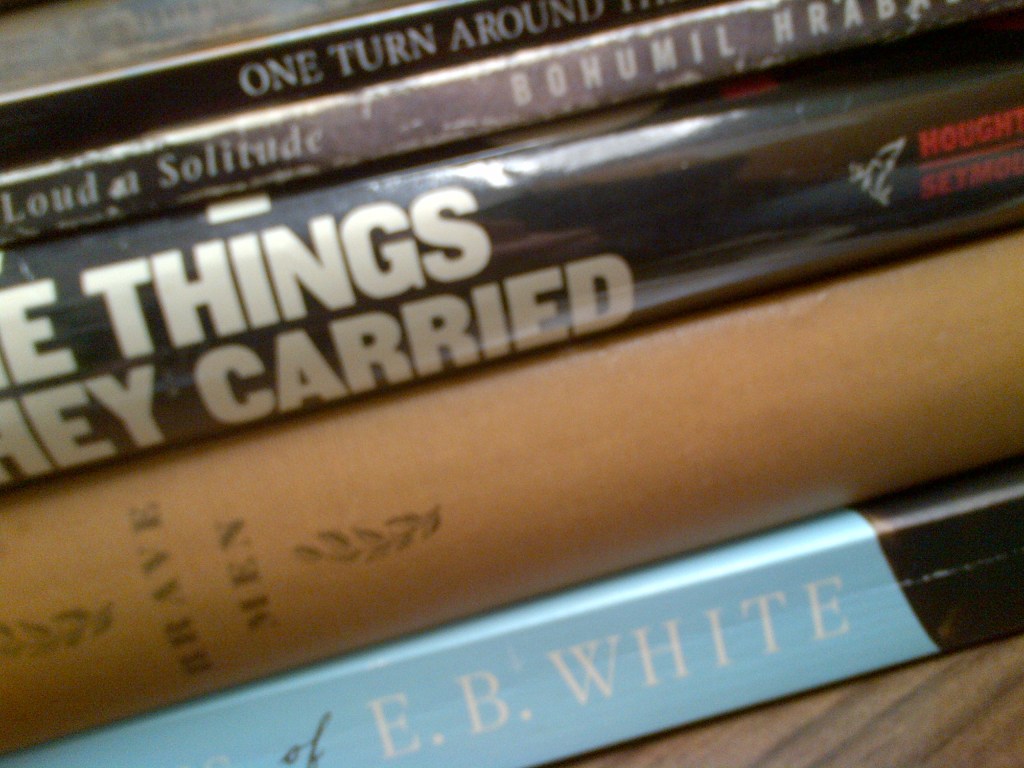
The Book List

Tim O’Brien The Things They Carried.

Tim Seibles One Turn Around the Sun

Ernest Hemingway Old Man and the Sea

Bohumil Hrabal Too Loud a Solitude

Carlos Fuentes Old Gringo

Ernie Pyle Brave Men

Roberto Bolano A Little Lumpen Novelita

E.B. White Here is New York

Frederick Douglass Narrative

Robin Lee Graham Dove

 ——

When I was in college a professor asked us to list ten books we loved so he could explain what he figured out about us from the list. Except for the minor detail that I wasn’t sure I had even read ten books, I thought it an interesting assignment. I remembered this a few years ago when I heard of a professor who claimed he could tell the IQ of a student by looking in his backpack. I thought about doing that assignment with my students at the last college where I worked full-time, but I think instead of being able to tell their IQ I’d be predicting the length of their jail time. 

My book list in college included Stephen King, Woody Guthrie, Robin Lee Graham, Woodward and Bernstein, and most likely Dr. Seuss because I was a wise-ass. I don’t remember much of the professor’s analysis except what was clear to anyone, I liked adventure and bent toward non-fiction.

I am doing this with my students next week, but to be fair I decided to redo my own list now that I have actually passed the ten-book mark. The ten books above are what I consider the most influential or memorable or re-readable books I can recall. I didn’t head to my bookshelves to come up with them; I simply put my head back and thought about books.

Some observations:

  • I still like adventure and have a bend toward non-fiction.
  • Five of the books are non-fiction though O’Brien is thinly disguised fiction (Read If I Die in a Combat Zone for reference)
  • Seven of the books are pretty short
  • None were written by women despite some heavy influence from women in my writing, including Alice Walker, Frances Harper, and Virginia Woolf.
  • Three were not written in English.
  • Seven do not take place in the United States, though The Things They Carried is debatable since much of it does but much of it doesn’t. So six and a half.
  • Five of the authors are also known as essay writers.
  • Seven somehow wrapped themselves into the narrative.

Tim O’Brien’s The Things They Carried is simply one of the greatest books of the 20th century, and while it takes place in Vietnam, it is not about Vietnam anymore than Tim Seible’s One Turn Around the Sun is about astronomy. In O’Brien’s book, along with Hemingway, Hrabal, White, Douglass, and to a lesser degree Pyle, the author either writes directly to the reader or involves the reader in some way.

Seibles’ book is about his parents and age. In fact, the passing of time is a common theme for Hrabal, O’Brien, Guthrie, and Pyle. I have heard Tim read from the book long before it was published, have talked to him many hours over lunch about our parents and time and age, and admire his diction and phrasing perhaps more than that of any writer I know. He is a giant in the poetry world and this book is his best. Read it from start to finish; don’t jump around. People pick up poetry books and read them like they’re Russell Stover boxes of chocolates. Stop. There is an arc in there, and it should be read that way.  

I love how Old Man and the Sea is about an old man at sea whose pride is simply too strong to let the damn marlin go and focus on the smaller fish around him. And then when I read it again it was really about pride in general and who we are and what we learn as we mature. And then when I read it a third time I realized the entire story is the Passion of the Christ. I like how Hemingway never lost his journalistic tightness and how he uses repetition as an art form. Also, the book is really short and I generally run out of steam at about 100 pages. When he wrote, “It was an hour before the first shark showed up” just a dozen pages from the end, I was already hoping the boat would sink.

Susan Sontag once said Czech writer Bohumil Hrabal is one of the finest writers she has ever read and Too Loud a Solitude is one of the finest books. I’m with her on that. It took me several reads to understand how this crazy-ass little book is a compact version of all the greatest philosophies in history, and the “compact”ness of it is a metaphoric spin from the lead character who compacts trash. It is funny as hell and poignant. To top it all off it happens to be parallel in so many ways to The Things They Carried that I could teach a seminar in those two books. As an aside I should say that Tim told me once he focused on Czech language and literature for a while and that Hrabal was a favorite. Go figure. Read both books and you’ll see what I mean.

When I was at Penn State, I spent a lot of time reading all of Fuentes’ work. He seems so much like Hemingway and uses a classic narrative structure. I read his work more because of his locales than the story, and also I was trying to fine tune my Spanish, but Old Gringo is my favorite. If anyone likes Hemingway, he or she will like Fuentes. Read it in English, though.

Ernie Pyle’s work was introduced to me by Professor Pete Barrecchia at St. Bonaventure. Since then I have not met a journalist who was not at least somewhat influenced by Pyle. He is, to be certain, above all other war journalists before or since, and Hemingway once said if Pyle had not been killed at the end of World War Two, it is unlikely anyone would know of what Hemingway wrote after that. Google “Ernie Pyle Normandy” and read his piece about walking the beach at Normandy. It is easy to see how Hem and O’Brien both took much away from this great journalist, particularly O’Brien.

A few months ago, Tim Seibles gave me a copy of Bolano’s book and I read it start to finish without stopping; a nearly impossible feat for me except it isn’t that long. I had given him a copy of Too Loud a Solitude and he said that crazy-ass book reminded him of this one and when I was through we laughed about how neither of us could explain to anyone what the hell it is about, but it simply keeps you from start to finish. It sent me to the rest of Bolano’s work. I still can’t explain what happens but I love how it happens. Bolano is a writer’s writer in that he is an artist in his work instead of simply a storyteller.

I was listening to “Selected Shorts” some years ago, already familiar with EB White’s excellent essay work outside of his famous grammar book, and I heard someone reading “Here is New York.” It stands alone for work that is less “about” New York than it is about the state of “being” in New York. If I were born earlier I think I’d like to have been EB White. It is absolutely one of the finest essays ever written about the spirit of place—something I am very drawn toward. Plus, you know, it’s about New York.

I love Douglass’ writing style—very journalistic in approach—and his description is honest and raw, made more revealing by his first-person experience. But there is something else that makes this one of my favorite all time books and Douglass my greatest American hero—his Character. Frederick Douglass is an inspiration not only for his accomplishments against the greatest odds in an evil system, but for his mostly firm moral compass through it all. He is simply a tremendous example. The Narrative of Frederick Douglass should be required reading in every single school.

Graham’s book was simultaneously published with a young adult version called The Boy Who Sailed Around the World Alone, one of the first books my father ever gave me for Christmas. Indeed, the first. This book’s influence, for me, has nothing to do with his writing. It is about sailing, seeing the world, writing about it, and taking that money to go see more of the world. It very well might be the most influential book in my life as far as my motivation is concerned. Years ago I lost the copy my father gave me, but a month ago my son and I were in a local shop and there was a copy. Reading it still stirs something in me I cannot explain.

These are not the most influential writers for me as a writer—that is a different list, though there is some crossover. To the point—O’Brien, Hemingway, Pyle, and Hrabel make both lists, but the rest do not. These four for one reason or another “inform” how I write—sometimes by outright theft. The other two writers who influenced me as a writer are first Aaron Sorkin, who I think is simply one of the finest writers working today, though he is wholly a screenwriter and playwright, but that makes him a master of dialogue. And finally Jackson Browne. His early emotionally-driven work sets tone for me better than any writer I know. Obviously, part of it is hearing a minor key come in for something like “Sky Blue and Black” or the musical phrasing of “For a Dancer.” As I get older, poetry for its diction has become more important, and I’m still trying to find the patience to be meticulous in that regard. But for tone, the music of Browne or Van Morrison or just the right rendition of Pachelbel’s “Canon in D” can light fire under my work way faster than the classic writers. Often even faster than caffeine.

I have read many books beyond this list, including a stack my son gives me saying, “This seemed like a book you’d like.” He has already read more books than I have in my life. I am not sure why I have an aversion to reading; I think it is because I try to spend as little time as possible reading about what other people have done and spend that time doing something. When my colleagues in the writing world get together and talk about our peers and what they’re doing, I generally slide out of the conversation and find someone who wants to talk about something more relevant to me, say like goats or the beach. Part of it is I hate talking about writing; but the larger issue is simply I do not read that much. I write or I do things.

So when I do come across a book that takes me in and takes over my mind for a while, I want everyone to read it. When they finish reading all my books of course. It shouldn’t take long; they’re short.

What books influenced you?
Poetics

I have several writing projects at various stages of incompletion.

My manuscript Front Row Seat is under negotiation; one of my early books, Penance, is getting attention and I’m seeking a new publishing home for it to find new life; I’m talking to a few publishers about my second book of short non-fiction prose, Wait/Loss, and I’m still in a boxing match—the same boxing match I’ve been in for decades—with my manuscript, Curious Men.

Shifting between projects is quite easy—oh, I can abandon one for another without much effort. It is sticking with one for a while that alludes me sometimes.

And I have drawers filled with starts and near-finishes, segments and introductions, good lines, decent paragraphs, and scribbles I can’t decipher but I keep them in case I learn my written language again.

This is all on my mind because at an online creative writing workshop recently someone asked the standard “Where do you get your ideas from?” question. I used to say, “Trenton. I use a mail-order catalogue,” but I realized that was somewhat snarky. Now I quote my good friend Tim Seibles:

Some things take root in the brain and just don’t let go

I love when someone says exactly what I’m thinking. Saves me time.

As for ideas, yes, that’s how it works. I might be out for a walk along the water, or perhaps driving somewhere, and one thought leads to another, and then just the right song comes on, or a smell—yes, sometimes it might be an aroma that makes me think of a place, and then the receptors in my head are off and running; I’m just along for the ride, somehow simply a spokesperson who never really gets the translation right. That’s the problem with writing; it is rarely right. If someone looks at a piece they’re working on and very comfortably suggests there is nothing more that can be done, I am weary of reading it.

But of all the writers I know it has always been the poets who can get me to sit back and say, “Yes! Exactly.” I can carry on conversations all day long about a subject and then toss it around in my head for a few days, write it out, readdress it, and pour some decent energy into it, only to turn to a few lines some poet wrote and find the need to burn my work. I’ll do it too; I’ll sit here with a match and hold the pages while they flare up. It has a very cleansing effect.

Here’s an example: Tim and I went to lunch at this same divey joint in Norfolk we always go to, and we talked. We talked about our fathers, or about something in the news. We talked about a variety of things that good friends talk about; no, we rarely talk about writing. Well, somewhere over the course of the last year I have several times talked about my dad, about how I miss him; I know Tim can relate so I don’t’ have to say much, but still, talking is always helpful. Unfortunately, my words are trite, predictable, and lazy descriptions of how missing a person feels. Of course, I’m not trying to compose a play; I’m just talking about my dad. Still, I want to get it right.

Then not too long ago I flipped through one of Tim’s books and came across this:

Missing someone is like hearing a

name sung quietly from somewhere

behind you. Even after you know no

one is there, you keep looking back.

I could write a thousand lines about how I miss my dad, but that covers it. That’s poetry.

Anyone who listens to a lot of music knows what I mean. Some lines just say it all.

I have tried to write essays about nature, already handicapped by the vast selection of the genre from people such as Thoreau, Muir, and E.O. Wilson. In my files are dozens of starts in an attempt to finish a piece about the closing of autumn and the onset of winter. Those particular brain receptors often click into the passing of time, the end of things, the changes beyond our control. I wrote one “epic” diatribe that might be the most bloated piece of crap I’ve ever attempted. The only way to make it more pretentious would have been to have it translated into Latin. Then Frost does this:

So dawn goes down to day,

Nothing gold can stay

Bastard.

I prefer conversations at lunch, of course. I like to sit and have a beer and talk about our dads; I like running into a friend and grabbing a bite and laughing about simple things like sports and movies.

But I also like reminders of our glide across this thin layer of life.

Still, over the course of the past bundle of time I found a way to handle my frustrations when I can’t find the right words to express our need to celebrate being alive: I call a friend and meet him for lunch. I head to a favorite café and have a beer and talk to strangers. After all, every single one of my closest friends was, at one time, a complete stranger. I walk along the water and watch the dolphins breech and disappear. I feel the coolness of morning give way to the warmth of the sun on my face.

I am surrounded by poetry.

I sat in an Irish pub in Prague once during a soccer match between Dublin and Manchester United. The excitement and roar of the crowd, the explosion of being in the moment, alive, right then ever-so-briefly, was poetry.

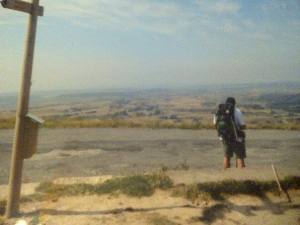
There was the time my friend Tom and I sat on a rock in the mountains west of Tucson and watched the sun work its way across the desert. Or that same year when my friend Renee and I walked through a Mexican village and found a restaurant inside a cave where, incredibly, someone who had babysat her sat at another table. Or the time Kay and I stood atop a supposedly haunted lighthouse and laughed uncontrollably, or when Michael and I walked past the small sign that said “Santiago de Compostella” five hundred miles and five weeks after we left France. Or when we watched the seals at Lake Baikal. Or nearly every night when we watch the sun slide away.

Poetry.

Or Tuesday nights after I finished teaching and Dad and I would have some Scotch. I can still hear the announcers of the baseball game, the sounds of ice in Dad’s glass.

So many poetic sounds.

The sound of the golf ball dropping into the cup.

The sound of cardinals on the porch, looking for food.

Waves. Rain on a lake.

A very long hug from an old, old friend when we knew there was no reason on Earth we should have lost touch.

My dad’s laugh.

His deep “Hello.”

A name sung quietly from somewhere behind you

A Non-Poet’s Tribute for National Poetry Month

At a creative writing workshop someone asked the standard “Where do you get your ideas from?” question. I used to say, “Trenton. I use a mail-order catalogue,” but I realized that was somewhat snarky. Now I quote my good friend Tim Seibles:

Some things take root in the brain and just don’t let go

I love when someone says exactly what I’m thinking. Saves me time.

As for ideas, yes, that’s how it works. I might be out for a walk along the water, or perhaps driving somewhere, and one thought leads to another, and then just the right song comes on, or a smell—yes, sometimes it might be an aroma that makes me think of a place, and then the receptors in my head are off and running; I’m just along for the ride, somehow simply a spokesperson who never really gets the translation right. That’s the problem with writing; it is never right. If someone looks at a piece they’re working on and very comfortably suggests there is nothing more that can be done, I am weary of reading it.

But of all the writers I know it has always been the poets who can get me to sit back and say, “Yes! Exactly.” I can carry on conversations all day long about a subject and then toss it around in my head for a few days, write it out, readdress it, and pour some decent energy into it, only to turn to a few lines some poet wrote and I find the need to burn my work. I’ll do it too; I’ll sit here with a match and hold the pages while they flare up. It has a very cleansing effect. Plus, you know, toasted peeps.

Here’s an example: Tim and I went to lunch at this same divey joint in Norfolk we always go to, and we talked. We talked about our fathers, or about something in the news. We talked about a variety of things that good friends talk about; we rarely talk about writing. Well, somewhere over the course of the last year I have several times talked about my dad, about how I miss him; I know Tim gets it so I don’t’ have to say much, but still, talking is always helpful. Unfortunately, my words are trite, predictable, and lazy descriptions of how missing a person feels. Of course, I’m not trying to compose a play; I’m just talking about my dad. Still, I want to get it right.

Then not too long ago I flipped through one of Tim’s books and came across this:

Missing someone is like hearing a

name sung quietly from somewhere

behind you. Even after you know no

one is there, you keep looking back.

I could write a thousand lines about how I miss my dad, but that covers it. That’s poetry.

Anyone who listens to a lot of music knows what I mean. Some lines just say it all.

I have tried to write essays about nature, already handicapped by the vast selection of the genre from people such as Thoreau, Muir, and E.O. Wilson. In my files are dozens of starts in an attempt to finish a piece about the fall of the year and the coming of winter. Those brain receptors often click into the passing of time, the end of things, the changes beyond our control. I wrote one “epic” diatribe that might be the most bloated, pretentious vomit I’ve ever attempted. The only way to make it more pretentious would have been to have it translated into Latin. Then Frost does this:

So dawn goes down to day,

Nothing gold can stay

Asshole.

I prefer conversations, of course. I like to sit and have a beer and talk about our dads; I like running into a friend and grabbing a bite and laughing about simple things like sports and movies. But I also like reminders of our glide across this thin layer of life.

Over the course of the past several years I found a way to handle my frustrations when I can’t find the right words to express our need to celebrate being alive. I call a friend and meet him for lunch; luckily, he’s usually a poet—I know a lot of poets. If I can’t find one, I head instead to a favorite café and have a glass of wine and talk to strangers. Every single one of my closest friends was, at one time, a complete stranger. I walk along the water and watch the dolphins breech and disappear. I feel the coolness of morning give way to the warmth of the sun on my face.

Note: We are surrounded by poetry.

I sat in an Irish pub in Prague once during a soccer match between Dublin and Manchester United. The excitement and roar of the crowd, the explosion of being in the moment, alive, then, ever-so-briefly, was poetry.

There was the time my friend Tom and I sat on a rock in the mountains west of Tucson and watched the sun work its way across the desert. Or when Michael and I walked past the small sign that said “Santiago de Compostella” five hundred miles and five weeks after we left France. Or when we watched the seals at Lake Baikal.

Poetry. Like when we walk to the river at sunset, most nights for twenty-five years now, and catch the colors, find the light on the water. Or those Tuesday nights a long time ago after I finished teaching and Dad and I would have some Scotch.

The sound of a golf ball dropping into the cup. The sound of cardinals on the porch, looking for food. Whippoorwills at dusk. Gulls at dawn. Rigging. Waves.

A very long hug from an old, old friend.

My dad’s laugh. His deep “Hello.”

A name sung quietly from somewhere behind you