
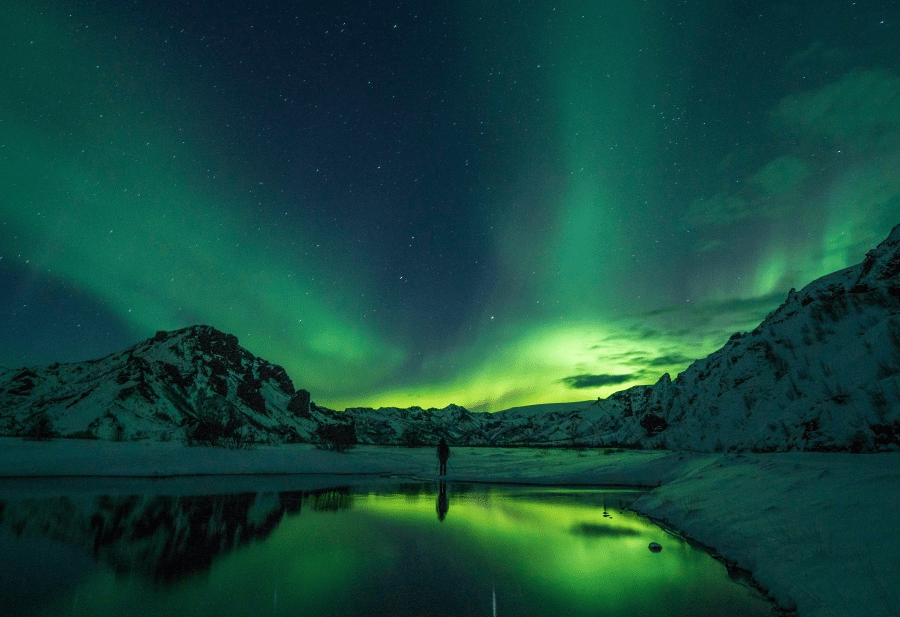
I fell through the ice on a frozen lake in northern Norway in March of ‘95. It was two in the morning, twenty below, and I followed two friends across the snowy ice toward a road on the other side. I heard the ice crack and I stood still, a green band of aurora borealis bent just above us, and I stood still like Wile E. Coyote—suspended for just a moment listening to the ice crack—and thought, “oh, wow, shit,” and went through.
I landed just about ten inches below the surface on another ice shelf. I stood just deep enough for frigid water to cover and fill my boots about calf high. I waited for the next crack when Joe turned and we froze in fear of us both plunging into the lake. This wasn’t the first time I’d walked on thin ice, but previous mishaps were mostly metaphorical. I stood with icy feet; my heart pounded in my chest ready to plunge into my stomach when the ice again cracked. Nothing. Our friend John turned and laughed. “It’s day melt,” he said, ahead of us by twenty feet, already on the shore. “The surface ice melts a bit each day then freezes at night, but it’s thin. That’s what we were walking on. The second layer you landed on is probably six feet thick.”
“Why didn’t you go through?” I asked, John was six three and not a light man.
“I was first,” he said. “I loosened it for you.” “Why didn’t you watch where you were going?” John asked.
“I was looking at the northern lights,” I told him. He looked up and nodded, “Oh yeah,” he replied. “I didn’t notice.”
WTF?! I thought.
I sloshed to shore, took off my socks, and stood at the end of a fjord when across a field six moose stood taller than us all. I put my boots back on and watched the moose move toward us. They were bull-like, each one heavier than the three of us combined. The night was still, and the air was calm. To the north lay nothing but wilderness for a thousand miles; the Arctic Circle sat a hundred miles south. I was soaked in below zero temperatures, green bands of borealis bent above my head, the moose moved toward us, and I never felt so awake, like sleep wasn’t part of the Human idea. Awake. The northern lights lingered as if in water, as if the sky was submerged and the green bands couldn’t bend faster than the deep blue flow would allow, and we floated between. The moose moved closer. I held my breath. Two leaped just beyond our reach and bounced over the ice with absolute grace.
That moment, right then, will never go away.
I’ve been thinking about life lately, the highs of accomplishments and the stress that comes with obligations, and I looked out across the bay this morning, took a deep breathe in the chilly autumn breeze, and thought about how grateful I am for having such wealth for just about my entire life. Truth be told, I have always been wealthy.
Like the tram ride at Lake Baikal in Siberia or just about any day in Spain, the sunsets in Tucson and just about any evening at the river. We rise every morning and gaze at life around us, but how often are we awake, I mean completely and blatantly awake? Sitting here tonight I understand for all of the gives and takes of life, I’ve had the privilege to be wide wake for most of it.
I mean Alive. It doesn’t hurt to take stock of those moments from time to time to remind us when we need a slap across our attitude to snap us back to the awareness that we are always alive if we choose to be.
Like sitting on the sand at the Gulf of Mexico drinking coconut rum and laughing; standing between cars on a train ten thousand miles from home; knee deep in the Great South Bay singing Harry Chapin songs; waist deep in the Congo in the rain; that lunch with my son, my brother, and my dad at the beach; riding a motorcycle from Amsterdam to the Zuiderzee; lunch at La Caverna after buying blankets; breakfast on the dirt in Dakar; clawing my way to the Wind Cave in Utah.
Studies tell us that most of us sleep a third of our lives and most of us work a third of our lives. And now at my age with hopefully about a third of my life left, I’d like to spend as much of what amounts to one third of that third being fully awake before the ground falls beneath my feet.
My grandparents’ attic; my mom’s laugh, salt water on my lips. My dad’s deep “very funny” response to a joke, that time I stayed with my brother at Notre Dame and we stood in the student section and watched the Irish destroy Air Force.
Pigeons at a graveyard on the Gulf of Finland.
The way Eddie and I would hike forever through the marshes of Hechscher; sitting behind third base at Shea in ’69; hitchhiking to Niagara Falls–an hour and a half drive that took us an hour and a half to thumb up there from college, but we began our hike back at 5 pm and were still walking at 3 am. The end zone at Rich Stadium when they retired Simpson’s 32. My sister’s guitar and how I played in Steve’s basement, how I listened to Jonmark in just about every venue in Virginia Beach, how I played my way through college, that time singing and playing “Danny’s Song” with KL in the dressing room before a gig, the midnight sun in St Petersburg in June of 99.
Oysters on ice. A good slice of pizza. The smell of food grilling. A blanket of stars.
The colors of autumn outside my home in New England, the smell of cider drifting down from the mill in Sterling. Running into an old friend in a new place.
A cow driving to work. My dog hiding beneath the bed during a storm. My son holding his too-big-for-his-arm’s bunny. The way when I returned from a month in Russia when my son was two, he grabbed his zoo book of pictures, climbed on my lap and would not let me get up.
An email from someone I had not heard from in twenty-two years. The first green showing through the snow in spring. The leaves just past peak. The sound of waves. The sound of kids laughing. An old couple holding hands.
The front edge of an idea. That feeling of outrageous anticipation when you decide to do something brand new. The way you one day realize who you are and that you’re okay with it.
Pachelbel’s Canon in D. Bach’s Joy. Walking down an old street in St Augustine and hearing a guitar player singing Marley’s Redemption Song like it was Bob himself. Chasing ghosts at the old lighthouse.
And other moments:
“Yes sir, it’s a boy.”
“He’s gone. Come back when you get this.”
“Hey…it’s me.”
I can tell you how much money I have made from working in hotels and health clubs, from teaching college and writing books, but I can never calculate the wealth of my life. Can you? Can you measure the moments on a spreadsheet? Can you figure the net value of that time you saw your dad waving to your plane from the observation deck at the airport? The value of those last lucid moments when he seemed young again? The priceless moment your son’s voice cracked and changed. That moment you realize it would have worked out just fine if given the chance. That moment you realize sometimes the most painful moments are the ones that taught you who you need to be and what you are made of.
We are alive. Now. Today. And yet people hold grudges, people don’t forgive, people don’t realize how fast it is, people don’t look up to watch life bounce across the sky.

 a view from this wilderness