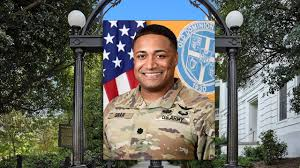
This past Monday morning I returned to classes at Old Dominion University for the first time since the day before the shooting which killed ODU professor Lt. Col Brandon Shah. On Thursday, March 12th, a gunman entered Professor Shah’s room in Constant Hall, where he taught ROTC students, and killed him. Classes were cancelled, Spring Break followed, and everyone left campus for ten days or so to process—or not process—what happened.
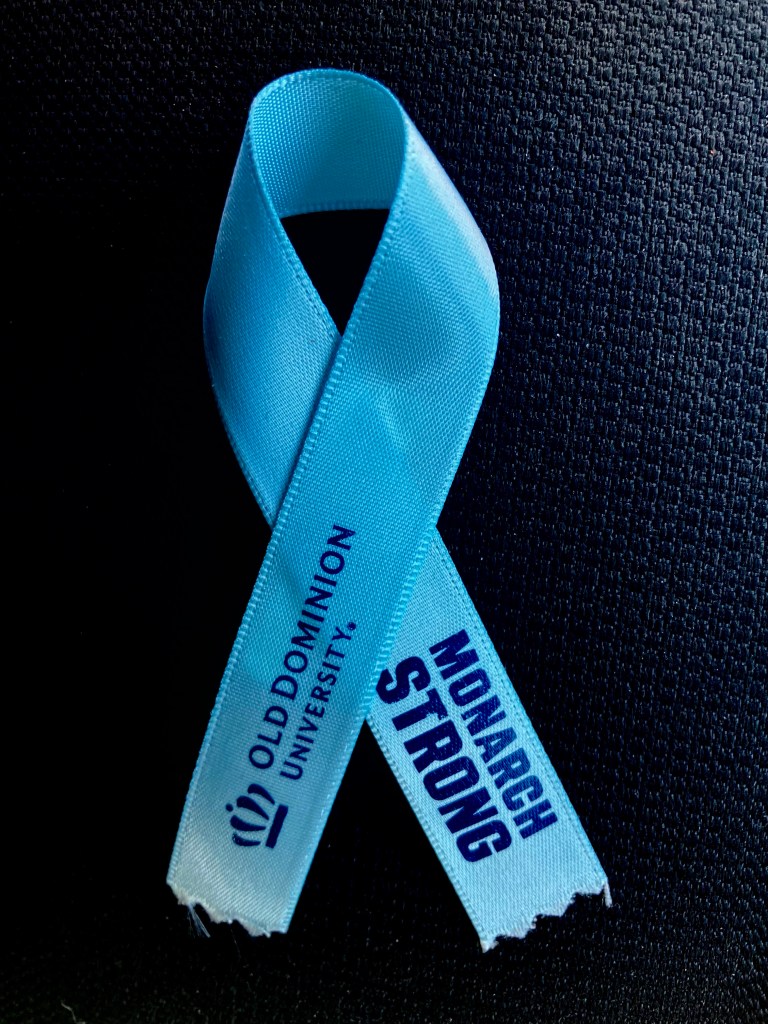
During break we received a stream of emails from the college president, the dean, the counselors, a colleague who has training and experience in trauma recovery,and more, all updating us on the actions of the college and reminding us of the availability of counselors, some of whom were set up across the street in the Chartway Arena. When I returned on Monday, a colleague sat with a counselor at a table in the lobby of our building and made themselves clearly available to anyone who wished to talk. They handed out blue ribbons of support, and their presence along with similar setups throughout campus reminded everyone that not only did something happen here, but not everyone will handle it the same way.
The very notion of yet another school shooting is actually somewhat abstract when it doesn’t occur in front of you; when the information you receive comes from the same devices which deliver the weather and Fortnight updates. While the incident occurred just a football field away, it is apparently only relative to those who were there when it happened, otherwise it might as well have been across the country.
At a table in the hallway on the floor where my classes meet sat a chaplain who wore a vest stating as much. I introduced myself and asked if anyone had spoken to him, out of curiosity. “They’re still processing” he said, which meant no. But my fears were about to be realized. They’re not processing this at all.
In some of those emails we received, experts, including counselors trained in post-traumatic situations, suggested how to discuss the events with students who might still be in denial, scared, in defense mode, or worse. One of the suggestions was to simply make students aware that it’s okay to talk about it but not necessarily talk about it then. In other words, business as usual but with a sense of awareness to the tragedy which played out just two hundred feet to the north.
I decided to go to my classes, pull my chair into the center of the room, and talk.
For too many years too many times on the news I have heard so many reports of how “counselors will be available” and “assistance will be available throughout the campus” or high school, or elementary school, and now this school, ODU, which is both one of my alma maters as well as my place of employment. Nine years of higher education and thirty-seven years as a college professor, yet this is the first time I experienced the presence of those aids. That’s a good thing, of course. I returned to campus and scattered throughout the buildings and outdoor areas were tables, counselors with identification about their necks indicating who they are, chaplains in yellow “Chaplain” vests. Blue Ribbons, Blue wrist bands. Boxes of Klenex.
I met one of the trauma specialists who introduced himself to me before class, who told me in front of everyone that he will be in the hallway if anyone wanted to talk.
I pulled my chair to the center of the room and I asked how their break had been, who had traveled, who stayed home. No one was going to bring it up, so I did. I said, “Listen, I didn’t know Lt. Colonel Shah. I have taught in Constant Hall several times and I know where the classroom is, but I was home when this happened and this is my first time back. But this hits close to home, doesn’t it? It does for me.”
Silence, of course. Honestly, at nineteen I don’t think I’d have a clue what to say either. So I put it out there. “Does anyone want to say anything about how this effected them?”
Oh my:
One girl was pissed because her math tutor is in that building and she had to miss her session that day and she has a midterm and isn’t doing well.
One guy shrugged and said he heard about it and was sorry for the loss, but it didn’t really affect him at all. “I’m not in ROTC.”
Another: Shit happens.
Laughter.
Complete indifference. It’s a reality show episode. It’s a reel on Instagram. It’s a minute ago so move on already.
During a break I asked the counselor, who could hear the entire exchange, if this was simply denial and some sort of defense mechanism, but he said he didn’t think so. That sure, for some of them, they truly are still in the denial stage and haven’t processed it enough yet to understand the implications of what happened, but for a growing number in his experience, the new norm is indifference. It isn’t a lack of compassion or even empathy; those are situational responses and they’re not necessarily ready to dial them up in a writing class. It is more or less “just something else that happened last week.”
Inside I wondered why everyone wasn’t outraged that one of their professors was gunned down closer to us in that class than their dorm rooms were. It’s not easy being a student today. Aside from the barrage of instructions and technology and demands, they are also part of a generation which grew up with shootings as daily news, guns in backpacks, violence as an alternative behavior, and media from movies to games which inundate us all with killings and destruction as entertainment.
I thought about one of my previous jobs as professor at Saint Leo University on the Little Creek Amphibious Base in Virginia Beach, where nearly all my students in thirty years were retiring or active-duty military who had served in the Gulf War, Afghanistan, Iraq, Kuwait, and some in Vietnam. I remembered how some didn’t come home, and some came home unable to function as they had before. I remembered one student who had been in three of my classes who went home from class one night and shot himself. But I always, absolutely always, felt safe in their presence, on that base—one of the most secure in the world. It never crossed my mind that anyone would come into the room and shoot me. But there, they all had stories like that, horrible and unforgettable stories which redefined their life’s narrative and reset the trajectory of their existence. At St Leo’s one time in 2009 or 2010, we talked about an incident in Camp Liberty, Iraq, when a solder went into a training camp during a seminar and killed five soldiers serving with him. In that class, everyone opened up about how they felt; they had been there and knew the value of sharing those emotions. On that night, one solider said, quietly, “I was there. I was at the clinic that day.”
The entire class at St Leo’s talked for an hour about how he processed it. Was still processing it.
Monday, I went back into class and some read their phones, some stared at the counselor, wondering, perhaps, if they should talk to him. I wondered if anyone wondered if they were supposed to feel more disturbed than they do and are worried about that.
I sat down and after some teaching wrapped up class. But before I stood up I said, “Listen. Seriously, everyone, please.” They were uncharacteristically present. “You’ve got three or four other classes still. It’s quite possible that you’re going to be in class next to someone who was in the room that day.” I waited. “It is possible that someone next to you in the next class was in the next room and heard the gunfire, heard the screams and chaos as other students your age subdued and killed the assailant. They may want to talk. They may just say that they were there, or maybe they’ll say more than that. They might want you to listen. So if that happens, listen—take the time to let them talk. Don’t say “I understand.” We don’t. Just say you’re sorry and listen more.
Two students broke down. A few others sat longer than they should, lingering like maybe they did want to say something after all.
Later the counselor told me that since they weren’t there, the indifference was prevalent. But when I suggested some friends of theirs might have been, certainly someone in a class might have been, their empathy rose to the surface and it became, perhaps for the first time, quite real to them indeed.
The world is a war zone, a failed project. These students sitting through their writing course with another four years ahead of them before “life actually starts” as someone once told me, are in it for real, wanting to change things, wanting to be part of something. I was glad to know that when it came to their peers, they were very much negatively affected by the possibility of violence.
Because they don’t know if at some point some other disturbed person will confront someone they know in some class and kill them. They do not know. Two weeks ago it seemed a mostly ridiculous notion.
Now it is part of their narrative. This is not the education they came here for.


 a view from this wilderness