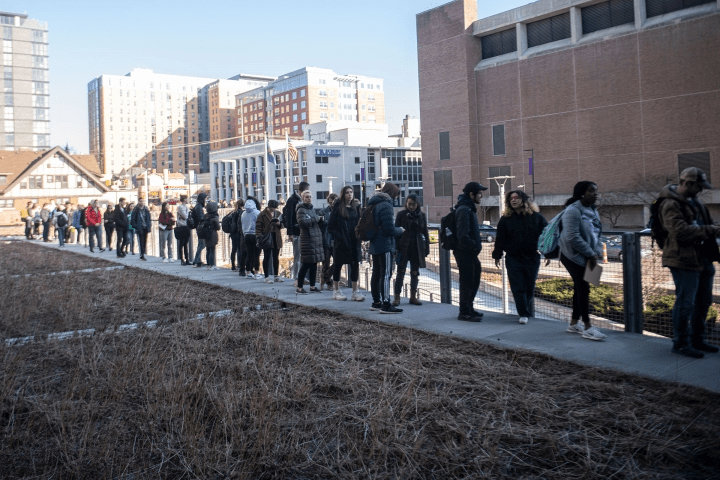
I miss the last millennium. I miss when students had to register by coming to the college and meeting with an advisor or faculty member or dean. The day registration opened, a line would form around the admissions building by six am, and some would be there for hours on end hoping to get their schedule. When I was a student, we all showed up to the basketball arena where tables were set up with members of various departments holding cards for each class. We’d be called down by seniority, and on the floor I would walk first to the Journalism faculty where one of the profs would give me a card for their course. I remember distinctly going to the Earth Sciences table where I asked for a card second semester senior year for a class I should have taken freshman year. The professor gave it to me and laughed. “When did you figure out you can’t put this off any longer?” he asked. “I’m still working on it,” I said, not kidding.
But in those seats waiting to be called to the floor, or in line wrapped around the buildings and often clear out to the lake on campus, students talked to each other with time enough to have deep conversations about where they’re from and what they are hoping to do with their lives. Friendships were made. My first day freshman year I came out of the dean’s office and a beautiful woman my age in a tie-dyed t-shirt and cut-offs leaned against the building trying to figure out her schedule. She looked up and said, “Hi, I’m Liz. Did you just see Dr. Jandoli?” I said I had and she asked for help. We talked for a few hours and I suggested some courses she might need to take, and the following Monday she found out she was in every single one of my classes. That was forty-seven years ago and she is still one of my dearest friends. The thing is, we talked, and by the time classes started I had a half dozen relationships already underway. And likewise at the college where I taught, I’d walk into class that first day and everyone was chatting away the time, having met and bonded while waiting in line. There is value in waiting, in having no device to occupy your time. But those days are gone now.
I miss those days in that long ago millennium when I might not see a friend or relative, or often enough a sibling or a parent, for weeks or months at a time, and when we did finally see each other again having not had the ability to communicate in any way other than what was not yet known as snail mail, we would practice the lost art of “catching up.” We’d sit into the small hours of the morning and swap stories about people we met and what others we knew were doing. We’d talk about mishaps and adventures, about what we missed and what we discovered. There was tremendous value in being out of the loop for months on end. You found out just how much you missed someone, you found out just how much you can handle on your own.
If the devices available now were available then I might never have lost touch with some people, one for twenty-two years, and we would have remained close and never learned just how much we value in each other, we never would have discovered how much we needed to learn on our own. Friendships can be destroyed by overuse. Certainly they can burn out. But in the last period of the second set of a thousand years, you looked for payphones, your asked directions, you waited in line for coffee, for meals, for God’s sake for everything. You understood the need to yield to others, you waited for the green, you waved someone else in, you had long periods of absolute silence. Silence is dead now, and when I asked my students how many minutes a day were they in complete silence other than what is heard outside such as cars or birds, only a few had any silence at all and even then for only a few minutes.
I miss the last millennium for the music I discovered by sliding up and down the radio dial while a friend drove us absolutely nowhere in particular. I miss the need to go to a theatre to see a movie without the option to simply stream it at home. I miss having no idea where I’m going and needing to ask for directions, during which I found out more about where I was and where I should go. Before GPS a friend of mine and I were doing readings in Cornell, New York. We got lost and discovered Vladimir’s Book Barns which could contest the most historic of bookstores anywhere, including Strands. Vlad suggested we find Dave’s Fish Fry to eat, which we never would have found on our own or, for that matter, online. By getting lost and not having a cell phone for directions or assistance, I have met indigenous people in the Sonoran Desert, talked for an hour to a Gambian in line at a post office in Senegal while waiting to use a phone, and wandered around a Virginia Beach college campus looking for a phone to call AAA to come get my car and ended up with a job.
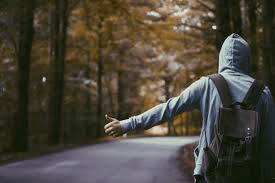
We have lost the art of getting lost, of asking for help from others. We stopped stopping people on the boardwalk to ask them to take our picture only to find out where they’re from and what we might have in common. I have friends all over the world, and the vast majority of them are because that’s what we did during the last millennium–we talked to strangers, we hitchhiked (that’s an early form of Uber where you didn’t have to pay anyone), we walked inside Chick-Fil-A and Starbucks, we turned to the student next to us and asked her major, where she was from, her name. I once asked my students during the last week of classes what the names were of the people sitting next to them and not a single one knew anyone else’s name.
We may not have been nearly as technologically savvy during the last semester, but we were human, and we could use more humanity these days.