2025 Day One

Life is too short to simply run out the clock.

Van Gogh once wondered, “Those of us who live; why don’t we live more?” I considered my lack of effort, my lack of discipline, my lack of patience; and I thought about my abundance of inattentiveness, my tendency to rush, to generalize, to blame. I need to live more not despite the losses of 2024 but because of them. Because I can, simply put. Fortune has me well in hand. Lesson Learned.

Is there an age limit on starting over? At what point are New Year’s Resolutions simply pointless?

Let’s find out.

Grandma Moses didn’t start painting at all until she was seventy-six.

Frank McCourt, author of Angela’s Ashes, winner of the Pulitzer Prize and National Book Critics Award, didn’t start writing until he was sixty-five.

Laura Ingalls Wilder started writing the Little House on the Prairie series at sixty-five.

Fauja Singh ran his first marathon at eighty-nine (luckily if I choose this path I can wait twenty-five years before getting off of the couch).

Harland Sanders established Kentucky Fried Chicken when he was in his sixties.

And for God’s sake, Noah was six hundred years old when the waters started to rise. Hell, I’m going back to bed.

Truthfully, it isn’t about starting over, really. We make resolutions this time of year to lose weight and exercise and save money and volunteer more, and those are common ambitions for a good reason: they’re admirable goals, apt adjustments to our otherwise well-planned life. Emerson tells us that “the purpose of life is to be useful, to be honorable, to be compassionate and have it make some difference that you have lived and lived well.” I must do all of those things, for certain. But a slight adjustment simply won’t cut it for me anymore. Not this time. 2024 was a wake-up call.

Certainly, the atmosphere these past few years hasn’t exactly been conducive to positive change. I seriously grew up believing my generation was the one that would clean the world, bring peace to all countries, and create a more inclusive society. I know it was innocent and naïve, of course, and I didn’t really expect some land of Oz, but I also didn’t expect this pathetic disaster we still call humanity. We are a mess; our supposed “intelligent life” turned out to have little compassion for each other, and it is stressing me out more than my meds can handle. I don’t understand why it all gets to me and brings me down. It just does. I know that “a happy soul is the best shield for a cruel world,” as Atticus wrote. But listening to the news is akin to swimming in toxins, and it has become overwhelming, drowning out whatever happiness takes root. Something has to change–if not out there, certainly in here.

And it helps to have a distinct starting-over point. A few times each year—birthdays, Spring equinox, for educators the first day of classes, and New Year’s Day for us all, we can take a deep breath and make some sort of commitment to do some small part by changing ourselves, either by dancing with the Druids at Stonehenge or making resolutions. Of course, I can only speak for me.

The clock is ticking while I’m distracted by society’s bad energy, spending valuable time on meaningless banter. I need to get back to me and remind myself, as Dan Fogelberg sang, that “there’s more than one way of growing old.” I need to take more chances and figure out which dreams I simply refuse to allow to fade before I die. Not all of my imaginings are realistic, of course. Certainly I can narrow down the list with some rationale: I can probably toss out the Wimbledon win and playing outfield for the Mets. I’m confident the circumnavigation of the world is sliding off the list as well, as is winning an Academy Award for directing.

So what do those people above have in common? They’re not afraid to fail, they’re not afraid to embarrass themselves and be transparent. They’re not afraid to be ridiculed, mocked, trolled, dissed, and dismissed.

With that in mind it occurs to me most of my successes came in the midst of countless failures for most of my life; I have embarrassed myself in front of crowds since I’m nineteen, I remain pretty open about myself, and as a professor and a writer, I have suffered a steady barrage of ridicule, mockery, rejection, and dismissal. Yet in the words of Hamlet: “I do not know why yet I live to say, ‘This Things to do.’”

And now it’s New Year’s 2025, and despite the crappy year that 2024 was, I’m still here and able to write these words. That is step one: Be Alive.

I know a man who joined the Peace Corp at seventy-five. Another who learned French and became a translator at seventy-one.

There are barriers to these resolutions, to be certain. Pressure, stress, money, fear, and sheer exhaustion. Age! Yes, dear, persistent and unyielding age. The obstacles can seem insurmountable, but as Moliere said, “The greater the obstacle, the more glory in overcoming it.” Still, on top of this, those battling depression have to also face those internal voices telling us there’s no point, those for whom the “resolve” in resolution can be a monumental task, those for whom as a friend of mine recently noted, “no longer care if there’s a light at the end of the tunnel; I’m tired of the tunnel.” But none of us, I am not wrong about this, none of us wants to reach the point of death, as Thoreau reminds us, only to find out we never really lived at all, and, even worse, never even tried.

Certainly, some of us are simply mentally exhausted. Some of us have little faith in ourselves or no clue where to begin with some of this. Some of us fear we are simply wasting our time. “I’m just going to gain back the weight,” people rationed when I worked for Richard Simmons. We used to tell those who wanted to quit that in everything in life we have two options: I will attempt this and do what’s necessary to succeed so that even if I fail, I know I tried, or I will not bother trying because I’m likely to quit anyway or simply do not have the energy.

Which group do I want to be in when I’m older? Older?! Ha! I mean now. When I am near the end of the end, what would I have been successful at if I had just, well, showed up?

So Happy New Year, and if you’re thinking it is too late and much too hard to start over, I leave you with the words of Joseph Zinker from the Gestalt Institute:

If a man in the street were to pursue his self, what kind of guiding thoughts would he come up with about changing his existence? He would perhaps discover that his brain is not yet dead, that his body is not dried up, and that no matter where he is right now, he is still the creator of his own destiny. He can change this destiny by taking his one decision to change seriously, by fighting his petty resistance against change and fear, by learning more about his mind, by trying out behavior which fills his real need, by carrying out concrete acts rather than conceptualizing about them, by practicing to see and hear and touch and feel as he has never before used these senses, by creating something with his own hands without demanding perfection…We must remind ourselves, however, that no change takes place without working hard and without getting your hands dirty. There are no formulae and no books to memorize on becoming. I only know this: I exist, I am, I am here, I am becoming, I make my life and no one else makes it for me. I must face my own shortcomings, mistakes, transgressions. No one can suffer my non-being as I do, but tomorrow is another day, and I must decide to leave my bed and live again. And if I fail, I don’t have the comfort of blaming you or life or God.
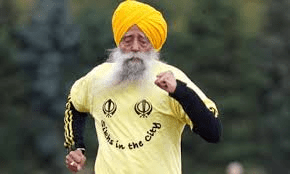
Fauja Singh running a marathon at 100

Breathe In, Breathe Out, Move On

The sun came up today; I guess I shouldn’t be surprised. People out on the highway going to work, rubbing their eyes. The morning flock came calling as kids ran off to school. Autumn leaves kept falling, following nature’s rule.

It seems I forgot. This happens to me a lot.

I need to head back to Boston; I need to be northbound. Feel the chill sweep down from the Berkshires and stop at the cider mill in town. Climb to the summit of Wachusett to watch kettles of hawks fly by; maybe drive up to Ringe, New Hampshire, to the Cathedral in the Pines.

I need to find that peace again. I’m tired of waking up in pieces.

I’ve been to the side of a canyon on New York’s Southern Tier and imagined it some foreign land then swam in the river, ate sundried fish, laughed at the infinite possibilities, threw caution to the wind. I once walked fifteen miles in the heat of the Sonoran Desert after my car broke down—no cell phone, few truckers with CB radios, just walking and dust, and I’d do it again, that silence, the distant hills of Mexico. Drove on over to New Orleans one January in some cold snap, drank wine watching a Dixie Jazz Band on Bourbon Street.

How can I forget that day? Why did I forget that day?

I woke up this morning at four am and grabbed my phone and read the news, turned over, went to sleep. Woke up a few hours later and headed to the bay, bothered by the reality of what comes next, until a gull flew by, and the bay like glass could pass for a blue mirror, sat like it did for watermen for centuries, like it has for those of us who dreamed of sailing away, like I dreamed of doing after reading Robin Lee Graham’s account of his five year journey around the world in the sixties during a decade of war and turmoil, and found peace, and the Great South Bay back then looked just like this today, just this morning after the news and the shock of it all.

No one’s going to slow me down.

“No one’s going to know I’m gone.”

After the last one I went to Florida and watched a manatee make his way north along the gulf shore and I was in the moment, alive, then, as life should be, as it always should be. Like the time a deer walked up to me in the woods of the Southern Tier and ate some bread I had in my hand, nibbled my palm, pushed her head against my chest, while my friend the late Fr Dan watched from a porch, like he sent her himself to come call me in for breakfast. That’s being alive. That’s me aware and present.

I need to ride again that ferry to Nantucket, pull my sweater around my neck, my face damp of saltwater, my heart solidly present and strong. It’s just up there, due north and to the right. Right now.

Life has not paused, will not pause, will not disappoint, cannot be compromised or negotiated with. Not my life anyway. Not for a speck of an insignificant bad decision. Not for this moment nor any implications for the next term. I can be too present to be distracted by yesterday’s or tomorrow’s false suggestions.

Venus is in the western sky before dusk tonight, bright right above the sliver of a moon. And just past there is some kid from the Island who once wanted to travel in space, who settled for Plan B, who measured the reach from Brooklyn to eventual nothingness and discovered there’s too much distance still to cover to not recover from some passing disappointment, some temporal distraction.

“Show don’t tell” said my writer friend Tim in Texas. He was talking about the narrative, but so am I when I thought and then said aloud to myself, “Show, don’t tell,” and thought again about the Netherlands and Connemara, about Boston, about the peace I know on Merton’s Southern Tier and the presence I know here at Aerie.

Yeah, the sun came up today; I shouldn’t be surprised. No one rewrites what I write. No one gets to decide where this narrative is going but me. Not today.  

Uncomplicated

30739603_10214554803251283_6796824465050173440_o
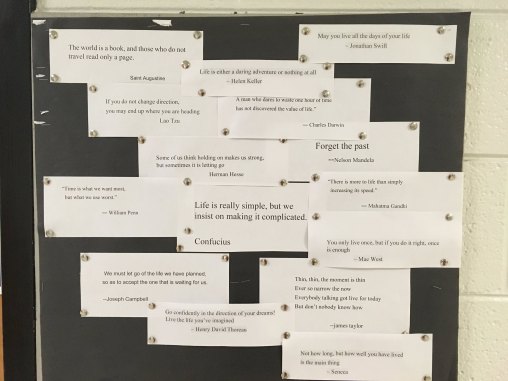
The board outside my former office, May 2018

Some years ago when I knew for sure I was leaving my job I held for nearly thirty years, I started to focus not so much on what was next as much as how fast, how so very fast it all went, and I realized that about the same amount of time to come would put me at nearly ninety years old.

I cleaned out my office—slowly at first, then with much more indifference. I carried piles of books to a common table in the building’s lobby, I moved file cabinets and other useless furniture into a storage area for someone else to claim and configure to their job the way we do with all things in our lives—we mold them to fit in the corners of our growth and accomplishments. Yeah, I was done with all of it.

And outside my office I took down all announcements and office hours and lists of readings from my bulletin board so that all that was left was black construction paper. It looked clean, like a slate, and I absolutely loved the metaphor of it all, but I also thought I should take a piece of chalk and write in some demanding font, “Outta here.”

Instead, I typed up a favorite saying of mine, “Life is really simple, but we insist on making it complicated,” by Confucius. I stapled it to the middle of the board, smiled, and went about my business of unraveling three decades and finding my way to that diversion Frost wrote about with such eloquence.  

Next to my office was a classroom, and students often leaned against the wall (and my door) while waiting for another class to empty before entering. A few noticed the saying and commented to me when I returned to my office. “I like it,” one woman commented, “because it makes me think about it.” I liked that. I wish she had been one of my students.

The following week I added another quote to the board. This time Lao Tzu, one of my absolute favorites: “If you don’t change directions, you may end up where you are going.” Just stapling that to the board punctured a ball of emotion that spilled out across the rest of that day. How many times have I preached, I thought, about the dangers of getting caught in the currents and letting the world around us carry us through instead of pulling ourselves out of the stream and deciding for ourselves where we are going? Students had the same reaction, and I know they were wondering just who is it that decided going to college right then was the right thing to do. Often there is absolutely nothing wrong with where we are going; this is not a rebellious statement, I don’t think. I believe Lao was just indicating it can’t hurt to get a glimpse of what’s ahead every once in a while to see if you really are okay with the path you’re on.

Well, the board caught on and people started asking when the next quote was going up, gathering around my door on Tuesdays after they figured out I didn’t work Monday’s and that I must have posted them early Tuesday mornings, which I did. Up went James Taylor, Mae West, Seneca, St Augustine, and Jonathan Swift. More than a few passing people commented on how motivating the sayings were, and how they looked forward to them. Well, motivation was always my profession anyway, not teaching. For those thirty years it wasn’t English I was there for—hell, I was barely qualified for the first fifteen of those years. It was that I knew how to get them to find significance in it all—the work, the direction, the balance of dreams and reality. My job in New England after college was to motivate people, and I learned it well. So when I ended up teaching college, I knew instinctively that it really doesn’t matter how much I know the work, if they aren’t engaged—if they don’t feel motivated—I’d be speaking to the walls. Plus, my board was an extension of what I knew was about to end, and I started in those last months to motivate myself forward. I was absolutely projecting.

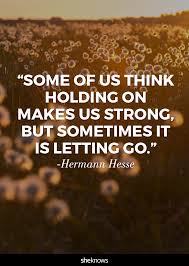
William Penn. Herman Hesse. Helen Keller.

Thoreau.

Darwin.

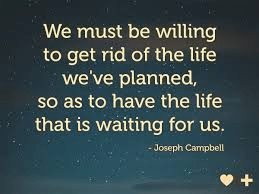
Then it was the first week in May at the start of my last week ever on campus. And I found this: We must let go of the life we have planned so as to accept the one that is waiting for us—Joseph Campbell.

I typed it up, printed it out, moved Thoreau a bit for balance, and stapled Joseph to the board. That one was for me.

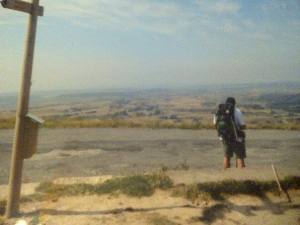
One of my most vivid memories from Spain was being in Santiago after more than a month of walking at about two or three miles an hour, sitting in cafes, crossing Roman bridges noting each step, each breath—essentially, more than a month of barely moving to cross a nation—and then seemingly suddenly we we boarded a train for the six-hour ride–just six hours–back to Pamplona. Six hours. It took four weeks to go from Pamplona to Santiago, and six hours to get back. On top of that disturbing reality check was that after a month of barely moving, we were suddenly barreling along at sixty and seventy miles per hour. It simply felt wrong. I leaned against a window looking at the landscape and when I saw pilgrims walking the opposite direction toward Santiago, holding their walking sticks, their backpacks strapped and the sun beating down as they walked and laughed, talking to other pilgrims on the road, I got a pit in the center of my stomach, a nauseous pain, like a child on a school bus for the first time who sees his parents outside walking the other way. I wanted to get off; I wanted to pull back the doors between the carriages, toss my pack out onto the trail and tumble out like a character in a movie. Writing that just now brought the pit back; it was that real, it is that real. It was the only time in my life I compared side by side the notion of getting somewhere and going somewhere. They’re not the same.

I’m a pilgrim, not a passenger.

Sometimes that happens. You’re riding along, caught up in the mainstream, barely noticing where you’re going because you’re engaged with everyone else in the stream barely noticing where they’re going, and you catch a glimpse of some shadow of yourself just out of reach. And you know that’s where you should be, of course, but the trouble, the pain, the expense, the sacrifice, the explanations necessary, the possibility of failure, the probability of doubt all slide in front of you, each holding you back just a little, all adding up to a gravitational force of “now” and “comfortable” and “responsible” that’s harder to break free from than the strongest of currents.

And even if you do jump, you’re immediately inflicted with that same pit in the stomach, only this time it pulsates, “Oh my God, what have I done?” The things is, you’ll never lose the pit, one way or the other.

Anyway.

On that last day back then, I cleaned out my office and walked outside the door, and for a moment I thought about leaving the quotes there, or maybe replacing them all with just one quote in the middle of the black construction paper, saying, “and this bird you cannot change—Ronnie van Zant,” but I changed my mind and took them all down and gave them to my friend Jack. Each week he’d come by my office and we’d talk about the latest quote and what it meant to us. Then on that last day when I was about to throw out the last folder of teaching materials, I found another passage, typed it up and stapled it to the board. I’d like to believe it is still there.

I know now how much I need that motivation again. But there are two types of motivation: Internal and external. That external one is easy: do the work or don’t get paid. Clean the room or don’t eat dinner. But the internal motivation that drives us from somewhere deep inside, that contradicts the currents, that learns how to turn on a dime, I need that once again. I’m surrounded by people retiring and settling their affairs, haunted by others who slipped off the stage too soon, and it simply creates an indefinable stagnation.

But today while walking along a street in a small village on the Rappahannock River, I remembered that last quote, and it felt right, deep in my stomach it felt right:

“If a man in the street were to pursue his self, what kind of guiding thoughts would he come up with about changing his existence? He would perhaps discover that his brain is not yet dead, that his body is not dried up, and that no matter where he is right now, he is still the creator of his own destiny. He can change this destiny by taking his one decision to change seriously, by fighting his petty resistance against change and fear, by learning more about his mind, by trying out behavior which fills his real need, by carrying out concrete acts rather than conceptualizing about them, by practicing to see and hear and touch and feel as he has never before used these senses…We must remind ourselves, however, that no change takes place without working hard and without getting your hands dirty. There are no formulae and no books to memorize on becoming. I only know this: I exist, I am, I am here, I am becoming, I am my life and no one else makes it for me. I must face my own shortcomings, mistakes, transgressions. No one can suffer my non-being as I do, but tomorrow is another day, and I must decide to leave my bed and live again. And if I fail, I don’t have the comfort of blaming you or life or God.”

                                                                                                                    –Joseph Zinker

12140843_10206985963235013_8819103812513984303_n

Etre en Vie


It’s New Year’s Day. Barely.

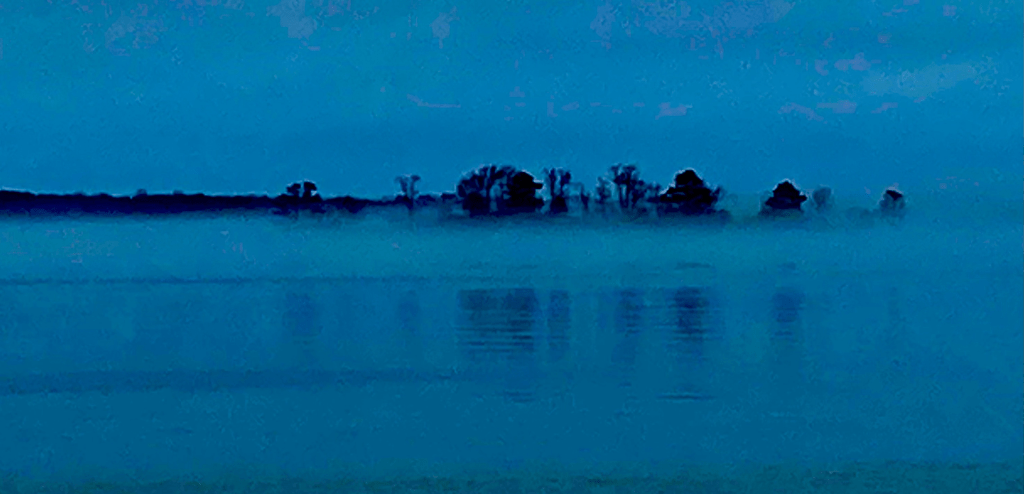
A heavy fog has settled on the Rappahannock and even out into the Chesapeake. It is calm and I can hear morning doves, some house wrens, and a few gulls calling from the docks. I like to think the fog is a cleanser, slowly sweeping through like mist to cleanse the world overnight so we can rise this morning and start fresh.

I promised someone I would get up and do something, so I went for a long walk, despite the fog. Even enhanced by this fog. I need a new start. My life could stand a decent cleansing.

I did a superb job of racking up a list of shortcomings to undo this coming year. The easy stuff includes losing the weight my doctor told me to lose and which I absolutely know how to lose but keep yo-yoing through the months. Also, to eat better. Again, I have the capability and the information to get it done, but it must be challenging enough that I still have these resolutions to make. I think you know what I mean.

That brings me to the difficult stuff: willpower, motivation, and simply getting through those tough three weeks or so where I still crave old ways while adjusting to a new way of doing things. I know after that time habits will form to achieve my goals, and old habits will be pushed out and cast aside. But I knew that fifty-two weeks ago—that’s seventeen chances of three-week periods to start again and stick with it that I simply didn’t bother. So why would now be different? What is it about this New Year that will find me a month from now well on my way to my goals, and a few months down the line having obtained them enough to enter that stage of maintenance only?

I’m getting to that. First though, I believe 2022 was a wake-up call for many people I know. Some dear friends of mine are not doing well, and the problems are beyond their control, so the rest of us must recognize that when the problem that slows us down and even compromises our lives is in our control, we should not hesitate to act. Another part of it is the peace of mind I used to love when everything was going right—physically and mentally, and while I must still pay close attention to many aspects of my life, I would like to knock this physical monster out of the way—the one I actually can take care of and was at one time an expert in doing so. It is inexcusable, to be sure.

The fog is starting to lift, and the river is like glass, like a mirror, and in the distance I can hear a flock of geese; out at the mouth of the river I can hear the diesel engine of a workboat. More geese. At the marsh two deer gently walk through the reeds. There was a time some years ago I made a resolution to spend more time in nature. I remember how hard it was adjusting my routine to make that possible, but I also remember it becoming such a part of my day that at some point I couldn’t recall not being out in nature all the time.

We choose the life we wish to live. Even if we don’t choose at all, which in itself is a choice.

To be blunt, 2022 was one of the crappiest years of my life. I’ve been fortunate to have very few of them, and when I do run into one of them, friends have always been there to help me keep perspective. But this last one, well, thank God for my friends and thank God it is gone.

But New Year’s is just another day. So sometimes it takes something more than some annual resolution to achieve the same annual goals we didn’t bother to attempt the previous annum. It takes more than some passing motivation.

ie:

Not long ago I had a conversation with someone about what I would do with my life if I knew I was dying. I sipped my coffee and thought about it and said I’d tie up loose ends and then drive to see everyone I’ve cared about—family from Long Island to Seattle, friends from Florida to Ohio, from Prague to Africa. I’d go for a long hike in the Rockies and I’d sail along the gulf coast. I told her more. She told me what she will do. It made me deeply sad, yet it also made me deeply aware of my aliveness, of my choices not everyone has.

Finally, after working the phrasing in my mind for a few minutes, I said, “I am dying. Maybe not in six to eight months, but maybe—I don’t know. Maybe thirty years.”

“Better get off your ass then,” she said. Then a very long pause. Then, “Just in case. Really, Bob,” she said from somewhere deep, like she reached as far as she could into her soul before speaking so I’d not just hear her but absorb every syllable. I’d never seen anyone push words out so hard before. “Be alive as long as you are.” We were both quiet a long time.

Sometimes you just know to be quiet.

After a while I said something to make us laugh, and we laughed for a very long time. I joked about the coffee and the overpriced croissants. Joking is my default position, and she appreciated it. Then I was quiet and added, “I’ll pick a day and get right on it. I Promise.”

Today is good. January 1st, 2023. Happy New Year my friends.

Be alive as long as you are.

It’s time to make mistakes again, it’s time to change the show.

It’s time and time and time again to find another way.

It’s time to gather forces and get out of yesterday.

–John Denver

Fill in the Blank

First, the analogy:

People in the literary world criticize formula fiction as “less than” literary. With good reason. It is predicable, redundant, and can be decidedly boring. I’m speaking in general terms, of course. Some of those formula-based works are exciting; they keep your attention and on occasion surprise you with some plot twist toward the end.

The thing is the vast majority of written work follows a formula. And in cinema, plot-driven material is the bread and butter of film productions. Sometimes we might catch a glimpse of a work whose crisis is created by some setting, and more often these days, character-driven material has become more common—those works which receive the vast majority of nods from awards committees. But the public at large is comfortable with the tried and true; they like predictability, and they find some refuge in knowing what to expect.

Reality jump:

We graduate high school, maybe college, in some cases post-graduate work. We find a job and then a career. We raise a family, we retire, pursuing those hobbies we either only dabbled in or hoped to learn someday. It is the Great American Dream. We live the best we can, we work hard, we play hard, we relax, we watch our children move further than we did.

My great-grandfather was a butcher, his father as well, came here from Germany with his brothers, presumably to “make a better life of it” than they had in 1850’s Bavaria. My grandfather owned a successful glass company in Brooklyn, was heavily involved in the Knights of Columbus, raised six kids, had an apartment in Brooklyn and a house on Long Island. All of his offspring moved on still, and my own father excelled on Wall Street, providing for us a childhood we could not have dreamed of being better (except for that one liver and onion incident). And when things got tough in the world in the early 1970’s, Dad stepped to the plate and kept everything in spin, eventually retiring and pursuing his passion since 1969—golf. He spent another solid twenty years living his life, enjoying his children, his grandkids, and eventually toward the end, his great-grandchildren.

Textbook successful life. Formula narrative line at its best, to be certain. Dad was one of my heroes. If I could have chosen a life of the people I’ve known, I’d have chosen his.

But I’m not a patient man. I’m not close to as intelligent as my father was, and I am too easily distracted by big picture stuff—I have trouble with the minutia in life, the details he was so good at corralling into a successful career.

But I can be creative.

I am sixty-two now, ten years an AARP member and now eligible for Social Security—all the stuff in life I was convinced I’d die before ever participating in. I had a terrific career as a college professor, as a writer, and I literally built my own home and have a son who I could not be prouder of—in fact, he reminds me in so very many ways of my father.

So—here we go. What’s next?

Sidebar: My boss at Saint Leo’s for a few years was a retired military man who went on to teach college math and become the director of the Little Creek amphibious Base college offices of the university. I know him well, and his daughter is a friend, having been in every class I taught as well as traveling to Russia on a study abroad. Just about at retirement age, beyond actually, his lovely wife passed away, and his children—now grown—moved out. He did his time—he served his country and then some by assisting military in pursing degrees so they can start their own second careers. He is a beautiful man, and just when you know he earned the right in his early seventies to settle into the “what’s next” in life, he made a left turn.

He joined the Peace Corps and did a tour teaching math to children in Ghana. After that he did a six-month extension in Micronesia. He remains, for me anyway, one of the more inspiring humans I’ve known.

While I have left my career at one college, I’m still teaching, and plan to for a while, and as a writer I will never be able to retire—my mind simply won’t allow it. It is why every writer, artist, and musician, dies with a pile of “unfinished” work. It isn’t an option for us, retiring. It isn’t a hobby. It is how we breath in and out.

But what’s next? I don’t know, but I know without question what’s next cannot be an extension of what was. It doesn’t work for me; that is not where this narrative arc is going.

I don’t want some great-grandchild to blog about me and write, “He taught college and was a writer and retired at” whatever age it is I can no longer tolerate twenty-year old’s.

No. Instead, let it read, “He taught college and was a writer, but then, get this, at sixty-five years old he…”

I like the blanks in life. I like that we get to fill in those blanks ourselves. I have great admiration for the formula—and there is not a day that goes by that I don’t wish I had set myself up to spend my waning years simply enjoying the passing of time. But my chemistry simply doesn’t blend like that. I really wish it did. Instead, I’ll stop worrying about the plot or the setting and focus on my character. It needs work, but this script isn’t finished yet.

Uncomplicated

I’m on a mission to dial back the news to a need-to-know-only basis. Even—especially—the news online, but even NPR has drifted into the “I have no use for this material” folder. It is essential to be well informed, but it is equally essential to be able to separate the news from the noise. My stress level has adjusted up during the last, I don’t know, five years, to some higher level of anxiety not at all compensated for by valuable information. Material gathered should be worth the anguish to obtain it. But that simply isn’t the case any longer. Now it is just static which causes stress, which doesn’t benefit me at all.

So…

excuse me while I step aside. It won’t bother anybody if I simply duck away for a while. I can no longer handle the endless stream of garbage reported in media. Don’t pay any mind to me if I move out of the way while I let pass the convoy of criticism and manipulation. I’ll just sit and watch the water and wildlife do their thing, the perpetual movement of the tide. In fact, my health, my energy, and my stress level are all improved by the absence of the nightly news, which I once revered back when it was journalism. And I’m better off without the one-on-one conversations with way too many negative people. I am more likely to live longer, less likely to have a negative disposition, and infinitely more likely to relax by turning away from those discussions. Remember the adage, “If you don’t have anything nice to say, don’t say anything at all”?

When I’m at the river and the sun is just changing tones behind clouds in the west, it doesn’t make a bit of difference who the president is, what the commentators had to say, which tweets came from which attention-deficit minds, who bought what company, who accused who of what with whom, what happened first, and what happens next. My phone alert from the NY Times Breaking News doesn’t really catch my attention anymore, and I am far more interested in keeping my blood pressure in double digits and my heart rate closer to my age than my golf score.

When the eagle glides from the tree tops, and the osprey teach their young to fly, and the clouds at dusk separate colors in prism-like perfection, it is hard to remember what the complaining was all about anyway. We carry our baggage way longer than we ever need to if we ever really needed to at all. And the answers we seek in our daily life won’t be unearthed during some pointless pursuit of fair and balanced. Even if I listened more intently to all the facts and expert opinions and came to the correct conclusions agreed upon by Nobel laureates and Pulitzer Prize winning journalists, what then? So I might know the truth about A and the lies told by B and the injustice we see served to those in need. Again, what then?

I think my students would be better served if instead of watching presidential debates and finding the fallacies, we all spent some time in soup kitchens and the cancer ward at a children’s hospital and then came back and discussed respect and morality and fair and balanced. Maybe we could spend a class talking about the good there is. Let’s write about that. Let’s take a stand and find expert support about that.

When I returned from Spain I was on a mission to “simplify” my life. It didn’t take long on the Camino to discover how little I needed; how superfluous most concerns really turned out to be. As a professor of critical thinking and research writing courses, I found it necessary, pre-trip, to discuss current events and breaking news. But afterwards I found philosophical discussions as relevant as any subject covered by some mass-com graduate reporting from The Hill. I told my students that any fool can gather and argue immigration or trade; but it took real thought to discuss the “matter” of things, the bend of time. “Which works better for you?” I asked. “Ted Cruz said that we need to make decisions based upon faith” or “St Bernard said, “We need to learn to make excuses for other people.”  One is a proclamation of how he intends to govern; the other is an edict of how we should live our lives. This led to discussions of driving and working, and we talked about getting along with relatives and partners. People like tangible applications. Those conversations spilled from the class to the hallway.

That’s how it should be.

But time got away from me. When all I hear is the call of an osprey or the way the waves lap at the edge of the land, I could be in so many other places and so many other times. It is innocent, even ignorant some might say.

We live in the age of information, the age of blame, the age of instantaneous and simultaneous where the comment you posted ten minutes ago is now ancient news five screens in the past. It is the age of convenience and the age of emotion, and the age of attention-getting-self-indulgent-everyone’s opinion matters and is valid and is equal and should be heard. And that’s just not true, it is wrong, it is defeatist, and it is destructive, and I’m simply over it.

So I’m done jumping through hoops and trying to walk across coals; I’m simply not built for it. I’ve finally “come ‘round right” and am simplifying my life like I hoped I would when I came home; like I hope I will again. My theory is this: I will be healthier, happier, more efficient, more useful and focused, and infinitely more at peace. Then I might be of use to others, and that is the point, isn’t it?

I love the way the water feels cool on the soles of my feet on a hot afternoon, or how the saltwater gets on my lips and seems to stay there all day, even after I shower. It is as if the movement of the waves exactly coincides with the movement of my blood, and that rhythm somehow settles my soul.

And it really wasn’t so complicated: I just decided to.

I’m going to sip my iced tea and let the river run by for a while. If it doesn’t work out, look for me chasing the windmills in Spain. There, I’ll be in good company, even if it seems a bit too quixotic for some.