Acceptance: Part Five of Five

This is Part Five of a Five Part Series here at A View.

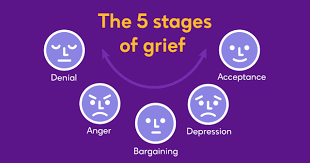
The five stages of grief as outlined in Elizabeth Kubler-Ross’ On Death and Dying are Denial, Anger, Bargaining, Depression, and Acceptance.

To wit:

  • Denial: A natural reaction to loss, denial can help people slow down the grieving process and avoid feeling overwhelmed. It can also be a way to try to understand what’s happening.
  • Anger: A common reaction to the frustration of no longer being able to live in denial, anger can feel like an emotional outlet as people adjust to a new reality. It can also provide temporary structure and a connection to the person who died.
  • Bargaining: People may try to change the circumstances that are causing their grief, such as hoping that things will improve if they take certain actions.
  • Depression: A stage of grief
  • Acceptance: A stage of grief where people find control and figure out how to proceed 

PART FIVE:

Acceptance:

The truth is I accepted some deaths nearly immediately. Letty is the best example. We saw it coming eighteen months out and we talked about it often, particularly her take on the post-life expectations. She told me to look for the birds feeding on the porch and she’d be among them. She told me she’s just going to close the door behind her. So by the time July rolled around and she slipped away, acceptance of that new reality was already on the table.

Dave was more difficult having not told a soul about his impending death due to cancer. Richard was a shock but his self-isolation from society for several years prior to falling and dying made his death closer to acceptance than any sort of anger or denial.

They’re all different, and Ms. Ross is clear that the stages weave in and out of our consciousness, rising then receding, and just when acceptance seems at hand, depression might pop back on the scene.

The thing is acceptance is about knowing someone you love is gone and finally learning to accept that your new reality is one without them and learning to live that way. The less involved someone has been in your life, the easier acceptance becomes. Dave and Letty and Fr Dan and Dad maintained an absolute presence in my life, so accepting their absence, particularly since with the exception of my father, the rest all checked out at nearly the same time, has been more difficult. Accepting is a sense of no longer being lost when a particular time of the day might have been occupied by conversation or even texting, a long walk to the Farmer’s Market or a slow walk around the mall. The instinct might remain to wish you could do that again, or at the very least to slip into a funk because you can’t do that again. But acceptance is being able to remember those times, smile, appreciate how lucky you were to have at least had them, and continue.

Caution: Just when that happens, depression might snap back. Just saying. These stages are circular.

In any case, when my father died nine years ago, acceptance was easy because of the conditions of those last few years, but to this day I have trouble sometimes understanding that loss of security, even at my age. There’s something about the loss of your father that says, “You’re on your own, Pal,” even if I was an AARP member when it happened.

What I have found interesting is the larger picture here that I’m trying to frame for myself. Accepting the deaths of the primary people in my life from all stages of my life—Eddie from childhood, Dave and Bobbie and Debbie from high school, Joe and Cole and Dave from college, Richard from a time I was learning to live on my own, and through those years and the rest of my years until recently, Dad, Letty, and Fr. Dan, has caused an unexpected twist: the acceptance of my own death. While it has not become something I welcome, it has become something I don’t worry about, as if everyone else on my team went on ahead and is waiting, but that’s not right either.

Maybe it is just that I accept that the world keeps turning without them, and so must I, maybe even by living more, experiencing more, particularly for those who left too soon. Acceptance for me—and this isn’t for everyone—means that death is more a motivator, like a new teammate; we’re working together here, this unusual macabre mentor whispering in my ear through the absence of my friends and family, “Keep going,” or as Virgil noted, Death “twitches my ear and says, ‘Live. I am coming,’”

Acceptance comes quickly when you hope for someone to no longer suffer, but it soon evaporates and is replaced by those other stages, like soccer players on a pitch replacing each other, taking a break so that the entire Grief Team remains strong. Eventually acceptance will return and dominate until it is our turn to put others through those same stages with our own departure, closing that door behind us.

For me there has been one exception, and those who knew Fr. Dan, and more specifically had a relationship with him like I did, as many have had, my “acceptance” of Fr. Dan’s death was nearly immediate. Of course the suddenness of his death, particularly only a day after we talked and hours before we planned to talk again, allowed Denial to dominate, but with Dan it is different. It has to do with his spiritual presence in all he did, his nearly reincarnation of the life of St. Francis and how Dan discussed saints and holiness as if they were brothers and sisters and he was already in and out of the otherworld, and more often than not it felt like he was heavenly from the start and took some time to visit us on occasion. This is difficult to explain, but he was not of this world anyway, so his departure from it seemed right. Letty wanted to stay, as did Dave and all the others. But Fr. always struck me as someone who couldn’t wait to die despite his absolute love of life and nature and all that exists, not in any depressive, suicidal way, but as if he knew something we didn’t, and we’d just have to see for ourselves.

People over the last six months have not missed the chance to remind me “you don’t get over one’s death or grief, but you learn to live with it, live differently.” Yeah, I know, and I do appreciate the sentiment and concern, but while acceptance is the ultimate goal, denial remains my favorite.

The Yankees lost the World Series

(how’s that for a non-sequitur—hang in there)

and while I’m not a fan having pulled for the Mets during the playoffs, once the Mets were out of it, as a native New Yorker I had to pull for the Boys from the Bronx. I know many Yankee fans, including close friends and a handful of misguided cousins, and I could observe the five stages of grief play out over the course of the last twenty-four hours. Denial, of course, that they could make it that far and lose so swiftly, despite the game they kept for themselves. Anger, of course; I mean they left the bases loaded with one out! Come on! That lead to bargaining of what could have been done differently, followed by the harsh reality you could see on the players faces after the Dodgers won, and, of course like all players of all games, eventual acceptance that this one got away but wait until next year. Having been a Bills fan for decades I’m well used to the routine.

So Liz’s efforts to label the stages of grief allow us to stretch beyond just death and find them applicable to many situations. But at the end of it all is death, which for the rest of us is the beginning of life without someone we loved and still love.

When I go for a walk I think of these people, and sometimes simply by having a wandering mind I end up in some pseudo conversation with them, talking to Letty about the floods in Spain, talking to Dad about his putting, talking to Fr. Dan about how hard it is sometimes to keep going.

And in my head he tilts his head back and smiles that wide smile, lets out a small laugh, and says, “I know Bobby, I know. It’s exciting, isn’t it? To not always know what happens next?”

In these days now when this happens, he walks away just then and I watch him move into my neighbor’s cornfield like James Earl Jones, and I turn to see Letty staring at me, saying, “He’s right Bawb. You need to keep going. Just ask him,” and she points behind me where I see Richard bouncing from foot to foot, saying, “She’s right Bob! Move your tooshie!”

and that thought makes me laugh out loud, until depression settles back in, and just as EKR warns, it gets heavier and heavier, and heavier, until I put it down and spin back into denial, wondering what everyone is up to that day, out doing their own thing in the world.

But I know better.

You’re the color of the sky
Reflected in each store-front window pane
You’re the whispering and the sighing of my tires in the rain

You’re the hidden cost and the thing that’s lost
In everything I do
Yeah and I’ll never stop looking for you
In the sunlight and the shadows

And the faces on the avenue
That’s the way love is

–Jackson Browne

Acceptance: Fr. Dan Riley, OFM

Depression: Part Four of Five

This is Part Four of a Five Part Series here at A View.

Elizabeth Kubler-Ross’ On Death and Dying defines the five stages of grief as Denial, Anger, Bargaining, Depression, and Acceptance.

Essentially:

  • Denial: A natural reaction to loss, denial can help people slow down the grieving process and avoid feeling overwhelmed. It can also be a way to try to understand what’s happening.
  • Anger: A common reaction to the frustration of no longer being able to live in denial, anger can feel like an emotional outlet as people adjust to a new reality. It can also provide temporary structure and a connection to the person who died.
  • Bargaining: People may try to change the circumstances that are causing their grief, such as hoping that things will improve if they take certain actions.
  • Depression: A stage of grief
  • Acceptance: A stage of grief where people find control and figure out how to proceed 

PART FOUR:

Depression:

Here’s One:

Dad once tried to buy a Snickers Bar from vending machine at a golf course. I hadn’t been nearby, but when I walked over he was getting angry. “Oh geez!” (Dad’s version of cursing). He said the machine was broken even though he kept trying to get it to work. He wanted number 110, the Snickers, and when he would push the “1” but before he would hit it again before moving to the “O,” it immediately gave me a pack of gum.  I pointed out there was actually a button that said, “110” and he only had to hit that button. He pushed it and the bar dropped, and I reached in for him to grab it and found four packs of gum. He wouldn’t mind me telling that story. Dad had a great sense of humor, though my tale would have been followed with a sarcastic laugh and a deep “Very funny” comment.

That story both makes me laugh and makes me sad.

When my father died, I wasn’t exactly depressed by his passing, not in the traditional meaning of the word; Dad had not been well for quite some time, and at ninety years old with dementia, his beautiful life as we knew it had ended long before his death. The depression I have about him is from him no longer being here, no longer around to talk to. I am depressed when I recall the grace of those days we spent walking at the mall, lunches around Virginia Beach, golf with my brother and son, sitting watching sports on television. Dad was a relatively quiet man, and he rarely spoke of his youth, but he celebrated ours and the childhoods of his children and grandchildren (and great grandchildren) every moment he could. It is his absence that hurts, the void, the knowing he no longer knows us, thinks of us, breathes.

Sometimes I think of him and can’t help but laugh at the endless great times we had; and I was fortunate enough to live near him right up until his death. Other times I think of him, something small, like his baritone “Yes Dear” when my mother asked him something, or the way he sat in his chair on holidays and watched everyone else talking, laughing, and he always looked so proud and happy, and when I remember those moments, it hurts, the goneness of him hurts. I don’t cry, which is odd to me since a passing line in Ted Lasso might make my eyes swell, but neither do I think clearly for a while.

Elizabeth Kubler-Ross points out something essential about grief—it is not linear. Depression and anger may weave their way around denial, and at any given time one might snap out of anger and cry for hours. When Letty died I was immediately—and even in those pre-death months—depressed. When Dave’s widow told me of his long illness and subsequent death, depression struck me like a baseball bat. The denial came a little while later and I liked it so I stayed there. But the depression makes its presence known at odd times. Predictably in the middle of the night when my mind can’t find anything positive to counteract it all, but also in random spurts, like driving past a mall dad used to walk at, and now they’re tearing it down. The mall didn’t depress me—the fact they’re tearing it down hurt.

But there is another facet to Stage Three which complicates the narrative. Depression has multiple layers.

Let’s start with this: I battle depression. It isn’t melancholy exactly, and it isn’t sadness either; it is a complete sense of malaise, or, in simpler terms, it is sometimes not giving a damn about a blessed thing. A doctor once told me this might be why I try to live so very consciously, taking risks and exploring. A person like me just might need a bit more stimulus to accept the reality of life. A chronically depressed person (which doesn’t mean we’re always depressed; it means depression may very likely come and go for the rest of our lives) may have no intention of killing themselves, but they’re not against the idea of evaporating either. It is complete indifference. It is this: In Woody Allen’s Radio Days, a young boy who won’t do his homework anymore is taken to a psychiatrist who asks him why he won’t do it. The boy responds, “The sun is going to burn out in four billion years.” “So?” the doctor responds. “So what’s the point?” the kid says.

See, I get that. Not that I don’t understand the point, of course. But when someone cycles through a low in the depressive state, everything seems irrelevant.

Yeah, that’s not what we’re talking about here. E K-Ross bends it like this:  Depression as Stage Four is a very specific “Situation” borne depression. The absence of someone’s laughter, not because they moved away or are ignoring you but because they no longer exist in this world, no longer contemplate the changing leaves, no longer taste or hear or feel, no longer imagine, no longer have any form at all, and when one acutely focuses on that reality, it can be overbearing. That thought, right there, that from now until the sun dries up, someone we love is simply not returning, that any chance you had to enjoy their company has passed, is depressing.

So too is a Jackson Browne song which cries out exactly what I was thinking about someone I loved. It’s everywhere, these depressive triggers. Some are obvious—like that damn Chevy commercial with the family visiting the grandparents at Christmas and a nearly comatose grandmother goes for a ride with her teenage granddaughter—”Sunshine on my Shoulders” on the radio—I can’t even watch that one anymore. OD—Obvious Depression. Some are subtle, like the sound of ice in a glass (Scotch on Tuesday nights with Dad) or peach pie (Dad loved Mom’s peach pie).

The death and subsequent goneness of them is not directly the trigger. If someone asks about my father and I say he passed away in 2015, it doesn’t directly depress me. But if they asked when was the last time I met my dad at the mall to go for a walk, I just might be incapacitated for the afternoon.

The sound of a golf ball leaving the tee, announcers calling a baseball game on a summer afternoon, the aroma of turkey in the kitchen while a football game is on in the other room, remembering, sometimes just remembering.

Stage Four is the weight on the chest. I remember a neighbor when I was young who not only lost a baby in infancy but lost her husband and her thirteen-year-old daughter to a car accident one rainy day. Sometime not long after that, her son found her in bed, dead, and it was said her heart just gave out.  Depression can literally kill, of course, but it can equally kill the spirit, disengage any humor, and dissolve all sense of hope. It leaves one questioning what they did wrong that they are alone now (Bargaining), leaves one pissed that they didn’t tell others how much they love them (Anger), renders them useless laying on the couch in the dark on a sunny afternoon until they can convince themselves it is simply a bad dream, and the deceased is actually at work (Denial). Depression is the umbrella that all other Stages must cower beneath.

When I get depressed, I remember something to laugh about.

Here’s another one:

When his dementia had progressed but when he was still quite functional (which he remained until his final trip to the hospital), he thought there were two Joans (my mother). An upstairs Joan and a downstairs Joan, though I’m pretty sure he thought there were simply two women, and one of them was his wife. One morning when he woke up, my mother—the upstairs one–asked if he wanted to go out to breakfast. He agreed. My mother went downstairs, and sometime later he came down and when she asked how he was doing, he said, “The lady upstairs wants to go out to breakfast, and I said yes, but I really don’t feel like it.”

That makes me laugh every time, as I know it would make him laugh, and the only depressive element to it is my brilliant father’s deteriorating mind. No, depression hits me worst when I recall our trip to Disneyland in California when I was fifteen—just the two of us—that’s a great memory that gets me down. It’s the time he brought me to college one fall and stood around talking to my friends and me like he just didn’t want to leave, like he thought he might not see me again, before leaving. It’s the time he brought me to the airport for a flight out of Norfolk and we shook hands and he left two hours before my flight, but when the plane taxied to the end of the runway near the observation area, I could see him outside his car waving to the plane, not knowing if I could see him or not, that tears me apart.

I don’t think I told him I loved him until he was very old. I wish I could have done so earlier…

Damn. Negotiating again. Always negotiating.

Sometimes when it gets bad and I’m coldly aware of how much I screwed up my life and could use his presence—he never gave advice, but he listened very well—I sit and wait for denial to snap back to attention and save me, and I can go about my business still a little depressed, but this time because I forgot to give him a call before he headed to Florida.

Depression never goes away, it just simmers, often without me even noticing, but also without me feeling completely relaxed. Ever. People tell me “You don’t recover from someone’s death, you just learn to live with it.”

Yeah, I know. And I appreciate the condolences and empathy. But what is not admitted is that while we live with it, yes, the truth is we do so a little slower each time, a little less of ourselves than we had been.

Depression: Dad

Anger: Part Two of Five

This is Part Two of a Five Part Series here at A View.

Psychologists, including Elizabeth Kubler-Ross in her definitive work On Death and Dying, teach us there are five stages of grief: Denial, Anger, Bargaining, Depression, and Acceptance.

First, here’s an AI sourced summary:

  • Denial: A natural reaction to loss, denial can help people slow down the grieving process and avoid feeling overwhelmed. It can also be a way to try to understand what’s happening.
  • Anger: A common reaction to the frustration of no longer being able to live in denial, anger can feel like an emotional outlet as people adjust to a new reality. It can also provide temporary structure and a connection to the person who died.
  • Bargaining: People may try to change the circumstances that are causing their grief, such as hoping that things will improve if they take certain actions.
  • Depression: A stage of grief
  • Acceptance: A stage of grief where people find control and figure out how to proceed 

PART TWO:

Anger:

(a bit more serious this time)

This is a tricky one since there are several levels involved. On the one hand we might lash out at others in some mind-bending way to “control” something, anything, as an emotional response to a death we had no control over which left us feeling helpless and abandoned. We might get angry at our children for the simplest of things to evade the reality of our own parents’ passing. Or we might be angry at the departed for departing, particularly when their exit is far too soon, burdening us with some sense of guilt for still being here, for slowly forgetting, for moving on. It’s a bit more rational to be angry when the death was self-inflicted. I’ve known several people who ignored that canon fixed against self-slaughter and ended their sea of troubles. Most notably a high school buddy who, after several attempts, succeeded when we were in our thirties. But I’ve learned much about mental health since then and it is hard to be angry at someone whose actions were quite decisively beyond their mental capabilities to control, despite what we wish.

In fact, anger either at the departed or at others because of the departed seems irrational at best. But it happens. For instance, my college friend Dave pissed me off. In the case of his death I blew right though denial and landed quite solidly in the deep end of anger. I’m not sure this is the type of emotion Betsy K-Ross was talking about, but give this a thought:

Some background. I knew Dave since the fall of 1979 and have written about him before on these pages. We ran a radio show together, worked at the campus newspaper together and the college radio station together, just him and me at 5 am for four years, Dave on news me spinning music, and we bonded during those pre-dawn hours in the chill of western New York. I stayed at his house in Buffalo on many occasions and became the “fourth son” of the family. We went on retreats together and relied upon each other for comic relief during pressing times throughout the next forty-five years.

Dave was talented but when he was faced with self-doubt, especially when he battled depression, he would call, and we’d talk until two or three in the morning. I once walked out of a reading in Virginia just after ten pm and he had called six or seven times. I returned the call and sat in the parking lot until dawn talking about all the reasons we keep breathing. He had no way of knowing I faced my own demons, and that he kept me going as well. I told him, but often Dave was not listening. That’s hard to explain. But we finished that conversation that morning laughing, laughing hard and even singing, “Old Friends.” And we talked about traveling to Australia together and writing a book. We both knew that would never happen; but talking about it pushed the other stuff out of view, and that’s why we stayed on the phone so long. We had to wait until our verbal tide came in and washed the rest away.

In the years since the introduction of the cell phone, we texted each other no less than three times a week. Sometimes it would be just some song lyrics that made us think of each other, sometimes a photo of the day. To be honest, I didn’t always answer when he called because he tended to ramble right past my “I have to go now, Dave” interjections, so I preferred the texts.

In late April, I texted him a simple hello and asked how he was doing. A random thing without lyrics or puns. He responded that he was fine, just a little tired, and he looked forward to talking soon. In mid-May the phone beeped, and it was a text from Dave. I opened it to find an obituary about Dave sent by his widow. My hands were shaking. I immediately called and we talked for a long time. Dave had been diagnosed with kidney cancer the previous September, but by the time they found it the disease had already metastasized rendering him a death sentence. “He fought hard the whole way,” she told me. He didn’t want anyone to know but his immediate family.

Pardon me on this one but Fuck You Dave (yeah, that’s anger right there). Seriously? First, the rationale for such silence is he thought he could beat it and didn’t want anyone to know, or he didn’t want people pouring sympathy all over him which he would hate, or he wanted to just focus on family, his beautiful three adult children and their own kids. Yes, I really do get that.

But those who exit without allowing others the chance to say goodbye or tell them how much they meant or at the very least acknowledge that you might not be alive if it wasn’t for him, just seems a tad selfish. This all came parallel to a deeply open knowledge of Letty’s impending death with the chance to tell it all to each other. Of the two, openness wins hands down. Are you kidding me? It’s hard not to tell someone what you wanted to say when they just go away for a while, never mind forever. When I told Letty of Dave’s passing, just two months before hers, she was even more sure of her decision to expose her impending death to those she knew. No questions at all.

After I hung up with Dave’s widow I called Fr. Dan, who himself had but two more months to live and didn’t know it, and I told him the news. He was dumbfounded. He had spoken to Dave just two weeks earlier and all Dave told him was “I haven’t been feeling well; please keep me in your prayers.”

This forced me to wonder what I would do. Of course, my life has been an open book for quite some time, but it is more than that. Eddie got hit by a car, Fr Dan died in mid-sentence about his plans for the weekend, someone we love right now may not know what is next. Why aren’t we leaving it all on the table? Why do we keep our feelings, those deep, often embarrassing to admit out loud ones, inside? I can testify that of all the emotions I have about Letty’s passing, none of them is anger.

Dave on the other hand; I’m just pissed for him not giving me the chance—and he could have; I mean he knew what was about to happen—to tell him what I wanted to, and perhaps he had a few things he would have liked to say.

Well, lesson learned though. I just might dump pleasantries on you at any given chance just in case one of us exits the stage in the middle of the third act.

Still, Kubler-Ross addresses another anger in addition to the one focused at the bastards who died. This is the one where we feel helpless and lost, and someone once a part of our daily routine is now absent in all ways, and there’s no way to control that absence, so we channel that thorny emotion into one we can control which might relieve some of our anxiety at floundering without someone: Anger at ourselves.

Well, yeah. I’m angry at myself every time someone I love dies. Angry for not being there more often, angry at not having said what I so easily could have but simply didn’t bother to say. Angry at myself for getting angry at them in the past for the stupidest reasons. Angry at my aloofness and at my over-dependence, at my distance and my closeness and my silence and for saying too much.

Angry at myself for sitting quietly at the bay and watching the sun slip up above the distance and giving me another chance. EKR is clear about this one: the anger of guilt.

I’m aware of the psychoanalytical responses to this; please don’t load up the discussion page with comments about carrying on and blah blah blah. I know, really, I know. I get it. BTDT.

But understand: I welcome the anger at myself when someone dies. I think we all should get angry at ourselves when we didn’t tell someone how much they meant to us, how much we cared, how much we still do. It forces us to not make that mistake again. It impels us to be open with those we can, now, while time has allowed us to remain part of this ongoing brilliance of exquisite life.

Don’t keep your death to yourself while you are still alive.

Finally, Liz Ross writes that often anger is directed at some Deity for allowing the death to happen, particularly a premature death which for my part is the case for, well, all of them. This is the most ridiculous anger of all and I’m bored with hearing it. Listen, if your faith suggests death is all part of some greater plan, than your anger is contradictory and quite dumb as you’re now getting angry at a God who has enough control to decide death and when it happens to each of us. If you don’t believe that’s how it happens then move on, it’s no one’s fault.

I miss Dave. I miss his texts and more than a few times I have reached for the phone to write, “How terribly strange to be seventy,” in reference to our plans to sit on a park bench when we reach that age and sing Paul Simon’s song. But then I remember he fell shy by seven years. When I’m thinking clearly, I’m not angry at Dave; that’s foolishness. I’m not angry at some God or even myself. No, when I’m thinking clearly, anger is not part of any equation; only love, and the times we could have loved more.

Thanks Dave. Good on ya.

Anger: Dave