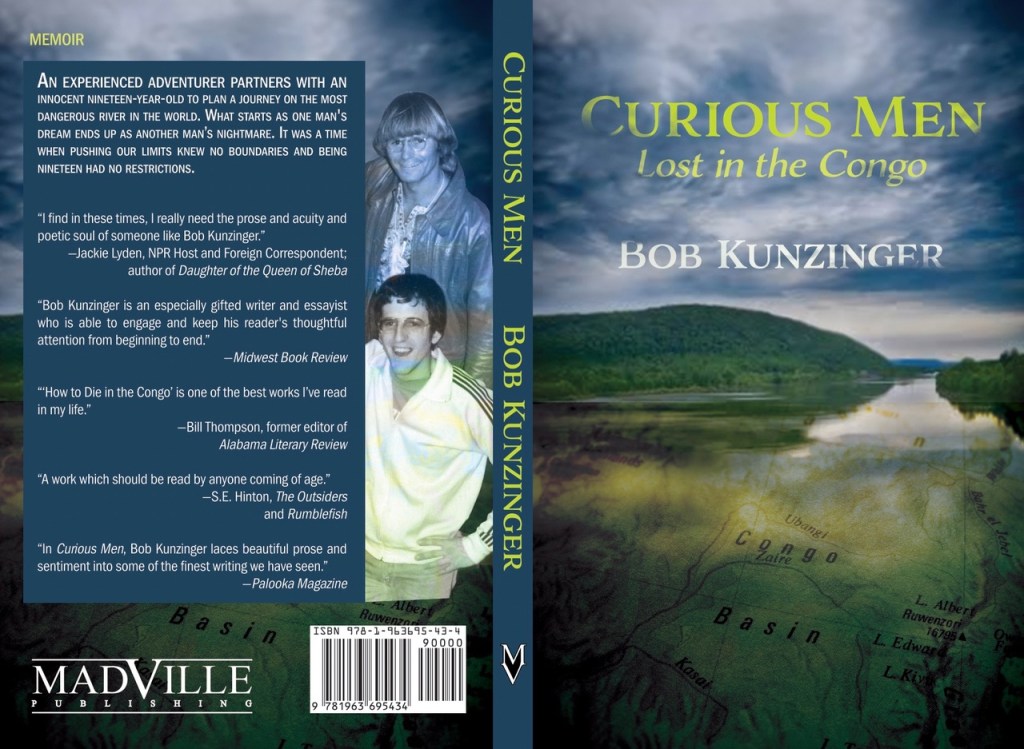
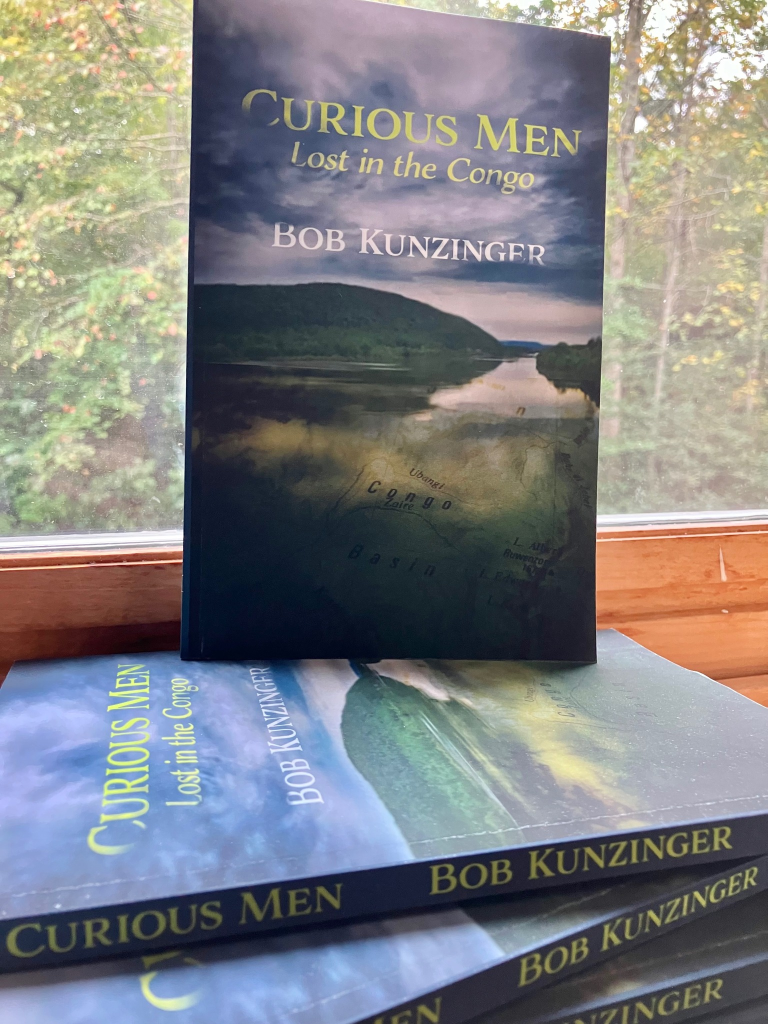
Announcing the release today of Curious Men: Lost in the Congo. Order by tapping the link below the video: Thank you for supporting independent presses and artists. Many thanks to Kim, Bill, and Jacquie, and everyone else at Madville Publishing.
Here’s a video about the writing of the book, the living of the book, and the time that has passed:
Memory is as fluid as anything in our lives. What happened and what “seemed to happen,” as writer Tim O’Brien points out, can often be confused. When looking back we might have a habit to recall what seemed to happen, reality having been washed and hung out to dry over the course of decades. Sometimes though we can recall nearly ever nuance of a time in our lives for its significance, its uniqueness, or its romance. I have a pretty sharp memory when it comes to many events. A friend of mine and I were talking not long ago about how we can both remember nearly every detail, everything, about a period in our lives so long ago you’d think it was from another life. Many of us have times like those which, for whatever psychological reason, we can summon up to the point of remembering the clothes we wore on a particular day.
My basic memory for most things is pretty solid. I remember all my phone numbers and license plates, and, worse, the phone numbers and license plates of friends of mine. The old joke about song lyrics holds true with me, but so do the times spent with extended family. One of my only memories of my paternal grandfather was him weeding a lot he owned next door to his house on Long Island. He died when I was five, so I was no older than that, probably still four. But I picture that day, those moments, perfectly.
Some years ago when Meanwhile in Leningrad came out, someone asked how I can remember the conversations I had with survivors of the Siege of Leningrad, who at the time I knew them were in their eighties, and I wrote the book several years after our conversations. I said, well, first of all, they’re never going to find or read the book, so there’s that. But more accurately, when a woman sitting on a bench holding my hand tells me about dragging her dead husband and son across the city to leave in a mass grave, and she sat with me clinging to their photograph sixty years later, I will not forget any of it. Much of the writing in that book falls in that category. Did the conversation happen verbatim? Doubtful, but the gist of it is pretty damn accurate. There’s an old journalism method that when you write the piece and include quotes from someone, call them up and read what you wrote to them and ask, “That’s pretty much what happened, right?” Nearly all the time they’ll say yes. Can you remember the words, exactly the words, you spoke an hour ago? Exactly. If that’s not possible as in this case, I rely on memory and notes.
Memory is reliable or not depending upon just how present we are during the event. That time so long ago when we said we could remember everything: We were both very much present at the time, we lived the example of what would later be called “mindfulness.” Of course we remember. Likewise there are times I so shut out of my memory it’s like they never happened at all.
Still, some events are so close to my soul I would need the team from Matrix to come extract them.
Like what happened in 1980 and 81, when I was a freshman and sophomore in college, the subject of my forthcoming book, Curious Men, from Madville Press. Of that time then, I remember everything. I watched, studied, and listened so intently that this memoir could be considered a documentary for how clear the details remain to me four and a half decades later.
I like that “memoir” includes the Spanish word “oir,” to hear, because much of memory stems from what we hear, and as a nonfiction writer I am bound by listening to the world around me, sometimes to the one sitting in front of me, and those sounds of vowels and consonants and the musicality of language I know will never escape my recollection.
My friend, colleague, and former officemate, Tom Williams, once introduced me at a reading as a non-fiction writer by saying, “Here’s some shit that happened to Bob and the best he can remember of it.” That’s pretty spot on. Despite a degree in journalism, I never had what it took to do the job in the traditional sense like so many I graduated with, some of whom have won prestigious awards for their work. I was definitively not up to that task. But I could handle the feature work, the “Let me tell you what just happened to me” work, just fine. In college, my friend Deb used to help me with news stories and I’d help her with features. We knew our strengths. I had a column in the college paper for which I ventured out into the community and did something, and then I wrote about it. I went horseback riding in Machias, New York, flew planes in Wellsville, kayaked the lake in Allegheny State Park, and sat on the ground behind campus at Merton’s Heart. Those events I could remember. I knew how to be present. Most of those activities were out of my wheelhouse at the time, so recalling what happened was easier. I was paying closer attention, sometimes just so I wouldn’t die.
Memoir is like that. If we can’t remember it we’re certainly not going to write about it.
But not this time, not this book. Summation: As a college freshman uninterested in the normal activities of my floormates–that is, drinking and drinking–I felt lost and disconnected from everyone. Then a family friend returned from the Peace Corps and asked me to help him plan a trip, solo, on the Congo River. So I did.
Long story short, it didn’t work out and his trip became mine. The first half of the book takes place in western New York. The second half in the Congo.
Still, that’s not what the books about.
Most of it takes place now, in every classroom across America where nineteen-year-olds sit and try and find something worth doing, something that reaches deep inside them and wakes them up. I’ve been staring at nineteen-year-olds for thirty-six years and one thing hasn’t changed: they’re scared out of their minds. They’re alone in a new place far from home living in a room this size of their car with a total stranger, and every adult within earshot constantly wants to know their plans for their major, their careers, their lives. It is often unbearable.
I was exactly like that back then. Until a friend walked into my life and said, “I have an idea. I need your help.”
We were so young.
So that’s what this memoir is about: About that time back then. What we did and how and why we did it, yes, but mostly about being nineteen and far from home looking for a reason to exist at all.
The piece I wrote which was the fastest to go from concept to completion, in ready to be published form, was in 2016 about Arlington National Cemetery. From the time I sat down to write to the moment I sent the version that would eventually be published in the Washington Post spanned just twenty minutes. We call that a lightning strike.
The slowest has been “in progress” for more than forty years, but as of a few days ago it headed to the fast lane and dragged my procrastinating ass with it. Here’s what happened:
When I was a freshmen and sophomore in college, I was deeply involved in the planning and training for a great adventure of a friend of mine who had graduated from the college about four years earlier. While it was not my adventure we planned but his, in just a couple of years it unsuspectingly became mine, and I have tried to write about it ever since. A few pieces have been published by journals such as Matador Review and Palooka, and the entire 275-page manuscript became my MFA thesis, Fly. It was more than a little weak, however, and I subsequently attacked it with a pen, markers, highlighters, and anything else to move hard-copy paragraphs from chapter to chapter and front to back. I trimmed it down to a not-so-well written 50 pages. That version, Curious Men, received some decent reviews, but the primary response involved readers wanting to know more. That can be both good and bad, and in this case, way bad. I was never satisfied with the work; I could not capture the excitement—exhilaration really—and anticipation at just twenty-years old, followed by confusion and disappointment. For me it became the quintessential “you had to be there” narrative. The true story goes to emotional extremes, pulling this nineteen-year-old boy out of some catatonic state and into some woke existence of adventure and exploration. The written version, well, didn’t.
Long story short: the long version was way too long, and the short version left people longing for more, indicating I came up short. I can’t get it right.
Honestly, I have been thinking about, writing about, messing with, focused on, and ignoring this story for forty years. I long ago decided that I would never get it right, figuring it would be wrong to put it out there. I have letters, maps, notes, journals, emails, and a half dozen different versions of the same manuscript all saying the same thing, and not very well.
Until last month. On a drive to Florida I listened to the audio version of Beryl Markham’s West with the Night. I enjoyed this version of the book I had read several times decades ago, but somewhere while driving past the dilapidated and very incorrect theme park, “South of the Border,” in South Carolina, my mind drifted back to my manuscripts. And on I-95 South I figured out exactly how to start, what to focus on, and I finally understood the problem I’ve had all along with the narrative: It isn’t about anyone else’s journey, it’s about mine. The book is not about the character I had been writing about for forty years; it is about me; I’m the protagonist.
When I got home, I pulled out the long, bound version that was my MFA thesis, as well as the short version in a binder on the shelves behind me. I pulled up the published versions which focused on one segment of the story, and I reread the longer version, Curious Men, and sat back knowing two essential things: First, they all suck. Second, I know now exactly what I need to do to unsuck them. My energy has returned, some internal motivation has been reignited.
It was a four-hour session that first morning I did little more than read through pages and chapters with a fine-tooth comb much like the NY Times editor must have when he first received the Pentagon Papers. What I believed was a story no one would care about and which I was not telling well at all, I finally knew exactly how to tell so others would be interested.
It was both exhilarating and terrorizing. I am ready to get back to this and get it done right this time, yet doing so means not only facing the possibility of not getting it right yet again but also dealing with some realities I’d almost rather let lie dormant.
But if my trip to Florida followed by an inspiring trip to western New York ignited some spark, it would be just a few hours later that some bomb exploded in a manner that sent those proverbial chills up my spine.
Long story not so short:
I received a message that very afternoon; I mean I closed the manuscript, got in the car to get a Slurpee, was sitting in the parking lot thinking about the protagonist of the work, me, and I received a message from the sister of the subject of my book. Be clear: I had never heard from her before in my life; I did not know she existed. Yet, she messaged me the very afternoon I had started work in earnest on a book about her brother.
She said in part, “My name is Kim and I just read online one of the stories you wrote about my older brother. I never knew him, he left with you that last time when I was five, and I am now almost fifty. I saw online you are a writer now and I am wondering if you plan to write a book about him.”
Again, that message came just hours after I decided in earnest to get back to it, my desk covered with pages and maps and journals and emails. Insert Twilight Zone music.
Kim wrote that she remembers the leather coat in a picture of him with me and a friend, Annemarie. We’re in a hallway at the college, laughing. She remembers him dropping her off at kindergarten the last week she saw him, and her teacher asked if the man in the car was someone else he happened to look like. She still has an old, worn sweatshirt of his he left behind. I asked what made her write me that day and she said their oldest brother George had recently died and it got her thinking about her other brother who was long gone, and so she found me online and messaged me.
I told her about my day up until then, and she agreed it was more than a little freaky that she chose to write me that day. Strange, but when I read her message, I didn’t picture a fifty-year-old, but instead a little girl.
The most difficult part of writing is getting started. In this case, I started more than a few times, and each complete version begins differently. Chronologically, the story starts in Virginia Beach in the mid-seventies. For narrative sake, it starts in February 1980 in my small dorm room. If I want to put a “hook” at the front, it starts a few years later seven thousand miles southeast of here in a then-peaceful, not-so-small-anymore village in what is now one of the most volatile and dangerous places on the planet. In a few versions it starts with a nightmare I had three or four times—same one—that woke me up. In one version it starts at the end and works its way backward.
None of them worked.
But when I think of that time, that experience; when I recall the “me” of back then and the life that I had, the energy and motivation and confidence I had then; when I think of the times I’ve told this story to others, my thoughts always go directly and immediately to one place: Antonio’s Italian Restaurant on Route 417 in Allegany, New York.
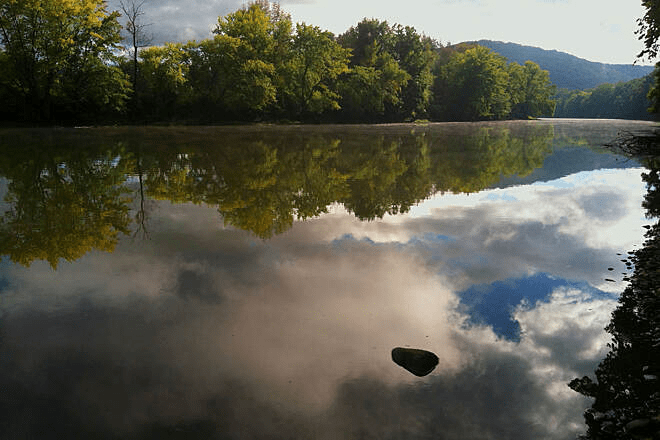
Last week I was in western New York, and I walked along the Allegheny River, followed a path through the woods, and remembered my life in that very spot almost forty-five years ago. I felt younger and vibrant yet somehow tired and disillusioned. The perfect combination for a work of creative non-fiction.
So that is where it starts. Time to wake this narrative back up so I can put it to bed and send Kim her own copy of a book about her brother that in the end isn’t about her brother at all. It truly should not take forty years to finish writing a book. On the other hand, some books, perhaps, should not be written at all, and that may well be the case here.
I have learned that sometimes it is best to not search too long and too deep for a resolution to the narrative, and that in real life sequels are rare. But I’m a naturally curious person, and it seems to me now that Joseph Conrad was absolutely correct: “Curious men go prying into all sorts of places where they have no business.”
My freshman year at college, Parents Weekend rolled around the end of September, and since my folks lived in Virginia Beach and St. Bonaventure University is on the Southern Tier of Western New York, they were not coming; neither were those of my roommate, Steve. He hailed from Auburn, NY, but he said they were busy and he had asked them not to make the drive.
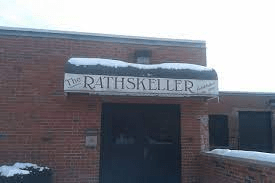
Friday evening Steve asked if I wanted to go to the Skeller. The Rathskeller was a bar under the campus dining hall, conveniently the building next to ours. A few particulars made the skeller the most popular place on campus. First, the drinking age back then was eighteen. Second, there was absolutely nothing—nothing—to do on the Southern Tier of Western New York. Third, there was (Youth: Read this twice to grasp it) no such thing as a computer available to the average person, phones were still connected to the wall, each dorm floor had one payphone to be shared by ninety drunk floormates, who were more likely to cover the earpiece with shaving cream as they were to answer the phone and find you, the dorm had one television and it was in the lobby, cable was brand new so most dorms didn’t receive more than a few channels, and pitchers in the skeller were $2.50 each.
So Steve and I went down there that Friday night. Understand, no one who went to Bonas knows exactly what the skeller looks like since it was always packed from wall to wall with students, shoulder to shoulder, with a small wooden raised, enclosed DJ booth in the back, and a bar running down the right. Tables throughout. It was always hot and walking down the stairs from outside meant taking your glasses off if you wanted to see without being steamed up. Music blared all the time—Springsteen, Joel, Stray Cats, the Clash, Lou Reed’s “Take a Walk on the Wild Side” which had its airtime nearly every two hours. If “Born to Run” came on, everyone stood up and sang, standing on chairs, screaming in unison, “ONE TWO THREE FOUR” at the exact moment. If “Piano Man” was on, the room swayed and pitchers of Genny Cream Ale slopped over their sides.
The smell of pizza, wings, and beer soaked our clothes.
Steve got a pitcher and we found a rare empty table since so many students were with their parents eating at The Castle Restaurant across the street. It was late-September cold out, with a crisp and refreshing chill in the air, and hot as hell in the underground bar.
Two women saw the empty seats at our table and asked if they could sit there. We all introduced ourselves, I got up and retrieved two more glasses from the bar, and we talked about where we were from, what dorms we lived in, our majors. Finally one of them asked if our parents were around for the weekend.
I went first. All of this had to be hollered over the music. “NO! IT’S SO FAR AND THEY WERE JUST HERE IN AUGUST, SO I WON’T SEE THEM UNTIL THANKSGIVING!!”
Both of the women’s parents would be there on Saturday. Then they asked Steve. He took a sip of beer, sighed, and said, “NO! MY PARENTS WERE KILLED IN A CAR ACCIDENT ON I-90 THE WEEK BEFORE CLASSES.”
Both women apologized profusely, moved about in their chairs for a minute, clearly uncomfortable after being quite settled in to our company, and then they said they had to leave since it would be a big day on Saturday, and they squeezed their way through the crowd toward the door.
Steve took another sip of his beer and smiled. I looked at him. “WHAT THE FUCK?!”
“THEY WERE DRINKING ALL OUR BEER!”
“I WOULD HAVE BOUGHT MORE.”
“OH!! RIGHT! WELL….SORRY!”
He was a good roommate. We got along fine that year, and while we traveled in separate circles, different interests, I don’t remember ever quarreling. He was there during some significant events in my life, and we talked about them often. Still, after that year I don’t ever remember seeing him again, even in a hallway anywhere. I never really thought about it since we did have such different interests.
Time jump thirty-four years.
A new hire at the college liked to talk. I forget her name as I left there five years ago, but I can picture her—always talking. One day in the copy room I stood quietly while she moved from subject to subject until she bounced into a few sentences about her home in Auburn, New York.
“One of my college roommates was from Auburn.” I told her his name.
They were next door neighbors their entire lives. Turns out Steve left Bonas, received a master’s from UNC-Chapel Hill, and has coached sports his entire life, currently golf at an Upstate NY community college. His son lives in Boston, and everyone is doing fine. I just had no idea.
I forgot he existed. Somewhere through the years I stopped thinking of some people from there, from then, as humans out living lives and just characters in a play that took place in the early ‘80s. I forget sometimes that out there, just over the slight curve of the earth, are those people who are now, four decades on, at the other end of our ambitions and hopes. They traveled their own narrative arcs and ended up wherever just like I did, and they, too, have memories of that time.
But when we last see someone, it is easy to think of them as “then” more than “them.” In The Big Chill, William Hurt says poignantly, “A long time ago we knew each other for a short period of time. It was easy then. I grew up.” All that is true, but these were people we lived with, day and night, shared bathrooms, showers, tragedies, and heartbreaks. Those four years were like dog years.
But look: Social media has refriended so many of us, closed that gap. I have colleagues at my job I’ve worked for five years making comments to friends I haven’t seen in forty, and conversing with childhood friends of mine who I can’t even remember. Time is out of joint and linear measure of memories is up for grabs.
And then you run into someone who knew someone who knew. This colleague spoke of Steve and I could smell the stale beer, the must of the dorm room. The cold of the hallway where all the windows to the outside were always broken. I could, just for a second, almost name every single person on the floor. Then it’s gone. But in that sudden flash of not-so-great memory, is some ghost, waving at me, awoken for a brief because I happened to look that way, and just when I realize I thought I saw something, it’s gone.
But it haunts me like a dream that wakes you up in a sweat but you can’t remember.
I stopped looking back in recent years. Still, when I do, I “look back carefully, because there’s still something there for me,” as Jackson Browne wrote. And I was wondering what that is; like going away and forgetting something you just knew you meant to bring along but can’t put your finger on it.
Thinking of that story in the Skellar brings me closer to remembering what it is that I feel like I should not have forgotten, but then it slips away.
Everyone we ever knew is out there somewhere, if they’re still with us—and even if they’re not, I suppose—living their lives well beyond the shared grey space of our Venn Graph that overlapped during the end of the Carter Administration. Now we’re senior citizens, have lived our lives, and no matter how much time we have left–hopefully a good deal–we wonder most about those we lost somewhere along the way. I wonder how many times I walked past someone I used to know so well—maybe on a city street or in some café somewhere.
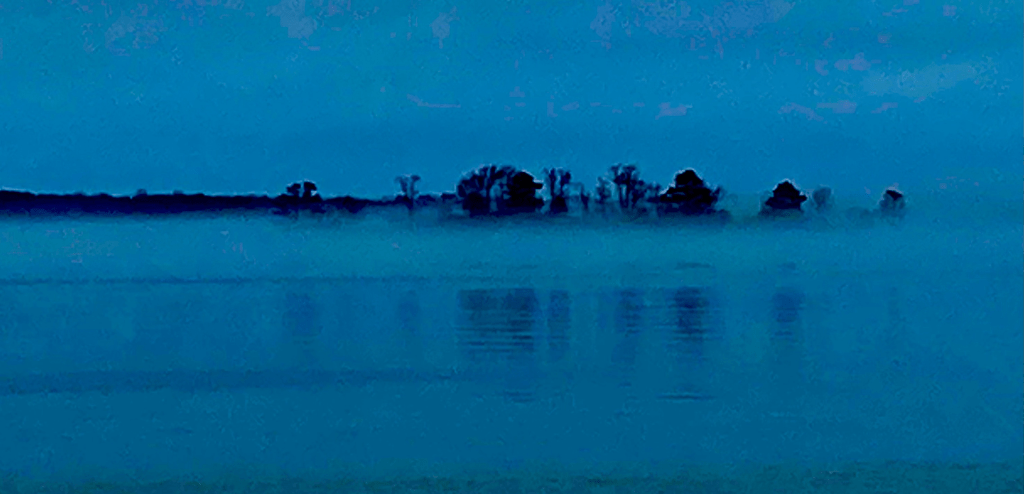
Today is one of those chilly, rainy Sundays I’ve always loved. There’s something immediate about them—I feel present. A mist is moving down river toward the bay and a Great Blue Heron has perched on a branch across the swamp, her head pulled down like a cold child. The air is calm and the tide high.
Like everyone else these days, I have a lot on my mind. I’m worried about a few friends, some projects I’m working on, some commitments I must stick to, some issues I’ve been dragging around for a few years. To push the tired metaphor that NPR guests cannot seem to use enough, it often feels like playing a game of Whack-a-Mole; just when one issue has been dealt with, another rises, and it goes on and on, and I feel like running away.
Instead I walk to the river dressed in seven layers and a raincoat, a hat, my hood up, hands shoved deep in my pockets. I can hear buffleheads in the fog diving under the surface, rising. Some gulls call from a nearby pier, and the diesel engine of some boat pushes it along the channel toward the bay.
Another typical rainy morning.
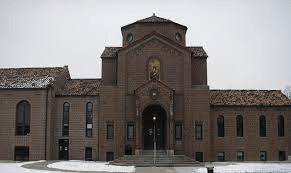
I remember a rainy Sunday morning forty-two years ago. Half the guys on my floor at the dorm were asleep, the other half just getting home from passing out somewhere. I had been up in Niagara all day Saturday and while the details aren’t important, it took me twelve hours to get home. I slept a few hours, noted the cold rain, and decided to walk to my friend’s painting studio under Francis Hall on the far side of the campus. It had been a seminary years earlier, and in an old library beneath the hall he set up his paintings. On the walk over I couldn’t even see the hills just behind campus across the Allegany River, and it was deafening quiet on campus. Quiet like today, misty too, and chilly like today.
I descended the stairs and could hear John Lennon’s “Double Fantasy” album; an album that artist Cole Young played non-stop for a few months that year. I was deathly tired, and Cole looked up from the canvas just briefly. “Kunzinger! Listen to this!” Then a minute later, “What the hell happened to you?”
“I walked home from Niagara Falls. Well, a good deal of it. I’m tired.”
Cole put his brush down and sat down, crossed his legs and picked up his coffee mug. “Go on.”
I told him how a friend and I hitchhiked to Niagara Falls the previous day and the hour and a half drive only took us an hour and a half—someone picked us up immediately and brought us right to a donut shop at the falls and bought us donuts and coffee. Then we ran into some other Bona people and hung out all day, and around four she said, “Bob if we leave now we can be back to the dining hall for dinner by 5:30.” Cole laughed hard because, of course, we were idiots.
“So you guys just decided you’d get a ride right away from someone who happened to be headed to this town that isn’t on the way anywhere?”
“Sure.”
“And you didn’t get a ride.”
“You’re a genius Cole.”
I told him we walked until nearly three in the morning then huddled together in the overhang of a hardware store in the small village of Machias, and after ten minutes I saw a payphone and convinced my friend to call her boyfriend, who is still a very close friend of mine despite that night, and ask if he can borrow someone’s car and come pick us up. He did. We got home. I slept, woke to the rain, walked to the studio.
“That is excellent, Kunzinger! Wow!!”
“I like your painting. What’s it called? ‘More trees somewhere’?”
He laughed. “Homage to Cole.”
“Oh but we don’t have an ego!” I quipped.
“Thomas Cole, Kunzinger.” Of course, the Hudson Valley School founder was a major influence in my friend’s craft. “Seriously! What a great night!” he said.
“I’m exhausted. That was frustrating because I KNOW that people we know passed us on Route 16!”
“But then you would have gotten home and done what? Gone to the skellar? The Club? Are you kidding?! You walked to Machias from Niagara Falls!”
“I know but…”
“Shhhh. Listen.”
Lennon played.
“Before you cross the street, take my hand.
Life is what happens when you’re busy making other plans.”
Cole was a beautiful man. He died young. But that day at that moment he nodded his head in a definitive manner as if to say “if you don’t agree with me you’re too stupid to live.” “Don’t you get it?” he asked me.
I got it.
“You would have had another unmemorable night in a long stream of unmemorable nights surrounded by drunks and loud music! You’ll be talking about last night for the rest of your life!”
That was more than four decades ago.
I’ve done really well. I have. I have a beautiful place, been around the world dozens of times, written books, and laughed hard—really really hard—with friends. But I’ve been down too, scraping by, not able to pull my own weight without help, living in the extremes—life at perfection that if you died then you’d be happy with it, and life so decidedly bad that if you died right then you’d be happy with it.
But in both cases, I was not busy making other plans. I was decidedly alive. Maybe I should have been more restrained, I don’t know. I’d do a lot differently, especially in the past few years. Even now I want to call a few people up and tell them to shut up while I apologize and explain myself, but there’s no point. There’s only now and next. That’s it.
It’s raining harder now, though I’m at my desk looking out at the woods where a fog has settled with the holly, and it is beautiful.
Sure, I could sit here, get some work done, prepare some lessons for my writing class Tuesday night, maybe finish an essay I’m working on about—no kidding—weather.
But life is happening, and I want to go be a part of it. I’m not irresponsible. Well, okay, I’m sometimes not irresponsible. But sometimes when the world “is too much with me” and I feel unable to think rationally, I get the attention span of a lightning bolt and need to get outside, and walk slowly, taking it in, sitting watching the heron on the branch perched watching me, and spend hours at a walker’s pace instead of seeing it all like a drive-by.
I don’t mind the rain or the cold. It is the nothingness of life that chills me to the bone.
The painting Cole Young was just starting that night, “Homage to Cole,” hung in the second floor lobby of the South Tower of the World Trade Center, and when they came down, I called him at his studio in Brooklyn at the time, and said I had read in the New York Times about the artwork in the towers, and how his was among them.
He laughed. “Yeah!” Then he moved on quickly. “Hey Kunzinger! When are you coming up here! We can hit some studios and some bars, listen to some live guitar music. Bring yours!” he said.
“It’s not around the corner,” I told him.
“I just assumed you’d hitchhike.”
The thing about the hills behind campus was I knew they were there even though on misty Sunday mornings you couldn’t see them at all. But they were there. I’m heading out to the river, walk in the morning fog and clear my head.
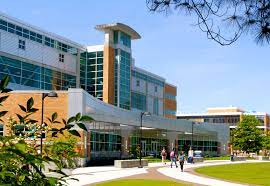
I walked through the library at the college before heading home, and I talked to a few present and former students studying for finals, writing papers, eating bagels. I did not frequent the library when I was in college; I knew where it was though.
This time I sat at a table to read notes sent by an editor for a book project—ironically, about teaching college—and looked up from time to time this last week of classes. A few were on cell phones, but not many. Many were on laptops, but more were reading textbooks, writing, or talking quietly to other students with open textbooks and laptops.
My collegiate muscle memory kicked in and I thought, but it isn’t raining out, or snowing, why are all of these people in here?!
After about ten minutes, a young man, John, who had been a student for a few classes of mine some years ago and for whom I wrote a letter of recommendation for a Study Abroad in Australia, came to my table. We talked about his trip and about how he can’t wait to graduate in May. He sat down and before me was a young man only a few years older than last time I saw him but a world away from who he had been back then. It was his maturity, yes—eighteen to twenty-two is a leap unlike most others in life. But it was more. Experience, of course, travel, and the fact he was always an excellent student.
But it was also anticipation. He is just months from moving away from the bubble of dormitories and fraternity fellowship, and it shows in his eyes, the way when I asked his plans, he sat up, how he talked faster. I rarely get to see this part. I teach predominantly freshman and sophomores here, and they’re still ripe, high school residue still on their shoulders they do not yet wish to brush off, in front of them the camp that can be college when you’re away from home but not really. That’s what I stare at. I’ve been looking at twenty-year-old’s for thirty-three years, and the eyes of someone just a couple of years down the line are different. I never get to look into those eyes.
John’s eyes have that hope, they have appreciation, they have understanding. He said the polite, “I could not have done this without you, Professor,” but I know better. He could have, of course. Some students have an internal motivation that no one could defy if they even wanted to.
I returned to my manuscript written on and off through the years of teaching mostly unmotivated, unenthusiastic, unhopeful twenty-year-old’s, and I knew what I needed to do to sharpen the narrative. Throughout the work I dip into the idea of “possibility,” but sitting in the library looking at the students studying, sharing ideas, working, I noted the one aspect of collegiate life I missed out on in my thirty years of teaching first and second year students—hope. The ones at my previous place of employment as well as many of my freshman and sophomore students here move through the day like they were lucky to drag their asses out of summer break. But later, when what’s next is the next forty years of their lives, these same students will come to life, will discover what they are capable of and if they have the metal to make it beyond the confines of the classroom for the first time in their lives, which already are about a quarter of the way over.
Sitting at that table, pushing aside my own work to watch others, talking to John, talking to a few others I knew as I moved my way from the study area to the Einstein Bagels area, filled me with a sense that whatever might be wrong in the world, these people have what it takes to make it right, and for the first time since I walked by Friedsam Memorial Library at St Bonaventure in 1983 on my way to my life, things felt like they were going to be just fine.
“Graveyard” by James Cole Young (author’s collection)
Note from Bob: This piece was originally written as “One Deer Running” for a seminar at ODU in 1998 with Mike D’Orso, then updated some years later and published in various journals and eventually in the collection, Borderline Crazy. I miss Cole, our long, late-night/early morning conversations. For reference, when we were hanging out together, Lennon’s “Double Fantasy” album had just been released and American hostages were being held in Tehran. I was 19 or 20, played music, and little else mattered but art, whether visual or otherwise. Then again in the late 80’s, and again from 1999 to his premature death in 2005. I’m finishing an entirely new essay about Cole and his work for an artist magazine, so he is very much on my mind. I won’t be publishing here pictures of his most brilliant work most of which remains in his daughter’s possession until the forthcoming artist’s magazine piece.
One Deer Running
for Cole
In autumn of 1987, I wandered into the Fishback Galleries off 57th street in Manhattan. The elevator leading to the studios had violet wallpaper with deep yellow flowers and dark green carpet. Spacious abstract paintings of some west coast artist filled the gallery. Large paintings with gobs of primary blues and reds drew me in, just paint on canvas, lines and circles forming predetermined direction with no apparent purpose.
When the curator approached, a notebook in her hand and clearly a lot on her mind, I felt out of place. But I asked anyway. “Do you still have the works of Cole Young here?” I thought I sounded artsy, as if I tossed out the names of landscape artists everyday over espresso at Raphael’s and Michael’s Pub. “James Cole Young. I think he had a show here last spring,” I explained.
“Yes,” she said, scanning a bookshelf for a specific title. “Two in the back office are all I have left.” She pulled out a thick volume and fingered the index. “You may spend a few minutes looking about at our current artist if you wish.” By the time she finished speaking, she had already returned to her desk‑‑a long virgin‑white graphics table covered with neatly stacked manila envelopes and coffee table books.
I followed her.
“Did he do well? I mean‑‑how did the show go over?” The glare of her cobalt blue eyes told me How did it go over? was not a phrase heard often in these titanium-white walls.
“He did well,” she said, turning back to her book. “He was one of our most successful artists. Some fine clients secured his works.”
Fine clients.
Martin Scorsese; John Reed, CEO of Citibank; Walter Shipley, CEO of Chase Manhattan, Wilson Greatbatch, the man who invented the pacemaker.
Fine, indeed.
“What paintings are left?” I asked.
Again, she raised her eyes, more slowly this time. Her Indian red skirt lifted toward her yellow hue thighs. She wore black heels. I wore jeans, long hair, and the scent of poverty. “A cloud scene,” she said, this time with a sigh. “And,” she added, “‘Homage to Cole’.”
“Homage to Cole.” I couldn’t believe it.
“Can I see that one please?”
“Please,” I went on. “Would you mind? I was there when he painted that. I was in the studio, smelling the paint. I remember when he moved a few things because they didn’t look right.” Her book slipped from her fingers, and she lost her place.
“I’m sorry,” she said. “That wouldn’t be possible. It is locked up for a buyer.”
Someone bought it, yes. The sale had been secured for tens of thousands of dollars and the painting eventually hung in a second-floor lobby of the World Trade Center.
The afternoon was waning as I stepped back onto 57th Street. The slate blue sky had darkened, and the sun had turned pale, a yellow oxide. They didn’t have his self portrait, I thought. We studied his self‑portrait in his class once, I remembered, as I walked toward a street vendor for dinner. I can picture it. He has no shirt and is standing sideways in front of a window. I think there was a dead bird on the sill.
And “Homage to Cole” painted in respect to one of the most influential artists in Cole’s life, Thomas Cole. Cole Young loved the way after painting landscapes most of his life, the most beautiful work Thomas Cole did was of the sky, where the Hudson School painter found “grace and expansive energy.”
Allegany, New York, is almost as far from the Fishback Galleries as the New York landscape allows. The small village on the state’s Southern Tier counts just six thousand residents. The town and its larger neighbor, Olean, are surrounded by the Allegheny Mountains while the Allegheny River S‑curves its way through, shallow enough to wade across. Pennsylvania lies just beyond the valley to the south, and Buffalo, about 75 miles north, is the closest town of any sprawl. In the midst of these “Enchanted Mountains” is St. Bonaventure University, which boosts the community’s head count another 33 percent.
It’s an old campus, dating to 1858, founded by Irish settlers and Franciscan Priests. Most of the buildings are surrounded by forests of gold and red and dark green and yellow trees and sprawling lawns. One of its older buildings is St Francis Friary which once housed priests and seminarians. In the mid‑seventies it was converted into a dorm with its own dining hall, chapel and majestic views, still students back then would shy from its remote location: It stood alone, accessed either by road or a walk through the woods on a narrow trail. When the University started its art program in ’75, the former friary was perfect. In the basement was an old storage room‑‑great for a teaching studio. Beneath it, deep in the ground, hid an old library once used by Franciscans ‑‑perfect for an artist’s studio.
Administrators never brought dignitaries here. The art studio and classroom were not on the campus tourback then‑‑someone might have run into Cole Young. At twenty-five, with long hair, mustache, and lanky limbs, Cole bent forward when he taught his classes, making sure his opinion, which bent to the left, was clear and understood.
“I can smell dead priests here, man,” he told me once. In class back then, students moved about—painting, drawing, modeling, seemingly on their own yet under Cole’s eyes, and even more, his preaching.
“Trust yourself,” he told a self‑conscious student with a pencil and a large pad. A nude female sprawled across an indigo blanket on the floor. The student was supposed to draw her without looking down at his own pad.
“Let go. You know what her hair looks like. Let the mind and the hands work together.” His head would thrust with each verb, for emphasis. He’d throw words at his students, desperately afraid they wouldn’t get it‑‑not the drawing, but the metaphor of it all. “You’ve been doing things without looking your whole lives,” he called to everyone. They all stopped. Cole was preaching.
“You tie yourshoes without looking sometimes, right? Button your shirt? Pee?” He turned back to the student. “You can find your pecker without looking, right? Know where it is?” Cole backed off. He made his point, albeit with the abrasiveness of a van Gogh brushstroke.
Then he taught. “Do it man, you can. Trust your hand. No, it will not look like a photograph. No, it may not look like hair. But it will be movement. It will be information.”
Then to everyone: “It is all information. Right? Talk to me. Tell me what her hair looks like. Tell me where it turns and darkens and falls freely. Give me all the information you can.” Music played when he taught. Dylan. Lennon. Van Morrison. Old Jackson Browne.
He and I would hit Perkins Pancake House at three am after some painting, music, and ranting. Everything was an issue for Cole. Some kid came in wearing a Nike shirt and Cole revved up. “You work for Nike?” he asked. The kid who seemed either on his way to or from being drunk said no. “Then why are you promoting Nike? You get paid to wear that shirt? We’re billboards! We’re being sucked in by the swoosh.” The kid just ate his eggs looking confused.
Cole once bought a van and demanded the dealer’s metal symbol on the back be taken off. “I don’t work for them. They want it on there they should pay me.” They took it off.
He was a skinny version of Harrison Ford when he smiled, his hair somewhere between auburn and light brown, long, near his shoulders. And his eyes would dart about the room while teaching or lock into another’s when one on one. Cole played his game and if you couldn’t play along, leave, take economics where no one gets it. Get off the freaking bus. Drop out. “Life, man. That’s all this is this whole education thing. Life. That’s it.”
Cole and his wife, Sharon, moved to a farm in Allegany. It was so far off the beaten path, you had to want to go there‑‑and most people who ended up there were usually lost. Still, Cole spent most of his time in his studio beneath the art classroom in the old friary on campus, about seven miles away.
Most mornings while I was a student, we’d be in the studio till three am, Lennon on the stereo, Cole smoking pot, working on something that looked like a valley beyond a secluded scenic overview. Pictures taped to the walls represented nature’s original inspiration for this work. Smoke filled the studio. Hours passed and he still worked on a rock. Same rock he had been working on for a week.
“Shit.” He put down his brush. “There isn’t enough detail in the trees.” He looked at the pictures. “See? I have to move the rock.”
The fine detail in “Homage to Cole” is laborious painting. A stick in the brush, fallen from the sugar maple in the foreground, was a week’s work. The birch tree, which gave him trouble in the painting, took even more time. It was done between classes, during lunch, late at night when no one was around, in the early hours while talking about John Lennon and listening to music. We’d be quiet for a while when he’d blurt out “‘life is what happens when you’re busy making other plans.’ Geez. Lennon’s a freaking genius.”
This was about the time of the Iranian hostage crisis and pictures of starving children in the third world poured in on network television every night. Cole was pissed. “No one in this country is going to give a damn until that kind of terrorism happens here, in America. Then they’ll wake up.” His anger produced two canvases, both set in New York City, and both of tall buildings ablaze after a terror attack. This was twenty years before 9/11.
Cole Young’s paintings have been compared to JMW Turner and Caspar Friedrich. One critic wrote that his work has the passion and range of Friedrich: The “calmness that evaporates into furious motifs in nature,” carried out with one of the most varied palettes in contemporary art. To Cole, rocks are not brown or slate or tan or white. They are a composite of colors. To use one color of oil to represent that rock is, to Cole, to focus on vague images instead of scrutinizing the scene. In the 1800’s, Friedrich used similar colors and approach. He too would labor over color, layering one on another and mixing and scraping until the right tone was achieved. I once pointed out that van Gogh said to leave the obvious vague. “Van Gogh was an asshole,” Cole responded. So it was.
Friedrich’s contemporary, Turner, whose work hangs in museums throughout the globe, mastered the turmoil in nature as well, particularly clouds. “Cole Young’s work,” one Buffalo art critic wrote, “is not unlike… the early paintings of Turner.”
With that remark, exhibitions began to emerge. So did his work. The volume of work in his studio grew. Three walls were blocked by large canvases in progress, balanced on cinder blocks, lit by huge mercury lamps to insure perfect color. All about each canvas were books‑‑Friedrich, Turner, Constable and pictures and studies of subjects. All are landscapes, though that term‑‑”landscape artist”‑‑was not right, not to Cole.
When his class studied a “landscape artist,” he’d say, “It sounds like he’s working for a garden center. It’s just a tag. What gross information does ‘land‑scape artist’ carry? Huh?” He smiled. “He’s a painter. He paints nature.”
“And damned well,” he’d add, and everyone laughed. Cole didn’t like to offend people, though he knew he did. “I’d rather offend some of you,” he told his class, “to wake you all up, than be oh‑so‑damned‑polite and have you not get it.”
What Cole got were acclaims in the art community and New York’s Fishback Gallery opened his one‑man exhibit. And he sold well there. Fine clients bought his paintings. But Cole sank into a deep depression, a lethargy he couldn’t explain, couldn’t control.
Nine years of complacent monotony later, in the spring of ‘96, during a brief period of what Cole later said was false energy, he painted two small canvases. They are both called “Graveyard.” In these paintings, he “ties nature directly to the human impulse to acknowledge and commemorate its dead.” It is a row of dead trees seen close and from a low vantage point from within the “decayed woods.”
The observer is inside, looking up. The view is “locked directly to the shredded, peeling bark and broken limbs of a few pitiable stalks. There is a hint of color in the brush, and the sky is neither threatening nor inviting.”
He also painted one large painting. A 4’ x 7’ scene in autumn woods, but the emphasis is on a bubbling, dark blue cloud. It is called “Difficult Cloud.” These three paintings head to the Buffalo State University Art Exhibit, win top awards and critical acclaim. “Difficult Cloud” sold for eighteen thousand. Still, these moments were patches of blue in an otherwise apocalyptic sky. Teaching, painting, nothing could keep Cole young anymore. He was a student staring at his hands because he didn’t trust himself. “I’m holding cigarettes where a brush should be,” he told me once.
In the late nineties, his daughter Dylaina encouraged him to join a smoking-cessation seminar. It was late and we sat on the porch of his farmhouse. He told me about the first night at the seminar and how it still gives him chills. On the way to the high school while driving along the upper end of 5th Street in Allegany, Cole saw a deer running across a field. At twilight‑‑too early for headlights, too late for the sun‑‑he watched the grace, the stretched limbs, the beauty. He also noticed that the deer, on its present course and speed, would have run into the side of his van.
He slammed on the brakes and old oil paint tubes flew out from the back with cans and bottles. The deer veered into the woods. Cole loved to philosophize, though, and he sat there a long time considering the collision of beauty and death. He lit a cigarette to calm his nerves.
That night, he sat among twelve other men and women in a room at an Olean High School. He waited silently. The director of the seminar walked in and talked. “You start. You stop. You will. You won’t. You’ll quit on your birthday. You’ll quit New Year’s. You’ll slow down. You’ll quit for lent. Listen, just quit smoking or drop the whole fucking issue,” the guy said. Then he left, telling them he’d be back in ten minutes.
Cole smiled. “Ingenious,” he had told me. To a participant that night, Cole said, “The man is brilliant. Don’t you get it, man? Christ, this is freaking ingenious. Don’t you get it?” He drew the whole room in, some talking, but most listening to Cole.
Cole finally got it. He returned to the studio with the enthusiasm and persistence of ten years earlier. He painted, he contacted the galleries again all eager to pick him up, all still a bit hesitant to commit to an artist who might drop out of sight again. Do it, don’t do it, whatever, but shut up and paint—that became his new philosophy. He stormed back into his studio. He traveled again, sketching landscapes and taking pictures in the Smokey’s, in the Adirondacks, in New Hampshire at a friend’s farm, at Mt Washington. He asked me to bring him to Russia. He worked. But our trip never materialized. A few years later, he suffered the chemo and operations to abort lung cancer about the same time he created large room-size canvases of clouds above New Hampshire’s Mount Washington. He was running as fast as he could toward a collision he knew was approaching, but he did it with grace. His later paintings show his mastery of color, especially of the sky, and the luminous clouds rise on endless canvases.
In September of 2001, when the towers fell, Cole heard it all happen from his studio down under the Manhattan Bridge Overpass. He didn’t think right away about “Homage to Cole,” one of many expensive pieces of art vaporized when the towers tumbled. He thought of the two canvases of terrorist-attacked buildings in Manhattan from two decades earlier, and chills ran up his spine.
Cole’s hero, landscape artist Thomas Cole, died young after a short illness, but his five-painting series TheCourse of Empire, painted in 1836, exposes the progress of a society from its savage beginnings to the apex of luxury and success and finally its demise and extinction. Later, he looked upward, detailing the colors and beauty of the sky. Both Coles loved symmetry.
Despite his illness, the energy in his voice didn’t fade. He called me, exclaiming, “I want to go to China. Let’s go to China and head down to the southern provinces where you can write and I can paint a lifetime of work in one month.” It was as if he was a teenager again when he sold his first drawing to the Saturday Evening Post. “China, Bob. You’re going. I can’t do that alone, it’s not in me but life is finally opening up,” he said. He wrote the next day to expound further about China, and he said he felt alive again, he said lifehad finally exposed itself to him, and he finished with, “I hope your journey on this planet reveals itself to you.”
I never spoke to him again.
When Cole Young died that November, I walked out and stared into the brilliant autumn sky. It was neither threatening nor inviting. High clouds reached across the horizon. I can see him leaning into me, preaching, telling me about the allusiveness of clouds, about their very temperance. Cole had always been a composite of colors, and what ignited him most was when someone looked at him, or anything, on the surface only. “We were born with energy and depth, man. Use it.” What energy he had. What remarkable energy his paintings generate; proof that sometimes the simplest and most fragile brushstrokes can create the most vibrant scenes.
quick artist sketch while hiking (author’s collection)







 a view from this wilderness