Present Perfect

1908040_10203813288720133_7224931381547605230_n

I’m thinking about Spain tonight, that time back then, and the lessons I forgot, the moments which were later diluted by misguided responsibilities. The way I fell apart just a few years later and leaned too hard for some time there; the way I still do sometimes. The way everything makes sense when I’m talking to the right person, and how I know it should make sense all the time, and how it doesn’t. That’s on my mind tonight. That, and Spain.

I’m thinking about how I carried home with me that sense of life as it was meant to be, at least for me it was, and how it lasted for a little while back then. And tonight I’m wondering what happened to it. I thought I’d never forget what I apparently forgot. Then more recently after some significant changes, I was sure I’d never again forget to be present, to be aware of life, now.

Then late last night I read a letter –this morning I suppose–in which a small part told me of all the versions of me in thirty-five years, that one, the one right after Spain, was the easiest to love. “Find him again,” it said. “You won’t be at peace until you do.”

Just. Well. Fuck.

Spain.

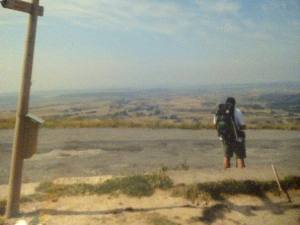
One evening a decade ago, Michael and I spent the night above a bar in the village of Samos and had pulpo–octopus–for dinner. Later that night a priest invited us to a private party and we stood next to four buffet tables of pintxos and wine, and we ate and stood on the balcony, drank wine and watched swans swim in the lake and hissing at the setting sun behind the cloister. Every single day outdid the previous one. I kept waiting for that golden moment, and they kept coming. Like that following morning when we walked to a nearby field and found a chapel from the 9th century alone in the mist, part of some eternal sacred silence. It was not a five-hundred mile journey; it was one step at a time, one moment at a time, over and over. That might be the most practical lesson of the Camino.

We slept on yoga mats in a hallway of an old church in Logrono, Spain, with seventy other tired souls after we shared dinner and walked through the basement of the five hundred year old building. For two nights we slept in comfort in the same hotel Hemingway stayed while working on The Sun Also Rises. In some small, old chicken village we stayed in a brand new albergue which had no business being open yet. The floors and ceilings weren’t done, it was freezing inside, and the yet-to-be-inspected bathroom was three floors down. The only bar in town was closed so the owner gave us a few beers which made up for the thick dust everywhere. We stayed near Torres del Rio above a bar with fine food and a wading pool out back to soak our blistered and swollen feet. We stayed in an old monastery a hundred yards from a church St Francis of Assisi himself asked to be built. In Portomarin, we stayed up as long as we could because the rooms were all filled. We hung out in a small café until 1am and then walked around the misty, cooling waterfront. Then we settled on the town square with covered walkways running next to a medieval church. Against some storefront we pulled together folding chairs and wrapped ourselves in whatever we could and tried to sleep in rapidly dropping temperatures. A kid on a bike did tricks on the steps of the church until 3 am which anyway kept me amused. At 4:30 we got out our flashlights and headed west. You can see a million stars in Spain at 4:30 in the morning, and the darkness makes the silence almost melodic.

In O’Cebreiro there was no room and we nearly walked out of town to camp when a man waved us toward a back door at an inn and we ended up with a beautiful private room for practically nothing at all and just outside the door were a few tables on a stone patio overlooking valleys that stretched across Galicia. In the morning the fog sat below us in those valleys, and the sun came up like we were looking at the ocean until the clouds dissolved and the sky turned blue and the green hills welcomed us.

A few weeks earlier when we first crossed the Pyrenees into Spain’s small village of Roncesvalles, we stayed next to a chapel Charlemagne used and at night we went to the basement and spent hours drinking gin and tonics and talking to the innkeeper. In the village of Zubiri in Navarra, just before Pamplona, we stayed in a new place on the fourth floor and shared a room with a couple from France. My son took pictures from the Roman Bridge outside our window. A few days later on the eve of the feast of Saint James, patron of this pilgrimage, we stayed in a small inn run by a single mom who made dinner for us, a woman from Madrid, and two men from Germany. We shared a delicious Italian meal and drank clay pitchers of red wine and talked about the distances. We laughed in three languages and despite someone snoring most of the night we slept well enough to leave an hour after everyone else making our journey quieter and more perfect. We didn’t worry about how far we walked or where we might stay. We walked and we would find a place. Like the fly-infested villa with tremendous views, or the albergue with dogs who insisted on sleeping on our laps, or the room above the garage with a killer bar at the street; or the stone building down some slope where we met some girl from Texas and a father and son from Amsterdam. After paying at the restaurant we drank the best hard cider in Spain.

In one neighborhood as close to suburbia as we ever saw, some couple opened an albergue in their house and we got the first two of five beds, the others occupied by a salesman from Madrid, a woman from Barcelona and another from Majorca. We all had dinner on the back porch where all the flies in Spain gathered to join us, as well as a dog named Bruno, and the sun was brilliant and we slept well. Once, we stumbled into some tiny town, another chicken village, looked like a movie set for an old western, and we slept in the bunk room with fifty other people. In the morning we picked up a few supplies at their shed they called a store, but man oh man the lemon chicken was awesome.

Everything we did was deliberate.

Everything we ate was delicious

Everyone we met enriched our lives. It should be this way all the time. At home. Anywhere. We live in a phenomenal world for a disturbingly short period of time. It should always be this way. In fifteen years I’ll be fifteen years older, no matter how I get there. In fifteen years I’ll be almost eighty. Life is too easy to love to give it the cold shoulder.

In Spain every single day for more than a month we remained present, aware, but when we came home after some time we slid quietly into the old routine, stumbled back upon a world where what was and what might be constantly drowns out what is, where few live in the present, where few talk to each other. Where people pass through life quietly.

“Those of us who live,” Vincent van Gogh wrote, “why don’t we live more?” It doesn’t have to be Spain, of course. It could be a week walking city streets, a day spent cleaning the garage, a moment watching the sunset across a salty plain.

And it doesn’t have to be fifteen years. It is, after all, jut one moment at a time, over and over, for fifteen years.

Buen Camino. I’ll be outside. Leave a message.
…the Fozzie pillow my sister made me,…

I have a lot of shit.

Books I’ll never read again, clothes I don’t wear, boxes of frames and a stack of artwork I’ll never hang leaning against the wall next to the bureau. I have enough pottery to supply a small restaurant, enough reusable grocery bags in my house and in the trunk of my car to carry away the frozen food isle of Kroger, and a shed full of tools I didn’t use when both me and them were newer.

I have scribbles of notes for articles and essays, folders of rough drafts for books and short non-fiction I never read or even attempted to get published, sixteen previous versions of a book which comes out in a year that doesn’t resemble any of the first fifteen variations.

Even when I get away from it and go for a walk down the hill to the river, I have too much stuff. I have obligations both financial and professional that weigh heavily, an overwhelming desire to call Letty or Dave or Dan and just talk like I did every few days for three, four, almost five decades, and sometimes a powerful flash of memory of my father so real I can hear his voice next to me. Those moments can be debilitating, and I just want to swim away. When that happens, I carry it all home and sometimes write about it, sometimes lay down and try and sleep. I lay down and not sleep at all a lot.

A few days ago my son and I took the ferry to Tangier Island, eighteen miles into the Chesapeake, and we walked the historic, tiny slab of sinking land. It was good to slap the world’s largest estuary between me and my stuff, walking around, talking, noticing the birds, the friendly residents, and watching the watermen do their thing the way their ancestors did since Cornish settlers arrived in the 1680’s, more than fifty years after John Smith rowed by and took note. A lady in a golf cart next to Lorraine’s restaurant where we had fresh soft shell crab sandwiches spoke to a friend of hers in a Cornish accent the islanders are famous for.

And we had ice cream.

But all of that was all I needed to clear my head and not carry around the volumes of concerns back on the mainland. I was in the moment, which is quite a rare thing for anyone these days. I have noticed that when I travel—Prague, Ireland, Spain, especially all those trips to Russia, even the pond of lily pads across the river where my son and I often stop to listen—I am completely present, uber aware of my surroundings, the people, and my memory sharpens so that I can write about it sometimes years later and still smell that moment, still hear a veteran’s voice telling me about “the time that…” Absolutely present.

And I come home after those moments and look around at the stacks of magazines I won’t read again if I ever did, the boxes of ornaments too many to hang them all, grade books from my early teaching years, relics of a time I wish hadn’t happened to begin with never mind reliving it, and I wonder why I still have it all.

When we walked the Camino de Santiago, it took about a week to shed the sense I was forgetting something, to ease up on the worry that something needed to be done. It took only a few more days to remind myself that at all times I am indeed here, breathing in and out, moving along, celebrating the passing of time, and everything else is needless no matter how sentimental we are about stuff. We rarely stop and appreciate the fact we are actually alive to begin with, standing here, able to negotiate the next moment however we desire. I forget this most of the time, and I wish I didn’t.

Many, many years ago I went to a wedding reception on the shore of Lake Erie in the small village of Angola on the Lake. I stood looking out across the water not unlike I do almost every morning when I head to the bay at Stingray Point and stare east, and Fr Dan, who had celebrated their marriage, walked to me and we talked. I remember he said I seemed quiet. I told him I wasn’t sure what to do with my life. He told me the normal Fr Dan stuff like God will show me the way, and I’m young and have so many options, and more of what I’ve heard him repeat to me and others in the nearly forty years since then, but I knew all that. So I said something to the effect of, “I suppose just knowing no matter what else all I need is ‘me,’ alive and functioning, to start over if things don’t work out in whatever direction I choose and to truly enjoy the ‘passing of time.’” He laughed and put his hand around my shoulder and said how right that is.

But we don’t really mean that. We work hard, we gather memories and even though we stack them next to the bureau or on closet shelves, we need them there to glance at once in a while to know there was some reason and rhyme to our pilgrimage until now. Of course I can land on my feet and start in a new direction at any time, knowing that in about a week that routine will realign my anxieties and I’ll be fine, and all I’ll need to carry with me are memories of those I have loved. Yes, that is all true.

But I like my shit. The funky photos Valentine took in Russia, and the photo Letty had framed for me of four ladies on a bench; the stacks of brochures and pamphlets from state parks and museums my son and I have hiked and visited for nearly thirty years, the signed books from authors I have had the pleasure to talk to and read with, the tins of pins from Soviet shops and Czech artists’ studios. The sloth birthday balloon and a crazy little light-generated cat from someone who can finish my sentences for me, the folders of drawings from my son’s youth, the small bottle of absinth I never opened.

The miter box my brother bought me and the rug of seascape my sister made when I was in college. My mom’s large Dopey Doll. Shells from a walk with a friend on the Gulf of Mexico and a nutcracker my son painted when he was young.

I have so much stuff, but it all reminds me of what an amazing pilgrimage it has been.

In two years I’m going back to St. Jean Pied de Port, France, to start walking again, south to Pamplona then west to Santiago. I’ll carry a pack with just enough to know I’ll be fine. And if I should stumble upon mementos to carry home, I am sure I can find someplace to put them.  

Uncomplicated

30739603_10214554803251283_6796824465050173440_o
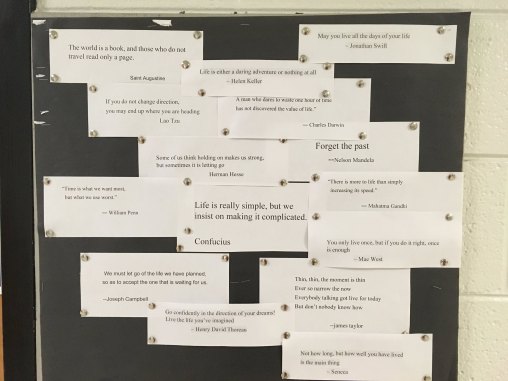
The board outside my former office, May 2018

Some years ago when I knew for sure I was leaving my job I held for nearly thirty years, I started to focus not so much on what was next as much as how fast, how so very fast it all went, and I realized that about the same amount of time to come would put me at nearly ninety years old.

I cleaned out my office—slowly at first, then with much more indifference. I carried piles of books to a common table in the building’s lobby, I moved file cabinets and other useless furniture into a storage area for someone else to claim and configure to their job the way we do with all things in our lives—we mold them to fit in the corners of our growth and accomplishments. Yeah, I was done with all of it.

And outside my office I took down all announcements and office hours and lists of readings from my bulletin board so that all that was left was black construction paper. It looked clean, like a slate, and I absolutely loved the metaphor of it all, but I also thought I should take a piece of chalk and write in some demanding font, “Outta here.”

Instead, I typed up a favorite saying of mine, “Life is really simple, but we insist on making it complicated,” by Confucius. I stapled it to the middle of the board, smiled, and went about my business of unraveling three decades and finding my way to that diversion Frost wrote about with such eloquence.  

Next to my office was a classroom, and students often leaned against the wall (and my door) while waiting for another class to empty before entering. A few noticed the saying and commented to me when I returned to my office. “I like it,” one woman commented, “because it makes me think about it.” I liked that. I wish she had been one of my students.

The following week I added another quote to the board. This time Lao Tzu, one of my absolute favorites: “If you don’t change directions, you may end up where you are going.” Just stapling that to the board punctured a ball of emotion that spilled out across the rest of that day. How many times have I preached, I thought, about the dangers of getting caught in the currents and letting the world around us carry us through instead of pulling ourselves out of the stream and deciding for ourselves where we are going? Students had the same reaction, and I know they were wondering just who is it that decided going to college right then was the right thing to do. Often there is absolutely nothing wrong with where we are going; this is not a rebellious statement, I don’t think. I believe Lao was just indicating it can’t hurt to get a glimpse of what’s ahead every once in a while to see if you really are okay with the path you’re on.

Well, the board caught on and people started asking when the next quote was going up, gathering around my door on Tuesdays after they figured out I didn’t work Monday’s and that I must have posted them early Tuesday mornings, which I did. Up went James Taylor, Mae West, Seneca, St Augustine, and Jonathan Swift. More than a few passing people commented on how motivating the sayings were, and how they looked forward to them. Well, motivation was always my profession anyway, not teaching. For those thirty years it wasn’t English I was there for—hell, I was barely qualified for the first fifteen of those years. It was that I knew how to get them to find significance in it all—the work, the direction, the balance of dreams and reality. My job in New England after college was to motivate people, and I learned it well. So when I ended up teaching college, I knew instinctively that it really doesn’t matter how much I know the work, if they aren’t engaged—if they don’t feel motivated—I’d be speaking to the walls. Plus, my board was an extension of what I knew was about to end, and I started in those last months to motivate myself forward. I was absolutely projecting.

William Penn. Herman Hesse. Helen Keller.

Thoreau.

Darwin.

Then it was the first week in May at the start of my last week ever on campus. And I found this: We must let go of the life we have planned so as to accept the one that is waiting for us—Joseph Campbell.

I typed it up, printed it out, moved Thoreau a bit for balance, and stapled Joseph to the board. That one was for me.

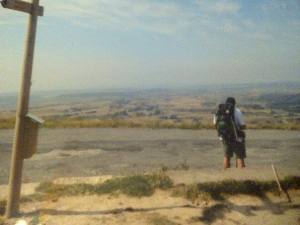
One of my most vivid memories from Spain was being in Santiago after more than a month of walking at about two or three miles an hour, sitting in cafes, crossing Roman bridges noting each step, each breath—essentially, more than a month of barely moving to cross a nation—and then seemingly suddenly we we boarded a train for the six-hour ride–just six hours–back to Pamplona. Six hours. It took four weeks to go from Pamplona to Santiago, and six hours to get back. On top of that disturbing reality check was that after a month of barely moving, we were suddenly barreling along at sixty and seventy miles per hour. It simply felt wrong. I leaned against a window looking at the landscape and when I saw pilgrims walking the opposite direction toward Santiago, holding their walking sticks, their backpacks strapped and the sun beating down as they walked and laughed, talking to other pilgrims on the road, I got a pit in the center of my stomach, a nauseous pain, like a child on a school bus for the first time who sees his parents outside walking the other way. I wanted to get off; I wanted to pull back the doors between the carriages, toss my pack out onto the trail and tumble out like a character in a movie. Writing that just now brought the pit back; it was that real, it is that real. It was the only time in my life I compared side by side the notion of getting somewhere and going somewhere. They’re not the same.

I’m a pilgrim, not a passenger.

Sometimes that happens. You’re riding along, caught up in the mainstream, barely noticing where you’re going because you’re engaged with everyone else in the stream barely noticing where they’re going, and you catch a glimpse of some shadow of yourself just out of reach. And you know that’s where you should be, of course, but the trouble, the pain, the expense, the sacrifice, the explanations necessary, the possibility of failure, the probability of doubt all slide in front of you, each holding you back just a little, all adding up to a gravitational force of “now” and “comfortable” and “responsible” that’s harder to break free from than the strongest of currents.

And even if you do jump, you’re immediately inflicted with that same pit in the stomach, only this time it pulsates, “Oh my God, what have I done?” The things is, you’ll never lose the pit, one way or the other.

Anyway.

On that last day back then, I cleaned out my office and walked outside the door, and for a moment I thought about leaving the quotes there, or maybe replacing them all with just one quote in the middle of the black construction paper, saying, “and this bird you cannot change—Ronnie van Zant,” but I changed my mind and took them all down and gave them to my friend Jack. Each week he’d come by my office and we’d talk about the latest quote and what it meant to us. Then on that last day when I was about to throw out the last folder of teaching materials, I found another passage, typed it up and stapled it to the board. I’d like to believe it is still there.

I know now how much I need that motivation again. But there are two types of motivation: Internal and external. That external one is easy: do the work or don’t get paid. Clean the room or don’t eat dinner. But the internal motivation that drives us from somewhere deep inside, that contradicts the currents, that learns how to turn on a dime, I need that once again. I’m surrounded by people retiring and settling their affairs, haunted by others who slipped off the stage too soon, and it simply creates an indefinable stagnation.

But today while walking along a street in a small village on the Rappahannock River, I remembered that last quote, and it felt right, deep in my stomach it felt right:

“If a man in the street were to pursue his self, what kind of guiding thoughts would he come up with about changing his existence? He would perhaps discover that his brain is not yet dead, that his body is not dried up, and that no matter where he is right now, he is still the creator of his own destiny. He can change this destiny by taking his one decision to change seriously, by fighting his petty resistance against change and fear, by learning more about his mind, by trying out behavior which fills his real need, by carrying out concrete acts rather than conceptualizing about them, by practicing to see and hear and touch and feel as he has never before used these senses…We must remind ourselves, however, that no change takes place without working hard and without getting your hands dirty. There are no formulae and no books to memorize on becoming. I only know this: I exist, I am, I am here, I am becoming, I am my life and no one else makes it for me. I must face my own shortcomings, mistakes, transgressions. No one can suffer my non-being as I do, but tomorrow is another day, and I must decide to leave my bed and live again. And if I fail, I don’t have the comfort of blaming you or life or God.”

                                                                                                                    –Joseph Zinker

12140843_10206985963235013_8819103812513984303_n

Love. And Time.

It’s Fourth of July week and I’m about to get older, and I’m in a café on the Bay thinking how I’d love for this place to be open at night, late, like 4am, and sit and have beers or wine and talk to strangers about where they’ve been, literally and figuratively. I’m sitting here thinking about the the past four or five decades. “Fortunate” doesn’t come close to describing this pilgrimage; but something is different lately. I’m just turning sixty-four and I’m outliving so many people I know. This makes me curious about what’s next, about this brief span before me. I thought I’d grow tired by now, start to unwind, but curiously I find myself gaining momentum.

Here’s a decidedly oversimplified explanation of what runs through my mind on an almost daily basis: We are going to die, of course, but we have no idea when, and even if I live to my mother’s age of ninety-one, that’s just twenty-seven years form now. That’s nothing. And after that we close the door behind us and slip into that nothingness of never being this way again, through the eternal and infinite future of all futures. My point is, to be trite, “Today is my moment; now is my story.”

And today while sipping a cappuccino and after talking to a couple who are sailing down the bay to cross back to the Netherlands, I felt awake, like that crystal-clear awake you have sometimes after it rains. Like all of my senses were cleansed and rebooted. Happy Birthday to me.

To be sure, I’ve had my share of everything: I’ve had a lot of chances to travel. I’ve walked across Spain, trained across Siberia, drove around North and Central America, stood in rivers from the Connetquot to the Congo, and I’ve followed a herd of moose through the woods in Northern Norway. But still it simply isn’t enough; not on this abbreviated timeline. There’s not enough time, never enough love, too much wasted energy, too many spoiled days and nights, not nearly enough love.

In looking back, the moments that stick out most in my mind are the ones where I stepped out of my comfort zone and risked being embarrassed, rejected, and humiliated. Sometimes those things happened, to be sure, but those times are still better and more memorable than sitting safely at home watching reruns of an old show, watching other people live still other people’s lives.

Oh there have been moments. And they all have one thing in common; my memories are of the people I was with completely engaged with each other. It might have been my son in Spain and Russia, or just us taking pictures down at the river. It could have been sitting on a beach in Florida or drinking champagne while watching a sunset on the Great Salt Lake.

Sitting around a club I ran in Massachusetts after hours and swapping stories, laughing, eating pizza from down the road after all the people left. It’s the one am stop at Ocean Eddies on the pier in Virginia Beach in the late ’70’s for a drink and a talk with someone from somewhere else, nothing but the sound of waves crashing under us.

One Fourth of July I was in Massachusetts and drove to Boston to watch the fireworks and I stopped at the Bull and Finch Pub, made famous for being the model for “Cheers.” I sat at the bar and had a beer and got talking to someone who was there to play music. I told him I had played and he asked me to play a short set during one of his breaks. Okay, so this is an example of knowing as sure as I’m sitting here that ten minutes after I said no I’d be absolutely pissed at myself, so I said yes. Rarely am I 100 percent in the moment, not distracted by next or was, but moments like that I am present, completely present–like on the Camino or the Train or the Lake or the river. I said yes and risked being myself. I even had the balls to play “Please Come to Boston.” When I got home to my house on the reservoir that night, I got out my guitar and played while my cat Huey sat on my knee and listened.

Alive. I was so freaking alive that night. The next day friends came by for my birthday and I told them about it and they were excited for me but like with most things in our lives, you absolutely had to be there. I was.

Geez I’ve been fortunate.

But there was one night in particular which stands out a bit more than most of the others. It took place in a bar which long ago burned down. We called it The Shack because it had no name.

This happened about twenty-five years ago.

Just off the Gulf of Finland not far from an exclusive hotel but well in the woods was one of this world’s coolest bars—a dive really—a place to drink and sing and meet people you’d never want mad at you. It was small, with broken-down shed-like walls and windows which barely kept out the storm blowing off the Baltic one May night in the nineties. It was well after midnight and we ordered a bottle of Georgian Merlot and several plates of shashleek, a Russian shish kabob dish. A gypsy band showed up, including a guitar and violin player I’d met before and had played with there along with a friend of theirs, a woman singer. Hours passed as we played and sang and drank. There were four others, three of them, a waitress, the owner and his cat, and we sang and drank while what must have been that hurricane from The Perfect Storm slammed to shore. This duck blind of a building sat amongst birch trees, but that simply made me more aware of the weather, wondering when one might topple through the roof. It was exhilarating, an adrenaline rush that had nothing to do with the wine. It was being alive, right then at 3 am, with total strangers, live gypsy music, Georgian wine, and shashleek, that kept us awake. It felt dangerous, subversive, but it was just a bar in the woods.

I had been in my hotel room, ready to call it a night since the next day we were all going on a river cruise, but I got dressed to head back up the beach to The Shack and have some wine. I didn’t want to wake up the next morning and wished I had gone. The storm hadn’t yet kicked up. But it was coming; you could see it in the haziness of the midnight sun.

The band took a break and came to our table and we spoke in broken Russian and English about the storm and how we hoped it wasn’t high tide soon since the water was just a hundred feet west, maybe less. Then Alexi, a two hundred eighty pound drunk Russian who hated Americans started screaming at us like he had the first time I ever met him, the first time I walked in the place a few years earlier. He had kept to himself mostly since then, sometimes talking to me, mostly not, but this night something got under his skin and he screamed at me like he did that first time, “I hate Fucking Americans.” He startled me, but he had a drink in front of him, and another regular customer, a friend of the gypsy band, was sitting with him and told him to quiet down so he did.

But then I saw his eyes. They were deep and vacant, like he’d seen a ghost, and when he saw me watching him he stood up and said, “I hate fucking Americans!” and he tossed his beer at me. Sasha, the guitar player, stood up and yelled at him in Russian. But just then thunder, with a sound like the sky opening up and dropping two tons of hard earth on our shack, rattled the walls and ceiling and we all cringed. I thought for sure one of the birch trees cracked and was going to kill us all. I went down on the floor with my friends and the gypsy band, and Alexi cursed and fell against the back of his chair. He suddenly looked so small, and the thunderclap crashed on us again, this time blowing open one of the windows, and rain and wind sheered a path across our booth and against the other wall. Dima put his violin under his coat and our shasleek flew off the table onto the floor. The shack cat went for it but the wind and rain chased him back under the bar and into his bed.

Another flash of light lit up the shack and Alexi was trying to hide under his table but he was too big, and just as he glanced out the window on his way to the floor, he stopped and stared. I was watching him, and he looked out the window for some time, then looked at me, and with a nod he said, “Horosho. Horosho” which means, “okay. It’s okay.” And he looked out the window again when the window slammed back and forth. He grabbed it before it hit him and he held it a second, staring out over the Gulf. He looked at me as if to ask me to come see but he didn’t know how. Instead he closed the window and latched it again and turned and sat down. He nodded to me, “Horosho. Edeesuda.” It’s okay, come here. A few of us gathered and sat at his table, and Dima took out his violin. Alexi smiled at me, looked out the window and peered with a stoic face, then turned and smiled again. He looked at the waitress and said “pivo,” beer, and he motioned to us all so she brought us all beer. The rest of the night we laughed and sang songs. I asked Alexi what he saw outside but he just nodded at me and said, “I hate fucking Americans,” and we laughed and toasted and Dima played, then Sasha joined in and then the woman singer, and the beer tasted good. Alexi sat quietly the rest of the night.

The storm passed and the sky quieted down. I almost had stayed at the hotel that evening, turned in early, read in bed. Those are all good things, quiet ambitions which keep me grounded and invested in whatever happens next. But that night I didn’t. Like the time we went Ghost Hunting at midnight at the Saint Augustine Lighthouse, or when my son and I sat up all night in the town square of Portomarin, Spain, because we couldn’t find a place to stay. One time a friend of mine and I hitchhiked to Niagara Falls and it took no longer than it would have to drive, but coming back we walked for eight hours along dark roads through small towns. But if we had been given a ride right away, I’m not so sure I’d remember we even made the trip to begin with. We talked a lot that night, and I wish I could walk like that with more people, and talk, and just walk quietly too.

Sometimes you have to stay up until dawn to understand what’s hiding behind the night. It’s the rest stop at three am with two truckers talking about the next town; or the sound of wildlife in the desert brush, or tall pines scraping together in winter in the woods with no light but the moon. It’s walking up an Arctic path at four am in snow-deep March with Northern Lights bouncing past like a bull whip; or lying on my back on a cot in a compound in Africa beneath more stars than could possibly exist, the distant sound of someone chanting the Koran. It’s walking out of a shack in the woods after a storm passed, the sun just lifting over the raised bridges, ears buzzing from loud live music. It’s the perfect silence on a salt bed and the music of family talking about old times, talking about now. My new year needs to start not just remembering the beautiful path it has been so far, but what made it beautiful to begin with. Its enjoying the passing of time, as JT wrote.

On that night on the gulf after the storm, after the music and the wine, when I stood in the quiet light of morning and shook hands with Alexi as we went separate ways, most likely for good, I began to understand that this crudely brief life of ours is best punctuated with those we love.

A Good Stretch of the Legs

In the summer of 2025, with hope and luck, I’m going to return to the small French village at the foot of the Pyrenees, and I’m going to start walking. Again. I’m going to slow my heartrate down to the length of my gait, and my world will stretch no further than the next kilometer. I’ll stop in thousand-year-old chapels and centuries-old pubs. I’ll drink café con leche every morning along with fajitas patatas, a glass of juice, and a baguette in my pack for the moments of rest, to share with others while we talk about where we’re from. In the afternoons I’ll find an albergue and sit at a picnic table with a bottle of rioja and a small meal, and new friends from Italy and the Netherlands and Nigeria will join me. It’s what we do.

And like last time, I’ll tell stories, and we’ll all laugh, and I’ll be in a fine mood the entire time. Just like last time. And it will again be genuine, not some façade forced by a preoccupied mind.

It is what I should have been doing for decades. No kidding. My life would have been drastically improved had I discovered Spain ten years earlier. I suppose each of us eventually careens into life as it should be. It simply seems most people I know collided earlier than me. I read once we all live out all periods of our life; it’s just that not everyone lives them out in the same order, some aspects delayed for one reason or another. The part where I unearth what brings me peace? Very recently. But that’s no surprise; at least not to me.

***

For far too many people, life can sometimes feel like everything changes at once; as if the Gods conspire to let all the difficult aspects of life accumulate until their collective voice announces, “Now!” and all the old ways are no longer relevant, the old friends no longer available, the old hopes and dreams seem adrift on some frayed tapestry of old expectations. And you feel just past the point where good times still seem plausible. It is the proverbial edge, and many people balance on that jagged edge on a regular basis.

Such is depression. Such is the crash of anxiety. Random afflictions are certainly less random when the smallest of circumstances consistently pinch that nerve between “everything’s fine” and “everything is going to fail.” I’ve been this way before. I’ll be this way again. A lot of us have, right? The “this too shall pass” and “it is what it is” lectures do not work.

You attempt to tackle the entire list of worries, but you know you’re never going to pay all the bills, you know you’re never going to finish the projects, and you are absolutely convinced you’re never going to get the car fixed, the oven fixed, the world fixed. You suffocate in the wash of world failures too, not just your own. So you seek some form of peace, some sense of escape, no matter what it takes to find it. Reason recedes to almost a suggestion, and what seems irrational and drastic to others can somehow make perfect sense. You don’t so much “decide” anymore; and it isn’t about “giving up.” Whatever happens next is simply the only exit in what became a cattle chute void of options. No one gets it. They think you should have simply “gotten over it.” They say, “Had we known.” They say, “What a waste.” They say, “We had no idea.” “We’ve done all we can.” “I didn’t know.”

Of course not. The depressed, the anxious, the one with deep, inescapable demons is more likely than not to make you laugh, get excited about plans, is always there with a sharp and funny story. No one knows; even they don’t know.

***

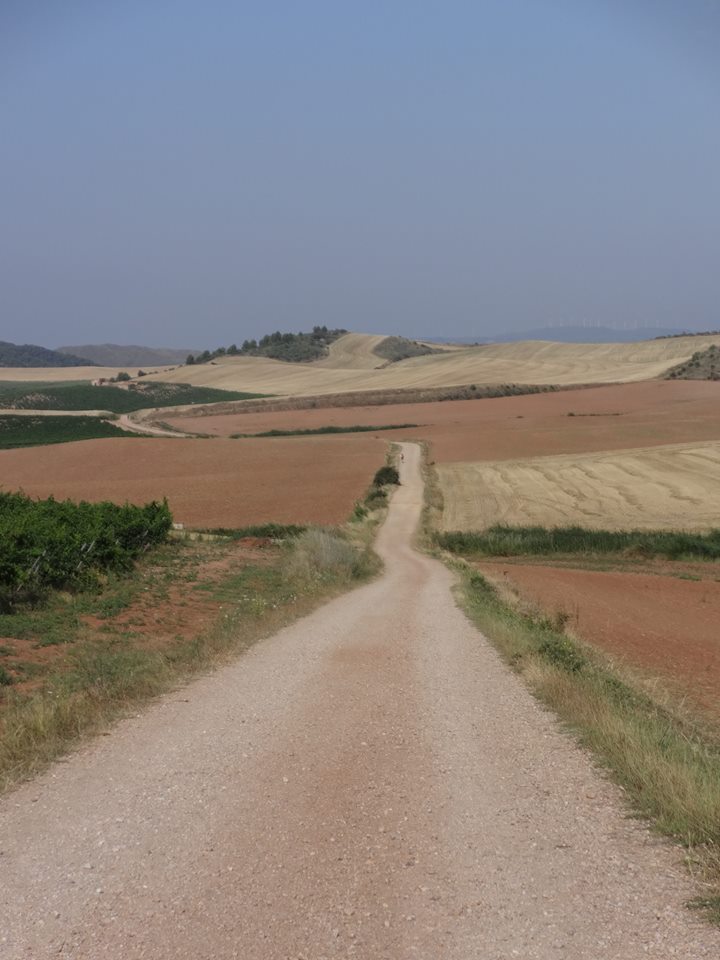
St. Jean Pied de Port, France, to Santiago de Compostella, Spain, is just under nine hundred kilometers—roughly five hundred miles. If you drive, you can make it in just about eight and a half hours. If you walk it takes about six weeks. I’m a walker.

I’ve been there before. I’ll be there again. It’s what psychologists call “the value of anticipation.” We all need something to look forward to. It can’t be out of reach or near the realm of fantasy. Yet it can’t be so obtainable that achievement becomes routine. As Lily Meola sings, “It’s not big enough if it doesn’t scare the hell out of you.” Yet it can’t be too big. Yeah, life for the afflicted can be a juggling act. In broad daylight you can keep those balls going, hands down. At three a.m. there’s a tendency to hear them all crash on the floor and scatter like delusions.

Welcome to how the world is for more than ten percent of the population. They must find their own truths, despite what others expect. And they carry their own baggage filled with failures and misunderstandings like backpacks, and the best anyone can hope to do is put them down and move on. Here’s the thing: the worst part of some psychological ailments is often the inability to see past the next hour, beyond the next mile, yet the ironic solution to those very same inflictions is to decidedly and quite purposefully not see past the next hour or beyond the next mile.  

You see, when you look too far down the path, and your blinders keep out the light of hope, there is no suspense to keep you turning pages; there is no reason to anticipate the resolution. Life is anything but dynamic.

***

Basque country is my favorite part of the Camino. Navarra. It runs from St Jean south to near Pamplona, and you pass locals who still speak this rare language, and all of the ones we met before, all of them, were friendly, helpful, and hopeful for your journey, as if they each have some personal stake in your every step.

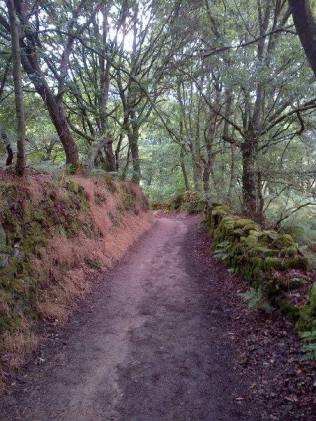
The first day is the hardest. Straight up hill for twenty miles. No kidding; a forty-five-degree angle at times. After that it levels off to just mountain hikes akin to the Catskills until Galacia, where some climbing is involved. But by then, a month later, the body doesn’t mind and the mind doesn’t doubt anymore. And the vistas and the visitors from all over the world keep your mind occupied, and after a week south of France—less maybe, four days—an unhurried pace takes over, and the entire world is arranged by where you’re going and where you “might” stay that night. Somewhere just south of Pamplona, just as the Camino bends to the west, you’ve shut down the part of the mind that begs for self-criticism and doubt, and you feel more free, lighter, but you can’t define it, not exactly. You just know it is easier to breathe; it is easier to sleep. All of the complications which haunt you dissolve. The ghosts recede.

***

Of course, our normal life can be a journey with some “hypothetical destination.” But a journey with some semblance of hope can be the difference between feeling alive and feeling dead all the time, where having an ordinary day is an extraordinary achievement.  

How many of us make plans just beyond our reach, a little past our current condition? It truly might be what saves us. Some of us anyway.

It’s well past time to change the narrative.  

It’s time to go back to Spain.

Simplicity is Gained

Aerie

Time to return to the wilderness.

I sat on the front porch tonight for a bit. Birds had been chirping for quite some time; cardinals, house wrens, and a couple of cooing doves somewhere in the woods to the southwest. When I was on the patio I sat and cupped my hands and blew through my thumbs to make a similar sound, though I doubt I fooled them. The thing is—they went quiet for awhile and then only replied when I made the noise again. I like to think I was telling them something or warning them, though they probably sat on a branch somewhere talking to each other about my opposing thumbs.

Those thoughts were fleeting—no worries. What stayed with me, however, looking out across the front yard into the woods, looking down the darkening path to the east and where it bends back toward the distant driveway, was thoughts about other paths in other places. The trails of eastern Virginia I’ve hiked with my son, the paths at Mt Irenaeus in western New York, the steeper, thin-air paths of Utah that wind straight up to the wind caves. I’ve walked paths I’ll remember forever and a few I wish I could forget, both in reality and metaphorically.

But the true path that always comes to mind, which set the standard and raised the bar, is the Camino de Santiago in Spain. It terrifies me that a pilgrimage across Spain that I can recall like I did it last month out west actually happened ten years ago next summer. It is with me still, but, unfortunately, many of the lessons I thought I learned there have slipped away. I came back convinced I had it right—I’d simplify, I’d organize and stay focused and follow through, but, as Jim Croce aptly reminds me, “So many times I thought I was changing then slipped into patterns of what happened before.”

Yeah. Damnit.

It’ll remain warm here for quite some time, but today there was a breeze off the bay that felt somehow foretelling of autumn. It wasn’t “cool” by any means, but certainly pleasant, welcome. As someone pointed out to me last week: “Summer isn’t through with you yet.” That’s fine; often come mid-September I want to “reach out and hold it back,” as Jay Gatsby desired. Almost all the time, I am like that.

Not this time. No. I’ve almost got my ducks in a row, and I’m casting aside as much as I can of old habits and tired routines. We are always looking for “kicking off” dates to start anew, to really “gather up our forces and get out of yesterday.” There are plenty to choose from: New Year’s and birthdays are probably the most common. But as a professor I have the added commencement of late August, early September, when classes start. This is the time of year everything is brand new, and my attitude is new, my hopes and ambitions, just like students I’ll face each week, just like it was for me forty-something years ago this week. It happens every year, but this time it is a bit different. I’ve worked very hard at separating myself from the umbilical cords of failed approaches and misguided directions. So this time is something closer to my return from Spain, when I knew, I mean I had the absolute conviction, that my destiny was my own. I thought that powerful knowledge would last, but it slipped through my mistakes and shortcomings.

This time, however, it won’t for one very essential reason: I’m older now, and I’ve reached the age where I know I’m running out of do-overs. And I sat on the porch thinking about Spain, about the summer of meandering, both physically and psychologically, and how I was focused on each moment, and I followed through with plans every day while there. I didn’t think in big ideas and sweeping hopes. I thought in small pleasures and that idea of simplicity.

I need to do that again, and for the first time nearly since returning from Spain, most certainly within a few years of returning, I find myself in a position to be able to do just that, and mean it this time when I say, “I’m through wasting what’s left of me.”

I’m at my desk now, an hour ago having left the circling hawk and the frightened doves to do what nature does. It is later and the sun is gone—it sets so much earlier now than just a few weeks ago. Someone across the river is shooting off fireworks. I never thought of Labor Day as a celebration to set off fireworks, but, well, maybe I shouldn’t ignore the symbolism of such New Year’s overtones.

It took ten years for the Camino to truly make sense to me. I’m a slow learner.

You know what? Maybe I’ll just go back to Spain.

Spain