Time. Out.

So here’s the thing: According to scientists who constantly work on and adjust the Asteroid-Satellite Collision Probability, when a meteor or other such space object hits a satellite, the rock “vaporizes into hot, electrically charged gas that can short out circuits and damage electronics, causing the satellite to spin out of control.” Don’t worry about being hit–it’ll burn up on reentry into the planet’s atmosphere. No, that’s not the problem.

See the problem? Yes, no more satellite. And if a large such space rock plays pinball with Space X’s system of communication, we here are earth are, as they might say on “Eureka,” simply fracked.

Since the beginning of the Industrial Age, humanity has forged ahead into the more convenient, even at the expense of the more improved. Further, we have built these castles at the expense of their foundations. The percolator becomes Mr. Coffee becomes a Keurig. Hell, I’ll just swing by Starbucks, and I’m not getting out of the car; I’ll go through the drive thru. Fine, but now give someone a percolator and ask them to make coffee. It’s not going to happen. How many people know their friends’ phone numbers? Their own? Ever been in a store in the middle of checking out when the “connection” fails on their register, and the clerk who can’t write in cursive or add without a calculator stands there completely perplexed?

The world became transfixed by convenience so that ambitious endeavors are no longer defined by “better than it was,” but “more convenient.”  As a result, we are completely, arguably, most definitively reliant upon the 2500 operational satellites orbiting the earth (about 6000 actually are orbiting, but more than half simply don’t work). The argument is the more time we save the more time we can spend with those we love.

Nice. But we’re not. People don’t drive by and visit. Hell, they don’t even call anymore. We’re not going for more walks in the park or along the beach. Where is that extra time? Where are all the people?

You know what? Let’s do it this way instead: Every single day, 100 tons of meteorite dust coats the entire planet. This is true. You, me, the cars, buildings, everywhere, everything. It is so miniscule, of course, that we don’t even know it is happening, preferring instead to wait for the Leonid shower, or the Perseid, the Geminid, or even the Urid, to run outside and watch the shooting stars every twenty or thirty seconds on a clear moonless night. Who isn’t transfixed by that?  Yet equally, who isn’t freaked out by the thought of meteor dust in their hair? On their ice cream cone?

But wait, there’s more:

The temperature at the core of the earth is the same, about 10K Fahrenheit, as the surface of the sun. I love symmetry but part of me wonders if The Great Universal Thermometer simply stops tracking at 10K. Based on that and some formula they figured out with a slide rule (look it up), scientists–the ones who know what they’re talking about because of generations of research and who have less ability to create a fiction than I do–say the planet is about 4.5 billion years old, but humans of any sort have only been here for about 450,000 years (Note: If you are even slightly considering posting a response about how the earth was created in April about 6000 years ago, go away). Now, if you do the math and divide the history of the universe into a day, humans have been searching for convenience stores for about ten seconds.

Our time here is short. So it comes back to meteors. Stardust. The naked-to-the-eye coating which exploded countless zeros away from here several billion years ago, arriving, now on our chocolate swirl cone.

Keep that dust in mind as we add this to the equation: The greatest scientists in the world have trouble wrapping their mind around the concept that our own planet is an anomaly. Even if you are like those of us who believe somewhere in the deep recesses of unthinkable distance are planets with lifeforms playing Scrabble and drinking Pinot Noir, astrophysicists like Stephen Hawking, Neil Tyson, Carl Sagan, and Brian May can’t tell you where, and they’ve looked with equipment so advanced some of it has left the solar system, some landed on moving asteroids, and some is scooping up dirt on the moon like it’s dog poop and bringing it back. And these experts with combined IQ’s in the thousands do not know.

But they can tell us around 100 tons of meteorite dust coats the earth, and us, daily.

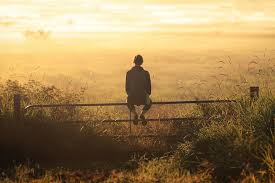
I sat at the river this morning completely unplugged and, to be honest, uninterested in much. I get that way a lot. I felt like going for a long walk in the mountains or sitting on the sand and look for manatee. But both those locales seem as distant as the stars. Instead, I looked out at the Norris Bridge two miles upriver, and the cars and trucks crossing the mile and a half span headed North, up toward DC, up toward New York, up, just further and further up and my mind wandered up as well, across the Niagara Frontier, across Ontario. Up.

I couldn’t hear them, the cars, but I could catch the glint of sun on their windows. Closer, on the river, some bufflehead ducks surfaced then dove again. A workboat headed out from Locklies; I guess to check some traps. And now it is raining, torrents. When it rains like this, when the sky seems to be falling, I don’t want to retreat inside as much as I want to go all in–dive into the river and feel the water around me like amniotic fluid. But it is late. Today, it is about noon, but as far as the history of “time in a day” is concerned, for me it is four in the afternoon. The sun is no longer at its full strength, dinner will be ready soon. The streetlights will soon be on.  

I can’t focus on the minutia in life; never could. Some student asks me about subject verb agreement and I’m wondering why we can only see about 2000-3000 stars, not “millions” as we feel when standing at the bay on a clear, moonless night. I’m more focused on the reality that I have so much I want to see, so many glasses of wine to drink with friends in European pubs and small quaint villages and sandy southern beaches, but very possibly won’t, brings me to the brink of psychosis when someone actually screws up simple comma rules. Part of me wants to say, “Come on! This isn’t rocket science! It’s a fracking comma!” and another part of me wants to whisper, “You’re doing fine. It’s just commas–I knew what you meant. Now go bathe in the miracle of meteorite dust. Buy a chocolate cone and wait for it!!”

In some inhumane attempt to find the easier, find the quicker, the more efficient, humanity has drifted too far astray in 450,000 years; so far from the essential; so far afield from what matters.

We’ve got to get ourselves back to the garden.
 stēlla

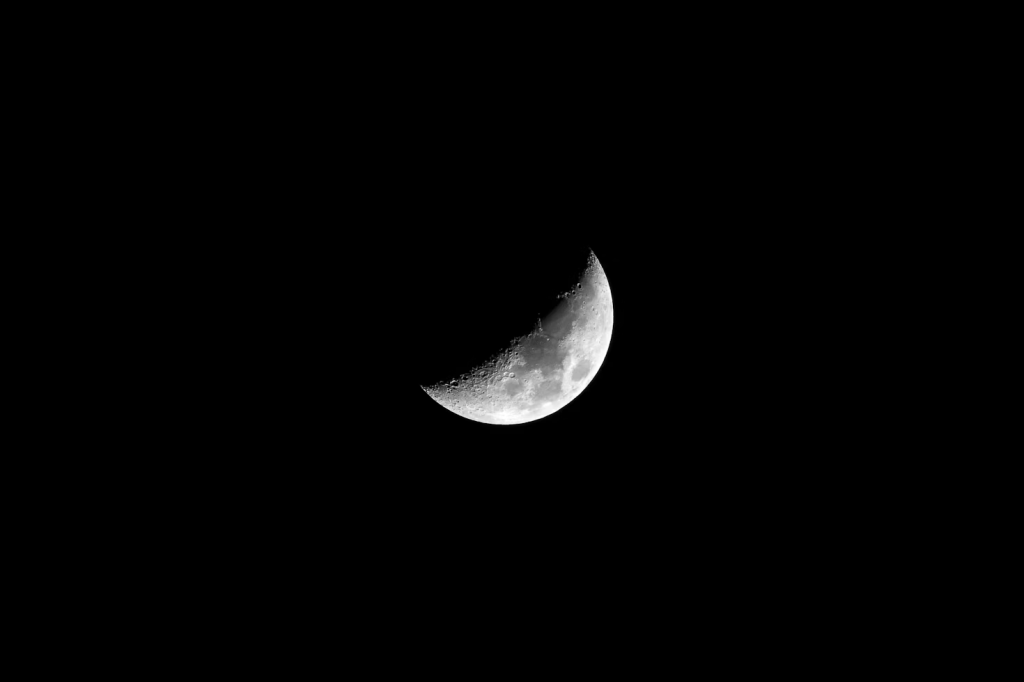
The moon last week through the telescope looked like a golf ball, the dimple-craters and the bright white side imbedded in the mud of the dark side. We looked at it a long time with the perspective Apollo 8 must have had when it orbited the place, moving around it like Tiger Woods circling his next putt.

It’s cold, but still, and the air off the bay bites a bit, and some rustling in the leaves makes me think the fox is around tonight, or a cat from a house through the woods, but it is how it should be–we seem to look at the stars most in winter because it gets dark so much sooner, the air is cleaner, the humidity low.

But last week despite the bright half-moon, the sky was dark and the telescope picked up an amazing nebula all ablaze not far from Orion, shining out from billions of years ago. It is the middle star on the belt and the brightest nebulae up there. I’ve needed perspective lately. When “the world is too much with me” and “life is like a pathless wood,” it is good to look at the same stars as did Copernicus and Galileo and ancient astronomers who saw bulls and crabs and horseheads where I can only see a random sampling of bright dots, like dots on a map.

And the top half of a golf ball stuck in the mud of space.

“Why, I ask myself, shouldn’t the shining dots of the sky be as accessible as the black dots on the map of France?” wrote Van Gogh to his brother, Theo. “Perhaps we take death to reach a star. We cannot get to a star while we are alive any more than we can take the train when we are dead. So to me it seems possible that cholera, tuberculosis and cancer are the celestial means of locomotion. Just as steamboats, buses and railways are the terrestrial means. To die quietly of old age would be to go there on foot.”

I like that, the illusion that death is another mode of transportation, and those we love and lose here are simply on some galactic pilgrimage. I have several books about the stars given to me by my brother, by my son, and I’ve read them, returned to them for reference, for maps, and I have such trouble remembering the names of space stuff. I mostly use my cellphone app, point, and then say with absolute authority, “I’m nearly positive that’s Avior. I think it’s a star in Corina if I’m not mistaken.” But I swear ten minutes later if anyone asked me to repeat it, I couldn’t.

So I’ve started making up my own star names, like the International Star Registry, only specific to Bob. Deep in the Pleiades I can see “Cole,” leaning into the other stars, preaching, pushing them into agreement about the colors he should use to paint Jupiter with all her moons. And what used to be Lesath in the Scorpio constellation according to my Backyard Guide to the Night Sky is now “Eddie.” I can almost hear some Janis wailing from his band of Red Dwarfs. “Dad” is clearly Polaris, my North Star, up there to guide me if I wish, follow him when I’m lost. I wish I had turned to him more when I couldn’t find my way.

Now, I know from these books from my brother and son that the brightest star in the night sky should be Sirius. Orion’s belt points right at it, yet more than a few times I’ve mistaken it for her sisters, like Vega and Canopus. So I’m saving her, putting a sticky note on Sirius. I have a special name for her I’m keeping to myself and will send to the Star Registry—though I doubt they’ll change the name of such an important celestial body; but I will, if only in my mind. And I’m going to memorize her location so I can go outside on a clear night and talk, reminisce, find a bit of permanence in an all too temporal existence.  

(nee Sirius)

The Drifters

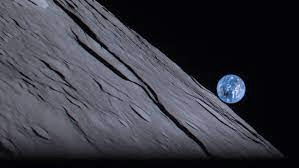
And today I learned that the moon is slowly drifting away from Earth. Like I really needed this with everything else going on. Last week it was one excuse after another from students; this week I picked up a new bottle of an old prescription but instead of it being 50 mg per dose, the pharmacy accidentally gave me 200 mg per dose. Yeah, yesterday sucked. The good news is I survived. Today I learned that the moon won’t.

The truth is we won’t really have to worry about losing our lunar brother. By the time it slips out of this planet’s gravitational hold, the sun will have already swallowed up most of the solar system anyway.

There’s a positive spin for everything.

This reminds me of Woody Allen’s movie Radio Days. The parents of a kid about ten take him to the psychiatrist because he refuses to do his homework. The doctor asks why he won’t do his homework and the kid replies, “I learned in school that the sun is going to die in four billion years.” “So??” the doctor says, and the kid replies, “So what’s the point?”

I know it is extreme, but I get this. I mean, I TOTALLY understand this. Especially yesterday with 150 extra milligrams of drugs in my blood. We put forth great efforts to make some contribution to the world, add our “verse” to the “play,” as Whitman wrote and which I’ve often quoted, yet even the greatest humans in history become footnotes. Friends die, parents, relatives die, or worse, fade away and stop calling or stop returning your calls, which can be even more painful, and you wonder what was it all for. What good amid these people, these trappings of life, am I, to cop another Whitmanism.

Answer: The moon.

The very orb whose drifting I learned about which caused not just a little sadness circles back to play the role of savior. I mean, just look at it, the most common object for all of humanity, the one—and other than the sun, the only—object we all share, stare at, dream about, write poems and prose about since the origins of humanity, the one object we’ve relied upon since humans looked up, save the sun, and even more so, actually, since we often look right into those cold, white crater eyes of the lunar surface but shy away from the retina-burning sun.  

At night, at the river, I watch the moon shimmy on the surface of the bay, or catch a gull in flight and watch her wings spread out over the reach of the fullness of the moon. It has stood witness to wars, to famine and plight, to self-destruction and sacrifice, to suicides and celebrations; it has hung peacefully above pilgrims and plane passengers traveling overseas overnight; it illuminated safaris and caravans of refugees, guided Marco Polo, Magellan, my son, now, in Spain, fumbling home to his hotel.

There’s the Wolf Moon, the Worm Moon, the Snow Moon, the Pink Moon. There’s the Flower Moon and the Buck Moon.

In my life I have counted on it, hanging out there over the Great South Bay, over the Allegheny River, hung just above Merton’s Heart, over the Sonoran, the Sahara, the Chesapeake.

There’s a moon over Brooklyn, Anne Murray sang, and it’s coming into view. It was certainly in view the day I was born in Brooklyn, as it was a waxing gibbus, with more than ninety percent of its surface illuminated that July night. The Bob Moon it was called.

The sun on the moon makes a mighty nice light, wrote James Taylor.

She comes more nearer earth than she was wont, and makes men mad, Shakespeare said.

It’s the small step. It’s the giant leap. It’s one of three things with the sun and the truth that Buddha reminds us cannot be hidden.

I walked once, many moons ago, along a mountain path in Norway, and I watched the moon shiver in the wake of the Northern Lights bouncing around my head like lace curtains lifted by a breeze through an open window. I glanced at Brother Moon as an old friend as if to say, “Are you seeing this?” He was.

It’s a harsh mistress.

It’s the friend, Sandburg tells us, all the lonesome can talk to.

It’s made of cheese.

It knows far more secrets than Sister Sun. Of course. People have less to confess in the light of day, which by its sunny nature brings out our hope, pulls from us some sliver of possibility. But the moon catches us at the witching hour, it remains sole witness to our suffering when those tigers come and taunt us, tug at our fears and anxieties that keep us awake. He’s watching; promising us, if we stop crying long enough to notice, that we’ve been this way before, and we will again.

We have been there, to this moon of ours, for it is ours for now. It was simple science. Jim Lovell once noted that we now live in a world where humans have walked on the moon; that it wasn’t a miracle; we just decided to go. I once wanted to go, when I was nine or ten and Neil and Buzz were blemishes on its face. As I grew, I knew I’d never get there, but that was okay. I started to contemplate people instead, and fixated on Merton’s inquiry as to what can we gain by sailing to the moon if we are not able to cross the abyss that separates us from ourselves.

Now I’m depressed again. Time for some moonshine, head outside to talk to some neighbors, and if we drink enough we’ll moon people in passing cars.

But I digress. I’m sorry; sheer lunacy.

***

Some years ago my son and I walked across Spain. Sometimes we got up before the sun, like we did in the village of Ponferrada, and followed the moon down a trail west toward Santiago. We talked about breakfast and new friends and old ways. We talked about other places to see and the last village we stayed in. We were that rarest of all things—absolutely and completely present, walking beneath the moon, talking.

We drifted away from the village and the lights and the people ever so slowly, wondering if we remembered everything, but then letting it go, moving away from the city’s gravity and into our own space, just the two of us, knowing full well, as did Lennon, that we all shine on, like the moon and the stars and the sun.

Drift away as you must, Brother Moon. I’m not going to let it bother me tonight. You’ve gotten me through some seriously long nights before, and you certainly will again.

Let’s take it one night at a time, shall we?

Stardust

Let’s start with this creepy little statistic: Every single day, one-hundred tons of meteorite dust coats the entire planet. You, me, the cars, buildings, everywhere, everything. It is so miniscule, of course, that we don’t even know it is happening, preferring instead to wait for the Leonid shower, or the Perseid, the Geminid, or even the Urid, to run outside and watch shooting stars every twenty or thirty seconds on a clear moonless night. Who isn’t transfixed by that? No one says, “Hey, I’m covered in microscopic meteor dust; make a wish!” But equally, who isn’t freaked out by the thought of meteor dust in their hair? On their ice cream cone?

This Earth of ours is at its core about ten thousand degrees Fahrenheit, exactly the same as the surface of the sun. Symmetry aside, one has to wonder if The Great Thermometer simply stops tracking at 10K. Also, Earth is the only planet not named for a God, and as crazy as this seems, no one knows who named it, though the etymological roots are Germanic and Old English. As for age, Scientists–the ones who know what they’re talking about because of generations of research–say the planet is about 4.5 billion years old, but humans of any sort have only been here for about 450,000 years. Some traditions and faiths call the start date around six thousand years ago. Either way, the human portion of earth hasn’t been here that long and isn’t staying long enough to wear out our welcome. It seems the earth is cleansing herself.

Since the onset of the Covid pandemic, this planet has shed about three thousand humans per day. That’s a 911 every single day. We are improving, but we are doing it on a very slippery slope. Why? Well, we’ve so adjusted for life to be “convenient” (think Smart Phone, think 5G, think online everything, think curbside, think Drive-thru, think Alexa, think Lunchables), that too many believe if some aspect of life is inconvenient, they’ll simply redefine reality to accommodate what they want, even if it chips away at Earth’s patience.

We’ve traded the rare beauty of this one-of-a-kind globe for “whatever’s easier.” The percolator becomes Mr. Coffee becomes a Keurig. It’s easier. We are completely, arguably, most definitively reliant upon the 2500 operational satellites orbiting the earth (about 6000 actually are orbiting, but more than half simply don’t work–how inconvenient). So here’s the thing: According to scientists who know what they’re talking about and constantly work on and adjust the Asteroid-Satellite Collision Probability, when a meteor or other such space object hits a satellite, the rock “vaporizes into hot, electrically charged gas that can short out circuits and damage electronics, causing the satellite to spin out of control.” Don’t worry about being hit–it’ll burn up on reentry into the planet’s atmosphere. No, that’s not the problem.

See the problem? Yes, no more satellite.

And if a large such space rock plays pinball with Space X’s system of communication, we here are earth are, as they might say on “Eureka,” simply fracked. And if one of them or a flock of them zero in on the Great Siberian Forest setting it ablaze, we are, once again, Stardust, part of the atmosphere, that naked-to-the-eye coating which exploded countless zeros away from here several billion years ago, arriving, now, on our chocolate swirl cone.

The greatest scientists in the world who know what they’re talking about have trouble wrapping their minds around this simple idea: We, Earth, are an anomaly, God’s only child. Even if you believe somewhere in the deep recesses of unthinkable distance are planets with lifeforms playing Scrabble and drinking Pinot Noir, astrophysicists like Stephen Hawking, Neil Tyson, Carl Sagan, and Brian May can’t tell you where, and they’ve looked with equipment so advanced some of it has left the solar system, some landed on moving asteroids, and some is scooping up dirt like a dog-walker in Central Park and bringing it back. Then they study it, then they tell us they still don’t know.

But they can tell us around 100 tons of meteorite dust coats the earth, and us, daily.

I walked to the river earlier. Unplugged and, to be honest, uninterested in much. The day started poorly but finished really strong, but still I felt like going for a long walk in the mountains or sitting on the sand at the gulf, quietly. Instead, here I am, more than a little content to look out at a distant bridge and watch the cars and trucks cross the mile and a half reach headed North, up toward DC, up toward New York, up, just further and further up, perhaps as far as the northern stretch of Ontario to watch the Northern Lights bounce across time. But closer, near me on the river, some bufflehead ducks surfaced and dove again. Watermen on a workboat checked traps.

See, it is information like this that makes me aware of why when a student asks me about subject-verb agreement I’m wondering why we can only see about 2000-3000 stars, not “millions” as we feel when standing at the bay on a clear, moonless night. And my frustration at knowing I have so much I want to see, so many glasses of wine to drink with friends in European pubs and small quaint villages, brings me to the brink of psychosis when someone actually screws up simple comma rules. Part of me wants to say, “Come on! This isn’t rocket science! It’s a fracking comma, for God’s sake!” but in the past few years, a stronger part of me, a more conscious part, wants to whisper, “You’re doing fine. It’s just commas–I knew what you meant. Now go outside and bathe in the miracle of meteorite dust. Buy a cone and wait for it.”

We’ve drifted too far astray from the essential, so far afield from what matters.

We’ve got to get ourselves back to the garden.