
It’s forty-five degrees and rainy today. Two days ago it was eighty-four and sunny. I think snow is in the forecast this week; that, or triple digits. I can’t keep track. Nor do I care that much. It’s weather; I like weather. Whether it is collar up, teary-eyed, runny-nose, bone-vibrating cold; or sweat on the tip of my nose, prickly heat, brow-dripping, sun-burning hot. Either. I’m good. Middle ground works best for being most benign, of course; those New England type, low-humidity seventies with the air-clarity of New York’s Southern Tier, the colors of the Sonoran Desert, and the salty-scented wind of the coast. Everyone loves autumn or spring weather. “Pleasant” they say. Mostly because it doesn’t hit you in the face.
I don’t mind a little headbanging with the elements.
Anyway, it’s raining now. So I’m inside, physically, mentally, psychologically. Like a grocery-store lobster, like a termite, like Kenneth Graham’s Mole, like the malted part of a malted milk ball. That’s me—I’m inside today. I will go for a walk to the river, stroll up Pintail Road past the pond to the dock; I’ll abandon the warm here at Aerie, finish first my cup of hot chai latte, all steamy and frothy.
I have a game I play when things seem down, dark, or otherwise non-descript and boring. It’s actually quite effective: I imagine I’m already dead.
I imagine I found out that time is short—a feat not difficult to imagine these days as several people I care for very deeply no longer have to imagine this; it is real. But I force myself to imagine hearing the news, the disbelief followed by denial and then anger. Then somewhere before acceptance I imagine the rain.
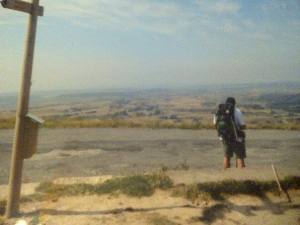
I remember the streak of wet up my back when I was a kid on the island riding my bike after a summer shower. Or the choppy Great South Bay splashing at my knees when Eddie and I would walk along the rocks of Heckscher. I remember Spain, the Camino back from Finisterre to Santiago, and that day it poured the entire time, and a fog settled ahead of us, and we were soaked, but we were so alive, finding small medieval chapels where we stood under the overhang and listened to the far-reaching quiet of Galicia. We found an albergue and changed clothes and walked to a pub and played foosball and had some local brew.
The rain was a visceral reminder we were alive, right then, a drop-by-drop pronouncement of existence. Rain doesn’t reach the interior walls of anyone’s sarcophagus. It is solely for us, for those here, those of us still alive and aware.
And then I imagine the sun.
I remember the heat while hiking Sabino near Tucson, deep pools of mountain water to dive into after my body was dripping with sweat from heat. Or the cold, the uniquely-desert-borne cold feel of my skin when I turned under a cliff into shade and the dry air dropped twenty degrees. Once, in Senegal, in the southwestern Sahara, I fell asleep on a cot in the yard of a house in a small village, and the heat woke me up. I went to the porch and the thermometer in the shade read one hundred and ten. I can remember my shoulders, the tingling sensation when I lightly rubbed my palm across my skin. It caused shivers to run down my spine.
Alive. Absolute clarity.
So, really, so I’ve stoped bitching about the rain, or the cold, or the heat.
Or about anything really. I am alive.
I’m at my desk and above me rain is pelting the skylight tonight. Out the window the deep woods are misty, and I can’t hear any of the normal wrens or even crows. Just the sound of rain and the distant rumble of tires out on 33 more than a mile away. If this clears out before bed, I’ll go out and look at the planets and the stars with the telescope and deep-space binoculars and it will be cold, upper thirties cold, and at first I’ll move from foot to foot, bouncing to keep warm, until some sort of numbness settles in, and I’ll breathe hard on purpose to watch my breath, and my neck will feel wet and cold, and I’ll remember this part of the night as much as I’ll remember spotting Vega or Alpha Centauri. What contrasts! The billions of years ago presence of stars and the immediate dripping reminder of the right now.
How often are we aware of our existence? I mean, how often are we conscious of the beauty and sensation of our life? We go through motions, we dress so we can’t feel the warmth or the cold but who doesn’t love the cold feel of our bare feet on the grass at twilight? We eat so we feel the nothingness of not being hungry, but to fast once in a while is to cleanse our minds of the monotony of food. We don’t connect to others because we find something familiar in the airgap lives we lead in a world where whatever is most convenient works best and connections back to those we knew is so much easier than reaching out to those who just might be in our lives moving forward.
But back to the rain,
my God the rain slaps us, and this is what makes our lives on this earth unique. In the distant unfathomable reaches of eternity both behind us and yet to come is a nothingness and never ever againness that stretches without end, in a state of seemingly complete unexisting. But here, now, we shiver, we sweat, we stretch ourselves to shake off the stiffness, and we wipe our eyes, throw some cold water on our faces, shake off the drowsiness, and live.
Because now is all there is left. As one dear friend of mine recently commented about “passing”: “Then I’ll close the door behind me.” This is it. Make no mistake, this is it,
and still people avoid the cold, avoid the rain, the sleet and snow, the blazing sun, but those extremes make us aware of the present. Humanity’s most vulnerable trait in shunning the passing of time is its apparent need to remain numb as much as possible. Meanwhile, if we tolerate the rain we can see droplets of life on the beautiful flowers outside, shake the wet from our hair, catch some drops of life on our tongue.
Am I being a bit mystical? A little too “earthy”? Damn right. But just how much time being alive have we lost by blaming weather? The atmosphere can be most inconvenient, it seems. Breathe in. Breathe out.
Move on.
“I hate the rain,” some say. “I hate the heat” some say. Sure there are legitimate reasons to abstain from constant weather-beating. Asthma, sensitive skin, and other issues.
But no one should ever miss the experience of the sound of rain on a lake. The blinking away of snow from your eyes. The vertical streak of sweat down your back on a hot day. No one should veer around the puddles. Let that water rip up your back and even the back of your head. Honestly, you can change clothes and dry off, put on warm clothes when you get back inside.
We are dying, my friends. Some soon, some not so soon. So let’s go for a walk in the rain. You and me. Let’s stand on the lawn when it snows. We can sit on a bench in a park when the sun is so strong we will feel it in our veins. Because at some point, whether we are ready or not, we will wish for one more rainfall. We will pray for another soft blanket of snow. We will trade the best of our days for one more season, whatever season it may be.
The weather is the closest we come to recognizing the immediate. And the rain says, quite softly most of the time, “Come. Fill up your senses.”
Truly. There will come a time when we understand that all of it–the lashing of rain and the drifts of endless snow–will be behind us, whether we wish it to be or not.
Jesus Christ, Fanny Brice
Wolfie Mozart and Humphrey Bogart
And Genghis Khan
And on to H. G. Wells
Ho Chi Minh, Gunga Din
Henry Luce and John Wilkes Booth
And Alexanders King and Graham Bell
Ramar Krishna, Mama Whistler
Patrice Lumumba and Russ Colombo
Karl and Chico Marx
Albert Camus
E.A. Poe, Henri Rousseau
Sholom Aleichem and Caryl Chessman
Alan Freed and Buster Keaton too
And each one there
Has one thing to share:
They have sweat beneath the same sun
Looked up in wonder at the same moon
And wept when it was all done
For bein’ done too soon
For bein’ done too soon
–Neil Diamond “Done too Soon”


 a view from this wilderness