I Barely Remember When

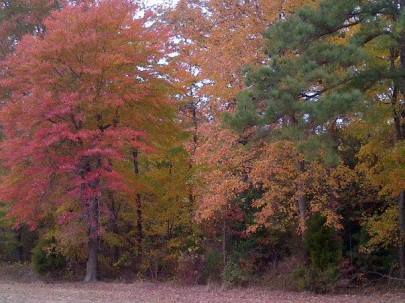
Fall has arrived and the breezes this weekend cleared away most of what was left of summer. Last week at home I walked along the river like I always do this time of year when the water laps at my feet, it is warmer than the air, inviting, deceiving, teasing me into thinking summer will push back on autumn and maybe even win out. I don’t mind the change so much; I’m not bothered by the passing of time as much as how I spend the passing of time.

The leaves are just beginning to change here, and my drive in a few weeks to West Virginia will bring me through every stage of autumn. Sometimes you can see all the changes happen in one day. Crazy. Well, the truth is, some things need to change. Even with resistance, sometimes it is the only way to make room for new growth.

For me even the seasonal change from summer to fall is often troublesome. Again, I don’t mind fall—my days in western New York and Massachusetts are most memorable for this time of year. And obviously I know it is going to happen. I watch the weather, I mark the calendar, I see the leaves letting go. But still it always takes me by surprise. I wake up one day and I need to wear more clothes, or I no longer feel the sun so strong on my shoulders, and I am saddened. The Seasonal Affective Disorder which strikes some of us in February can also have its way in October, though usually not as bad.

This year is different; I’m both tired of change and in desperate need of some right now.

In kindergarten I liked a little red-haired girl, Kathleen.

Stay with me here.

Just like Charlie Brown I was afraid to approach her. At the same time I was thrilled I met someone I would get to grow up with. We were in the same class until third grade when at the end of the school year my family moved much further out on the Island. Instead of saying goodbye to her I made a card that said, “I love you” and threw it at her in the hallway. I think she got it. Now I wish I had just handed it to her politely and said I was sorry I was moving. I never saw her again. I probably didn’t handle that relationship well. The change, however, the move east to what would become where I would forever call “where I am from,” was unexpectedly pleasant despite my resistance at first. The same thing happened when I was fourteen and moved to Virginia Beach, four hundred miles south. I absolutely and definitively did not want to go; I’m so glad we did.

During each major change in life, though, I consistently ignored the advice of my older siblings or from examples set down on television or in school. I simply preferred to assess a situation and have at it on my own terms, even if it meant complete and utter disaster. I was slow to learn as a result, but I gained that small bit of confidence we used to earn out on our own, trying and failing, fantasizing and acting and pretending. You simply never know when those youthful lessons will return to come in handy, see us through an unexpected left-turn, help us through the changes. And it seems these days everything is changing, doesn’t it? It’s as if people in positions of power are scanning the horizon to see what they can disrupt next. Even friends are acting strange, distant, and when the very essence of what we can count on is no longer predictable, we must either adapt or run away. I’m running away.

I thought about those years, my early youth in on Long Island, and how innocent it all was; how we flipped baseball cards and played stickball. We had block parties where the block would be closed to traffic and we all put picnic tables and grills out and walked up and down the street talking to everyone else and sharing food, and riding bikes, and the adults had drinks and the kids had fun. Television went off the air at night, just a fuzzy white noise until the early morning when a black and white flag waved across the screen and some dude said, “We now begin our broadcast day” after the National Anthem.

This was the age of my youth. It was innocent and tech-free and filled with hippies and protests and flag-burning and marches and sit-ins and rumbles. The laughable Mets became the champs and we walked on the moon. On the moon, for God’s sake. How can you possibly not understand why at the core of my generation is some semblance of hope, still simmering. Hope is what got us through; the hope of humanity, the hope of leaders, the hope of lovers and friends. We were not a generation of followers staring at our hands; not by any stretch of the imagination. So when the times were a ‘changing, we changed—or we were the ones causing the change to begin with. And as we grew older, those organic traits became part of our DNA.
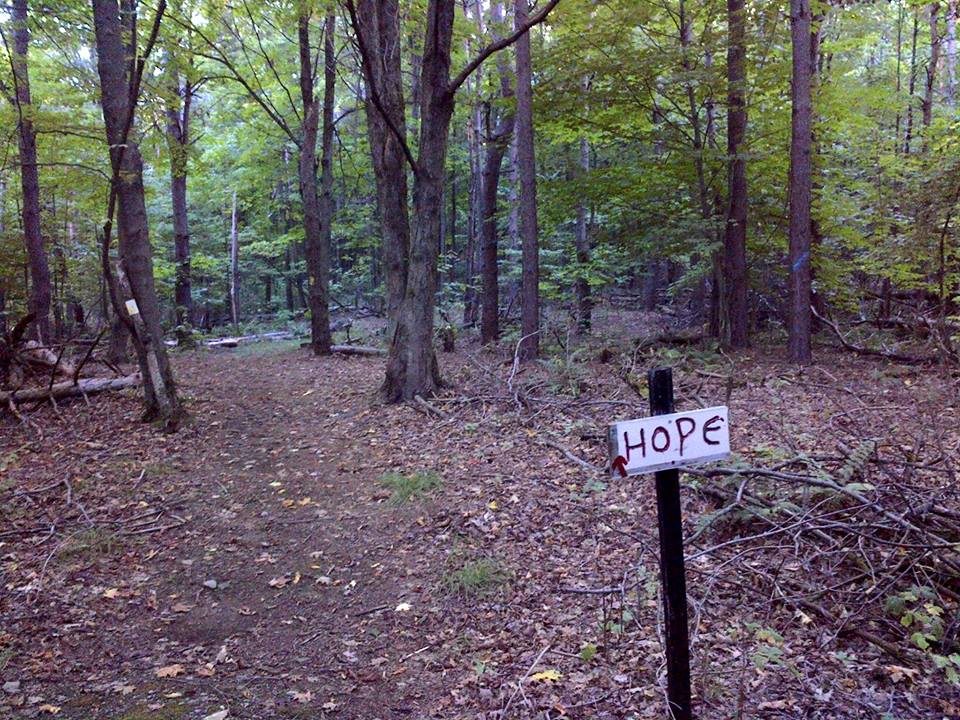
But hope in everything is fragile now. And the falling leaves are no help; not for me anyway.

It almost seems ridiculous and it is certainly ironic that the best way for me to handle these unexpected and troublesome changes is to, in fact, change. So be it. “To change is to be new. To be new is to be young again.”

“If you do not change direction, you may end up where you are going.”

–Lao Tzu

We now begin our broadcast day.

Eostre: The Goddess of Dawn

aerie one

Eōstre is the Old English way of saying Easter. The reference is to a new birth, a sense of rising quite appropriate for the holiday. Few realize, I’m sure, that Eostre was the name of the pre-Christian Goddess of Dawn.

Life is always being reborn, whether the result of the changing seasons or divine intervention, rising from the past to try again.

I’m home now, and it is Easter Sunday, and I’m thinking about the need to start over. In that frame of mind with the buzz of a dozen candy coated chocolate malted eggs, I found again a metaphor in nature.

Back to this wilderness.

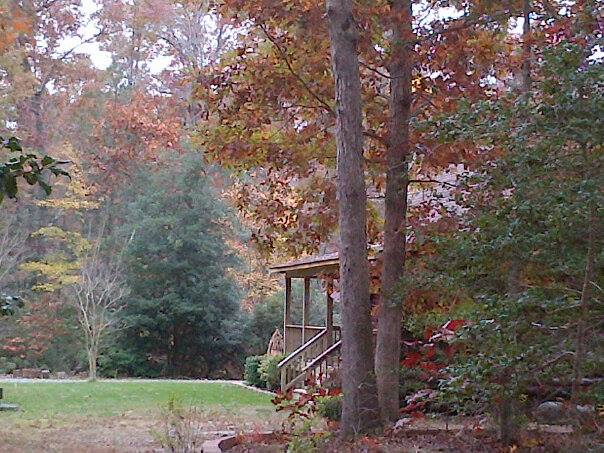
It occurred to me one day on my porch while staring at the surrounding woods, that at some point less than one hundred years ago none of those trees were there. The land has beautiful eighty foot oaks, some maples, tall thin pines and various other hardwoods including black walnut trees, which I am told can provide the ingredient necessary in the liqueur, Wild Spiced Nocino.

The branches protect birds as diverse as red-tailed hawks, downy woodpeckers, and countless chickadees, and they are habitat to other wildlife including one flying squirrel we spotted a few years ago when his tree fell. The squirrel was fine and found a new home in a white oak.

But a hundred years ago this was just land, sandy land, edged by the running Rappahannock River and backed by equally treeless farmland. A century before that these nearby plantations provided food for the region at the expense of slavery, and some slave descendants remain, selling vegetables at food carts out on the main road, or working the bay as watermen, telling stories about how the Chesapeake is just about farmed clean every season by crabbers at the mouth or the headwaters leaving nothing left for those working the midland shoals.

This area hasn’t changed much in one hundred years.

It is like this everywhere, the coming and going of things. In Manhattan a few hundred years before the wild construction on bedrock, coyote and deer were common. It was hilly (Manhattan means land of hills), and where the United Nations stands once stood grand oaks. The Lower West side was a sandy beach, and ecologists say if left to do what it wanted, most of the upper west side would be covered in trees and vines, shrubbery and wildflowers inside twenty years.

I can’t imagine what my house would look like if left untouched. When I don’t mow the lawn for a few weeks it looks like a refuge for timber wolves.

But these trees weren’t here a century ago and I sat on my porch and wondered if there had been other trees or if this land was barren, or was it used by the Powhatans, or was it home to some former slave family, or just a dumping ground. Evidence is scarce, buried beneath the roots of this small forest. Local historians settled long ago that this lower part of the peninsula was primarily hunting ground for the Powhatans, including Chief Powhatan and his daughter Pocahontas.

It’s changed since then. Four hundred years of rebirth in these woods finds me on the porch contemplating the ghosts of Aerie

This happens to me everywhere I lived; I like to imagine what was on that spot one hundred, two hundred, a millennium earlier. The house I rented in Pennsylvania was used as a hospital during the civil war. Before that it was a farm. Now it is a Real Estate office. The maples which lined the road and shaded the living room are gone. Someone planted new ones but it will be decades before they mature. My house in Massachusetts was a fish market a century earlier. Purpose moves on with time. Maybe that’s why I’m so mesmerized by the Prague hotel I always stay at. It was the same building seven hundred years ago that it is now. But here on my porch I realize this house is the only place in my life I’ve lived for twenty years, and I was curious if five times that score of years ago I could sit on this spot and see right out on the water, or were there trees then as well, different ones which died or were timbered to make room for crops.

The house is made from western pine forested on land which I assume is either now empty of trees or filled with young pines waiting to become log homes. What will be left a hundred years from now? Will someone sit on this same porch and look right out toward the bay once these oaks have long fallen? I know this house, this land, is a “hotel at best” as Jackson Browne despondently points out. “We’re here as a guest.”

Wow. Wrote myself into some sad corner there. Thanks Jackson.

I know nothing is as permanent as nature, despite the constant changes. It simply isn’t going anywhere. We are. So I like to remember that a century ago farmers sat here and talked about the bounty in the soil, or talked to 19th century watermen about the changing tides. And I like to realize that a hundred years before that the nearby swampland, now home to so many osprey and egrets, was a major route for runaway slaves. They’d have been safe in these woods, if there were woods then.

I like to do that because it reminds me a hundred years from now perhaps I will have left some sort of evidence of my passing through; even if just in the cultivation of language, the farming of words.

So I sit on the porch and listen to the wind through the leaves. It is now; it is right here, now. Sometimes at night we stand in the driveway with the telescope and study Saturn, or contemplate the craters on the moon—both here long before us and in some comforting way, long after we’re gone.

In spring and fall the bay breezes bring music even Vivaldi would envy, and I’ll listen to his Four Seasons, written nearly four hundred years ago, and listen to the wind through the leaves of these majestic, young trees reaching eighty feet high, and be completely, perfectly in the moment.

Despite the warming trends, the extreme tendencies of weather, the fragile ecosystem which sustains life, nature is still the only place I have found that really doesn’t change. It never has. Ice ages and dust bowls will alter it, but eventually some seed will take root.

aerie two

These Days

I like to sit in my green writing chair my father gave me years ago and look past my books and paintings into the wilderness which surrounds my home. The first time I sat here at Aerie, it was winter, and the birds could not find food in the morning’s snow so a slow spread of seed across the porch rails brought nature as close as possible without opening the windows. House wrens, warblers, robins, cardinals, downy woodpeckers and others all winged in from the apple trees to the rail, grabbed some seeds or stood and ate them there. Next to the porch is a larger than me thorn bush covered in red leaves which the birds use for hiding. They popped in and out from the bush to the porch and back to grab more of the only food around. Eventually they all work their way back to the woods by dodging from tree to tree like soldiers moving forward on a night raid. The thorn bush first, of course, followed by a quick flight to the first holly. From there the apple trees, despite their dormant branches, are fine for resting because of the snowy limbs. The last leg is a short one to more holly at the edge of the woods. Once there they seem to pause, look back as if they are wondering if they had enough, or if they forgot anything, and then they disappear into the high branches of dense forest. Later they’ll return.

I have found two ways to experience nature. First by moving through her: Sunday drives, evening strolls, afternoon hikes, morning runs, and any average commute. We take in what we can, view the variety of colors in spring and the fall foliage. But I’ve driven the route to work enough times in two decades to really not see it at all anymore. Are the trees taller? I assume they must be, but a change cannot be noticed by one who watches it grow. I cross three bridges along the way and two of them have been rebuilt since I started. Still, my mind is elsewhere when nature simply rests there sixty-five miles an hour slower than me. We can’t always be aware of nature; I understand this. But I’m not fully sure I know what it is that distracts me to begin with. There are other means to move through nature: A few years ago my son and I trained across the vast empire of eastern Russia, across the Steppes and hills of Siberia, and to the pacific coast. Along the way we saw thousands of acres of birch forests and hundreds of small, curious shacks all painted royal blue. I could never drive across Siberia, so the train would have to do, but the journey left me with more questions than answers. Who works out there? Are the dilapidated gulags we passed empty or just in ruins? What kinds of wildlife did we pass, mostly at night, just beyond the trees away from the tracks? Surely a grizzly or two or a Siberian tiger stood and watched us roll along.

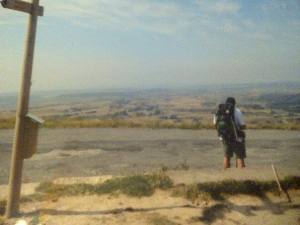
As if extremes exemplified my existence, the following summer we walked the medieval pilgrimage route from southern France to Santiago, Spain, on the Camino de Santiago. The Camino is five hundred miles long, and at just about three miles an hour or so means every Basque slug, meseta insect and Galacian fly could be personally experienced and known by name. We watched the colors of the sky change and stood still every few kilometers to take in the vistas, drink some coffee, and walk the rocky paths again. To drive that distance takes roughly eight hours. It took us five weeks. One sees more when moving slowly. It is simple physics. But in the end we are still moving through.

Which leads me to way number two to experience nature: Sit still.

I took pictures of birds outside my window, and then I put down the camera and watched. They tilt their heads when they eat, as if they can’t see the food unless their eyes face down. Most varieties get along well, but the chickadees are little bastards. They’ll chase away or dare anyone, squirrels included. Yellow warblers are neurotic and Cardinals look pissed off though I think they really just want to be left alone, like old writers.

It is strangely the same in winter. But I’ll never forget that first winter in this chair. I simply stared at the bare brown branches against the gray sky. Somehow the white snow on dark green holly leaves brought the yard to life. I have lived here for twenty-six years but it seems I never before sat and stared at trees, at birds’ wings just inches away, at the patches of green grass surrounded by a dusting of snow. Even walking across the yard would have chased away these observations as quickly as the birds would have scattered into their hiding spots. As if my Siberian questions needed the balance of answers, I looked about the yard and witnessed more in an hour than I had for three weeks on the rails. Usually it is in Spring that we pay attention to the trees, when bare branches give way to buds, which give way to new life. Or in the autumn when we calculate our driving times on Sunday afternoons for when the leaves will be at their “peak.”

I sat perfectly still, doused in the narration-free documentary playing out before me, and discovered something phenomenal: Trees are always at their peak.

They stand strong like church steeples. The thick brown branches reach up, shirts off, muscles taut, every bone exposed, wrestling, bent at the elbows, visible like some skeleton x-ray against a low, gray sky, or a deep dark blue sky, or a snowy dirty white sky, and these trees don’t balk, they don’t flinch. They dare every aspect of deep winter weather. The wind moves through unnoticed, and snow catches crevices and freezes further growth for months. What wonder it is to watch their stern and steady rise, proof of decades, sometimes centuries, dug in for winter, standing guard in forests and backyards, unable for a while to block the sun, bare enough for us to listen at night to the geese. Starlings settle on naked limbs, thousands of starlings like leaves land, rest awhile, then leave, the trees once again alone waiting out winter, as if to say they’ll let winter leave when they’re damn well ready.

I used to think time went by so fast. I remember my dad sitting on the porch in our backyard watching birds outside the screened-in porch. He was a relatively quiet man but loved to watch the birds. One time he and my mom watched a pair of cardinals teach their young one to fly. They watched it fail a few times until it finally took to the air, making it to the nearest branch, not far from the porch. I never had time for that when I lived there. I wonder if my parents, maybe like the cardinals themselves, were both thrilled to see me leave the nest but sad at how fast I found my wings. Now I sit in his chair watching a robin work through the seed on the rail, and I realize it isn’t time that moves too fast—it’s me.