Valuation

outside my window

It’s foggy across the river and bay this morning, and out on the bridge a heavy mist blanketed the area so that even seeing the sky-blue girders above us was difficult. A foghorn sounded from the mouth of the river, presumably menhaden boats out on the Chesapeake, perhaps an oyster workboat. It’s chilly, but not too bad. That could be a description of my head, but it’s not. It’s outside my head I’m pretty certain.

The view from this desk is only slightly better. The woods are misty, but the fog lifted. I can see pretty deep into the trees, and the skylight above my head is wet.

Sitting before me is a to-do list. I need to record a few art lectures for a university in Ohio, send edits of a piece to a journal, read proposals from capstone writing students in West Virginia, make a topic list for my writing students down in Norfolk, rewrite twenty pages of the monster—twenty pages about a time in my life when absolutely nothing happened, but something should have happened and that is the point of nothing happening, so that the reader will feel like something should have happened all the while nothing happens at all. Wow. That sounds like a metaphor for life. But it’s not. It was life, once.

And I need to send emails to a bunch of people who I was supposed to send emails to a few weeks ago but then college happened. And deadlines. And basic malaise. Luckly, the Kahlua bottle behind me is still full.

Alternate plan: Sail down to the Gulf of Mexico, teach online from the aft cabin, grab the guitar, play some Fogelberg and Cat and Van around a beach bonfire with friends and Malibu rum. Forget finally that social media had ever been invented. Go back to wondering how everyone is instead of knowing constantly. I miss wondering, I miss “catching up,” telling stories about things that others don’t know about yet. But we don’t. We value our homes and the lives we built; we asses and measure in terms of security and balance instead of whim and ideals. Of course. It’s called being mature, something I have rarely been, I suppose. I don’t know why; a design flaw, perhaps? Too much daydreaming when I was young? Not enough classical music?

So naturally I’ll need to stick with Plan A for a while. I wonder why, of course. Not enough nerve? Gummies? Too many responsibilities?

First, though, I need to complete a self-evaluation for the college. It’s a once-a-year thing, not difficult, which includes understanding what I did right, what I might change, how I respond to criticism of others, particularly students, what I’m going to include or exclude in the future, and some sort of game plan. It sounds more involved than it is, and it won’t take long. And after thirty five years of these things, I can clearly see how they have helped fine-tune my work.

Yet recently I realized I should have been doing one of these self-evaluations about my life all along. Five pages about the year, perhaps. Five written pages about what worked, what didn’t, what I need to do differently and proposals of how I might get there. This time five pages might not do it; I messed up in some big ways simply by not doing things, which should be part of any evaluation: what didn’t I do that I should or could have?

Do you do this? Maybe schedule a drink with a significant other or close friend next to a fire, talk a bit, then do self-evals with each other. It’s what I like about the assignment: At least a few other people are going to read it, so I need to be clear, concise, constructive. And so the “life-evals” should be too, whether oral or written. In both cases, honesty is essential. In both cases, brevity is dangerous. The college assignment is two or three pages of actual written self-analysis. That’s just short enough to bullshit with the best of them, which is why I believe it should be five pages; then I’d have to come up with some serious details and examples to maintain info about the man in the mirror for that long. Plus my writing is foggy and misty for the first two pages, even in rewrites, but by the time I’m moving into page four, everything is clearer, and you can see even my metaphorical trees far into the woods.

She’s a 41’ Morgan Out Island, spacy aft cabin with a queen size bed, long and wide main cabin with a navigator’s table which converted makes an excellent writing desk, another two cabins up front and two heads, one forward and one aft. The stove is a good size, and the refrigerator holds more than a few bottles of Kahlua.

What would you do? How do you write this into your self-evaluation? Truthfully.

I guess we’re not always so honest with ourselves after all, are we? I need to finish preparing the week’s lectures, send in the rewrites to the journal, and clean up the monster, clarify I wasn’t doing anything when I was hoping to be doing something.

That’s the point, though, isn’t it?

Cool Change

It’s raining. The sky is deep grey, like it’s never going to clear. A steady breeze is pushing down the river, and out on the bay a fog has settled. No one is out in the village, not at the IGA, not at the convenience store. A worker stood smoking a cigarette under the overhang and said, “Ain’t no one been here today. A few for gas is all. Beer for the game. Quiet.” I bought a coffee and left the change on the counter so he could stay outside and finish his Marlboro Red. “You watching the game, tonight?” he asked when I came out and sat on the bags of logs.

“Some. Michael’s headed to a violin concert by a touring musician down at the episcopal church on 17, so I might head over to the 606 to catch the second half.” The 606 is a pub run by some guys from Australia who also have an Irish pub attached to it, though that part—The Quay—is hardly ever open. Next month it will be, obviously.

“Good food.”

“Yes, and Fosters.”

He took a drag and snubbed out the butt in the ashtray on top of the huge cement garbage can. “I better start wings and pizza. Gonna be a rush on wings and pizza soon.”

“I’m just going to have one draft and head home and eat there.”

He nodded. “Philly gonna win.”

“Okay.”

“Don’t talk to me about KC’s defense. This is going to be all Philly.”

I sipped my coffee.

“You don’t care do you?” he asked.

“Not really, no. Go Bills!” We laughed.

“This rain ain’t never letting up. I think it supposed to do this all night.”

I looked out at the Exxon sign. $3.25 a gallon for regular. A white truck pulled in and parked next to the kerosene pump. He pulled out a blue can and put it on the ground.

“Yeah, it’s pretty steady.”

“Don’t it bother you? All this rain? It’s starting to bother me.”

“Not really, no.”

He held the door open for Bubba, who said hello, commented on the weather, asked how Michael’s doing, and went in to pay. I sat thinking about Sundays, the pace, the slow erosion of hours. I thought of Sundays in my childhood when it rained and I’d lay on the floor and read or watch football or an old black and white western. I almost felt like the aroma of pot roast should drift out of some kitchen. Onions.

I thought about the book.

Yesterday at a local shop, Nauti Nell’s, Michael and I stopped to see if they had any books he liked. The shop has stationary, enough nautical equipment to build several sea-going crafts, candles, Old Bay seasoned peanuts, and more, and one of the finest book collections—mostly used—about the Chesapeake, and sailing in general, anywhere.

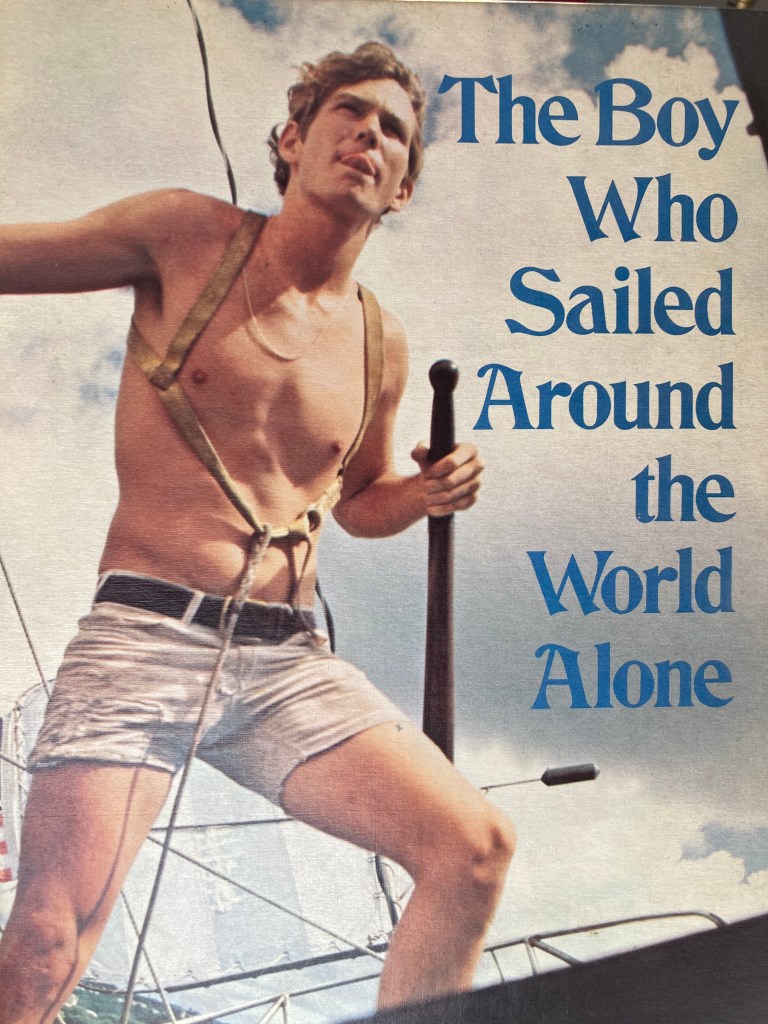
I’ve told this part before: Growing up, my dad would give each of us a book for Christmas. He shopped for them himself and picked up books which he believed met our personality. I still have almost all of them—James Herriot’s All Things Great and Small series, A Walk Across America, Bound for Glory, and more. But the first one and the one that had the most impressionable impact on my way of thinking was Robin Lee Graham’s The Boy Who Sailed Around the World Alone; the young adult version of his bestseller Dove.

Through the years of moving, packing and ditching things, selling and losing things, I lost that one. The irony is that was the one book that I specifically remember waking me up, making be think of something beyond my tight little world.

Yesterday I turned a corner inside Nells, and there it was, same publishing year, same hardback everything. I opened it slowly half-expecting to see “Merry Christ Robert, Love Dad, 1974” scribbled inside.

Five bucks. I didn’t even have my wallet, so I dug the change out of a canvas bag in my car. Then last night I read it again for the first time since Gerald Ford was president.

I do have the adult version, Dove. In the mid-90’s, not long after Michael was born, I acquired a 26’ Columbia sloop—identical to Graham’s boat. I worked on it most of my free time, and bought a copy of the book for inspiration. When Michael was three he’d come with me and sit in the cabin playing with his Legos as I worked on the deck and the rigging. I didn’t plan to sail around the world, of course. But I did think about circumnavigating the Chesapeake. If it had been slightly bigger and a little less leaky, I could envision myself sailing it to Florida, across to the gulf and up the southern coast.

It was my very first dream that I recall with such specificness and with such clarity. Previous ambitions involved some sort of magical realism, like when I wanted to build a rocket and fly to space, or when I wanted to design and build a car that could also go in water and on snow. Early on I set myself up for failure.

But the boat was different. Even in my early teens it was real. We lived at the water on Long Island’s south shore, and I was around boats all the time, albeit other people’s boats. And Graham’s YA book had lots of pictures and details of how he came up with the plan and saw it through.

My boat sank in Broad Bay in Virginia Beach. The police called me at Aerie and asked, “Did you own a 26’ Columbia?” Honestly, they used past tense.

Michael was not happy about the loss of his Legos still in the cabin.

Bubba came out of the store. “$6.35 a gallon for kerosene. Geeeeeez. You’d think with all the marinas and boats and users in this town it would be cheaper!”

This seventy-something-year-old man has sailed quite far from here, as have most of the people in this small village. It is what they do. “Deltaville: Sailing Capital of the Chesapeake” the sign says when you enter town from 33 to this place, the very end of the road before hitting the Bay. “Deltaville: A Drinking Town with a Boating Problem,” says it all, and the fact there are three times more boats than people here.

I thought of Joshua Slocum, the first American to circumnavigate the world, and my favorite, Laura Dekker, now the youngest person to do so. And of course, Graham, who lives in Montana now, fifty years after returning from his five-year journey.  

It’s nice to have dreams, to find some old ones literally on some shelf somewhere. To pick them up and blow off the dust and remember that ancient and very real spark, the one that helped you turn some corner toward adulthood.

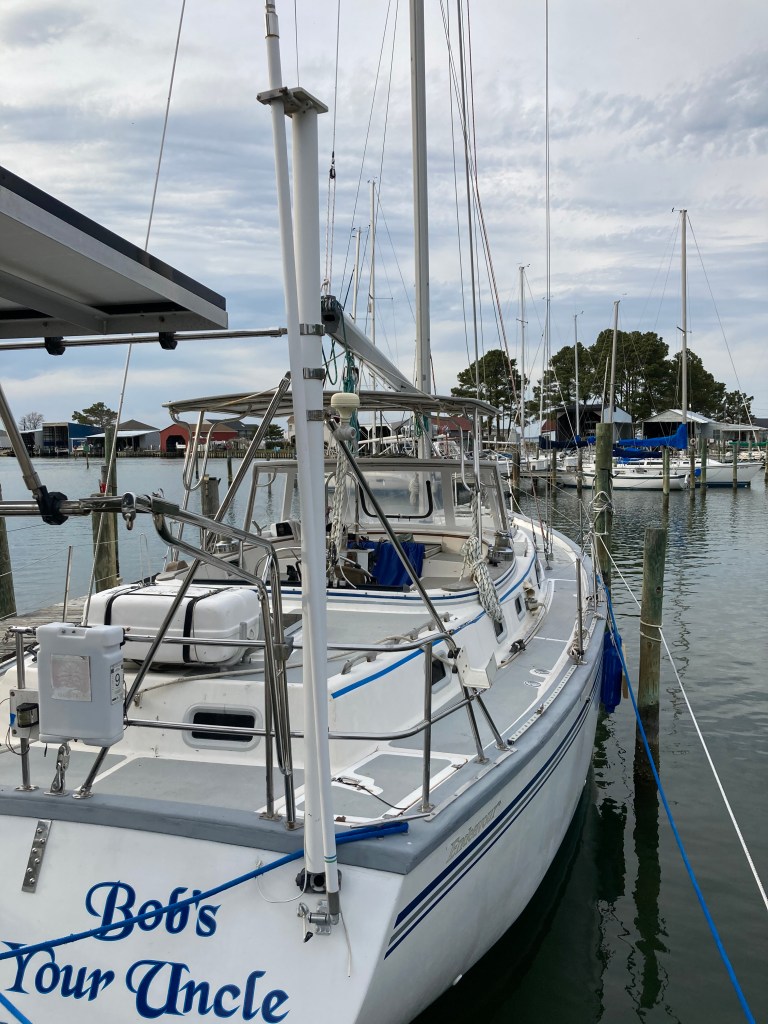
I drove to the bay and walked in the rain on the docks at Stingray Marina, noticing the sloops, a couple of Ketches, one conveniently called, “Bob’s Your Uncle.” I thought of the Morgan Out Island down at the slip in Wilmington, the one with charts of the intercoastal. “Begin Again,” it’s called.

Do we move on from our youthful dreams because they’re not practical or because we don’t know what to do next? When are we simply too old?

It would take real gumption to chuck it all and take off, open it up wing on wing and glide past all the excuses and hesitations. But “not just ordinary gumption,” as Paul Thoreau once wrote, “But three in the morning gumption.”

And who’s got that?