Mint and White Hawthorn

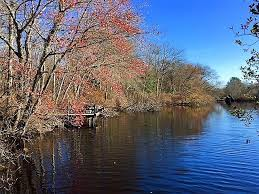
Connetquot River

The tide is low this afternoon, and the vapors from the marsh saturate the air along the road all the way up the hill. I know this smell, low tide. I’ve inhaled it since I was nine years old when we moved to a small village on the Island where the Connetquot River meets the Great South Bay. My friend Eddie and I would walk the bay and meander through the marshes along the waters of Heckscher State Park next to the town, and it filled my senses so that when I walk now along the Rappahannock half a century later and the small creeks near Aerie during low waters, I still smell my youth. In so many ways those years seem like I see them just below the surface, sometimes exposed when the water recedes.

But here, now, when the tide rolls in, the refreshing smell of salt water and Atlantic mist overtakes everything, like it did back then too when the fog horns out on the Great South Bay called through the wet and cool mornings.

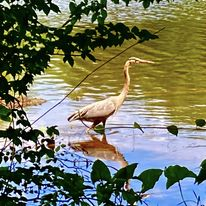
Today the muddy marsh is exposed with reeds and fiddler crabs, small bubbles from submerged frogs, and periwinkles everywhere, hundreds of them; thousands. Herons pull their fragile legs up out of the mud as they walk, and above me several osprey circle and dive for small fish and crabs in the Rapp. Soon they will make their pilgrimage to South America for the winter only to be replaced locally by eagles.

I come here to clarify my confused and often anxiety-ridden mind. Everyone needs a place like this, akin to that “safe home” kids designate during hide and seek—if you touch it before anyone touches you, you’re safe. This is that for me, when I’m here no one can touch me; I cannot be “it” when I’m surrounded by water and salty air, even at low tide. And if I close my eyes this could be the marsh running behind the greens at Timber Point, and boaters might be headed out to Fire Island or just across the river to Oakdale and West Sayville, and sometimes I feel like I’m twelve when my mind would drift during Social Studies at seventh period to the waters of Heckscher and the muddy flats off of Montauk Highway.

Those are familiar names to me, but probably not most others. And those places at that time still belong to me. Just like the aroma of the marsh near Aerie; that’s mine too, and the sound of gulls and osprey and herons, and diesel engines of fishing boats before dawn, and the water lapping on the riprap and sand. Those smells and sounds belong to me; always have. Of course many others know and have absorbed these visceral aspects of life as well, but that’s not what it feels like when you’re alone at a marsh, relishing the peopleless world, and the only sound is the call of gulls, and your sole desire is to roll out with the tide and see what happens; it has the same enticing pull as the comforting tug home up the hill, as strong as the moon’s grip on the tides. We are seventy-percent water, after all, and so is the earth. Being near the ocean or this river and bay helps me keep my balance, like some sort of metronome. It’s always been that way.

Nature has always been my safety net no matter where and when life happens. It is predictable in its controlling and haphazard way. It is non-judgmental; it isn’t distracted. It is as consistent now as it was for the native Americans who hunted on this land, and perhaps some nomads before that, as ancient and consistent as whatever life lived here, died here. Nature asks nothing of me except to be left alone. It’s all I ask of it.

I left the marshes of the Island fifty years ago next June. And even though I’m not there and Eddie is gone, I know the marshes still line the shore of the Connetquot, and out on the Bay the fishing boats cross before dawn. The salty air I’ve always inhaled is in my DNA, and it still hangs out on the reach just below our consciousness. I don’t know how long I might have survived without nature to steady the tides of my moods as they move in and out, pulling me further afar right before I’m trust back ashore. In so many ways my life is one of extremes.

I have been around the block since my days on the Island, and just when I thought I had grown tired and weary of fighting the tides; just when it seems life was more akin to the salt flats out on the Great Salt Lake with a shoreline that will never recover, I notice some sunset beyond the pulsating marsh and it settles me again, moves me right back into the moment where nothing had ever happened and nothing will ever change, for a little while anyway.

It’s like that here, at the river, just down the hill. High tides are exciting and fill me with a sense of awe and possibility, hope, but when the tide pulls back out, that ebb exposes nature for everything it is with its raw and beautifully honest frame filled with nature’s debris. I wish I could see myself with such blatant honesty.

I wish I could always feel so at home, safe and untouchable. How much of our identity can be traced to our youth and those places we chased each other through after school, explored and conquered on summer afternoons? If I lived in the city, miles from any semblance of the salty marshes of the South Shore, would I still feel the tug of the tides? I tell people I found this land here at Aerie by accident. I tell myself that. Sometimes I feel like I should turn around and find Eddie a few steps behind, whispering to himself the lyrics to some Harry Chapin song, asking if we should go swimming in the bay.

September is just days from now, and the August heat, the rise of gnats in the hazy air, the stillness of often stifling walks along the Rappahannock are once again slipping behind me. I believe that like Jay Gatsby I can be melancholic, some strong desire to “reach out and hold it back” overcomes me when the weather turns, and to be honest, Nick’s retort that “there’ll be other summers” is simply not good enough. Not when so many of them fade so fast. Not when the afternoon sun can so easily burn off the mist of our youth.
Forthcoming

Allegheny River

I had an unconventional youth. Specifically, I did not lead the normal life of a nineteen-year-old away at college. While my floormates were drinking heavily and sleeping until noon, I was at classes early to get them out of the way so I could head out to the Allegany River, or up to Niagara, or out to Chautauqua Lake, canoeing, listening to fascinating stories from a friend of mine, helping him plan his return to the Congo River for an adventure I couldn’t possibly contemplate prior to then.

I have two books coming out next year. The first, Office Hours, is a “Sedaris-like story-telling” of thirty-five years of college teaching. The second, Curious Men, is about that time back then in college myself, planning the Congo trip, turning a first semester probation they said was due to grades but I knew was due to complete indifference, into an honor-roll semester due to my sudden acute interest in absolutely everything. A friend of mine used to ask, “You mean that year you were on crack without ever touching a single drug?”

Yes, that year. Nineteen.

Memoir writing is a challenge for the need to engulf yourself in the emotions of a time that was apparently significant enough to warrant a book, yet absent enough of those same emotions so the reader can find the bigger picture of the narrative, the part that must reach up and out of itself into their lives, show them their emotions instead of displaying my own.

I brought this up because I just finished it, the book, Curious Men: Lost in the Congo. As a point of reference, though, and in full disclosure, I started it forty years ago. I’m a slow writer.

But the primary question publishers, publicists, agents, and–what do you call them? Oh yeah, readers–ask is, “What’s it about?”

So that needs to be split into two answers. Most people mean “What happens” when they ask what it is about. And that’s fine and not too difficult to answer: A friend asked me to help him plan a canoe trip—solo—on the Congo River. I did, and he went, and he never returned. Eventually, I went. But I returned—most of me anyway. This might be of interest to readers, particularly those who have enjoyed my writing in the past, or those who like adventure, distant places, rivers. Mysteries, even. Possibly psychology. But that “what happens’ response makes it all seem very 1981ish, and little more.

Which means there must be a second answer for this to work. And that is the true response to “What’s it about?”

In this case, it’s about being nineteen-years-old. It’s about being on my own for the first time, out from under the parental umbrella only to be thrust into a world where countless adults want to know my plans for the rest of my life, my major, my summer internship possibilities, my “declaring” of a focus for my entire career before I’d even taken a single class, all the while living with someone I’d never met on a floor with ninety guys I’d never met who seemed to insist I drink despite my desire not necessarily to not drink, but not to drink because they insisted; and all of us with two bathrooms, one payphone, and honestly little guidance to navigate. This wasn’t the military where some sergeant told us what to do when to do it how to do it but never why. We were paddling out in the deep-end, completely solo. Hence, the drinking and the need to join the pack. Just because I didn’t end up face down in the stairwell every night doesn’t mean I didn’t understand the draw of the need to do so. It’s just that I found my own alcohol of sorts.

I found another outlet, something well outside the box, and in doing so ended up with a working knowledge of a few African languages, an understanding of the fauna of equatorial Africa, a comprehension of diseases, some knowledge on how to temper loneliness, and a taste of a particular lesson I couldn’t find in my mass comm classes: outrageous adventure is simply a matter of deciding to do something and following through. I discovered that I didn’t need to follow some template to be alive. I learned that maybe it was everyone else who didn’t fit in. At least that’s what I told myself at the time as a defense mechanism.

But something changed over the years. You see, I’ve been staring at nineteen-year-olds for thirty-five years now and that alters the narrative some.

In the end, Curious Men is not about Africa, it’s not about the Congo or anyone in particular; it is about being nineteen and scared, and how that has changed in the decades since I ate sun-dried fish while bantering in Lingala, and most importantly, learning how to jump, knowing, absolutely understanding, that once you jump, you’ll either land on your feet or you’ll learn how to fly. Unless you don’t. Then you need the “What’s it about?” to step to the plate. Sure, it takes place in rural western New York and ruraler central Africa, but the narrative and the theme often divert.

Indeed, I’ve been staring at nineteen-year-olds for thirty five years now, and students today are no less timid then then, no less adventurous, no less interested. The difference is they are infinitely more distracted, bending toward convenience and accessibility, seeking and finding adventure on a screen, through gaming and TikTok, and I don’t doubt that if I were nineteen today the rivers I sought out would be virtual from the safety of some Virginia Beach bedroom. Maybe I was born at the right time, back when you sat around some diner eating wings and talking until some spark ignited, and you drew maps and made lists on the back of placemats, and then, most importantly, you followed through.

Curious Men: Lost in the Congo, is, as S.E. Hinton (The Outsiders) wrote, “A story that should be a must read for all teenagers—and adults alike for that matter.”

I’m just deciding now on the dedication. That’s a tough one. In ten books I’ve ever only dedicated one; The Iron Scar: A Father and Son in Siberia is dedicated to my father and my son. I’m not sure yet I am going to do so this time, but I’m leaning toward this, a variation of sorts of something Richard Bach once wrote:

To the nineteen-year-old who lives within us all

The Congo