I’ve run out of words. Out of ideas. Out of patience and interest and desire. I’ve run out of stories to share and any sense that any of those stories are remotely worth writing about to begin with. I’ve grown tired of getting it right, of editing, of restructuring and developing and trimming down. I’m over the clarity thing, finding the right noun, the more specific verb, eliminating obtuse modifiers, over the placement of pronouns and split infinitives.
I’ve said what I wanted to say.
Except to say this:
Every instance is miraculous to me. Every nuance of life, the breezes and stillness of a summer night, the aroma of honeysuckle, lavender in the air, the yellow of forsythia, the hints of orange and rust low on the horizon. All of it and more of it strikes me speechless and as often as I’ve tried to write about this I couldn’t do it justice. Time and again I ripped up or deleted the prose out of protest to my own lack of focus and ability. I should have been a photographer, bought the equipment and peddled my pictures to magazines and couples on the beach just before dawn–you know the shot, two people in the sand leaning against each other watching the sky lighten in the east. Before cellphones, couples remembered the moment by their presence, but now the moment is ever present because of the picture from the phone, so they no longer know if they recall that moment or simply the endless stream of “love this picture of you two” comments which flood their feed. But what of the shot from behind? The one of the two of them three feet from the water’s edge when the quick ray of dawn hits that small solstice space between their otherwise entangled lives. I could have done that instead of writing about dead relatives and other love songs.
It turns out what I’m best at is simply being present, watching the river run past, a heron searching for minnows and the osprey teaching her young to fly. I have mastered the art of taking it all in and the constant state of miraculous now which engulfs us every moment. But I tried writing instead because I couldn’t make money simply being alive, though I came close; but I could make money writing, teaching about writing, showing people some places I’ve been and what happened along the way, hoping they would sit back and say, “Yes, I know what you mean.”
Instead, I’m out of stories. I am starting to believe my last book took forty years to write not because it was so difficult but because I knew once that story was told I would have nothing left to say.
The story is told and I was right: I have nothing left to say.
Except to say this:
I have been working on a book about teaching. Well, it’s not about teaching, it’s about the best of and worst of what happens when you spend thirty plus years with twenty-year-olds and some of them go on to wonderous things while others die by their own hand, or their ex’s hand, or the random drop of evil. So I’m dealing with a publisher about that manuscript, but my mind is entangled in something that is a bigger deal to me, and that’s the “who gives a damn” factor which plagues writers from time to time, only this time the plague has spread into sentence structure and transitions and now its damned near everywhere. Even the pronouns are complaining; it’s always “I hate” this and “You suck at” that. And I’m also stage-deep in a play, a tragic play about the glory of hope, a one person play which I’m planning to premier in upstate New York but I ran into the “this kind of sucks” part of the writing process and if the book were not out I’d totally use the play as an excuse to avoid the book and most likely would finish the play, but instead the book is out and the play is pointless now. And my book about traveling, about the philosophy of being somewhere for a week or a month and being 100 percent present so that years later we remember every moment—that book, it is out there waiting for me to gather all the words and slap them into the correct order. But not today. It’s rainy and windy and there’s a possibility of tornados today, so maybe next week after coffee one morning.
You see what I mean? It just might be that all the other books and essays and readings and articles I’ve done in the past thirty plus years was a way to avoid finishing the book, and it worked, but now that that the book is done and out, everything else seems to have been a distraction from what I wanted to do originally, before the writing, before the planning and scheming and blind ambitions of a teenager, and that was simply to “live in the world, not inside my head” with thanks to Jackson for the line—to just take it all in at this rest stop as I pass through nature. Wordless. Anonymous. Present.
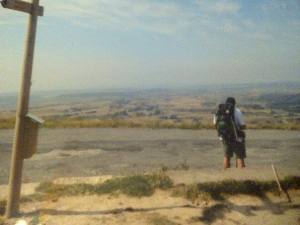
Maybe I’ll just head back to Spain.
After I get back from Oregon of course.
And Paris.
I feel as if my point—if I ever had one—has been made so I have no reason to go on with these unalphabetically disorganized letters.
Except to say this:
Everything I do seems to be prep work for something that I have not yet figured out. Or, to return to Jackson again, “It seems I’m just a day away from where I ought to be.”
Letty’s birthday would be Wednesday. Dave’s next week. Mom’s and Dad’s in two months, Dan’s a month ago, Cole’s in ten days. I’ve written about all of them. And about Joe, whose birthday was the day my last book, the one about him, kinda sorta, launched. So it can often feel like I’m all out of words, but this time it’s extreme, like the alphabet hasn’t even been invented yet.
But then a hawk flew by my window here at Aerie, and I read something about the Oregon coast, and I saw a clip of Lady Gaga singing “La Vie en Rose,” and I woke up. See, there’s no such thing as writer’s block, there’s only the lack of wind and the empty sails and that sense the doldrums are a permanent state of being. Then, softly at first like a fragment, like a clause, the wind picks up, then more, and suddenly you’re sailing wing on wing through compound sentences and everything, I mean all of it, falls into place and, as Dan notes, “There’s nothing left to say but come on morning.”
Except to say this.




 a view from this wilderness