Mint and White Hawthorn

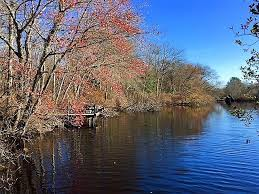
Connetquot River

The tide is low this afternoon, and the vapors from the marsh saturate the air along the road all the way up the hill. I know this smell, low tide. I’ve inhaled it since I was nine years old when we moved to a small village on the Island where the Connetquot River meets the Great South Bay. My friend Eddie and I would walk the bay and meander through the marshes along the waters of Heckscher State Park next to the town, and it filled my senses so that when I walk now along the Rappahannock half a century later and the small creeks near Aerie during low waters, I still smell my youth. In so many ways those years seem like I see them just below the surface, sometimes exposed when the water recedes.

But here, now, when the tide rolls in, the refreshing smell of salt water and Atlantic mist overtakes everything, like it did back then too when the fog horns out on the Great South Bay called through the wet and cool mornings.

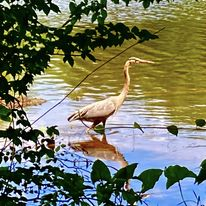
Today the muddy marsh is exposed with reeds and fiddler crabs, small bubbles from submerged frogs, and periwinkles everywhere, hundreds of them; thousands. Herons pull their fragile legs up out of the mud as they walk, and above me several osprey circle and dive for small fish and crabs in the Rapp. Soon they will make their pilgrimage to South America for the winter only to be replaced locally by eagles.

I come here to clarify my confused and often anxiety-ridden mind. Everyone needs a place like this, akin to that “safe home” kids designate during hide and seek—if you touch it before anyone touches you, you’re safe. This is that for me, when I’m here no one can touch me; I cannot be “it” when I’m surrounded by water and salty air, even at low tide. And if I close my eyes this could be the marsh running behind the greens at Timber Point, and boaters might be headed out to Fire Island or just across the river to Oakdale and West Sayville, and sometimes I feel like I’m twelve when my mind would drift during Social Studies at seventh period to the waters of Heckscher and the muddy flats off of Montauk Highway.

Those are familiar names to me, but probably not most others. And those places at that time still belong to me. Just like the aroma of the marsh near Aerie; that’s mine too, and the sound of gulls and osprey and herons, and diesel engines of fishing boats before dawn, and the water lapping on the riprap and sand. Those smells and sounds belong to me; always have. Of course many others know and have absorbed these visceral aspects of life as well, but that’s not what it feels like when you’re alone at a marsh, relishing the peopleless world, and the only sound is the call of gulls, and your sole desire is to roll out with the tide and see what happens; it has the same enticing pull as the comforting tug home up the hill, as strong as the moon’s grip on the tides. We are seventy-percent water, after all, and so is the earth. Being near the ocean or this river and bay helps me keep my balance, like some sort of metronome. It’s always been that way.

Nature has always been my safety net no matter where and when life happens. It is predictable in its controlling and haphazard way. It is non-judgmental; it isn’t distracted. It is as consistent now as it was for the native Americans who hunted on this land, and perhaps some nomads before that, as ancient and consistent as whatever life lived here, died here. Nature asks nothing of me except to be left alone. It’s all I ask of it.

I left the marshes of the Island fifty years ago next June. And even though I’m not there and Eddie is gone, I know the marshes still line the shore of the Connetquot, and out on the Bay the fishing boats cross before dawn. The salty air I’ve always inhaled is in my DNA, and it still hangs out on the reach just below our consciousness. I don’t know how long I might have survived without nature to steady the tides of my moods as they move in and out, pulling me further afar right before I’m trust back ashore. In so many ways my life is one of extremes.

I have been around the block since my days on the Island, and just when I thought I had grown tired and weary of fighting the tides; just when it seems life was more akin to the salt flats out on the Great Salt Lake with a shoreline that will never recover, I notice some sunset beyond the pulsating marsh and it settles me again, moves me right back into the moment where nothing had ever happened and nothing will ever change, for a little while anyway.

It’s like that here, at the river, just down the hill. High tides are exciting and fill me with a sense of awe and possibility, hope, but when the tide pulls back out, that ebb exposes nature for everything it is with its raw and beautifully honest frame filled with nature’s debris. I wish I could see myself with such blatant honesty.

I wish I could always feel so at home, safe and untouchable. How much of our identity can be traced to our youth and those places we chased each other through after school, explored and conquered on summer afternoons? If I lived in the city, miles from any semblance of the salty marshes of the South Shore, would I still feel the tug of the tides? I tell people I found this land here at Aerie by accident. I tell myself that. Sometimes I feel like I should turn around and find Eddie a few steps behind, whispering to himself the lyrics to some Harry Chapin song, asking if we should go swimming in the bay.

September is just days from now, and the August heat, the rise of gnats in the hazy air, the stillness of often stifling walks along the Rappahannock are once again slipping behind me. I believe that like Jay Gatsby I can be melancholic, some strong desire to “reach out and hold it back” overcomes me when the weather turns, and to be honest, Nick’s retort that “there’ll be other summers” is simply not good enough. Not when so many of them fade so fast. Not when the afternoon sun can so easily burn off the mist of our youth.

Can You Dig It?

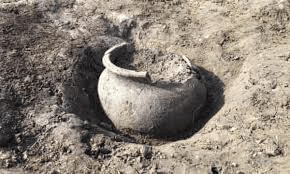
When my son was young, he liked to dig. He was convinced somewhere on our property, which sits uphill from the Rappahannock River near where Civil War troops marched, and for centuries before them the Powhatan people hunted, is spent ammunition. He may be right. There are mounds along the perimeter that resemble casements, and a few seem too much like burial hills. So he would dig. Once, when I knew I brought back too much crap from Russia, including Khokloma bowls, trays, and small lacquer boxes, he came up with the notion that if we buried a few dozen broken Khokloma bowls, a few spent bottles of vodka, and perhaps a torn up book written in Cyrillic along with some beets in an old campfire, a thousand years from now archaeologists will rope off the area and attempt to figure out why the hell the trade route brought Russians from Western Europe to central Virginia. Future Phds might note these ancient people most likely couldn’t survive due to a fondness of bad alcohol, or even just bad oysters one warm summer day.

I like screwing with future historians that way.

A few years ago, a horde of Bronze Age weapons was unearthed in England. From this very cool discovery of what resembles small shovels, pickaxes, and what can best be described as head-cracking-open thingys, researchers and other people who know determined the Bronze Age inhabitants of that part of England were violent nomads who couldn’t organize enough to conquer each other. Okay, on the surface I can see where it appears that way, but perhaps they liked each other just fine. Maybe those small Bronze Age tools were gifts, or their so-called weapons were their version of our cold war stockpiles of nuclear threats so they wouldn’t attack each other. They may, in fact, have meant to defend themselves against aliens, but when the otherworlders arrived, they all got along simply divinely and they buried their hatchets in celebration of intergalactic accords, and from that time we gained the expression, “Let’s bury the hatchet.” Really, who the hell knows? Maybe those rudimentary objects were the Bronze Age equivalent of ashtrays from seventh grade shop. The shovel and head-cracking-open thingys were all they could figure out how to make. “It was supposed to be a lamp, Ma!” little Zorr might have whined. “Oh honey it looks lovely,” his mom answered in a pre-British accent as she tossed it on the neighborhood pile of trash with other discarded tool-looking things.

They didn’t recycle. Time passes.

So in my attempts to clean out this house of twenty-five years of accumulated crap (clearly to make room for more soon-to-accumulate crap), I’ve decided to make an archaeological compost pile. This one mostly Russian, though some broken Czech glass would be humorous to include. I might even toss in some torn and tattered strips of bark with nonsensical language and send the diggers searching for a new Rosetta Stone to break the code of these Slavic people speaking Old English in America.

Yes, I am the benevolent supporter of scientists from a different era, ready to guarantee future funding of necessary research projects and ensure jobs to graduate students a thousand years from now. I am doing my part. Open some vodka.

But first I need to unearth something closer to my own surface, some relics from my recent past. I’ve gathered mental artifacts through the times and places of my life, and often it is difficult for anyone else to see how they match up. Each of them as separate events seem clear enough—I enjoyed those car rides to Canada, the quiet moments at the Wachusett Reservoir, the dust of the Mexican desert—but the big picture is awash with non-sequiturs. Did the farmhouse in Pennsylvania where I spent some intensely happy days in ’86 leave a mark in my narrative which appears unrelated to Mexican blankets? Because to me it makes perfect sense how they’re connected. And those stories an old friend of mine told me while driving to Niagara Falls on random weekends more than forty years ago; are they related to my trip across Siberia or Spain ten years ago? Because on a quick glance, of course not; but when I’m standing at the river at dusk, and in the east Venus is rising like a cloud of gnats from 1974 on the Connetquot River, a close scrutiny of my life reveals a narrative which makes perfect sense. While Robert Browning believed, “The past is in its grave,” Jackson Browne said, “I’m looking back carefully. There’s still something there for me.” Yeah, me too. My life is a vibrating screen, and the dirt of a half-dozen decades is sifting through, exposing treasures I thought I’d left on the banks of the river, well upstream by now.

So I like to walk carefully through the woods near home; it is where I leave my thoughts, and I do not want them trampled upon. In fact, if I am not paying attention I might think I’m walking through Heckscher State Park on Long Island’s South Shore where I grew up; or it could be the Berkshires, or the Enchanted Mountains of Western New York. Or the Sonoran Desert. The Lynnhaven River. The Neva River. The Vltava. The Congo. The Rappahannock. I believe when I look at my life many years from now to trace my journey on this earth, what on the surface seemed decisions as random as the ricochet of a pinball, were all connected by passion and desire and some quixotic need to keep digging, perhaps in search of love. Certainly in search of myself.

I pray my son never stops digging, never ceases his attempts to find the connections in his life. At this very moment he is somewhere in Connemara with another artist—I hope he understands how directly related that is to the small cherry tree at the apartment complex where we lived when he was two and he’d stand perfectly still under the branches while I shook the tree until cherries rained down on his head.

And we’d laugh. My God, we’d laugh until we rolled on the ground.

Honestly, how can anyone not see connections?