Student Comes to See Me

A Personal Reflection This Week:

I woke about three this morning; it happens a lot. This time it happened because this weekend has always represented change in my life. Growing up, of course, the school year is just about over and summer is waiting; throughout my college summers not only was one year over and another still three months away, during that time I worked at a beachfront resort hotel every summer, so the “season” started this weekend. And for more than thirty-five years in higher ed, this is about the time of year we finally exhale for a few months. At three this morning I woke thinking about those changes this weekend those years, but this time I found myself surrounded by the ghosts of those dear to me, and in my tired, gummy-induced thought process, they all had the same opinion.

This weekend might feel more significant because so much of my life completely changed in the past twelve months, beginning about mid-May last year, and I added to that weight by spending this same year tuning my manuscript for my next book about a time in my life when I had to grow up and move on, about learning what to let go of and what to hold on to and guessing wrong in both cases. The brain decides on its own when it will dump all of this in your lap to stare at and make sense of. Usually it’s at three am. And raining.

It’s safe to say that my life has been anything but consistent and predictable, but when we’re young we have more courage to change. I believe that’s because if whatever we try falls apart, well, we’re still young enough to laugh it off and start over. But as the years pass, we tie ourselves down, let the roots take hold, gather more responsibilities and obligations. So change is usually subtle, a series of nuanced negotiations that are closer related to diversions than anything resembling a complete abandonment of one way in favor of another.

When I was young, I would regularly jump into some unknown ideal. Now, with Realism as my guide, I am more apt to step off carefully, insuring there is solid ground ahead. But at three am the smallest variation in our path can seem like a canyon. This morning started like that as I listened to the rain on the skylight. I felt my anxiety simmer just below the surface and I was in danger of completely waking up, so I tried to repress it, remind myself that whatever status quo I find myself part of is not only fine but damn near ideal. But that didn’t hold. I thought of a line from, of all people, Barry Manilow: “My life goes along as it should; it’s all very nice but not very good.”

Just wait. I’m one of the more fortunate souls I’ve ever known, and I know that; but that is an external judgement. “Very good” is a relative term. We are in the awful habit of comparing ourselves to others when we should be measuring ourselves against ourselves alone: What are we capable of? What do we wish we had done? What are you going to do with the time that is left? This is that old axiom, “The only way to fail is to not even try.” And this isn’t about you. I swear it’s not. It’s about me, from the young boy in the park, to the young teen on the courts, to the young man on the go. The distance between where I am and where I will end up can only be measured by how I feel about where I am and where I am going; this has nothing to do with “accomplishment” and “achievement.” I think I’ve done okay. It’s has something to do with fulfillment and a personal sense of purpose. Honestly, success has many definitions; just ask the ghosts.

So I stumbled to my desk to organize my thoughts, write down my list for the day to help settle my simmering mind before my anxiety won, and in the pile of stuff I created on the floor while trying to find a piece of paper to write on, I found a postcard from one of my earliest students.

It was about 1994.  

Student comes to see me. He says he can’t handle the pressure of school. I tell him I think he’s a good student and he says yes, he can do the work, he just can’t stand it. He hates it, he says. He gets bored fast. It’s a good conversation, honest. Had we been somewhere else we would have talked over beers. He looks at his watch and says he has to work in a few hours and sighs. He’s twenty-five and runs his own roofing company but hates that too. He has six grand invested in equipment and no help and he just dreads doing the work now. He says he’s at some fork in the road, referencing our work in class, two paths that look the same, so he’s frozen, finds it easier to just stay put. He gets quiet and stares at a photograph on my wall of a village in Africa. Looks nice he says, like he wants to say anything to forget what he’s really thinking about. Then he remembers and sighs again. He’s quiet for some time and I find myself drifting.

I worked at a bar. Good money and mindless work; the kind of work where if you don’t think too much about what you’re doing, you can keep on working. I know I only spent a few years there but it seems like it was always winter, all grey and bone-cold. One morning I woke on a bench near a lake in a park and didn’t know how I got there. I had to work a few hours later but never made it. I quit the bar, withdrew most of my money, and bought a ticket to Africa. Turns out changing my life was as easy as jumping off a cliff knowing for certain I would either land on my feet or learn how to fly. “Boring” disappeared from my life.

But this student has trouble talking about it, so I talk: I tell him I get that feeling in my chest too. Tight, constricting, difficulty breathing. You know what I’m talking about. It’s the sense that something needs to change. I tell him all of that, and then I think, but I don’t say, that it’s the Philosophy class with five minutes left of three hours and the prof starts another chapter because there are still five minutes left; it’s the meeting you can’t tolerate but you’re in a row of seats with too many people on both sides so you can’t leave and all you can think about is how if this is your career, if this is how you’ve chosen to spend your life, shouldn’t you love being here, love the interaction and discussions instead of dreading every word that someone says; it’s that this-homily-is-way-too-long feeling. It’s the feeling you’re just one day away from something else, but then that day comes and you find yourself one day away from something. I tell him it’s the Whitman poem about astronomy; the wide awake at three am feeling and you can’t move so you stare at the alarm clock wondering what your someday-dying self would say to you now.

Exactly, he says. I’m always staring at the clock. I’d love to know what you’d do, he says. I tell him about a bar somewhere I didn’t belong. I remember working and then not working but I don’t remember what happened between the two. I just recall waking up one day in the peace-of-mind of another world, centuries away from being behind bars; like I could finally breathe on my own. I remember dreading the moment between what was and what was next, so I just kept pouring drinks, hesitating, putting off change. But then one day I didn’t, and when I looked back from where I ended up, the “what used to be” that so engulfed my life didn’t even exist anymore. He looks at me like I am looking in a mirror. I tell him if it were me, I’d withdraw from school, liquidate my roofing equipment, put some in the bank and some in the gas tank and take just one slice of life to myself for a while. School isn’t going anywhere, I tell him. We’ll wait for you.

He stares at me a long time then laughs, sweeps his long blond hair back and blinks his eyes a few times, as if to restrain some emotion. “I’m not that brave,” he says, and we laugh. Then he says he’s going to work and he leaves. 

Six months later he sends me this postcard from Australia. “Don’t know when I’ll return,” it says. “When I am, let’s get some beers and talk.

I look forward to it but, of course, way leads on to way, and I doubt he ever came back
That Student

Its the end of a semester, finishing up today, and I sit and remember one of my favorite moments as a professor; ironically, it was a day I encouraged a student to quit school. Honestly, not everyone belongs. Not yet.

A student comes to see me. He says he can’t handle the pressure of school. I tell him I think he’s a good student and he says yes, he can do the work, he just can’t stand it. He hates it, he says. He gets bored fast. It’s a good conversation, honest. Had we been somewhere else we would have talked over beers. He looks at his watch and says he has to work in a few hours and sighs. He runs his own roofing company but hates that too. He has six grand invested in equipment and no help and he just dreads doing the work now. He says he’s at some fork in the road, two paths that look the same so he’s frozen, easier to just stay put. He gets quiet and stares at a photograph on my wall of a village in Africa. Looks nice he says, like he wants to say anything to forget what he’s really thinking about. Then he remembers and sighs again. He’s quiet for some time and I find myself drifting.

I worked at a bar. Good money and mindless work; the kind of work where if you don’t think too much about what you’re doing, you can keep on smiling. I know I spent a few years there but it seems like it was always winter, all grey and bone-cold. One morning I woke on a bench near a lake in a state park near my country house, but I didn’t know how I got there. I had to work a few hours later but never made it. I drained my accounts, stuck a little aside, then bought a ticket to Africa. Turns out changing my life, kicking my own ass out of the same ‘ol same ‘ol, was as easy as jumping off a cliff knowing you’re either going to land on your feet or learn how to fly. Boring disappeared from my life.

But this student has trouble talking about it, so I talk: I tell him I get that feeling in my chest too. Tight, constricting, difficulty breathing. You know what I’m talking about. It’s the sense that something needs to change. It’s the Philosophy class with five minutes left of three hours and the prof starts another chapter because there are still five minutes left; it’s the meeting you can’t tolerate but you’re in a row of seats with too many people on both sides so you can’t leave; it’s that this-homily-is-way-too-long feeling. It’s the feeling you’re just one day away from something else, but then that day comes and you find yourself one day away from something. It’s the Whitman poem about astronomy; the wide awake at three am feeling and you can’t move so you stare at the alarm clock. Exactly, he says. I’m always staring at the clock, he says. I’d love to know what you’d do, he says.

I tell him about that bar somewhere I didn’t belong. I remember working and then not working but I don’t remember what happened between the two. I just recall waking up one day in the peace-of-mind of another world, centuries away from being behind bars; like I could finally breathe on my own. I let him know I remember dreading the moment between what was and what was next so I just kept pouring drinks, and he nods. He knows. Then I say that one day I didn’t. It was that simple. He looked at me like I was looking in a mirror. Then he says he’s going to work and he leaves. I went to class slightly high on remembering, still somehow slightly down, suddenly lethargic.

Six months later he sends me a postcard from Australia. Don’t know when I’ll be back, it says. When I am, let’s get some beers and talk. I look forward to it but, of course, way leads on to way, and I doubt he ever came back.

Ever So Narrow the Now

30739603_10214554803251283_6796824465050173440_o

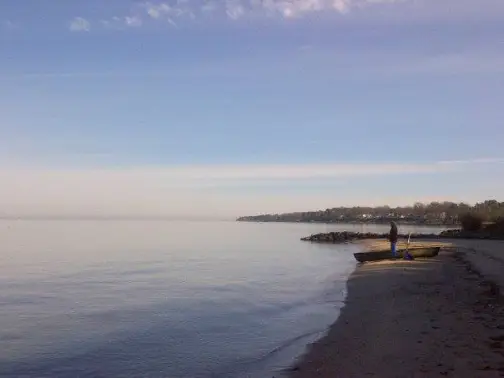
The View, this time, is from behind.

I am recycling an old post because what it contains is suddenly fresh and nudging my psyche into somewhere new, or, maybe, somewhere I haven’t been in a long time.

It’s like this: When I knew for sure I was leaving my job I held for nearly thirty years, I started to focus not so much on what was next as much as how fast, how so very fast it all went, and I realized that about the same amount of time to come would put me at ninety years old. Sigh.

I cleaned out my office—slowly at first, then with much more indifference. I carried piles of books to a common table in the building’s lobby, I moved file cabinets and other useless furniture into a storage area for someone else to claim and configure to their job the way we do with all things in our lives—we mold them to fit in the corners of our growth and accomplishments. Yeah, I was done with all of it. I absolutely knew I needed to redefine “accomplishment.”

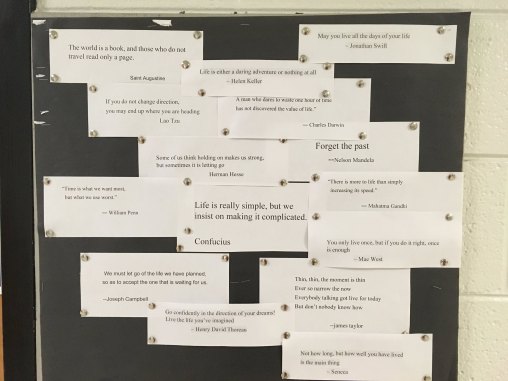
And outside my office I took down all announcements and office hours and lists of readings from my bulletin board so that all that was left was black construction paper. It looked clean, like a slate, and I absolutely loved the metaphor of it all, but I also thought I should take a piece of chalk and write in some demanding font, “Outta here.”

Instead, I typed up a favorite saying of mine:

Life is really simple, but we insist on making it complicated

–Confucius.

I stapled it to the middle of the board, smiled, and went about my business of unraveling three decades and finding my way to that diversion Frost wrote about with such eloquence.  

Next to my office was a classroom, and students often leaned against the wall (and my door) while waiting for another class to empty before entering. A few noticed the saying and commented to me when I returned to my office. “I like it,” one woman commented, “because it makes me think about it.” I liked that she said that. I wish she had been one of my students.

The following week I added another quote to the board, one of my absolute favorites:

If you don’t change directions, you may end up where you are going.

–Lao Tzu

Just stapling that to the board punctured a ball of emotion that spilled out across the rest of that day. How many times have I preached, I thought, about the dangers of getting caught in the currents and letting the world around us carry us through instead of pulling ourselves out of the stream and deciding for ourselves where we are going? Students had the same reaction, and I know they were wondering just who is it that decided going to college right then was the right thing to do. Often there is absolutely nothing wrong with where we are going; this is not a rebellious statement, I don’t think. I believe Lao was just indicating it can’t hurt to get a glimpse of what’s ahead every once in a while to see if you really are okay with the path you’re on.

The board caught on and people started asking when the next quote was going up, gathering around my door on Tuesdays after they figured out I didn’t work Monday’s and that I must have posted them early Tuesday mornings, which I did. Up went James Taylor, Mae West, Seneca, St Augustine, and Jonathan Swift. More than a few passing people commented on how motivating the sayings were, and how they looked forward to them. Well, motivation was always my profession anyway, not teaching. For those thirty years it wasn’t English I was there for—hell, I was barely qualified for the first fifteen of those years. It was that I knew how to get them to find significance in it all—the work, the direction, the balance of dreams and reality, the math necessary to never forget life is a line segment, not a ray. My job in New England after college was to motivate people, and I learned it well. So when my car broke down and I ended up teaching college, I knew instinctively that it really doesn’t matter how much I know the work, if they aren’t engaged—if they don’t feel motivated—I’d be speaking to the walls.

Plus, I think my board was an extension of what I knew was about to end, and I started in those last months to motivate myself.

William Penn. Herman Hesse. Helen Keller.

Thoreau.

Darwin.

Then it was the first week in May at the start of my last week ever on campus. And I found this: 

We must let go of the life we have planned so as to accept the one that is waiting for us

—Joseph Campbell.

I typed it up, printed it out, moved Thoreau a bit for balance, and stapled Joseph to the board. That one was for me.

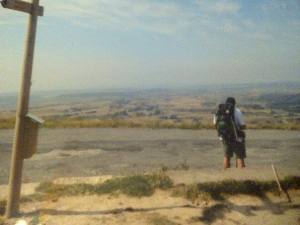
One of my most vivid memories from Spain was being in Santiago after more than a month of walking at about two or three miles an hour, sitting in cafes, crossing Roman bridges noting each step, each breath—essentially more than a month of barely moving to cross a nation—and then suddenly we were boarding a train for the six-hour ride–just six hours–back to Pamplona. Six hours. It took four weeks to go from Pamplona to Santiago, and six hours to get back. On top of that disturbing reality check was that after a month of barely moving, we were suddenly barreling along at sixty and seventy miles per hour. It simply felt wrong. I leaned against a window looking at the landscape and when I saw pilgrims walking the opposite direction toward Santiago, holding their walking sticks, their backpacks strapped and the sun beating down as they walked and laughed, talking to other pilgrims on the road, I got a pit in the center of my stomach, a nauseous pain, like a child on a school bus for the first time who sees his parents outside walking the other way. I wanted to get off; I wanted to pull back the doors between the carriages, toss my pack out onto the trail and tumble out like a character in a movie. Writing that just now brought the pit back; it was that real, it is that real.

And what I learned on that train ride east I am relearning now: I’m a pilgrim, not a passenger.

Sometimes that happens. You’re riding along, caught up in the mainstream, barely noticing where you’re going because you’re engaged with everyone else in the stream barely noticing where they’re going, and you catch a glimpse of some shadow of yourself just out of reach. And you know that’s where you should be, of course, or at least you dream that’s where you should be, but the trouble, the pain, the expense, the sacrifice, the explanations necessary, the possibility of failure, the probability of doubt all slide in front of you, each holding you back just a little, all adding up to a gravitational force of “now” and “comfortable” and “responsible” that’s harder to break free from than the strongest of currents.

Then you jump. And when you do, it’s terrifying. The pit returns in a different fashion, this time pulsating, “Oh my God, what have I done?” And you come to accept that you’ll never lose the pit, one way or the other.

But then you turn around and look back down the stream where you had been going, where everyone else is laughing and engaged and are all still heading, and finally, from this vantage, you see what you couldn’t from the stream, and you know, I mean you know that no matter where you go next, you had been heading in the wrong direction. No one will ever understand that but you. No one.

Anyway.

I cleaned out my office, and I walked outside the door that last day and for a moment I thought about leaving the quotes there, or maybe replacing them all with just one quote in the middle of the black construction paper, saying,

and this bird you cannot change

–Ronnie van Zant

but I changed my mind and took them all down and gave them to my friend Jack. Each week he’d come by my office and we’d talk about the latest quote and what it meant to us. Then on that last day when I was about to throw out the last folder of teaching materials, I found another passage, typed it up and stapled it to the board.

I’d like to believe it is still there:

Life is what you make of it; always has been, always will be

–Grandma Moses

12140843_10206985963235013_8819103812513984303_n