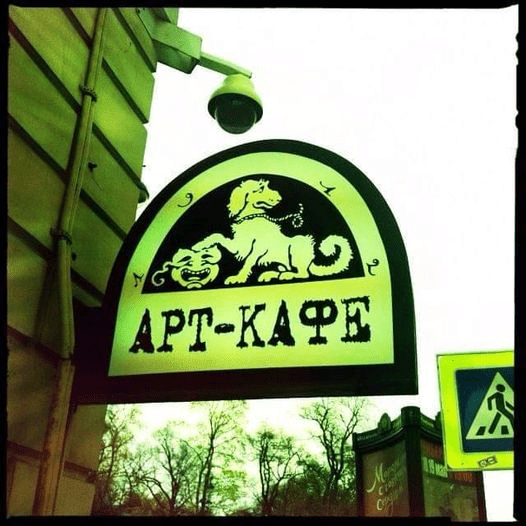
Eleven years ago I read a not-so-subversive piece called “Driving Under the Influence” at St Petersburg, Russia’s, infamous Stray Dog Café, where in earlier years Pasternak had read, and before him Mandelstam, who died in a gulag near Vladivostok for his threatening words, and also Anna Akhmatova, and a string of dissidents who risked their lives so their prose and poetry might be read and heard.
We sat at a long table, and while everyone listened to my innocent story of teaching my son to drive, I imagined the whispers and quiet conversations in those same corners about the Czar, who walked the hallways of the Winter Palace a few hundred yards away. What a world it must have been, I thought, but also, how good those days of revolution and dissidence were in the past. The city in 2013 was alive with artists, writers, photographers, musicians, and mostly legal political opposition to everything, with St Petersburg University students free to protest, complain, object, and support whatever they desired. As a result, no one needed to so much. It’s the greatest value of freedom; when people are free to choose, fighting and uprising recede. The horror of seventy-five years of Soviet oppression, preceded by three centuries of Czarist rule, was finally over.
My Russian friend and photographer Valentine shot pictures of old women, survivors of the siege, and of his children, his “Butterflies,” and laughed through a cloud of vodka, ever ecstatic at being able to express himself in marketplaces, newspapers, and galleries. Full of life and hope, these artists pushed their mediums to the max and shared stories of “darker” times when pointing a camera at anyone meant a possible sentence in Siberia, just east of Irkutsk, not far from the archipelago of dead poets. Not any longer, Valentine told me again and again over shots of Russian Standard and tables of photographs that just a few years earlier he had to hide those photographs inside the lining of books. “You should write here, Bob,” he told me. “You’d be free to write here,” he said. “Those dark days of Soviet Russia are dead.”
That was then.
The truth has once again folded up her tables and left the marketplace; transparency has turned away in shame. The Russia that Valentine came to love for three decades, and the only one I ever knew firsthand, is gone. It is gone. The citizens still attempt to navigate the streets of Peter the Great, the backroads of their “Window to the West,” but they are once again driving under the influence of a Neo-Stalinism, Vladimir Putin’sFascist Regime.
Russia needs dissidents again. It is a time for poets. The Stray Dog should be crowded again with college students and artists listening to new poets risk everything for a few stanzas of truth. A contemporary Mandelstam, a modern-day Pasternak, should come out of the corners of the university classrooms and set ablaze a bonfire of observations and digressions. Because nothing ignites writers more than the attempt to extinguish truth.
Every year since the end of the “Great Patriotic War,” veterans and their families remember something different than their counterparts throughout Europe and the United States who celebrate the Nazi’s surrender, the liberation of millions of people. In Russia, Victory Day is celebrated on May 9th. In St. Petersburg in particular, they celebrate survival. For nine hundred days the Nazis bombarded the city in an attempt to “wipe it from the face of the earth.” The Nazis failed; the veterans never forgot.
But apparently, you have, Mr. Putin, haven’t you? Your beloved Leningrad. I was there at the Piskarevskoe Cemetery twenty years ago when you placed the wreath at the foot of the statue of the Motherland and mourned for the seven-hundred-thousand women and children buried in mass graves; your relatives, your family, friends, all starved to death or killed during the Blockade. “One of the most tragic events in human history,” you called it. “This must never happen again,” you said.
In the 1990s, when you were vice mayor of St Petersburg, you stood in front of the Mariinsky Palace—City Hall—and nodded as a guide explained to a Canadian delegation the wonderful story of perseverance. I was a professor traveling alone from America who happened by, lucky to hear the story in English. And after two dozen trips to St. Petersburg, I have become quite aware how this story of pride is ingrained in the hearts of all of the city’s residents, including you, so you said. “Everyone in this city knows this story,” the guide said, and you nodded, smiled.
Your actions in Ukraine suggest you’ve forgotten, so let me jog your memory: Hitler was so convinced he would take Leningrad, he sent out 250 invitations for a celebration party to be held at the Astoria Hotel, just feet from where we stood near the statue of Nicholas I. The guide said that when it became clear to Hitler that he was not going to be able to take the city after all, he ordered Leningrad be “completely destroyed and wiped off the map.” Hence the siege—nine-hundred days of bombing, a million and a half dead, nearly seven-hundred thousand of them women and children. But it didn’t work. Your own relatives insured your birth by holding off the Nazis. And for decades, even as late as the 1990s when I spoke to old women in the city about it—survivors of the siege—they remained proud to say that “Hitler never dined at the Astoria Hotel.” Everyone clapped. You clapped. It’s a great story.
A few days later I watched you lay the wreath on Victory Day and declare such terror should never occur again in the world.
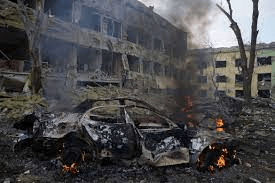
It has come full circle, hasn’t it, Mr. Putin, only now you are the evil aggressor who has abandoned his own people, a population who swore such an event should never be experienced by humanity again, when you imposed a similar fate on the citizens of Mariupol, Ukraine. Now the people of Ukraine are fighting their own Great Patriotic War, and you are their Hitler. It took eighty years for another madman to think he has the right to destroy a population to satisfy his own ego and insecurities. We’ve seen it before; we know how this turns out. No matter what happens geopolitically, you will go down in human history as a tyrant and cold-blooded killer, “Putin” spoken in the same sentence as “Hitler,” Mariupol in the same breath as Leningrad.
What’s tragic personally is I stood there in that cemetery, Shostakovich’s Seventh Symphony, the Leningrad Symphony, on the speakers, and watched you place that wreath, listened to my translator proudly repeat what you said: “This is one of the most tragic events in human history and we must never allow it to happen again.”
The people of your city—St Petersburg—are ashamed that not only did it happen again, but it was conceived by and carried out by one of their own citizens.
The true Russian heart, the true soul of someone from St Petersburg, is one who celebrates survival and all that Peter the Great’s “Window to the West” has to offer the world. You might be from the Soviet Union, but you are not Russian. There was a time when even St. Petersburg could see the beautiful and celebrated results of your efforts to bring the city and the country back to life after a century of darkness. But once this is over, you will only be mentioned as the tyrant who sacrificed his own people to destroy another culture. And then, like all monstrous dictators, you will simply be forgotten.
In the early ‘90s, I stood in line at a bakery in St. Petersburg, Russia. I was in the city for three weeks teaching American culture to the faculty at Baltic State University. The entire nation had just opened up after seventy-five years of communism and four hundred years of czarist rule. Things were a bit unorganized and haphazard. Yeltsin was in charge but not really; the Russian mafia was in charge. But that’s an entirely different story with a very bad ending for so many people.
But in the early ‘90s my colleague Joe and I had an apartment near the Gulf of Finland, not far from a family who we paid a great deal of money to host us for three meals a day plus tours. It was incredible to be part of all these changes with this family—him, a former Soviet Naval Captain whose job had been to search the arctic for American submarines, and her a translator and professor of English and languages at the university. We became family. More stories.
But mostly Joe and I discovered Russia on our own when not through the experiences of this family whose own changes were occurring daily. Understand, Russia never knew democracy, never knew capitalism.
So the bakery story:
I stood in line and Joe videotaped me waiting. But I waited forty minutes. Finally I arrived at the counter and pointed out a dozen or so pastries. She bagged them but put the bag behind her and handed me a piece of paper with the total price and pointed me to another line. I waited there. Ten minutes. Twenty. Finally when I was second in line, the cashier went outside to smoke, and we all waited another ten or fifteen minutes. Eventually she returned and rang up the sale, I paid, and I moved back to the first line where I waited as long to turn in my proof of payment for my bag of pastries.
Most of this is on tape somewhere.
That night at the college we talked about many things and answered many questions. That deserves a different story entirely, but not here. To the point: we had handed out US newspapers, and someone held up coupons and asked what they were. We explained, and he commented why in the world would you sell something for less than the price, that is dumb, no wonder capitalism doesn’t work. So I told them all the bakery story, and they nodded as if to say, “yeah, that sounds about right.”
And then he asked, “So how is it different in America.” I love a good setup.
I told them: In the states the cashier is fired; she sucks at her job and I’m losing business—you know why? Because Joe has a bakery across the street and his line is moving, and my customers are heading over there, and my income comes from customers, not the government, and while your income is guaranteed, it allows you commune apartments and mafia shakedowns. We offer coupons as incentive to try my pastries, and if you work hard and keep the line moving and don’t eat the pastries, you’ll get raises and promotions and eventually own your own store.
Yeah, they didn’t get it.
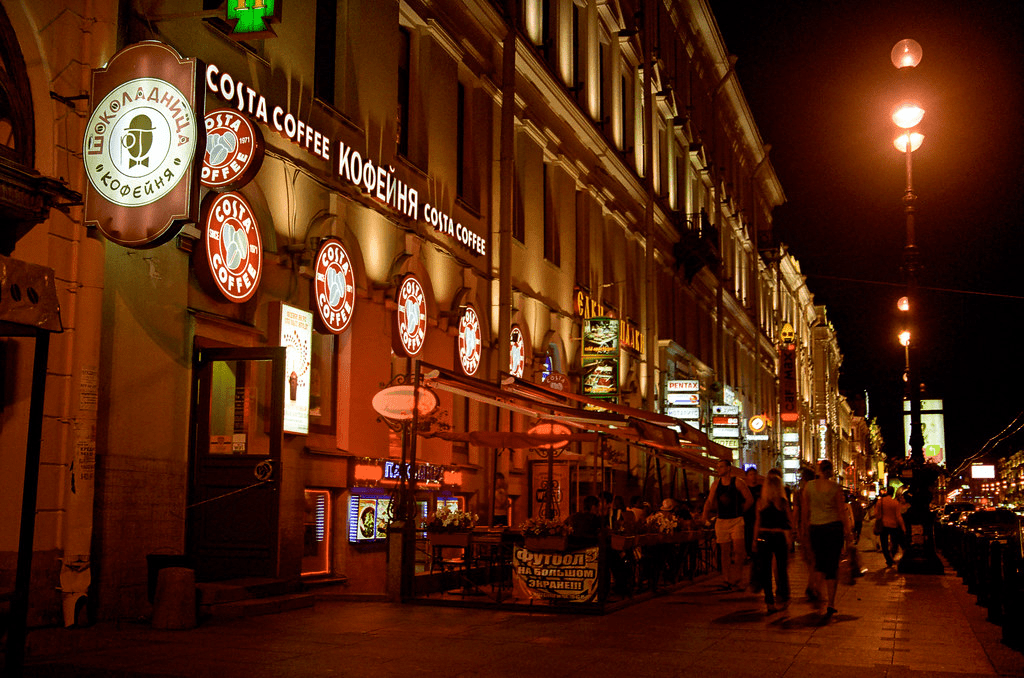
That is Soviet Russia; that is how Putin mistakenly sees Russia. That is how he was raised and was already part of that mafia/governmental system by the time we arrived thirty years ago. His Russia was a population paid by the government no matter what, and no where on Nevsky Prospect (Fifth Avenue) was a single billboard, a single neon sign, few restaurants, no advertising save Marlboro. You bought sour cream and milk from the back of trucks, or you went to the stores set up exactly like the bakery with long lines, and that was how it was since the Romanov’s came to power in the 1600s. Putin gained control by gaining control over an economy and country that was shredded after the coup; and when the government gave everyone across the empire three days to trade in Soviet money for Russian money, and the vast majority of people live three days from a bank—Putin and his cronies scoured the countryside buying Soviet money at twenty cents on the dollar and making millions.
But the Russia he runs now is not the Russia he so quickly gained control over by the late ‘90s. That Russia was still filled with people used to the government telling them what to do and they complied so long as their pension was secure. Today’s Russia has had thirty years of absolute freedom to come and go, make money a la capitalism, set up and own businesses, travel the world, speak relatively freely, and families live all over the world without fear of repercussions. Anyone in Russia who was even ten at the time of the coup is now in their forties, so all Russians forty or so years old and younger know nothing but the freedoms listed, the opportunities experienced by the west, and they like it—a lot. Enter McDonald’s, KFC, Starbucks, western music, movies, travel packages, tours of New York, London, and LA. Enter jobs with international corporations and BMW’s and HoHo’s.
This is NOT their father’s Russia.
So to keep them quiet and subdued, it is now illegal to indicate support of Ukraine, illegal to travel abroad, illegal to speak openly unless it is for the government.
People compare Putin to Hitler. That is not accurate.
Putin is Stalin.
But his narrative has a significant flaw which perhaps Stalin was able to avoid for some time—the population of Russia and Ukraine have a western mentality that simply didn’t exist there at all prior to the early 90’s. Sure, he keeps getting re-elected: At first simply for stability—no one liked Yeltsin or Zyuganov. Later he was re-elected because of fraud (the 2018 election found one of his two opponents dead and the other poisoned and later imprisoned). But the country he rules will quickly become unruly, much like the citizens of Czechoslovakia who knew democracy well when communism came in 48 and again in 68, and those who remembered how life was prior to communism refused to allow the suppression, hence the Velvet Revolution, led by those who remembered.
People have something now they didn’t in Stalin’s day—a basis of comparison. They’ve not had to stand in line for pastries for three decades, and they have family not just in Ukraine but throughout the world. The government, the military who act out of fear of Stalinesque punishment (like the Not One Step Backwards decrees which insured that any Soviet soldiers retreating or disobeying would be shot), cannot sustain the isolation required to continue the onslaught of other nations.
I’ve made more than two dozen trips to Russia, crossed it by train, traveled with more than 500 people including US Army generals, professors, writers, artists, lawyers, and others, and I kept journals, I wrote extensively to the tune of three books and countless editorials and essays.
There was so much more to write—about Valentine, my dear photographer friend, about a graveyard on the gulf, about the rebuilding of a church by another close friend, and the planned exodus of two other friends, artists, some years ago to avoid draft into the army to fight in Chechnya. Stories about old women in the Hermitage and a homeless man who became a companion.
And I could write an entire book about The Shack, about playing guitar with a gypsy band every night until five am, drinking outlawed Georgian wine and laughing, teaching them “American Pie,” learning their folk songs which made us all cry despite not knowing a single word.
For thirty years Russia was a fine combination of history and romance with hope and emergence, like a young child with an old soul. And I have full confidence when the dust settles, the that Russia I came to love will survive. The bell of freedom rang for those people years and years ago, the chimes of hope, the echoes of prosperity.
The old truism is indeed true: You cannot unring that bell.
Oh I have stories. Geez what a time it was. Nothing is what I was told it would be when I was young. Nothing.
I’ll go back, but I don’t see a need to write about Russia anymore.My last piece of writing besides this short blog is my book in which my son and I travel from one end of the country to the other, and we see the world together, enjoying the fragile and beautiful passing of time. How can I possibly follow that?


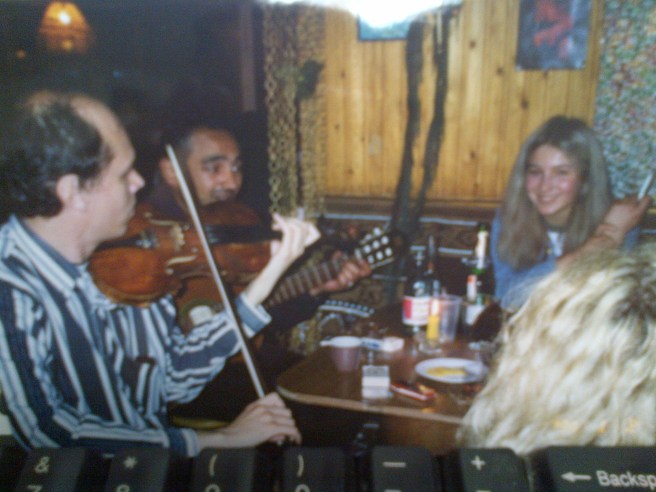
 a view from this wilderness