Stop covering President Trump’s daily activities and decisions. We are numb to their predictability and redundancy. I could write the next ten days’ headlines concerning his knee-jerk presidency and be pretty close. We know seventy-five percent of Americans disagree with most of his current obsessions, including Greenland, Iran, and Venezuela. They are concerned about affordability, a word Mr. Trump apparently thinks was only recently invented. They are concerned about housing prices and the cost of milk.
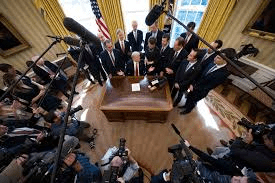
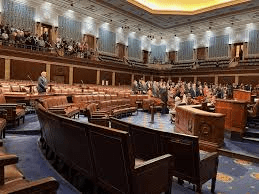
Do this instead: Cover congress. Obviously, most of them have gone silent since they know that to suffer the wrath of Mr. Trump is to risk unemployment, perhaps even an investigation, but not if all of them all at once stand up and say, “No more.” Report about that. Ask them the questions instead of the president. Ask congressional leaders if they agree with the possible invasion of Greenland and the likely subsequent chaos at the United Nations, in NATO, and the inevitable explosion of prices for everything from Europe, and make that front page top of the hour news instead of comments from Mr. We’ve Heard it All Before. Ask them how they feel about the president’s threats to invade Iran if they continue to badly treat the protestors while he defends ICE’s motives, including shooting a woman in the face as the agent called her a “fucking bitch.” Ask congress where they stand on that matter. Find out why they are not proposing bills with an overwhelming majority to avoid veto that state any action by the military must be approved by Congress. Ask them if they are aware that their constituency has ceased liking the president’s actions to the point of a supermajority. Make it front page news that in this republic that the overwhelmingly majority of actions taken by the president are only possible because of either their approval or their silence. Don’t let them be silent. Don’t let them avoid the truth. Expose their cowardice at supporting anti-American policies from the American president because they’re afraid of losing their civil servant job.
Make it clear that the American public lays the blame for all of this at their feet, and every single morning be at their doors asking them again, and again, how they are letting him get away with his unprecedented weak-minded plans. Remind them that when a bully’s disciples refuse to go along with the demands and threats, the bully stands alone and inevitably folds, and his supporters will move quickly behind someone else to stand in unity. Then, in the form of a question, somehow tell them that if a handful of republican leaders stand against the president, they will likely suffer childish ridicule and adolescent belittling, followed by a public shaming and a loss of office. But if a majority of them stand against the president, if they all decide that enough is enough, their followers will abandon Mr. Trump and stand behind them, even if simply because they don’t want to appear to go down alone.
This is psychology 101, but you are too misfocused on the hype and vacuum created by the president. Make it your mission to control the conversation since you have from Edward. R Murrow to now. And today’s headlines should no longer begin with “Here is what the president did today.” It must begin, “Here is what congress did not do today.”
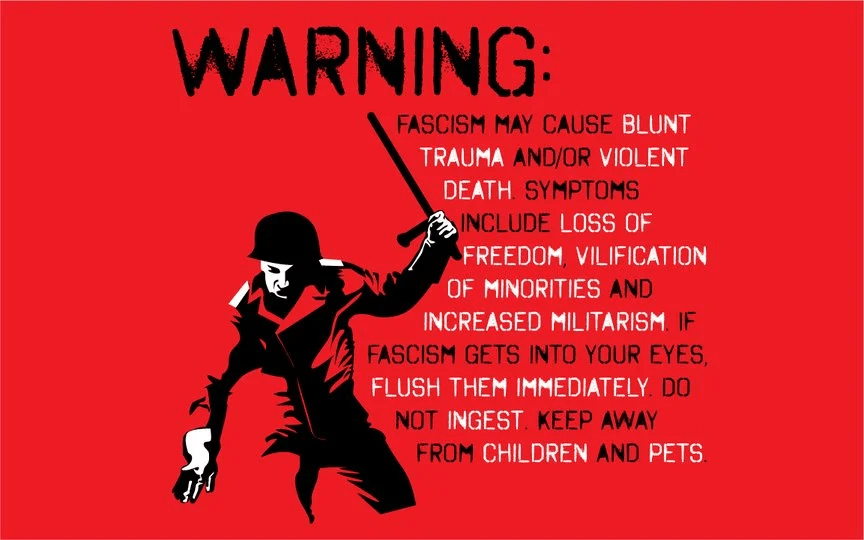
“A far-right, authoritarian political ideology emphasizing extreme nationalism, militarism, a strong dictatorial leader, and the subordination of individual rights to the state, often involving forcible suppression of opposition, economic regimentation, and national rebirth through controlled unity and traditionalism. Fascist movements, like Mussolini’s Italy and Hitler’s Germany, use propaganda, cults of personality, and violence to create a unified, powerful nation, often targeting minorities and foreigners as scapegoats for national decline.”
Yeah, that’s not me. Not a fan of Hitler. Not a fan of Stalin. Not a fan of the Father of Fascism, Mussolini. Never have been.
I don’t believe:
In an infallible leader who never makes mistakes
That the democratic ideals of freedom and equality are a threat
in rampant sexism or the need to control mass media or consider it dangerous for telling the truth
in sustaining a false sense of “victimhood” or that the nation is under attack
in questioning reality and verifiable truth while at the same time encouraging myth and false narratives
So, yes, I am anti (“opposed to, against”) fascist (see above). If someone prefers to drop the “scist” from that title, that’s fine. I’ll go with Antifa
as would:
Ronald Reagan, who said that fascism “glorifies the state and denies individual liberties.” He suggested that fascism would be most evident because of liberals, not knowing, of course, that the current president makes Reagan seem like an MSNBC junkie.
Primo Levi, who said that fascism wants everyone to be the same
FDR, who said that fascism was ownership of government by an individual
Henry Wallace, who said “if we define an American fascist as one who in case of conflict puts money and power ahead of human beings, then there are undoubtedly several million fascists in the United States”
Upton Sinclair, who said that fascism is capitalism plus murder
Eric Fromm, who reminded us that. “When Fascism came into power, most people were unprepared, both theoretically and practically. They were unable to believe that man could exhibit such propensities for evil, such lust for power, such disregard for the rights of the weak, or such yearning for submission. Only a few had been aware of the rumbling of the volcano preceding the outbreak”
The desire on the part of some to define “the Antifa movement” as anti-American is ridiculous, uneducated, and blatantly contrary to the very American “values and ideals” those same sound-bite-driven complainers propose they protect. Nearly all of this country’s forefathers were Antifa, which is why they left Europe and why they tossed the tea in the bay, why they said, “no more.”
So, to all of this country’s new accurate-information-deprived streamers, No More. Not only were the antifas like myself here first, this country still exists because of them. To not support anyone who is anti-fascist is to in turn support North Korea, the Soviet ideals of modern-day Russia; it is to be against all Americans who fought in World War One, Two, Korea, and Vietnam. If your instinct is to don a swastika or raise the confederate flag, then, yes, we are enemies and I’m on the right side of history, you’re not. But if you are just repeating the shouts of the ignorant masses and never took the time to think this through, think it through now and then turn and proudly declare, “Of course I’m against Fascism. Duh.”
First, the president of the United States is not the “deal maker” here, we are. We hired him to carry out what we decide needs to be done. Sometimes that power is abused; sometimes we need to reevaluate our own choices; and sometimes it simply goes awry and we hire an immoral, indecent, and perverted asshole, but we’ll decide what needs to be done, not him, and if errors continue we’ll find someone else to take the job who will listen to what we say. When that isn’t done efficiently and with our confidence, most of us regret it. Not everyone, of course, but that’s another problem; some buy into the propaganda hook, line and sound-bite. Not because these sheep believe it so much as the methods employed to communicate such crap is so convincing. Huxley wrote in ’58: “The effectiveness of political and religious propaganda depends upon the methods employed, not upon the doctrines taught. Under favorable conditions, practically everybody can be converted to practically anything.”
Or anyone.
Second, the president often makes executive decisions we don’t like. Our support of US troops, for instance, should not be mistaken for a belief that most American’s think those same troops should be sent to North Korea, Somalia, Venezuela, or anywhere else. Additionally, many Americans understand true Islam is not what the president is mouthing off about, and most Americans know that the environment must be our primary concern. I’m sorry if the president and some people around him leave the impression that Americans stand behind destroying the world either by imminent destruction because of childish and irresponsible hyperbole or by some slow erosion through pollution and overuse of natural resources. We were doing fine until about a year ago. Forgive us. We are embarrassed by the president’s inability to recognize his mistakes and refusal to reverse bad decisions out of some false sense of pride.
But that is not what we need to apologize for, though we’re really sorry for that, too. No, what sits atop this mass of mess we’ve helped make is the greatest of ills for which perhaps no apology will suffice: we’re sorry we are not what we used to be. At one time Americans created a constitution that rewrote how government should be run. The world turned toward us with respect for our progress. We didn’t suddenly succeed at nearly everything we did—military, invention, science, medicine, and engineering—because of our population: we’re not that big. We didn’t surpass the expectations of critics from Czars to Monarchs because all Americans got along—we disagree with each other perhaps more than most citizens in most countries; that happens in an experiment like ours which is why dissent is written into the Constitution. In fact, the constitution encourages it, particularly free speech. With that model, we made good on our word for two centuries, and when we had problems of our own—the Civil War, Slavery, Civil Rights, Women’s Rights, political scandals like Watergate, LGBTQ+ rights—we dealt with it, sometimes aggressively, sometimes diplomatically, and sometimes poorly, but we dealt with it and moved on. No longer. No, now, I’m sorry to say we attempt to bury our faults beneath distraction and fear. We simply are not what we used to be, and that isn’t fair to our future or the future of countries which turn to us as an example.
The truth is, the United States as we knew it is ill. Its heart is filled with fear and unsubstantiated speculation, and when executive decisions are coupled with personal attacks, degrading and racist statements, and absolute ineptitude, a change has to happen. This country does not have the moral strength it did in its youth, and any artificial means of sustaining life will eventually collapse to the reality of this false resuscitation in some pathetic tagline like “Make American Great Again.” Honestly, most of us are too smart for this. Patriotism has always been the backbone of this country; but it had always been a patriotism built on pride—the pride that came from making the right decisions, following the right paths, no matter how hard; it was a patriotism built on the backs of dissidents and soldiers who knew how to fight for our freedoms without compromising them. It was not false; it avoided the trite sound-bite built by committees and marketed to the mob who drive about the country with flags flying from car antennas.
But many here have bought into this new, veneer patriotism. It has a different grain, this national pride which permeates every aspect of American life. It’s a patriotism balanced on fear and propped up by stimulus-response. It has not the historic sense about it the world so respected and tried to emulate in decades past.
It is Lord of the Flies here right now; it is the reactionary leader creating a monster he is set on protecting us against, silencing the dissent of investigations like most dictatorships do, convincing us the one who leads with reason and diplomacy will place everyone in danger; it is Moby Dick, with Ahab determined to commit suicide against an unassuming nemesis solely for revenge and not to advance some greater good. It is the tragedy of the ages, the fall of an empire. It is our own fault, and we’re sorry. No one here is happy about this.
No one here is happy when the president declares he is a deal maker not a diplomat; when he pushes aside world leaders to get in the spotlight; when he ridicules mentally or physically challenged people; when he badmouths journalists—the very soul of a democracy—when he treats women like objects and brags about it; when he lies about his accomplishments; when he makes fun of anyone who disagrees with him, when he destroys national treasures and institutions without permission, when he associates with pedophiles and criminals and lies about it, when he fights the judicial system tooth and nail to keep food aid out of the hands of starving Americans.
This man is an embarrassment no matter how far to the left or the right he might stand. This is about human behavior. We were supposed to be a better example than this. We were supposed to provide proof that humanity had it in its collective power to accept the ways of many people and, based upon a common constitution, work together. Our proclamations promised in writing the rights of liberty and happiness—amazingly, for the first time in recorded history. And it worked for a while. Oh, the democratic principles of our founding fathers remain the cornerstone of any government that hopes to rule without revolution; that aspires to last longer than its military forces allow. We were really good at it, too. But who isn’t embarrassed by the fall of a good example? It is, perhaps, worse than watching some wretched foe attempt to lead you into the abyss; for after proving oneself worthy, after placing oneself in the position of respect and admiration, after followers line up blindly trusting this once-great prototype of human justice, to bend toward being an aggressor, to bring the balance of criticism against the once seemingly-faultless government, is nothing short of deplorable. We preached to the world that our way of life should be emulated and respected; and certainly for some time it was. But we’ve become the spoiled athlete with talent and power who bends rules to benefit himself. Watch closely then because we are truly falling. And it is undoubtedly because of a small group of demented leaders manipulated by the current fascist president.
Talk about inappropriate behavior in the workplace.
We are not on this slippery slope because of some foreign power who takes issue with our self-worth; no, we’ve made it here on our own. We spend more time studying the drinking habits of bad actresses than the decisions made in congress. We propose new governments to foreign lands while our own executive branch is under investigation; cabinet members disagree; both major political parties prefer there were only one party; what the president says is cause for war both domestic and international; race relations are once again in turmoil; the president wants to literally build a wall between us and our neighbors; we spend more on fast food and gourmet coffee than we do on education; we don’t handle natural disasters very well; violent crime is higher here than in most countries on the planet; our jails are saturated, and our waterways are polluted. And all the while we spend a great deal of energy telling other countries how they should act and what is wrong with their leaders and policies. Are we right? Perhaps, but we’ve lost credibility, and many of us would rather our leaders simply keep their mouths shut for awhile and let the world, as Mark Twain said, believe we are stupid than open our mouths and remove all doubt. Please, just for a short time while we straighten this out, could everyone look away?
We are so sorry. We may have earned the position of respect and reverence in the past, but it is not automatically renewable. We should not follow up these successes of domestic and foreign programs fifty years ago with a new foreign policy based upon “gut feelings.” The primary fault and eventual downfall of any great nation is hypocrisy.
We weren’t always this way. When we recognized our own hypocrisy—slavery, for instance—the collective power of this country’s citizens demanded we set it right. Now we call for executive privilege as if we’re ordering a pizza. We refuse to testify like we’re turning down dessert. We’re scattering troops about the world like it’s a Risk board and the only place left to put a few cannons and horses is Kamchatka. We refuse to accept the ideas of other nations no matter how many are unified against us, and we withdraw from treaties set up to protect the globe solely to protect our wallets.
We’re sorry our leadership often acts and speaks less than presidential. Listen, lots of people here make fun of our president. They make fun of his tweets, his verbal sweeping generalizations, his inability to act like a mature adult. Yes, it’s embarrassing– the world has made that clear, but you don’t need to tell us.
Believe me.
Newspapers in countries that once turned to the United States for leadership and guidance mock our president on a regular basis, emphasizing his flaws, using his fallacies as some proof that America is not what it used to be.
And it’s not. And we’re sorry, but the rest of the world needs to understand how this works. When we collectively decide he needs to be fired, we will do so. For now, disagree as we might, our system is set up so that other branches of our government hopefully pull up the slack. This type freedom comes at a price, and we don’t always make the right decisions. But they’re our decisions, and while we deeply apologize for not maintaining our past strength and dignity, that respect was not earned by any one president or any single policy, but by the collective efforts of the American people and supported by the finest constitution in human history which guarantees rights that have made this country work. Rights such as the one that states anyone born here can become president. Anyone.
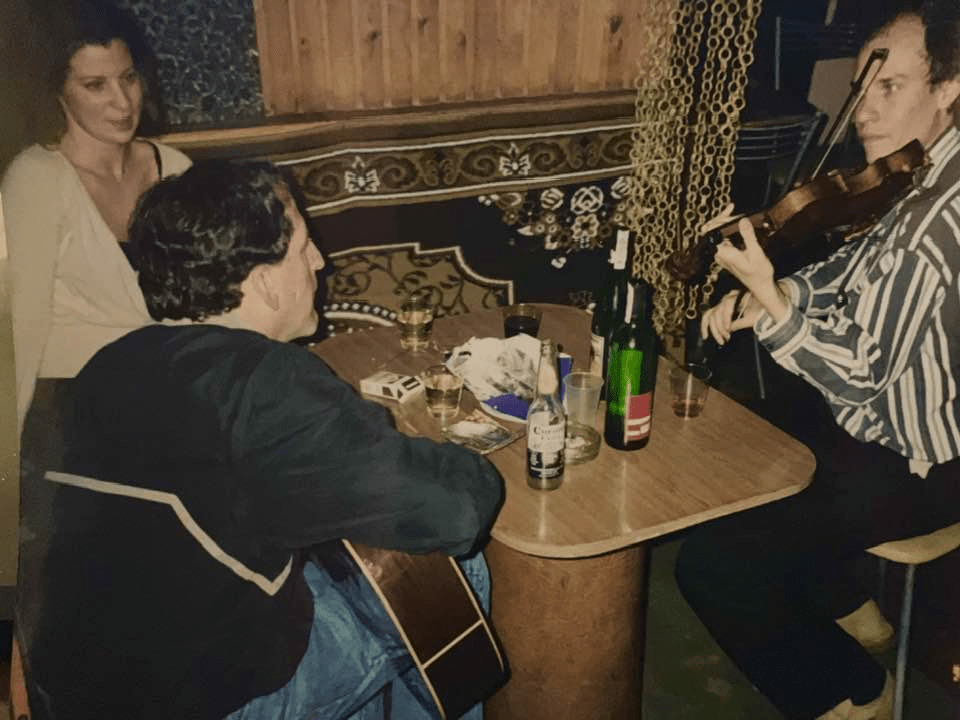
The Infamous Stray Dog Café where I read with Anna Akhmatova and others (not at the same time or in the same century)I had just given this carnation to the WW2 vet on Victory Day3 am at The Shack, my hang out for years where I met locals and played music in the woods on the beach of the Gulf of Finland
I’ve traveled all over the world with friends and family: To Ireland, Prague, France and Spain, Norway and Amsterdam. But Russia has been on my mind the past few days as it and the war in Ukraine seems to have been drowned out by the noise coming from the Middle East. For quite some time I had quite some time there. I dined in palaces while quartets played for our private group, and I’ve paid off people guarding graveyard gates so we could explore the backstreets of St Petersburg. I’ve brought friends to apartments of artist and writer friends of mine, sat backstage during rehearsals at the Conservatory, had private concerts at the home of Rimsky-Korsakov, and read my work at the famous, dissident occupied Stray Dog Café as well as Dostoevsky’s flat. I know the streets of that city better than any other place in the world, including places I’ve lived. It has something to do with that heightened, acute awareness we experience when we travel. It also has something to do with going back dozens of times.
The city today in this post-Ukraine-invasion world, I fear, more closely resembles the city it was when I first arrived just after the coup. I thought those times were dead and buried, covered by the fresh grass of several new generations who know little else but freedom and capitalism. But it took one sick man to throw it all back thirty-five years.
In 1994, the streets of St Petersburg were dank, a monotone of browns absent of advertising, neon, or anything other than some Soviet style atmosphere. The only placards placed in random spots on Nevsky Prospect—the city’s Fifth Avenue—were Marlboro signs, the only western clothing of note worn by the suddenly displaced masses was Adidas warm-up suits. It appeared a parody of itself as presented in 1970’s and ‘80’s anti-Soviet movies. For seventy-five years the country, and Leningrad, moved in darkness under the Soviet leadership, and for centuries before that under the long reach of the Czars.
When I first arrived to teach American culture to faculty at Baltic State University, the first of what would end up being more than twenty-five trips in thirty years, democracy had found the streets of Leningrad, which had just changed its name back to the Imperial “St. Petersburg,” and Russians struggled to figure it out. The first week there, I stood in line for two hours at a bakery, and when I pointed this out at the college, my colleagues shrugged and said, “Da. Canushna.” Yes, of course. I explained that in the States, a new bakery would open across the street and be faster, charge less, offer discounts. Then I had to explain discounts and why, explain that the cashier who stood outside smoking while twenty people were in line would be fired. This led to a conversation about capitalism, and everyone was suddenly enthralled to hear about businesses and learn how to make money, the advantages of choices, the value of options. The men of the previous generation on through to the college students present when I first taught in the city, simply understood service to their country as paramount; it involved time away from family, but also provided pensions and a chance to protect their living conditions.
But after the coup, and certainly in the few years which followed leading up to 1994, it was a brand-new way of existence, and the long, cold winter of communism had finally ended. Things changed—and this is where it got tricky. At first everything was different overnight, like their currency, living conditions, international relationships, and availability of goods. But then the changes slowed to an immeasurable pace. People couldn’t find jobs or food, or they had to work for some organized crime group. Old folks lined the metro begging for money or selling items—shoes, loose cigarettes, empty bottles. But within a few years they figured it out. One afternoon that first year I went to the market behind a cathedral in the arts district. It was a park area with tables covered in tourist items: matryoshka dolls, the famous Russian wooden bowls known as khokloma, pins, small wooden toys bears. Scarfs, shawls, icons, amber jewelry. The following year the market built small booths in long rows instead of random tables. A year or two later, the booths had roofs over them, then lighting was put in for night shopping, and by the 300th anniversary of the city in 2003, the entire market was covered, gates out front, a veritable mall filled with all the previous items, but also fine art, expensive purses, technology, and food were added to the shelves. The Russians were figuring it all out, and many made more money in a month than they had in a year under the Soviet regime. Organized crime groups took over and took a cut, and the city streets once filled with just Russian-made Ladas were now lined with black SUVs.
A friend of mine in the marketplace, photographer and artist Valentine, remained my source of all things business, and the changes almost became too much for him to handle. In 1995, I went in the Catholic Church nearby to find piles of rubble where an altar used to stand eighty years earlier, and the walls had been painted black, on the floor lay statues without heads. The priest, Fr. Frank Sutman, explained it had been used as a storage facility for motorcycles since the Great Patriotic War, World War Two, but the church took it over for the first time since 1917. By the turn of the millennium, the grandeur of the marble floors and beautiful walls had been restored. Across the street was a small shop. In the early years, I had to point to the item I wanted on the shelf behind a counter or in a glass case, and if I liked it, I took a handwritten receipt to the cashier who figured out the total on an abacus (no kidding), gave me a new receipt which I took back to the first worker to retrieve the items. This is how it was in the few grocers, the pharmacies, the bakeries. Only in the tourist market did one deal directly with one person.
Years pass.
A supermarket opened with cashiers at the end of conveyor belts who rang up your items, bagged them, and you walked out like you just left Walmart. The discovered calculators, paper bags, and the shelves were stocked with European goods. And on the streets, neon signs dominated the avenue: KFC, McDonalds, Pizza Hut, clothing brands, cigarettes, alcohol, appliances, cars. Except for the language I could have been in my native New York. The once empty streets were filled with people, all on their new phones, all taking pictures, all donning expensive jackets and shoes.
These were the years of tourism, of an entire generation and the next growing up without memory of Gorbachev, even of Yeltsin. Today no one under forty-five would remember communism. For thirty-years we went on canal rides and took videos, wandered through neighborhoods and graveyards. I went to Victory Day a dozen times, talked to Vets of the Great Patriotic War, who loved to share their experiences, and I talked to the women—St Petersburg became known as a city of old women since the men mostly died in the war and children starved to death—about the changes, often as they swept the streets with brooms made from birch branches. I played guitar with a gypsy band in the woods and danced on stage with a folk group with no inhibitions at all. I have absolutely successfully embarrassed myself behind the former Iron Curtain.
We went to the Kirov Ballet, the opera, folk shows, and soccer games. We dined in restaurants from Germany, Italy, China, and played music, danced and drink at The Liverpool, a Beatles bar.
Peter the Great’s dream of a city of culture, his “Window to the West” as he called it, had come to fruition. Over those decades I have written three books and dozens of articles about my experiences there, and the experiences of the World War Two veterans.
By 2014, after twenty-years of going to Russia, anyone thirty or thirty-five years old and younger only new this new way of life. By 2025, the Soviet system was foreign to anyone under fifty. The very notion that the government would dictate what they could and could not do was as foreign to them as it is to us in the west. Students graduated from college and set up businesses, tech companies, they traveled freely and often to Portugal, the United States, Hong Kong, Sicily, everywhere. After almost a century of needing to walk everywhere and live with two other families in small communal apartments, they now owned cars and nice apartments. The once common practice of tourists bringing Levis or other western brands to trade for Russian trinkets was not only over, but laughable, with malls opening up with shoe stores, clothing stores, phone, sporting goods, and music stores, all filled with western brands.
Again, it’s crazy to realize that the “old country” of Russia had so modified over the course of just two decades, one had to be in their forties to remember the Soviet system. What the average Russian citizen could not know, of course, was that the modifications made in palaces throughout the country, but in particular St Petersburg, was paid for by organized crime to increase tourism and international trade. The city where I could in those early years buy items for a few dollars, quickly figured it out and charged twenty or thirty dollars for the same items. Restaurants appeared everywhere with prices for those driving the SUVs, not for the Lada crowd.
My friends from Russia adjusted. A tour operator learned business well and built a company that dealt with tourists from all over the world. My artist and writer friends found new freedom in being able to take pictures of anything and anyone they wanted without recourse. They criticized the Yeltsin administration without worry of harm. For seventy-five years, the notion of dissidence, which not only included those who wrote against the government, but those who simply didn’t always write positive things about the government; particularly Stalin, had in just a few shaky years, slipped into history. Going to St Petersburg became simple. There was even talk for a while of dropping all the VISA requirements. I wouldn’t call it democracy, as such, but communism was dead. Gone. Lenin’s statues which had been everywhere in the early ‘90s were much more difficult to find. It became simple for a Russian to leave home and travel to the United States. And the did, gladly, relishing in being a part of the world, finally. This wasn’t simply détente; this was the start of a beautiful relationship.
In 2013, my son and I rode the trans-Siberian railway from St. Petersburg to Vladivostok, across more than six-thousand miles, and seemingly across decades as we retreated into the previous century the further east we traveled. In Yekaterinburg the western influence was still obvious, but in Irkutsk, another few days east, Soviet style practices still appeared common. The one fortunate thread remained the people, all deeply rooted in new democratic, even capitalistic practices. They drove Kias and Toyotas, they wore Levis and Ray-Ban sunglasses, and they spoke of their vacations in Australia, the Canary Islands, Florida. If I had not been already in my fifties, there would be no basis of comparison to the old, Soviet ways I grew up learning about, fearing, hating. Nothing I had learned about these people was true, even in the early nineties. The propaganda machine, practiced just as efficiently in the west, had turned out to be shallow, and that was with a generation of Russians whose experience had only ever been Soviet or Czarist. This new generation, those already well into their careers, families, homeownership, and substantial investments, just two decades old, was the dominant population across the country, and they knew less about living under a fascist regime than I did.
Until Vladimir Putin.
He came in early and soft, almost friendly, certainly acceptable. He was a man with a vision for this new country who followed the floundering Boris Yeltsin, and as Putin’s power and wealth increased, he rebuilt his native St. Petersburg. He saved the former Soviet Union from ruin and the economic disaster of the Yeltsin years, which left a rampant homeless and starving population to fend for themselves. Right after the coup to end communism, the nationalization of all businesses and housing ended, but so did the pensions. Housing privatized and if the residents couldn’t afford the new rent they were kicked out. Hospitals quite literally rolled patients out the door and left them near churches to fend for themselves. Putin moved from the city’s Vice Mayor up the ladder to President on the promise he would “clean up” the homeless problem, “employ” people willing to work for anyone, and made business deals that brought unprecedented wealth to the nation. Russians welcomed him; so did western leaders. And the population which benefited the most were under forty, tech-savvy millennials who worked their way up, drove expensive cars, and lived in large sweeping apartments on Nevsky Prospect with beautiful dachas in the countryside or Ekaterinburg. Tourists who visited St Petersburg discovered open palaces with gourmet dining rooms, clean hotels with five-star service, shops with icons, malachite and amber jewels, and all-things-fashion. Russians, too, became tourists able to see more than the dachas they shared with other families. They traveled to Italy, to Portugal, France, and the United States. Satellite television common in the nineties became fast internet service enabling partnerships and communication with anyone anywhere.
Then Ukraine happened.
Those same students just out of communism and thrust into capitalism are now in their late forties, at least, and their children, raised in nothing but a mostly free-capital society with all the advantages and freedoms we understand here in the States, are being drafted into an army to attack a country they spent their entire lives visiting on vacation. When the news speaks of “Russian military,” this is who they’re talking about; men and women whose only reference and background was freedom of choice, of employment, of wandering, of economic wealth. Their only requirement was the possibility of two years mandatory service before they turned twenty-seven. Piece of cake; their billets ranged from one end of the earth to the other. So while their parents may not have been surprised to have been called to service in Afghanistan in the seventies for the Soviet government, these men and women dreading duty in neighboring Ukraine had anticipated their best-laid plans to pursue personal ambitions, and went to schools which had been teaching them international relations and economics, until the hope they had for life was disturbingly aborted for reasons beyond their comprehension or desire.
Then western sanctions hit and the country shut down, banks stopped all business outside the borders, foreign companies which lined Nevsky Prospect with signs and tables and parties were suddenly gone. The streets once again seemed grey, empty of life. Employment disappeared and no pension waited by to save them, so the army promised to pay their bills, which they did for a short while, and when word spread that the truth is they could barely feed their soldiers, let alone pay them wagers a fraction of what they had been used to, many fled.
Back in the mid-nineties, a friend of mine would write complaining about Yeltsin, about the lack of support from the United States, about the homelessness and difficulties dealing with “Old Russians,” who knew Soviet Ways, and how the “New Russians,” assume they have a right to whatever they can get. The anecdote which circulated then was how a New Russian in a Mercedes SUV waited at a stoplight when an Old Russian in a Lada with no brakes hit him from behind. The Old Russian got out of his car terrified, but the New Russian simply said, “Aren’t you glad I’m here to stop you? Otherwise you would have run out of control and killed yourself.” That was the propaganda which took hold and brought this nation to life; this nation now isolated and quite possibly on life support.
In the last few months, after a year of no word from friends who still live behind this new Putin Curtain, I heard from the friend who twenty years ago spoke openly of the problems in the city, back when the place was starting to shine. This time he speaks only of pleasantries, of how beautiful the weather is, and how he loves his city. No word of Putin; my friend remains uncharacteristically quiet about all things governmental. Another friend in Europe tells me his own family in St. Petersburg reports the lines are back for the purchase of many goods, like before the coup thirty-five years ago, and families are once again forced to move in together to save money, and he cried knowing his family whom he could visit whenever he wanted and who came to see him often, no longer has the ability to travel anywhere, nor the means even if they could leave. And he spoke as if this was the early fifties and Stalin was still in charge, that “to speak negatively about President Putin is to be thrown in jail.” And today come reports that anyone with dual citizenship with the US and Russia who had been contemplating going back to Russia should not do so lest they be detained indefinitely in Russian “holding” areas.
Maintaining control over the population of the Russian Empire after the Civil War following World War One was not difficult; the people had never truly known freedom as we understand it; Czarist Russia ruled for nearly a millennium. Russians appreciated the promises made by the Bolsheviks, and despite many of those promises never coming to fruition, most people abided by the Soviet system, even out of fear. And following the fall of communism in the late eighties and early nineties, Russians welcomed the opportunity to break free of the limitations of their previous government, but when almost a decade passed and things got worse, not better, it was not difficult for someone like Putin to convince them a little more government control, “like it used to be,” was a good thing. For a while, he maintained a perfect balance of top-heavy government—albeit one on the take to the tune of billions of dollars—and the personal freedom to come and go, grow and expand, as one pleased. This lasted until February 24th, 2022, when Russia invaded Ukraine.
But something is different this time. One hundred years ago the people had only known an oppressive government, as was the case thirty-five years ago, so leading them down the path the new leaders desired was not difficult. But now, two generations into a country used to most of the freedoms we have in the west, the population, despite the Russian propaganda to the contrary, is displeased with their government’s bombing of an innocent nation, ending the freedoms of the people of both countries. When the war began, Russia had 360,000 active troops. In the past years, well more than 315,000 of them have been killed or badly wounded, only to be replaced by new “recruits.” According to the UN, that amounts to 87% of their numbers at the start of the war. In the Ukraine since the world changed two years ago, more than 30,000 soldiers and civilians have been killed or wounded. When the communists took over from the Czars, the people only knew submission, but this time they need to be threatened to fight. Things are different indeed. Like Weimar Germany, Russia between Gorbachev and Putin was a fine place to travel, to live, and to have hope. It’s gone, at least until Putin is gone, and the people who remain remember that time of peace and prosperity and can on with their lives.
The Russia I knew is dead. I miss my friends, Valentine, Igor, Sasha the guitar player, and Dima the violin player. I miss the atmosphere, the storied example of perseverance that was the St Petersburg I knew, filled with veterans who miraculously survived the siege of their city for nine hundred days in World War Two; a siege and destruction of people which one of the city’s own, Vladimir Putin, once exclaimed must never be allowed to happen again, until he did just that. The promise and beauty of the Russian artists, the teachers, and the children, are simply gone. And in Ukraine with a history deeper, older, and more beautiful than even Russia’s, a civilization has been annihilated. Historians will not point to a myriad of reasons for this incomprehensible tragedy; studies will not have to be undertaken to better comprehend the causes of the invasion. The brunt of this brutality falls squarely on the shoulders of Vladimir Putin.
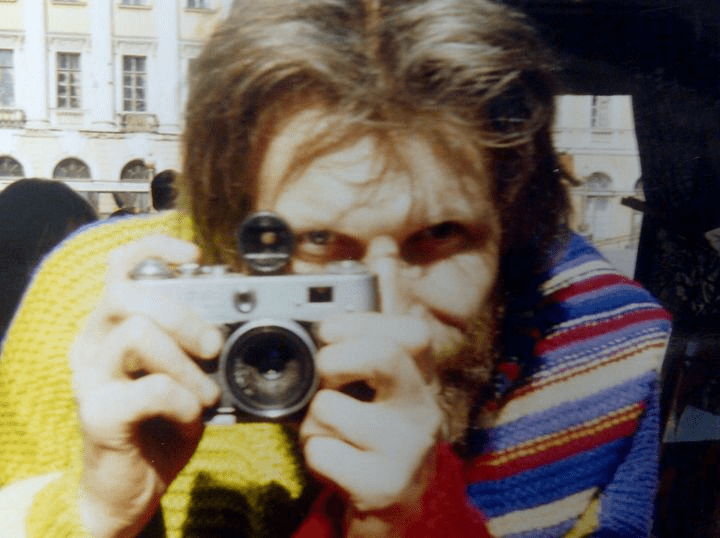
Valentine
Valentine loved Ukraine and took many pictures there
Not for nothing, here are three definitions straight from my lecture on the first day of my Critical Writing and Thinking course:
Fact. A fact is anything independently verifiable. No one should disagree with the facts unless they haven’t done their homework to find out what is and what is not factual. There are no such things as alternative facts; true facts can be verified and are not obtained from biased individuals with personal agendas. They come from independent sources. Note: The opposing side of an argument would still agree with the facts.
Opinion. A lot of people have the wrong opinion about what an opinion is. It is not how you feel about something. We’ll get to that. It is a “judgement based upon the facts.” So the value of the opinion is dependent on whose judgement it is. Ideally, experts; that is, people who have taken the time, education, and research to find out as much information as possible about a particular idea and disseminate the results for us. They know more about the subject than anyone else and have no agenda in the results. Their experience at being able to decipher information through time and in consultation with various other independent researchers, validates the perspective. If someone offers an opinion without finding out the expertise or validity of the source, the opinion is in question and often wrong. Yes, it is possible to have a bad or wrong opinion if the judgement is not based upon independent experts.
Belief. This is what many think of as an opinion. A belief is a judgement based upon faith. Not necessarily religious, but that too. It is a conviction not based upon anything directly and empirically verifiable, but through trust. No one is wrong for their beliefs as they are not opinions, that is, judgements based upon facts; they are judgements based upon convictions.
Here’s the example:
No one questions that when we buy a house and we need to get it inspected, we are wholly concerned about the opinion of the inspector. We want expert inspectors to tell us what is wrong and right with the place and present factual evidence, and we certainly don’t want an inspector who works for the seller and only has their welfare in mind, nor do we want one who doesn’t have the experience and expertise to do the inspection to begin with. No one questions this, but there are people who insist the opinion of a botanist about political affairs is valid. It is not. The botanist has beliefs one may align with—so be it, but do not pretend the information is valid from independent sources.
This leads to the most important question in all of discussions about politics, world affairs, and finances. It is also the question I tell my students is the primary concern of every professor from the time students write a paper for freshman comp to when they obtain a PhD:
Where did you get your information?
That’s it. Everything else isn’t even worth discussing without first establishing that the opinions and facts come from independent, verifiable sources who can study not only historical trends but predict pretty accurately what is likely to happen based upon that knowledge. This is what economists are best at, and so too political scientists. They are able to say, “Based upon these legal notations and previous attempts in various situations, the most likely outcome of these actions is….”
Hope and faith have nothing to do with it.
The emotion swirling through today’s atmosphere is unprecedented, and some of it isn’t because decisions being made are necessarily wrong but because they are unprecedented and seemingly dangerous as they negatively affect millions of people. Those people who are affected—all of us actually—want to know upon what basis these decisions are being made to do whatever it is being done, and who are the independent and valid experts who suggested those actions to begin with. A full disclosure of that information from researchers and experts would curb much anxiety.
No one should be out to change another person’s convictions. But if there is an argument at hand, the only way to win is by presenting facts and opinions, not beliefs, and one must maintain the belief that others will accept those facts and opinions.
Let’s be clear: This information is accurate. For more than thirty-five years I’ve made a good living teaching research methods to ensure validity in collegiate essays. All support needs to be thoroughly investigated, not by finding a source, and not a few sources, but no less than three independent-from-each-other sources to guarantee the accuracy of the information. Further, only after a spin as Devil’s Advocate to guarantee all sides have been considered and all perspectives anticipated can anyone trust the validity of the content.
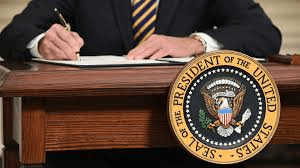
So, that being understood, President Donald J. Trump is out of his mind. He is ruining this country and has convinced a majority of its voting public that what is happening is for their better good.
In the past ten days—his first ten days in his second term—he has done the following:
Allowed energy exploration and production on Federal Lands, including offshore sites, for critical minerals and fossil fuels, removed regulations which favor electric cars, and canceled all previous orders already in place to avoid such disasters to the environment and sustainability.
He also declared a National Energy Emergency which allows the executive branch to have more power to facilitate projects, including putting pipelines across land. Note that solar and wind power are excluded from this declaration.
Withdrew from the Paris Climate Accord. Again.
Allowed the government and companies to fully avail themselves of Alaska’s vast lands and resources to drill for natural gas.
This dictator declared that all agency heads should review all previous criminal enforcement, civil enforcement, and intelligence conduct, decide if it was politically motivated, and hold those actors accountable with possible criminal prosecution and punishment.
This neo Hitler-in-charge has reclassified career federal employees as political appointees, which means if they don’t sway to political pressure they can now legally be fired.
Donald J Stalin revoked security clearances for dozens of intelligence officials who agreed with former president Joseph Biden.
He terminated all diversity, equity, and inclusion programs in the federal government. Yes, this homophobe and racist bastard ordered that all agencies report to the OMB director a list of all employees in DEI positions. They have sixty days to comply or they will be fired.
This genital-grabbing, foul-mouthed accused rapist has mandated that the federal government will henceforth recognize only two genders: male and female, and they must be referred to by the term “sex” instead of “gender identity.” That alone would push him toward a failing grade in my class for ignorance in diction, but that’s a rabbit hole I’ll avoid for now. For now.
He has established with psychopathic South African born genius and immigrant in favor, Elon Musk, the Department of Government Efficiency, or DOGE (how clever) to cut government spending, which on the surface isn’t a poor idea, but it works only if those charged with carrying out the mission have a clue as to the cause and effects of financial spending in the government. Most foreign aid, for example, isn’t a gift, but allows trade to occur with benefits to the US, allows use of airspace for military and commercial use, and prevents war—it prevents war. Again, Foreign Aid Prevents Wars. That should be branded on his stomach.
He wants to “clean out (note the sliver of space between his phrase and the word “cleansing” often used during the holocaust) the Gaza Strip. He and Musk have already stated the “resort potential in the lands of Gaza.”
He has ordered that the rights guaranteed in the First Amendment should not be interfered with, which includes disinformation, libel, and lying even when it harms others, and that anyone in the last four years who did interfere with his ideas of the above will be investigated and punished.
Take a minute to get a drink or take a shower.
Okay,
This old man withdrew the US from the World Health Organization, which includes cancelling a Biden Administration order to cooperate with the WHO in the case of a future pandemic.
He has ended the moratorium on the Death Penalty and ordered the USAG to pursue the death penalty “whenever possible,” and that State prosecutors, who are not bound by the federal order, are still “highly encouraged” to do the same. “Highly encouraged” is how Trump spells “do it or I’ll ruin you.”
He signed a new order which revoked a Biden order which promoted voter registration, and the same new order makes it easier to reshape election maps.
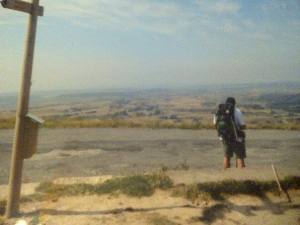
There’s more, but that’s for another time. Some of these directives still must pass congress’ scrutiny, but they are in place and on their way to being status quo, which is how nazis defined every small new law against Jews which built over the course of the thirties leading up to the holocaust. The view from this wilderness is grim. We have entered an age in America where the person in charge, over the course of several decades, gained the admiration and trust of a great deal of mostly under-educated Americans who never learned how to measure the effects of another’s actions; who never learned to investigate the repercussions of carrying out an act which on the surface seems logical enough but has ramifications which can not only damage this country, but can directly lead to its demise. He’ll have the support of right-wing media outlets, whose “commentators” have no experience at all in government, political science, military strategy, or economics. But they’ll mouth off in agreement anyway because then they’ll be famous and rich and maybe even given a cabinet position, and many Americans will listen and agree because the ten-second soundbite is easier to comprehend than the research necessary to find out the truth.
The truth is tariffs will cause prices to rise drastically, and he’ll lie about how it happened. Policies will damage all sustainability programs and environmental protections at a time we are dangerously close to crossing the tipping point, and he’ll claim as he has before that the statistics are made up by left-wing radicals.
Left wing radicals, like scientists, economists, Nobel laureates, every living former president, the leading minds in the military and political science worlds, and historians who measure these things from the past nearly 250 years. And writers.
With President Trump cozying up to dictators and morally corrupt billionaires, this sycophant will not stop until he undoes the twenty-second amendment and heads toward more terms with his pal Vlad Putin.
Listen, I know many people who support this con-artist. Some are friends and some are relatives, and they all voted for him for some specific reason which they could not find in former vice president and presidential candidate Kamala Harris. Some may have even voted for him for no other reason than they didn’t want a woman or person of color in office, which in itself is a repulsive reason. And some of these aforementioned realities they will either deny or defend. Some wanted him in office to ensure more conservative judges, and some because they simply can’t stand diversity. There’s absolutely no arguing with them; it’s a waste of time to engage with people who won’t take the time to understand the long-term effects of a narcissist at the helm.
I’m sure most of those people aren’t even reading this. But if they are—if you are—please understand I don’t directly contend conservative programs and missions. I don’t agree with them, but that is for the voter to decide. What I am disappointed in is the lack of ability of so many to do the homework necessary to learn firsthand that the man is a liar of the highest order, who couldn’t give a damn about anything but himself and his power and popularity, and it is going to crush us all—ALL of us—in the end.
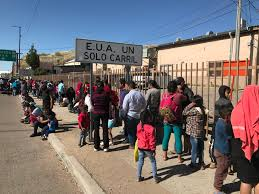
I found the streets of Nogales, Mexico, on Google Earth, or whatever one lets you watch it live, now, immediately. The streets are crowded these days, and the crossing is packed with people trying to walk or drive through to Nogales, Arizona. I’ve crossed that border at exactly that spot dozens of times, albeit forty years ago. Yes, there were migrants wishing to make it to the United States back then; after all, we invited them. We put up a big lady who literally said to come here, and we pushed our excellence in the marketplace every chance we could. If you build a huge ice cream shop and flash it in front of everyone who has no ice cream at all, a line will form; mayhem will follow. Either feed the poor souls or take down the “Give us your poor” statue.
Anyway. Nogales.
I used to eat at a small café there called La Caverna. They served cold Tecate and a burrito with jalapeno sauce and salad. One afternoon after lunch while standing on the dusty Mexican village street, an old man approached me. “You want to buy some blankets?” he asked in Spanish. His face was sun-carved and his thin frame as prickly as the saguaro cactus at the edge of town.
“How much?” I asked, knowing I only had about twenty dollars left.
“Two dollars,” he said. Now my Spanish was pretty decent, but I still stopped to figure if he meant two, or twelve, or twenty-two.
“How much?”
“Dos. Solamente dos mi amigo.” I agreed and he walked me down a few streets and a few back alleys. I was nervous, anticipating being jumped by younger, athletic guys who would steal my wallet, my car keys. Instead, we approached a small shed and Diego unlocked a padlock and opened the door. Stacked from floor to ceiling and throughout the 12×14 or so room were blankets of every color, with just enough room to step in and then crawl up the mounds to look for different kinds.
I looked at my twenty. “I’ll take ten,” I said, and left for my apartment in Tucson with my arms full. At this now-famous border, the guard asked if I had purchased anything. I had just graduated from college, drove a small Chevy, and hadn’t cut my hair or shaved in some time. The odds were high I had bought at least a few ounces of something illegal, though I hadn’t.
“Just those blankets,” I said, motioning to the back seat.
“How many?”
“Ten.”
He stared at me then let me go. I brought them to my Tucson apartment noting the unusually cold weather. A neighbor called to me, “Good thinking; it might be cold at the game tomorrow.” We lived across from the University of Arizona. He helped me carry the blankets inside and asked how much I paid.
“Twenty dollars,” I said. He thought I meant each.
“I’ll give you twenty-five.”
“Sure.” He gave me the cash and chose a green blanket with tan stripes. Very Mexican. “Hey, my buddy Paul will want one,” he said. “Can you sell another?”
I decided I could sell all of them and before night I’d done just that, pocketing two hundred and fifty dollars. The following week I went back, had lunch and found Diego. We backed my car up to his shack and loaded one hundred blankets.
Mexico then had a simplicity to it that seems to have been hijacked by drug cartels and border crashers. Not that these things were absent in the early eighties, but they certainly weren’t covered as closely by media, and the impact on people like me just bouncing around Mexico was nearly non-existent. Back then people who lived in southern Mexico, Guatemala and Nicaragua certainly knew of the promise of a better life in America–in particular for those pressured by the rising drug cartels and street gangs, but the lure was not as present. There was no internet to push them, not social media or other methods of communicating for Coyotes to build a small human-smuggling empire upon. The vast majority of migrants traveled in small groups and weren’t scrutinized by media–which had only just reached the now-antiquated level of “Cable TV.” Surveillance cameras were non-existent. Commentary on American radio stations or by political operatives was minimal at best. It was simply easier. I could train to Mazatlán, hitch to villages, and even drive my car deep into the interior without worry. Even when someone did approach me, whether to sell me something, check out what I had, or simply seek a ride North, the only consequence was time, and a few times I made friendships which lasted a little while anyway.
At the border, a different patrolman approached my car.“About one hundred,” I said somewhat nervously, even though I cut my hair and shaved.
“Then you’ll have to pay taxes,” he said, not moving away from the car.
“But they’re for my family.” He smiled. “I have a big family,” I added. We both laughed.
He stared at me. “Open the trunk.” Very colorful, really, all that wool shoved into every corner of the Chevy. “Sometimes college students will distract us by buying a lot of one thing and smuggling something else. Like drugs.” This was true: More than ninety-three million cars crossed the border between the US and Mexico that year and not all carried blankets.
I laughed. “Oh hell, I hadn’t thought of that.” He smiled but I don’t think he believed me.
“Why buy one hundred blankets?”
I thought about my answer the way I think when I’m pulled over for a ticket and the cop hasn’t reached my window yet. What angle should I take? I gave in completely. “Look, I’m broke,” I said. “These cost me two dollars each and I can sell them for twenty-five bucks each at the UA game this weekend.”
He looked at me awhile, then back at the car, pulling up a few floor mats. He didn’t seem to be concentrating, though, and then I found out why. “I need ten,” he said.
He wanted a bribe. El Duh. “That’s a two-hundred-fifty dollar loss,” I said.
“No, that’s a twenty-dollar loss.”
“Cost, yes. But not profit. I mean, the taxes can’t be that high.”
“No, they’re not,” he said. “But the paperwork can take forever to finish.”
I stared at another agent ripping the panels off of some guy’s car doors.
“Ten blankets,” he repeated.
“Done.” He chose ten blankets. I got back in the car and he carried the blankets to the office where he put the “confiscated” goods and returned. “Next time, buy one hundred and ten blankets, Si?”
“Si, gracias,” I said, and started to drive off, but stopped. I backed up and he came to my window.
“When do you work?” I asked. I wrote his schedule on a napkin in black marker and in no time at all we became friends. That winter I made a ton of money and made a few good friends just south of the border. Decades later, I still have a few blankets. For me they represent time and place. Going to Mexico meant more than crossing into another culture; when I hear the word “blanket,” I sense the dust of a quiet road and the taste of cold Tecate, I hear the rough tones of Diego’s voice. It turns out there is a thin line between what we buy and where we’ve been. Souvenirs are more akin to snapshots than presents. They are narratives and conversations; they are moments, not mementos. And I learned more about where I am from by crossing the border than had I stayed home, like what true “need” is, the value of simplicity, and the restlessness that comes with a desire to improve. I had never thought about what it “takes” to grow, to improve my life; at home we didn’t really need to do more than keep moving forward. But in Mexican villages I witnessed first hand the work ethic and determination which makes improvement possible to begin with.
And really, once I saw the line someone else drew in the sand, how could I not cross it?I made a dozen or more trips for the sole purpose of buying blankets. By the last one in January of ’84 I was picking out ten blankets myself for the guard and simply handing them to him before driving on. During one of my last trips to Mexico I wasn’t going for the blankets. The line through the automobile gates was long, so I parked and walked across the border, ate one more lunch at La Caverna, bought some Kahlua and talked to Diego for a while. I brought him a University of Arizona Wildcats sweatshirt and we talked a long time. It was only then I learned his family actually lived in Mexico City. He had come to the border to try and make it to Tucson and work, and would send for his family later. He got as far as the border, like so many do, especially today, who make it to the southern edge of the United States, and no further. I asked him what will he do since he had been selling blankets at that point for a few years. “I’ll head back to Mexico City this summer,” he told me. The following year was one of the worst Earthquakes in history, virtually destroying a large portion of Mexico City. I thought of Diego then, and his family. I think of him when I open my trunk where I keep one of the blankets–it is indigo blue with tan and red stripes and has been everywhere with me for four decades now.
I walked to the turnstile gates that last time, nodding to my agent friend, who waved not knowing I’d never be back. I stood in the short line and wondered if I would have what it takes to leave absolutely everything I know–all of it–at a time when contact was primitive and I would perhaps never talk to or ever see my friends and family again, so that my life, and that of my kids and descendants would be better. For all of our wealth and their poverty, I learned that for the most part, my friends in Mexico, and those I only passed crossing the border one way or the other, value life itself much more than we do. I did carry some of that north with me.
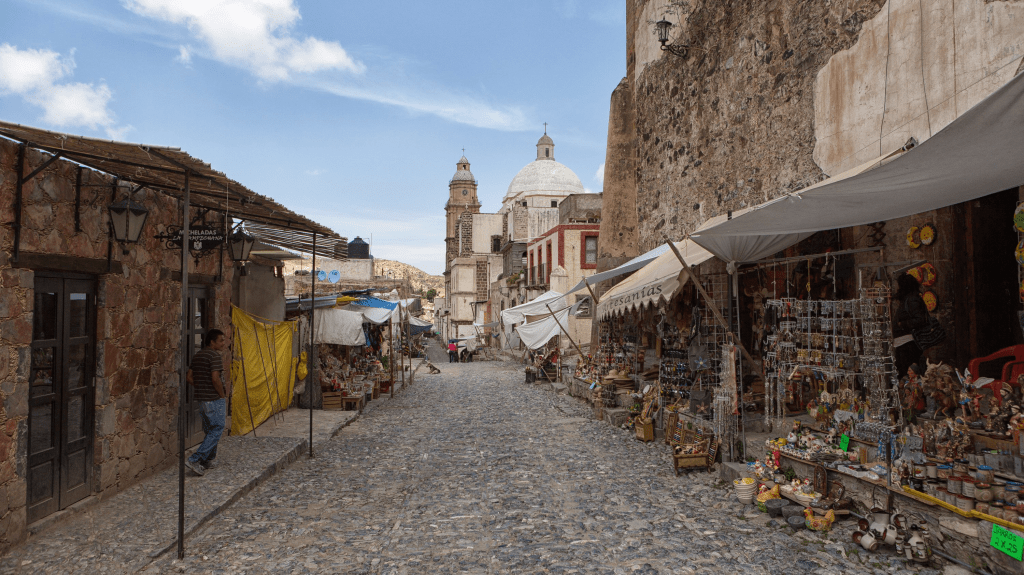
Aerie is surrounded by farms worked by mostly migrant workers who speak little English. On more than one occasion while waiting to buy coffee in the early summer morning at 711, I’ve translated the order of a frustrated worker from Mexico living for the season in Deltaville. Inevitably, the conversation moves outside, and they ask how I know Mexico, and I tell them about my time there, back when “Coyotes” were animals. I tell them that I can recall quite clearly sitting on the porch of a café there, sipping beer and watching people walk by, and the faces of those heading north for the first time were alive and filled with promise. And just beyond them, through the gates on the other side of a few guards, was the literal line in the sand, and what I always saw as the southern border of my own country, they all knew as the front edge of hope.





 a view from this wilderness