…the Fozzie pillow my sister made me,…

I have a lot of shit.

Books I’ll never read again, clothes I don’t wear, boxes of frames and a stack of artwork I’ll never hang leaning against the wall next to the bureau. I have enough pottery to supply a small restaurant, enough reusable grocery bags in my house and in the trunk of my car to carry away the frozen food isle of Kroger, and a shed full of tools I didn’t use when both me and them were newer.

I have scribbles of notes for articles and essays, folders of rough drafts for books and short non-fiction I never read or even attempted to get published, sixteen previous versions of a book which comes out in a year that doesn’t resemble any of the first fifteen variations.

Even when I get away from it and go for a walk down the hill to the river, I have too much stuff. I have obligations both financial and professional that weigh heavily, an overwhelming desire to call Letty or Dave or Dan and just talk like I did every few days for three, four, almost five decades, and sometimes a powerful flash of memory of my father so real I can hear his voice next to me. Those moments can be debilitating, and I just want to swim away. When that happens, I carry it all home and sometimes write about it, sometimes lay down and try and sleep. I lay down and not sleep at all a lot.

A few days ago my son and I took the ferry to Tangier Island, eighteen miles into the Chesapeake, and we walked the historic, tiny slab of sinking land. It was good to slap the world’s largest estuary between me and my stuff, walking around, talking, noticing the birds, the friendly residents, and watching the watermen do their thing the way their ancestors did since Cornish settlers arrived in the 1680’s, more than fifty years after John Smith rowed by and took note. A lady in a golf cart next to Lorraine’s restaurant where we had fresh soft shell crab sandwiches spoke to a friend of hers in a Cornish accent the islanders are famous for.

And we had ice cream.

But all of that was all I needed to clear my head and not carry around the volumes of concerns back on the mainland. I was in the moment, which is quite a rare thing for anyone these days. I have noticed that when I travel—Prague, Ireland, Spain, especially all those trips to Russia, even the pond of lily pads across the river where my son and I often stop to listen—I am completely present, uber aware of my surroundings, the people, and my memory sharpens so that I can write about it sometimes years later and still smell that moment, still hear a veteran’s voice telling me about “the time that…” Absolutely present.

And I come home after those moments and look around at the stacks of magazines I won’t read again if I ever did, the boxes of ornaments too many to hang them all, grade books from my early teaching years, relics of a time I wish hadn’t happened to begin with never mind reliving it, and I wonder why I still have it all.

When we walked the Camino de Santiago, it took about a week to shed the sense I was forgetting something, to ease up on the worry that something needed to be done. It took only a few more days to remind myself that at all times I am indeed here, breathing in and out, moving along, celebrating the passing of time, and everything else is needless no matter how sentimental we are about stuff. We rarely stop and appreciate the fact we are actually alive to begin with, standing here, able to negotiate the next moment however we desire. I forget this most of the time, and I wish I didn’t.

Many, many years ago I went to a wedding reception on the shore of Lake Erie in the small village of Angola on the Lake. I stood looking out across the water not unlike I do almost every morning when I head to the bay at Stingray Point and stare east, and Fr Dan, who had celebrated their marriage, walked to me and we talked. I remember he said I seemed quiet. I told him I wasn’t sure what to do with my life. He told me the normal Fr Dan stuff like God will show me the way, and I’m young and have so many options, and more of what I’ve heard him repeat to me and others in the nearly forty years since then, but I knew all that. So I said something to the effect of, “I suppose just knowing no matter what else all I need is ‘me,’ alive and functioning, to start over if things don’t work out in whatever direction I choose and to truly enjoy the ‘passing of time.’” He laughed and put his hand around my shoulder and said how right that is.

But we don’t really mean that. We work hard, we gather memories and even though we stack them next to the bureau or on closet shelves, we need them there to glance at once in a while to know there was some reason and rhyme to our pilgrimage until now. Of course I can land on my feet and start in a new direction at any time, knowing that in about a week that routine will realign my anxieties and I’ll be fine, and all I’ll need to carry with me are memories of those I have loved. Yes, that is all true.

But I like my shit. The funky photos Valentine took in Russia, and the photo Letty had framed for me of four ladies on a bench; the stacks of brochures and pamphlets from state parks and museums my son and I have hiked and visited for nearly thirty years, the signed books from authors I have had the pleasure to talk to and read with, the tins of pins from Soviet shops and Czech artists’ studios. The sloth birthday balloon and a crazy little light-generated cat from someone who can finish my sentences for me, the folders of drawings from my son’s youth, the small bottle of absinth I never opened.

The miter box my brother bought me and the rug of seascape my sister made when I was in college. My mom’s large Dopey Doll. Shells from a walk with a friend on the Gulf of Mexico and a nutcracker my son painted when he was young.

I have so much stuff, but it all reminds me of what an amazing pilgrimage it has been.

In two years I’m going back to St. Jean Pied de Port, France, to start walking again, south to Pamplona then west to Santiago. I’ll carry a pack with just enough to know I’ll be fine. And if I should stumble upon mementos to carry home, I am sure I can find someplace to put them.  
Uncomplicated

30739603_10214554803251283_6796824465050173440_o
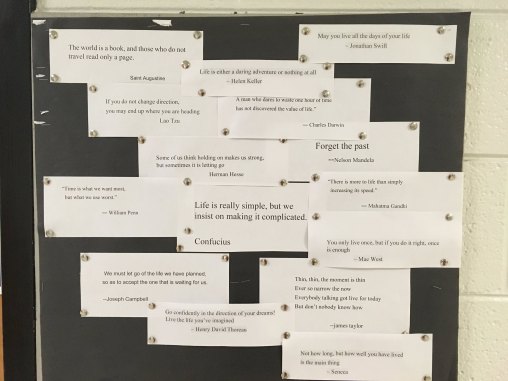
The board outside my former office, May 2018

Some years ago when I knew for sure I was leaving my job I held for nearly thirty years, I started to focus not so much on what was next as much as how fast, how so very fast it all went, and I realized that about the same amount of time to come would put me at nearly ninety years old.

I cleaned out my office—slowly at first, then with much more indifference. I carried piles of books to a common table in the building’s lobby, I moved file cabinets and other useless furniture into a storage area for someone else to claim and configure to their job the way we do with all things in our lives—we mold them to fit in the corners of our growth and accomplishments. Yeah, I was done with all of it.

And outside my office I took down all announcements and office hours and lists of readings from my bulletin board so that all that was left was black construction paper. It looked clean, like a slate, and I absolutely loved the metaphor of it all, but I also thought I should take a piece of chalk and write in some demanding font, “Outta here.”

Instead, I typed up a favorite saying of mine, “Life is really simple, but we insist on making it complicated,” by Confucius. I stapled it to the middle of the board, smiled, and went about my business of unraveling three decades and finding my way to that diversion Frost wrote about with such eloquence.  

Next to my office was a classroom, and students often leaned against the wall (and my door) while waiting for another class to empty before entering. A few noticed the saying and commented to me when I returned to my office. “I like it,” one woman commented, “because it makes me think about it.” I liked that. I wish she had been one of my students.

The following week I added another quote to the board. This time Lao Tzu, one of my absolute favorites: “If you don’t change directions, you may end up where you are going.” Just stapling that to the board punctured a ball of emotion that spilled out across the rest of that day. How many times have I preached, I thought, about the dangers of getting caught in the currents and letting the world around us carry us through instead of pulling ourselves out of the stream and deciding for ourselves where we are going? Students had the same reaction, and I know they were wondering just who is it that decided going to college right then was the right thing to do. Often there is absolutely nothing wrong with where we are going; this is not a rebellious statement, I don’t think. I believe Lao was just indicating it can’t hurt to get a glimpse of what’s ahead every once in a while to see if you really are okay with the path you’re on.

Well, the board caught on and people started asking when the next quote was going up, gathering around my door on Tuesdays after they figured out I didn’t work Monday’s and that I must have posted them early Tuesday mornings, which I did. Up went James Taylor, Mae West, Seneca, St Augustine, and Jonathan Swift. More than a few passing people commented on how motivating the sayings were, and how they looked forward to them. Well, motivation was always my profession anyway, not teaching. For those thirty years it wasn’t English I was there for—hell, I was barely qualified for the first fifteen of those years. It was that I knew how to get them to find significance in it all—the work, the direction, the balance of dreams and reality. My job in New England after college was to motivate people, and I learned it well. So when I ended up teaching college, I knew instinctively that it really doesn’t matter how much I know the work, if they aren’t engaged—if they don’t feel motivated—I’d be speaking to the walls. Plus, my board was an extension of what I knew was about to end, and I started in those last months to motivate myself forward. I was absolutely projecting.

William Penn. Herman Hesse. Helen Keller.

Thoreau.

Darwin.

Then it was the first week in May at the start of my last week ever on campus. And I found this: We must let go of the life we have planned so as to accept the one that is waiting for us—Joseph Campbell.

I typed it up, printed it out, moved Thoreau a bit for balance, and stapled Joseph to the board. That one was for me.

One of my most vivid memories from Spain was being in Santiago after more than a month of walking at about two or three miles an hour, sitting in cafes, crossing Roman bridges noting each step, each breath—essentially, more than a month of barely moving to cross a nation—and then seemingly suddenly we we boarded a train for the six-hour ride–just six hours–back to Pamplona. Six hours. It took four weeks to go from Pamplona to Santiago, and six hours to get back. On top of that disturbing reality check was that after a month of barely moving, we were suddenly barreling along at sixty and seventy miles per hour. It simply felt wrong. I leaned against a window looking at the landscape and when I saw pilgrims walking the opposite direction toward Santiago, holding their walking sticks, their backpacks strapped and the sun beating down as they walked and laughed, talking to other pilgrims on the road, I got a pit in the center of my stomach, a nauseous pain, like a child on a school bus for the first time who sees his parents outside walking the other way. I wanted to get off; I wanted to pull back the doors between the carriages, toss my pack out onto the trail and tumble out like a character in a movie. Writing that just now brought the pit back; it was that real, it is that real. It was the only time in my life I compared side by side the notion of getting somewhere and going somewhere. They’re not the same.

I’m a pilgrim, not a passenger.

Sometimes that happens. You’re riding along, caught up in the mainstream, barely noticing where you’re going because you’re engaged with everyone else in the stream barely noticing where they’re going, and you catch a glimpse of some shadow of yourself just out of reach. And you know that’s where you should be, of course, but the trouble, the pain, the expense, the sacrifice, the explanations necessary, the possibility of failure, the probability of doubt all slide in front of you, each holding you back just a little, all adding up to a gravitational force of “now” and “comfortable” and “responsible” that’s harder to break free from than the strongest of currents.

And even if you do jump, you’re immediately inflicted with that same pit in the stomach, only this time it pulsates, “Oh my God, what have I done?” The things is, you’ll never lose the pit, one way or the other.

Anyway.

On that last day back then, I cleaned out my office and walked outside the door, and for a moment I thought about leaving the quotes there, or maybe replacing them all with just one quote in the middle of the black construction paper, saying, “and this bird you cannot change—Ronnie van Zant,” but I changed my mind and took them all down and gave them to my friend Jack. Each week he’d come by my office and we’d talk about the latest quote and what it meant to us. Then on that last day when I was about to throw out the last folder of teaching materials, I found another passage, typed it up and stapled it to the board. I’d like to believe it is still there.

I know now how much I need that motivation again. But there are two types of motivation: Internal and external. That external one is easy: do the work or don’t get paid. Clean the room or don’t eat dinner. But the internal motivation that drives us from somewhere deep inside, that contradicts the currents, that learns how to turn on a dime, I need that once again. I’m surrounded by people retiring and settling their affairs, haunted by others who slipped off the stage too soon, and it simply creates an indefinable stagnation.

But today while walking along a street in a small village on the Rappahannock River, I remembered that last quote, and it felt right, deep in my stomach it felt right:

“If a man in the street were to pursue his self, what kind of guiding thoughts would he come up with about changing his existence? He would perhaps discover that his brain is not yet dead, that his body is not dried up, and that no matter where he is right now, he is still the creator of his own destiny. He can change this destiny by taking his one decision to change seriously, by fighting his petty resistance against change and fear, by learning more about his mind, by trying out behavior which fills his real need, by carrying out concrete acts rather than conceptualizing about them, by practicing to see and hear and touch and feel as he has never before used these senses…We must remind ourselves, however, that no change takes place without working hard and without getting your hands dirty. There are no formulae and no books to memorize on becoming. I only know this: I exist, I am, I am here, I am becoming, I am my life and no one else makes it for me. I must face my own shortcomings, mistakes, transgressions. No one can suffer my non-being as I do, but tomorrow is another day, and I must decide to leave my bed and live again. And if I fail, I don’t have the comfort of blaming you or life or God.”

                                                                                                                    –Joseph Zinker

12140843_10206985963235013_8819103812513984303_n