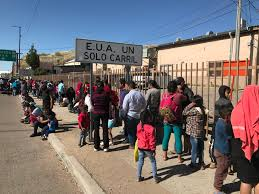
I found the streets of Nogales, Mexico, on Google Earth, or whatever one lets you watch it live, now, immediately. The streets are crowded these days, and the crossing is packed with people trying to walk or drive through to Nogales, Arizona. I’ve crossed that border at exactly that spot dozens of times, albeit forty years ago. Yes, there were migrants wishing to make it to the United States back then; after all, we invited them. We put up a big lady who literally said to come here, and we pushed our excellence in the marketplace every chance we could. If you build a huge ice cream shop and flash it in front of everyone who has no ice cream at all, a line will form; mayhem will follow. Either feed the poor souls or take down the “Give us your poor” statue.
Anyway. Nogales.
I used to eat at a small café there called La Caverna. They served cold Tecate and a burrito with jalapeno sauce and salad. One afternoon after lunch while standing on the dusty Mexican village street, an old man approached me. “You want to buy some blankets?” he asked in Spanish. His face was sun-carved and his thin frame as prickly as the saguaro cactus at the edge of town.
“How much?” I asked, knowing I only had about twenty dollars left.
“Two dollars,” he said. Now my Spanish was pretty decent, but I still stopped to figure if he meant two, or twelve, or twenty-two.
“How much?”
“Dos. Solamente dos mi amigo.” I agreed and he walked me down a few streets and a few back alleys. I was nervous, anticipating being jumped by younger, athletic guys who would steal my wallet, my car keys. Instead, we approached a small shed and Diego unlocked a padlock and opened the door. Stacked from floor to ceiling and throughout the 12×14 or so room were blankets of every color, with just enough room to step in and then crawl up the mounds to look for different kinds.
I looked at my twenty. “I’ll take ten,” I said, and left for my apartment in Tucson with my arms full. At this now-famous border, the guard asked if I had purchased anything. I had just graduated from college, drove a small Chevy, and hadn’t cut my hair or shaved in some time. The odds were high I had bought at least a few ounces of something illegal, though I hadn’t.
“Just those blankets,” I said, motioning to the back seat.
“How many?”
“Ten.”
He stared at me then let me go. I brought them to my Tucson apartment noting the unusually cold weather. A neighbor called to me, “Good thinking; it might be cold at the game tomorrow.” We lived across from the University of Arizona. He helped me carry the blankets inside and asked how much I paid.
“Twenty dollars,” I said. He thought I meant each.
“I’ll give you twenty-five.”
“Sure.” He gave me the cash and chose a green blanket with tan stripes. Very Mexican. “Hey, my buddy Paul will want one,” he said. “Can you sell another?”
I decided I could sell all of them and before night I’d done just that, pocketing two hundred and fifty dollars. The following week I went back, had lunch and found Diego. We backed my car up to his shack and loaded one hundred blankets.
Mexico then had a simplicity to it that seems to have been hijacked by drug cartels and border crashers. Not that these things were absent in the early eighties, but they certainly weren’t covered as closely by media, and the impact on people like me just bouncing around Mexico was nearly non-existent. Back then people who lived in southern Mexico, Guatemala and Nicaragua certainly knew of the promise of a better life in America–in particular for those pressured by the rising drug cartels and street gangs, but the lure was not as present. There was no internet to push them, not social media or other methods of communicating for Coyotes to build a small human-smuggling empire upon. The vast majority of migrants traveled in small groups and weren’t scrutinized by media–which had only just reached the now-antiquated level of “Cable TV.” Surveillance cameras were non-existent. Commentary on American radio stations or by political operatives was minimal at best. It was simply easier. I could train to Mazatlán, hitch to villages, and even drive my car deep into the interior without worry. Even when someone did approach me, whether to sell me something, check out what I had, or simply seek a ride North, the only consequence was time, and a few times I made friendships which lasted a little while anyway.
At the border, a different patrolman approached my car. “About one hundred,” I said somewhat nervously, even though I cut my hair and shaved.
“Then you’ll have to pay taxes,” he said, not moving away from the car.
“But they’re for my family.” He smiled. “I have a big family,” I added. We both laughed.
He stared at me. “Open the trunk.” Very colorful, really, all that wool shoved into every corner of the Chevy. “Sometimes college students will distract us by buying a lot of one thing and smuggling something else. Like drugs.” This was true: More than ninety-three million cars crossed the border between the US and Mexico that year and not all carried blankets.
I laughed. “Oh hell, I hadn’t thought of that.” He smiled but I don’t think he believed me.
“Why buy one hundred blankets?”
I thought about my answer the way I think when I’m pulled over for a ticket and the cop hasn’t reached my window yet. What angle should I take? I gave in completely. “Look, I’m broke,” I said. “These cost me two dollars each and I can sell them for twenty-five bucks each at the UA game this weekend.”
He looked at me awhile, then back at the car, pulling up a few floor mats. He didn’t seem to be concentrating, though, and then I found out why. “I need ten,” he said.
He wanted a bribe. El Duh. “That’s a two-hundred-fifty dollar loss,” I said.
“No, that’s a twenty-dollar loss.”
“Cost, yes. But not profit. I mean, the taxes can’t be that high.”
“No, they’re not,” he said. “But the paperwork can take forever to finish.”
I stared at another agent ripping the panels off of some guy’s car doors.
“Ten blankets,” he repeated.
“Done.” He chose ten blankets. I got back in the car and he carried the blankets to the office where he put the “confiscated” goods and returned. “Next time, buy one hundred and ten blankets, Si?”
“Si, gracias,” I said, and started to drive off, but stopped. I backed up and he came to my window.
“When do you work?” I asked. I wrote his schedule on a napkin in black marker and in no time at all we became friends. That winter I made a ton of money and made a few good friends just south of the border. Decades later, I still have a few blankets. For me they represent time and place. Going to Mexico meant more than crossing into another culture; when I hear the word “blanket,” I sense the dust of a quiet road and the taste of cold Tecate, I hear the rough tones of Diego’s voice. It turns out there is a thin line between what we buy and where we’ve been. Souvenirs are more akin to snapshots than presents. They are narratives and conversations; they are moments, not mementos. And I learned more about where I am from by crossing the border than had I stayed home, like what true “need” is, the value of simplicity, and the restlessness that comes with a desire to improve. I had never thought about what it “takes” to grow, to improve my life; at home we didn’t really need to do more than keep moving forward. But in Mexican villages I witnessed first hand the work ethic and determination which makes improvement possible to begin with.
And really, once I saw the line someone else drew in the sand, how could I not cross it? I made a dozen or more trips for the sole purpose of buying blankets. By the last one in January of ’84 I was picking out ten blankets myself for the guard and simply handing them to him before driving on. During one of my last trips to Mexico I wasn’t going for the blankets. The line through the automobile gates was long, so I parked and walked across the border, ate one more lunch at La Caverna, bought some Kahlua and talked to Diego for a while. I brought him a University of Arizona Wildcats sweatshirt and we talked a long time. It was only then I learned his family actually lived in Mexico City. He had come to the border to try and make it to Tucson and work, and would send for his family later. He got as far as the border, like so many do, especially today, who make it to the southern edge of the United States, and no further. I asked him what will he do since he had been selling blankets at that point for a few years. “I’ll head back to Mexico City this summer,” he told me. The following year was one of the worst Earthquakes in history, virtually destroying a large portion of Mexico City. I thought of Diego then, and his family. I think of him when I open my trunk where I keep one of the blankets–it is indigo blue with tan and red stripes and has been everywhere with me for four decades now.
I walked to the turnstile gates that last time, nodding to my agent friend, who waved not knowing I’d never be back. I stood in the short line and wondered if I would have what it takes to leave absolutely everything I know–all of it–at a time when contact was primitive and I would perhaps never talk to or ever see my friends and family again, so that my life, and that of my kids and descendants would be better. For all of our wealth and their poverty, I learned that for the most part, my friends in Mexico, and those I only passed crossing the border one way or the other, value life itself much more than we do. I did carry some of that north with me.
Aerie is surrounded by farms worked by mostly migrant workers who speak little English. On more than one occasion while waiting to buy coffee in the early summer morning at 711, I’ve translated the order of a frustrated worker from Mexico living for the season in Deltaville. Inevitably, the conversation moves outside, and they ask how I know Mexico, and I tell them about my time there, back when “Coyotes” were animals. I tell them that I can recall quite clearly sitting on the porch of a café there, sipping beer and watching people walk by, and the faces of those heading north for the first time were alive and filled with promise. And just beyond them, through the gates on the other side of a few guards, was the literal line in the sand, and what I always saw as the southern border of my own country, they all knew as the front edge of hope.
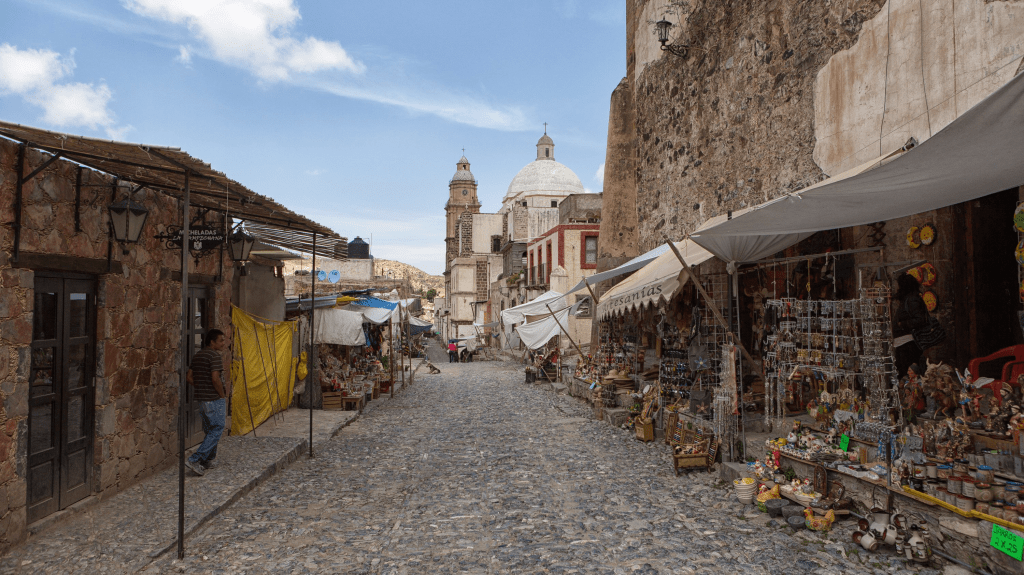
 a view from this wilderness