2025 Day One

Life is too short to simply run out the clock.

Van Gogh once wondered, “Those of us who live; why don’t we live more?” I considered my lack of effort, my lack of discipline, my lack of patience; and I thought about my abundance of inattentiveness, my tendency to rush, to generalize, to blame. I need to live more not despite the losses of 2024 but because of them. Because I can, simply put. Fortune has me well in hand. Lesson Learned.

Is there an age limit on starting over? At what point are New Year’s Resolutions simply pointless?

Let’s find out.

Grandma Moses didn’t start painting at all until she was seventy-six.

Frank McCourt, author of Angela’s Ashes, winner of the Pulitzer Prize and National Book Critics Award, didn’t start writing until he was sixty-five.

Laura Ingalls Wilder started writing the Little House on the Prairie series at sixty-five.

Fauja Singh ran his first marathon at eighty-nine (luckily if I choose this path I can wait twenty-five years before getting off of the couch).

Harland Sanders established Kentucky Fried Chicken when he was in his sixties.

And for God’s sake, Noah was six hundred years old when the waters started to rise. Hell, I’m going back to bed.

Truthfully, it isn’t about starting over, really. We make resolutions this time of year to lose weight and exercise and save money and volunteer more, and those are common ambitions for a good reason: they’re admirable goals, apt adjustments to our otherwise well-planned life. Emerson tells us that “the purpose of life is to be useful, to be honorable, to be compassionate and have it make some difference that you have lived and lived well.” I must do all of those things, for certain. But a slight adjustment simply won’t cut it for me anymore. Not this time. 2024 was a wake-up call.

Certainly, the atmosphere these past few years hasn’t exactly been conducive to positive change. I seriously grew up believing my generation was the one that would clean the world, bring peace to all countries, and create a more inclusive society. I know it was innocent and naïve, of course, and I didn’t really expect some land of Oz, but I also didn’t expect this pathetic disaster we still call humanity. We are a mess; our supposed “intelligent life” turned out to have little compassion for each other, and it is stressing me out more than my meds can handle. I don’t understand why it all gets to me and brings me down. It just does. I know that “a happy soul is the best shield for a cruel world,” as Atticus wrote. But listening to the news is akin to swimming in toxins, and it has become overwhelming, drowning out whatever happiness takes root. Something has to change–if not out there, certainly in here.

And it helps to have a distinct starting-over point. A few times each year—birthdays, Spring equinox, for educators the first day of classes, and New Year’s Day for us all, we can take a deep breath and make some sort of commitment to do some small part by changing ourselves, either by dancing with the Druids at Stonehenge or making resolutions. Of course, I can only speak for me.

The clock is ticking while I’m distracted by society’s bad energy, spending valuable time on meaningless banter. I need to get back to me and remind myself, as Dan Fogelberg sang, that “there’s more than one way of growing old.” I need to take more chances and figure out which dreams I simply refuse to allow to fade before I die. Not all of my imaginings are realistic, of course. Certainly I can narrow down the list with some rationale: I can probably toss out the Wimbledon win and playing outfield for the Mets. I’m confident the circumnavigation of the world is sliding off the list as well, as is winning an Academy Award for directing.

So what do those people above have in common? They’re not afraid to fail, they’re not afraid to embarrass themselves and be transparent. They’re not afraid to be ridiculed, mocked, trolled, dissed, and dismissed.

With that in mind it occurs to me most of my successes came in the midst of countless failures for most of my life; I have embarrassed myself in front of crowds since I’m nineteen, I remain pretty open about myself, and as a professor and a writer, I have suffered a steady barrage of ridicule, mockery, rejection, and dismissal. Yet in the words of Hamlet: “I do not know why yet I live to say, ‘This Things to do.’”

And now it’s New Year’s 2025, and despite the crappy year that 2024 was, I’m still here and able to write these words. That is step one: Be Alive.

I know a man who joined the Peace Corp at seventy-five. Another who learned French and became a translator at seventy-one.

There are barriers to these resolutions, to be certain. Pressure, stress, money, fear, and sheer exhaustion. Age! Yes, dear, persistent and unyielding age. The obstacles can seem insurmountable, but as Moliere said, “The greater the obstacle, the more glory in overcoming it.” Still, on top of this, those battling depression have to also face those internal voices telling us there’s no point, those for whom the “resolve” in resolution can be a monumental task, those for whom as a friend of mine recently noted, “no longer care if there’s a light at the end of the tunnel; I’m tired of the tunnel.” But none of us, I am not wrong about this, none of us wants to reach the point of death, as Thoreau reminds us, only to find out we never really lived at all, and, even worse, never even tried.

Certainly, some of us are simply mentally exhausted. Some of us have little faith in ourselves or no clue where to begin with some of this. Some of us fear we are simply wasting our time. “I’m just going to gain back the weight,” people rationed when I worked for Richard Simmons. We used to tell those who wanted to quit that in everything in life we have two options: I will attempt this and do what’s necessary to succeed so that even if I fail, I know I tried, or I will not bother trying because I’m likely to quit anyway or simply do not have the energy.

Which group do I want to be in when I’m older? Older?! Ha! I mean now. When I am near the end of the end, what would I have been successful at if I had just, well, showed up?

So Happy New Year, and if you’re thinking it is too late and much too hard to start over, I leave you with the words of Joseph Zinker from the Gestalt Institute:

If a man in the street were to pursue his self, what kind of guiding thoughts would he come up with about changing his existence? He would perhaps discover that his brain is not yet dead, that his body is not dried up, and that no matter where he is right now, he is still the creator of his own destiny. He can change this destiny by taking his one decision to change seriously, by fighting his petty resistance against change and fear, by learning more about his mind, by trying out behavior which fills his real need, by carrying out concrete acts rather than conceptualizing about them, by practicing to see and hear and touch and feel as he has never before used these senses, by creating something with his own hands without demanding perfection…We must remind ourselves, however, that no change takes place without working hard and without getting your hands dirty. There are no formulae and no books to memorize on becoming. I only know this: I exist, I am, I am here, I am becoming, I make my life and no one else makes it for me. I must face my own shortcomings, mistakes, transgressions. No one can suffer my non-being as I do, but tomorrow is another day, and I must decide to leave my bed and live again. And if I fail, I don’t have the comfort of blaming you or life or God.
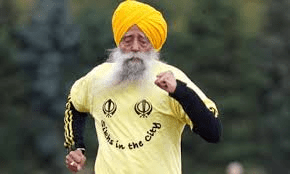

Fauja Singh running a marathon at 100

Sixty-Two Running

The real question, I suppose, is how much of what happens to us, or better stated, how much of what happens in our lives, is the result of uncontrollable outside forces and how much do we simply let happen either out of ignorance of the situation, inability to handle the situation, or, closely related to that, some particular condition (addiction, learning disorders, etc)?

It seems understandable when students with particular disorders don’t produce as well as others, even though they might have the knowledge or ambition; this makes sense these days and we make accommodations. But where is that thin line between true inability to see something through and simple negligence? I’ve written before about my challenge on the first day to my writing students. I ask them if they thought they could write a 500 word paper about being in college and I get them all to acknowledge they can. That’s an easy one, I say. They actually have to write more than that just to get in the college, I remind them.  Okay, then, I continue. But if I read them all and the five best would receive one thousand dollars each, would they be better? Would they be among the five best? And they all sit up, excited by the false proposition, exclaiming that, yes, indeed, they would make sure theirs was among the best for a grand. I remain quiet for a bit for effect and to see if anyone realizes what I just did. “Well, look at that,” I say. “You just admitted to me and to everyone else you actually can do better, you just apparently can’t be bothered. Not unless I pay you. Then, sure, you’ll put in the effort if there’s something tangible in it for you. Stop telling me you can’t write or that you’ve done your best when you know if you focus and work like there’s more of a reward at the end of this than a grade. Because there is.”

It usually has a profound effect. I’ve turned that on myself at times when working on a project. The Siberian book, for instance, went through several growth spurts each time I reminded myself that the better the prose, the more people will read it. I’m not quite sure and never will be quite sure if it is the best I could have done—every writer’s curse. But there is a time to move on as well. Hard call, to be sure.

Shift one:

I turn sixty-two next week. Sigh. And I’ve let a few things slip past me, writing it off to depressive tendencies, side-effects of medicines, basic aging, and of course a complete indifference. That one’s a killer.

But here’s the thing: with a week out from my Grand Old Welcome into the world of Social Security Eligibility, I am seeing just how much I can do better and how much of these less than hoped for conditions truly are my new companions.

I have needed to lose weight for quite some time—not a lot, but more than enough for it to be an issue addressed by my doctor, who indicated two of my medicines could go away if I lost twenty pounds. It’s the proverbial vicious cycle: the side effects of the meds include weight gain, but if I lost the weight I wouldn’t need the meds. Sigh.

So a few weeks ago, disgusted more than usual with my condition among other things, I reminded myself that I actually used to be an expert in weight loss and exercise—true story. And I helped more than a few people lose a lot more weight than I need to lose. Tons more. I then recognized that when I’m traveling or very busy I don’t eat that much—at least not bad stuff—and I walk everywhere.

Could I do better than this or can I just not be bothered? So I stopped eating poorly (this after doing that before with several nutritional programs); I just stopped. And I started walking six and seven miles a day. Not every day but some days more. Bottom line? In the past ten days I’ve lost twelve pounds. There’s MY thousand dollars. It seems the older we get the more excuses we come up with. But I’m not doing anything any average sixty-one (for another seven days, thank you) year old can’t do. I walk. I eat right. Go figure. The weight is dropping. I’ll add more exercise again in a few pounds.

But there’s more. My life was on one trajectory for thirty years, and then it came completely off the rails (train metaphor—stop here and go order my book). I have made excuses about why it has taken so long to reinvent myself, but the truth is I just didn’t know where to start. I took shots at different ways of getting back on my feet but always in a half-hearted effort thinking things would continue to move along smoothly as they have for me since I am in my teens. Not so much.

I remembered a common response from that first day of writing classes for all those years: “Professor, I have no idea what to write about but even when I do I can’t get started. I sit and stare at the computer and just really don’t know where to begin!”

It’s a valid point. My response has several layers. First, yes, welcome to everything in life. We simply don’t know where to start, how to get going. I tell them that first of all stop trying to write about world peace or the rain forest. That’s like trying to fit a tractor trailer into a one car garage. The best writers in the world cannot take a subject the size of a room and fit it in a small box. Don’t write about the rainforest—write about one plant. Don’t write about world peace, write about one person, one event. So for me then, in essence, instead of thinking “Okay I need to reinvent myself by returning to that level I was at of senior faculty and three decades of pull behind me,” I need to walk out the front door, volunteer at the food bank one day and see what it’s like. I also remind them that the first step in writing, according to my mentor, the late Pete Barrecchia, is to “just write the fucking thing, you can fix it up later.”

And there it is. It’s Nike’s “Just do it” campaign; it’s Hemingway defying the blank page every morning before booze; it’s not thinking too much about what might go wrong and understanding if you’re going to sculpt an elephant out of a block of clay, the first step is to start whacking away at whatever doesn’t look like an elephant.

If this all seems a tad like oversimplification, you’d be right. There are times that demand a simplified look at what’s next, because sometimes what’s next is not some grand achievement but a simple subject followed by a verb.

And once you get a good verb down there’s no stopping you.

I know it seems silly for some specific date to mean anything. But we do that a lot—New Year’s resolutions, for example. Well this is mine. I saw this birthday coming for quite some time now, so I got a head start. By next week I’m planning on hitting sixty-two running.

But here’s the thing… I saw a guy on a corner last week in Virginia Beach with a “God Bless You—Help if you Can” sign. I helped the best I can. And I’ll be honest: partly because I’m a human being and to not help even in some small way seems ridiculous, partly because he was clearly a vet and I taught vets for nearly three decades and I understand the circumstances which may have found this man hoping for a few dollars at a red light. But also, I must admit, because I wonder sometimes how close we all are at times to the corner, sign in hand. How close are we to the acceptance of things we cannot change when we know, I mean we have the absolute conviction, that usually those “things” fall in the category of “change the things we can.” I may not be wise enough most of the time to recognize the difference, but at sixty-one years, eleven months, and twenty-seven days, I’ll be damned if simple acceptance is going to be my game plan for whatever comes next.

I’m going for a walk now, and I’m going to walk like someone’s holding out ten Ben Franklins at the other end.