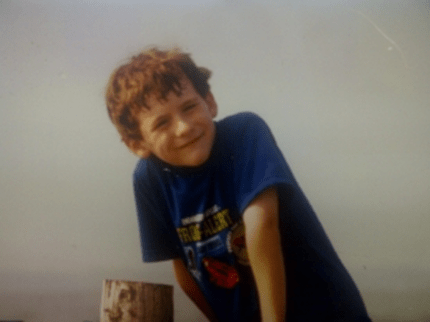
When Michael was about three or four, he used to play “Sir Michael the Knight.” Sometimes it would be on the sand in the yard of a beach house we rented one winter where we would build elaborate castles and he’d be Sir Michael and I was the dragon inevitably slain by the knight, culminating in my plunging death into the castle. Most often he occupied himself on rainy days when he would don his shield and sword and cardboard helmet and then barrel around the house. One time he ran through his grandmother’s home, cardboard sword before him, through the kitchen to the living room to the dining room and back into the kitchen, several times always calling “Sir Michael the Knight is going to slay the dragon!” or “You can’t get away from me dragon!” as he passed again, his voice fading in some Doppler effect as he disappeared into the kitchen, emerging around the corner seconds later. On one turn he was mid-sentence running into the dining room when his shoulder clipped the table and his feet flew out before him and his entire body slammed to the floor in perfect professional wrestling fashion. I jumped from the couch when I heard his head hit the ground, but he only lay there a second before he said, “Sir Michael the Knight hurts himself bad.” He got up and kept running.
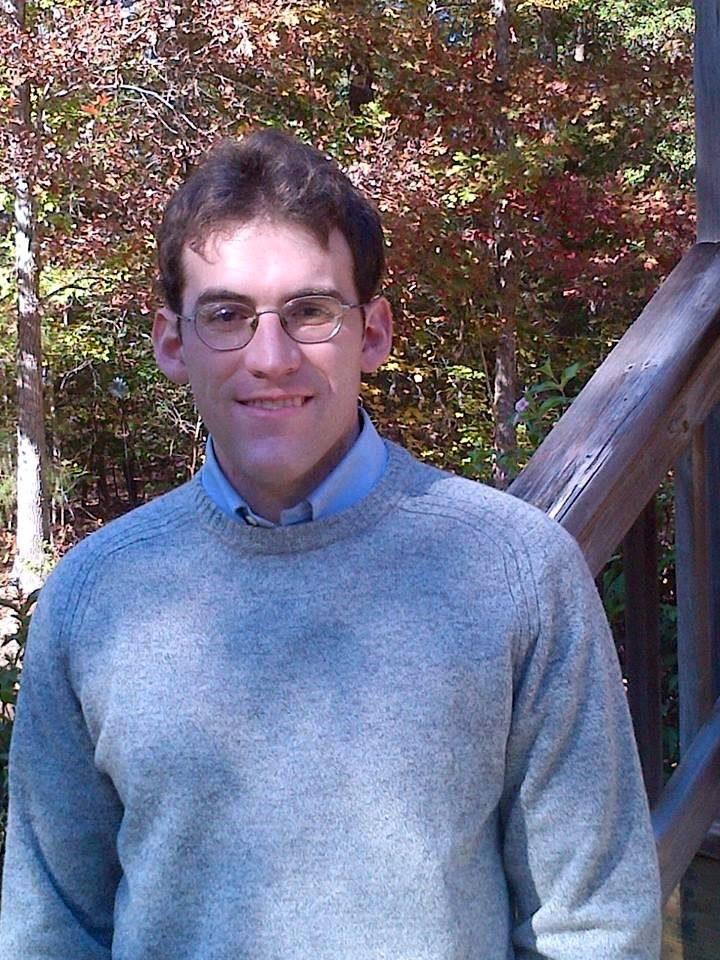
He is still running. Michael turns thirty-two tomorrow; half my age. When he was born, I was thirty-two times his age, and now we’re down to twice his age. He’s aging, I’m not, is how I like to look at it.
What’s crazy is the obvious math here: The time it took for me to get to Michael’s birth is the time it took to get from his birth to now. It makes me examine everything I did in those first thirty-two years, and it was a lot. By the time he was born I had been around the block, to be sure. Time pushes us in multiple directions. A week from now seems a stretch compared to thirty-two years ago. Anticipation slows down time, but recollection instantly thrusts us back to one moment like it just happened. And when I look back at what happened, I often wonder how I’m still here. But all of those years are nothing at all compared to what we’ve done since 1993. It’s been one hell of a ride.
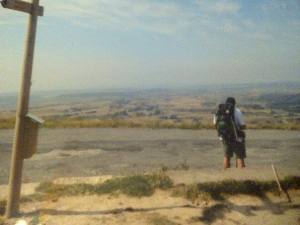
It isn’t unusual to find us at a local oyster bar splitting a dozen and drinking hard cider. Together we’ve ventured to various east coast spots like Long Island and the Outer Banks of North Carolina, trained across Europe and Asia on the Trans-Siberian Railway, and walked across Spain. We’ve seen more together than most fathers and sons get to experience in a lifetime. I am constantly aware of this and deeply grateful.
But none of those journeys compare to the pilgrimage we make to the river every evening when we’re both home to take pictures of the setting sun, and we wander around in silence to listen to the water and watch the wildlife. One of us might mention a colorful cloud formation or the approach of an osprey, but mostly we take pictures and point out the peacefulness. This has been a steady routine since he was four; the picture taking started just a few years later. In the summer the sand fleas can be unbearable but we tolerate them, swatting our legs and faces determined to remain at the river a bit longer. In winter we bundle up ready for whatever wind whips down the Rappahannock toward the bay.
Over these nearly three decades we must have taken thousands of pictures. I prefer to point my camera up at the ever-changing cloud formations picking up the last bit of light from the fading sun. I try not to allow anything “earthbound” into the frame, including trees or even the water. I like the fluidity of clouds, how beautiful they are ever so briefly before they dissipate. Michael aims at the surface, seeing hues and shapes that swirl and gather and disperse as fast as he can find them, capturing just the right combination of color and design before the tide takes over.
It is about perspective.
He’s been around the world on his own. Ireland, Spain, Cuba. And he holds together the art community here on the Bay. He’s done alright. When someone asks who he is like in the family, I don’t have to hesitate: My father. And I wouldn’t have it any other way.
These days I prefer to look forward. There’s a lot to look forward to, and more often than not these days it is separate from each other, but always letting each other know how it’s going. I am not sure where Michael’s headed next but wherever it is and for whatever reason, I am confident it is with faith, a sense of humor, and an instinctive ability to be kind to people. I am as excited as he is about what’s laying out there ahead of him in that land of hopes and dreams.
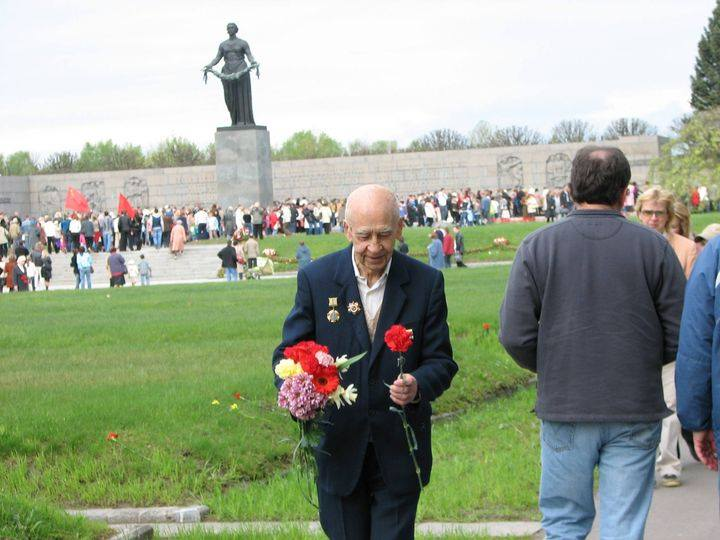
For two decades I traveled to St. Petersburg, Russia, to teach, to write, and to lead Study Abroad groups. In that time I had the privilege of celebrating Victory Day a dozen times in the city on May 9th. During the day I would attend memorial services at the Priskarevskoe Cemetery, where three quarters of a million people–mostly women and children–are buried. I was there when Bill Clinton was in attendance, and George W. Bush, and Vladimir Putin. It is a somber place, and Shostakovich and Pachelbel play on the speakers while thousands walk around and pay respects to the vets in attendance. Then that night a million people fill the streets and drink and watch fireworks and remember that Hitler, despite his demands to wipe the city from the face of the map, could not defeat the “Defenders of Leningrad.”
This is their story as related in a chapter from my new book. Thank you for reading.–BK
*********
Persistence
(from The Iron Scar: A Father and Son in Siberia)
Bob Kunzinger
This evening I sit in the dining car somewhere in eastern Siberia, writing, drinking tea, and the only other passengers are an elderly man and his son, also drinking tea. They’re quiet and both glance at me from time to time. Eventually, I walk to their booth and ask if I can join them—the younger of the two speaks broken English and he waves to the empty spot next to his father. He introduces himself as Dima; and the elderly man, Sergei, wears two or three medals on his green shirt, and I ask if one particular medal is the same as another I had seen in St. Petersburg, given for bravery during the siege of Leningrad. It is.
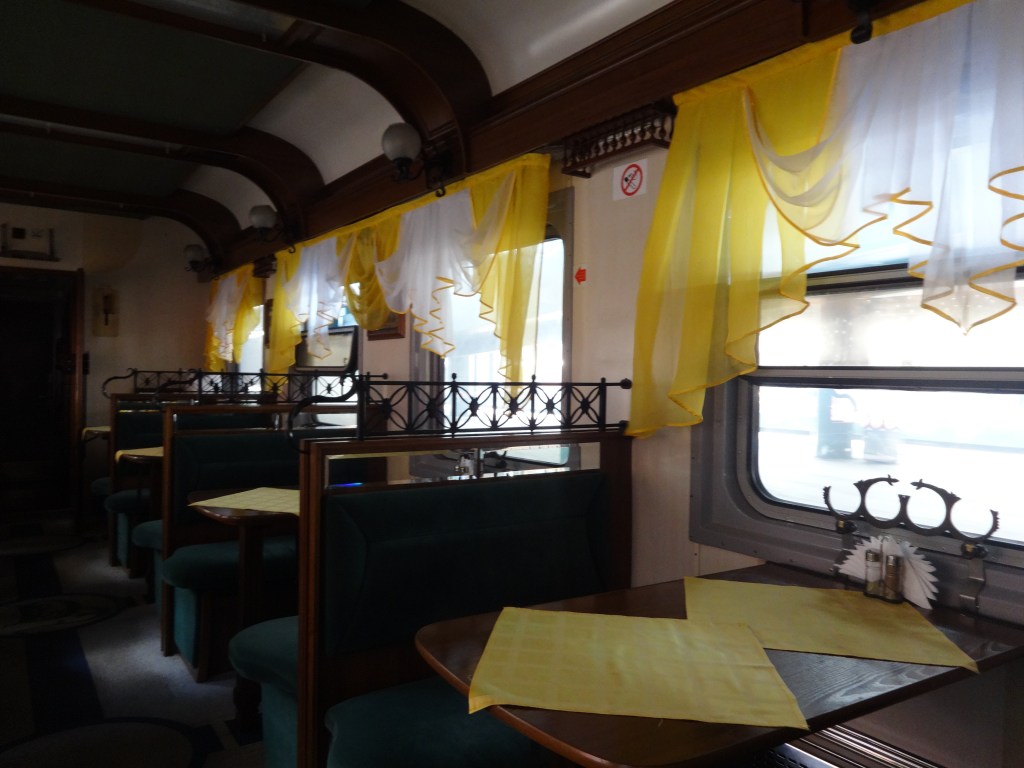
The dining car on the trans-Siberian railroad looks much like old Airstream-style diners in America, with booths along both sides, full size windows at each one with small curtains, and all are kept clean, with flowers, a napkin holder and place mats. At one end of the car is a bar with well drinks as well as a small variety of more expensive liquor on a higher shelf, and a generous selection of domestic and imported beers and soft drinks. The menu rivals the most common pub at home. Grilled chicken, hamburgers with French fries and other sides are available, as well as more complete dinners and some appetizers. Caviar, too, and salmon slices with toast, borsch, and traditional fare such as cabbage and sausages for tourists like us who wish to feel part of the landscape, and for locals whose daily diet includes such items anyway.
The prices are about the same as they would be at stateside diners, but Russians for the most part can’t afford that and usually buy their food from the babushkas at the stops along the way. Seeing as how there are so few tourists, the booths are always available, so Michael and I spend much of our time here, playing chess, eating, and working.
Paying attention to this sudden mixture of cultures is the tender. This always smiling woman sits at her own booth near the bar with several pads spread about which apparently need her attention. From time to time she looks up, partly to see if we need anything and partly, it seems, to catch what she can of our conversation. She normally likes to play traditional music on the player whenever I sit down, but when she sees me join this veteran and his son, she puts on Shostakovich. We all recognize it immediately and the old man smiles. Composer Dmitri Shostakovich wrote his Seventh Symphony, the Leningrad Symphony, in the forties and performed it for the first time to a packed theater in his besieged city of Leningrad. Despite the rattle of Nazi bombs exploding in the background, no one left the performance. Today in the memorial cemetery in that city where nearly 700,000 people are buried, Piskaryovskoye Cemetery, it is still played while thousands of people pay their respects. I have spent many Victory Days there, meeting veterans, offering them a carnation in thanks for their work in the war, so it is an honor to share tea with this veteran.
It would be negligent of any traveler, foreign or domestic, to make this journey without learning about and acknowledging the Blockade in Leningrad, the horrors of the Great Patriotic War, and the incomprehensible courage displayed by the citizens of what is now St. Petersburg, which was bombarded by the Nazi’s for 900 days in an effort to complete Hitler’s desire to “wipe Leningrad from the map.” That history is this old man’s youth; and the fact he survived and went on to raise a son is nothing short of miraculous.
This is where this great railway and Russian history collide.
Some background:
The original name in Russia for the railway was the “Great Siberian Way,” and it was only in the west we called it the trans-Siberian railway. At the World’s Fair in Paris in 1900, the railway was an exhibit with the most extravagant interior cars on display and promoted as the ride of Czars. While it was true the line from St. Petersburg to Yekaterinburg was indeed the rail for Czar Nicholas II and his family to seek refuge in their palace on the Iset River, the promotion at the Fair was misleading since from the start this railway mostly carried people to war. When Czar Alexander put his son Nicholas on the project, he did so with the assistance of Sergei Witte, a minister in the Russian government and confidant of the Czar. The heart of the empire was, indeed, in the western third of the country. St. Petersburg and Moscow were, and still are for that matter, the center of the Russian universe, and from the time of Peter the Great’s ambition to create a “Window to the West,” the powers-that-be focused their attentions there. But in the late 1800’s, the government noted the potential resources available in the east, thinking Siberia might be an economic boon instead of simply a destiny for dissidents. At the same time, St. Petersburg had its eye on parts of Manchuria and moved forward with the rail to that destination under the pretense of trade; the truth is they eventually occupied the territory, a move which aggravated Japan who also wanted control of the area. Japan saw the TSRR as a tool of expansion and eventual invasion, which, of course, it was. Hence, the Russo-Japanese War in 1904. But the tracks weren’t finished yet, and troop movement in the area where roads even today are poor, meant ultimate defeat for Russia.
Still, they had their rail, which a few years later was completed to the Pacific port of Vladivostok. But Japan had its day, and instead of Russia using the railway to dominate the eastern Asian region, Japan did just that by defeating Russia’s Pacific fleet and controlling territory they long wanted. Their rise to power anticipated the conflict in the Pacific which would be that part of the globe’s World War Two.
During World War One, the United States had many economic interests in the region, not the least of which was a ton of weapons strewn north from Vladivostok along the rail. To protect those interests, President Wilson sent eight thousand US troops to the region—the only time US soldiers were stationed in Russia. The War in Europe would not be over for another three months, but in Russia, change was constant. The Mensheviks had ousted Czar Nicholas and replaced him with Kerensky, who the Bolsheviks quickly ousted, so the allies had no one with whom to work in eastern Asia. But it was during that short and welcome reign of Kerensky that the US took over the operation of the trans-Siberian railway, a move supported by the allies in Europe and seen as the spread of democracy the western world had hoped for. At the same time, however, the Bolshevik Revolution swept east literally following the tracks all the way to Vladivostok. The United States withdrew their interests and in a few short years the noble ambitions of the entire empire would quickly derail.
Josef Stalin took over the Soviet Union in 1922, a post he would hold for thirty-one years. He longed for a railway across the polar region of Russia to expedite travel to the Far East. This “Dead Road” was built by “enemies of the people” of Russia. It is estimated that 300,000 prisoners worked on this project with a third of them dying in the brutal northern winters. The entire project proved short-lived, however, when the short part of the line which had been completed sank into the ice and snow. But Stalin understood the value of rail transport, and the pogroms started by the Czar to relocate Jews to eastern Russia were continued under his rule with the aid of the Trans-Siberian railway further south. It was no possible to purge entire towns, exile anyone who so much as spoke about him without praise, as well as those who outwardly opposed the oppressive government. In fact, not many people during those years rode the railway by choice. It was a means for guards to get to work or to send prisoners east. The rail between St. Petersburg and Moscow remained a crucial route between what is considered the cultural capital in the north and the political capital an eight-hour ride south. And the cross-continental railway in post-coup Russia became a means of transport for workers heading to and from a job, families going to a dacha, and the rare and idealistic tourist heading to Beijing or Vladivostok.
Aside from so much death associated with this transport, there is one glaring and essential exception when rail travel was, in fact, a lifeline in Russia: The Great Patriotic War. World War Two. A separate rail from the trans-Siberian route was built by hand every single winter during the war across the frozen Lake Ladoga just to the east of Leningrad to try and bring in supplies and bring out citizens of the city, which was besieged from September 8th, 1941, until January 27th, 1944. During that time nearly one and a half million people in the city—mostly women and children—died of starvation. The people of the city to this day are most proud of the fact that, despite nine-hundred days of bombardment, the Nazi’s still couldn’t defeat the “defenders of Leningrad.” And because of the invading Germans, factories were moved from the western part of the country to the most eastern reaches of European Russia, in the Ural Mountains, where more than three hundred plants were rebuilt close to the railway, mostly by the prisoner population.
Before me now, however, is a man who refused to leave Leningrad. I mention my understanding of his courage and struggle, and the old man smiles. He places his hand on my wrist and says, yes, he could have ridden the rail across the lake during that first winter—he was just a young teenager, and no one would have questioned it. But he chose to stay and help transport whatever food he could to the front line, which during the blockade was in every direction.
The tender brings a plate of salmon and bread which they share with me, and we drink more tea. Sergei dips some bread in his tea, and his son offers me salmon.
We speak for quite some time about the trail, about Michael and I and our wild idea to see Siberia, and about their present journey to a Dacha to spend August. Eventually, I ask about his medal, about the war, and how much he remembers. Sergei takes a long bite of his bread and nods toward the plate of salmon. “Food was the most significant issue,” Dima translates as he looks in despair at his father, clearly knowing what comes next. “Leningrad’s population of dogs, cats, horses, rats, and crows disappeared as they became the main courses on many dinner tables. Nothing was off limits. People ate dirt, paper, and wood. The vast majority of casualties were not soldiers, but women and children.”
This much I know already: The siege of Leningrad is political history as well as military history, yet it is also personal. It is the story of a child living on a few grams of bread, his mother making sure he only takes small bites throughout the day for fear if he eats it all at once he will surely starve to death. He will anyway, and the history of the siege of Leningrad must include the story of these women who survived, these sorrowful mothers, who had to grasp whatever sliver of hope they could that they would win in the end so to save their beloved Mother Russia.
The siege is one of the chapters in books about 20th-century atrocities; yet it is also the conversation over beers in a corner pub, where as late as the nineties when I first started coming here, most veterans still held back their emotions against the questions of the curious’. Some allowed others to cross the line into their world, allowed them to suffer the starvation through stories and tears because they knew it might be the only way these great heroes, the defenders of Leningrad, will be remembered.
Author on right after giving the carnation to the veteran (photo by Kay Debow)
I recall a conversation I had once with a woman in St. Petersburg’s Palace Square. She was fifteen during the siege when she had to pull a sleigh carrying the body of her sister, who had died of starvation. She made it to the graveyard and left her sister on the pile of bodies. Another there, Alexander, remembered how he would cut up a piece of bread once a day for his brothers. His parents had died of starvation some time earlier.
Nearly three million civilians, including nearly half a million children, refused to surrender despite having to deal with extreme hardships in the encircled city. Food and fuel would last only about two months after the siege began, and by winter there was no heat, no water, almost no electricity, and little sustenance. These citizens still had two more years of this to endure. Leningrad is roughly at the same latitude as Anchorage, Alaska. It gets cold.
During that first January and February, 200,000 people died of cold and starvation. Because disease was a problem, the bodies were carried to various locations in the city. Even so, people continued to work in the deplorable conditions to keep the war industries operating. When they were not working or looking for food and water, they were carrying the dead, dragging bodies on children’s sleighs or pulling them through the snow by their wrists to the cemetery.
One man said, “To take someone who has died to the cemetery is an affair of so much labor that it exhausts the last strength in the survivors. The living, having fulfilled their duty to the dead, are themselves brought to the brink of death.”
But the people of Leningrad would not surrender. I met a woman named Sophia in a graveyard on the north side of the city. She had been an adolescent during the reign of Czar Nicholas II and thirty years later lost her husband and son during the siege. We sat on a bench, and she told me of her life, of her family, as if time had turned it into a hazy event she had heard someone talk about years earlier. Her hands were transparent, and she spoke of Leningrad as being a prisoner of war, with no rations and no electricity and little hope. The city became a concentration camp, its citizens condemned to death by Hitler.
But thousands of people were evacuated across Lake Ladoga via the famous frozen Doroga Zhinzni, the Road of Life. During warm weather, some were boated across, but in winter they were carried on trucks across the frozen lake under German fire and moved via the railway. Heading north was pointless; the Finnish Army, allied with the Germans since the bitter Winter War with the Soviets in 1939-1940, held the line there. But once across the lake, this very train took people further east until the rails simply could not run. When we stand between the cars and rumble along, listening to the clashing of metal beneath us, it is hard for me not to think of the thousands of starving citizens transported east, listening to the same sounds.
“We simply had nothing to eat.” Yes, starvation was the Nazi’s objective. The blockade was a time during which one gauged success by being alive or not. Some survivors, however, tell of encounters with people who had such severe mental illness from disease and starvation that it had become unbearable. The accounts are sometimes spurious, but too many narratives contain too many parallel events to write them off as exaggerated. Several wrote of what became known as “blockade cannibalism,” including the story of a boy who was enticed to enter someone’s apartment to eat warm cereal
One woman used one of her dead children to feed the others.
For nearly three years, Leningrad was under attack night and day, and almost half its population, including 700,000 women and children, perished. The Germans left the city of Peter the Great, his “Window to the West,” in ruins. Still, the Nazis could not defeat Leningrad.
The likes of that bravery and sacrifice will never be seen again.
During those years as well as a decade before and past Stalin’s death in 1954, Soviet industrialization moved many citizens to the region stretching from Omsk to the Pacific, and the vast majority of these people worked in towns built for the sole purpose of some factory. But the most infamous use of the railroad during this dark period was to transport prisoners to the Gulag system. Prisoners in the penal system in Russia were tapped to exploit the natural resources in the mineral-rich east. It started officially in 1929, but just five years later, nearly half a million Soviet citizens with a prison term of three years or longer were loaded on these railcars and transported to the Gulags. Five years after that, the camp population totaled more than two million. Some eighteen to twenty million inmates, while suffering the most inhumane conditions, facilitated the exploitation of timber and minerals in remote areas in slightly more than two decades. They also laid railroads which branched off of this one, constructed roads, secured dams, and worked in the factories and on the farms,
The veteran looks around and says more quietly as his son again translates, “Every single person on this train is connected to the war; either a grandparent or parent was killed, or less likely, survived. Everyone on this train is fortunate to be alive because of citizens of Leningrad under the most horrific conditions. I played a very small part, but I am glad I survived to be able to raise my own family.” He smiles at his son, who places his own hand on his father’s sleeve.
Today, war monuments dot the landscape. Most of them honor veterans of the two World Wars, but many as well for those who served in Afghanistan, the most notable being the Black Tulip memorial in Yekaterinburg, named for the ship which carried home the Soviet deceased. The monuments to the Siege of Leningrad, or the “Blockade” as Russians refer to those dark nine-hundred days, are numerous in St. Petersburg, of course, but they also spread surprising far to the east, following the tracks taken by those souls who managed to get out of the city under cover of a cold, dark winter. The same chance Sergei turned down, as his medal clearly shows.
I grew up during the age of the Evil Empire, the Red Menace. Siberia and Irkutsk might as well have been on the moon—I was never going. All I knew of this land when I was young was from playing RISK with my older brother. He usually won but I had fun moving my armies around the board, sometimes skipping from Alaska to Kamchatka, proving to me capture of the Russian coast was key in controlling the outcome. When Michael was growing up we did the same thing. But it wasn’t until I was much older that I learned something valuable: that miserable game screwed up my sense of geography. Siberia is not a country or a state, it is a region, like the American West or heading out to the Plains. Ian Frazier wrote Siberia is more of an idea than a place. Irkutsk is not a country but a city, and Yakutsk is not east of Siberia it is in Siberia. The Ukraine does not take up most of map, doesn’t run from the Arctic to the Med, and doesn’t replace Russia, which that Soviet era game completely left off the planet. Still, those faraway places in beautiful colors with brightly colored armies became mythical. In the end, I didn’t have to move armies to travel to Siberia; no opponents waited across Parker Brother’s boundaries. I didn’t roll doubles. I didn’t pick the wild cards. I just came, and in doing so I wiped out decades of ignorance about these people over a cup of tea and some salmon slices.
The old man looks out the window into the dark evening, and I can sense his mind has recessed into some sharp and tortured memories. His son leaves his hand on his father’s and nods to me, indicating he sees I understand. We sit quietly like this for a long time, drinking tea, as the train rolls forward through history.
photo by Michael Kunzinger
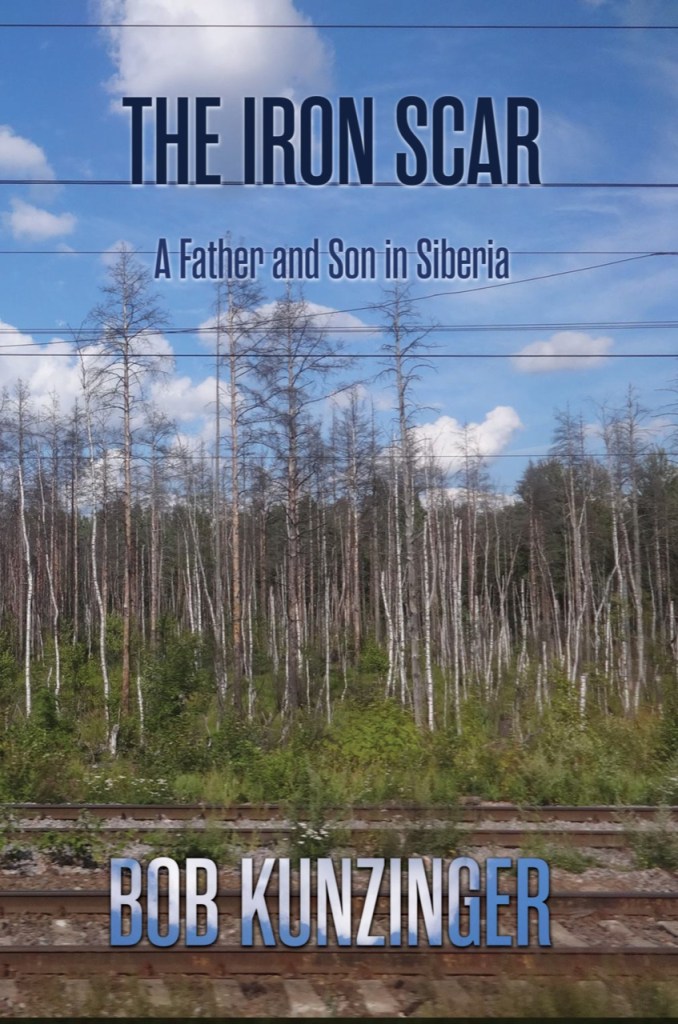
You can order The Iron Scar: A Father and Son in Siberia, by clicking here
I’m excited to announce here on A View from this Wilderness, the release of my ninth book, this time a memoir; The Iron Scar: A Father and Son in Siberia.
The official release date from Madville Publishing in Texas is April 22nd, though word on the street is it will be available in March at the Associated Writers Programs conference in Philadelphia. And I’ll be there for that.
It is difficult to promote a book without sounding like one is bragging, but the reviews have been beyond my expectations. From Martin Sheen (actor, author of Along the Way: The Journey of a Father and Son, written with Emilio Estevez) to Tim O’Brien (writer, The Things They Carried and Going After Cacciato) to Sam Pickering and more, it has been a true journey that did not end in Vladivostok.
Mostly, I’m excited and proud of this book because not only was my then-twenty-year-old son (now turning twenty-nine), Michael, along with me for the entire journey, venturing out, exploring the world, but as a professional photographer I used him and his talents for the brilliant Photo Gallery within the book. Talk about proud.
This is about traveling across Europe and Asia by train, of course, but it is also about fathers and sons, about feeling like you’re starting brand new whether you’re in your twenties or your fifties. My father is very present in these pages, and the book is dedicated to him and Michael.
You can order right now and for the next few days by clicking here: inscribed copies directly from me for $20 each, which includes shipping, and when the books arrive on my doorstop I will sign them and send them right off to you (or wherever you’d like them to go); or you can order directly through the publisher at Madville Publishing once the site is ready to accept pre-orders.
I’ve made many trips to Russia–nearly thirty–but that trip, that summer, meeting new friends, playing chess, sharing meals and drinks, walking the streets of Irkutsk and Yekaterinburg, of Vladivostok and St Petersburg, walking the hills near Chersky Rock high above Lake Baikal, nearly getting completely stranded on the edge of Siberia, inching over a once-in-a-100 year flood in tiger-saturated taiga region of eastern Siberia, living for several days in a cramped cabin with a large, mostly drunk, boisterous Russia, playing chess against a gang of four chessmen, negotiating for food on platforms, talking about movies, about music, about the rain all those countless times just the two of us stood between train cars, and on and on
I hope you take this ride with us. It is an exciting place to be. If you wish to support the arts, writers, photographers, all in one shot, head up to that link above and order some copies for you and your friends.
Here are some reviews:
From National Book Award Winner, Tim O’Brien:
I just finished again– it’s wonderful. I wish every book and manuscript I’ve read over the past two months had been as moving, gripping, and/or loaded with fascinating information about a huge swath ofour planet. Your relationship with Michael leads the way, of course, and binds the journey into an emotional and thematic whole that transcends the standard “look what I saw” travel book. The chess, the harp, the photography, and the desire to take a 7-time-zone journey with his dad — wow, what a son to have. And bravo to you for risking it, especially the whole language problem, which would’ve stopped me in my tracks, pun intended. So many things stick with me. The czar and Alexi and their fate. I’ve read a book — read it twice — about the ending days, execution, disposal, and eventual recovery of the Romanovs, or what little was left of them, so I didn’t go into it blind with your book, but I felt the father-son, sharing-death connection much more powerfully. Boris (Alexander Ivanovich, that is) was a memorable character portrait in all kinds of ways, and your descriptions (along with the photo of him) certainly match my memories of the cartoon character! Moscow time. What a nightmare. What a miraculous ending to the nightmare. The royal blue station shacks, the birches with no tops, the meat and potato pastries — if pastry is the correct word — the smell of onions, the vodka, the wheel tapping, the once-in-hundred-year flooding, the vast vacancies of human presence, the moving village of the train, the Leningrad hero, the Leningrad ghosts, the ungraspable Leningrad numbers . . . Just so much. Well done, Bob. My congratulations. And thank you for a pleasurable few hours.
From Actor and Author, Martin Sheen:
The Iron Scar brought me on a journey that unexpectedly and artfully had me thinking about my own father and my sons throughout the book, as well as introducing me to the wild, warm, and colorful world of Siberia. Thank you for bringing me onboard with you and your son.
In Vladivostok at the end of the line (photo by some French guy)


 a view from this wilderness